Your ShelfYour Projects

The Youth’s Instructor, Vol. 47, No. 14.

We Have Made It Easy
Earlier text: THE RESURRECTION OF LAZARUS

HOW TO DO DOVETAILING.

Our lesson this week is more difficult to put in practise than any you have yet had; but in this, as in most other things, patience and practise bring perfection. It is an encouragement to remember that Jesus worked at the carpenter’s bench, and, as we are told, “was not willing to be defective, even in the use of tools. He was perfect as a workman, as he was perfect in character. By his own example he taught that it is our duty to be industrious, that our work should be performed with exactness and thoroughness, and that such work is honorable.” So as we strive to follow in his footsteps in other things, let us strive, like him, to become workmen that need not be ashamed.
Fig. 1   Fig. 2
Fig. 1 Fig. 2
Our lesson this week is on the art of dovetailing, or so locking the corners of a box or chest together as to make them strong. Having decided how large your box is to be, get out the lumber for the sides and ends, gauge them, and dress them to an even thickness. For a common-sized work-box or handkerchief-box the lumber should be three-eighths or one-half inch thick. Make the box twelve inches long, eight inches wide, and six inches deep. Of course you can make a box any size you want, up to a chest.
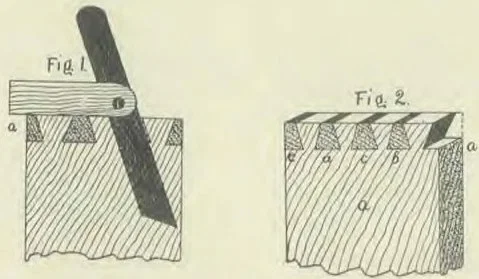
When your stuff is dressed to the desired thickness, square up the ends. Take the same gauge that you used in getting the thickness, and make a gauge-mark across each end of the sides and ends of the box, as shown in Fig. 1, a. Take your compasses, and space off the tenons, making any number you wish, and set your bevel as shown in Fig. 1. Then with the point of your knife, mark down for your tenons, square across, and saw your tenons to your gauge-mark. As I have cautioned you before, be careful to saw outside the pins and inside the mortises.
In Fig. 2 you will see one of the ends sawed ready for mortising. With your saw, cut out, as seen at a, e; then take a chisel, and cut out b, c, and d, cutting part way down from one side, then turning the board over and cutting from the other side, so as not to split your work.
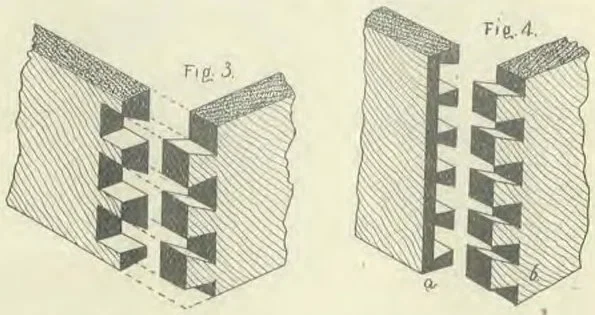
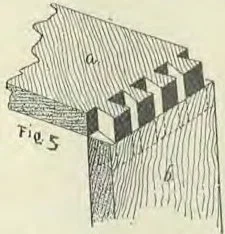
When these are cut out, take a of Fig. 2, and place it upon b, as shown in Fig. 5, making them come even upon the edge. Mark each side carefully with your knife, square down on the board, saw down and cut them out, and they will then be ready to put together, as seen in Fig. 3. Put on a little thin glue, and drive them together.
When the sides and ends are put together, fit the bottom of the box upon the inside, and glue it in. Glue the top of the box upon the top edges. Then gauge down from the top of the box an inch and a half, and with a fine rip-saw cut your box open. Dress off the edges smooth, being careful not to split off the corners. Put on your hinges and locks; but before doing this, sandpaper it smooth with fine sandpaper. In using sandpaper I generally cut the sheet into four pieces. This is best done by laying down upon the paper a fine saw or anything that will lie down tight, and then drawing up on the paper. When the paper is cut up, I rub white chalk on the smooth side, and double the pieces together. The chalk prevents the paper from slipping around, and makes it last longer.
In Fig. 4 you will see what is called a “blind dovetail.” It is used on a drawer front. You will see that it is not cut clear through to the front. The front piece has the thickness of the drawer end gauged upon the back side. Set your gauge about two thirds the thickness of the drawer front, and gauge from the back side, as shown in Fig. 4, a. Gauge the same at b.
Fig. 3. Fig. 4.
Fig. 3. Fig. 4.
I think I have told you that sometime I would tell you how to finish your work. In using wood that has an open grain, it is necessary to fill up the grains in order to get a smooth surface. If varnish is put upon the wood before the grain is filled up, it strikes in, and will give a rough surface unless several coats are applied, and it is rubbed down a number of times.
To make a filling, take equal parts of boiled linseed oil, japan, and spirits of turpentine, mix well together, and thicken by stirring in corn-starch until the mixture is of the consistency of cream. If you wish to make oak antique, put in a little vandyke brown, but be careful not to put in too much, as it will make the filling too dark. With a brush put a heavy coat upon the work, and let it stand until it is quite “tacky;” then, with some excelsior shavings or top-tow, rub it off crosswise of the grain. With some old cotton cloth rub the remaining filling all off, leaving the work smooth. Then take a sharp-pointed stick, fold the cloth over it, and clean out all the corners.
Fig. 5
Fig. 5
Let the work stand overnight, then put on a coat of shellac varnish, which will dry in a few minutes. When this is hard, sandpaper it down with No. ½ sandpaper. If you want an extra finish, put on another coat of shellac.
The best way to get your shellac varnish is to make it. You may do this by putting into a bottle one pint of grain-alcohol and one-fourth pound of orange shellac. Let it stand a few hours, shaking it up occasionally. The alcohol will cut the gum, and make it ready for use. I generally make it in a fruit-can, and leave the brush in the can, fitting a wooden cover over the top, with an opening for the handle of the brush to stick out. If the brush should be left out, it would dry up very hard, and you would have to soak it in alcohol for some time to get it ready for use. When your shellac varnish has been put on, follow it with a coat of copal varnish.
See if you can help me out with this puzzle: I want to put up a building twelve feet square. I have the sills upon the walls. I have but four joists, and they are only eight feet long. I have no more timber to splice them with. I have just one hundred and forty-four feet of floor boards eight feet long, and I can not waste an inch. How shall I go to work to lay a floor and nail the boards to the joists?
W. K. LOUGHBOROUGH.

HOW TO MAKE A BATTERY.

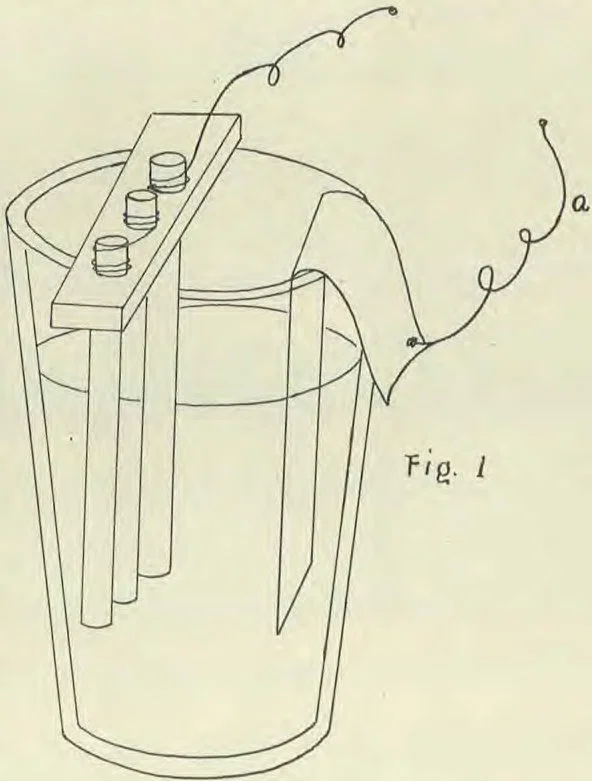
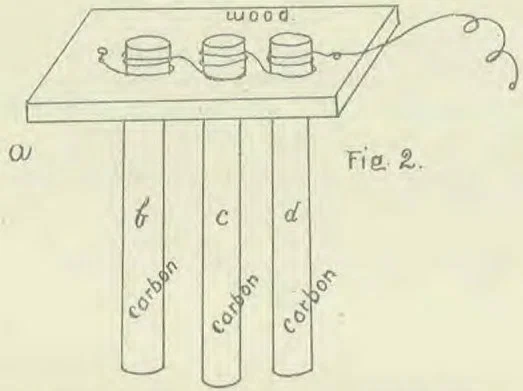
To make an electric battery, we must have, first, some way of producing a current. There are several ways, but the easiest is to use chemicals. Take a glass tumbler two-thirds full of water, as shown in Fig. 1, and two or three pieces of carbon pencils, such as the man who cleans and renews the electric lamps throws away. If you can not get these, a strip of copper two inches wide and five inches long will answer the purpose. Now take a piece of box-board, or any thin board, and cut out a strip (a, Fig. 2) an inch and a half wide, and long enough to go across the top of the tumbler. Next bore three holes through this strip, into which the carbon pencils (b, c, d, Fig. 2) will fit tightly around each pencil, leaving one end about six or eight inches long. This wire will keep the pencils from dropping through the strip of board, and also serve to carry the current. Would it pass over a string?—No; electricity likes a metal path best. It will sometimes take some other path, but not if it can find a metal path.
Fig. 1
Fig. 1
Now we have one element of our battery. The chemicals that we will put in the tumbler will not act on the carbon; so it is called the negative, or not working, element.
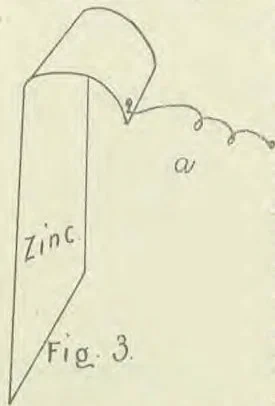
But one element will not make a battery; what shall we do now? We must have one that the chemicals will act upon. The best metal for this purpose is zinc. This is known as the positive element. A strip of zinc (Fig. 3) an inch and a half wide and five inches long will be about right. Bend the end over so it will rest on one side of the glass, and fasten a wire (a, Fig. 3) on it for a conductor.
Fig. 2.
Fig. 2.
Both elements of the battery are now ready; so we will pour about two tablespoonfuls of sulphuric acid into the water in the tumbler. Do not measure it in a spoon; for it will spoil the spoon. You can guess near enough; but do not get in too much, or the solution will be too strong. This acid is very strong and poisonous, and will burn almost everything it comes in contact with; so be careful not to spill any, or get it in your mouth or on your fingers, wash it off at once with soap and water.
Fig. 3.
Fig. 3.
Now put the elements in the tumbler, as shown in Fig. 1. If we bring the ends of the wires (a and e, Fig. 1) together, and then separate them, we shall see a tiny spark; this shows that we have an electric current; but as long as the wires are separated, no current will be produced. You see the current acts with much more wisdom than do many persons; for it never starts out on a journey till there is a way for it to get home again. It does not go wandering around, not knowing where. It waits till there is a definite path for it to travel over; then it goes ahead, does its work, and comes back quickly.
Watch closely where you have the ends of the wire connected, and you will see small bubbles on the carbon in the battery. They are bubbles of hydrogen gas, which are set free by the action of the acid on the zinc. When these bubbles cover the carbons, no more current will pass; for it can not get through this gas; so we shall have to shake the pencils to make the bubbles rise.
Fig. 4.
Fig. 4.
The current starts from the zinc beneath the liquid, goes over to the carbon, then out over the wires, and back to the zinc. Since the current starts out over the wire from the carbon, this is called the “positive” pole; and as the current goes in at the zinc, it is called the “negative” pole.
This completes our battery. Make two or three of them before our next study, so you will have current enough for our experiments.
V. L. HOWARD.

Christ's Answer: My Father Worketh Hitherto

“BUT Jesus answered them, My Father worketh hitherto, and I work.”

QUEER NEIGHBORS.

To the corner of our street came a newly wedded pair; She had feathers in her hat, he was gay and debonair. Underneath the maple shade, where the shadows play and dance, There they chose their bridal home (I was looking on by chance).
Peeping through the lowered blind, I was quiet as a mouse While I watched the cottage built,—'t was a pretty rustic house. Then I saw them moving in. First a carpet soft was spread; Then,—and this was all they had,—just a downy feather-bed!
Such an oddly furnished house for the sunny month of June! Not a change of raiment theirs; not a plate, nor cup, nor spoon; Not a cupboard did they bring; not a table nor a chair: And I wondered much to see the contentment of the pair.
Though I never saw him read, yet he told her all the news; Though she never stirred from home, yet she never had "the blues;" Though she never did a "wash," they were always trim and neat; Though she never cooked a meal, they had always food to eat.
How they managed thus to live was a mystery to me; Long I wondered, but at last I determined I would see; So I ventured to their door, but they fled in fear intense; For the birds are keeping house in a corner of the fence!
ELIZABETH ROSSER.

The Voice of a Holy Life

A HOLY life has a voice: it speaks when the tongue is silent, and is either a constant attraction or a perpetual reproof.—Hinton.

MAKING HOME PEACEFUL.

XVIII.

An hour later James Beardsley stepped upstairs, and opened the door of his father’s room. The old man sat facing the large west window, in his old-fashioned, high-backed rocker. The setting sun threw a halo of light around the snowy head, and a solemn, sacred hush pervaded the room. What is it that causes the strong man’s heart to grow faint, and his limbs to tremble as if with palsy?
“Father!” There is no reply. The thin face is a trifle paler than usual, but a smile of infinite peace has settled upon it. The dear hands are clasped as if in prayer. Hush! break not the sacred stillness. Grandpa Beardsley sleeps the peaceful sleep that knows no waking till Gabriel’s trump shall rend the dusty tombs, and the “dead in Christ shall rise.”
James Beardsley buried his dead, with many tears, in the old cemetery at Jonesville, close beside mother and “little Jennie.”
Ah, there is no time when the human heart So gropes in the gloom of night, As the time when we turn from our dead apart, And cover them up from sight.
And there is no time when our hearts so call For the deathless home above, As the day when the clods of the valley fall O’er the grave of the one we love.
Kind reader, come with me to the little home of Tom Willis and his sister. It is a beautiful day in late September,—one of those delicious, dreamy days when it seems happiness unspeakable just to live. The air is laden with sunshine, and the gorgeous leaves of the old maples by the front gate quiver and tremble in the soft breeze, as if for very joy.
The front door of the little cottage is open, and a fair young girl is sitting by the window, her head bowed in her hands. There are traces of tears on her pale cheeks, and her eyes are dim with weeping. A step sounds on the gravel walk. Some one is coming through the gate.
“O Tom! is that you? The grocer sent his bill over, and it’s a little higher than I expected. But see! I’m cheering up already, Tom;” and she smiled,—a pitiful little smile it was. “Any good news, brother?”
“Well, Maggie, I got a few hours’ work this afternoon over at Tupper’s grocery, doing some boxing; I brought you this basket of peaches,—beauties are n’t they?” said Tom, displaying the tiny basket of choice fruit, for which he had just paid his last quarter, hoping to tempt his sister’s appetite with the unaccustomed dainty.
“O Tom! how good of you! but really, brother, we can’t afford peaches. Just think! peaches! we have n’t had one this year! Well, I’ll banish the blues, and we’ll have one good meal, anyway.”
“That’s a dear little sister! Do you know, Maggie, I’m afraid we have been distrusting God for a while back? We’ve been so gloomy.”
“Yes, Tom; but what are we going to do? The last dollar of our savings was gone last week, and your doctor’s bill is n’t half paid yet; and the grocery bill is due, and the rent,—and really, Tom, your old coat is getting to look too shabby to wear to church.”
“Yes, Maggie, but God knows all about it as well as we do; he says he does. It’s a great comfort to me to read, ‘For your Heavenly Father knoweth that ye have need of all these things.’ We’re trying to do right, and I feel more than I ever did in my life, Maggie, that God will and does hear our prayers. And even if we are destitute, it is not at all pleasing to him for us to distrust his kindness or his care.”
“By the way, I saw Reginald Beardsley to-day. He was hanging around Reddy’s saloon, with Will Green and Harry Colman. O, if I could only do something to save him!”
“O Tom! I believe you’ll be a missionary yet. I declare you make me ashamed of my own selfishness. Do you know, sometimes when I think how much that boy has done to cause us trouble, I just feel wicked,—I do, Tom, I truly do,—and you’re longing to do something to help him.”
“Well, never mind, little sister; you’d be as willing to help him as anybody, if you saw him in trouble. Let me tell you what I’ve been thinking for a long time. I’ve about decided to write to Uncle Ben, out in Dakota; you know he keeps a small grocery, and I’ve been wondering if he would n’t give me a job. Of course he’s poor, and I would n’t get very high wages, but it would be better than nothing.”
“O Tom! leave me and go away out there! Clear out to Dakota? O Tom!”
“I know, Maggie, but you could come after a while. I hate to leave you, but maybe you might stay with Mrs. Hill till I could send for you. I don’t feel very strong, someway, since that fever last spring, and it tires me more than I can tell you to run all round town after stray jobs, and then not get enough to do to earn half what you and I need to eat.”
“I know it, Tom; maybe it would be best; but I can’t help thinking about Aunt Linda. I don’t see what good she thinks all her money will do her by and by—she can’t take it with her to the grave. O brother! if only the Lord would open Aunt Linda’s heart!”
No wonder Maggie thought about Aunt Linda. She was her mother’s only sister. Rich and prosperous, she had given small thought to her dead sister’s struggling son and daughter, from whom she had scarcely heard in years. There had been a bitter quarrel when Mrs. Willis had married the handsome young man who inherited little from his father save a legacy of debt and a thirst for strong drink, which the poor fellow feebly fought at first, only to yield passively before many months.
It is not at all to be wondered at that Maggie often thought, during those days of darkness, of her aunt, and wondered vaguely why Aunt Linda could not be converted.
“Listen, Maggie, listen to the words of the tender Shepherd of Israel; he is speaking to you even as he did to the faithless, trembling disciple of old: ‘O thou of little faith, wherefore dost thou doubt?’”
Yes, my reader; he is speaking to you and me in tones of tenderness and love. Is the way dark? Does it seem that heaven is a long way off? Do you feel that you are in immediate need of help? Have you reached some crisis in your life, where it seems as impossible to go forward as it did to the trembling hosts of Israel—mountains on either side, the black waters before, the cruel enemy behind? “Go forward!” thunders the great Captain. But even as you go, behold the waters fall back; the clouds are lifted; light shines. “When thou passest through the waters, I will be with thee; and through the rivers, they shall not overflow thee: when thou walkest through the fire, thou shalt not be burned; neither shall the flame kindle upon thee.”
It was finally decided that the letter should be written to Uncle Ben; though when the brother and sister bowed that evening in prayer, Maggie’s thoughts would, somehow, turn to Aunt Linda. At last she fell asleep, with the words Tom had read from his Bible ringing in her ears: “Fear ye not therefore, ye are of more value than many sparrows.”
MRS. L. D. AVERY-STUTTLE.
(To be continued.)

WORDS FROM CALVARY.

“I DIED to save thee, sinner,” Says the Master, plain and clear; “There on the cross I suffered; Sinner, friend, dost thou not hear?”
“Dear child, I suffered thus for thee, ’T was there I bled and died; And now, hast thou done aught for me? To serve me, hast thou tried?”
“Poor weary one, look up and live; Turn away from din and strife. Give me thyself, and I will give To thee a crown of life.”
C. F. LADD.

BE FAITHFUL TO TRUTH.

In Jesus we have the light of life; that is, both knowledge and power to live the best life. A life of heart-union with God is the satisfactory and complete life which God wishes his children to enjoy. Each time one yields to a temptation to sin, he makes it easier to yield again, and harder to resist in the future. Soon the habit of sin enchains him, so he can not set himself free. Becoming a slave to one sin makes one a ready victim to other forms of sin. By opening the heart to the love of Jesus, cultivating love toward him and toward all men, the heart is set free from the love and power of sin. We should be most careful always to speak the exact truth. Moreover, we ourselves should be true at all times, under all circumstances. It is bad policy ever to practise deceit, or to wish to seem to be what we are not. Fidelity to the truth prevents our becoming victims of sins or of mistakes.

A DANGEROUS SERVITUDE.

A THOUGHT worthy the careful contemplation of every youth and maiden is thus expressed by the Roman philosopher, Seneca: “Into what dangerous and miserable servitude does he fall who suffereth pleasures and sorrows (two unfaithful and cruel commanders) to possess him successively.” To be intemperate in feeling and sentiment is as destructive to body and brain as intemperance in its grosser forms, although the effects may not be so immediately apparent. While every slave-master is a hard master, no servitude is so severe as the service of one’s own passions. There is but one task-master whose burdens are light.

Storms Test the Fiber of Character

Not calm, but storm, tests the stuff a ship is made of. Thus also is proved the fiber of one's character.

CALLING OF FOUR DISCIPLES AND HEALING OF THE DEMONIAC

SABBATH-SCHOOL LESSON.—NO. 3.
(April 15, 1899.)

CALLING OF FOUR DISCIPLES AND HEALING OF THE DEMONIAC.
Lesson Scripture.—Matt. 4:18-22; Mark 1:16-28; Luke 5:1-11.
Memory Verses.—Matt. 4:18-20.
TIME: A. D. 31. PLACE: In and about Capernaum. PERSONS: Jesus, Simon Peter, Andrew, James, John, Zebedee, man with an unclean spirit.

QUESTIONS AND NOTES.

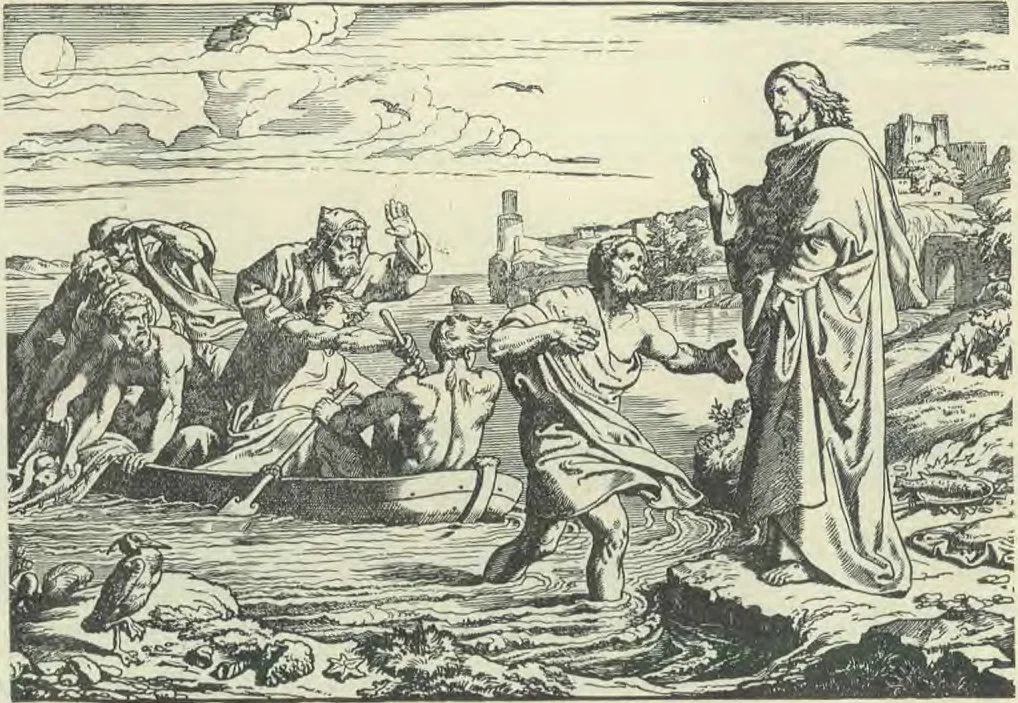
1. As Jesus taught by the Sea of Galilee, how great was the interest to hear him and the desire to be healed? Luke 5:1. What familiar objects were lying by? What were the fishermen doing? V. 2; note 1.
2. What favor did Jesus ask of one of these fishermen? V. 3. Was it granted? Why did the people follow Christ in such large numbers?
3. After the discourse, what did the Saviour ask Simon to do? V. 4. Did Simon think it would be of any use? Why? V. 5; note 2. What was the result of obeying Christ’s command? Vs. 6, 7. What lesson may we draw from this? Note 3.
4. Seeing the miracle that had been performed, what did Simon Peter do? V. 8; note 4. What assuring words were spoken to this disciple? V. 10. Give in brief Matthew’s account of the calling of Peter and his three friends to the work of the gospel ministry. Matt. 4:18-22. Had these men joined themselves to Christ before this? Note 5.
5. Where did Christ and his four disciples now go? Mark 1:21. How did Christ’s sermon in the synagogue affect the people? V. 22. What was there peculiar about his teaching? Why could he teach with authority? Note 6.
6. How was the service in the synagogue interrupted? Vs. 23, 24. With what words did Jesus rebuke the devil? V. 25; note 7. What took place at his command? V. 26. What was the effect upon the audience? V. 27. How far did the news of this miracle reach? V. 28.
1. The Sea of Galilee, also known as Lake Gennesaret, because of a most beautiful and fertile plain by that name to the north of it, is about thirteen miles long and six miles broad, and lies five hundred feet below the level of the Mediterranean. It is even to-day a sheet of water of surpassing beauty, and teeming with fish, though the shores are all deserted. No trace remains of Capernaum. Tiberias and Mejdel (the ancient Magdala) are small, decaying villages, whose inhabitants live in great filth and degradation. One miserable little boat has taken the place of the three or four thousand craft of all kinds that formerly sailed on the bosom of this lake.
2. All night Peter had toiled in vain. “During the lonely hours he had thought of the fate of John the Baptist, who was languishing alone in his dungeon. He had thought of the prospect before Jesus and his followers, of the ill success of the mission to Judea, and the malice of the priests and rabbis. Even his own occupation had failed him; and as he watched by the empty nets, the future had seemed dark with discouragement.”—“The Desire of Ages,” page 245.
3. The miraculous draught of fishes was due to the fact that the nets were let down at the word of Christ. The disciples had toiled all night in their own strength, and had taken nothing; their arduous efforts had been entirely fruitless. Now they take up the same work, but under the guidance and direction of Christ, trusting in his word, and the result is perfect success. Many a man, nearing the close of life, looks back on years of hard, toilsome work and painful drudgery done solely in human strength and for selfish purposes, and sadly admits that he has labored in vain. Let us who have life before us seek heavenly guidance, let us let down our nets at the word of God, and we shall have real success.
4. Conflicting emotions overcame the erring disciple. He had, in great measure, lost sight of Christ’s calling, of which he had been convinced a few months before. His was now the cry of self-loathing, as his true self of unbelief and unholiness was clearly revealed by the flash of supernatural illumination.
5. Some months before this these men had voluntarily, but temporarily, it seems, joined themselves to Christ, as related in John 1:35-42. They had listened to his teaching and witnessed his miracles; but having also seen the combination of religious leaders formed against him, they had, in the midst of some doubt and hesitation, found relief in assuming their former occupation.
6. Christ could teach with authority, because he was on intimate terms with the Father, and knew his will concerning man. This privilege, which he enjoyed as a man, and not as the Son of God, is to-day vouchsafed to every true Christian; but few avail themselves of it, few are willing to endure toil, and sacrifice their ease and comfort, in order to find time for communion with God. Few are willing to walk in the light given, and therefore God can not reveal to them the fulness of his knowledge. For further discussion of Christ’s method of teaching, see “The Desire of Ages,” pages 253, 254.
7. A strong expression, which would be rendered literally: “Be thou muzzled.” The Lord would not recognize this satanic testimony to his office and work. His calm intrepidity gave force to his word of authority, and a dignified standing to his heavenly message. For further comments on this case, see “The Desire of Ages,” pages 255, 256.

JESUS TEACHING HUMILITY

INTERNATIONAL LESSON.—NO. 3.

(April 16, 1899.)

JESUS TEACHING HUMILITY.

Lesson Scripture.—John 13:1–17.
Memory Verses.—Vs. 14–17.
Outline.—A lowly service. Vs. 1–5. A tender rebuke. Vs. 6–11. A worthy example. Vs. 12–17.
TIME: The evening before the crucifixion, A. D. 30. PLACE: An upper room in the city of Jerusalem. PERSONS: Jesus and his disciples.

QUESTIONS.

Preliminary.—When did the incidents of this lesson occur? Where? Give a summary of the incidents between this lesson and the last. Give the order of events on the night of the supper, as gathered from the Gospels.
A Lowly Service.—To what hour does Jesus refer? Who are meant by “his own”? What precious thing is here said of Jesus? What did Jesus know? From whom had he come? To whom was he soon to go? What lowly service did he perform?
A Tender Rebuke.—What did Peter say? What was Jesus’ reply? When should we understand it? Why did Peter refuse the loving service? What was the reply? What did he then exclaim?
A Worthy Example.—What question did Jesus ask the disciples? By what name did they call him? What did this mean? For what purpose had he performed the lowly service? How may we follow his example? If we do these things, how shall we feel?
The desire to be greater than others is the cause of many quarrels and much evil. Man’s way to be great is to seek to be greater than others—self-seeking. God’s way to be great is to serve others, to do all we can for them—love. It is pharisaism to have a form but neglect the spirit.
Often spiritual pride clothes itself in humble forms. We have known a man very proud of a buckskin watch-guard. Pride may put on a towel and wash feet. Once when Dr. Bethune preached against pride, a man went to him, and pointed to leather buttons on his coat, saying, “See, I am not proud.” “Yes,” said the doctor, “you are proud of your leather buttons.” It is very properly said: “The great law of the kingdom of heaven is not this: Use thyself for thyself. Still less is it this: Use others for thyself. But it is this: Use thyself for others.” “Voluntary service in the kingdom of love, and under the impulse of humility and self-denial, makes a man a spiritual power, gives him an unconscious and blessed greatness.”

Kindly Thoughts Must Become Generous Deeds

A KINDLY thought toward a fellow mortal has but little virtue in it if it be not transmuted into a generous deed.

Pleasure's Pathway Leads to Sorrow and Death

To countless millions has pleasure’s pathway been but a darkly shadowed street, leading to sorrow, despair, and death.
Continue reading: NOTE AND COMMENT