Add to your friends’ occasional thoughtlessness their countless kindnesses; subtract the things that grieve you from the things that prove their love—and then divide them into such minute particles that they can never come together again to disturb your peace, thus leaving the beautiful account clear; then multiply the outward manifestations of their good will by what they would do if they could; and you will find the world a cheerful place to live in.
Home Life as the True Test of Character
By F. B. Meyer
WHAT we are in our homes is a test of what we are really. The way we act to those nearest and dearest to us is the true test of our behavior in the great world of men.—F. B. Meyer.
Judging Ourselves by Conduct, Not Aspiration
We are very apt to measure ourselves by our aspiration instead of our performance. But in truth the conduct of our lives is the only proof of the sincerity of our hearts.—George Eliot.
A SECRET
By Well Spring
WHAT makes the springtime of the year?
Why, sunlight!
Just sunlight!
It makes the tender bud appear,
It crowns the autumn with good cheer —
Just sunlight!
What gladdens all this world of ours?
Why, sunlight!
Just sunlight!
It paints the beauty of the flowers,
It sets the rainbow in the showers —
Just sunlight!
What if thy lot right hard hath been?
Try sunlight,
God's sunlight!
Throw open wide thy heart of sin,
And let his glorious sunshine in.
Try sunlight!
Well Spring.
THE TEN-CENT-A-WEEK PLAN
Was presented to the Battle Creek Young People's Society on Sabbath, March 1, by Elder I. H. Evans, after a short general talk on the privilege and blessing of giving. At the close of the service it was suggested that there might be many present who would like to express their approval of this plan, and their desire to adopt it themselves. Accordingly, a call was made, and exactly one hundred responded. Plans will be laid for securing the names of these, and either visiting them regularly or taking up their contributions at the weekly meeting; also for enlisting the interest of others in this plan.
It was suggested by the speaker that this large company might easily raise a thousand dollars a year for missions. While at first thought this seems like a large sum, we believe that if all will co-operate heartily with the simple plan outlined, this, and even more, can be raised.
The objection is sometimes heard that “ten cents a week is such a trifle for missions,” and in one way this is true; nevertheless the sum total of ten cents a week, every week in the year, from every Seventh-day Adventist, would far exceed any total yearly offering in our history. Then, too, it should be remembered that there are always some in every company to whom the giving of even so small an amount is not possible; while others, by the exercise of a little self-denial,—and it is self-denial that sweetens our gifts,—can spare more. The majority of our young people, however, could easily co-operate with this plan; and if all would do so, heartily and faithfully, “as unto the Lord,” the result would be not only an increased fund to carry the gospel into the needy fields beyond, but a rich blessing for the workers at home.
STUDIES IN THE MESSAGE
By Luther Warren
How to Study These Lessons
FIRST: Read the lesson story.
SECOND: Try to recall or find scriptures in proof of each statement.
THIRD: Study the questions and texts.
FOURTH: See how many missing links you can supply.
LAST, but by no means least, give the lesson to some one else. You will keep only that which you give away. If you fail to find the proof for any point, let us hear from you. But let us dig in God's mine of truth. May the great Teacher himself give each of you first the ear to hear his word, and then the tongue of the learned.
Yours to know more of God and his dear Son,
LUTHER WARREN.
400 West Fifty-Seventh St., New York City.
The First Battle
(March 23-29)
AWAY back in the eternal ages, before the creation of this earth, the Heavenly Father had an associate, his dear Son. By him God created heaven and the angels, the worlds and their inhabitants. The universe was lighted with the joy of a million worlds. Harmony and happiness reigned everywhere. But there came a time when a note of discord was sounded. Lucifer, the “light-bearer,” the choirmaster of heaven, renounced allegiance to the Prince of Life, and rebelled against the government of heaven.
Then the peace of the universe was broken, and there was war in heaven. Under the plea that it was necessary to fight for their liberty, the rebel prince succeeded in drawing one third of the angels under the standard of rebellion.
Only one result could follow such a battle. Satan and his sympathizers were cast out of heaven. All the universe watched the struggle with intense interest. Of course the great Creator could at once have taken back the life that had been given on condition, since it had been forfeited by disobedience. But if this were done, some might be held back from disobedience merely from fear of the consequences.
God desires only the happy service of true love. So it was decided to let the strange seed of sin fully develop, that it might be recognized as the hateful thing it is, and that every creature might know that obedience and happiness are bound together, and that any other path must lead to sorrow, pain, and death.
What was the secret of Lucifer's rebellion? Isa. 14:12-14.
11. Why were not Satan and his angels at once destroyed? — It is God's plan to let things develop. “Let both grow together until the harvest.” Matt. 13:24-30, 37-43.
“ONE THOUSAND DOLLARS FOR FRANCE”
By L. Flora Plummer
Is the battle-cry of the Iowa Young People’s Societies. The members of the Des Moines Society read that extremely interesting article in the Review of January 7, entitled “The Tarn, France.” As they thought over the call for means made by Professor Wilkinson, who went last year from Union College to labor in that neglected field, the Spirit of the Lord impressed their minds with their responsibility in answering the call. They have entered upon the work with commendable zeal. The Des Moines Society started the list with a liberal contribution, and are now appealing by letter to all the other Societies, and to the young people of every church in the State, to contribute to the fund. If the young people in Iowa rally to this work as it is their privilege to do, there is no question but that the entire amount will be raised. The effort will certainly bring rich spiritual blessings to the workers. It is a definite move toward the actual carrying out of the aim of the young people’s organization, — “The Advent Message to all the world in this generation.”
Why should not the young men and young women throughout our ranks feel the joy of the message in their own hearts, and with steady purpose share in the burdens of the hour? Can not the young people in each State band together in a missionary enterprise of this kind? Certainly none of us wish to expend all our resources of means, time, and strength in the home field. Why shall not our young people extend a strong, helping hand to the “regions beyond,” that are giving to us the Macedonian cry? What is more fitting than that the young people in the home field should actively engage in the support of the work in which one of their number is engaged in a far-away land? We need not undertake impossibilities, for that will result in discouragement; but it is not an impossible thing for the young people in each State to lift a very appreciable load in a needy mission field. To our young people everywhere, we say: “Who knoweth whether thou art come to the kingdom for such a time as this?”
Mrs. L. Flora Plummer.
WINNING SOULS
A STRANGE reluctance comes over many when they try to talk about the soul and its relation to God. It is felt alike by the converted and the unconverted. Very often the gay young girl, whose heart is running over with mirth and fun, and whose speech sparkles with wit and humor, has deep in her consciousness the feeling that she is unsatisfied, that she wants something better, purer, and higher. She wishes that the Christian woman who is talking with her would ask her a question, would give her a hint, would lead the conversation to the subject of personal religion.
The other has no thought of the kind. She even has a faint, undefinable dread that any effort on her part would be received coldly or be the subject of ridicule. So the opportunity passes. The souls have been within speaking distance, but have failed to communicate with each other. Each goes on its way. The friend of Christ, who might have won a soul to him, has been silent, ashamed, afraid.
What wonder if to that faithless friend there comes the sad experience that the Beloved has withdrawn himself, and is gone; that, seeking the Spirit, it finds him not, and calling, there comes no answer? Can there be perfect serenity and the full sense of communion with God to one who refuses or neglects so important a duty?— Selected.
Joplin Young People's Society Outlook and Activities
By Thos. W. Lewis
FROM JOPLIN, MISSOURI
THE outlook for our Young People's Society at Joplin is most encouraging. At present our membership numbers thirteen,—ten resident and three associate members,—though nearly twenty-five attend the weekly meetings. Most of these take part in the testimony service following the study. We meet on Sabbath morning, immediately after Sabbath-school, and take up the study outlined in the INSTRUCTOR. We have found these studies very helpful; especially have the missionary studies caused us to realize something of the needs of the great fields abroad, and of our duty toward them. We now have a Missionary Map of the World, and this will no doubt add to the interest in the field studies.
One of our number teaches the church school; another regularly disposes of a number of the Signs of the Times; and still others are engaged in other lines of work. A number of tracts and papers have been distributed, and a sum of money has been sent to help forward the work in Kentucky. A few weeks ago the young ladies of the Society formed a sewing circle, to earn money for mission purposes. Nearly all the members take an active interest in this work.
Our residence membership was recently increased by the three children of Brother Munson, our missionary in Padang, Sumatra. A letter written by Miriam, the elder girl, in behalf of herself and her two brothers, stated that they wished to join our Society; and when the matter was brought before the young people, they gladly united in welcoming them as associate members. These children say they will be glad to co-operate in the work of the Society; and we hope that their membership therein may be not only a source of strength to them, but an inspiration to us.
Knowing that the time has come in which there is to be an advance all along the line in carrying the “Advent Message to all the world in this generation,” I pray that as young people, we may awake to a sense of our responsibility in keeping pace with the message, and reflect upon the sad consequence of neglecting our God-given duty at this time. THOS. W. LEWIS.
DICKIE'S SECOND THOUGHT
DICKIE had just come. So, of course, he had to look at everything on the place. It took him the most of the day; for there were the chickens, and the geese, and the turkeys, and the pigeons, and the bees, and the pigs. There was old Dan in the stable, and there were the plow-horses, and the frisky colts in the meadow.
Late in the afternoon Dickie, his tour of inspection ended, sat down on the side porch to rest.
“Well,” asked Uncle Jack, “what do you think of us?”
“I think everything is splendid,” said Dickie, “except —.” He paused. He did not wish to be impolite.
Grandmother, who was looking over the top of her knitting-needles, and grandfather, who was looking over the top of his newspaper, both smiled.
“Jonas is not pretty on the outside,” said Uncle Jack; “but,” picking Dickie up, and swinging him to the rail of the banister, “let me give you a piece of advice, youngster. It doesn’t always do to make up our minds too fast,—about human beings or other things.”
Dickie thought of the big, awkward hired man in shabby blue overalls, with a fringe of wild hair under his wide, broken straw hat. He had a great beard, too, and there was a long scar beside one eye. Dickie said nothing, but he did not believe that he should change his mind.
Next morning, after breakfast, Jonas stopped his horses outside the kitchen window in the lane.
“I thought p’raps,” he called in, “the boy’d like a ride atop of my load.”
“Will you go with Jonas?” Uncle Jack asked Dickie, with a twinkle in his eye.
Dickie hesitated only a minute. What boy could refuse the lofty seat on all that mass of sweet-smelling hay, even though Jonas were his companion? He went.
They had not gone far up the road when they overtook a little bent old woman, who walked with a limp along the dusty side-path.
Jonas pulled in his horses.
“Good morning, Mrs. Green,” he said. “What’s that you’ve got,—a letter? I’m going past the office, if it’d be any accommodation.”
Every wrinkle on the old face smoothed out a little.
“Well, now, if that ain’t good!” she cried. “I can get right back to my work.”
Big Jonas lumbered down off the hay, and took the letter.
“Don’t you worry, Mrs. Green,” he said, “I’ll be careful of it.”
The little old woman chuckled.
“I won’t worry,” she promised, “not a mite.”
After the horses had started again, Dickie stole a sidewise look at Jonas. The ugly scar was toward him.
Jonas caught the look, and said, in a tone of apology: “Mrs. Green is too old and too poorly for such walks in the sun. She’s getting up in her years, Mrs. Green is, and she hasn’t any of her folks around to do for her.”94
Dickie told this to Uncle Jack later in the day.
“I suppose,” said Uncle Jack, “Jonas didn’t tell you who it is that chops her kindling, and carries her coal, and ‘does’ for her, without being any of her folks.”
“No, he didn’t say,” answered Dickie.
“I suppose not,” said Uncle Jack.
Then he walked out of the room, and left Dickie wondering who it was he meant. Could he mean Jonas?
When Dickie came into the house at supper-time, he said: “I asked Jonas how did he hurt himself on the eye.”
Uncle Jack laughed.
“Did you? Well, no doubt I asked a few questions myself when I was a boy.”
“You did,” said grandmother.
“What did Jonas say?” asked Uncle Jack.
“He said that something fell on him there once when he was running away from a barn that was on fire.”
“Did he tell you that the barn belonged to a man who had cheated him out of his money, and told mean lies about him, and that he was saving that man’s horses and cows from the fire when the beam struck him?”
“Why, no!” said Dickie. “Was he?”
“Jonas is a foolish man,” said Uncle Jack. “He has a bad habit of leaving out the best part of his stories.”
After Dickie had been a week on the farm, he announced, one day, rather shyly: “I think Jonas is an awfully nice man.”
“You do!” said Uncle Jack. “I thought you said that he was the one thing in the country that wasn’t nice.”
“But that was when I first came,—that was the first day. You know a good deal more in a week than you do the first day.”
“Very true,” said Uncle Jack; “still, Jonas is not a beauty.”
“But it doesn’t matter,” protested Dickie, eagerly, “what you look like, if, whenever people think about you, they think about being kind, and looking out to help folks. I think God likes to look at Jonas, and so do I.”—Sunday School Times.
LITTLE DORCAS
By Aunt Betty
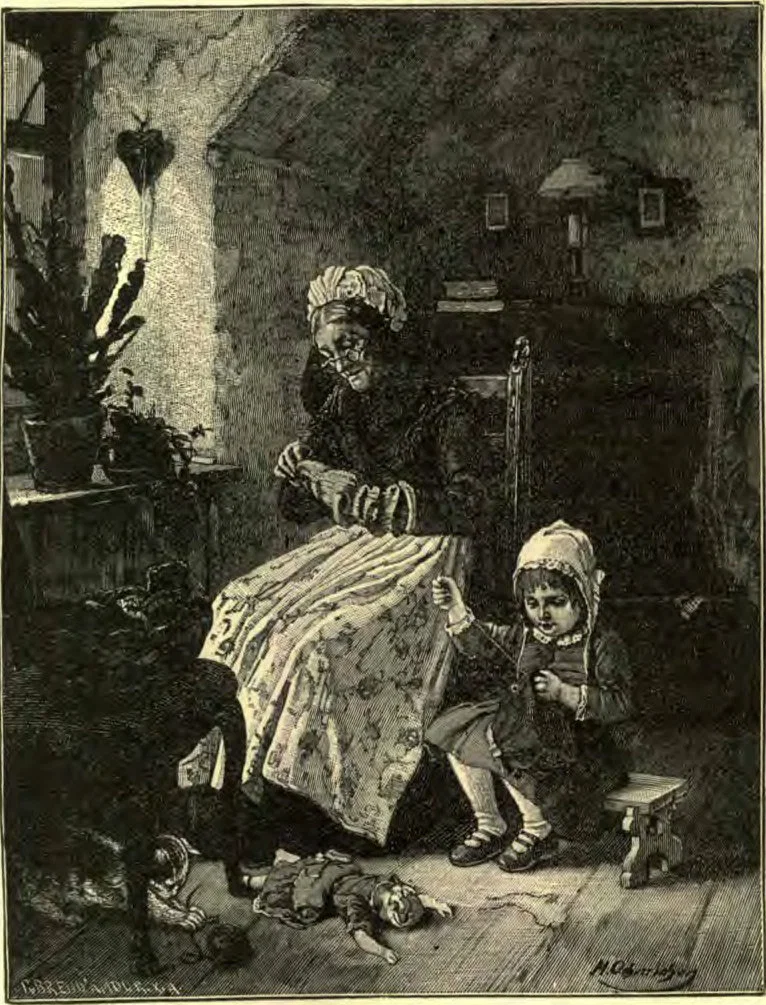
“Come, Dorcas,” said grandma; “I’m going to do my mending, and you’d better get your stool and sewing, and keep me company.”
“Yes, grandma; what shall I sew to-day?”
“Why, I think Polly Margaret would look the better for a new dress. Here is a piece of pink-sprigged calico I saved for that very purpose.”
“O, thank you, grandma!” said Dorcas. “Now, if you will please do one more thing for me—”
“And what may that be?” asked grandma, smiling. Well she knew the request that was coming.
“Tell me a story.”
“Very well, dearie. What shall it be about?”
“About a little girl, please,—a little girl like me,—O, you don’t know any story about a little girl named Dorcas, do you, grandma?”
“Indeed I do; and a beautiful story it is, too. This Dorcas lived many, many years ago, in a country very far from here. When she was a little girl like you, I am quite sure she was loving and obedient; and she learned to sew, as you are learning. I think her kind mother taught her, though the story does not tell us; perhaps it was her grandma.”
LITTLE DORCAS
“Did she make dresses for her dolly?”
“I do not know whether she or any of her playmates had dollies. If they had, be sure they were not at all like yours, but probably of wood, and you might not think them pretty.”
“Poor little Dorcas! Then what did she sew, grandma?”
“Well, I think she helped make the coats and dresses for her little brothers and sisters. But as they grew up, and learned to make their own garments, Dorcas, who was now a woman, looked about her, and saw many widows and orphans who needed clothing; for poverty and want were in the world then just as they are now.
“So day after day she sewed for them, and the poor of her city loved her dearly for her kindness. But there came a day when the beloved Dorcas fell ill; and though many prayed for her recovery, she died. After she was dressed ready for the tomb, her friends laid her in an upper chamber.”
“Now there was a good man named Peter in a town near by; so they sent two men to him, asking him to come to them in their trouble. When he came, they took him into the room where their dear friend was laid. And all the widows stood about him, weeping, telling Peter of her good deeds, and showing the coats and garments she had made for them.”
“Peter put them all gently out of the room, and kneeled down and prayed; and turning toward her, he said, ‘Dorcas, arise.’ Then she opened her eyes, and sat up. Peter took her by her hand, and helped her to her feet, and, calling her friends, presented her alive.”
“O grandma! weren’t they glad?” asked Dorcas.
“Indeed they were; and I have no doubt she went right on making coats and garments for the poor.”
“Grandma, do you think I can ever grow to be like that other Dorcas?”
“I know you can, my dear. If you love the Lord Jesus so that you will do kind works for his poor, you will be loved by them, just as she was. And though, when he sees fit to give you rest from your labors, there may not be a Peter to take you by the hand, and bid you arise, yet when ‘the Lord himself shall descend from heaven with a shout, with the voice of the archangel, and with the trump of God,’ you will be among those who will hear his voice, and come forth, to be ‘ever with the Lord.’ And some day—who can tell?—you may know that other Dorcas.” AUNT BETTY.
April: A Spring Invitation to Children
April
Little girl! Little girl! Little girl!
Don't you hear me calling from the meadow by the brook,
Where violets are peeping up in every sunny nook;
Where bluets brave are standing, with their faces to the sky,
Watching for gleams of sunshine through the clouds that scurry by?
Little boy! Little boy! Little boy!
Don't you hear me calling from the pussy-willow tree,
Where the robins and the pussies live in peace and harmony,
While the drowsy woodchuck wakens from his quiet winter nap,
And frisky squirrels dance in time to woodpecker's tap, tap?
Little girl! Little boy! Little girl!
Come, I'll tell to you a secret that my sister May told me:
There's to be a grand May party down beside the old oak-tree!
All the sweet spring flowers are coming, and the brook and birds will sing,
And the little girl shall be May Queen, and the little boy May King.
Little boy! Little girl! Come and see!
— Selected.
A SPROUTING WOOD-PILE
By Fannie L. Brent
CARL and Annie Thurston lived in Pasadena, California, where geraniums grow as high as small trees. The Thurston’s kitchen window was screened from the driveway by a hedge of red geraniums, which grew as high as the roof.
The hedge had been there a good many years, and the old stalks were very thick and woody. They were bare, too, and Mrs. Thurston decided that all the old woody part must be cut down, to give the young stalks a chance to grow up. So one January morning she set Ling, the Chinese boy, to cutting them down, and told Carl and Annie to carry them away. They were busy and happy. They knew that their mother always had trouble to get good, dry kindling-wood, and as they dragged away the old stalks, Carl said, “Let’s break them up into short pieces, and pile them up to dry for kindling-wood.”
Annie agreed, and they found a nice, dry place near the barn where they could pile them. When the pile was done, they called their mother, and showed it to her very proudly. Their mother said it was a good idea, and when it was dry, it would make very good kindling. But it did not get dry.
There were nearly two weeks of pleasant weather after that, and the kindling began to look almost dry enough to use, when one Monday morning a soft, gray cloud spread over the blue sky, and the rain began to fall very gently. There was no thunder nor lightning nor wind, only the steady rain-drops; but Carl and Annie settled themselves for two or three days indoors.
They did not think of their kindling for several days, but when they did see it, each one day, looked at the other, and wondered why they didn’t think to bring it in when the rain began. “Well, it’ll have to dry all over again, that’s all,” Carl said.
The next day the clouds were all gone, the town was as bright and fresh as a good washing could make it, and the tops of the mountains were just whitened with snow. In the afternoon the children drove with their mother down to Los Angeles to spend a few days with their aunt; and when they drove back the next week, they brought their cousin George with them.
They took George out to see their wood-pile, but they were as much surprised as he at what they saw; for from every joint in the old, woody stalks a tiny, fresh green leaf was growing. They ran to bring mother, and what a laugh they all had over their kindling-wood that had sprouted!
“Poor old stalks!” she said. “I think we ought to encourage them. If you children would like, you may plant them between your own little garden and the orchard, and have a hedge of your own.”
So the boys took Carl’s little spade and hoe and dug up the earth, Ling stretched a cord, to help them get it straight, and Annie planted the old stalks; and now there are two geranium hedges on the Thurston place, instead of one. But they had to buy their kindling-wood.—Fannie L. Brent, in Youth’s Companion.
DIVISION III — ASTRONOMY
By O. C. Godsmark
Chapter XXII — The Stars: What Are They?
§ 220. FROM the earliest dawn of recorded history the stars have been the constant study of the human race, and through them God has ever spoken to men of his love and tender care. The more we study the handiwork of God as manifested in the heavens, the more we realize the greatness of him who made us, and the more we sense our nothingness before him with whom we have to do. This was the experience of David as expressed in Ps. 8:3, 4: “When I consider thy heavens, the work of thy fingers, the moon and the stars, which thou hast ordained; what is man, that thou art mindful of him? and the son of man, that thou visitest him?”
§ 221. The myriads of stars are, with four or five exceptions, blazing suns like our own; only the vast majority of them are many times larger than the star which we call our sun, and which lights our earth. Our sun is only a star, and comparatively a small one at that. Were all the stars as small as our sun, the light of many of them would be lost in the depths of space, millions of miles before its faintest gleam could reach the planet on which we live. They appear small because of the immense distance through which their light has to travel to reach our earth.
§ 222. In speaking of the completeness of his forgiveness, our Heavenly Father says, “As far as the east is from the west, so far hath he removed our transgressions from us.” O, the blessedness of that thought! How far has he removed our transgressions?—As far as the east is from the west. How far is that? Is it twelve thousand miles, or half-way round this little world of ours?—No, a thousand times no! East and west are relative terms. Astronomically speaking, east is that part of the heavens toward which we are moving, while west is that point in the depths of space from which our earth is passing.
§ 223. Would you not like to be able to tell in just what direction our earth is moving in its journey around the sun? It is a pretty little point in astronomy, which you will often wish to make use of, so we will tell the fact now, and they explain the why when you become better able to grapple with these problems. They are all easy if we take them one at a time, and master them as we go along. Always remember that when the moon is at its first quarter,—any almanac will tell you when that comes each month,—it is exactly behind the earth in her onward path. By noticing in what part of the heavens the moon is on that particular evening, you can point out the exact relative west at that time, or the direction from which we are moving in our course among the stars. Again: when the moon is at its third quarter, it is exactly ahead of our earth; and should it stand still, we would soon smash into it. This would be at that time the relative east, or direction toward which we are traveling. Now to grasp the idea of how far the Lord has removed our transgressions from us, let the mind run out into the immeasurable depths of space, considering our world as a mere speck in the great universe of God, and you will have some faint conception of the fullness of redeeming love.
§ 224. “He telleth the number of the stars; he calleth them all by their names. Great is our Lord, and of great power: his understanding is infinite.” Yes; he who “hath created these things, that bringeth out their host by number: he calleth them all by names, . . . for that he is strong in power; not one faileth.” We have no conception of their number; for with every increased power of the telescope, a corresponding increase in the stars is brought to view; therefore it is useless to speculate regarding how many there are. God knows. We do not. Jeremiah tells us that “the host of heaven can not be numbered;” and the Lord challenged Abraham to tell their number if it were possible.
§ 225. Before the invention of the telescope, the camera, and the spectroscope, infidel scientists boastfully taunted believers in Bible truths of being ignorant and unscientific. They claimed as one unanswerable argument against the inspiration of the Bible that Paul knew not the mistake he made when he said, in 1 Cor. 15:41, that “one star differeth from another star in glory.” “For,” said they, “had Paul been a scientist, he would have known that all stars shine alike, and differ not in glory.”
§ 226. How foolish seem our boasted criticisms against God’s word, after he draws back the veil from before our eyes, and allows us a little deeper glimpse into the mysteries beyond. Those stars, which to men’s eyes appeared but mere “candles of the sky,” are now known to be mighty suns, each with its retinue of planets. “Canst thou guide Arcturus with his sons?” asks God. Arcturus is a sun like our own, and we shall soon learn where to locate him. His sons are the worlds that journey around him, their great center, the same as our earth and her sister planets revolve about the sun.
§ 227. These stars do differ one from another in glory; for there are, shining in the depths of almost boundless space, not only white suns, like our own, but red suns, green suns, orange-colored suns, and so on. Many systems of worlds have two, three, and four different suns, and frequently each of a different color. Imagine a period of red days caused by the shining of a red sun; followed by a period of green days, whose emerald rays interlace and play among the shadows of the red, as the green sun mounts to the zenith, and the red sun sinks from sight. Perhaps before the faint rays of this sun fade in the distant sky, the bright-orange of a third sun would arise to vie with the green rays of the sun holding supreme control. Varied and beautiful would be the face of all nature were such the case; and yet with such beauty God paints the heavens of more than one system of worlds. As we study concerning these distant worlds, do we not feel anew the longing for the glad day when we shall behold them?