The Youth’s Instructor, Vol. I, No. 12

OUR FRIEND THE ROBIN
Earlier text: Counting Kindness: A Cheerful Way to Live

Parable of the Ten Virgins

  • (March 29) *
MEMORY VERSE: “Watch therefore, for ye know neither the day nor the hour wherein the Son of man cometh.”
LESSON SCRIPTURE: Matt. 25: 1–13.
LESSON HELP: “Christ’s Object Lessons,” pages 405–441.

Synopsis

“Christ with his disciples is seated upon the Mount of Olives. The sun has set behind the mountains, and the heavens are curtained with the shades of evening. In full view is a dwelling-house, lighted up brilliantly, as if for some festive scene. The light streams from the openings, and an expectant company wait around, indicating that a marriage procession is soon to appear. In many parts of the East, wedding festivities are held in the evening. The bridegroom goes forth to meet his bride, and bring her to his home. By torchlight the bridal party proceed from her father’s house to his own, where a feast is provided for the invited guests. In the scene upon which Christ looks, a company are awaiting the appearance of the bridal party intending to join the procession.”
“Lingering near the bride’s house are ten young women robed in white. Each carries a lighted lamp, and a small flagon for oil. All are anxiously watching for the appearance of the bridegroom. But there is a delay. Hour after hour passes, the watchers become weary, and fall asleep. At midnight the cry is heard, ‘Behold, the bridegroom cometh; go ye out to meet him.’ The sleepers, suddenly awakening, spring to their feet. They see the procession moving on, bright with torches and glad with music. They hear the voice of the bridegroom and the voice of the bride. The ten maidens seize their lamps and begin to trim them, in haste to go forth. But five have neglected to fill their flasks with oil. They did not anticipate so long a delay, and they have not prepared for the emergency. In distress they appeal to their wiser companions, saying, ‘Give us of your oil; for our lamps are going out.’ But the waiting five, with their freshly trimmed lamps, have emptied their flagons. They have no oil to spare, and they answer, ‘Not so; lest there be not enough for us and you: but go ye rather to them that sell, and buy for yourselves.’”
“While they went to buy, the procession moved on, and left them behind. The five with lighted lamps joined the throng, and entered the house with the bridal train, and the door was shut. When the foolish virgins reached the banqueting hall, they received an unexpected denial. The master of the feast declared, ‘I know you not.’ They were left standing out in the empty street in the blackness of the night.”
“As Christ sat looking upon the party that waited for the bridegroom, he told his disciples the story of the ten virgins, by their experience illustrating the experience of the church that shall live just before his second coming.” — “Christ’s Object Lessons,” pages 405, 406.

Questions

1. In this parable to what is the kingdom of heaven likened? What does this expression mean? See note.
2. When will the kingdom of heaven be like ten virgins with their lamps? Matthew 24 shows at what time the word then applies.
3. What was the character of these virgins?
4. What did they do? Whom do they represent? See Quotation 1.
5. What do the lamps represent? See Quotation 2. What is the oil?
6. While the bridegroom tarried, what did the virgins do?
7. What startling cry awakened them?
8. When was it made? How did it affect the virgins?
9. In their confusion, what did the foolish say to the wise?
10. Why had their lamps gone out? Whose lamp does Job say shall be put out? Job 18: 5, 6.
11. Seeing that the oil represents the Holy Spirit, what is meant by the lamps of the foolish going out?
12. What answer did the wise virgins make?
13. While the foolish went to buy, what happened?
14. Who were ready to receive the bridegroom?
15. Where did they then go?
16. What prevented the foolish from entering?
17. What piteous appeal did they make?
18. What sad answer was given them?
19. With what solemn warning does the Saviour close the parable?
20. What comparisons can you make between the experience of the ten virgins and that of the church at this time? Read the Quotations on the lesson.

Note

The phrase, “The kingdom of heaven,” occurs only in the Gospel of Matthew. It is found there about thirty times. Mark and Luke always say, “The kingdom of God,” which means the same thing. This last term occurs in the New Testament over seventy times. The two expressions more commonly refer to the work of the gospel in the earth, but sometimes to the future everlasting kingdom.

Quotations from the Lesson Help

1. “In the parable, all the ten virgins went out to meet the bridegroom. All had lamps, and vessels for oil. For a time there was seen no difference between them. So with the church that lives just before Christ’s second coming. All have a knowledge of the Scriptures. All have heard the message of Christ’s near approach, and confidently expect his appearing. But as in the parable, so it is now. A time of waiting intervenes, faith is tried; and when the cry is heard, ‘Behold, the Bridegroom cometh; go ye out to meet him,’ many are unready. They have no oil in their vessels with their lamps. They are destitute of the Holy Spirit.” — Page 408.
2. “The two classes of watchers profess to be waiting for the coming of the Lord. They are called virgins because they profess a pure faith. By the lamps is represented the word of God. . . . The oil is a symbol of the Holy Spirit.” — Pages 406, 407.
3. “The class represented by the foolish virgins are not hypocrites. They have a regard for the truth, they have advocated the truth, they are attracted to those who believe the truth; but they have not yielded themselves to the Holy Spirit’s working. They have not fallen upon the Rock, Christ Jesus, and permitted their old nature to be broken up. This class are represented also by the stony-ground hearers. They receive the word with readiness, but they fail of assimilating its principles. Its influence is not abiding.” — Page 411.
4. “The ten virgins are watching in the evening of this earth’s history. All claim to be Christians. All have a call, a name, a lamp, and all profess to be doing God’s service. All apparently wait for Christ’s appearing. But five are unready. Five will be found surprised, dismayed, outside the banquet hall.” — Page 412.
5. “The coming of the bridegroom was at midnight,—the darkest hour. So the coming of Christ will take place in the darkest period of earth’s history.” — Page 414.

THE STORY OF THE STUDENT VOLUNTEER MOVEMENT
The Student Volunteer Movement, the quadrennial convention of which was held in Toronto the last few days of February and the opening days of March, has been brought to the attention of the public everywhere through the secular and religious newspapers.
The story of this movement among the young people of the higher institutions of learning throughout the world, is not only interesting and inspiring, but marks one of the epochs in the history of missions during the nineteenth century.
As many of our young people have been educated in our own colleges and academies, and so have not come in contact with this movement, a brief outline of its origin and rapid progress up to the last convention will probably be of interest.
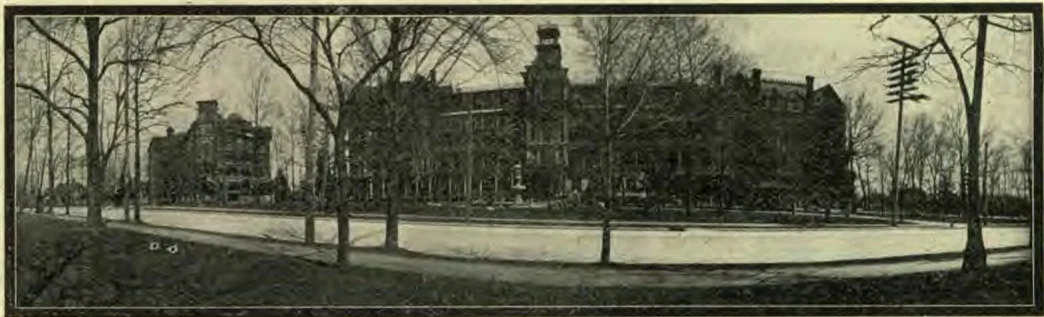
Photograph of the old Sanitarium and Hospital, with double mount, seven by fourteen inches, suitable for framing. This is the finest photograph ever made, and every one will be pleased with it. Price, fifty cents, postpaid. Address Retail Department, Review and Herald, Battle Creek, Mich.
At Princeton, New Jersey, was the home of a returned missionary, where a few young men whose hearts God had touched with the great need, were wont to meet for prayer and counsel. A few of these attended the memorable conference of college students which was held at Mt. Hermon, Massachusetts, in 1886, where they had been invited by Mr. D. L. Moody to spend four weeks in Bible study. Nearly two weeks passed before the subject of missions was mentioned. But one of the young men from Princeton had come from a home whose members were praying that this summer school might be marked by a great missionary revival. He, too, had been praying for weeks; and believing that from this gathering God would call at least a few college men who would consecrate themselves to foreign service, he called together the young men who were thinking of the fields abroad, and twenty-one responded. They began to pray that the spirit of missions might pervade the conference, and that the Lord would separate many men unto this great work.
Dr. A. T. Pierson, the editor of the Missionary Review of the World, and Dr. Ashmore, a returned missionary from China, added fuel to the little flame already kindled by their ardent appeals and convincing argument that “all should go, and go to all.” This was the keynote which set men to thinking and praying; and, one by one, alone with their Bibles and with God, the question of their life-work was settled. At the close of the conference one hundred of the two hundred and fifty young men assembled had signified that they were “willing and desirous, God permitting, to become foreign missionaries.” And this for several years was the pledge of the movement, and was signed by thousands of young people.
The step which had been taken at Mt. Hermon was heralded quickly all over the country, and there was a unanimous expression among those interested in this enterprise that the missionary spirit which had manifested itself with such power at Mt. Hermon, should be extended to other institutions. Two young men from Princeton spent much of the following year in preaching the new crusade among the colleges and universities of the United States. One hundred and sixty-seven were visited; and when the term closed, twenty-two hundred young men and women had taken the volunteer pledge.
Two years later experience demonstrated the necessity of the movement taking definite shape, and a few representatives met at Northfield, Massachusetts, and a simple organization was effected. Thus the Student Volunteer Movement for Foreign Missions came into formal existence, and since that time it has been an important factor in the increasing interest in the worldwide work which we see on every hand.
The chairman, Mr. John R. Mott, who presided at the last convention in Toronto, has been identified with the movement from its beginning; and his consecration to, and sanguine faith in, the realization of their motto, “The Evangelization of the World in This Generation,” are indeed inspiring.
The development of this organization has been continuous from the beginning. During the past four years about nine hundred higher institutions of learning were visited, and more than five thousand young people enrolled in missionary study classes. Through its influence young people are not only enlisted in this great work in the regions beyond; but those who do not see their way clear to go abroad, are awakened to the need, and shown how they may form a base of supplies, as it were, at home. It certainly can not be denied that through this movement, college men and women are becoming intelligent concerning the world's appalling spiritual need, and their privileges in connection with it. Does this mean naught to the young man and young woman to-day who is a student of prophecy, and knows from God's word that the great work to which these young people are giving themselves will be accomplished?
Not only are students being aroused, but the Christian church has been moved by this offering of young people for service abroad, as earnest young men and women have come before its members to voice the convictions which mean so much to them, and to plead for a like sacrifice of the means and prayers that are needed to make their own gift of life effective.
The movement has been even more far-reaching in its influence, for it has gone beyond the United States and Canada. Thirteen years ago no such organization was known outside of these countries; but to-day there are similar movements, under different names, in Great Britain, Scandinavia, Germany, Holland, French-speaking Europe, Australasia, South Africa, Japan, China, India, and Ceylon.
The World's Student Christian Federation unites all the Christian Student movements of the world. It includes over fifteen hundred student Christian organizations, with a total membership of seventy thousand.
It would be difficult to estimate the vast influence of this movement on the world-wide extension of the gospel of Jesus. We dare not say that it has ever had a parallel in the history of the church since Pentecost. But the fact that it has arisen at this time in the world's history is evidence to us that God is awakening his people, and preparing the world for that last message of mercy which must go to every nation, kindred, tongue, and people, and then shall the end come.
ESTELLA HOUSER.

SPECIAL NOTICE!

WE regret to say that the Ideal Home Work Company, whose advertisement appeared in the INSTRUCTOR a number of times early in the year, has failed to give our readers satisfaction in its transactions; and we would advise no further application to this house for materials for carrying on its so-called “home work.”

Carrying Chips on One's Shoulder

PEOPLE who will persist in carrying chips around on their shoulders must not complain if they get knocked off occasionally.

SHORTHAND BY MAIL

Your spare time can be well improved by studying shorthand, and this can be done at small expense to you by taking a mail course at your home. We are using “The Rogers Compendium of the Graham System of Shorthand,” a method arranged especially for home study, and giving an epitome of a system of shorthand acknowledged to be the best, the briefest, and the most complete. The only presentation of Standard Phonography in which all shorthand outlines are written as first learned, thus greatly abbreviating the work on the part of the student. A complete course in thirty lessons, illustrated by facsimile notes, with key. The correction of all students’ papers given special attention by experts. Reasonable tuition rates. If interested, write for full particulars. Practicing stenographers wishing to prepare for rapid reporting work should secure the last twenty lessons.
FIRESIDE CORRESPONDENCE SCHOOL, Battle Creek, Mich.

The Cow Pea: Experiment Farm Pamphlet

“THE COW PEA” is the title of the latest publication issued by the Experiment Farm of the North Carolina State Horticultural Society at Southern Pines, N. C. This pamphlet discusses the value and uses of the cow pea. Readers who desire a copy will be supplied free by addressing the superintendent of the experiment farm, Southern Pines, N. C.

SOLID THROUGH TRAINS OF

WIDE VESTIBULE COACHES and PULLMAN SLEEPING CARS BETWEEN
“Battle Creek and Chicago, Buffalo, New York, Philadelphia, Toronto, Montreal, Boston
For time-tables, descriptive matter, and information, apply to any representative of the company.

Living With Christ Here and Hereafter

If we would live with Christ in heaven, we must let him live with us here.

Papers Requested for Sabbath-School in the Woods

SISTER HATTIE SUMERIX, of Trowbridge, Mich., wishes to thank all who have responded to the call made by Brother Moore in the issue of February 13 for papers for her little “Sabbath-school in the woods.”

Iowa Young People's Societies Raise Funds for France

We note with interest that the Young People's Societies of Iowa have decided to raise a thousand dollars for France. It can be done, and done easily; for where the people, young or old, have a mind to work, God has a mind to add his blessing to their efforts; and his blessing maketh rich.

IMPORTANT!

SABBATH-SCHOOL secretaries are urged to give special notice to the change in the lessons to be made next week. Look the classes over carefully, and if additional copies of the INSTRUCTOR will be needed, order early, that all may be supplied on Sabbath, March 27.

A SPECIAL NUMBER

THE April issue of the Life Boat will be a special prisoners’ number, and a supply will be sent to all the penal institutions of the land for distribution among the inmates. We shall do all in our power, and we trust the Lord will help us, to make this issue an especially helpful and instructive one to the prisoner, but we shall need money to defray the expense of publishing the large number necessary. We trust that all the readers of the INSTRUCTOR will recognize in this an unusual missionary opportunity, and will send at least a small offering for this purpose. Address 28 Thirty-third Place, Chicago.
DAVID PAULSON, M. D.

THE NEW SABBATH-SCHOOL LESSONS

BEGINNING with the first Sabbath in April, there will be another department in our Sabbath-schools, or rather, the old Intermediate department will be restored. This is in harmony with the action taken by the Committee of the Sabbath-school Department of the General Conference at its first meeting, when it was decided to prepare two series of lessons on Bible history for the children, each to cover a period of three years. The first, or Primary lessons, will be for children from seven to nine years inclusive, and will be printed in the Little Friend. The second, or Intermediate, series will be for children of ten, eleven, and twelve years. These will appear in the INSTRUCTOR, together with the regular Youth’s lessons for older young people, thus making two lessons in each paper instead of one, as formerly.
The Intermediate lessons for the coming quarter cover the history recorded in the first two chapters of Genesis. The youth’s lessons will be an adaptation of the senior series, as heretofore.

You have reached the end of this edition.

The Youth’s Instructor · March 20, 1902