The Youth’s Instructor, Vol. I, No. 12

OUR FRIEND THE ROBIN

The Youth’s Instructor

March 20, 1902

Review and Herald Publishing Company · Battle Creek, Mich. · March 20, 1902

OUR FRIEND THE ROBIN
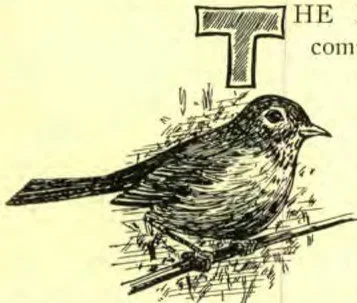
The Robin is a very common bird, and doubtless all are more or less familiar with it. This interesting bird is much the same wherever we find him, and he may be seen all over the United States, from Maine to California, and from the Great Lakes to the Gulf. Now and then in winter we run across Robins that did not go South in the fall, but stayed with us all through the winter; on bright days you will find them feeding, and as happy as birds can be, though the skies may soon send snow, and the air may be ready to chill.
The Robin’s nest is usually made of small twigs with a mud lining, fastened somewhere in a tree. The bird comes North early in March, and remains until late in the fall. Robins begin nest-building almost the first of the birds. They do not always build their nests in the same way, but usually there is considerable mud about them; for this bird is something of a mason. Olive Thorne Miller says she has seen a Robin’s nest made of the white flowers of life-everlasting. The bird had woven the stems together for the framework, and the little clusters of blossoms were left outside for ornament.
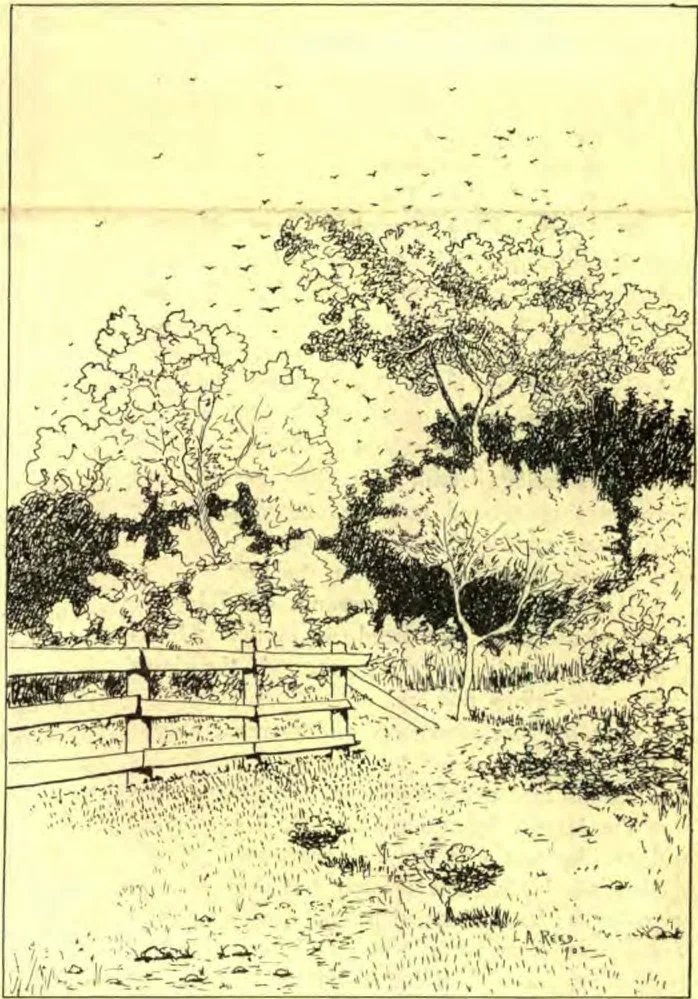
The latter part of June the young birds of the first brood, with some of the old males, each night resort to a roosting-place. This habit is a peculiar one, and one with which many are not familiar; so we will say a few words about it. Mrs. Robin remains on the nest during the night, as she is busy hatching the second brood; but it seems that Mr. Robin and his oldest children prefer to have each night an evening party, with plenty of company. Mr. Bradford Torrey has written considerable upon this characteristic of the Robins. Toward the end of summer some years ago, he saw what looked like a daily trip back and forth of small companies of Robins. A friend in a near-by town had observed a similar thing; and they talked the matter over, and decided that the birds must have a resort somewhere. Later, on learning that another bird-lover had discovered a Robin roost, Mr. Torrey kept a sharper eye upon the Robins he had seen. Every evening, shortly before and after sunset, he saw them flying, by twos, threes, or even by the half dozen, all going toward one place. At last he found the place where they roosted overnight,—an isolated piece of swampy wood, a few acres in extent, covered with a dense growth of gray birches and swamp white-oaks, with a sprinkling of maples and other trees.
Having found their nightly resort, whenever it was so he could, he set himself, a trifle before sundown, to count the number of Robins that gathered there. The first night he counted three hundred fly by the place where he was. The next time, in less than an hour he counted over one thousand. At another time he counted over twelve hundred; and at a still later date, fourteen hundred.
A ROBIN ROOST
A ROBIN ROOST
Why do the Robins congregate thus at night? Is it the husbands going off to the nightly club, and leaving the wife at home alone? Do they, as men sometimes do, have a night of it out in their own company? If so, the lesson is not a good one. But before we believe such an idea, we should ask the Robins themselves. How can we do this? do you say?—Easily enough. Mr. Torrey undertook the task. He entered the wood early in the evening, and took a sheltered position where, as the Robins flew by him, or alighted for a moment in the trees just across the brook, they would have the sunlight on their breasts. Then when they came near enough for observation, he noted whether it was an old bird, or a streaked, spotted bird, lately out of the nest. He counted fifty-seven birds altogether, forty-nine of which were surely young birds, and only eight were old birds. So it seems that the fathers do not run away from home at night, after all. But the young birds, who have but lately left the nests, thus assemble to keep one another company.
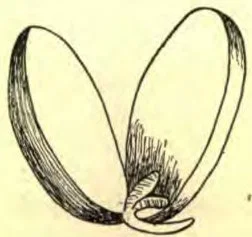
But why do the young birds thus congregate? What motive draws them together? It can not be that they are afraid of the dark. Why, then, does not each one sleep on its own feeding-grounds, alone, or with a few neighbors for company? Why fly two or three miles, twice a day, simply to pass the night in a common roost? I can give no answer, only to say that it is probably their love of society that brings them together in this manner each night.
And this is not so strange an explanation. Sociability is a common mark throughout nature. The family, which is but one aspect of the social instinct, is not by any means confined to the human race, but is to be met with everywhere throughout the animal kingdom. Even the plants produce seed, in the greater number of instances, by cross-fertilization, the pollen of one plant fertilizing the anthers of the other.
The only explanation of the fact that there is a universe, the only explanation we can give for the fact that there is anything outside of God himself, lies in this—that God himself is governed by this same great law of associating others with himself. And thus he has bound up the world and the universe into one associated whole. As in the human body we have the sympathetic system, which puts all parts of the body in touch, so that if one member suffers, the others suffer with it, so in the world of nature, each part is co-ordinated with every other part. We can not wantonly destroy the birds without increasing the bugs and worms, and thus decreasing the amount of food we otherwise should have. Similarly, no man can live an evil life, and prevent the retribution which shall thereby be visited upon him; and he can not so live without leaving about him an influence that mars and destroys. On the other hand, no man can live a good life but the world shall be made the better for it.
The birds associate for help and protection. Men sometimes associate for that which will leave them none the better, and often much the worse. Here, again, we can learn a lesson from the birds. To have our hearts as light as those of the birds, to have our associations as pure as theirs, we must live a life as true as theirs.
“Then let your secret thoughts be fair— They have a vital part and share In shaping worlds and molding fate; God’s system is so intricate.”
L. A. REED.

EXPERIENCES WITH “HUMMERS”.

Did you ever hold a live humming-bird in your hand? Well, I have held several of the wee, wee creatures. Did you ever look into a humming-bird’s nest? Well, I have peeped into several of the tiny, downy affairs.
Two of the nests contained young birds. The eggs were as small as an ordinary garden pea—perfectly egg-shaped. Can I describe the young of the humming-bird?—No; impossible. I can only say that they are the smallest bird creatures I ever saw in my life.
How did I contrive to get hold of a live humming-bird?—One hot afternoon in June I was sitting in a garden reading. A few yards away stood a large bunch of brilliant carnations. Now if there is anything on which a hummer dotes, it is pinks. Suddenly I heard a loud hum near by. I looked toward the carnations, and, sure enough, there were two humming-birds hovering over the flowers.
I watched their movements for several minutes with great interest. Presently I observed that one of the birds appeared to be entangled. Its tongue, or long, needle-like beak, was caught in some manner in the petals of a large pink. The little fellow kept fluttering around in a helpless way, but could not liberate itself.
Instantly I dropped the book, and ran over to the bed. The other humming-bird darted away like a shot. I very softly took the tiny prisoner in my hand, and then gently liberated it. For half a minute or more I held the trembling, fluttering creature in my hand. I wish I could describe the beauty and brilliancy of its plumage. Silk, velvet, and the delicate tints of the rainbow are the only adequate words. Finally I released the prisoner. In a flash he was out of sight.
One good fright was enough. Neither bird ever came back to the carnations again, at least not that season.
On another occasion I was out in an orchard. I noticed two humming-birds flying around a certain apple-tree limb. As I approached, they became more excited. When within a few yards of the tree, I noticed a young bird sitting on a nest. He was almost grown. Not wishing to frighten the little chap, I stopped abruptly. But he darted away. However, his wings were too weak for sustained flight, even of so small a body, and down he sank fluttering, falling into a big tuft of tall grass.
He was perfectly helpless, so I very tenderly picked him up, and placed him back on the nest. To my surprise and amusement he did not attempt to escape, but stood up boldly, and looked at me in a saucy, defiant way. The parent birds were buzzing around me like angry bees; but when they saw that I did not harm their offspring, they both alighted near the nest.
A large clump of wild currants stood in one corner of the yard. I noticed two humming-birds almost constantly hovering around the bush among the yellow flowers.
I went out one afternoon, and secreted myself in the clump, in order to observe more closely the actions and peculiarities of the birds. One was the largest humming-bird I had ever seen, and its plumage was simply gorgeous.
Soon the birds came around, but they did not seem in the least alarmed by my presence. The larger one came very near, and actually flew against my face. Holding up my hand, the bird flew straight into it. I instantly closed my fingers, and held him a prisoner. His plumage was brilliant beyond description. As the beautiful captive did not seem to resent my familiarity, I examined his coat carefully before giving him his freedom.
I had still another experience with a hummer. On a bright summer day one flew through an open door into a room where I was sitting. Quick as a flash the bird discovered its mistake. It dashed against a window-pane with all its might, and dropped on the floor. I hastily picked it up. It seemed quite dead. But as I held it in my open hand, silently sympathizing over its fate, the bird suddenly revived, and flitted out through the open door before I could wink.—J. Mayne 'Baltimore, in Birds and All Nature.

LIVING FOR CHRIST

It is a solemn thing to live, because we are not our own, but the Lord’s, bought with the blood of his only begotten Son. Think of the estimate God has placed on us! When we were ready to perish, he sent his Son to die for us, that we might have an opportunity to regain what has been lost by sin. “God so loved the world, that he gave his only begotten Son, that whosoever believeth in him should not perish, but have everlasting life.” This infinite sacrifice connects us with God. Satan can not hold us if we will accept Christ as our hope, our life, our personal Saviour. The spotless, sinless Son of God has borne our sins in his own body on the cross, that we might live unto God. When we truly receive Christ, we live his life, not our own. Our highest aim is to do his will, and represent his character.
Christ bore our sins that we might live unto righteousness. We were as sheep going astray, but he came from the heavenly courts to bring us back to the fold.
He died to make it possible for us to keep the law. But all are left to make their choice for themselves. God forces no one to accept the advantages secured for him at an infinite cost.
A large number of God’s subjects have taken their position under the banner of rebellion; but God has not treated them as they deserve. They have declared of Christ, “We will not have this man to reign over us;” but the Lord’s hand of love is stretched out still. Men have become bondmen of Satan, but the Lord is entreating them to enlist in his army.
Christ lived on this earth the life he desires his disciples to live,—a life of unselfish service. Let his children remember that he has a work for each one of them to do. He has given them talents, which they are to hold and use for him. But do we appreciate the privilege thus placed within our reach for blessing those around us? Do we use our talents to the best advantage? Are not many of us asleep, doing nothing to save our fellow men? Is not the Bible, God’s great text-book of education, superficially read, and therefore superficially understood and superficially practiced?
Time is fast passing. Let us remember that while life is ours, we are under the solemn responsibility of working for God. Let us throw aside our narrow, selfish plans, and do our very best to accomplish the work God desires to have accomplished. Let us give the invitation, “Ho, every one that thirsteth, come ye to the waters, and he that hath no money; come ye, buy, and eat; yea, come, buy wine and milk without money and without price.” Let us think of the sacrifice Jesus made to obtain our redemption. Let us study how we can most intelligently work for him. We have been bought with a price; therefore let us do all in our power to glorify him who has purchased us. God calls upon us to go to those in error, and point them to the right way. It is not only the ordained ministers who are to do this work. Ministering angels will co-operate with all who will labor unselfishly for the Master.
MRS. E. G. WHITE.

THE STORY OF AN AMBITION

He was called Bartholomew Beals, or “Bardy” Beals. He was a bookkeeper, and used to live in Ashleyville. He happened to read, one day, that Lincoln and Horace Greeley and several other celebrities had picked up most of their learning by using the odds and ends of time for reading and studying, and he thought it a fine idea.
Soon after this he ran across another article, which stated that Grote, the famous English historian was a banker by occupation, who conducted all his historical study out of bank hours.
“Splendid!” thought Bardy. Why, he had been fond of history himself, in school! He went to work at eight o’clock, had an hour’s nooning, and stopped work at five. Doubtless he had more time of his own than most of those other men had had. Yes, he would study history. He might be the subject of a magazine article himself in a few years.
One noon Bardy went down-town and bought the Chautauqua Course Greek history, looked it over that evening, was pleased with it, and put it in his bookcase, saying, “I’ll read that all through some evening when I feel like it.”
The next noon he bought “Pictures from English History,” spent another delightful evening skimming it through, and put it on his shelf beside the Greek history, remarking to himself that he would certainly read the “Pictures” more carefully some morning, when he was fresh and felt like it.
He began to feel very learned now. He bought Liddell’s “History of Rome,” and rather looked down on people who had no taste for such things.
At birthday time Bardy’s mother gave him Ridpath’s “American History” for a present. She was so proud that her boy loved history, the dear, believing mother! Bardy was greatly pleased with his gift, and set it up on his shelf with a fresh determination to try to get about reading some of those books. They did look attractive there in the case, and so scholarly!
By Christmas time most of Bardy’s friends and relatives had heard what a devoted historian he had become, and some of them set about encouraging such a desirable predilection. The brothers and sisters “clubbed together,” and bought him a ten-volume set of Gibbon; a cousin sent him a Green’s “Shorter History;” his father gave him a “Compendium of Universal History;” and his Bible-class teacher presented him with a copy of Carlyle’s “French Revolution.”
He had quite a library now. His mother was very careful about dusting the books; but after a while she began to suggest, very gently, “Bardy, dear, don’t you think you ought to begin to read your histories a little bit?”
And Bardy would answer, cheerfully, “O, yes, mother, I’m going to. I haven’t just felt like it yet, but I shall. You’ll see.”
That was twenty years ago. Bardy has that historical library yet. And Bardy knows just as much history as he did twenty years ago. At least, he does not know any more. For the time never came when he felt precisely like reading history, and he never thought he could read it if he did not feel like it.
He was always too tired or too busy or too something, and there were always such a lot of the popular new books around that he somehow got in the way of reading them instead.
Then mornings and evenings the other men on the train were reading the daily papers, and he would look peculiar reading history; and at noon a man likes to loaf a little, and look into the shops after lunch. It rests his mind.
Perhaps Bardy had never happened to hear that aphorism of the Southern preacher: “Anybody can do a thing he feels like doing, but it takes a true man to do a thing when he doesn’t feel like doing it.”—Selected.

TALKS WITH OUR BOYS

To the boys who have decided to use all their powers, all their time, and all their opportunities to the best possible advantage, and to make of themselves all that God would have them be, I wish to whisper a secret: To carry out your decision will require long and persevering effort, and many times you will feel like giving up. You will meet plenty of people who will be ready to discourage you, and make light of your efforts; therefore it is better to say little about your intentions, especially to any but those who are sure to be a help to you. In general I would say, Don’t tell such things without a good reason for so doing. It is always safe to confide in father and mother, and best of all, to tell your Saviour all your desires. If you make him your confidant, you will find that when the dark times come, you can go to him, and he will have help for you.
Have you noticed that some people never undertake anything without telling every one they know all about their plans, and not only so, but boasting as if they had already proved a success? This makes failure harder to bear—and such people usually fail.
Sometimes in the summer we see rising a cloud that looks as black as ink. It rolls and foams and rushes on at a mad rate. For a while everything is rattle, bluster, and flurry, but there are seldom more than a few drops of rain; even if rain does fall, it often does more injury than good. But when we see a cloud that hangs low in the west, and pushes up slowly, gradually covering the whole heavens, heavy with its freight of blessing, we expect a gentle rain, and plenty of it. Such rain is a real blessing.
So don’t be in too great a hurry to tell what you intend to learn, or even what you know after you have learned it. The power of an engine lies not in the steam it has given off, but in the supply yet in the boiler. When you have something of real value, something that will be a blessing to others, God will give you the opportunity to impart it. And don’t fail to use it then: that would be as great a mistake as to talk too much, or to become puffed up with little learning.
Don’t be in too great a hurry to attempt to do things, especially before the public. First be sure that you can do well what you wish to do. So many people are trying to gain the attention of the public, only to prove dismal failures, that it is a relief to see some one who is a worker, and yet who is not obtrusive. The world is always looking for men of real worth; there is little fear that such will be overlooked long.
To sum up, I would say: Set your aim high; go to work to reach it; and make some progress every day. Lose no time, neglect no opportunity, but say little or nothing about what you are doing.
FLOYD BRALLIAR.

THY FATHER CALLS

WANDERER! wanderer! turn thee again! Wander not farther in byways of sin. Over the hills and the valleys why stray Ever with strangers, and farther away?
Lonely, so lonely, so hungry at heart, Ever unsatisfied, roving thou art. Listen! — so far away — what sweet sound falls? Gladness! — but list! ’tis thy Father who calls!
Hasten o’er rocks, O so rugged! to go Homeward, now homeward,— he loveth thee so! Tarry not! tarry not! will not your choice Lead thee to follow that sweet, wooing voice?
Prodigal, listen! “Come back, O my child! Wander not farther in deserts so wild!” Feastings await thee; the angels will sing Jubilant anthems of peace to their King.
Listen! far off o’er the hills and the dells Hear the sweet voice—in thy spirit it dwells; Will thy sad heart to its pleadings be dumb? ’Tis the grieved voice of his love crying, “Come!”
B. F. M. Sours.

GENERAL CHARACTERISTICS OF FLOWERING PLANTS
The vegetable kingdom has been divided by botanists into six distinct branches, beginning with plants of the most simple structure, and ending with those that are most complicated. In our present study, it is the last branch that we have to deal with. This includes about three fourths of all plant life, and almost all those plants that are of any special economic importance.
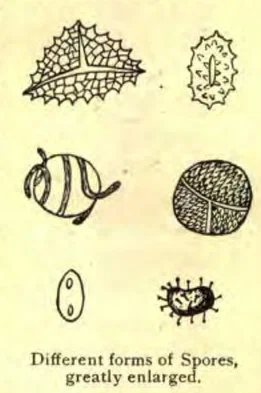
Different forms of Spores, greatly enlarged.
11. This branch is called Sper-moph'y-ta or Phae"no-ga'mi-a, sper-mophyta meaning “plants that bear seeds,” and phænogamia “plants that bear flowers.” These two characteristics distinguish them from all other forms of vegetable life. None of the other plants have flowers or true seeds.
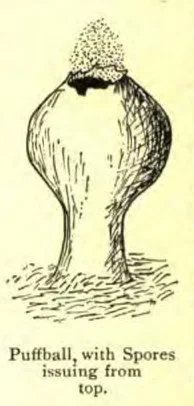
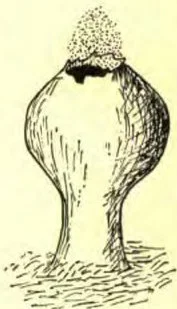
Puffball, with Spores issuing from top.
12. The lower forms of vegetable life are propagated by spores, which are often produced in immense numbers. Spores are special reproductive cells which, after separation from the parent body, will, under favorable conditions, develop into new organisms. They are usually microscopic in size, and in quantity appear as fine dust. The fine powder from the puffball is made up entirely of spores.
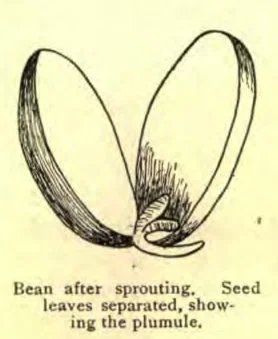
13. Seeds, on the other hand, are not simple cells, but complex structures made up of many cells. A seed consists of a plantlet surrounded with a protective covering, with a supply of food material stored up either in the plantlet itself, or deposited beside or around it. In the bean this food material is stored up in the thickened seed leaves of the plant; while in Indian corn the little plantlet occupies only a small portion of the seed. Upon this stored-up food the plant must live until it has developed roots and leaves sufficient to enable it to take nourishment from the soil and the air.
Bean after sprouting. Seed leaves separated, showing the plumule.
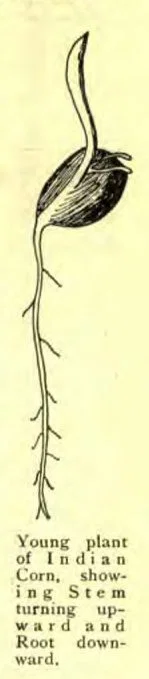
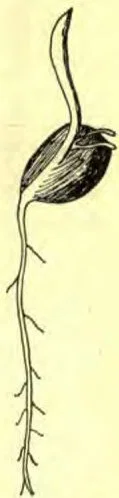
Young plant of Indian Corn, showing stem turning upward and Root downward.
14. When placed under favorable conditions, as in moist, warm soil, or in water that is not too cold, the seed absorbs a portion of the moisture; this causes it to swell, and burst its protective covering, so that the young plantlet, or embryo, is set free to continue its growth until it reaches maturity. In whatever position the seed may be planted, as soon as germination takes place, the root-end of the embryo, usually called the “caulicle,” always turns downward, giving off roots, which fasten it firmly to the soil, and at the same time furnish channels through which nourishment is absorbed, to be carried to all parts of the plant. The opposite, or stem, end always turns upward, and gets into the light as soon as possible. Continuing to grow, it gives off leaves and branches at the proper places, until the plant has reached its full development.
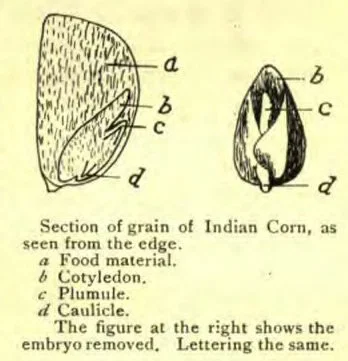
Section of grain of Indian Corn, as seen from the edge.
a Food material.
b Cotyledon.
c Plumule.
d Caulicle.
The figure at the right shows the embryo removed. Lettering the same.
Section of grain of Indian Corn, as seen from the edge. a Food material. b Cotyledon. c Plumule. d Caulicle. The figure at the right shows the embryo removed. Lettering the same.
15. We may well ask, in wonder, Does the little plant never make a mistake, and send its roots upward and its stem downward? How does it know which way to find the light? —No; it never makes a mistake; for it is directed by Him who does not make mistakes, but does all things well. The embryonic plantlet, inclosed within its prison-house, and buried beneath the soil, where not a ray of light penetrates the darkness, obeys the voice of its Maker, and at his bidding comes forth to the light to fulfill the purposes for which it was called into existence. What a lesson for man who, in his blindness and foolishness, loves darkness rather than light!
16. All the flowering plants are constructed on one general plan, or type, so that the parts of one plant correspond to the parts of every other. All have root, stem, and leaf, which may be either simple or branched. In most cases they also bear flowers and seeds, though the flowers may not be produced each year. The century plant, for example, blossoms only once in about a hundred years.
17. Of all these parts, root, stem, leaf, flower, and seed, there are many different forms and sizes in the different species of plants, each form having its own particular name. These various forms, together with their names, will receive further consideration when we come to a more definite study of individual plants.
18. The flowering plants have been divided into a large number of natural orders, or families. Some of these orders contain plants of great economic importance, including our common grains, vegetables, and trees, of field, garden, orchard, and forest. In our future studies we will consider the chief characteristics of the more important of these orders, and under each order the life, history, habits, and uses of representative species.
B. E. Crawford.
Continue reading: Counting Kindness: A Cheerful Way to Live