Your ShelfYour Projects

Review and Herald, Vol. 89, No. 28.

Prayer
Earlier text: An Ancient Evil

A Wave of Degeneracy

THE following striking statement appeared in the Sentinel, of Jamestown, N. Y., dated June 20:—
A wave of degeneracy is sweeping the land, a degeneracy so appalling in magnitude that it staggers the mind and threatens to destroy this republic, numbering more victims than have been slain in all the wars and in all the epidemics of acute diseases that have swept the country within two hundred years.
Following this statement, the author calls attention to the marked difference between the way in which men deal with disease and the plague and the way in which they deal with alcohol. A war is waged against the lesser evil and the greater is licensed to operate as a legitimate business.

Emmanuel Mission, Basutoland

H. C. OLMSTEAD
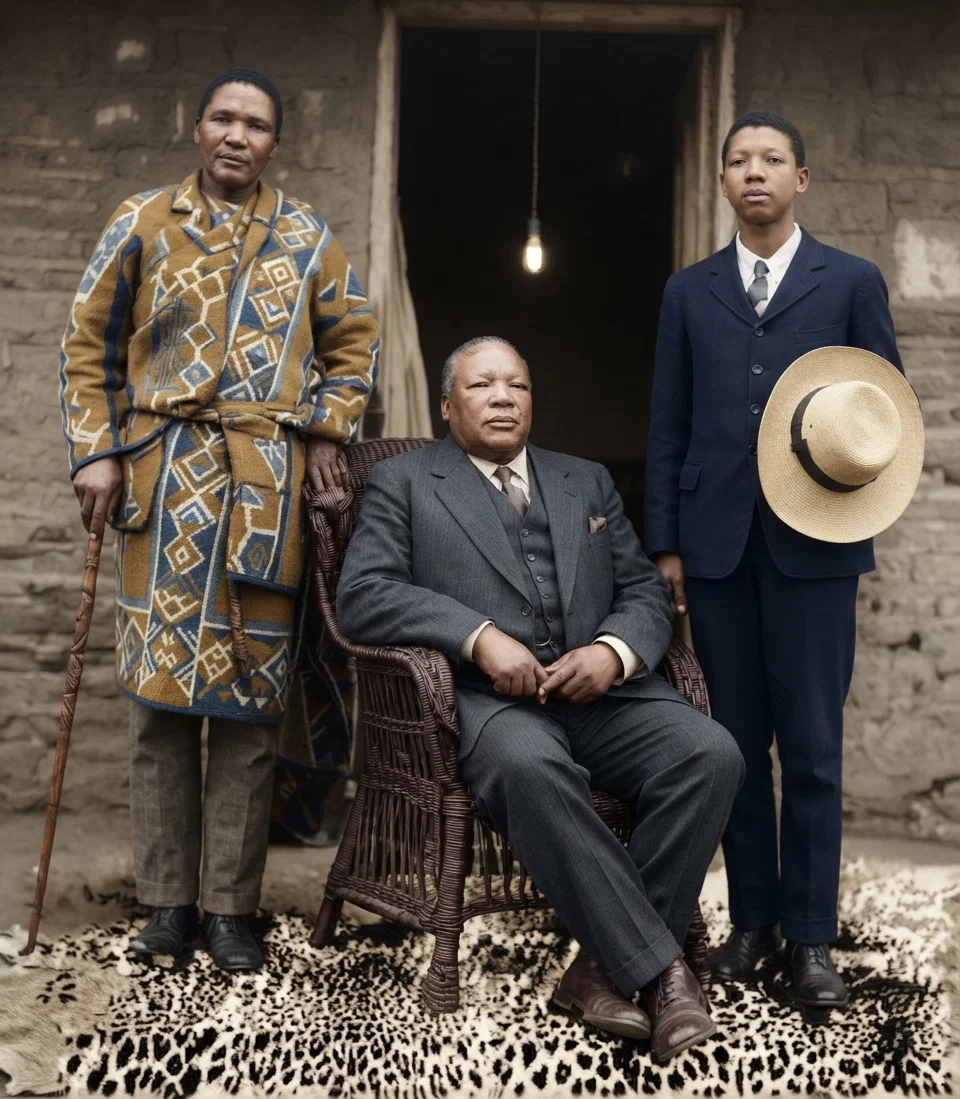
It has now been a year and nine months since Chief Jonathan gave us the site for this mission station. During this time we have had abundant evidence that the mission's name is true. When a fence was being made around the place, a petty chief tried to cut back the bounds; but God so overruled that Jonathan gave us even more land, and the petty chief also remained friendly. As frost had destroyed all peaches near us, so that none could be purchased from the natives, the big chief sent a number of basketfuls from his orchard. He also has freely given a pony to use for the keeping, and as the mission has no milch-cows, he supplies us with a little milk each day. But it is in the daily work and plans that we especially see God's leading and overruling hand. This gives us courage and confidence to push forward.
The Holy Spirit has witnessed in the meetings held each Sabbath and Sunday. Several are taking Bible studies, and are walking in the light as far as they know. The husband and the mother-in-law of one of these raised so much opposition that she declared she was treated as a stranger in her own village. Her former friends refused to speak to her, yet she still has a desire to obey God. As missionaries have been numerous in the little native country of Basutoland for sixty years, all have heard the gospel story. Yet we know that with God's blessing, his special message for this time will convert even hardened heathen.
Many have come with all manner of ailments for treatment and medicine. Common among these are the syphilitic sores which affect such a large per cent of the African natives. Then there are many cases of lung and throat diseases, caused largely by the people's always sleeping with the head completely covered by their blankets, and with their small huts sealed as tightly as possible. Tuberculosis is killing thousands. Again, the Basutos suffer much from stomach and bowel disorders. This is not surprising, as the principal food of adults is leting (light beer) and joala (strong beer), both made by fermenting Kafir-corn. Indeed, many men eat little other nourishment for weeks at a time. Even the infants are forced to drink a coarse, thin porridge, which has been barely boiled.
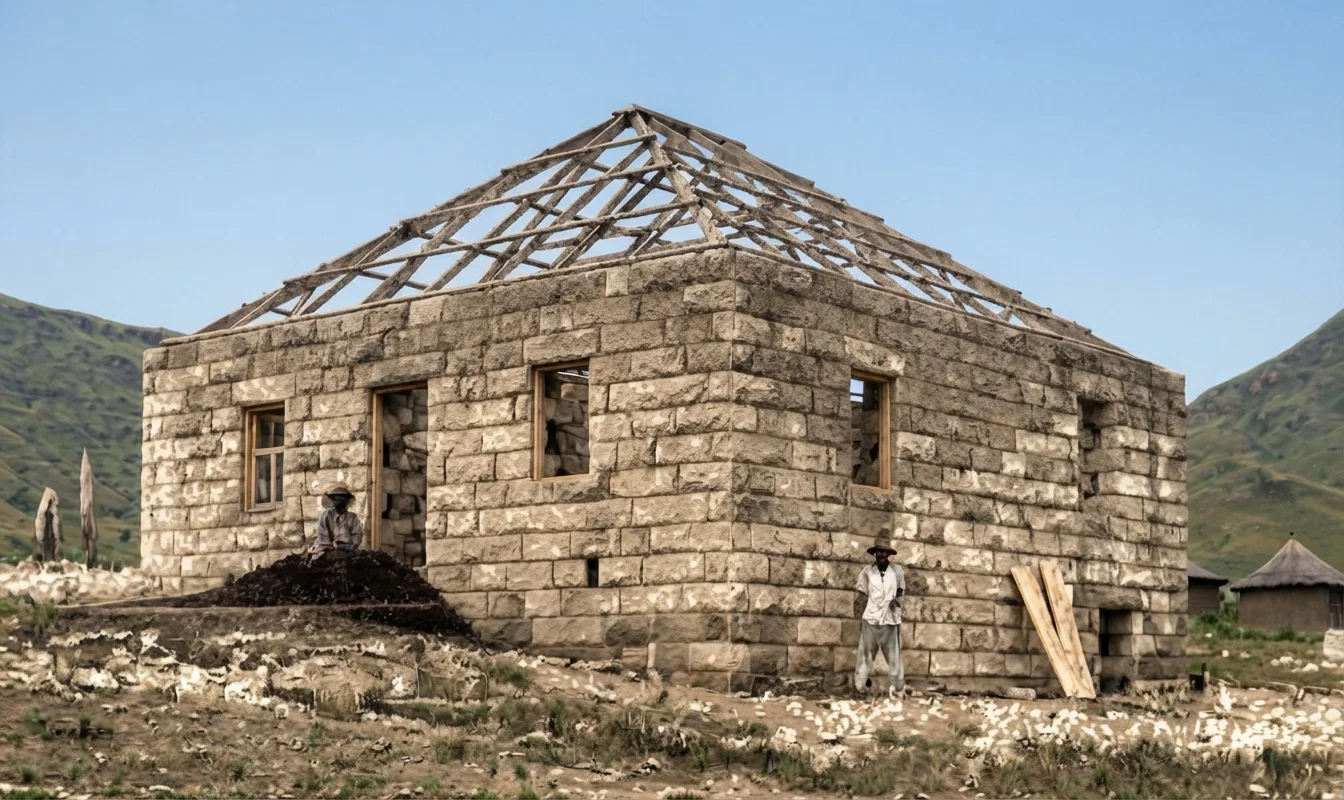
NEW MISSION HOUSE, EMMANUEL MISSION, NEARLY COMPLETED
The little mission farm has yielded its first crop of mealies (maize), Kafir-corn, oat forage, and potatoes. These crops enable us to avoid heavy running expenses, and furnish a little income. Later, fruit-trees and vines which have been planted will materially help in this respect.
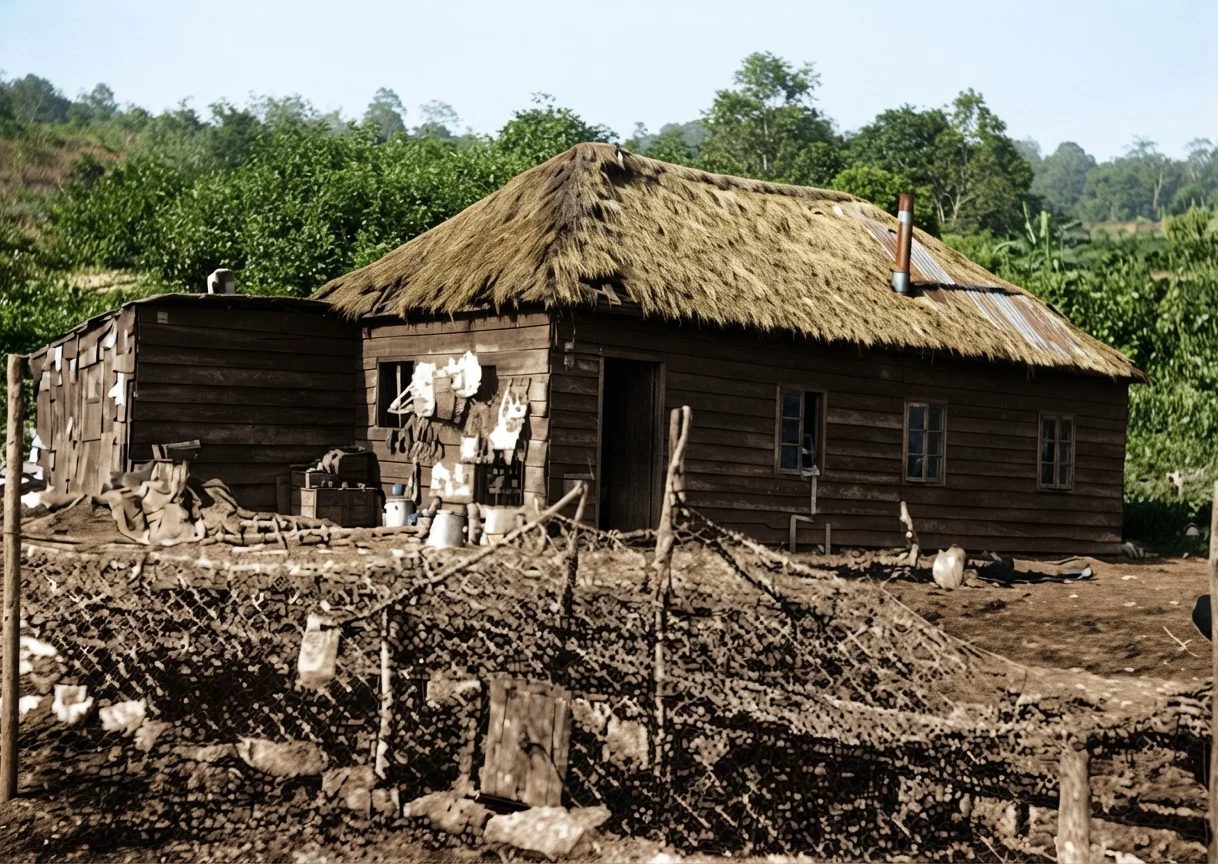
A good stone house is nearing completion, and one for the native helper is being built. Work has also been started on a stone schoolhouse and stable. As is the rule on new stations, a number of temporary huts answer the purpose of dwellings, storerooms, and students' quarters, while more permanent buildings are being erected. We are now living in half of the new stone house, and it does seem good.
Much of our time thus far has been spent in temporal work, building up a good home base. But now as these things begin to take shape, we are turning our attention more and more to evangelistic work. A wagon and lantern have been ordered to aid in this. The many signs of our Lord's soon return urge us to work with zeal that this land may be warned before his coming.
CHIEF JONATHAN (SEATED) AND TWO ASSOCIATE CHIEFS
Leribe.

In Jesus

THERE is gladness all the way Walking with Jesus; There is beauty all the day, Looking at Jesus.
There is solace for the heart, Trusting in Jesus; Healing for each earth-made smart, Simply in Jesus.
There is shelter from the storm, Hiding in Jesus; There is friendship true and warm Ever in Jesus.
There is rest for weary feet, Leaning on Jesus; There's communion glad and sweet, Dwelling with Jesus.
There is grace for all who seek, Asking of Jesus; Strength for weakest of the weak, Hidden in Jesus.
There is wisdom for the mind, Given by Jesus; There's salvation none may find Saving in Jesus.
There is victory over strife Promised in Jesus; Then an everlasting life, Simply through Jesus.
Hinsdale, Ill.

Brazilian Union and Santa Catharina Conferences

F. W. SPIES
IN order to reach Blumenau, Brazil, in time for the opening of the second session of the Brazilian Union Conference, it was necessary for us to leave the Rio Grande do Sul conference before its close. We accordingly embarked for Santa Catharina on March 30. Inasmuch as we lost two days on our journey on account of bad weather, we did not arrive at Blumenau until April 6. We were glad, however, to find almost all of the union delegates and workers at Blumenau upon our arrival, so we could spend three full days in a workers' meeting, which was certainly a privilege and a blessing.
The principal instruction of the workers' institute was given by Elders W. A. Spicer and J. W. Westphal. This instruction was timely and of such a character as to help the workers to get a better idea and appreciation of their work than they had ever had before.
April 9 the second session of the Brazilian Union conference opened, and on the tenth the Santa Catharina local conference opened its seventh session, both of which were conducted at the same time.
These meetings were also a great blessing to the brethren and sisters, for the clear and definite instruction given by Elder Spicer on our message could not but strengthen the faith of the brethren in this work, and also convince them that the time of final reward is approaching.
It was encouraging indeed to hear what progress the message is making in some of the fields, both financially and numerically, and as those fields which in the past have been suffering for lack of leaders now advance, we believe there will be a general forward movement all along the line. The evening meetings were well attended by the people of Blumenau, who came each evening to listen to the words of life. As all the workers return to their fields we can but pray the Lord to bless them and make them a blessing during the coming year.

Malacca, Straits Settlements

G. F. JONES
MALACCA dates its history from about the year 1377. In the year 1360 some Malays from Palembang in Sumatra settled in Singapore. In 1377 the Javanese invaded Singapore, and the Malays fled to Malacca, drove out the Negritos, or aborigines, and founded the kingdom of Malacca, so that by the year 1405 they had become a strong nation. Envoys were then sent to China, and were recognized by that nation.
In those days the nations of the East regarded China just as they regard Europe in these days. Malacca was not disturbed again until the year 1509, when the Portuguese, for the first time, made their appearance in the Straits; but this first attack on Malacca and the Malays failed. Later, in 1511 Affonso de Albuquerque, the great viceroy of India made a successful attack, and routed the Malays out of every settlement, compelling them to shift up and down the peninsula. The Portuguese then controlled all the Malay Peninsula Straits and its trade. In 1641 Malacca fell into the hands of the Dutch, and the Portuguese had to go. The Dutch placed as governor a gentleman by the name of Westerhout, of a distinguished family, of whom there are now many descendants in the Straits Settlements. In 1826 the British came into possession of everything. Peace, prosperity, education, and liberty have followed in the wake of British rule, so that now Malacca is fast becoming a rich country.
In the beginning of the nineteenth century Dr. Milne came. He had found no liberty in China to put religious work into print, so he started a China mission printing establishment and mission work in Malacca. Here was the first native convert of the Straits Settlements. Three of Dr. Milne's granddaughters accepted present truth. Two of them were recently baptized, and are now members of the Seventh-day Adventist Church of Singapore. The other granddaughter recently died. The mission building and home used by Dr. Milne was bought by the Westerhout family, the descendants of the first Dutch governor. The materials and timber of this house, most of which were hard wood or teak, were used to build the Westerhout home in the town of Malacca.
A few weeks ago, in company with a member of this family, my wife and I disembarked from a small coasting steamer which had arrived from Singapore just before daylight. We landed in a native boat, possibly on the very spot where the celebrated Affonso de Albuquerque and his men landed in the year 1511; and where later the Dutch landed, and ascending the hill that immediately rises from the water's edge, attacked the fort and captured it. On the hill stood a cathedral, and connected with it were secret passages and chambers. On the approach of the Dutch the monks caused these passages to be blocked by the falling in of earth, and it is believed by some that there are many treasures hidden under that historical hill.
FIRST EMMANUEL MISSION HOME
We ascended this hill just as the sun was rising above the horizon, and entered the old cathedral, whose walls are as good as they were four hundred years ago. The first thing we saw was a large tomb. The inscription on it in Dutch was defaced with age, but we managed to make out the names of several of the Westerhout family. This tomb is probably two hundred fifty years old. We next entered a side chamber, where the body of Francis Xavier lay until its removal to India. At the foot of the hill on the farther side, is a small, but ancient cemetery where some of the first British residents, and army and naval officers are buried. Here also is the tomb of the Milne family. While standing by the tomb of these Protestant pioneer missionaries of the Far East, our feelings were stirred as we thought of the hardships they endured in those days and their willingness to deny self for the gospel's sake. Erelong this tomb will be rent asunder, and those in it will come forth at the voice of their Master and the sound of the great trumpet.
However, our object in coming to Malacca was not sightseeing, but to visit an estate belonging to Brother Westerhout, where a training-school may be established for the purpose of fitting young people to carry the threefold message quickly to every tribe and people in Malaysia. Concerning this enterprise I hope later to be able to write more definitely.
Singapore.

Dying Beneath the Gods in Whom They Have Trusted

MRS. J. B. COCHRAN wrote the following touching scene, during the recent famine in China:—
"The temple of the city god, right under our windows, a stone's throw from our veranda, raises its rugged walls and picturesque, curved roofs with as stanch a face to the world as it has shown for all these long centuries past; and the old city god himself sits stolidly on his throne and smiles calmly and benignly down, untouched, though his people, hundreds of them, are starving and dying before his face, and his temple has become indeed 'the city of dreadful night.'
"There are huddled there in that old temple, homeless and starving, professional beggars, with their masses of tatters, and conventional cracked bowl and staff; people from the city whose homes have been chopped up and sold for kindling-wood to buy bread; decent country people, with their little wailing children, who have wandered in, in a forlorn hope, rather than sit quietly and starve at home; parents who have seen their children, one after the other, starve and die; children left behind when the parents, having given them their last bite, staggered and fell; they were all there, and the old idol smiles benignly down on all these his children.
"A few nights ago a family—there were five left—gave up hope, and in one corner of this 'city of dreadful night' the father strangled his three children, and then he and the mother hanged themselves. A strange sight this for the city god to smile upon when the sun struggled in and showed it the next morning.
"Two days ago, kind Mr. Liu, going about with bread, said to Mr. Chen, 'We will wait till about ten o'clock in the morning; then all who are able will have crawled out to beg.' At ten o'clock, when they entered the temple, they found twenty-eight men, women, and little children too weak to move, lying prostrate, perforce, before the placid face of their god. The two Christians, sick with pity, gave them food; but when they came again next morning, six, too far gone to take the food even when it came, had died. "Each morning, long before daylight, these two good men take out what money we can all give (for we ourselves being foreigners and marked men, dare not give a cent, for fear of mobs) and distribute it in coin and food to those who are, as Mr. Liu says, 'about to die.' As these two Christians enter the temple, the gaunt, wretched figures rise up from all the shadows, and crowd and snatch like crazy things for the food they are trying to give out. Once Mr. Liu held out a bit of bean-cake to a man who stood swaying as he waited; but the crowd cried out, 'Too late,' as the man, his hand still outstretched, staggered and fell dead.
" 'They die there,' said Mr. Liu, 'almost every night. Sometimes only one or two, sometimes, if the night has been bitterly cold, many more, frozen or starved to death.'
" 'O God, pity them! these dwellers in 'the city of dreadful night.' For hundreds, yes, hundreds of thousands of them are starving and dying before their idol's benign smiling face and placidly folded hands.'"

India

C. E. WEEKS
THE work in the India Union Mission field is onward. It has been my privilege during the last few months to visit every station, with two exceptions, in the union field, and to see some of the great things God is doing in preparing the way to finish quickly the work in heathen India. At times as we see how slowly things move in these Eastern lands, we are almost led to ask ourselves the question, How can this work be finished here in the time allotted by God for its completion? But when Jesus made the promise that the gospel would be preached as a witness in all the world, and that the end would come in this generation, he was speaking directly to Eastern minds, surrounded by Eastern conditions and influences. That promise holds good, and we can see how wonderfully it is being fulfilled in all the world to-day.

South India

Leaving Mussoorie the first of last October, I spent several weeks in south India and Ceylon. The work at our Tinnevelli stations, among those known to the REVIEW readers as the Tamil Sabbath-keepers, is advancing encouragingly. Elder J. S. James and his associates have been laboring hard, and a good work has been done. The evangelical, educational, and medical branches are all well represented, thus giving a good foundation upon which to build. In the past, owing to a lack of proper men, we have not done a great deal in the canvassing work in that section, but steps have now been taken to give this work the prominence that its importance demands. It is planned to start a quarterly journal in the Tamil language for the use of our colporteurs. The school at our main station has more than one hundred young people in attendance, among whom are quite a number who are children of Adventist parents. As in the home land, I believe that many will go out from this school to scatter the printed page of truth among the millions of south India.

Ceylon

While we have no regular work established on the island of Ceylon, much seed has been sown. During the last year Brother Raymond has gone to all parts of the island selling our literature, having sold more than two thousand rupees [about $670] worth in five months. Ceylon is the most beautiful place I ever saw. Although it is so near the equator, a delightful sea breeze is generally blowing, which makes the climate much more temperate than it is in many parts of India. Then there are a number of delightful hill stations, which afford a climate unexcelled in the tropics.
Yet most of the 4,000,000 people of that beautiful isle are still bowing to gods of "wood and stone," knowing nothing of the soon coming of the One who died to redeem them. How much longer must these millions wait for a representative of the third angel's message to locate among them?

Bengal

During the early part of December, in connection with our Bengal conference held in the city of Calcutta, we conducted our first canvassers' institute for India. Our work in India was first opened in Bengal, so we have the strongest work developed in that section of the field. A monthly journal, Signs of the Times, is being issued in the Bengali language, and we have ten or twelve colporteurs giving their time quite largely to its circulation. At the time of our institute, we were sending out from fifteen hundred to two thousand copies of this paper monthly. We all felt that during the year 1912 this number should be greatly increased, so we decided to endeavor to raise the circulation to five thousand by the time of our general meeting, to be held this coming fall. For the present month (April) we have sent out forty-five hundred copies, so we believe that we shall pass the mark set. This monthly journal, filled with the message of Christ's soon coming, should take a prominent part in giving the glad tidings to the 78,000,000 of the Bengal division of this union mission field.

Burma

From the middle of December until the middle of February I was in the interesting land of Burma. Although that is part of British India, it is very different in many ways from India proper. The people are more of a Mongolian type, and everything has more of a Western air. Though the Burmese is a care-free man of leisure, little thinking of to-morrow and its needs, his wife makes up for his lack in shrewdness and business ability—quite different from India, where the women of the better classes are kept in seclusion. The per cent of literacy is very high for the East, over thirty per cent being able to read. Money is also quite plentiful. These conditions make it a fruitful field for the sale of our literature. One day during our Burmese conference, twelve of us went out into the city of Rangoon with our Burmese tract "Signs of the Times and End of the World," and in about three hours between meetings, we sold over six hundred copies. Here, as in all parts of the world, thousands are willing and glad to purchase our literature if we will only do our part to give them the opportunity. Steps were taken to start a quarterly journal in the Burmese language, and the first number will soon be ready.
Having so many languages—one hundred forty-seven—to contend with, the literature question is a great problem; but the Lord is going before us, and is giving victory in our efforts to get the printed message before the 315,000,000 of this land. Pray and give for India.

Egypt

EGYPT! what memories the name awakens in the minds of all familiar with the Bible story! The bondage of Israel, and their wonderful deliverance; the miracles wrought and the plagues sent by God before Pharaoh would let Israel go; the crossing of the Red Sea and the overthrow of the Egyptian hosts,—all these have made Egypt one of the foremost of Bible lands, and has given her a spiritual significance equal to that of the land of Palestine. Egypt is, and ever has been, the type of that spiritual bondage and darkness from which the people of God are called to the inheritance of the heavenly Canaan. This spiritual meaning of Egypt is spoken of in the New Testament in Rev. 11:8.
But this is not the only connection that Egypt has had with the people of God. Here it was that the children of the promise "increased abundantly, and multiplied, and waxed exceeding mighty." Here also the Son of God found a refuge, and dwelt in safety when his enemies were seeking his life.
Egypt is still the land of bondage and darkness and oppression. It is also a place where, by the power of God, children of the promise may be multiplied. If the light of the glorious gospel of Christ be allowed to shine, the darkness will not overcome it.
We are glad to report that this has been proved to be true. Egyptians have taken hold of the truth and have shown themselves willing to suffer for it. They, like the people of all other lands, rejoice when the light of truth shines into their hearts. At the beginning of this year we were called to visit individuals who for a long time had been anxious to find messengers of present truth. When we arrived, one man embraced us, thanking God that he had been permitted to see us. Then, sitting on the ground at our feet, he did not wish any one to speak, or disturb him. He felt, he said, that his pleasure was too great for words, and so he had no mind to speak or to hear, but only to sit and feel thankful to God.
Thus we see that God has children in Egypt who long for the truth. We labor in hope, for God has promised to call them out. Isa. 11:11.
Akhmim.

The Requirements

If I am weak, and you are strong, Why then, why then, To you the braver deeds belong. And so, again, If you have gifts and I have none; If I have shade and you have sun, 'Tis yours with freer hand to give, 'Tis yours with truer grace to live, Than I who giftless, sunless, stand, With barren life and hand.
We do not ask the little brook To turn the wheel; Unto the larger stream we look. The strength of steel We do not ask of silken bands, Nor heart of oak in willow wands. We do not ask the wren to go Up to the heights the eagles know, Nor yet expect the lark's clear note From out the dove's dumb throat.
'Tis wisdom's law, the perfect code, By love inspired: Of him on whom much is bestowed, Is much required. The tuneful throat is bid to sing; The oak must reign the forest's king; The rushing stream the wheel must move; The beaten steel its strength must prove; 'Tis given unto the eagle's eyes To face the midday skies. — Youth's Companion.

The Home

THE women of the Seventh-day Adventist Church of Boulder have a society called the Woman's Home and Health Society. It is for the mutual benefit of all women who are interested in home improvement.
The Lord says, in Mal. 4:6, that he is going to turn the "heart of the fathers to the children and the heart of the children to the fathers" before the day of his coming. He is sending messengers to the ends of the earth, telling the inhabitants that the day of the Lord is at hand.
God has made women the home-keepers. The great apostle mentions as one of the duties of Christian women the "guiding of the house." The Lord has told us that the highest kind of home missionary work is the training of the children in the home. Yet how few mothers ever have any training in this important branch of missionary work, except what they stumble into in their blindness as they worry along with their own children. We say "stumble," but is it not rather that the mother is led by an unseen hand, though not aware of it? For is it not true that the Lord is especially near to help the mother in training the children he has given her? One writer has said that the "Lord always works with the mother." It is sad that her faith does not always grasp this fact. If it did, her work would be more satisfactory.
But the Lord has seen what women need, so he has given instruction in regard to how they may help themselves. In "Testimonies for the Church," Vol. VI, pages 117, 118, we read: "The Lord has a work for women as well as men to do." "Women may take their places in the work at this crisis, and the Lord will work through them." "They can do in families a work that men can not do, a work that reaches the inner life. They can come close to the hearts of those whom men can not reach. Their labor is needed."
"If we can arrange to have regular, organized companies instructed intelligently in regard to the part they should act as servants of the Master, our churches will have a vitality that they have long needed. . . . Our sisters generally have a hard time with their increasing families and their unappreciated trials. I have so longed for women who could be educated to help our sisters rise from their discouragement and feel that they could do a work for the Lord! This will bring rays of sunshine into their own lives, which will be reflected into the lives of others. God will bless all who unite in this grand work."
Heeding this instruction, our sisters in Boulder have organized a company to educate themselves to help in the work of the Lord. Their field of action is the home, their own homes and the homes of those around them. They hold meetings weekly. At each meeting, a subject, previously assigned for study, is discussed. Usually two papers on the subject are read, followed by a free discussion. The subjects chosen are those deemed to be of importance to mothers and home-keepers, but they always prove to be interesting to others as well, chiefly subjects bearing upon the teaching and training of the children so they may grow up healthy, happy, and useful. In this way the women teach themselves, learning afresh the long-neglected or poorly learned lessons of bygone years. They study how cheerfully to make the best of their circumstances, how to do things, not forgetting that it takes the little things to make the big things. "The most successful toilers are those who cheerfully take up the work of serving God in little things." These women study how to lighten their own burdens and the burdens of others. In short, they are trying to learn how to be good mothers and good housekeepers, to do the work that God has for Christian women to do.
The strong foundation-stone of this work is the prayer band. Little companies of women, two or three or more, as the case may be, meet for prayer, usually on Wednesday afternoon. Sometimes these bands all join together, and spend a few extra hours in helping some sister with her sewing. Many a weary mother has thus been greatly relieved in time of special strain. These prayer bands are always reported at the weekly meetings.
Another important factor in this organization is the Look-out Committee, whose duty it is to look out for those needing help or sympathy, and render assistance if possible, the cases being reported at the weekly meetings. This committee is composed of the whole company.
This work was started by our sisters in much weakness, and with some trepidation, no one knowing what would be the result of the effort. But feeling that the Lord was leading, they determined to stand by the work and follow as he might guide. It has proved a great blessing to all who have engaged in it. They have all been drawn nearer to one another, nearer to their fellow mortals, and nearer to the Lord. Many have never realized how Jesus loved and pitied others as they do now since they have become interested in this work for the home.
An organization of this kind would be encouraging and helpful to all our sisters, even in small churches.
Several of our members have borne testimony to the benefits which they have received from this association. For the encouragement of others in organizing a similar society, we give several of these statements:—
"Meeting with my sisters in this society, has many times been an inspiration to me in my home life. It has strengthened me in my determination to stand by principle, in training my children for the Lord. Words fail to express the appreciation I feel in regard to our Woman's Society."—Mrs. C. F. Lane.
"When I first attended this society, I noticed the spirit of freedom and oneness that existed. The many practical points brought out in each lesson teach every mother something new in the task of training her children. Many people pay for tickets to attend lectures on character study; but we mothers receive free, valuable instruction each week in the discussion of these subjects."—Mrs. Josephine Gibbs.
"The Woman's Home and Health Society has been very beneficial to me in many ways. I have learned many great truths, given in such simple, plain language, that I have been able to understand and to put them into practical daily use."—Mrs. Alma Britt.
"The Woman's Home and Health meetings have been a school to me. I have learned something practical in almost every meeting; something that I can apply in the training of children, in the cooking of food, in clothing and caring for my loved ones, and in controlling myself. The discussion of the different subjects has caused me to think and read on those subjects, when otherwise I should have given them but a passing thought."—Mrs. Jessie Davy.
Boulder, Colo.

Unpleasant Tasks Made Pleasant

Pitter, patter on the window-pane and down came the rain.
"Mama, look at the rain; isn't it beautiful?" exclaimed little Paul McKee, pressing his tiny nose to the window-pane and looking out at the rain as the wind drove it fiercely against the house across the way.
Mrs. McKee looked up from her sewing, and smiled at her little son. "Why do you think it looks beautiful, Paul?" she asked in her pleasant way.
"Why, mama, we always have such fine times with the toys on rainy days that I don't mind staying indoors at all. You are such a dear mama, and home is such a splendid place," continued Paul; and going over to Mrs. McKee's side, he gave her a hearty kiss.
Just then ting-a-ling went the door-bell. Mrs. McKee arose, and as she opened the door, Paul heard her say, "Why, Edward, how pleased Paul will be to see you! and what a fine time you will have with the toys!"
Little Edward Lee lived in the next block, and was very happy when his mama gave him permission to visit Paul's home. He had been there once, and had had a splendid time; for Paul had such a wonderful home. This time mama had said that he might stay two long hours.
Soon Paul and Edward were busy with the toys. The soldier boys were marching to the beat of the drum, with the flag floating above them. The fire-wagons were all out; and how busy the firemen were as they rushed to the many fourth of July fires! The automobile was spinning around on the floor, with the chauffeur sitting faithfully at his post. The carpenters were unusually busy building an eighteen-story house. How fast the blocks were piling up in the air!
The merry clatter of the children filled the room, and Mrs. McKee smiled as she saw the children having such an enjoyable time.
Suddenly the soldier boys ceased to march, Old Glory fell to the ground, the fire-wagons halted, the carpenters left the apartment-house before it was completed, and little Edward, creeping up to Paul, exclaimed in an undertone, "Paul, won't your mama scold when she looks up and sees all these things on the floor?"
"O, no," replied Paul, "mama won't care, if we pick them all up; and really, Edward, picking them up is the best fun of all."
Edward opened his eyes in wonder as Paul continued, "You see it is this way: Sometimes when the toys are all around, mama says, 'Now, Paul, the soldier boys must be tired from being on parade so long, so if the toy-box is put in the corner, part of it will do nicely for the barracks; and then after your bugle-call, you may form your soldiers in line and march them one by one to the barracks,' and that is such fun," continued Paul.
"Then part of the toy-box is the fire station; and after the fires are all out, the chief's wagon has to go back to the station, and then the chemical and hook-and-ladder wagons, which are followed by the engine. They all go back slowly; for you see the fires are out, and the horses ran so hard to get there that they are tired going back. Then the automobile—mama says it has run so many miles to-day that surely it must go to the garage for repairs, and will need more gasoline for to-morrow. Now, Edward, isn't that great fun?" exclaimed Paul.
"Then we always have something just as nice planned for the top and ball. And the blocks, I must tell you about them. One end of the toy-box is the lumber-yard; and as the old house is torn down, we draw all the lumber to the lumber-yard in my little red cart; then we pile it up nicely, ready to sell to the first buyer in the morning."
"O," exclaimed little Edward, "won't that be fine! May we put them all away now?"
Soon the children were busy marching the toys to their respective places.
Mrs. McKee paused in her sewing, and a happy look came into her eyes. "Surely," she thought, "the time spent with Paul has implanted in his little heart true happiness and contentment, and has made what seems like unpleasant tasks to children pleasant ones."
After Edward had gone, Mrs. McKee drew her young son to her side; the evening shadows were beginning to creep into the cozy sitting-room, and here we leave them. As the door closes, we catch a few words which tell us that mother and son are having a twilight heart-to-heart talk, which Paul considers the happiest time of the day.
As parents, let us study ways and means whereby we may keep our children near us. Let us make home the brightest spot in our children's lives. Thus the Christian's home will become a school where the tender hearts will receive impressions that will bear fruit in eternity. Lessons of usefulness, kindness, and cheerfulness will be learned; and as the years roll by and our children mingle with the world, it will not be able to draw them from us. The world, with all its allurements, its dazzling gaiety, will not seem desirable to our loved ones. Why?—Because before their mind's eye will rise a gentle mother and a kind father, a cozy spot where love and happiness have always reigned, and they will desire to be at home, which to them is the best place in all the world.
Buffalo, N. Y.
Continue reading: Being Above One's Work