The Youth’s Instructor, Vol. 37, No. 31.

FOR THE INSTRUCTOR

The Youth’s Instructor

Jul 31, 1889

S. D. A. Publishing Association · Battle Creek, Mich. · Jul 31, 1889

FOR THE INSTRUCTOR

HOW PIG-IRON IS TREATED.
WHO has not stood and watched the blacksmith hammer iron into different shapes on the anvil? How pliable the hot iron seems, as the blows of the hammer fall upon it in rapid succession. Only a few moments ago that finely rounded horseshoe was but a shapeless piece of metal; it seemed, however, to take its present form so naturally by being hammered, that one almost thinks he could easily do the same with a piece of iron. He would, however, change his mind after the first trial; for it needs some skill to shape iron into a desired form.
But the metal as we saw it coming from the blast furnace, and left in the form of pig-iron, could not be drawn out in this way, even by a skillful blacksmith, because it is not adapted to such manipulations. It must beforehand be put through a purifying process, to remove from it those elements which make it so brittle as to forbid its being shaped under the hammer. The process by which this is accomplished is called “puddling,” and is done by throwing the pigs into a hot furnace, which has an opening in the front, through which a long bar is thrust to poke and stir the melted mass, in order to have every part of it come to the surface, and in contact with a purifying flame.
By this process the carbon, a substance which is more mineral than metal in its nature, and the silicon, a dark brown substance which forms the base of flint or quartz, becomes oxidized, that is, have the acids and salt removed. The metal being free from these, continued puddling causes a further separation of matter which is a combination of sulphide and phosphide.
These impurities worked out, the puddler vigorously works upon the glowing liquid with his rod, to remove other impurities, which come away in the form of cinder. By this time the whole mass comes to the point at which the pure iron separates into little lumps, about which fine jets of gas appear to dance. The man then turns and rolls his rod at a rapid rate, until he collects these small balls into larger lumps of fifty or sixty pounds each, when they are removed from the furnace.
The removal of one of these huge fire balls is worth seeing. At a given signal, a boy lifts, by a lever, the heavy iron door in the front of the furnace, and the lump of red-hot iron is seized by some tongs, swung upon a small car, and carried to where a massive steam hammer beats it into an oblong piece. It is then taken and passed between monstrous rollers, first flatwise, and then edgewise, until it is in the form of a long, flat bar. This is cut up into short pieces, and made up into tight bundles. These are put into another furnace, and brought to a welding heat, and again subjected to the steam hammer and the rolling process, where they are rolled into all shapes for the market. Some come through as round, and some flat, bar-iron, and still another lot will be a bar in the form of an L; while much of it, perhaps, will be rolled into larger plates, to be used in making steam-boilers, or to be put on to the outside of ships of war as armor plates.
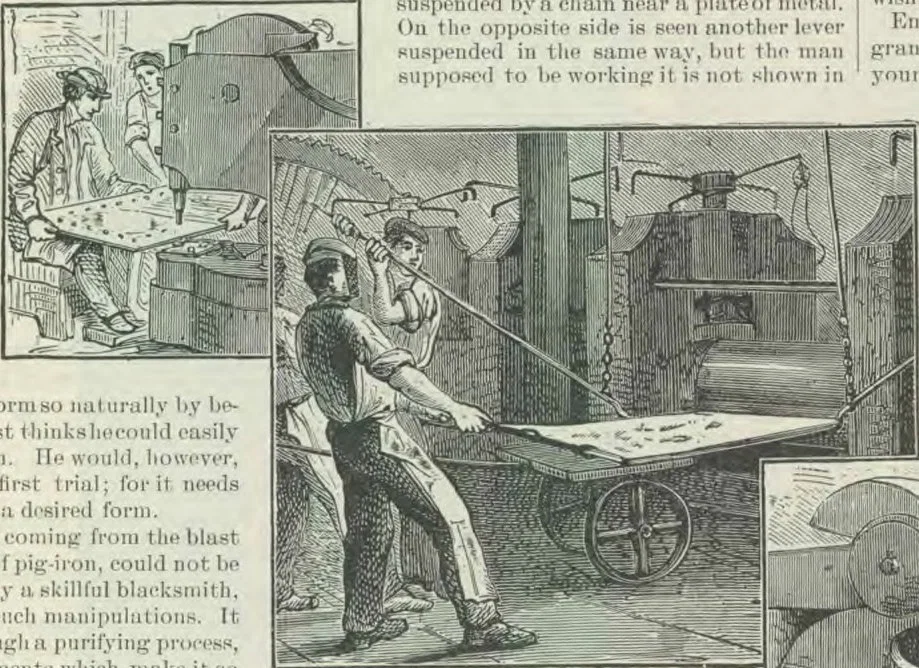
The accompanying picture shows how this plate-rolling process is performed. In the center of the cut, two men are seen, one holding the end of a heavy, broad plate of iron, which rests on a pair of wheels, while the other man is working a bar of iron suspended by a chain near a plate of metal. On the opposite side is seen another lever suspended in the same way, but the man supposed to be working it is not shown in the picture. The end of these levers is put under the edge of the iron plate as it comes through the rolls, to keep it from falling to the floor, and to guide it back again between the rollers, as each piece of plate must pass through the rollers many times, in order to bring it to the desired thickness.
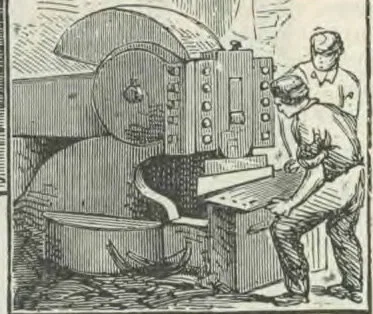
After passing all these journeys back and forth through the rollers, the solid bar of iron has become a long, ragged-edged, helpless-looking strip of reddish-white metal, which is then hurriedly seized upon, and carried over to a ponderous pair of shears, where its rough edges are clipped as easily as you would clip a piece of card-board. After being cut into smaller pieces, these are taken to another machine, where their final rolling is secured. Some of them are rolled out very thin, and coated with zinc, for roofing and other purposes. In this form they are called galvanized sheet-iron. Others are rolled into various thicknesses, and used in making steam-boilers and covering for the sides and bottoms of ships. Such plates, or strips, are taken to a piercing-machine, where, as seen in the upper left-hand corner of the engraving, their edges are pierced with holes at regular intervals, that they may be fastened together with iron bolts.
J. O. C.

THE BEAUTIFUL ORNAMENTS.

“GRANDMOTHER,” said Emily, “what do you think? Mamie Stone’s father has given her a beautiful set of pearl jewelry; it cost ever so much.”
Emily was so eager to tell her news that her entrance into the room was somewhat noisy. Her sister Lily said gently,—
“Please be a little more quiet, sister. I have taken baby from mother, and I want to get him to sleep before she comes back.”
“Dear me, Lily, you always find some occasion for reproving me. I’m sure I should think I could talk to grandmother.”
Emily spoke pettishly, but Lily did not reply; she continued to rock little Willy to and fro and try to quiet the fretful cry Emily’s entrance had aroused. Emily took off her hat, and muttered something about its being so disagreeable to be interrupted in the middle of a story.
“Come and sit down by me, my child,” said grandmother, “and then you can quietly tell me what you wish.”
Emily obeyed. “I wish you could see those pearls, grandmother,” she said. “Did you ever know such a young girl as Mamie to have such elegant jewelry? Her mother is not going to let her wear them often; she says it would not be appropriate. Mamie does not think so, though, and I should not, if I had such beautiful things. What do you think, grandmother? Do you think young girls ought not to wear ornaments?”
“That would depend upon what the ornaments were. I know a young girl, no older than Mamie, who owns and wears a beautiful set of ornaments.”
“And they do not seem inappropriate?”
“On the contrary, they seem very becoming.”
“Perhaps they are not as valuable as Mamie’s.”
“I should think they were much finer.”
“Were they a present?”
“Not exactly; she exercised a great deal of self-denial to obtain them.”
“What! she got them for herself.”
“There was a friend who assisted her when he saw how much in earnest she was to have them.”
“Does she often wear these beautiful ornaments, grandmother?”
“I never see her without them.”
“No matter how she is dressed, or what she is doing!” cried Emily. “What a strange taste! Her jewels cannot be very showy.”
“No, not showy, but they are noticeable; and I think they are rather uncommon.”
“I think it is queer her mother lets her wear so much valuable jewelry all the time. Does she never object?”
“Oh, no! I have heard her wish that all her children had such a set of ornaments.”
“Grandmother,” said Emily, after a pause, “is this girl a Christian?”
“Yes, indeed, she is.”
“Then do you think it is quite consistent for her to think so much of ornaments?”
“Why, yes, of these ornaments.”
“Grandmother, you are smiling so queerly! Do tell what these ornaments are, and the name of the girl who owns them.”
“The ornaments, dear child, are those spoken of in the Bible as the ornaments of a meek and quiet spirit, and the girl who owns them is your sister Lily.”
“Dear me, I might have known it was something of that kind,” said Emily. “I thought you meant something real.”
“So I do mean something real; these ornaments are more real and enduring than diamonds; they will never wear out. They lend a luster to the eye and a radiance to the face that rubies and diamonds can never give.”
“And does Lily really own them?”
“What do you think?” said grandmother.
Emily looked thoughtfully at Lily, who, having got the baby to sleep, was now setting the supper-table, a task that Emily disliked, and was generally cross when asked to perform. She wondered for the first time, if Lily liked it any better. How gently Lily answered grandfather’s querulous complaint that she rattled the dishes; and here on the table lay the painting Lily was so anxious to finish. Emily saw it had not advanced that afternoon; Lily had been too busy with the baby.
Emily looked at Lily’s face, shining with the spirit of Jesus, and whispered,—
“Grandmother, I would rather have Lily’s ornaments than Mamie’s.”—Ellen V. Talbot.

MY WORK.

MASTER, to do great work for thee, my hand Is far too weak. Thou givest what may suit,— Some little chips to cut with care minute, Or tint, or grace, or polish. Others stand Before their quarried marble, fair and grand, And make a life-work of the great design Which thou hast traced; or, many-skilled, combine To build vast temples, gloriously planned, Yet take the tiny stones which I have wrought, Just one by one, as they were given by thee, Not knowing what came next in thy wise thought. Set each stone by thy master-hand of grace, Form the mosaic as thou wilt, for me, And in thy temple-pavement give it place. —Frances Ridley Havergal.

A GOOD MOTTO.

“What queer thing are you doing now?” exclaimed Ralph Smith, as he saw Waldo Newton painting a pick he had made from a piece of wood.
“Something that will help me to master myself, I hope,” replied Waldo. “I’m tired of being nothing but a shiftless, lazy boy that never accomplishes anything of worth.”
“Well, I should like to know how that wooden pick can help you. Are you going to dig through the difficulties that come in your way?”
“I’ll tell you, Ralph. Yesterday I read of an old pick that was found in Italy, by men who were digging among some ruins. It had on it a Latin inscription which means, ‘I’ll either find a way or make one,’ and I’m going to take that for my motto. I know I shall be constantly tempted to fall into my old habits of idleness, so I’m going to paint the motto on this pick, and hang it over the door of my room, to remind me every time I go out that I must find a way to success, or make one.”
“I thought that genius was necessary to success, and everybody knows you are not a genius,” said Ralph, good-naturedly.
“No one knows it better than myself,” replied Waldo; “but even genius cannot succeed without work. Don’t you know that Michael Angelo said, ‘Genius is an eternal patience,’ and Carlyle defined it as ‘the infinite capability of work’? I can plod, if I can’t do anything else, and something will come of it if I only keep on doing the best I can every day.”
“Why, what has come over you, Waldo? I never heard you talk like this before. I didn’t know you had the capability for anything except play. If your pick works wonders for you, I think I, too, shall have to go to digging.”
“A new purpose and plan have come to me, Ralph, to make the best use of life, and I shall be glad if the motto on the old pick helps you as well as myself, to ‘find a way or make one.’”—Sel.

THE AMERICAN INDIAN.

PART I.—HIS CHARACTER.

“INDIAN” is a generic name for thousands of tribes, from the Arctic region to the equator, each tribe differing widely from all the others. The ones Americans are most interested in are those of the plains of the West, and what follows refers more to them than to the others. The Indian of novels, like Fenimore Cooper’s, are ideal myths, being simply impossible beings. Catlin, writing of the Indian, says: “In his native state he is an honest, hospitable, brave, warlike, cruel, relentless, yet honorable, contemplative, and religious being.” Col. Dodge adds: “To these epithets, which are true in a certain sense, I add that he is vain, crafty, deceitful, ungrateful, treacherous, grasping, and utterly selfish. He is affectionate, patient, self-reliant, and enduring. He has a marvelous instinct in traveling, and a memory of apparently unimportant landmarks, simply wonderful. In short, he has the ordinary good and bad qualities of the mere animal, modified to some extent by reason.”
The dignity and reserve of an Indian that we see him exhibit, and which we read about so much, are all assumed—are simply “airs.” “At home he is a roving, jolly, rollicking, mischief-loving braggadocio, brimful of practical jokes and rough fun of any kind, making the welkin ring with his laughter, and rousing the midnight echoes by song and dance, whoops and yells.”
The reason why an Indian expresses no wonder at new and marvelous sights, seen for the first time, like the steam engine, and other appliances of civilization, is because they are beyond his comprehension. Having nothing in his former experience with which to compare them, he is unable to perceive the marvel in their production. To him a bottle is as much a mystery as the huge steamship, just as it would be to an infant; and so, as a child, he can gaze on the wonders produced by the white man, for hours, without becoming excited or even interested. Let an athlete perform before him, however, and he is alive with curiosity and enthusiasm, because feats of physical dexterity and strength are within the range of his comprehension. So when a telegraph line repairer walks up a telegraph pole by means of his spikes, foot over foot, it never fails to elicit applause from Indians who would stand unconcerned before the mammoth Corliss engine.
Indians are “nomads,” that is, wanderers, in that they have no fixed abode, wandering from place to place; yet they have a strong love for “home,” and whenever they happen to spend a pleasant and happy winter in any locality, it is remembered and spoken of tenderly for years. The territory in which they live constitutes their home; and though they change their location in the territory frequently, if removed from it to another, they invariably become homesick, and often die of grief.
The Indian is a thief only when away from his tribe. If one Indian steals from another member of the same tribe, it is an unpardonable crime; but to steal from other than their own people is the highest kind of virtue. Stealing is taught to children early, and the highest ambition of the young men is to become expert at it, that they may procure many ponies with which to purchase a nice wife. To be an accomplished horse thief is the highest notch of honor. Fifty years ago, when an Indian stole from a member of the same tribe, he was cruelly beaten by all the members of it, then stripped of all his clothing and everything he possessed, and, together with his wife and children, kicked out of the camp. A woman stealing was treated in the same manner, only the husband and children did not have to suffer with her. A child stealing was whipped both by the father and the one stolen from, and the father had to make good the loss. Now the line is not drawn so strictly, and often Indians of different bands from the same tribes, will steal from each other with impunity. Hide anything from an Indian, and he will steal it. Intrust it to him for safe-keeping, and it will generally be returned, but a demand will be made for a reward because of his honesty. He has no perception of right or wrong. Right to him is what he wants to do; wrong is anything that opposes him. If an Indian is judged from his own status, or level, he does not commit crime. Crime is an infringement of law. The Indian has no law. His grandest achievements, and that which he has been taught to honor, the white man calls “theft, pillage, arson, rapine, murder. He is a savage, noxious animal, and his actions are those of a ferocious beast of prey, unsoftened by any touch of pity or mercy.” Endurance and patience are virtues that are cultivated, and are the distinctive badges of manhood. Even in torturing a victim, he inflicts upon him only what he claims he could endure without flinching.
W. S. C.

Good Manners: Politeness Toward Others

GOOD MANNERS.—NO. 1.

The child who is always polite and obliging is sure to be well thought of. Not only will he be well thought of, but he will get favors which he could not otherwise obtain. It will pay to be respectful and attentive to those about you. You will never lose anything when you unselfishly put yourself out to make others happy. They will see that you have been willing to forego your own ease to do a kind act for them, and that you are not selfish. But the best pay that comes from polite acts does not lie in the favors others may be ready to grant. Every act for others which is done without a thought to win the praise or good will of those for whom it is done,—every kind act which is done unselfishly,—has a reward in itself. It makes the boy or girl who does it more noble, more like the Blessed One who taught us to love others as well as we love ourselves.
Politeness is not like a nice garment you keep to wear at special times. It is not something to be put on and put off as you may feel like it. You must be kind and obliging all the time, whether you feel like it or not. I want to mention two or three things in which you should show your good breeding.
1. Do not laugh or giggle at the mistakes people make before you. It is best not to notice them at all. If you do say anything, say it in a way that will not hurt their feelings, or that will not make them feel mortified. I know a boy who laughed at his grandmother, when, in attempting to get out of the carriage, she slipped and nearly fell. It was on Sunday before the church door, and there were several people standing round. This boy thought it was very funny to see the poor woman clutching round to keep her balance, and to see how plagued she looked. He laughed, and kept it up all during meeting, so that the minister spoke to him about it when service was over. This boy has grown to be a man, and is now telling you about it, that you may not so lightly regard the mishaps of others.
2. Be respectful to strangers. Don't be rude, so as to make them think, “Where was that child raised, I wonder?” Be as civil to them as to your teacher, to your father and mother, or to any one else. Do not think you may never see them again, and that it will make no difference. It will make a difference. It is ill mannered. It is displeasing to God. It will make the weak place in your character weaker and larger.
3. Don't contradict, especially people older than yourself. If you think they are wrong in what they say, don't begin to deny and to dispute it. They are as apt to be right as you, and may be more so. If you think you must speak, go to the person in private. As likely as not you will be convinced that you are wrong. It is very much out of place to contradict people in company.
4. Do not talk when others are speaking.
5. Do not say “halloo,” when you meet an acquaintance, even a little companion, but speak politely.
Next time I will tell you what became of disrespectful children in Bible times. N. J. BOWERS.

LOVING WORDS!

LOVING words are rays of sunshine, Falling on the path of life, Driving out the gloom and shadow Born of weariness and strife. Often we forget our troubles When a friendly voice is heard; They are banished by the magic Of a kind and helpful word.
Keep not back a word of kindness When the chance to speak it comes Though it seems to you a trifle, Many a heart that grief benumbs Will grow strong and brave to hear it, And the world will brighter grow Just because the word was spoken. Try it—you will find it so. —Eben E. Rexford.

THE WAX AND THE SEAL.

“Unaccountable, this!” said the Wax, as from the flame it dropped, melting upon the Paper beneath.
“Do not grieve,” said the Paper; “I am sure it is all right.”
“I was never in such agony!” exclaimed the Wax, still dropping.
“It is not without a good design, and will end well,” replied the Paper.
The Wax was unable to reply at that moment, owing to a strong pressure; and when it again looked up, it bore a beautiful impression, the counterpart of the seal which had been applied to it.
“Ah, I comprehend now!” said the Wax, no longer in suffering. “I was softened in order to receive this lovely, durable impress. Yes, I see now that it was all right, because it has given to me the beautiful likeness which I could not otherwise have obtained.”

Telegraph Lines in Brazil Face Constant Hazards

TELEGRAPH building in Brazil is a very troublesome business. The wires corrode very rapidly, and the luxurious vegetation requires constant pruning to keep it from growing so as to interfere. Violent storms often prostrate the lines. Birds build their nests on the top of the poles, and ants on their sides; while skunks and armadillos undermine them, and cause their sudden fall. The ants’ nests, when old and hard, have to be chopped off with axes. Wasps build nests in the bell-shaped porcelain insulators, apes meddle with the wires, and the enormous swarms of birds flying by night often wreck or tangle them. More mischievous than any of these is a huge spider that weaves its web between the wires and interferes with the electric currents.

Wolves, the Greek Year, and Lycabas Etymology

SIR RICHARD PHILLIPS, in his curious book called “A Million Facts,” quotes the Abbe Pluche for authority that wolves, in crossing a river, hold on by their mouths to each other’s tails, and that this figure was chosen by the Greeks to denote the year of twelve months following each other, which they called the march of wolves, or Lycabas. A more probable etymology of lycabas, meaning the annual solar path, is from luke, light, and baino, to go. The Greek word for wolf is lucos.

JOHN S. CROW.

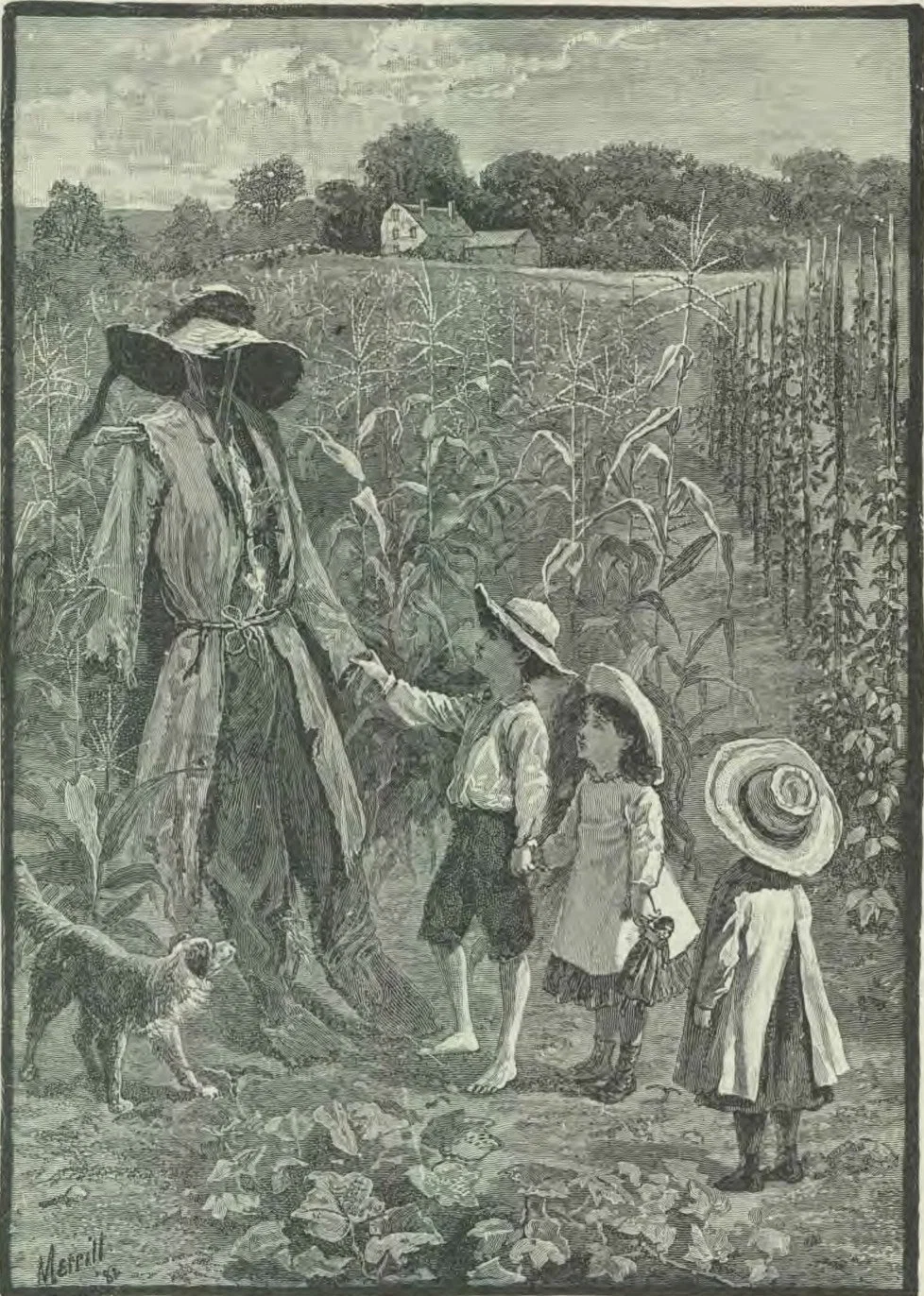
All alone in the field Stands John S. Crow: And a curious sight is he, With his head of tow, And a hat pulled low On a face that you never see.
His clothes are ragged And horrid and old. The worst that ever were worn; They're covered with mold, And in each fold A terrible rent is torn.
They once were new, And spick and span, As nice as clothes could be; For though John hardly can Be called a man, They were made for men, you see.
But a steady old chap Is John S. Crow, And for months has stood at his post: For corn, you know, Takes time to grow, And 'tis long between seed and roast.
And it has to be watched And guarded with care From the time it is put in the ground; For over there, And everywhere, Sad thieves are waiting around.
Sad thieves in black, A cowardly set, Who wait for John to be gone, That they may get A chance to upset The plans of the planter of corn.
They are no kin to John, Though they bear his name And belong to the family Crow; He'd scorn to claim Any part of the fame That is theirs wherever you go.
So he sticks to the field And watches the corn, And is watched by the crows from the hill; Till at length they'll be gone, And so will the corn— They away, and it to the mill.
Then the work will be done, 'T will be time for play, For which John will be glad, I know; For though made of hay, If he could, he would say, “It's stupid to be a scarecrow.”
But though it is stupid, And though it is slow, To fill such a humble position; To be a good scarecrow Is better I know Than to scorn a lowly condition.
—Wide Awake, adapted.

THE PEA BLOSSOM.

There were five peas in one shell; they were green, and the pod was green, and so they thought all the world was green. The shell grew, and the peas grew. They were like little brothers, each one smaller than the other. As they grew bigger, they cuddled up closer together; for although the pod grew also, it did not grow as fast as they did. By and by they sat there all in a row, with their pretty round cheeks pressed lovingly against one another. The sun shone without and warmed the shell, and the rain made it clear and transparent; it was mild and agreeable in the bright day and in the dark night, just as it should be. As the peas sat there, and grew bigger and bigger they became more and more thoughtful, and began to say they must be doing something.
“Are we to sit here forever?” asked one. “I'm afraid we shall grow hard by keeping still so long. It seems to me there must be something outside.”
The days went by, and the weeks went by. The peas became yellow, and the pod also. “All the world's turning yellow,” said they. And so it was, all the world that they could see.
Suddenly they felt a pull at the pod. It was torn off by a little boy's hand, and was pushed down into the pocket of his jacket, in company with many other pea pods. They were not much frightened; for they had been waiting and hoping that something would come to them.
“Now we shall soon see the world,” said one.
“I should like to know which of us will travel farthest,” said the smallest pea; “we shall soon see now.”
Crack! went the pod as it burst, and the five peas rolled out into the bright sunshine. There they lay in a child's hand. A little boy was holding them fast. He said they were fine fellows for his pea-shooter, and directly he put one in and shot it out.
“Now I'm flying out into the wide world; catch me if you can!” And he was gone. He fell into the gutter on the roof of a house, and ended his travels in the crop of a pigeon.
“I,” said the second, “shall fly straight into the sun; that is a fine shell, and suits me exactly;” but he fell into a sink, and lay there in the water for days and weeks, swelling and swelling till he was of great size.
“We shall go farthest of all,” said the next two. But they also fell on to the roof, and were eaten by pigeons.
Then the little pea said, “I will go wherever the great Father sends me to do his work.” He was put into the pea-shooter, and away he flew, up against an old board under the garret window, and fell into a little crevice which was almost filled up with moss and soft earth. The moss closed around him, and he was shut in, but not forgotten by God.
Within the little garret lived a poor woman, who went out every day to clean stoves, chop kindlings, and clean houses for other people; for she was strong and brave and industrious. But she was very poor, and at home in the garret lay her only child, a young girl, very delicate and weak.
“She is going to die as did her little sister,” said the poor woman; “I had only the two children, and the good God took one of them to himself. Now I would gladly keep the other, but I fear that she too will very soon go.”
But the sick girl still remained where she was. Quietly and patiently she lay all the day long, while her mother was away from home at her work.
Spring came, and one morning early the sun shone brightly through the little window, and threw its rays over the floor of the room. Just as the mother was going to her work, the sick girl called out, “Mother, what can that little green thing be that peeps in at the window? It is moving in the wind.” The mother stepped to the window and opened it. “Oh,” she said, “there is really a little pea which has taken root, and is putting out its green leaves. How could it have gotten into this crack? Well, now, here is a little garden for you.” So her bed was drawn nearer to the window, that she might always see the growing pea; and the mother went forth to her work.
The little pea was glad, and hastened to grow with all his might. “Mother, I believe I shall get well,” said the sick child in the evening; “the sun shone in here so brightly and warmly to-day, and the little pea is thriving so well; I shall get on better, too, and go out into the warm sunshine again.”
“God grant it!” said the mother. And she tied a piece of string to the window-sill and to the upper part of the frame, so that the pea tendrils might twine round it when it shot up; for it had given her daughter such pleasant hopes of life.
Then the little pea was very happy and grateful that the great Father had placed him where he could cheer and help the sorrowful and weary girl, and he grew and grew taller every day.
“Now, really, here is a flower coming!” called the mother, one day, and her heart was glad. For her child had been more cheerful lately, and that day she had sat up for a whole hour, looking with delighted eyes at the little garden, in which her one little plant grew.
A week later the young maiden stood at the open window in the warm sunshine, with sparkling eyes and rosy cheeks, while outside grew the little plant, and on it a pink pea-blossom in full bloom. She bent down, and gently kissed the delicate leaves. This day was to her a festival.
“The Heavenly Father himself has planted that pea, and made it grow and flourish, to bring joy to you and hope to me, my blessed child,” said the happy mother; and she smiled at the flower as if it had been a good angel. Then the little pea swung back and forth on the string for joy, and clapped his tiny green leaves together, and sent out from his pretty blossom its sweetest fragrance. For he said, “I went the farthest, after all; for I have brought gladness into two hearts.”—Adapted from Hans Christian Andersen.

ROBBIE'S BANK ACCOUNT.

“Just ask papa for the quarter; it will be all right.”
“But papa said for us to be business-like, you know,” urged Percy; “so you’d better make out the—the check, isn’t it?”
“Draw a check, that’s what it is. All right, here goes,” and Rob drew his check for twenty-five cents, payable to Percy Gray, and signed Robert Gray.
But when the check was presented, Papa Gray said, “I’ll have to see how the books stand. Rob has been running his account pretty close lately.”
To Percy’s dismay, and Rob’s surprise, he came out of the study presently, saying,—
“Bank account overdrawn. Check of no value.”
“Why, Rob!” said Percy, “I never thought you’d cheat.”
Rob’s cheeks grew red.
“You know I’m no cheat. I didn’t reckon up, that’s all.”
“If your money had been in a real bank, and Percy a stranger, instead of your brother, and the amount twenty-five dollars, say, instead of twenty-five cents, it would be embarrassing to have to say, ‘I didn’t reckon up;’ wouldn’t it?” said Mr. Gray.
“Yes, sir,” said Rob, soberly; “but I can’t think where that last quarter went. Oh, I know now; I treated the boys to soda-water.”
A little shadow fell upon Mr. Gray’s kind face. “You do love soda-water, don’t you, Rob?”
“Indeed I do, sir,” answered Rob.
“And it seems a very innocent thing; but I tremble a little to see you form a habit of drinking anything at a public place, and ‘treating’ too!”
“Why, father, I’m temperance all through!”
“And I want you to keep ‘temperance’ my boy. The habit of running in to get a glass of soda may prove the entering wedge to your temperance principles. Think twice before you take a glass of soda, Robbie. First, ‘Can I afford it?’ and second, ‘Am I adding a link to the chain of habit?’ By the way, did you borrow of Percy the quarter which paid for the treats?”
“Yes, papa.”
“Well look out for your bank account next time, and look out for your habits all the time.”—S. S. Advocate.

LIVING FOR JESUS.

Living for Jesus! Just little things In our daily life may take the wings Of messengers swift and strong and brave, And—God only knows—a soul may save.

HOW IT LOOKED TO JESSIE.

“I wish I was Kitty Ray, mamma,” said Jessie. “I am glad you are not,” said her mamma, smiling; “for then Mrs. Ray would have too many little girls, and I would have none. But why would you rather be Kitty Ray, little daughter?”
“Kitty has such nice times doing things, mamma. Yesterday, when I took Dolly down the lane to gather flowers, I met Kitty going out to the field with dinner for her father and brothers; I think it must be so nice to carry a basket covered with leaves and a white towel, and to dip water from the spring.”
“Suppose you go and live at Mrs. Ray’s a day or two?” said her mother.
Jessie was delighted, and her mother made a secret plan with Mrs. Ray, by which it was agreed that Jessie was not to be treated like company, but was to help Kitty in all her work. For the first few hours Jessie thought it fine; but before night she got very tired weeding the garden, and minding the fussy little children, and picking blackberries in the lane.
When she went to supper, she thought the bread very hard, and the milk very blue. There were no preserves, no dainty muffins, no tea-cakes—not even butter on the table. She slept in Kitty’s bed, which was a hard little cot, while Kitty slept on the floor on a comfortable.
Nobody told her a story before bed-time, nobody kissed her good-night, nobody helped her to say her prayers. Jessie felt very unhappy, and wet Kitty’s hard pillow with tears. Early in the morning she was awakened by the farm-horn (Kitty’s father was a field-hand), and, slipping into her clothes, she ran home through the wet field and lane.
“O mamma,” she cried, “I don’t want to be anybody’s little girl but yours.”
Mamma hugged her tight, and told her she only meant to show her how grateful she ought to be to the Heavenly Father for all her blessings.
“But I’ll go and help Kitty some every day,” said Jessie, “and give her one of my dolls, because she doesn’t have as good a time as your little girl.”—Sunbeam.
Continue reading: WOULD YOU HAVE DONE SO?