The Youth’s Instructor, Vol. L., No. 7

IN BLUE UNIFORM

The Youth’s Instructor

February 13, 1902

Review and Herald Publishing Company · Battle Creek, Mich. · February 13, 1902

IN BLUE UNIFORM

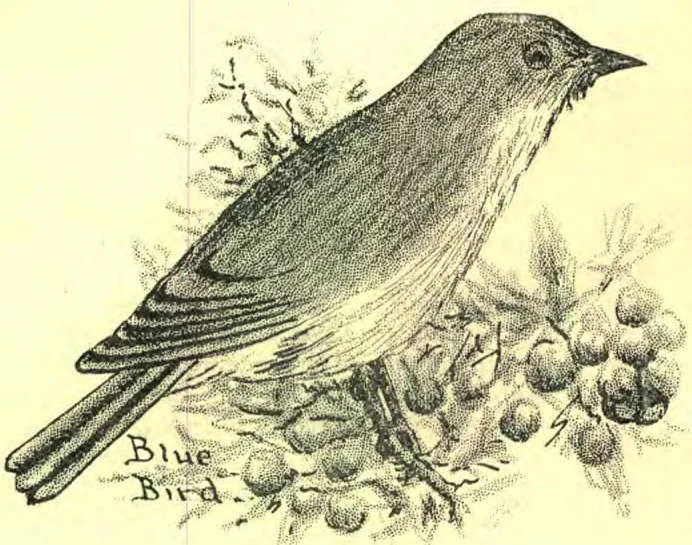
THERE are several birds which, by different people, are called “bluebirds,” but only one of them is the Bluebird. The other two are the Indigo-bird and the Blue Jay. As well known as the Blue Jay should be, it seems rather strange that any should confuse it with the Bluebird. Its piercing, hawk-like cry alone should forever distinguish it from any other bird that wears blue clothes. Besides, it wears a crest, or topknot, and there are black stripes on its tail and wings, and it has a black collar. The Bluebird has none of these marks; it is blue above, reddish-brown on throat and breast, and the under parts are white. The Indigo-bunting is wholly blue, and is smaller than either of the others.

The Indigo-Bird

The Indigo-bird, or Indigo-bunting, sings late into the summer. His song is given by some as Chritty-chritty-chritty-chrit, chrit, chrit, chee! Florence A. Merriam says: “I well remember watching one Indigo-bird who, day after day, used to fly to the lowest limb of a high tree, and sing his way up from branch to branch, bursting into jubilant song when he reached the topmost bough. I watched him climb as high into the air as he could, when, against a background of blue sky and rolling white clouds, the blessed little songster broke out into the blithest roundelay that ever bubbled up from a glad heart.”
The female Indigo-bird is not blue, like the male. When you see her, you will have found a small, sparrow-like bird, though unlike any of the sparrows. You will see a gleam of blue on her shoulders and tail. Wait a little, till she calls her mate; when he comes, all dressed in indigo-blue, you will know you have not been mistaken. But Mr. Indigo-bird is the singer. His lady utters only a plain cheep, cheep, and nervously twitches her tail from side to side. You will find her very suspicious of you, and not at all willing to take you into her confidence. Her husband seems very happy, and sings when almost all the other birds have ceased, his clear notes ringing out even in the long, dry days of August.
Description.— Adult male: entire body deep-blue. Adult female: plain olive-brown above, dusky below; wings and tail black, with glint of blue on shoulders and tail.

The Bluebird

There is hardly any bird that will more fully repay our kindness than the Bluebird. He loves to live in our orchards and gardens or near our homes. If you make boxes for the Bluebird, be sure to put no perch at the entrance. Make the opening in the flat wall of the box; then the sparrows will be unable to dispossess the Bluebirds. Keep away cats and gunners. Plant a corner of your yard with sunflowers and berry bushes, so that they will have food and tangled thickets for safety, and Bluebirds will build their nests there. Cans, gourds, and bird-houses will be further invitations for them to take up their abode with you. The mulberry, June-berry, shadberry, buckthorn, elder, choke-cherry, wild black cherry, Virginia creeper, dogwood, mountain ash, pokeberry, etc., are all valuable in enticing birds; and as the birds love wild berries better than cultivated, you will, by planting these, protect your own fruit as well.
As the Indigo-bird is the embodiment of good cheer, so the Bluebird is the type of amiability. He is so given to peace and good will that the pugnacious English Sparrows have driven him away from many gardens and orchards where once he was a permanent resident.
In the winter the Bluebird is a great rover, and travels in flocks through the Southern States; but in the spring he is back to the North again, and soon sets up housekeeping.
As we study the birds, we find that each has some distinguishing characteristic or attribute, and generally it is something that we should strive to possess ourselves. God has put for us in the Indigo-bird a picture of bubbling good cheer, of happy thanksgiving, which we should aim to embody in our own character; and in the life of the Bluebird we see an amiability and sweetness of temper that wins us in spite of ourselves, thus teaching us the wondrous power of a truly kind heart.
Description.— Adult male: upper parts, blue. Adult female: upper parts grayish-blue; under parts duller. Length about seven inches.
L. A. REED.

NATURE STUDY

It has been proved that the surest way to keep young is to live outdoors, take an interest in growing things, study the stones and rocks, associate with the beautiful birds, and listen to nature’s thousand voices that speak of God. This secret of perpetual youth seems to have been discovered by the naturalists; for, however venerable they became, their fresh hearts kept their eyes from fading, and the lines from gathering on their faces, and made them proverbially young both in manner and in spirit.
Nature study brightens faces and enlarges minds. Not only may one “go to the ant” and “be wise,” but insects, birds, and beasts are our great teachers. They are always furnishing us with useful patterns and ideas, and some of our most wonderful inventions have been merely copies from their feats of engineering.
There is no such thing as a lonely forest or field. The city’s activity is nothing compared with the life that is to be studied in nature’s quiet places, where each leaf is a separate study; for no two of the countless billions that clothe the trees are exactly alike.
The great musicians of the world have put into their finest compositions echoes of the lovely bird-songs they have heard in their rambles, and the great artists have taken their fadeless colors from the numberless tints of the flowers. When we recall that there are fifty shades of red between crimson and scarlet, we are able to realize dimly that the study of color alone could keep one busy a lifetime. No one can be low-spirited who opens his eyes, mind, and heart to the pure world of nature. A high, earnest, happy look must be on his face; and happiness is beauty always.—Union Signal.

REMEMBER

A STAFF-OFFICER riding over the field of battle during the Civil War was attracted by a body lying under a tree; the figure was handsomely dressed, and a fancy sword lay near by. He removed the covering, and saw the sweet face of a boy of about twelve years,—a temporary aid to some officer. In his pocket was found a Testament, in which was written: “James Simmons. My son, ‘remember now thy Creator in the days of thy youth.’”
Of all the wise sayings and excellent advice given by Solomon, none, dear young people, exceeds this. To hear and heed is to crown life with blessedness. It will, if followed, be a preventive from falling into many sins; but to neglect it is to court, through misdoings, remorse and repentance in the future.
These words are for you,—the youth. No period of life is so important as yours. “It is the time of the development of the faculties; the time when tastes are created, habits acquired, and character formed for future weal or woe.” It is to you, and to you only, that the holy words can be applied: “Those that seek me early shall find me.”
Now let us look at this passage in which the word “remember” is mentioned, and see what we can learn. Whom remember?—“Creator.” Whose Creator?—“Thy Creator.” How remember?—Why, his word, and believe it; for, “He that heareth my word, and believeth on him that sent me, hath everlasting life.” Remember his work, and accept it; for “Christ died for our sins.” Remember his love, and return it; for “herein is love, not that we loved God, but that he loved us.” When should this Creator be remembered?—“Now.” This is the most important moment, and the only moment we can call our own. Why should we remember?—Because there is not an hour but trembles with destinies, not a moment but is of infinite importance! Now glance at a few reasons as to why remember:—
1. That you may be safe. As we grow out of youth, we are apt to grow away from opportunities of salvation and the probabilities of being saved. Nine tenths of all who accept Christ, dear young friends, are said to do so before they are twenty.
2. That you may be happy. To remember God properly is to lose ourselves in adoration of him, to be like him, to be holy as he is holy.
3. To be useful. God’s promise to Abraham if he would follow him was, “I will bless thee, . . . and thou shalt be a blessing.” It pays to live to do good as well as to be good. In fact, no one can be really good without doing good.
When Earl Cairns was a little boy, he heard three words: “God claims you.” Then came the question, “What am I going to do with the claim?” He answered, “I will own it, and give myself to God.” He went home, and told his mother, “God claims me.” At school, in Parliament, and when he was made lord chancellor, he would always say, before he undertook anything, “God claims me.” So does he claim you, young reader. What are you going to do with the claim? Answer, What?
Wm. P. Pearce.

GOD’S PURPOSE FOR THE YOUTH

WONDERFUL are the possibilities before the youth who grasp the assurances of God’s word. Scarcely can the human mind comprehend the spiritual attainments which can be reached by them as they become partakers of the divine nature. Daily correcting mistakes and gaining victories, they grow into wise, strong men and women in Christ.
The Lord says to every one of you, “My son, give me thine heart.” He sees your disorders. He knows that your soul is diseased with sin, and he desires to say to you, “Thy sins are forgiven.” The Great Physician has a remedy for every ill. He understands your case. Whatever may have been your errors, he knows how to deal with them. Will you not trust yourself to him?
Before you are two ways,—the broad road of self-indulgence and the narrow path of self-sacrifice. Into the broad road you can take selfishness, pride, love of the world; but those who walk in the narrow way must lay aside every weight, and the sin which doth so easily beset. Which road have you chosen,—the road which leads to everlasting death, or the road which leads to glory and immortality?
The Lord has given you your life as a sacred trust. Spend it for him. Visit the sick; comfort the poor and sorrowful, speaking to them of the compassionate Redeemer. This work will bring to you health of body and peace of mind. Your countenance will reflect the joy that comes as the reward of unselfish service. The price of Christlike love is beyond computation; it makes human beings like Him who lived not to please himself.
In the history of Timothy are found precious lessons. He was a mere lad when chosen by God as a teacher; but so fixed were his principles by a correct education that he was fitted for this important position. He bore his responsibilities with Christlike meekness. He was faithful, steadfast, and true, and Paul selected him to be his companion in labor and travel. Lest Timothy should meet with slights because of his youthfulness, Paul wrote to him, “Let no man despise thy youth.” He could safely do this, because Timothy was not self-sufficient, but continually sought guidance.
There are many youth who move from impulse rather than from judgment. But Timothy inquired at every step, “Is this the way of the Lord?” He had no specially brilliant talents, but he consecrated all his abilities to the service of God, and this made his work valuable. The Lord found in him a mind that he could mold and fashion for the indwelling of the Holy Spirit.
God will use the youth to-day as he used Timothy, if they will submit to his guidance. It is your privilege to be God’s missionaries. He calls upon you to work for your companions. Seek out those you know to be in danger, and in the love of Christ try to help them. How are they to know the Saviour unless they see his virtues in his followers?
Take time to ask yourself, What am I doing for the Master? Work for him while the day lasts; the night is coming, and then you will not be able to work. Do not seek some great undertaking. Do the work nearest you, be it ever so humble. “He that is faithful in that which is least is faithful also in much.” At the close of each day review your record, noting where you have failed to improve the precious opportunities that have come to you. Ask the Lord to pardon your neglect, and seek for strength to act with greater fidelity on the morrow.
Many youth are ready to make excuses for not entering the service of Christ. “I do not profess to be a Christian,” one says, “and those who make a profession are no more Christlike than I am. If I professed to be a Christian, I would certainly do the works of a Christian.” To the self-deceived ones who speak thus, come the words, He that knoweth his Master’s will, and doeth it not, “shall be beaten with many stripes.” If you have a clear understanding of the duties of the Christian life, and yet refuse to accept Christ, choosing rather to make yourself a stumbling-block by pointing to the errors of others, great will be your punishment.
At the eleventh hour the Lord will call into his service many faithful workers. Self-sacrificing men and women will step into the places made vacant by apostasy and death. To young men and young women, as well as to those who are older, God will give power from above. With converted minds, converted hands, converted feet, and converted tongues, their lips touched with a living coal from the divine altar, they will go forth into the Master’s service, moving steadily onward and upward, carrying the work forward to completion. MRS. E. G. WHITE.

YOUR NAME

“A good name is rather to be chosen than great riches.” Here is presented a worthy ambition for every young man and woman. The genuine ring of sterling worth lies back of every “good name.” The name suggests the character of the individual. He may be without money, or in possession of great wealth; but of still greater worth than his riches, and beyond his poverty, he is valued for what he is.
One day in conversation the remark was made that whenever one sees the name of a certain writer, he can count on good reading, genuine in every particular. I have pondered over this remark since. Such confidence comes not in a moment. It is the precious reward of hard work, an earnest devotion to that known to be just, lovely, and of good report. It is the result of strict adherence to principle.
Think not that after sowing wild oats a while, such a name may be chosen, and this confidence in you be realized. If wild oats are sown, a like harvest will be reaped. The good name should be chosen early in life. Once tarnished, it is almost, if not quite, impossible to remove the stain.
Do not prevaricate. When you undertake to tell something, tell it as it is. Don’t color it for effect. At the time it may seem a desirable thing to do, but there is likely to be a reaction. If your name is attached to anything, may it be known to everybody that it is genuine in every particular. Put soul into whatever you do; that is, yourself; and know that as you do your work, whether you master a lesson, tidy a room, or make a bed, so are you. Let it be known that you are a genuine boy or girl, subject to no discount. Never let it be said, after you have told some happening, “It will be safe to divide that story by two.”
This world needs such young men and women. They will be in demand in the home, the school, the ministry, the publishing houses, our offices, counting-rooms,—in fact, everywhere. Will you, dear young friend, count as one of them?
T. E. BOWEN.

IN HIS STEPS

Dear Lord, perhaps within this very day Which looks as earth's calm level to mine eyes, Thou seest wide before my feet the way Up thine own heights of love and sacrifice.
It may be there is space this day to bear The sweet self-humbling of thy Bethlehem; In Nazareth's grace of patient toil to share; In desert hours the tempter's might to stem;
To turn love's daily drink to wine of joy; To break love's bread, made blest and multiplied; In help and healing still to find employ; To lull the tempest-waves of wrath and pride;
To bear my cross, perhaps, up Calvary, If I would keep beside thee all the way; Dying to self as thou hast died for me; Rising in thee. Dear Lord, is this my day?
—Mabel Earle, in Christian Endeavor World.

A QUESTION

SHOULD the Young People's Society detract from the interest of the church? — Certainly it should not. A Society that in any sense draws the interest away from any of the regular services of the church is evidence that the members have not caught the true spirit of this movement. The banding together of our young people into companies of workers, means that they are to be church workers. It should mean that our young people “who really love Jesus” will be more faithful in their attendance at the regular church services, the prayer-meeting, the missionary meeting, and the Sabbath-school. And it should mean that these young people will be workers in all these lines of work. It should not mean a separation of interests.
Young people, the honor of the cause of God is at stake in this work. If you allow the Society to draw your interest away from any of the regularly established services of the church, it will be a serious mistake. Band together to take a more active part in the church work. Encourage one another in this. Otherwise, the Spirit of God will be grieved, church officers and members will regard the Society with disfavor, and the result will be a lowering of the standard, and consequent failure. Unless the organization of the Young People's Society has a direct tendency to encourage each member to be more faithful in all church duties, it would better never be organized.
A report of a Society in one city, says: “We have had unusually interesting meetings. Every young person in the church has taken a stand for the truth. All are deeply interested, and the Lord is greatly blessing the entire church.” This report is only an example of what might be done in every place. “Press together” should be our rule of action. Let the church help the young people, and the young people help the church. How can it be otherwise if the work is on a right basis? The young people should be a part of the church, and of course the church should help its own.
MRS. L. FLORA PLUMMER.

TALENTS — LESSON II

Mental Faculties

(February 16-22)
PLACE the lesson outlines upon the blackboard, leaving space, not only for the references given, but for at least two others under each head. It would be well in addition to the Bible references to give those from “Christ’s Object Lessons” and the Testimonies.
As a basis for the lesson read again the parable of the talents, as given in Matt. 25: 14-29; also the last nine verses of the first chapter of Daniel, and that part of the chapter on “Talents” in “Christ’s Object Lessons” given under the heading, “Mental Faculties,” beginning on page 333.

Note

Minds are to be molded and character is to be developed by interested experiment. In the fear of God, every endeavor to develop the higher faculties, even if it is marked with great imperfection, should be encouraged and strengthened. The minds of many of the youth are rich in talents which are put to no available use, because they have lacked opportunity to develop them. . . . Aids to self-development must be given to the youth; they must be drawn out, stimulated, encouraged, and urged to action.
Workers are needed all over the world. The truth of God is to be carried to foreign lands, that those in darkness may be enlightened by it. God requires that a zeal be shown in this direction infinitely greater than has hitherto been manifested. . . . We are not doing one twentieth part of the good we might, because selfishness prevails to a large extent among us. Cultivated intellect is now needed in the cause of God; for novices can not do the work acceptably.—“Testimonies,” Vol. IV, pages 425, 426.

Lesson Outline

Show, by lesson scriptures and references, that God wants, for his work,—
  1. Trained mental faculties.
  2. Cultivated intellects, that are under the power of his Spirit.
  3. Minds that are educated and stored with useful knowledge. See also Prov. 10: 14.
  4. Wise men and women. Read Prov. 4: 7.
  5. Men and women who know him, and understand his word.
  6. Men and women who know how to discipline themselves.
Also that God wants to give to his children—
  1. Wisdom. Ps. 19: 7.
  2. Knowledge. Dan. 1: 17.
  3. Learning (education). Dan. 1: 17, 20.
  4. Understanding (judgment). Dan. 1: 17, 20.

ENCOURAGING TOKENS

NOTICE the report from the Philadelphia Young People's Society. Their weekly meeting is made the occasion for a “thorough study,” in preparing for which each one “studies the subject for himself beforehand.” Of course the inevitable result of such preparation would be that stated,—that the meeting “is the most interesting of the week.” Given an inexhaustible subject to study, with enthusiasm, application, and diligence on the part of students; and the meetings can not help being interesting and helpful.
The report from Winnipeg also merits thankful and thoughtful consideration,—thankful that God is using the work of this earnest little company to his praise, and thoughtful because it should awaken the inquiry, Am I willing to be used in such humble, lowly ways to God’s glory? We hope that many a Young People’s Society will read these reports, and by them be stirred to greater activity in study, and greater willingness and effectiveness in service.

A HAPPY DAY

UNDER the direction of one of their number, the students of South Lancaster Academy prepared a dinner on Christmas day for the needy children of a near-by town. While some went to gather in the children, others busied themselves in the kitchen, and in preparing the four tables set apart in the dining-room for the little guests. When they arrived, they were first taken to the parlor, where for a short time a general program was given, followed by a division into smaller groups, each under the care of a teacher, who told them the beautiful story of the first Christmas day. Nearly every face manifested interest as the children told their experiences, and listened to the story of the Good Shepherd.
After dinner the children were made happy with gifts, and a short talk was given by Professor Griggs. Half an hour longer they stayed, and were then returned to their homes, a few with baskets of food for those who could not come.
But we do not feel that our work should end here. Literature must enter these and other homes; where Christian Help work is needed, it is to be done; and where the doors are thus opened, we must be ready to enter to sow seeds of truth.
After the children had gone, a number of the young ladies visited a home not far away, where a large basket of clean clothes was waiting the attention that could not be given by the inmates of the home. Everything was in readiness on their arrival; and as many hands make quick work, it was not long till the basket was empty. Then followed a pleasant hour spent in singing, dialogue, readings, etc.
As the day closed, all remarked what a pleasant one it had been. We were happy because we had made others happy.

A WORKING SOCIETY

Mrs. Jessie L. Adams, of Winnipeg, Manitoba, writes as follows of the Young People’s Society recently formed there: “Our Young People’s Society is now well started, though we have not a large membership. We are taking up the studies in the INSTRUCTOR with good courage and zeal. We have a club of Signs, and some of our number have already a good paper route. One of the boys has five copies that he sells each week, and others sell also. The older members were asked last week to go, two and two, to call on some of the members who had not attended meeting for a week or two. I think we shall form ourselves into a visiting committee to look after this class of persons,—see if they are sick, and if so, report it; then they may have help if they need it.
“The younger children are saving their papers; and when they get a few, we shall make another trip, as we did not long ago, and distribute them. As the result of our last trip with the papers, one lady has attended Sabbath-school and meeting regularly, and she now wishes to be baptized. She had heard the truth before, but had never attended meetings, and felt lonely. She seems so happy now, and we feel more than repaid for all our work thus far. Three of the older girls have been doing tract work on the envelope plan, and seem to enjoy it. We know that the seed will spring up and grow. In a city there seems so much to do, but we are trying to make a few people happier, and God gives to us double for our work in real happiness.”

NOTES FROM THE FIELD

A YOUNG PEOPLE'S SOCIETY has been organized in the Indianapolis church, with a growing interest.
Miss Anna Myberg, Seattle, Wash., writes under date of January 7: “Some of the young people here have come to the conclusion that we must do something to help one another and others. We have organized a Young People's Society as nearly according to the directions set forth in the YOUTH'S INSTRUCTOR as possible; and we hope with the Lord's help to be able to help some, for we know that this is his will. Seattle is a large place, with many young people, and we know that a great responsibility rests upon us, and that the Lord would have none of us stand idle, but desires all to go to work before it is too late. We hope you will remember us in this place when praying for the young people; for without the Lord's help we can do nothing.”
From Mrs. W. J. Fitzgerald, Philadelphia: “I know you will be glad to have a report of the Philadelphia Young People's Society. This church is fortunate in having a great many young people from twenty to thirty years of age, and many of them are the most active workers in the church. The Berean lessons are studied at the church midweek meeting, so the committee on Young People's work thought it would be well to take up a line of study that would fit the members to give an intelligent reason for their hope. The pastor and another able Bible instructor were asked to become teachers, and the evening is devoted to studying a subject which has been previously announced. It is not given as a model Bible reading, but is a thorough study, that fills one with the subject, and from which a good reading can be reduced. Each one studies the subject for himself beforehand; but the class work brings out the greater and more beautiful truths. Many of the senior members say it is the most interesting meeting of the week, and have joined the Society. The membership is about forty-four. We are not burdened with machinery, having only a president, a secretary, and a teacher.”

TRANSFORMATION OF WOOD PULP

Let us consider how news paper is made in one of the great mills of the Adirondack Mountains, where the giant machines, rattling on, day after day, never stopping, are scarcely able to supply the demand of a single New York newspaper. The timber, which is felled in the forests of the north in winter, is floated to the mill in the mountain streams by the spring freshets, and piled up in great heaps about the mill buildings, whose many roofs, chimneys, and towers form a strange picture in the wilderness against the background of cloud-topped mountains.
By being fed to shrieking saws, the spruce logs are cut into pieces that are no longer than a man’s arm. “Barking” machines, which have disks of rapidly whirling radial knives, attack the wood, and tear off the bark. To prevent a waste of any part of the timber, an endless chain conveyor carries the bark to the boiler-room, where it is fed to the fires. Another conveyor, like the trottoir roulant at Paris, carries the clean logs to the grinding-room, where a long line of three-horned monsters is waiting for them.
Flumes, beside which men are mere pigmies, bring the mountain torrents rushing down to the grinding-room, feeding the energy of forest cataracts to the great turbines. They have an enormous work to do. Within the iron cases of the three-horned monsters are grindstones of a special hardness, turned by the turbines. The “horns” are hydraulic presses, which force the logs under them against the stones. Thus the wood is ground to pulp, the stones eating away three feet of wood an hour. The engineer tells us that more than ten thousand “horse-power-hours” of energy are needed to convert one cord of spruce into pulp, and that the mills use more power than a whole manufacturing city in New England. Cold water flows continuously on the grindstones to prevent the friction setting fire to the wood, and the mixture of ground wood and water which flows away from the grinders, as a pinkish, gruel-like fluid, runs over dams and through screens and drying machines, until, a thick mass, it is either put in storage tanks, in bulk, or formed by machinery into thick sheets that can be rolled up like blankets. It is then ground wood-pulp, ready for the paper machines.
The sulphite pulp is prepared in a different way. The logs, when they come from the barking machines, are cut up lengthwise, by “splitters,” and then cut crosswise, by “chippers,” into pieces less than an inch thick. This thickness gives the length of the fiber. A “chipper” with its whirling knives eats up a hundred cords of wood in a day. By falling on another “moving sidewalk,” the chips are carried away to be screened and then hand-picked,—to sort out dust and dirt,—and then are carried to storage bins above the great sulphite “digesters,”—monster steel cylinders, with conical ends, standing upright in a row.— Frank Hix Fayant, in January Success.

CHEERFULNESS

It will help us in learning the lesson of cheerfulness if we persistently train ourselves to see the good things, the bright things, in our common life. Many persons seem to have eyes only for unpleasant things. They see at once, and see it magnified, every disagreeable thing that comes into their life. They remember all the unhappy experiences they have ever had. They keep on their hearts’ walls the pictures of all their vanished joys and faded hopes, writing thereon, as with a diamond on glass, the record of all the trials, adversities, and misfortunes they have ever suffered. They forget all their blessings; they hang up no pictures of the joys they did not lose; but cherish only the dark side, forgetting that “heaviness in the heart of a man maketh it stoop,” but “a merry heart doeth good like a medicine.”
We often make our own shadows by turning our faces from the source of light; if we would always be cheerful, we must learn to see the beautiful things, and be blind to the disagreeable things.
Some feel sad and discouraged when all is bright except one little thing, while others are cheerful and happy when they have only one thing to rejoice over.
“Some murmur when the sky is clear, And wholly bright the view, If one small speck of dark appear In their great heaven of blue; And some with thankful love are filled If but one streak of light, One ray of God’s good mercy, gild The darkness of their night.”
Even Christians sometimes fall to murmuring on account of a few trials. If we would only remember that “all things work together for good to them that love God,” we should not so often feel cast down. Jesus has promised us that he will never allow us to be tempted above what we are able to bear. That should be a source of joy to every one who bears his name.
If we keep our eye single to the glory of God, we can have another thing to rejoice over. Christ says, “Son, be of good cheer; thy sins be forgiven thee;” and the psalmist declares, “Blessed is he whose transgression is forgiven, whose sin is covered.” It is joy of the highest order to be free in Christ Jesus. We should always be able to say, with the prophet: “I will greatly rejoice in the Lord, my soul shall be joyful in my God; for he hath clothed me with the garments of salvation, he hath covered me with the robe of righteousness.”
“Spin cheerfully, Not tearfully, Though wearily you plod; Spin carefully, Spin prayerfully, But leave the thread with God.
“The shuttles of his purpose move To carry out his own design, Seek not too soon to disapprove His work, nor yet assign Dark motives, when, with silent dread, You view each somber fold; For lo! within each darker thread There twines a thread of gold.
“Spin cheerfully, Not tearfully, He knows the way you plod; Spin carefully, Spin prayerfully, But leave the thread with God.”
EMMA L. RUNCK.

IS THIS A FAIR COMMENT?

“So the one dog you helped returned to thank you; and you know we read that our Lord cleansed ten lepers, and only one came to give him thanks. It looks as if a dog might do better in that respect than nine tenths of the people.”
This was a comment received upon the following true story, as I wrote it to a friend:—
This last Christmas day, I heard a dog barking and howling by turns for a long time, till at last I went to see what was the matter. I found a neighbor’s dog with one foot fast in a steel trap.
Setting my foot on the trap, I released the tortured animal, and immediately he started down the hill like mad, but ran only a few rods when he came limping back to thank me. He wagged his tail, bobbed his head, and barked in such a way that it was impossible to misunderstand. He let me look at his injured foot; and later, after I carried him through some brush and turned him loose toward home, he would stop every few feet to nod his head and wag his tail at me, until I was out of sight.
CARL BOND.
Continue reading: THE ART OF LETTING GO