WE held on to a great many things last year which we should have let go,—shaken off entirely. In the first place, we should expel from our minds completely the things which can not be helped,—our past misfortunes, the trivial occurrences which have mortified or humiliated us. Thinking of them not only does no good, but it robs us of peace and comfort. The art of forgetting useless things is a great one, and we should learn it at any cost.
It is just as important to learn to let go as to hold on. Anything that can not help us to get on and up in the world; anything that is a drag, a stumbling-block, or a hindrance, should be expunged from our memory. Many people seem to take a positive pleasure in recalling past misfortunes, sufferings, and failures. They dwell upon such experiences, and repaint the dark pictures until the mind becomes melancholy and sad. If they would only learn to drive them out, and banish their attempts to return, as they would banish a thief from the house, those painful thoughts would cease to demand entrance. We want all we can get of sunshine, encouragement, and inspiration. Life is too short to dwell upon things which only hinder our growth.
One of the first lessons in life is to learn to be absolute master of one’s own mind, to clear it of its enemies, and to keep it clear. A well-trained mind will never harbor thoughts inimical to success or happiness. You have the ability to choose your mind’s company; you can call up at will any guest you please. Then why not choose the noblest and best?—Selected.
THE MOTH'S ACHIEVEMENT
By Amos R. Wells
THE Moth was a creature of darkness and night, And thus an inveterate foe of the Light. Right boldly, one evening, he rushed at his foe, And stoutly assailed him with blow upon blow. The Light fell to trembling, the Moth laughed in glee,— And sought out a surgeon; his wings were but three.
The stump nicely bandaged, once more to the charge, With expletives vigorous, valiant, and large! The Light bent and quivered before he was through, But a slight pause was needed,—his wings being two.
Undaunted, hilarious, forward again Sir Moth dashes boldly with might and with main. So swift is his onset, his cudgel so stout, The poor Light is just on the point to go out, When our hero, quite pleased with the work he has done, Makes his bow and retires,—his wings being one.
Triumphant, exultant, with fire in his eye, Our hero, one-winged, is able to fly. How he pommels the Light! How he raves, how he tears! How the Light, in extremity, flickers and flares! How unlucky, that just before triumph is won, Sir Moth falls to table,—his wings being—none! In expiring, he sighed: “I’d have managed the thing, Had I only possessed an additional wing!”
—Amos R. Wells, in Christian Endeavor World.
BOYING
By Elizabeth Rosser
A JOLLY fish, one summer day,
Weary of swimming, tired of play,
Remembered, with a thrill of joy,
That he might go upstream, and boy.
He dug some colored lolly-pops,
Some sugar-plums, and chocolate-drops,
And to his mother chuckled he,
“We’ll have some boy to-night, for tea.”
Then, with his boy-rod ’neath his fin,
And armed with baited, bended pin,
He hid among the rushes rank,
Near by a boy upon the bank.
The boy-hook swung above the boy,
Who saw the sugar-plum with joy;
He grasped it, then there came a shriek:
The cruel hook sank in his cheek.
The fish, exultant in his work,
Gave his boy-pole a mighty jerk;
But as the boy fell in the stream,
He woke, and lo! it was a dream.
ELIZABETH ROSSER.
LYDIA'S FRIENDS
OUTSIDE of Lydia’s window stood a row of evergreen trees, the tall kind, whose branches hang down to the ground; and in summer Lydia thought the very nicest playhouse she had ever had was under those sweet-smelling boughs. But now it was winter; and although they smelled just as sweet, the boughs were powdered with snow and hung with icicles, and Lydia thought the trees looked like court ladies in powder and diamonds.
Then she thought of the pretty verse which she had learned at school:—
“O hemlock-tree, O hemlock-tree, how faithful are thy branches!
Green not alone in summer-time, but in the winter’s frost and rime,
O hemlock-tree, O hemlock-tree, how faithful are thy branches!”
When she asked her mother what the branches were faithful to, she said, “Wait until winter comes, then you will see.” And now winter was here; and Lydia, who could only go to school for a few weeks in the spring and fall, when her father could take her so far, sat in the window of her little room, and watched the trees to see how faithful they were.
She thought there never had been such a nice window in a little girl’s room before; for it was very low, and so close to the floor that she had to sit down on the floor to look out of it; and then she was looking right into the branches of the trees. And there very soon she saw why it was so nice of them to be green in the winter-time.
THE SABBATH-SCHOOL IN THE WOODS
All through their branches a red squirrel ran and played and jumped, and no matter how deep the snow was beyond the circle of the drooping boughs, underneath them was a warm, dry, brown space where he found nuts and bits of other things to eat. And every day there came birds, in twos and threes, and by and by, when the snow was deeper, in flocks, to shelter in the branches, and pick about in the sheltered arbor underneath.
Then Lydia’s mother let her put out a great tin pan of water, and every morning she and the cook went out and melted the ice in the pan, and filled it fresh, and the little snowbirds, which came in flocks of twenty,—little gray birds with paler gray under-bodies and white bands on each side of their heads,—bathed in the pan, no matter how cold it was.
The blue jays thought it altogether too cold for that. There were three of them, and first Lydia thought she was listening to a squeaky wheelbarrow, until she saw one of the big blue-and-white birds open his bill, and make the harsh noise. It was not music; but they were brave and noisy, and so blue that they looked like a bit of the sky when they flew in and out of the green boughs of the hemlock; so no one minded their chatter and scolding, it made the winter days so cheerful.
Then there came a solitary dark-red bird, which was very shy,—a cardinal grosbeak they said he was,—and his little song of thanks, when every day he came and found hemp-seed and crumbs and bits of suet and apple on the ground, was sweeter than anything the blue jays could say. But although the song was sweeter, we knew they both meant the same.
There was a funny little woodpecker, too, the kind they call a “high-holder,” but he never came off of his tree, a small, dead chestnut, which stood between the hemlocks and the house. He would run round and round the tree from the branches nearly down to the ground, with his head downward, and stop near the bottom to turn his saucy little head backward, poke out his strong, sharp bill, and look up at Lydia with his pretty black eye; but although she put cracked nuts and hemp-seed near the foot of his tree, she never saw him leave it to get them; and although he sang very sweetly, he never grew tame.
The others, however, got to be like chickens. They saw Lydia the moment she came out of the door, and flew down, and crowded about her while she fed them. She had to stand very still; for at any move except that of her little hand to toss the crumbs and grain, whir! off they went, and the biggest blue jay sat on a high branch out of harm’s way and scolded as only a jay can.—Youth’s Companion.
THE OUTRAGED BIRD
Once upon a time, nearly seventy years ago, a little boy in a New England town was given a gun on the condition that he must not shoot any birds except those that robbed the cornfields. In those days farmers thought that the crow, brown thrasher, and crow-black-bird stole so much grain that it was right to kill them; and therefore a bounty, large for that time, of twenty-five cents was offered for every crow destroyed. Nowadays we are wiser; and this very boy, who has grown into a tall, gray-haired, tender-hearted man, says that there is not a bird living that is not more a blessing than a curse.
But to go on with my story. The little gunner went out one day to see what he could hit with his new gun. About a quarter of a mile from the house he spied a little bird in a tree54on the edge of the woods. He took aim and fired. He did not kill the bird, did not even seriously wound it, only injured one of its wings. The bird dropped down at his feet, and began chirping and scolding, as if to demand an explanation.
The boy tried to get away; but every time he moved aside, the poor little outraged creature hopped in his path, never ceasing his vehement, indignant protest against the unwarrantable deed.
Finally the conscience-smitten boy, seeing that there was no escape for him, and pitying the wounded condition of the bird, killed it outright, carrying away in his throat a great lump, and in his heart a sharp pain, which will never die out. Although he is now over eighty years of age, he says that he would gladly give all the money he owns if he could undo that one thoughtless act.
When a bird can say so plainly that his life is his own, and no one has a right wantonly to take it from him, what must have been the thought of that bird’s loving Creator, without whose knowledge and pity not even a sparrow falls to the ground!—Selected.
A SABBATH-SCHOOL IN A LUMBER CAMP
By L. G. Moore
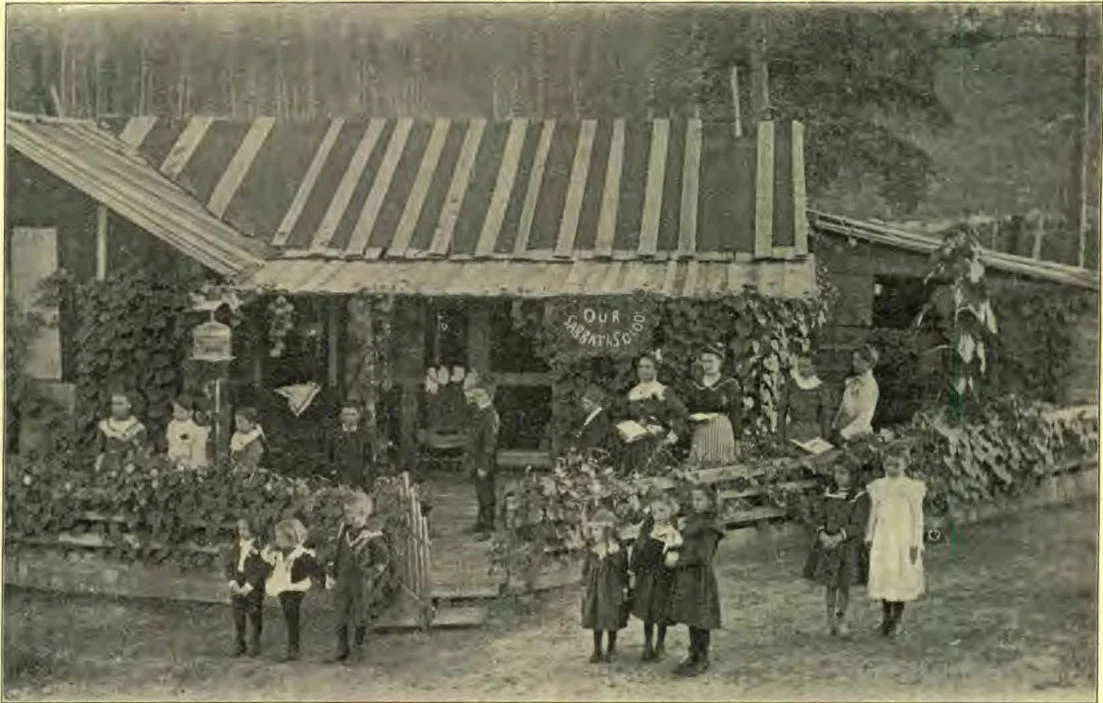
As you notice this vine-covered cottage, with its beautiful surroundings, the little children, the ladies standing near the house, and the motto, “Our Sabbath-school,” perhaps you wonder where this strange Sabbath-school is held, and how it came to be at all. I will tell you.
About three years ago, Sister Hattie Sumerix, from Lansing, moved to northern Michigan, where her husband began to work in a lumber camp in the pine woods. Soon after getting settled, she began to look around her to see what she could do for Jesus. There were none of her faith near, so she gathered a few of the children together, and began to tell them about Jesus and his love. God blessed the work, and soon there was a flourishing little school in that lumber camp. The children loved to come; and a year ago they sent a cash offering to the Haskell Home, and a letter expressing their sympathy for the homeless ones.
This sister does not have nice, fresh INSTRUCTORS to hand out to the children; but has to use second-hand papers, sometimes months old. She has never complained about this, but I have wondered if there might not be some one who would be glad to send a little club of papers to this school. (Her address is Trowbridge, Cheboygan Co., Mich.)
On Friday evenings she has a study on some phase of present truth. The Lord is blessing the effort put forth.
As I have known of the difficulties under which this sister has worked, I have wondered if many of us might not do far more if we would only labor as faithfully and perseveringly? Wherever God in his providence has placed us, let us see if we can not find something to do for Jesus.
L. G. MOORE.
THE TWO DEMONIACS AT GADARA
By W. S. Sadler
(Concluded.)
What Is Thy Name?—The question that Jesus asked, “What is thy name?” may have been directed either to the demons or to the man himself, perhaps with the intent to bring him to realize that he was an individual with an independent will, capable of acting for himself. However this may have been, the evil spirit seized the question, and answered it. Again: it may have been that the question was asked to show the one possessed what a great deliverance he was about to experience.
A Great Herd of Swine Feeding.—On the mountainside, not far from the scene of this restoration, a herd of swine was feeding. (Mark, with his usual fullness of detail, gives their number as “about two thousand.”) It was this herd of swine that the demons asked Jesus’ permission to enter. When this request was granted, panic seized the animals, and they rushed down over the cliffs, and into the sea.
And They That Fed the Swine Fled and Told It.—From the cliffs near by, the keepers of the swine observed all that had occurred, and hurriedly went to publish the news. The demoniacs had been the terror of the country, and their fear was upon all. Now, clothed and in their right mind, they were sitting at the feet of Jesus; but a greater fear seized these wicked people. They had been in fear of the demons, but now they were in fear of him who had power over demons, and they besought him to depart from their coast.
“Sitting at the feet of Jesus” is what is said of the demoniac. He heard but one sermon from the Saviour; but this, with the wonderful work that had been wrought for him, was sufficient to make him a messenger of the gospel’s glad tidings to his countrymen. But the people “began to pray him to depart.” Let us beware how we bid Jesus leave our coasts, depart from our hearts. Let us welcome him, even when he comes as a destroyer of those things which have kept us from glorifying and honoring our Father’s name. In bidding Jesus depart from their coasts these Gadarenes were but types of thousands upon thousands who seem more anxious to escape from salvation than to receive its blessings.
Besought Him That He Might Be with Him.—The petition of the sinful Gadarenes, that Jesus would depart out of their coasts, seemed to be answered, as was also that of the evil spirits; and yet the request of the restored demoniac was not granted. He prayed to go with his Master, perhaps because of fear of what the people would do to him, when he saw how hostile they were to the One who had cured him; or perhaps he feared that without the presence of Jesus the evil spirits would again take possession of him. But it was possible for this poor man, although he was denied the privilege of going with Christ, to work for Jesus in his home country. It is good to be with Christ, but far more blessed is our privilege of working for him.
Tell How Great Things the Lord Hath Done for Thee.—In sending the demoniac to his own people, Jesus would give a lesson to every Christian. Let us begin our work at home, with those nearest. As Andrew first went to work with his brother Simon, and Philip with his friend Nathanael, let us begin with those dearest to us.55This liberated soul was commissioned to go home to his friends, and to them tell the story of his personal experience,—his bondage and his salvation. He wanted to go with the Master, but Jesus had a better thing in store for him than the immediate answering of his prayers. He was to be made a missionary, to go and tell his friends what great things the Lord had done for him. While Christ himself was to leave these shores, he would not leave himself without a witness.
W. S. SADLER.
DIVISION II — PHILOSOPHY
By Dr. O. C. Godsmark
Chapter XIX (Continued) — Light
§200. THE seven distinct colors obtained by the spectrum analysis of the solar-light ray are but the different manifestations of vibration that come within the field of light. These seven colors are as follows: red, orange, yellow, green, blue, indigo, and violet. The red ray, which is the lowest form of vibration that the eye can recognize as light, is produced, to be exact, by 481,536,000,000,000 vibrations a second, giving to that ray 37,640 undulations to the inch. The yellow ray is produced by 535,000,000,000,000,000 vibrations a second, or 44,000 pulsations to the inch. The blue ray is produced by 622,000,000,000,000 vibrations a second, equaling 51,110 vibrations to the inch; while the violet, or highest form of light, is produced by 722,304,000,000,000 vibrations to the second.
§201. When we get above the violet ray in the scale of vibration, we enter the field of electricity, and have to depend upon the sense of touch to distinguish the various vibrations, rather than upon the sense of sight or hearing. Just as the field of heat lies above that of sound, and the scope of light lies above that of heat, overlapping and commingling with it, so the sphere of electricity lies above that of light, only that it is distinct therefrom and does not overlap, or commingle, with light, as we shall learn further on.
§202. Inasmuch as electricity is a higher form of vibration than light, we find it more rapid in its flight through space. Electricity travels at the rate of 288,000 miles a second, while light travels only 192,000 miles in the same length of time. Sound travels, on an average, 1,142 feet a second, though this rate varies according to atmospheric conditions. A rifle ball travels at the rate of 1,466 feet a second.
§203. The special point we wish to emphasize in this present study is that the change in vibration from one tone to another, or from one ray of light to another, is not abrupt, but a gradual blending from the one to the other; that is, if the number of vibrations forming the red ray be slowly increased, we find it gradually blending into the next higher order of light,—the orange ray; this, in turn, will change to the yellow; and this to the next higher order until we pass through all seven of the primary solar colors by merely increasing the number of vibrations a second. The change is not abrupt; but one color merges, or blends, beautifully into the next in order.
§204. This same blending is true in the field of sound, and may be illustrated in the following manner: With a violin properly tuned and in position, carefully draw the bow over any of the open strings, say the D string. Then by pressing the same string with the forefinger in the proper place, and again drawing the bow across the string, the tone known as E is heard. What have we done?—By pressing the string against the fingerboard, we have shortened the string sufficiently to increase the number of the vibrations a second so that the next higher tone, in the scale is produced. Now let us change the experiment. Place the finger as low down as possible on the same string, and while drawing the bow as before, gradually slide the finger up the string to that point where it was first placed to produce the tone E. Thus one tone is gradually merged into another, instead of passing directly from one tone to the next higher.
This same sliding up and down—raising and lowering the number of vibrations a second—may be seen in all phases of vibratory manifestation, whether they be in the range of sound, heat, or light, and is, we shall find, a most important factor in our understanding of the great truths of astronomy.
Questions
Name, in their order, the seven primary colors of which light is composed. What is the lowest form of vibration recognized by the eye? How many vibrations a second produce this color? What is the highest form of light which the eye recognizes? Give the number of vibrations a second producing this color. What form of vibration lies next above that of light? What is the velocity of electricity? Of light? How does this compare with the velocity of sound? As the vibrations in the field of light are increased or diminished, is the change from one color to another abrupt or gradual? How is this in the field of sound? Illustrate.
DR. O. C. GODSMARK.
2005 Magazine St., Louisville, Ky.
A WISE MOTTO
The other day, as I was clinging to the strap of a Lexington avenue car, says a writer in the Christian Advocate, two ladies sat near me, and as one opened her purse to pay her fare, a scrap of paper pasted to the leather was disclosed.
“Is that your shopping list?” asked the other; “it doesn’t look like a long one.”
“No,” was the reply, “it is not the list, but it is what keeps the list from being a long one,” and she read:—
“He who buys what he does not need, will soon need what he can not buy.”
“What a capital guardian of your capital! You must let me copy that for my leaky purse. Who wrote it?”
“I don’t know, but I wish I did; for he has saved many a dollar from lightly rolling from my hands since I put it here.”
I was interested in the conversation, for at that very moment there lay in my note book a scrap which I would have brought forth but for the fact that my own corner was reached.
I publish it; for if the truth which it contains were assimilated, many a pocketbook would remain a pocketbook:—
“We are ruined, not by what we really want, but by what we think we do: therefore, never go abroad in search of your wants. If they be real wants, they will come home in search of you; for he that buys what he does not want will soon want what he can not buy.”
Patience as the Ballast of the Soul
PATIENCE is the ballast of the soul, that will keep it from rolling and tumbling in the greatest storm.—Bishop Hopkins.
PARABLE OF THE VINEYARD
(February 22)*
MEMORY VERSE: “I am the true vine, and my Father is the husbandman.”
33. Hear another parable: There was a certain householder, which planted a vineyard, and hedged it round about, and digged a wine-press in it, and built a tower, and let it out to husbandmen, and went into a far country:
34. And when the time of the fruit drew near, he sent his servants to the husbandmen, that they might receive the fruits of it.
35. And the husbandmen took his servants, and beat one, and killed another, and stoned another.
36. Again, he sent other servants more than the first: and they did unto them likewise.
37. But last of all he sent unto them his son, saying, They will reverence my son.
38. But when the husbandmen saw the son, they said among themselves, This is the heir; come, let us kill him, and let us seize on his inheritance.
39. And they caught him, and cast him out of the vineyard, and slew him.
40. When the lord therefore of the vineyard cometh, what will he do unto those husbandmen?
41. They say unto him, He will miserably destroy those wicked men, and will let out his vineyard unto other husbandmen, which shall render him the fruits in their seasons.
42. Jesus saith unto them, Did ye never read in the scriptures, The stone which the builders rejected, the same is become the head of the corner: this is the Lord’s doing, and it is marvelous in our eyes?
43. Therefore say I unto you, The kingdom of God shall be taken from you, and given to a nation bringing forth the fruits thereof.
44. And whosoever shall fall on this stone shall be broken: but on whomsoever it shall fall, it will grind him to powder.
45. And when the chief priests and Pharisees had heard his parables, they perceived that he spake of them.
46. But when they sought to lay hands on him, they feared the multitude, because they took him for a prophet.—Matt. 21:33–46.
Synopsis
In the parable of the Two Sons, Christ set before the Jewish leaders an important lesson in obedience. They hated to hear such pointed teaching, but remained silent, hoping that Jesus would say something whereby they might condemn him. Closely they followed the Saviour in the story of The Vineyard, and not considering its relation to themselves, answered, “He will miserably destroy those wicked men.” They were the wicked husbandmen, and unwittingly they had pronounced their own doom. As soon as they realized what they had done, they involuntarily exclaimed, “God forbid.” “Did ye never read,” said the Saviour, “that the stone which the builders rejected, the same is become the head of the corner?” Those men that stood there ready to kill the Son of God that they might seize the inheritance, were soon to lose their kingdom, which was to be given to a nation bringing forth the fruits thereof.
Questions
1. After giving the parable of the Two Sons, how did Christ further instruct the priests and elders?
2. Who planted this vineyard?
3. How was it protected?
4. What was the wine-press for? the tower? See note.
5. What do these terms represent,—householder, vineyard, hedge, and tower? See quotations.
6. To whom did the householder let his vineyard out?
8. At the proper season, whom did he send to receive the fruit?
9. How was the servant treated?
10. What other servants were sent?
11. What did the husbandmen do to them?
12. What last effort did the householder make to get his fruit?
13. What thought prompted him to do this?
14. But when the husbandmen saw the son, what did they say?
15. What did they do? With what object in view?
16. At this point in the parable what searching question did Christ put to the chief priests and elders?
17. What answer did they give to it?
18. Realizing that they had pronounced their own doom, what did they involuntarily exclaim? Luke 20.
19. Of what did Christ then remind them?
20. What was to be the result of their rejection of that chief corner stone?
21. What will that stone do for one? See quotation 3.
22. When the Pharisees heard the parable, what did they perceive?
23. Why did they not do what they had in mind?
Note
In olden time every vineyard had its tower. Here the keeper stayed and watched his fruit, thus protecting it from raids of the enemy. In the parable, the tower is a symbol of the temple, the place where God dwelt and cared for his vineyard, the house of Israel.
Quotations
1. “In the parable, the householder represented God, the vineyard the Jewish nation, and the hedge the divine law which was their protection. The tower was a symbol of the temple.”—“Desire of Ages.”
2. “To fall upon the Rock and be broken is to give up our self-righteousness, and go to Christ with the humility of a child, repenting of our transgressions, and believing in his forgiving love.”—Id., page 599.
3. “In quoting the prophecy of the rejected stone, Christ referred to an actual occurrence in the history of Israel. The incident was connected with the building of the first temple. While it has a special application at the time of Christ’s first advent, and should have appealed with special force to the Jews, it has also a lesson for us. When the temple of Solomon was erected, the immense stones for the walls and the foundation were entirely prepared at the quarry; after they were brought to the place of building, not an instrument was to be used upon them; the workman had only to place them in position. For use in the foundation, one stone of unusual size and peculiar shape had been brought; but the workmen could find no place for it, and would not accept it. It was an annoyance to them as it lay unused in their way. Long it remained a rejected stone. But when the builders came to the laying of the corner, they searched for a long time to find a stone of sufficient size and strength and of the proper shape to take that particular place and bear the great weight which would rest upon it. Should they make an unwise choice for this important place, the safety of the entire building would be endangered. They must find a stone capable of resisting the influence of the sun, of frost, and of tempest. Several stones had at different times been chosen, but under the pressure of immense weights they had crumbled to pieces. Others could not bear the test of the sudden atmospheric changes, but at last attention was called to the stone so long rejected. It had been exposed to the air, to sun and storm, without revealing the slightest crack. The builders examined this stone. It had borne every test but one. If it could bear the test of severe pressure, they decided to accept it for the corner stone. The trial was made. The stone was accepted, brought to its assigned position, and found to be an exact fit. In prophetic vision, Isaiah was shown that this stone was a symbol of Christ.”—Id., pages 597, 598.
4. “And on whomsoever it shall fall, it will grind him to powder.” . . . What was it that destroyed the Jews?—It was the rock which, had they built upon it, would have been their security. It was the goodness of God despised, the righteousness spurned, the mercy slighted.”—Id., page 600.
SHORTHAND BY MAIL
Your spare time can be well improved by studying shorthand, and this can be done at small expense to you by taking a mail course at your home. We are using “The Rogers Compendium of the Graham System of Shorthand,” a method arranged especially for home study, and giving an epitome of a system of shorthand acknowledged to be the best, the briefest, and the most complete. The only presentation of Standard Phonography in which all shorthand outlines are written as first learned, thus greatly abbreviating the work on the part of the student. A complete course in thirty lessons, illustrated by facsimile notes, with key. The correction of all students’ papers given special attention by experts. Reasonable tuition rates. If interested, write for full particulars. Practicing stenographers wishing to prepare for rapid reporting work should secure the last twenty lessons.
FIRESIDE CORRESPONDENCE SCHOOL,
Battle Creek, Mich.
GRAND TRUNK R'Y SYSTEM.
By W. C. Cunliffe
Taking Effect June 2, 1901.
Trains leave Battle Creek.
WEST-BOUND.
No. 9, Mail and Express, to Chicago. 12.15 P. M.
No. 7, Limited Express, to Chicago. 7.10 A. M.
No. 3, Lehigh Valley Express, to Chicago. 3.50 P. M.
No. 5, International Express. 2.17 A. M.
No. 75, Mixed, to South Bend. 7.30 A. M.
Nos. 9 and 75, daily, except Sunday.
Nos. 3, 5, and 7, daily.
EAST-BOUND.
No. 10, Mail and Express, East and Detroit. 3.45 P. M.
No. 8, Limited Express, East and Detroit. 4.14 P. M.
No. 4, Lehigh Express, East and Canada. 8.22 P. M.
No. 6, Atlantic Express, East and Detroit. 2.10 A. M.
No. 2, Express, East and Detroit. 7.00 A. M.
No. 74, Mixed (starts from Nichols yard). 7.15 A. M.
Nos. 10 and 74, daily, except Sunday.
Nos. 4, 6, 8, and 2, daily.
W. C. CUNLIFFE, Agent,
BATTLE CREEK.
The Rarer Grace of Willingness to Obey God
By Professor Drummond
It requires a well-kept life to do the will of God, and even a better-kept life to will to do his will. To be willing is a rarer grace than to be doing the will of God. For he who is willing may sometimes have nothing to do, and must only be willing to wait; and it is easier far to be doing God's will than to be willing to have nothing to do: it is easier far to be working for Christ than it is to be willing to cease. No, there is nothing rarer in the world to-day than the truly willing soul, and there is nothing more worth coveting than the will to will God's will. There is no grander possession for any Christian life than the transparently simple mechanism of a sincerely obeying heart.—Professor Drummond.
Advocate of Christian Education February Number Review
The Advocate of Christian Education for February is a valuable number for every Sabbath-school teacher as well as for the church-school teachers. To be sure, there is a special department for the Sabbath-school teacher; but it would be a poor teacher who could not find in other parts of the magazine that which would be of the greatest help in his work on the Sabbath.
The Advocate is published at Berrien Springs, Mich., under the auspices of the Educational Department of the General Conference. Price, in clubs of two or more, forty cents a year; single copies, fifty cents; to foreign countries, seventy-five cents. Address all orders and make all checks payable to the Advocate, Berrien Springs, Mich.
Pronunciation of Hawaii and Honolulu
“HA-wy-EE,” with the accent on the second syllable, is the pronunciation for Hawaii, as given in a recent Honolulu newspaper. The same authority declares that the name Honolulu should be pronounced “Ho-no-lulu,” with the accent on the “Ho.”