MR. WILSON, by careful attention to the details of a thriving business, had acquired much wealth, and the social and scenic advantages and pleasures it could procure. Among many sources of pleasure there were none that seemed to fill so large a place in the estimation of his wife, at least, as that of a fine naphtha launch, in which the family, attended by servants, made many a cruise upon beautiful inland lakes and rivers, until every babbling, stony-bedded brook, cascade, or bubbling spring, shaded by balmy cedars and firs, were known and visited again and again.
But, at length, from constant familiarity, they became satiated with this source of pleasure, and began to give expressions of jealous feelings because the Browns owned a little larger and more finely-trimmed launch than their own.
Mrs. Wilson had had the advantages of an early Christian training by a pious mother, long now deceased; but she had seemingly, amidst wealth and pleasure, forgotten nearly all its principles, and had become, in nearly every respect, a woman of the world. But sometimes there would come an inspiration to her soul from the long ago, like the corruscations of an electric light, only, from disuse, to fade away again into oblivion.
One day, however, there came an inspiration of this kind, that would not be put down, "Even the Son of man came not to be ministered unto but to minister." It seemed as if an angel voice kept repeating it in her mind; and she thought: "Am I better than Jesus, that I should allow others to serve me, and minister to my pleasure, while I, who am so able to help others, should do next to nothing of the kind? But how can I minister to others? I'm sure I would like to if I knew how." Just then this text of Scripture, that she had learned when a child, came to her mind: "When thou makest a feast, call the poor, the maimed, the lame, the blind; and thou shalt be blessed; for they can not recompense thee; for thou shalt be recompensed at the resurrection of the just."
One day she said to Mr. Wilson, "Husband, can I have the launch to-morrow, to do as I please with her?"
"O, yes," said he laughingly, "only on condition that you don't sink, sell, or burn her! And, by the way, as a precautionary measure, I insist that John, our trusted engineer and pilot, shall not relinquish his care of the boat, altho you may be the captain in control of her movements."
The conditions being perfectly satisfactory, Mrs. Wilson sent out invitations to a ride in the launch.
First she invited the Widow Day and her four children, ranging in ages from five to twelve years. They had never taken a trip to a lake resort, even in a crowded, cheap excursion. The widow had known nothing but hard work and penury. The widow's boys thought this was the grand event of their lives. Nothing could be thought of, or talked about, but the proposed trip aboard the beautiful "Swan."
Next, Mr. Jennings, a lame man, aged and in feeble health, and cared for, not any too kindly, by relatives, was invited.
Mr. Baxter and family were also invited. Mrs. Baxter was just recovering from a long illness, and doubted her ability to endure the trip; but, encouraged by friends, she decided to undertake it.
Several others were invited, and, at first, Mrs. Wilson thought she would send her housemaid to look after the company; but then she thought again that Jesus did not do that way, but ministered to the needy Himself; and surely she was not as good or worthy as Jesus was.
So she decided to go with the company, "just to see how they would act." Not to make it seem too much of a charity excursion, she invited a young lady of a wealthy neighbor's family, to join them; and by her tact she inspired the belief that it was just an ordinary good neighborly feeling that prompted the "basket picnic."
Of course each family and person thought they would have to provide for themselves, which was poor enough for some of them. But Mrs. Wilson took aboard some big baskets, bulging with something, hidden by drapery that excited half-concealed speculation among the children.
Well, the start was at length made; and the boys said that the first stopping-place must be "Liverpool." But, on landing, Mary said it could not be Liverpool, for there was no river there. "Yes," said John, pointing to a little rill, "that's the M-e-r-e-y." "No," said Nellie, "that isn't the way it's spelled; it's M-e-r-e-e-y."
The next landing-place was to be "Calcutty."
"A funny Calcutta this," said Mary, "with a tangle of vines, and cedars, and just a spring of cold water." Then followed a discussion concerning the Indian metropolis, its people, and customs, and the celebrated river Ganges.
The next stopping-place was to be for dinner, and Will said, "That must be Chicago." All laughed at the sudden transition of the little vessel to the opposite side of the earth.
At length they landed at "Chicago," where they had a great rock for a table, densely shaded by cedars and vines, while a cascade of pure, sparkling water, near by, seemed to cool the balmy air.
The snow-white cloth was spread, and Mrs. Wilson's "mystery baskets," as the boys had secretly called them, were opened, and their contents spread upon the "table,"—the most delicious fruits and other viands, the boys thought, that they had ever seen.
Mrs. Jennings gave thanks to God, the bountiful Giver of the blessings they were enjoying, and especially prayed for the lady who had made the happiness of that day possible. Tears came to Mrs. Wilson's eyes, but they were those of awakening tenderness toward Jesus, and those for whom He had died. Mr. Jennings told them about the beautiful new earth, and drew attention to the beauties around them, that made them so happy, and told them that they were mementoes of the earth as it was in the beginning, and promises of what it will be by and by, when the burdens and sorrows of mortality will be lost in everlasting life.
On the return voyage a sudden storm arose, and the lake became very rough; but, while some were much excited, Mrs. Wilson, for the first time in her life, on such an occasion, was calm and happy; for she remembered Jesus in the ship, on storm-tossed Galilee, and felt, somehow, that He was with her in her danger; for did not an almost audible voice say to her, "Inasmuch as ye did it unto the least of these, ye did it unto Me"? She had found her Saviour.
Other wealthy people became interested in Mrs. Wilson's enterprise, and copied her example, and learned the lesson that the chief happiness of this life consisted in making others happy, and that no blessing was so satisfying and no prayer in their behalf so prevailing as those of the widow, the fatherless, and the poor, whom they befriended. A. SMITH. Grandville, Mich.
THE STIMULANT DELUSION.
By David Paulson, M.D.
THE mistake many people make when they begin to feel run down and exhausted all the time is that they want to get something to "brace them up." It is a delusion and a snare to try to put something into a man to bring something out of him that is not there. The nerve energy must be built up. We often hear it said that a man has a "torpid liver." There is no such thing as a torpid liver—it is nothing but a tired liver. We may take a drug to whip up that tired liver and make it do more work for a time, just as a man will whip up a tired horse to make him pull more. He may pull a little farther, but it does not put any more strength into him to whip him.
You all know something about a mortgage. It gives a person for the time being some ready cash; but a mortgage can be foreclosed. So we may get a mortgage for a time on nature's forces, but the time comes when this mortgage must be foreclosed. In a similar manner, thousands of people all around us are foreclosing their mortgages now.
We may illustrate this subject in another way. Just think of an ordinary drinking tank full of water, and let that represent the nervous system full of energy. The water, you see, is running out of the faucet in a perfect stream. So with multitudes of young people; they seem to have plenty of nerve energy, and they plunge into various lines of dissipation, and13when remonstrated with, the answer is, "It does not hurt me in the least." But days of folly and nights of dissipation continue, and the nerve energy begins to run low; the day of reckoning is coming on apace. At last the water in the tank gets so low that instead of running out in a perfect stream, it is a mere dribble. Finally, it will not run out at all, although there is a little water left below the faucet. We can get that water to run again. By introducing a siphon tube, you can begin to draw off the remainder of the water, but by and by the bottom is reached, and the day of reckoning has come. So it is with the man who gets all tired and worn out; he feels that he can not go any farther. He says he must have something "to tone him up;" and he goes over to the drug store and gets a little strychnine or caffeine, or his wife makes the coffee a little stronger, and thus the tired nerves are whipped up by these poisonous drugs to go on a little longer, just as the siphon, introduced into the water tank, secured the rest of the water. The man feels better. He will say: "Why, how that built me up! I am just getting along beautifully." He thinks he is getting ahead of nature.
Now, we all make mistakes, even expert accountants sometimes make mistakes, but be assured nature does not make mistakes. She deals with unerring accuracy and never forgets the injuries done her. "Whatsoever a man soweth, that shall he also reap."
The only legitimate way to get nervous energy is to eat proper food, to take proper exercise, breathe an abundance of heaven's pure air, and in other ways live in harmony with nature's laws. Under those circumstances God imparts to us day by day His strength, and we may realize in our lives the promise, As our days are, so shall our strength be.
DAVID PAULSON, M.D.
Battle Creek, Mich.
WILL YOU RECEIVE HIM?
By Harry Armstrong
SUPPOSE some day unto your door
A friend should come so very poor,
And he should ask for bread,
What would you do? Ah, you would say,
"Come in, my friend, for you, this day,
Shall at my house be fed"!
Suppose, again, a little child
Should come to you with face so mild,
And plead your tender care,
What would you do? Ah, you would say,
"Come in, my child, for you, this day,
My home and love shall share"!
And now, suppose that Jesus came
Unto your heart, so full of shame,
To cleanse it from all sin,
What would you do? Ah, would you say,
"Come in, Lord Jesus, and to-day
Thy holy work begin"?
Or would you coldly from Him turn,
And all His tender mercies spurn,
And closer shut the door?
O, if thy heart could only see
Its need, methinks 'twould be for thee
His mercy to implore!
Remember, when, by Adam's fall,
The sentence, "Death," was passed on all,
He came and took your place;
And now to-day He humbly stands,
Inviting you, with outstretched hands.
Will you receive His grace?
—Harry Armstrong.
"PULLING EVEN."
By Cora S. Day
JERRY AND DICK were two brown horses who lived out in the country on Mr. Stratton's farm. In the winter time they did not have much to do, but when spring came they were busy every day, helping their master get the broad fields ready for the seeds. Then, when haying time came, they were harnessed to the big farm wagon, and drew load after load of hay to the barn. There the sweet-smelling clover, which they liked so well, was stored away in the lofts for winter.
Any one looking at the two horses would have said they were just alike. But if you had asked Farmer Stratton he would have shaken his head, and answered at once:—
"O, no, Jerry is the best worker! Dick is just as strong and able to pull as Jerry, but he is not so willing. If I don't watch them when they are working together, Jerry does all the work, and Dick shirks. To make them work even, I have to urge Dick and hold Jerry back."
Jerry and Dick are only horses, and, of course, can not be expected to understand the right and wrong of the question. But I wonder if boys and girls always "pull even"! You know there is work for us all in this world, and if we don't do our own work—if we shirk—some one else must do our work, or it will go undone. I suppose Dick was quite willing to eat his share of the hay that was brought in. Don't you think it would be fairer if he did his share of the pulling?
I am sure you see the point, and, if you remember Jerry and Dick, I think you will need no urging to do your work and that you will not be so unfair as to let another do your work and his own, too, but will "pull even."
—Cora S. Day.
TWO WAYS.
IN these days, when so many sincere people are trying to help their weaker brothers, this incident, true in every detail, may have its significance and use:—
Three years ago, the pastor of a city church appealed to the members of his congregation to take a more active part in helping the poor and the criminal classes. The next day two young married women, wealthy and gently bred, went to him in response to his appeal. He sent them to the women's ward of the city prison. They went together, separated after being taken to the ward by an attendant, and in an hour or two met again at the gate.
"Tell me how you were received and what you did," said Mrs. C. anxiously. She was a timid, diffident woman.
"The work is, of course, new to me," said Mrs. V., "and I know nothing of the habits and minds of these women, nor what would appeal to them. The gulf between us seems so wide that I concluded the more direct and plain I made my condemnation of their evil habits of conduct the better.
"At the window of each cell I spoke kindly but firmly to the occupant, and told her I had come to talk about her life and its sinfulness. One of them was stolid and dumb. Two were really abusive. I do not feel sure that one of the four or five with whom I talked was impressed by the truths I told her.
"I shall come again," she continued, "but I believe it to be useless. Between us and them there certainly is a great gulf, and I do not see how it is to be covered."
The two women walked in silence for a while, and then Mrs. V. said:—
"What did you do?"
"O, so little!" exclaimed the other. "I only went to one cell. I saw a poor woman who had been convicted of larceny. Her defense was that her child was starving, and so her sentence was light. When I saw her, I thought I might be where she is if God had given me poverty and a hungry child—"
"Ridiculous!" said Mrs. V. indignantly. "You could never have been a thief!"
"God only knows. At any rate, I could not preach to her. So I only talked of her child, and told her about my little Jack, and said how sorry I was she could not be with her baby. I am going to see it, and I shall go to-morrow to tell her about it."
Mrs. V. visited the prison twice after this first interview, and lectured the women, but, finding that she was received coldly, she abandoned them, and ever after spoke of the criminal classes as "hopeless."
Mrs. C. looked after the poor baby while its mother was in prison. When the woman was released, she took her into her house, contrary to Mrs. V.'s advice, and gave her work and a home.
"I can not think she will steal from me," she said smiling. She taught and watched over her as tenderly as a sister.
The poor thief is now a member of the church, earnest and hopeful in her struggle to do right, and to make a good man of her boy.
We can not stand upon a height and order our brother out of vice.
Christ, let us remember, when He blessed the weak and helped the wicked, first laid His loving hands upon them.—Exchange.
Fall Catalog Announcement
By Editor
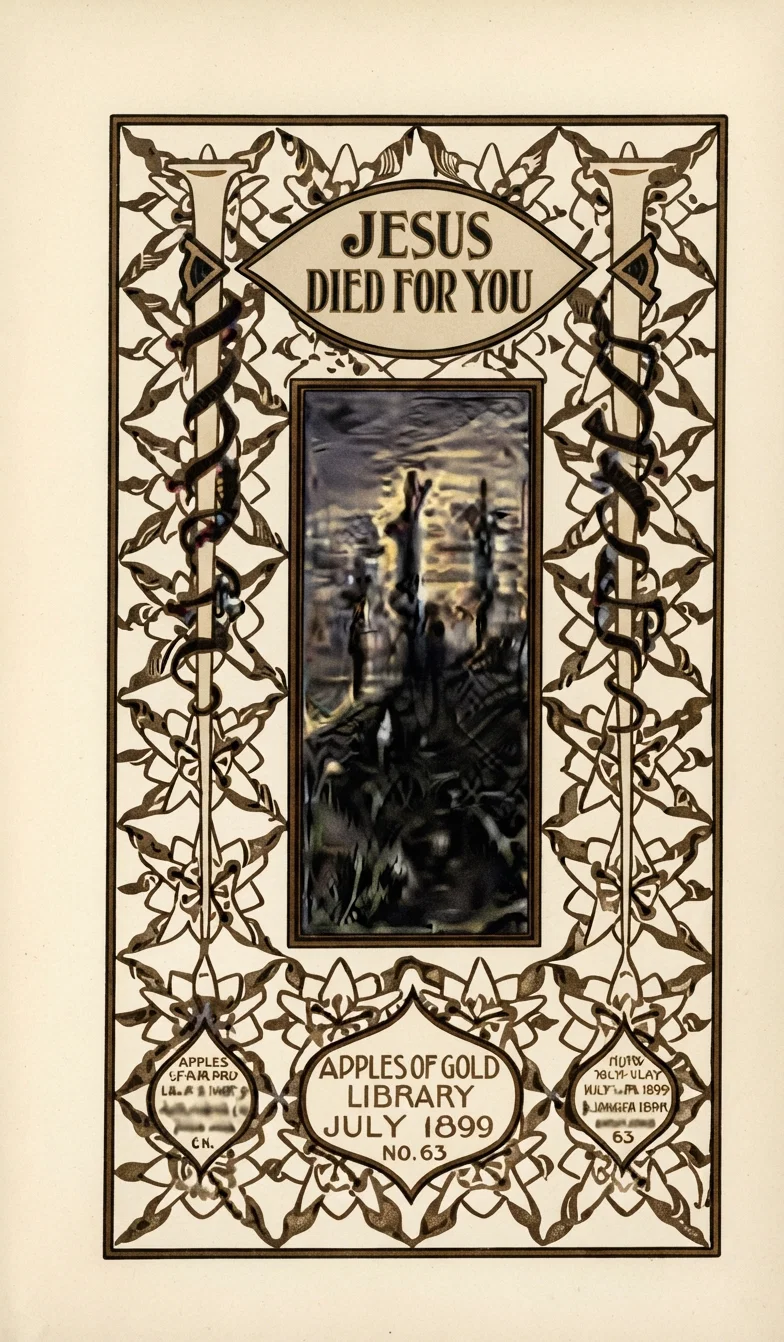
The above is a facsimile of the original design which will appear on the first cover page of our Fall Catalog. The fourth cover of this Catalog contains a calendar for the last three months of 1899 and the first three of 1900. It will be ready October 1, and will be sent free to applicants
Jesus Died for You
By Editor
Reduced cover page
This is the title of the new number (No. 63) of the APPLES OF GOLD LIBRARY written by Mrs. Luella L. Harmon. It is a Christ-filled appeal to sinners to yield themselves to Him who died for them. It is well calculated to soften and subdue hearts, and to do good wherever circulated.
Date of publication is Friday, Sept. 22
Price, 50 cents per hundred
PACIFIC PRESS PUBLISHING CO.
Oakland, California
39 Bond St., New York City
18 W. 5th St., Kansas City, Mo.
6 "Now WHEN JESUS was in Bethany, in the house of Simon 7 the leper, there came unto Him a woman having an alabaster cruse of exceeding precious ointment, and she poured it upon His head, as He sat at meat."
14 "Then one of the twelve, who was called Judas Iscariot, 15 went unto the chief priests, and said, What are ye willing to give me, and I will deliver Him unto you? And they weighed 16 unto him thirty pieces of silver. And from that time he sought opportunity to deliver Him unto them."
3 "And while He was in Bethany in the house of Simon the leper, as He sat at meat, there came a woman having an alabaster cruse of ointment of spikenard very costly; and she 4 brake the cruse, and poured it over His head. But there were some that had indignation among themselves, saying, To what 5 purpose hath this waste of the ointment been made? For this ointment might have been sold for above three hundred pence, 6 and given to the poor. And they murmured against her. But Jesus said, Let her alone; why trouble ye her? she hath 7 wrought a good work on Me. For ye have the poor always 8 with you, and whensoever ye will ye can do them good; but 9 Me ye have not always. She hath done what she could; she hath anointed My body aforehand for the burying. And verily I say unto you, Wheresoever the Gospel shall be preached throughout the whole world, that also which this woman hath done shall be spoken of for a memorial of her.
10 "And Judas Iscariot, he that was one of the twelve, went away unto the chief priests, that he might deliver Him unto 11 them. And they, when they heard it, were glad, and promised to give him money. And he sought how he might conveniently deliver Him unto them."
1 "Jesus therefore six days before the Passover came to Bethany, where Lazarus was, whom Jesus raised from the dead. 2 So they made Him a supper there; and Martha served; but Lazarus was one of them that sat at meat with Him."
4 "But Judas Iscariot, one of His disciples, which should be 5 betray Him, saith, Why was not this ointment sold for three 6 hundred pence, and given to the poor? Now this he said, not because he cared for the poor; but because he was a thief, and having the bag took away what was put therein."
9 "The common people therefore of the Jews learned that He was there; and they came, not for Jesus' sake only, but that they might see Lazarus also, whom He had raised from the 10 dead. But the chief priests took counsel that they might put 11 Lazarus also to death; because that by reason of him many of the Jews went away, and believed on Jesus."
NOTE.—The texts inclosed in marks of parentheses, while not essential to the lesson study, will be found to throw much light upon the lesson, and are suggested for those who wish to study further.
When may we bestow gifts on them? V. 7. (Deut. 15:11.)
How did Jesus say this gracious act should be kept in remembrance? Verse 9.
When the Jews learned that Jesus was at Bethany what did they do? For what purpose? John 12:9.
How did this curiosity about Lazarus make the chief priests feel? Verse 10. (Luke 16:31.)
For what reason did they feel thus? V. 11. (Verses 17-19.)
After receiving his rebuke for calling the anointing of Jesus a waste, what did Judas do? Matt. 26:14, 15. (Zech. 11:12.)
How did the priests feel when Judas made known his errand? Mark 14:11.
Altho still professing to be a disciple of Jesus, what did Judas do from that time forward? Matt. 26:16.
Side Lights.—"Desire of Ages," chapter 62; "Spirit of Prophecy," vol. 2, chapter 32.
NOTES.
1. Came unto Him a woman.—Some have concluded that the anointing of Jesus recorded in Luke 7:36-50, and the one described in Matt. 26:6-16, are the same, because in "Desire of Ages" and in "Spirit of Prophecy," vol. 2, the two accounts are blended in one. This is not a necessary conclusion, because we find similar events spoken of in the same connection in the Scriptures, as tho they were one and the same, and yet they were far removed from each other in point of time. The prophecy of the destruction of Jerusalem and the second coming of Christ, as recorded in Matthew 24, is an example.
2. Precious ointment.—This was the costliest anointing oil known. It was made from an Indian plant, and sold throughout the Roman Empire at fabulous prices. It was a common thing to anoint the heads of rabbis, and special guests at marriage feasts, with fragrant oil, but this surpassed anything in that line then known. Her great sacrifice revealed the depth of Mary's love for her Master. Reckoning according to the standard of that day, this was more than £10, or about $50.
1 "AFTER these things did King Ahasuerus promote Haman the son of Hammedatha the Agagite, and advanced him, and 2 set his seat above all the princes that were with him. And all the king's servants, that were in the king's gate, bowed down, and did reverence to Haman: for the king had so commanded concerning him. But Mordecai bowed not down, 3 nor did him reverence. Then the king's servants, that were in the king's gate, said unto Mordecai, Why transgressest 4 thou the king's commandment? Now it came to pass, when they spake daily unto him, and he harkened not unto them,15that they told Haman, to see whether Mordecai's matters 5 would stand; for he had told them that he was a Jew. And when Haman saw that Mordecai bowed not down, nor did 6 him reverence, then was Haman full of wrath. But he thought scorn to lay hands on Mordecai alone; for they had showed him the people of Mordecai; wherefore Haman sought to destroy all the Jews that were throughout the whole kingdom of Ahasuerus, 7 even the people of Mordecai. In the first month, which is the month Nisan, in the twelfth year of king Ahasuerus, they cast Pur, that is, the lot, before Haman from day to day, and from month to month, to the twelfth month, 8 which is the month Adar. And Haman said unto King Ahasuerus, There is a certain people scattered abroad and dispersed among the peoples in all the provinces of thy kingdom; and their laws are diverse from those of every people; neither keep they the king's laws; therefore it is not for the king's 9 profit to suffer them. If it please the king, let it be written that they be destroyed; and I will pay ten thousand talents of silver into the hands of those that have the charge of the king's business, to bring it into the king's treasuries. 10 And the king took his ring from his hand, and gave it unto Haman 11 the son of Hammedatha the Agagite, the Jews' enemy. And the king said unto Haman, The silver is given to thee, the people also, to do with them as it seemeth good to thee."
Golden Text: "If God be for us, who can be against us." Rom. 8: 31.
SUGGESTIVE QUESTIONS.
(1) What is the historical setting of the book of Esther? Note 1. (2) Mention the points of interest in connection with it. (3) After Mordecai's service to the king what did Ahasuerus do? V. 1. (4) How did the king's servants regard Haman? and why? How did Mordecai regard him? V. 2. Note 2. (5) What question was asked Mordecai? V. 3. (6) When Mordecai persisted in his refusal to honor Haman, what did the king's servants do? and why? V. 4. (7) How did Mordecai's course affect Haman? V. 5. (8) What did Haman purpose to do? V. 6. Note 3. (9) What steps were taken by Haman? V. 7. Note 4. (10) How did Haman describe the Jews to the king? V. 8. Note 5. (11) What request and proposition did Haman make the king? V. 9. Note 6. (12) How did the king respond? V. 10. Note 7. (13) How full a commission did the king give to Haman? V. 11. (14) When was Haman's will embodied in law? Note 8.
NOTES.
1. Book of Esther.—The Ahasuerus of Esther is the Xerxes of history. The story told in this book belongs to the fifty-eight years between Ezra 7 and 8, between B.C. 515 and B.C. 458, or more nearly in the middle of Xerxes' reign, B.C. 485 to 474, about threescore years after the first return of Ezra, two-score years after the completion of the temple. Xerxes' third year (Esther 1:3) B.C. 482; Esther made queen in his seventh year (2: 16), B.C. 478; Haman's plot in his thirteenth year, B.C. 472.
The book opens with a magnificent description of the great Persian Empire, with its 127 provinces; of the six months' great international exposition held in his third year; of his drunken demand for the exposure of Vashti's beauty, and her virtuous refusal; of her deposition; of the search for a new favorite; of Mordecai and Esther, and her acceptance by the king; and of God's overruling providence in using Mordecai to save the king from a conspiracy against his life. Here our lesson begins.
2. Bowed not.—He could not bow to a man as God; and it is not unreasonable to suppose that Haman was an Amalekite, a descendant of Agag the king. The Amalekites were the most bitter enemies of the Lord. See 1 Samuel 15.
3. All the Jews.—He would scorn to put one man to death. Mordecai had insulted him as a Jew; all the nation must die.
4. They cast Pur.—"Pur" means lot; that is, they consulted by their idolatrous practises, by sacrifices, by a flight of birds, or the entrails of beasts, for a favorable day for asking the king's permission. God interposed in His providence to put it off for nearly a year, to give Esther and His people time.
5. Laws diverse.—They kept God's law. Altho neither God nor His worship is mentioned in this book, doubtless for fear of the Persians, it is clear that the Jews were not worshipers of idols. Their laws were diverse from all peoples. They kept God's law, and this diversity, tho no damage to his kingdom, was used to prejudice the king against them.
6. Ten thousand talents of silver.—Estimated at from $10,000,000 to $20,000,000. Haman was doubtless a rich man, but he would have secured as much or more than this in spoiling the Jews.
7. His ring, containing the king's official seal, conveying to the wicked plotter royal authority. Ahasuerus acted with his characteristic rashness and folly. The silver is given thee (verse 11) may refer to the spoil of the Jews, or the silver offered by Haman.
8. Haman's cruelty was promulgated as law on the thirteenth day of the first month, a year from his first knowledge of Mordecai's insult. The decree was published in every province that on the thirteenth day of the twelfth month all, old and young, little children and women, were to perish. Our next lesson will show how God can overrule all things.
COVER YOUR OWN UMBRELLA
Don't throw away your old one—make it new for $1.00. Recovering only takes one minute. No sewing. A clumsy man can do it as well as a clever woman.
TEN DAYS' FREE TRIAL.
Send us $1.00 and we will mail you, PREPAID, a Union Twilled Silk, 26-inch "Adjustable Roof" (28-inch, $1.25; 30-inch, $1.50). If the "Roof" is not all you expected, or hoped for, return AT OUR EXPENSE and get your money back by return mail—no questions asked.
WHAT TO DO.—Take the measure (in inches) of your old umbrella. Count the number of outside ribs. State if the center rod is of steel or wood. Full instructions for putting on the cover will be sent with all orders. Our special price-list of different sizes and qualities mailed on request.
Send for our free book, "Umbrella Economy," anyway. Your umbrella will wear out some day, and you will be glad that you know about
THE JONES-MULLEN CO., 396-398 Broadway, New York
The Walla Walla College
Offers Practical Courses for those who wish to prepare for MINISTERS
NURSES
BIBLE WORKERS
MUSICIANS
TEACHERS
MEDICAL
MISSIONARIES
COMMERCIAL
WORKERS
STENOGRAPHERS
A TRAINING-SCHOOL FOR WORKERS
A TRAINING-SCHOOL FOR WORKERS
ONE YEAR will be sufficient to prepare consecrated young men and women of average ability, and having a common school education, to take up work in the above lines. Rates very reasonable. Board is given on the European plan, thus affording opportunity for reducing expenses.
DO YOU WANT AN EDUCATION? DO YOU WISH TO PREPARE YOURSELF TO TAKE AN ACTIVE PART IN THE CLOSING WORK OF THE THIRD ANGEL'S MESSAGE? Our schools are being conducted for the training of young people to engage in the work. They are training-schools.
The Walla Walla College has a liberal offer to make to canvassers who wish to take a special course in any of the above lines.
For full information address W. R. SUTHERLAND, College Place, Washington
SIGNS OF THE TIMES
By Editor
Address
SIGNS OF THE TIMES
Oakland, Cal.
The Winning of Margaret
How Margaret and her skeptical friend Ralph were converted. A well-told story.
Price, $1.00 per 100.
PACIFIC PRESS PUBLISHING CO.
New York City Oakland, Cal. Kansas City, Mo.
Prophetic Lights
By Editor
If you want a real help in the study of prophecy, you will find it in Dr. E. J. Waggoner's book,
"Prophetic Lights"
Heavy paper-cover edition - $0 50
SIGNS, one year - - - 1 00
Both, post-paid, $1 25
Book free for one new yearly subscriber and one renewal at $1.00 each
Instructions for Ordering.
By Editor
1. REMIT by P. O. Money Order, Express Order, or Bank Draft on New York, Chicago, or San Francisco.
2. If paper money or silver is sent, register the letter.
3. Orders and Drafts should be made payable to the PACIFIC PRESS PUBLISHING CO., or to SIGNS OF THE TIMES.
Postage-stamps.—Please do not send postage-stamps, as they are liable to stick together, and are useless in this condition.
Foreign Money.—Do not send any.
Receipt.—No formal receipt is sent unless by special request. The address label on your paper will indicate the time to which your subscription is paid. In case of non-receipt of papers, or any other irregularity, please notify us immediately.
Expiration of Subscription.—All papers are discontinued at the expiration of the time paid for. Notification will be sent several weeks before date of expiration, thus enabling you to renew in ample time to secure unbroken files. Please be prompt, as we can not always furnish back numbers.
Change of Address.—When ordering change of address, please give both the old and the new address.
Important.—Use a separate sheet for SIGNS orders, separate for other papers, separate for books, for tracts, etc., and if you address the editor, use a separate sheet. All can be sent in one envelope, and the money all sent in one order, but write each kind of business on a separate sheet. In this way each order can be handed to the proper clerk and filled at once.
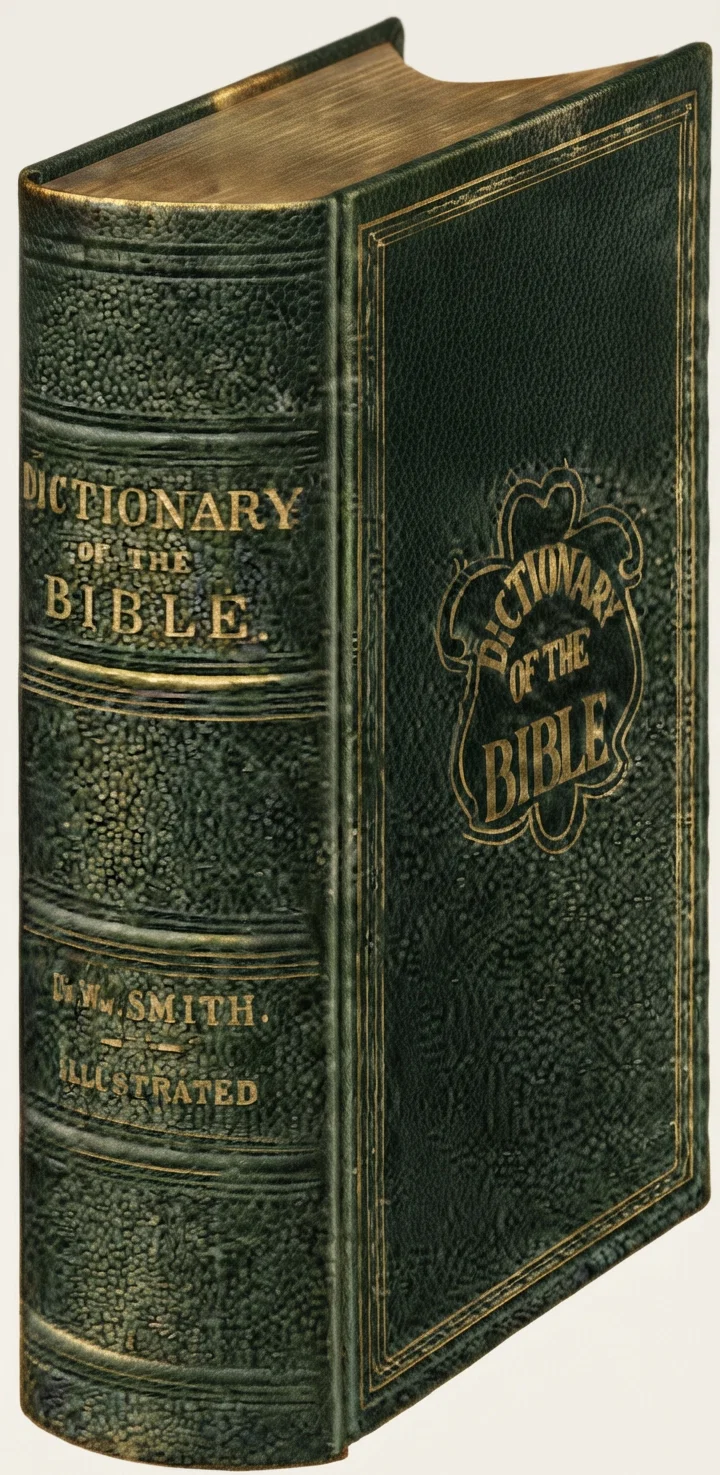
Dictionary of the Bible
By Editor
$5.50 for 2.25
Dictionary of the Bible
By Dr. Wm. Smith
Size, 6¼ x 9½ x 2½ inches
1017 pages
Illustrated
It contains a full description of every custom, place, plant, mineral, animal, etc., and a biographical sketch of every individual mentioned in the Bible
Publishers' price, bound in cloth, $4.50
Our price, post-paid, with the SIGNS, one year, $2.25
Book sent free for five new yearly subscriptions and one renewal at $1.00 each