Not long ago I saw something in a village in the southern part of India that brought very forcibly to my mind the text, “My people are destroyed for lack of knowledge.” It was about the middle of May, the hottest part of the year in this country. The village is about three quarters of a mile from our home, and is a very dark heathen place. I had been holding some gospel meetings under a large banyan tree in the center of the village, and had been telling the people of the great and powerful God, who created the heavens and the earth, and of his Son Jesus Christ, who had come to this world and died that we might all be saved in the eternal kingdom of God.
At the close of one of the meetings an old man came up to me and said: “Sir, you tell of your God and the wonderful things that he has done. I want you to attend the great festival that is to be held within a few days, in this very place, in honor of the goddess Kali, and see what the god that we worship is able to do.”
On inquiry I learned that this service is held only once in three years, and that about three months before the service is to be held the goddess appears to the one whom she wishes to be master of ceremonies on that particular occasion. From the time the goddess makes her appearance until the festival is over, the man to whom she appears seems to be possessed of some supernatural power, which enables him to do some very extraordinary things. While under this influence, things that he may prophesy will certainly come to pass. A blessing or a curse that he may pronounce upon a person will most surely affect the person either for good or bad. Consequently the people are always very much afraid of the man upon whom the goddess has descended, and for this reason they worship him, and make large gifts of money, jewelry, goats, sheep, hogs, etc. Those who are sick, or troubled in any way, and wish to be relieved and blessed, come to this festival prepared to make an offering in accordance with the blessing which they expect to receive.
All this information, and much more which the people were anxious to give me, interested me, and I determined to attend the festival and see the man whom the people feared and reverenced so much.
The appointed day finally came, and I with others went to see the performance. Long before we reached the place, we could hear the shouts of the people, and the loud weird blasts of the trumpets that are used on such occasions. As we drew near, we saw thousands who had come from numerous villages round about, gathered around a small Hindu temple in the center of the town. The police, who were there to watch the ceremonies and to keep order, came out to meet us, and clearing a path through the vast crowds, escorted us to some seats near the center, where the offerings were being received, and where the principal part of the service was to be held.
There were a number of priests engaged in receiving the offerings of the worshipers. They had a fire burning, before which the offerings were made:13and as the priest made the offering, he mumbled a prayer to the gods.
While this was going on, twelve or fifteen men, with no clothing except a narrow strip of cloth around their loins and a string of small bells on their feet, with clubs and spears in their hands, were wildly dancing with all their might around the man upon whom the goddess Kali was supposed to be resting. The man himself was a very ordinary-looking man, tall and slender, with peaked face, sunken eyes, and head shorn, all but a small tuft of hair in the middle. He had a wild, excited look on his face, and seemed very nervous. Now and then as the men danced around him, a goat was brought into the center of the ring, and with one stroke of a large knife, its head was cut off, the blood caught in an earthen pot, and given to the man to drink. The body of the goat was then offered to the gods. To me this was revolting and terrible; but the people looked on with great satisfaction, believing that this was one more sign that the man was really possessed by the deity.
They told me that this was not all that he would do, however, and I soon found that it was not indeed. The principal part of the service was to be held at noon, and they now began to prepare for it. They had a scaffold eight feet long, six feet wide, and six feet high constructed near the middle of the ring. All the time the scaffold was being arranged, people who were there for some special blessing were wildly dancing and shouting, to the beat of the drum and the blast of the trumpets.
When the platform was finally completed, four live goats were put upon it, upon their backs, their feet tied down firmly to the floor, with their heads hanging over the edge next to us. A man then climbed up, with a huge crooked knife, sat down astride the goats, one at a time, and with the knife, one end in each hand, started in just at the top of the breastbone and cut a great gash in each goat. The blood flew in all directions, and the sight of it seemed fairly to enrage the man who was supposed to be possessed. Several men were detailed to hold him, which they did with great difficulty. The muscles of his body writhed and twisted, and his eyes and face presented an agonized appearance. Finally he was permitted to climb up on the scaffold, and immediately he began greedily to devour the blood of the goats, dipping it up with both hands, smearing it over his face and body, and eating great quantities of it. Bananas were also cut into small bits, mixed with the blood, and given him to eat. During the thirty minutes or more that this was going on, the expression on his face was too terrible for description. After eating until he could eat no more, he fell exhausted into the hands of his worshipers, who carried him away to the small temple, and we saw him no more.
It was a terrible sight, at which some of the natives themselves fainted and had to be carried away. Upon inquiry as to why the man ate the blood in this way, I was told that the goddess Kali is very fond of blood, and that the people took this means of satisfying her. They said if they did not do this, the goddess would get angry with her devotees, and in revenge would kill and eat their children. So it is from fear of her, and not because they love her, that they serve her in this way.
How it must pain the great heart of God as he looks down upon thousands of villages in dark India where such things are going on in the name of religion, and sees the poor benighted people wandering like sheep without a shepherd, in the terrible darkness of Hinduism. How different would be the scene if the people of that village, and of thousands of other villages like it in India, were only Christians! What a contrast between the strange, weird, lonesome sound of the trumpets used on such occasions, and the sweet tones of Christian church bells which call the followers of King Jesus to worship. It is to bring the glad news of salvation, the story of a loving Heavenly Father, the gospel of freedom from the chains of superstition, ignorance, and idolatry, that we are called upon to work in India, and that you are called upon for support by your money and your prayers. May God help us all to do our duty to our brothers and sisters in this dark land.
Coimbatore, South India.
Getting Started in Old Spain
By H. A. B. Robinson
H. A. B. ROBINSON
ON August 1, my wife and I arrived in Barcelona, after three weeks of traveling from New York City. We had an uneventful trip across the ocean, landing at Cadiz, the first port touched by the Spanish boat on which we sailed. We saw no battleships and no submarines, indeed nothing but sea and sky for the first eight days, and then we passed between two of the Azores, or Western Islands.
At Cadiz we were met by Brother J. L. Brown, his wife, and two of the canvassers. Brother Brown and his family left five days later for Cuba, en route to San Salvador, his new field of labor.14
We then visited three of the colporteurs in Cordoba, on our way to Alicante, where Elder Frank Bond lives, who is our only minister among Spain’s nineteen millions, mostly Roman Catholics. We were glad to meet and speak to the little company of believers in that place, leaving soon afterwards for headquarters in Barcelona.
From August 26 to September 1 the annual conference and colporteurs’ institute were held, Elders L. P. Tieche and W. Dexter, of France, assisting, and a very profitable time was spent together. Two new canvassers entered the book work following this meeting. All are having as good success now as they had last year, when their sales for the year amounted to over $11,600, gold, two of them earning the premium offered for sales of over $1,500 worth of literature in one year.
I am now on a trip through southern Spain, visiting some of the colporteurs, small companies, and isolated Sabbath keepers, encouraging them especially in the home missionary work.
OUR FIJIAN PREACHER METHUSELAH
AND A NEW CONVERT
Suva Vou, Fiji
By A. G. STEWART
A. G. STEWART
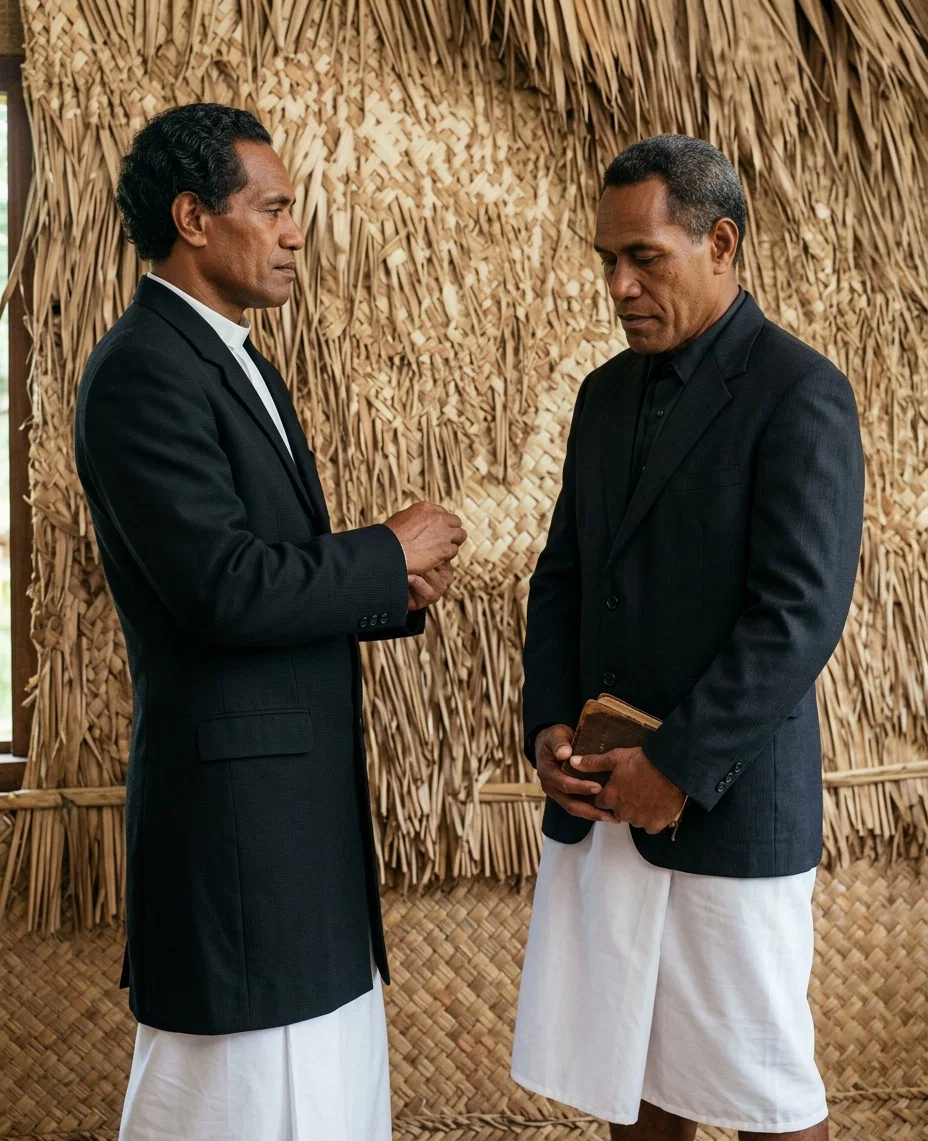
THE following is a letter we received a few days ago from Mecusela [Methuselah] Naisogo, one of our native licensed ministers:—
“To the Elder and Lady.
“Sir: I am pleased to write you a little concerning my work for the month of June. At the close of our large council at Buresala, I said I was going out again to look for some more people to bring into the true church of God, and it seems the Lord accepted the desire of my heart.
“My work has been like this: The first day of June, we left Buresala and slept at Namarai; on the morrow we left there and slept at Matawailevu, where I preached. The result was that a man prominent in the community accepted the truth. He went through the training school before I did. He will be a useful man in this church. By and by you will see him. After this I went on and preached at Soeri, where five more came in. . . . One of them is a local preacher in the community, and his experience will be of use to him in this church. He is also the village chief in Soeri.
Two of these men's wives are with them, and so there are eight altogether which have come in during the month of June. Let us thank the Lord because he has blessed with results. I cannot say for this month of July whether there will be more or not. But this is my request: Pray for me and the work here at this time, that I may be helped of the Lord.
“I close this letter with truly much love to you both.
“Your true assistant,
“MECUSELA NAISOGO.”
Following is his monthly report for June: “1. I left Buresala and slept at Namarai. 2. Preached at Namarai and went on to Wailevu. 3. Preached there and went on and slept at Namara. 4. Left Namara and slept at Nukulau. 5. Went to Namara and preached there. 6. Preached at Namara until night. 7. Preached in the morning again, and went on to Nukulau. 8. Stayed at Nukulau, talking the truth. 9. Building your house all day. 10. Same as day before. 11. Went to Soeri and preached. 12. Stayed at Soeri, preaching until night. 13. Stayed at Soeri, and preached in the evening. 14. Stayed at Soeri, explaining. 15. Held meeting and gave explanation. 16. Went to Wairuarua and held a meeting. 17. Same as day before. 18. Still at Wairuarua, explaining. 19. Went to Soeri and preached. 20. Preached until evening. 21. Went to Nukulau and gave Bible reading. 22. At Nukulau, explaining. 23. Gave two explanations. 24. Went to Nukulau and preached. 25. Dug my garden. 26. Went to Matawailevu. 27. Preached there until night. 28. Preached again in the morning. 29. Went to Soeri and gave an explanation. 30. Returned to Nukulau and held quarterly meeting.”
His total for the month, besides other work: “Gave sixteen sermons and fifty-two explanations of Scripture.” Needless to say, we greatly appreciate the help of such workers as this, and rejoice in the success that has attended such a month's labor.
The Home Department
By Mrs. I. H. Evans; Miss Lora E. Clement
Conducted by Mrs. I. H. Evans, Takoma Park, Washington D. C.
Assisted by Miss Lora E. Clement
Through the columns of this department, hints will be given on all matters pertaining to the home life. Short articles and letters are solicited from home makers, telling of their everyday experiences,—their joys and sorrows, their failures and successes.
Homesick for Heaven
By Mrs. I. H. E.
“THEY say”—so wrote a friend a few days ago—“that it is the aged ones who look forward most constantly and with sweetest anticipation to the homeland; but I am coming to think that when the tale of woe and suffering and sin has reached its culmination, young and old alike who are children of God will be homesick for heaven.”
Never, perhaps, since time began was there an hour when so many widows and orphans, so many homeless and bereft, so many maimed and suffering, so many broken and breaking hearts, filled the earth as at the present. Our minds are staggered at the merest thought of the anguish that racks the world—now, in the hour of its proudest achievements, its highest development, its most wonderful civilization.
If we look about us nearer home, at our own little circle, we find sorrow and care, “with perplexity,” in the life of each. Often a brave front is shown to the world; and this is as it should be, for sorrow on parade, seeking sympathy, loses its sacredness.
But heartache! parents mourning for their wayward sons and daughters; children carrying loads far too heavy for young shoulders; tried and sorrowful husbands; wives whose trust and honor have been violated; friends betrayed; death robbing homes of their most cherished treasures; sin—far worse than death—laying its blighting, blasting touch on young lives radiant with promise. As old Egypt on its night of doom had mourning in every household, so now the souls of the children of men are bowed with grief. Every home has its sorrow, every heart its bitterness.
How comforting, in such an hour, to find refuge in the Christian’s hope! to rest the bruised soul on the precious promises! to remember that God doth not willingly afflict nor grieve the children of men; that while he refines them as silver and purifies them as gold, his eye is upon them, and his arms of love are beneath them! Sorrow may be the teacher that our loving Father has sent to instruct us in the way of righteousness; it may, if rightly received, bring to our hearts a benediction from his throne. “Some golden fruit lies hidden in the rough husk. Some bit of gold in us God designs to set free from its dross by this fire.” Our griefs may become “but the shaded gateway to peace and blessedness.” By suffering, the heart is purged, the faith tried, the love quickened, and the courage and confidence in God increased. Moreover, by it the life is weaned from the unsatisfying, transitory things of this world, and turned toward the better country. “Homesick for heaven!”—a blessed homesickness, provided with a sure and unfailing remedy!
“O sweet and blessed country,
The home of God’s elect!
O sweet and blessed country,
That eager hearts expect!
Jesus, in mercy bring us
To that dear land of rest,
Who art, with God the Father,
And Spirit, ever blest.”
MRS. I. H. E.
Spain
By Frank Bond
FRANK BOND
There are eight or nine provinces in Spain where some evangelical effort has already been made, and in every one of these a faithful worker should be located without delay. In fact, at least one ministerial laborer and several Bible workers should be located in each of the forty-nine provinces of Spain. Nineteen million souls in this dark land, which has for so many centuries been bound by the chains of Roman Catholicism, are without God and without hope in the world. At present our force of workers is one ordained minister, three Bible workers, and a few canvassers.
O dear brethren and sisters, pray for God's work in Spain! Pray that the lives of the few remaining workers may be spared, and that God's power may be manifested in their efforts to win souls to his precious truth. Pray that additional laborers may soon be sent to fill the places of those who have fallen at their posts.
Our faith leads us to believe that the coming week of prayer will produce such results in favor of our mission fields as we have never seen. Surely the time has come when we should expect greater things from God.
I see by the REVIEW which has reached us today, that there are two hundred students enrolled in our Washington Missionary College. Why cannot a few of these decide to come to Spain?
Thus far during 1915 I have had the privilege of baptizing twenty-one believers, and others are awaiting an opportunity to take this forward step. Sometimes we are led to feel that the time and effort required to lead one soul to walk in the truth here, might perhaps be sufficient to bring a large number of persons to the truth in some heathen land. There are precious jewels scattered throughout Spain, however, and our great need is faithful laborers to help gather them.
Like as a Father
By Arthur W. Spaulding
ARTHUR W. SPAULDING
“Like as a father!” What, O Lord, am I,
To serve as symbol of thy matchless love?
“A father pitieth when his children cry.”
Own I that pity that hath birth above?
“Like as a father!” When light strength is spent,
And the heart breaketh o’er the petty task,
And childish fear sets up its monument,
Is succor ready ere my children ask?
“Like as a father!” In the wayward hour,
When creeping evil palsies all the will,
And the soul’s windows mirror demon power,
Keep I the father’s love and pity still?
“Like as a father!” When the sore heart lies
Wounded and quivering from the stunning fall,
Know I the splendor of the glad surprise
That leaps to meet a father’s tender call?
“Like as a father!” Nay; with what gray shame,
O thou my God,—and yet what thrilling hope,—
I hear thee name thyself with my poor name,
Dazzling the eyes on which thy portals ope.
Father in heaven, teach me, by the sign
Of thy calm conquest of my fretted life,
The science of a father’s power benign
O’er all his children’s sorrows and their strife.
The Wise Woman
By Zelia Margaret Walters
The woman set out on her long journey with a heavy burden on her shoulders.
Before the midmorning had come, she was stooping, half fainting. She could not carry the burden farther, and, weeping and repining, she prayed.16
Then appeared an angel, so that all the place was glorified.
“Your prayer is heard,” said the angel. “God gives no burdens too heavy to be borne. Now what will you? Shall I remove the burden, or give you strength to bear it?”
The woman was wise.
She reflected that if added strength were given, it would help her in all things. Besides, now that she might part with it if she chose, she half suspected that the burden might be of use to her. So she said, “I would choose strength, that I might not sink nor despair under it.”
“So be it,” said the angel, and went away.
And the woman, with a great new strength, arose, and went out on the road. The burden was no longer heavy, but so light that at times she was not conscious of it.
O, the blessing of the new strength! More than once she found a fainting fellow traveler by the way, and with her strong arm was able to support her to a place of safety. When she found a lost child, weary unto death, she was able to carry it to its home. She could help remove obstacles from the path. She sometimes took another’s burden, and carried it till the tired one grew rested and strong.
And no day passed but she rejoiced that she had chosen strength.
When she came to the journey’s end, the angel met her, and unbound the burden from her shoulders. And lo! the bundle held robes and a crown to make her fit for the King’s palace, and also gifts that she could offer to her King.
— Zelia Margaret Walters.
Laying a Good Foundation.
By Louise Hogan
THERE is no universal formula for the bringing up of children,— one that can be applied to all children, everywhere and always,— any more than there is a universal formula for fertilizing soil, or curing disease, or feeding babies. Yet there are certain general laws of child development, and certain general principles of child training, which have been derived from scientific studies of children, and which agree with the best thought and experience of those who have learned to know their children without the help of science. And these general laws and principles may be profitably learned and used.
The regularity which must be practiced in the nursery to keep an infant healthy has an educational influence as well. As the child learns by experience that its wants are supplied at a regular time, it becomes accustomed to an element of regularity and reliability. If it is not indulged whenever it cries, it soon learns the value of self-control. Regularity and self-control are large factors in discipline, and thus, unconsciously, even the infant can receive it. All so-called discipline—in the sense of breaking the will of the child—is to be absolutely forbidden. It breeds obstinacy, deception, nervous conditions, and many undesirable qualities; and all these may have their foundations laid in the first twelve months of the child's life, if great care be not exercised to have kind, sympathetic, yet perfectly just treatment for this early period.—Mrs. Louise Hogan.
Mother Problems
By Martha E. Warner
MARTHA E. WARNER
Teasing
FRANK came to spend a few weeks at Jack’s home. After Jack had shown him all around the place, he was heard to say: “Now, Frank, you will like this home, and you will like my mamma; but it will not do you any good to tease. When I used to ask my very own mother for anything, and she said, ‘No,’ I just teased till I got it. I tried it with this mamma, and it didn’t work. When she says, ‘No,’ she means no; and when she says, ‘Yes,’ she means yes. You can tease all day, but it won’t do any good. You just remember that, and you will get along all right.”
Not a hard lesson for any child to learn, if the mother will take the time to teach it. And once learned, it is not soon forgotten.
An Allowance
A mother expressed the wish that her daughter knew how to buy economically; yet that mother does not realize that it is her own fault her daughter knows so little about spending money.
I have found it a satisfactory plan to give children an allowance, small at first, but to be depended on. Out of it they were required to supply themselves with some little thing, such as pencils or handkerchiefs. They were taught to tithe the allowance, but the matter of offerings was left wholly to them. In a little book they kept account of money received and spent, and in this way obtained their first lessons in bookkeeping. As they grew older, and the allowance was increased, they were taught to buy their own clothes.
Such training may often tax the time and patience of mothers, but it will be of untold advantage to children in the years to come.
Manners in Public
Eight or ten girls were on the trolley one day, laughing, talking, screaming, chewing gum, and waving to the men on the streets.
“A Sunday school class going to The Rock for a good time,” some one remarked.
As I looked, my first thought was to blame the girls; my second, that the girls were publishing, as upon a housetop, the utter lack of good form in the homes from which they had tumbled pell-mell, without that instruction and those fixed habits which would have insured decorum and decency.
Begin when the children are small to teach them how to conduct themselves in public. Teach them that loud talking and laughter, which might pass uncriticized in the home yard or in the open country, must never be indulged in on the street car or the public street. The moment the street is reached, the deportment should be quiet.
Nowhere does good breeding reveal itself more quickly than in the quiet, unobtrusive “I-am-minding-my-own-business” air of a girl or boy in public.
Clintonville, Conn.
The Mothers’ Creed
We Believe:
THAT God gave us our children as a precious gift.
That constant, watchful care of them is our full duty.
That we should guard well their health.
That we should train them to right living.
That we should give them the best education we can afford.
That we should give them much chance to play.
That we should pray daily for their welfare.
That our deeds should be right models for them to follow.— Selected.
Home Teaching
By Mrs. D. A. Fitch
MRS. D. A. FITCH
SCHOOLS are established to impart instruction, and this is as it should be. Churches do an efficient work in their own field of effort; but where is there a more important opportunity for teaching than in the home itself? Here the first duty and privilege of the parent lies. This is the field where effort brings the best results. Blessed indeed are the father and mother who recognize their high calling. Yet in how many Christian homes is the gaining of instruction sadly neglected. Too many evenings and mealtimes are spent in conversation that is unprofitable if not worse.
Let us gather up the fragments of time, of wisdom, and of all else that will contribute to the mental, moral, and spiritual uplift of the whole family.
Meeting Small Troubles Cheerily
By Lora E. Clement
LORA E. CLEMENT
It happened right at the corner. Every one was in a hurry, for twilight was treading on the heels of sunset, and the wind blew a terrific gale. Autumn leaves, stray papers, dust, hats, and people as well, came down our street in a whirling cloud. Suddenly there was a collision, and Marian’s glasses lay in ruins on the pavement, while a bent old Negro made humble apology, as he clutched his battered hat: “Deed, Miss, and I’s ebber so sorry,” he quavered.
A ringing laugh broke the tension of the next moment, as my friend rescued the nose piece of her “pinchers.” “How lucky!”—and she beamed on the distressed old darky—“that I have the foundation left. It will be a small matter to get new lenses; and now let me help you gather your things,” for the contents of his market basket were in the gutter. So the old man went on his way, never dreaming of the dismay in the heart of the girl, whose face sobered strangely as she hurried along.
Now Marian’s purse was almost empty. That very day she had “taken stock,” finding barely enough to provide necessities until next pay day. But a smothered sigh ended in a laugh as she listened to my sympathizings. “O, this is the time I play ‘the glad game’ with Pollyanna!” she told me.
We spent the evening with friends, and of all the jolly party none appeared more light-hearted than Marian. She might have silently brooded over her accident, and refused to be merry; she might have intimated (what was the truth) that the glasses could not be replaced immediately unless she went on half rations until the first of the month; she might have done a dozen things that would have spoiled the evening for her hostess and friends, but she didn’t; and I was the only one who knew.
“Well,” she said, as we considered ways and means later, “it won’t do a mite of good to feel dismal. Can’t mend broken spectacles with tears or sighs. I agree with Josh Billings ‘if a man kan’t laff, there is sum mistake made in putting him together; and if he won’t laff, he wants az mutch keeping away from az a bear trap when it iz sot.’”
The Whirligig of Time
FOR ten years the Corey family had been trying to induce Cousin Rebecca to come into town during the winter, but they never succeeded until the year of Betty Corey’s wedding. Then, at last, she consented to close her house for six months. Betty was triumphant.
“Of course the rest of you might have persuaded Cousin Rebecca to come for the winter,” she conceded, “but you know perfectly well that if I hadn’t decided upon being married in October, no power on earth could have dragged her away until after Christmas. And I don’t blame her. If I had an old house like that, I couldn’t be enticed away from it. Cousin Rebecca and I understand!”
However, Cousin Rebecca, once lured away from the homestead, threw herself heartily into everything that was going on. She was seventy years old, but no girl of seventeen enjoyed life more keenly. In the gayeties that preceded Betty’s wedding, the family reunion at Thanksgiving, and the Christmas celebrations, Cousin Rebecca was a vivacious figure. She was so popular that the girls declared she gave the rest of them no chance at all. It was therefore with incredulous amazement that the family received the announcement, in the middle of January, that she could not stand it any longer—she was going back home.
“Can’t stand what, Cousin Rebecca?” they asked. “We thought you were enjoying it all so much. And to go back in the very worst of the winter—”
“That’s precisely it,” Cousin Rebecca returned. “At home I know exactly what time of year it is, and what to expect; here, from the day I came, I’ve been so hustled and pushed about from one season to another that I’m all in a muddle.”
“Before November had fairly begun, there were Thanksgiving announcements in all the shop windows; and before Thanksgiving came, there were signs up everywhere—‘Twenty-nine shopping days before Christmas!’ Long before Christmas I’d got so mixed up that I didn’t know whether it was 1911 or 1912.
“I hung on somehow, thinking that after the holidays things would settle down, but dear sakes, no! Now it is early spring fashions and fresh strawberries. It gave me a real turn at first, for I always plant my sweet peas in March, and I had a feeling that I had forgotten them. No, I’m going home. You’ve all been real good to me, and I’ve enjoyed a lot of things, but I can’t stand the way you juggle the seasons. I was brought up to an old-fashioned calendar, and I’m too old to change. Perhaps if I pack right away, I can get off before I see any Fourth of July powder crackers.”
So Cousin Rebecca went back. A few days later the Coreys received a letter.
“The pump in the shed froze last night,” she wrote, “and the hill road is closed by the drifts, and just now Mary Jane Haskins has gone by in the coat she’s worn twelve winters. There’s no doubt about its being January here.”—Youth’s Companion.
Before They Call
By Mrs. M. E. Bodwell
MRS. M. E. BODWELL
A WOMAN driving through a misting rain in a Western State suddenly discovered that a heavy farm wagon had collided with the light vehicle in which she was riding, and had crushed one of its wheels.
With what seemed to be a note of genuine regret in his voice, the owner of the wagon said, “I’m sorry, lady,”—and drove on.
A stranger in the country,—four miles from any one she knew, and nine miles from where she wished to go,—what should she do? What could she do? It was easy to cry, but it occurred to her to pray. This she did. Telling the Lord that had she been more careful, this need not have happened, and reminding him that it is our need that recommends us most to him, she asked help to get out of the unfortunate predicament in which she found herself.
In a short time, some friends who lived twenty-six miles from where she was going, but who were bound for the same place, drove up, and took her into their comfortable carriage. A kind farmer, who followed close behind, fastened the disabled vehicle to his wagon, and led her horse to town.
“I do not know why we came this way,” said the man and his wife.
“I do,” answered the woman; “it was in direct answer to prayer. I had just been praying for the Lord to help me out of this trouble, and he has done more than I asked.”
“But,” said the man and his wife, “we started at six o’clock this morning.” It was then nearly noon. Like a flash the precious words of the prophet came to mind, and she slowly repeated them, “And it shall come to pass, that before they call, I will answer.”
Needy, trembling souls, ask God for what you most desire. Ask in faith, “nothing doubting,” and always with the spirit of submission to the divine will. “Ask, and it shall be given you; seek, and ye shall find; knock, and it shall be opened unto you.” We are assured that those who “wait on the Lord” shall never be ashamed. The answer may be more than six hours in reaching you, but it will surely come when you most need it.
Boulder, Colo.
Easier Ways
By Rose C. Hill
MRS. ROSE C. HILL
STARCH MAKING.—The following method of making starch is one I have used for years, and found to be entirely satisfactory. Into a pail (for the starch can be stirred smooth more easily in a pail than in a pan) put the required amount of dry starch, and dissolve in a little cold or lukewarm water. Then add boiling water from the teakettle, stirring the starch rapidly all the time with a long-handled spoon. Stir till clear, add a very little kerosene, and the starch is done. My starch never sticks and the odor from the small quantity of kerosene used disappears in drying.
BREAD MAKING.—For one quart of water in which potatoes have been boiled, add half a cup of sugar and one yeast cake, broken into small pieces. Stir well together, and set in a warm place. In twenty-four hours or less it will have worked nicely. To this add a little more potato water, and sugar, and it will work again in a few hours. Use this as wetting for your bread, adding water to make the desired quantity. Half water may be used. Do not make a sponge, but make into a hard loaf at once. Let it rise once, then mold and put into pans. This bread rises rapidly, and is not so sensitive to uneven temperature as other bread.
Some of the liquid yeast should be saved for next time. This I keep handy, and frequently add a little potato water and sugar, so that I shall have plenty whenever I wish to bake. If not allowed to freeze in winter, or get stale in summer, this yeast makes light, sweet bread.
Wood, S. Dak.
Keep No Company in Your Heart
“Do not keep any company in your heart that you have to apologize to yourself for.”
The Set of the Sails
ONE ship drives east and the other
drives west,
By the very same wind that blows;
'Tis the set of the sails, and not the gales,
That shows which way she goes.
Like the gates of the sea are the waves
of fate,
As we journey along through life;
'Tis the set of the soul that determines
the goal,
And not the storm nor the strife.
— Selected.
Pennsylvania
By Chas. F. Ulrich
ALTOONA.— On a recent Sabbath afternoon the Altoona church witnessed a scene long to be remembered, which brought rejoicing to every heart, and made every one happy in the Lord, and grateful to him for his loving-kindness in drawing souls to him.
For the first time in the history of the Altoona church, the brethren were privileged to witness a baptismal scene in their own church, when seven persons followed their Master in the sacred ordinance of baptism. It was a very touching scene as one by one they were buried with their Master, and we earnestly pray that they may walk in newness of life until they see the Saviour whom they have followed in baptism. We were glad not only for these dear ones, but for four or five others who will soon be baptized.
This year, when we planned to install a baptistery in the church, a young man who is not a church member offered us a good concrete font if the excavating were done by others. His mother is a member of the church, his sister will soon be baptized, and we hope that he himself will yet be led to obey the truth. We thank God that this young man's heart was turned toward us to help us in our time of need. Not only did he give the font, but he and his brother painted the building outside, and frescoed it inside, all for the bare cost of materials. We have a neat house of worship, to which we need not be ashamed to invite our friends to worship with us.
We are of good courage in the Lord, and mean to work faithfully unto the end.