Your ShelfYour Projects

Review and Herald, Vol. 80, No. 24.

THE YOUTH'S INSTRUCTOR
Earlier text: God’s Purpose for His People

Begin the Day With Prayer

EVERY day should be commenced with God. The busiest and best man in Jerusalem was wont to say, “In the morning will I direct my prayer unto thee, and will look up.” “I will sing aloud of thy mercy in the morning.” Daniel, too, saluted his God with prayer and praise at early dawn. We begin the day unwisely, and at great risk to ourselves, if we leave our chamber without a secret conference with our Almighty Friend. Every Christian, when he puts on his clothes, should also put on his spiritual armor. Before the day’s march begins, he should gather up a portion of heavenly manna to feed the inner man. As the oriental traveler sets out for the sultry journey over the burning sands by loading up his camel under the palm tree’s shade, and fills his water flagons from the crystal fountain which sparkles at its roots, so doth Christ’s pilgrim draw his morning supplies from the exhaustless spring.
Morning is the golden hour for prayer and praise. The mind is fresh. The mercies of the night and the new resurrection of the dawn both prompt a devout soul to thankfulness. The buoyant heart takes its earliest flight, like the lark, toward the gates of heaven. One of the finest touches in Bunyan’s immortal allegory is his description of Christian in the Chamber of Peace, who “awoke and sang” while his window looked out toward the sun rising. If even the stony statue of old heathen Memnon made music when the first rays of the dawn kindled on its flinty brow, surely no Christian heart should be dumb when God causes the outgoings of the morning to rejoice.—N. Y. Evangelist.

The Mother's Prayer

STARTING forth on life's rough way, Father, guide them; O, we know not what of harm May betide them! 'Neath the shadow of thy wing, Father, hide them. Waking, sleeping, Lord, we pray, Go beside them.
When in prayer they cry to thee, Do thou hear them; From the stains of sin and shame Do thou clear them; 'Mid the quicksands and the rocks Do thou steer them; In temptation, trial, grief, Be thou near them.
Unto thee we give them up; Lord, receive them; In the world we know must be Much to grieve them,— Many striving oft and strong To deceive them. Trustful, in thy hands of love We must leave them.
— William Cullen Bryant.

A Few Hygienic “Do’s”

L. RUTH MERRITT, M. D.
1. REMEMBER that every organ, every fiber of your being, was made for a purpose. Then guard them all from harmful practices, and use them all as God intended.
2. Breathe pure air. Use all your lungs in breathing. Practice deep breathing daily. Many of us go about half dead, because we are not getting our share of the breath of life. We cram our living engine full of fuel, shut off the draft, and wonder why we lack energy.
3. Drink pure water. Soft water is preferable. Hard water is as injurious to mucous membrane as it is to the skin. Boiling will improve hard water, and will destroy bacteria. This takes a little time and trouble, but so does typhoid fever, which often takes away a life. Distilled water is best.
4. Eat pure food. Make a careful study of diet, and eat what is best adapted to your case, heartily, as unto the Lord, and not unto men. Don’t eat everything set before you just to please yourself or the one who prepared it.
5. Keep the blood pure. Keep poisons out of the system. Don’t eat them, drink them, breathe them, smoke them, chew them, absorb them, swallow them, or think them. Keep the eliminative organs in good condition by proper care.
6. Keep your surroundings sweet, clean, and cheerful. Be cheerful yourself. “A merry heart doeth good like a medicine.” Enjoy your work, whatever it is, and do it with your might. Call nothing drudgery which falls to your lot to do, if it is needful. Don’t wear your strength away and waste your time in needless work. Let the sunshine enter your heart and life.
7. Take time to rest. Whatever your work, divert your mind from it at times, and let it dwell upon something else that is good. Specialties are a necessity, but they bring insanity when carried to extremes. Do whatever you do as unto the Lord, and never go beyond your strength for fear of what some one may say or think.
8. Read and practice Isaiah 58.

Home Sanitation

SANITATION means healthful living. To live in a state of ideal health requires ideal conditions.
Few of us possess these ideal conditions. All of us wish for them. Many of us are striving after them, but with vague notions of the road leading to success in the undertaking.
To start right, one must begin with the house foundations, consider the site, and this, whether it be a public or a private building.
The house should be built on the highest point of ground available. For even if it be on the side of a hill, if other buildings are still higher up, the health of the household is sure to be injured by the impurities filtering down through the soil and the air to the level of the dwelling. But we can not always choose the site. We rent or buy or inherit houses which are unfavorably located. Then it is that the earnest home-maker must “buckle on her armor.”
She must make it her duty to understand what constitutes perfect drainage, and personally superintend the work of making or reconstructing drains.
If the house stands too low, and water is in the cellar during rainy seasons, the drain ditches must be dug deep, and if not connected with city sewers, must open into a cesspool at such a distance from the house as to prevent contamination of the air or the water supply. Glazed pipes are safest for conducting water from the house to the cesspool.
The “vitrified” pipe connecting this with the kitchen sink should be carefully cemented to the sink pipe. None of the plumbing about the house should be enclosed. If leakage occurs, and dangerous gas escapes, it may be easily detected.
The old plan of building closets about the sink was unsanitary to the last degree. They were always damp and ill-smelling, no matter how careful one might be, and quite too handy for old stove cloths and wet brushes. Our thoughtful woman examines her house drain pipes in a novel way. If she suspects a leak, she pours an ounce or two of peppermint essence into the sink and the stationary wash bowls. If the leaks exist, the penetrating odor of the peppermint reveals them at once, and the plumber is called.
An excellent way to clean and disinfect pipes is to put a tablespoonful of dissolved lye (concentrated) into each vent at night, and flush the pipes thoroughly with scalding water in the morning. This removes any grease that may have accumulated about the joints or bends of the pipes. Followed by another flushing with copperas water, they are well cleansed and disinfected.
If the house is in the country, and the cesspool a necessity, have it cleaned often. All the undissolved “waste” can be used for fertilizing, and the water can be drained off by several pipes, so as to enrich a piece of crop land or meadow, or by one pipe into a flowing stream. This last method, however, takes an unfair advantage of fishes and children who own the stream, and have their natural rights.
The closet outside should also be connected with the cesspool by glazed pipes, besides having a drawer which is on small wheels, and which can be drawn out often,—once a week in the warm months,—and the contents mixed with fresh earth and applied as a fertilizing medium to any part of the garden or field where it may be most needed. If a box of fresh dry soil is kept in the closet, and a few shovelfulls thrown into the box every day, it will prevent odors, and make the labor of emptying it less disagreeable. In addition to this, in the hot months copperas water should be used freely. It is odorless, cheap, and effectual.
If the cellar is damp, dig deep drains on two sides of it, and connect these with the main drain leading to the cesspool. The floor should be carefully cemented, and the ceiling and sides whitewashed several times in the year. See to it that there are windows opening out on opposite sides to insure free circulation of air.
Be sure that all your vegetables and fresh fruits are in boxes or barrels, and standing on platforms raised from three to six inches from the floor. Never allow any refuse vegetables or fruit in the cellar, not so much as a decaying cabbage leaf.
Sprouting potatoes and turnips in the spring are dangerous. They should be carried out and aired in the sunshine, the sprouts broken off, and then returned to the cellar in fresh dry boxes or barrels.
This foundation “story” of the house should be swept every week, and aired all the time, except in freezing weather. The milk safe is the best place for butter and eggs, as well as milk, but no other food should be kept there. A smaller cupboard with wire doors or sides could be placed at the foot of the cellar stairs, if you have no refrigerator, where cooked vegetables and other foods could be conveniently kept. Canned fruit and jellies should have the coolest place in the cellar, and be kept in a dark cupboard. It will save time and handling if it stands in front of a window, that the light may strike the jars where you open the doors, and reveal fermenting fruit or anything that needs attention.
If the house is furnace heated, the cellars for furnace and coal should be separated from the cold storage portions by a solid brick or stone wall. Unless your cellar is nine feet high, or nearly so, the platform for the furnace should be laid about two feet below the surface of the floor, to give the upward stand to the heating pipes so necessary for the best conveyance of hot air to the upper rooms.
If the house has steam heat or hot water, this precaution is not necessary.
Is the home in the city or a village with a system of water works? Then of course the water supply is not under control. But it can be improved after reaching the house by boiling or filtering, or made absolutely pure by distilling.
Small stills can now be procured, which are attached to the teakettle, and each day’s supply of drinking water prepared at very small expense. People do not drink enough water; that is, the grown people. Some are afraid of the live germs, and dislike the flavor of them cooked. Boiling water renders it rather flat to the taste, but if cooled in the refrigerator, it is drinkable. The filter removes the coarser impurities, but not the germs. The only absolutely clean water is distilled; of this one is not likely to drink too much. It should not be taken with the meals, but between them and at bedtime. It would save innumerable doctors’ bills if every one would drink two quarts a day, and so bathe the inner man, greatly to his advantage. It promotes digestion by dissolving and carrying off waste from the system.
If the water supply at the schoolhouse is not above suspicion, have a pasteur filter on every floor, and be sure that the janitor has a conscience and washes the cylinders each day. It is amazing to see the amount of awfulness that collects on one of these cylinders in the course of twenty-four hours.
And the children drink so much! It is appalling to consider how careless we are as to what sort of water they drink.
Then they all drink from one cup. This is unsanitary and unnecessary. Many times their little mouths are impure from want of cleanly habits or from disease. Small collapsable cups, say of aluminum, could be made, which would not be expensive, and these should be as much a part of a child’s school outfit as his lead pencil and his spelling-book.
If no cup is chained to the filter, he would learn very soon not to forget his own.
The dainty ones would carry their cups in little linen or chamois cases, but even if carried in the pocket with the inevitable strings and marbles, it would be better than the cup promiscuous.
If schoolhouses or private homes have not been built with an adequate or up-to-date system of ventilation, much can be done on sanitary lines by adjustable windows and open fireplaces. A window open two or three inches from the bottom and pulled down as far from the top creates a good circulation of air and occasions no draught, while a fire, even a little one, in an open grate gathers all the cold air from the floor, and equalizes the temperature of the room, besides carrying off many of its impurities.
If the fireplace was not built with the house, it can be added afterwards, either by bringing the chimney down inside or building one outside at an expense in no way commensurate with the good it accomplishes, whether one considers it from a physical or an ethical standpoint.
The joy-giving, health-promoting open fire would really not cost so much as we pay each year for doctors and drugs to cure quite preventable diseases.
All these things are for women to think and act upon. They are peculiarly woman’s province.—Katherine Ames, in American Mother.

How to Keep Cool When the Weather Is Hot

DAVID PAULSON, M. D.
THE cold season affords a favorable opportunity to tone up the system and to develop physical stamina, and at the same time, owing to its chilly rains and more or less sudden changes of temperature, the chances to contract acute colds, influenza, pleurisy, pneumonia, and tuberculosis are increased tenfold.
The summer time is nature’s opportunity to burn up the various cinders and clinkers, and other waste products that are lodged in the system, and to inaugurate a general cleansing and renovation of all the tissues. At the same time the debilitating effect of the heat often lays the foundation for nervous prostration, and tempts many a weak mortal to resort to various artificial stimulants, which soon prove to be both a snare and a delusion to him.
The temperature created within by the food we eat, has more to do with our bodily comfort or discomfort than has the surrounding atmosphere.
Careful observations have shown that nine tenths of the prostrations from heat are among those who are trying to subsist upon an unnatural and an unwholesome dietary, and who are indulging in liquor and tobacco; while those who are eating thoroughly ‘dextrinized’ grain preparations, luscious fruits, and the nourishing nut preparations, are discovering that such food is conducive not only to coolness of blood, but also to calmness of spirit.
Another means of being comfortable when others are uncomfortable is to take liberal installments of winter during the summer. This can easily be done by frequent cool bathing. It is impossible to conceive of a person being overcome by heat while camping in a tub of cold water, or even while wrapped snugly in a sheet which had been wrung out of cool water.
On the hottest day of last summer a patient in our Chicago Branch Sanitarium began to have symptoms which indicated that she was being prostrated by heat. She was immediately placed in a bath at a temperature a few degrees below that of the body, and cloths wrung out of ice-cold water were put around her neck and upon her head; in a few minutes she was perfectly comfortable. Her dinner was served to her under these unique circumstances. She remained in the bath several hours, and by that time the cool evening breezes had made the atmosphere so comfortable that she returned to her room. While others had been sweltering from the extreme heat, she had been enjoying the equivalent of a spring climate; as a result, she felt refreshed and invigorated.
During the hot season all should, as far as possible, take some form of cold bath in the morning and evening; if the heat is very oppressive, and prostration is threatened, one or more may be taken during the day. It is a little inconvenient to carry out this suggestion, but it is more inconvenient to have thousands of funerals in summer which never would have taken place if those whose lives were thus uselessly sacrificed had only been willing to use the same amount of good sense and judgment in reference to caring for themselves that they exercised in the management of even their ordinary business affairs.

Where Lies the Blame?

A FARMER drove up to our mill door with a load of wheat. He had a fine team of horses, but he, alas, was a sickly, meager-looking creature. Now, as he handed out the sacks of grain, he chanced upon a basket well filled with golden apples.
Forthwith he gave the precious fruit to the miller, saying, in grievous tones: “Never do apples pass my lips without subsequent suffering; take them, and may they deal better with you than with me. I have no pleasure in food; all alike causes distress and bitterness.”
“On what do you dine, friend?” asked the miller.
“Salt meat, sausage, eggs, pancakes, pickles, and white bread form the chief part of my dietary, but the water is bad where I live. The only way for me to have better health is to sell what I have and move away.”
But the miller, noticing his sleek-looking horses, remarked: “And do your horses partake of the same water?”
“Indeed, they take no other,” the farmer made answer.
“Tobacco is a daily indulgence with you?” said the miller.
“O, yes, I couldn’t live without my pipe.”
“But your horses seem to thrive on the water which injures you. If they used the tobacco you do, if they lived on your diet, would they thrive, or would the water sicken them too?”
The farmer changed his diet, and left off using tobacco. Strange to relate, the water agrees with him to perfection, and he eats apples with impunity.—St. Louis Magazine.

Health Is Wealth

“HEALTH is wealth.”

A Wheelbarrow Trip in Honan, China

J. N. ANDERSON
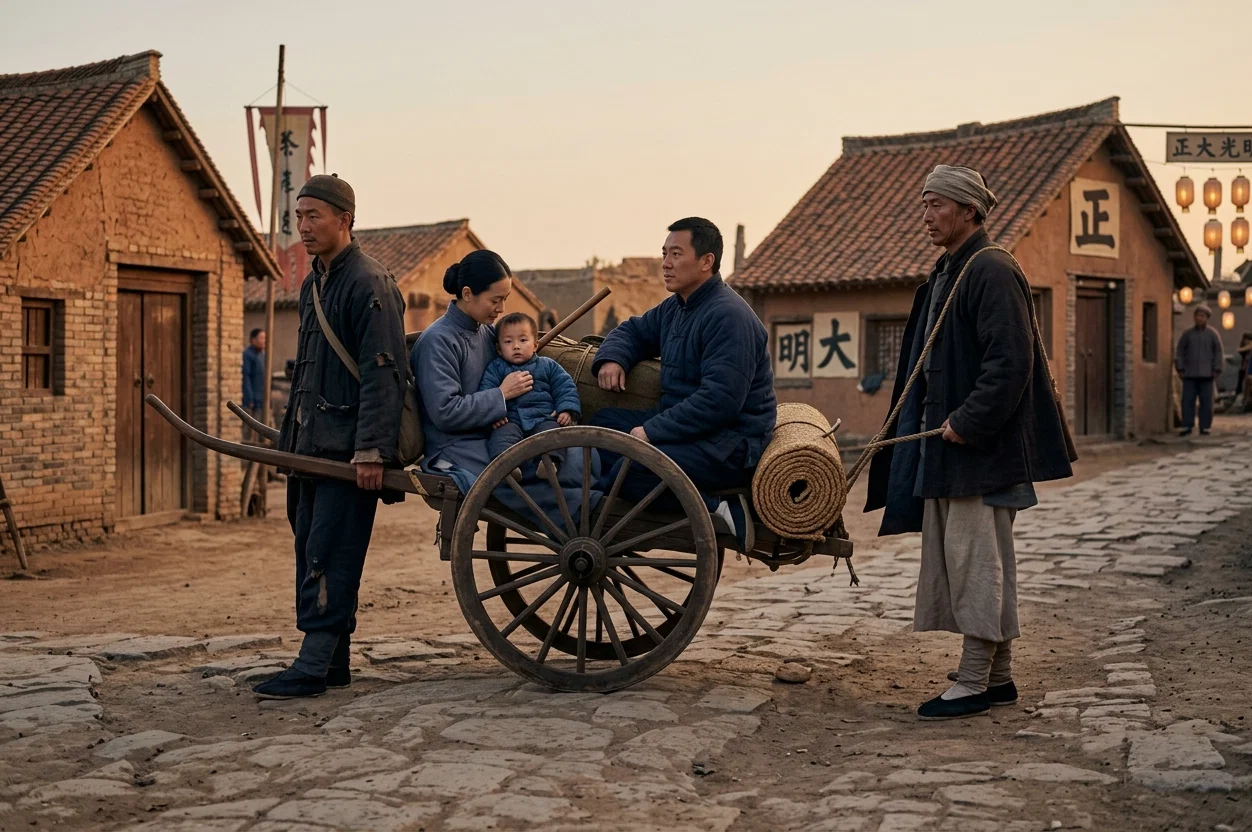
DURING a visit to our mission station in the province of Honan, it was decided to make a short journey to a small city about twenty miles distant, where an interest to hear the truth had been awakened. Our only practical means of conveyance was a Chinese wheelbarrow, which is to Central China what the railroad is to America. It is no uncommon sight to see a train of twenty-five or thirty barrows, loaded with freight or passengers, slowly wending its way along the narrow, rough, and crooked roads of China. Thus communication is kept up between villages, cities, and even remote parts of this section of the country. South China has sampans and sedan-chairs, while in the north mules and carts take the place of wheelbarrows.
TRAVELING BY WHEELBARROW IN CHINA
Our first step was to secure a wheelbarrow outfit, which was a little difficult, it being Chinese New Year, a period of about three weeks at the beginning of their calendar year, during which time all the people as far as possible give themselves to holidayism and vacation, so much so that nearly all the wheels of activity are brought to a standstill. But money has its magnetic power in China, as elsewhere, so our desired barrow was forthcoming when the chief driver was promised twelve hundred cash, worth about sixty cents United States currency, but a stiff price for the trip, which required two days, going and returning.
In general, the Chinese wheelbarrow is like that of the United States, but in point of size the latter is a mere dwarf. It has a frame built upon it large enough to accommodate two persons, with their hand luggage and bedding so distributed as to afford a very comfortable place on which to sit or lie, as inclination prompts. The propelling power is of course human Chinese brawn, under favorable conditions augmented by large sails. Behind is a Chinaman with a large strap passing over his shoulders and attached to the handles, balancing and supporting the load, while in the front is a second man working between handles similar to those behind, balancing and guiding. He, too, has a strap passing over his shoulders and hitched to the body of the barrow, answering to traces, with which the load of four or five hundred pounds is lifted forward.
This, let it be remembered, is first-class wheelbarrow accommodation, a real luxury as compared to second and third. Second class affords less room and speed, the conveyance being smaller, and the propelling power consisting of one man, or, at best, with a boy or cheap man in front, pulling with a rope. The third class differs from the other two chiefly in that it is what we would call a mixed train, carrying both passengers and freight—men, women, or children on the one side, with an equal weight of dried fish, poultry, pigs, or produce on the other.
As stated, ours was first class, which combined both speed and comfort. Thus provided, we—Mr. Pilquist and the writer, accompanied by four native believers —proceeded on our journey across the country, which is beautiful even in February, this great plain beginning at the southern border of this province, and stretching away to the northeast for hundreds of miles, far beyond Peking.
The day was bright and clear and warm, not unlike the sunny April days in Michigan and Wisconsin. It was spring in this part of China, and while very little spring work had yet begun, the rich, garden-like fields, cut up into small crazy-quilt patches, were green with wheat and peas, which are sown in the fall, and harvested about the end of May. Whatever else may be said of the Chinese, one thing is certainly true—they know how to till the soil.
After a short, brisk walk out of our city, across the river, and past many nestling villages, which, as a rule, surround a Chinese city, we found ourselves on the main road leading to the place of our destination. Here our train made its first halt, which was instantly improved by the barrow drivers, who took a few whiffs at their pipes and drank a cup of weak tea, whereupon, removing their outer garments, they set themselves to their task. With some reluctance I was persuaded to mount the wheelbarrow with Mr. Pilquist as a balancing factor. As I have before stated, passengers may either sit or recline, and as the latter seemed most convenient, we took to that. The coolies bent their backs to their burden, and the load moved forward.
As the Chinese never lubricate their barrows, a groaning, creaking noise is made with every revolution of the wheel, which I almost imagined had a softening influence on the jars and jolts occasioned by the wheel bumping over stones and rough places in the road. Thus we were provided with a species of music gratis, which, though somewhat unpleasant and monotonous, served to neutralize other even more distracting features. If one is endowed with the right kind of nerves, or with no nerves at all, it acts with a soporific effect, inducing rest and sleep. I must add that the Chinese omit the oiling element from principle; first, because the groan of the wheel, according to their belief, puts to flight the evil spirits which may be—indeed, are sure to be—skulking about; and in the second place, it is economy in the matter of money, if not of muscle.
If the readers of this paper could hear and feel the ghostly groans of these wheelbarrow trains, it might not be so very difficult to believe that evil demons might be either frightened or disgusted into precipitate flight.
But, to resume, our journey progressed well. The barrow proceeded at the rate of about four miles an hour; meanwhile I felt myself growing drowsy as I lay stretched in the warm, genial sunshine ; and despite these adverse conditions lost myself in sleep. It was only for a moment, when, with a vigorous jolt of the wheelbarrow, I was suddenly and abruptly brought back to the world of sense and consciousness.
Regardless of my rude awakening, the men with steady and firm pace urged on along the tortuous road, here and there turnpiked, varying in width from four to seven feet. It was about as crooked as one can imagine, and this is neither accidental nor incidental. These same evil spirits are believed to travel in a straight line, hence all roads and paths are made devious and tortuous in order to confound the invisible monsters. The same is true of hedges; and even houses are so built that the spirits in seeking to enter are liable to strike their rectilinear heads against some opposing object; which, although it never results fatally, yet so confuses them that in bewilderment they beat a hasty retreat in the same straight line. This is another illustration of how the Chinese bulldoze, browbeat, and bribe their multiform devil, who, by the fear and terror he inspires, becomes the veritable god of the Chinese.
After a ride of about five miles, we reached a small wayside inn, near a massive, well-constructed stone bridge over a small stream. As is common in China, large, engraved slate slabs fixed in brick columns set forth the name and merit of the man or men who by their liberality and public spirit caused the construction of the bridge. All such matters as bridge building, constructing and repairing roads, receive no attention from the government, but depend on private enterprise. Here our train halted, and we alighted simultaneously, lest our car be capsized. The drivers again filled their pipes, and quietly seated themselves for a smoke on some wooden benches, under a straw canopy provided for just such travelers as we. The rest of our company, except myself, who had not learned the art of improvising a sorghum mill, bought, with two or three cash apiece, a stalk or two of sugarcane, with which, like true Chinamen, they revived their flagging energies.
A short rest, and again we moved on. This time two others had their turn at the soft seats, or more properly beds, on the wheelbarrow. The next halt was for tiffin in a small village. It was about half way. After satisfying our appetites, some time was spent in distributing Gospels among the people who gathered about us; although a copy of any one of the four Gospels was offered for about one-fourth cent, few felt able to purchase. Some, of course, are not able to read.
We reached our destination about 4 P. M., and were at once ushered into humble but comfortable quarters, which had been specially prepared to receive us in the event of our returning with the messenger who had been sent out by a small company of earnest inquirers after truth with the request that a gospel teacher come to instruct them. Without delay the native evangelist who accompanied us sent out his card—a slip of thin scarlet paper bearing the three characters of his name in a perpendicular line down the center—to a number of his friends who hold official positions in the city. Many callers came in response, and they circulated the announcement of a gospel meeting to be held that evening.
When the evening service was opened, the people came in to the number of fully two hundred, or until the standing room was occupied. It was a motley crowd of men and boys, with a few venturesome women, who were admitted because the gathering was in a private house. There were the poor and the rich, docile peasant clad in wadded garments of blue cotton, and dignified mandarins in rich silks and soft furs. All alike listened with rapt attention while the evangelist gave a short sermon on The Commandments of God Versus Traditions of Men. Brother Pilquist followed with an exhortation, after which the evangelist in a most touching and striking manner related his own experience in accepting the gospel message, urging as a final argument that if God could save him, he certainly was able to save these his friends. Early the next morning the chief mandarin of the city sent his card with an invitation for us to call at his yamun, where we were received with true oriental hospitality. He, in common with many other leading men of the place, expressed the desire that a gospel mission be opened in their city.
The Chinese may be far behind the Western world in mechanical invention, science, and art; but as to their need of Christ and appreciation of his gospel of salvation when once it has appealed to their darkened minds, they are on an equal footing with ourselves.
Canton, China.

Two Years in Alaska

A. M. DART
It will soon be two years since we came to Alaska to proclaim the truth of the third angel's message. In some respects the results of this labor are not the most gratifying, yet we can see that much has been accomplished. We have seen some fruit, and a most encouraging feature is that in every effort prejudice has been broken down in a marked degree.
In several respects, we find this a hard field in which to labor. Churches of different denominations are established in every place, and prejudice against our work is just as marked as in California, and efforts against us by the leaders of the churches are equally as great. Work with the unconverted is hard; for their minds are entirely taken up with the procuring of gold.
Alaska is fast developing. During the last session of Congress the securing of public lands under the homestead act was made possible, and with her vast resources in the fishing and mining industries, the latter of which is probably in its infancy, and in some places promising results in an agricultural way, without doubt Alaska's population will rapidly increase. The people to whom God has entrusted the greatest truths ever given to mortals should certainly establish memorials for him in this land.
After carefully and prayerfully watching the trend of affairs in the different towns where we have preached the message, I can say without hesitancy that the best possible means of reaching the people in Alaska is by health restaurants and sanitarium treatment rooms. In the different places where we have been, we have tried to enlighten the people concerning health principles. We have given health dinners, and have sold about seventy-five dollars' worth of health foods to those who became interested through our efforts to make known their value. We could have sold much more had we always been supplied with them. The people in Alaska will give attention to the principles of healthful living, even more quickly than those in the States; for here a vast amount of canned goods is used, and meat is shipped from below, making the question, “What shall we eat?” more of a problem than where the inhabitants eat the products of their own country.
Sanitarium treatment rooms would be appreciated here. The population largely consists of people with no home; these get sick with la grippe and other diseases, and their homeless condition would add to their appreciation of sanitarium treatment. At Juneau, where we labored last winter, on one occasion—of course this was an exceptional one—fifty dollars a week was offered for a nurse; but in every place we have been, I have noticed that good nurses have been in demand.
I can speak most encouragingly of the place the message occupies in the minds of business men and the unconverted generally where we have labored; and among professed Christians prejudice has been removed in a marvelous way. Brethren, this will be a help in establishing an institution, and in these things rather than in the number who have accepted the message, I am encouraged in our work here.
At Skagway last Thanksgiving day I was invited by the Protestant churches to participate with them in union services. I was asked upon the rostrum, and was assigned a part in the services. A donation was taken up for the poor, which amounted to about twenty dollars. This was divided among the ministers, for each to use as he saw fit. I received five dollars as my portion. I am well aware that the leaders of these churches were not favorable to my presence, but we had been invited to the homes of some of their most prominent members to study the Bible with them, and they had listened attentively and had received favorably the precious truths for this time. These circumstances placed me there in spite of the leaders.
We are now at White Horse, Yukon Territory, about one hundred miles from the coast. The interest at this place is not encouraging, but we have done what we could, and hope for some results.
Most of the time since we came to Alaska, my wife and little girl have disposed of a club of twenty-five Signs each week, and we have sold books at every place visited.
As workers we are alone in this field, and we ask the prayers of God's people that with meekness, heavenly wisdom, and increasing faith, we may pursue our labors.
In about two weeks we expect to put our few effects in our own boat (which will cost thirty or thirty-five dollars), and take a four-hundred-mile ride down the Yukon River to Dawson. This is a very pleasant trip this time of the year, and is sometimes a little exciting, but attended by no particular danger.

The Oldest Medical Mission in the World

THE command to “begin at Jerusalem” was literally observed by the early promoters of medical missions. A medical mission was established in that old city as far back as 1824, and the number of out-patients who visited the English Mission Hospital for Jews at Jerusalem was 12,255, not including dressings to wounds, sores, etc., which numbered 11,880. The in-patients numbered 879. Many sick Jews had to be refused for lack of room. The patients came from Cairo, Alexandria, Damascus, etc., as well as from Jerusalem. The new hospital which is being built will have forty beds,—fifteen more than the one used at present, which was built in 1832. So still walks through the old city, over which he wept, for which he prayed, in which he worked and died, the Great Healer, working through the branches of himself—“the Vine.”—Selected.

Mountains of Iceland

DAVID OSTLUND
IN some parts of the country the mountains are fifty-seven hundred feet above the level of the sea. As the snow limit is about twenty-five hundred feet above the sea-level, it is believed that there must be large masses of eternal snow.
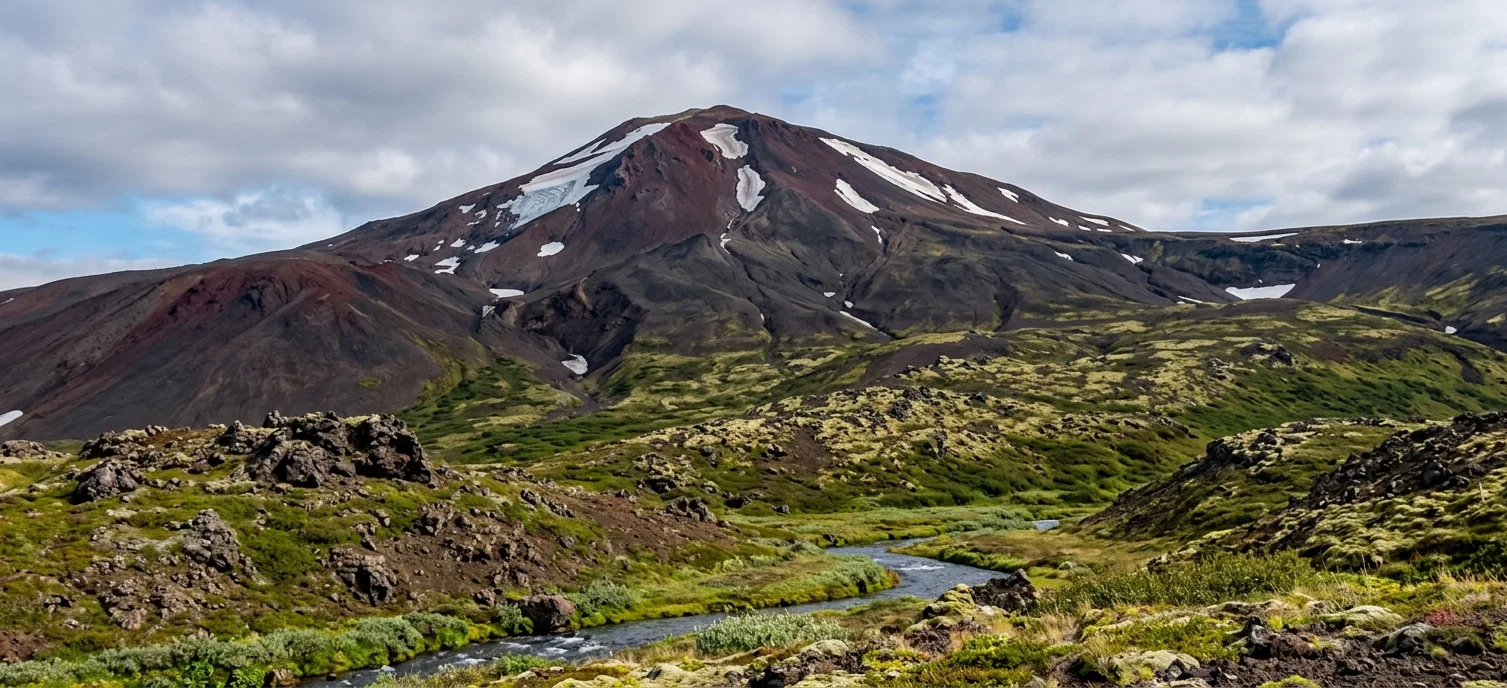
MOUNT HECLA, ICELAND
These great masses are called “jaclar.” They cover a great deal of the surface, by some estimated at about fifty thousand square miles. The largest of these is called Vatna Jökull, and is in the southeastern part of the island. It covers an area of nearly thirty thousand square miles, and is the largest field of snow in Europe. Its highest point is fifty-eight hundred feet. Out from this great snow field extend other smaller fields, down toward the lower part of the island.
From this some of our readers may think it must be very cold, and a very undesirable place in which to live. But this is a mistake. By scanning the map, it will be seen that Iceland is almost surrounded by the Gulf Stream. This makes the climate very much milder than a person would suppose it to be. The summer is not warm, but the winters are not much colder than in the northern part of America.
The mountainous part of Iceland contains many volcanoes, though only a few of them have been active for the last one thousand years; but that they were at some time active, many of the craters give abundant evidence; and by digging in the soil, there are found in many places layers of ashes several inches in thickness, which can not be explained in any other way than that they were thrown there by volcanic action. From the time that Iceland was first settled, there have been no less than eighty-six eruptions, and of these thirteen occurred in the nineteenth century.
The best known of these volcanoes is Hecla, about five thousand feet high, situated in the southern part. In the last thousand years there have been twenty-one eruptions from this volcano, the last two in the nineteenth century (1845 and 1878). Among other volcanoes, we might mention Katla, with twelve eruptions, the last two in 1823 and 1860; Eldeyjar, with ten eruptions, the last two in 1830 and 1879; Krafla, with four eruptions between the years 1725 and 1729; and Kverkfjöll, with three eruptions—one in 1717, one in 1867, and another in 1873.
The following from the Abbot Arngrimur Brandson (1361) describes graphically the volcanic eruptions on the island: “Some mountains in this land throw out terrible fire and great rocks, and the sound of the explosions can be heard over the whole land; and sometimes these eruptions are accompanied by such darkness that people in the summer time, in the middle of the day, can hardly see their own hands. In the ocean south of the land these eruptions have formed a great mountain, and another has disappeared which had been made in the same way.”
— Seydisfjördi.
Continue reading: Australia’s Need