Your ShelfYour Projects

Signs of the Times, Vol. 25, No. 23.

CORNELIUS
Earlier text: A SYSTEM OF EDUCATION FOR ISRAEL

WHAT OF TRUSTS?

ALMOST every paper brings us news of the formation of at least one gigantic trust or monopoly. The press all over the world is busy giving voice to the trust-opposing sentiments of thousands.
To-day as never before, we stand face to face with the stern reality that "money is power." The voice of the people has little weight when compared with the great balance of power on the side of wealth. In spite of all opposition the "trust-mad" spirit rages unrestrained.
And because these things are so, thoughtful minds are troubled with grave unrest and anxiety for looking after those things which are coming to pass in the earth. "The subject is a serious one," says Governor Pingree, of Michigan. "Why, if I had nothing, I wouldn't know how to advise my own son to start."
"And the cause of this?" he was asked.
"Are trusts and monopolies."
For a great many years labor unions and protective organizations have been formed among workmen to maintain their rights against the confederacies of wealth. But now they are beginning to realize that their precautions can but ineffectually compete with this insatiable greed for gain. It is becoming impossible for the laborer to get living wages.
"The trusts are inimical to the public policy," says the Philadelphia Ledger, "not only because they are monopolistic and in restraint of competition, but because they oppress labor. . . . There has been latterly scarcely a trust formed, the first step of which was not that of limiting production, by shutting down works and thus reducing the number of wage earners."
Speaking of this selfish principle, Attorney-General Haines, of Maine, says, "I expect to see the greatest panic the country ever saw in less than five years as a result of trusts."
Why?—Because wealth is working against its own best interest. "For whatsoever a man soweth, that shall he also reap." If they are sowing the seeds of hatred and unrest now, their harvest by and by can only be that bitter fruit, revenge.
"And the songs of the palace [homes of wealth] shall be howlings in that day, saith the Lord God; the dead bodies shall be many; in every place shall they cast them forth with silence. Hear this, O ye that would swallow up the needy, and cause the poor of the land to fall." Amos 8:3, 4, R.V.
The situation is terrible beyond human comprehension. Exaggeration is almost impossible. Blindly, madly, the world is rushing headlong into the horrors of revolution. The crisis is just before us.
O may we, therefore, as those who would hearken to understanding, become stockholders in that better union in Jesus Christ, that we may stand firm and fearless through the trials of the coming storm. E. J. DRIVER. Fresno, Cal.

Prosecuting Christian Scientists

Several prosecutions of "Christian Scientists" are going on in the East. The charge is of practising medicine without a license. The hope of conviction rests in the fact that the patient died. Now we do not believe in so-called "Christian Science." So far as we can understand, it is neither Christian nor scientific, and is so demonstrated, if a negative can be, by the teachings and practises of the cult. But when a patient, in his right mind, voluntarily seeks "Christian Science" aid, and dies, why should the "Christian Science" "doctor" be prosecuted more than the "regular" practitioner who loses his patient? or the homeopath, who does not agree with the regular? or the eclectic, who disagrees with both? Nature, after all, must effect the cure. How many times do the licensed physicians hinder or utterly thwart nature? This is not to condemn the doctors. We prefer their advice to "Christian Science," but there is no gain made by prosecuting the followers of Mrs. Eddy.

LOVE'S CONQUEST.

[By James Allen, in the Herald of the Golden Age.]
I stood upon the shore, and saw the rocks Resist the onslaught of the mighty sea, And when I thought how all the countless shocks They had withstood through an eternity, I said, "To wear away this solid main The ceaseless efforts of the waves are vain." But when I thought how they the rocks had rent, And saw the sand and shingles at my feet (Poor passive remnants of resistance spent), Tumbled and tossed where they the waters meet, Then saw I ancient landmarks 'neath the waves, And knew the waters held the stones their slaves.
I saw the mighty work the waters wrought By patient softness and unceasing flow; How they the proudest promontory brought Unto their feet, and massy hills laid low; How the soft drops the adamantine wall Conquered at last, and brought it to its fall. And then I knew that hard-resisting sin Should yield at last to Love's soft ceaseless roll Coming and going, ever flowing in Upon the proud rocks of the human soul; That all resistance should be spent and past, And hardest hearts yield unto it at last.

THE GOSPEL FOR THE FILIPINOS.

Missionary journals state that Spain has unwittingly done an important service in preparing the way for the introduction of pure Christianity into the Philippines. Some time previous to the insurrection in the islands a Filipino, Don Pascual Pubiete, who had large influence with his countrymen, was suspected of inciting rebellion, carried a prisoner to Spain, and banished to a fort in Africa, where he suffered much from ill treatment. He succeeded in establishing his innocence. Being permitted to go to Madrid, he found his way into a Protestant service; became interested, was converted, and has lately been received into membership in the Church of the Saviour, in that city. He now intends to return to his own country as an evangelist. He has already translated the first three Gospels and the book of Acts into the Tagal language, under the direction of an agent of the British and Foreign Bible Society.
Photo by Dr. E. G. Wood, Hospital Corps, Manila. Statue of Fernando de Magellan, Manila.

An Opening in Puerto Rico

An Opening in Puerto Rico.—The following extract from a report by Rev. W. H. Sloane, in the Missionary Review, would indicate that Puerto Rico is a good opening for independent missionary work:—
"The inhabitants of Puerto Rico are Roman Catholics, but the hold that the church has upon them is very slight. Church and State have been so closely identified that the oppression exerted by the Spanish government has weakened the influence of the clergy. Religious services in all parts of the island are poorly attended, and the catechetical instruction of the children has been greatly neglected. Those evidences of rigid training that are seen in Mexico and South American countries, are here absent. Many country districts have no churches, and the monasteries and convents that have been founded have never taken deep root in the Puerto Rican soil, nor been to the liking of the Puerto Rican people. Now that Church and State are separated, as a result of the war, many priests, deprived of governmental support, are leaving for Spain. Some remain in hopes of aid from the United States Government, and some are endeavoring to educate their congregations to look after the temporal wants of their pastors. The change brought about in the Catholic ecclesiastical system in Puerto Rico has, for the time being, by its suddenness and force, dazed the adherents of the Roman Church."

The Hindu Idea

The Hindu Idea.—I met in India an intelligent Sikh from the Punjab, and asked him about his religion. He replied: "I believe in one God, and I repeat my prayers, called Japji, every morning and evening. These prayers occupy six pages of print, but I can get through them in little more than ten minutes." He seemed to pride himself on this rapid recitation as a work of increased merit. I said, "What else does your religion require of you?" He replied: "I have made one pilgrimage to a holy well near Amritsar. Eighty-five steps lead down to it. I descended and bathed in the sacred pool. Then I ascended one step, and repeated my Japji in about ten minutes. Then I descended again to the pool and bathed again, and ascended to the second step, and repeated my Japji a second time. Then I descended a third time and bathed, and ascended to the third step, and repeated my Japji a third time; and so on for the whole eighty-five steps, eighty-five bathings, and eighty-five repetitions of the same prayers. It took me exactly fourteen hours, from 5 P.M. one evening to 7 A.M. next morning." I asked, "What good did you expect to get by going through this task?" He replied, "I hope I have laid up a great store of merit, which will last me a long time." This is the genuine Hindu idea.—Sir Monier-Williams.

Missionary Support

The idea of individuals and churches assuming the support of missionaries is rapidly growing in favor. The Missionary Herald gives these facts concerning the American Board: "Since the late annual meeting at Grand Rapids a number of missionaries have been placed in intimate relations with churches or Sunday-schools, resulting in an entirely extra gift to the board, or a greatly enlarged offering. 'The Brotherhood' of the Harvard Church in Brookline, Mass., has raised about $1,100, which is to be above all usual gifts to the board, and has taken the support of a missionary in China. A church in Bangor, Me., has assumed the support of a single missionary in Japan, and another church in the same city is planning to do the same thing. A young man and wife recently appointed were sought for by three churches, but were assigned to a church in Fall River. One of the missionaries in Turkey is cared for by a church in Andover, while his wife is supported by a church in Lynn. A Sunday-school in Springfield, Mass., has taken the support of a young physician recently sent to Eastern Turkey. One of the latest accessions to Central Turkey is a young man who pledges his own support for a time. A missionary now about reaching his work in Micronesia, is to be supported by a church in Providence, R. I. Several missionaries are offered to Endeavor Societies to be supported by shares. Apart from the missionaries maintained by the woman's boards, something like fifty missionaries are supported in whole or in part by churches, societies, or individuals."

A TIMELY WORD.

IN a meeting held in the Meionaon in Boston, January 5, 1869, the subject of personal effort and personal influence was introduced, and after others had alluded to its importance, an intelligent man arose and briefly said:—
"Ten years ago a deacon of the church came to me, and taking me by the hand, and putting his hand on my shoulder, and calling me by name, said, 'Isn't it time for you to find your Saviour?' I turned to him and said, 'Deacon, you mind your business, and I will mind mine.' He left me, but those words, 'Isn't it time for you to find your Saviour,' followed me, and I could not escape from them until I found my Saviour, and was forgiven."
We can hardly imagine a more ungracious retort than this good deacon received, when he sought to win a soul to God; but his labor was not in vain. The arrow reached the sinner's heart, and no hand but the hand of Jesus could pluck it out and heal the wound. Let Christians take courage, in view of facts like this, and do their work with dauntless zeal, knowing that God will give the blessing and the increase in His own good time.—H. L. Hastings.

The Lord Is Nigh Unto the Brokenhearted

"The Lord is nigh unto them that are of a broken heart; and saveth such as be of a contrite spirit."

The Missionary's Call.

What constitutes the mission call?—There are two parts to it—first, the call to Christ; then the call to His work. There is but one response to be made, —consecration. Surrender the will. The rest is only matter of judgment, according to providential indications. Men have forced their way into the mission field against almost every possible obstacle. This was the experience of Carey and many other pioneers. Others have been led along by providential appointment, where every step taken was against their own preference, until at last they found themselves set down in mission work.
God deals with men as individuals, and most diversely. There are calls contained in repulses, and tests contained in invitations. Sometimes the call consists of the simple presentation of facts to the mind and conscience, which, when calmly weighed, seem important enough to decide the choice of the will and the work of the lifetime. The mission field is then entered with precisely the same calm business spirit as that with which another would enter a mercantile employment—only it is done in the service of the King. God calls men through the reason as well as through conscience and providence and the Holy Spirit.—Gospel in All Lands.

OUR WORK AND WORKERS.

As this paper goes to press a State camp-meeting is in progress at Des Moines, Iowa.
A report in The Advance mentions the baptism of five candidates at Ormondville, N. Z.
A Bible worker in Merrill, Wis., uses seventy-five copies of the SIGNS each week. She has sixty-five regular subscribers.
The Illinois Conference Committee are considering the matter of a church school, and have been looking for a location at Sheridan.
Three persons were recently added to the church at Missoula, Mont., having been baptized by Bro. W. B. White, president of the conference.
Brother D. A. Robinson is calling for additional help in India so that he can give more time to the study of the Hindu and Urdu languages, which he now reads quite readily. This seems necessary so that attention can be given to translating our tracts and books into these and other tongues.
Of the church in Napier, N. Z., Bro. E. W. Farnsworth says:
"Their rescue and Christian help work in connection with the Bethany Home has been blessed of God, and it has been a blessing to those who have engaged in it. Twenty-five women have here found a home for a longer or shorter time during the year. Some have found permanent situations where, through the blessing of God, they are leading an upward life."
Writing from Macon, Ga., Bro. D. M. Moore says:
"Our little tract and missionary society handled four hundred of the Resurrection number of the SIGNS. Sold them without any trouble, and could have sold a thousand if we had ordered them with the first lot. I was delighted with the special number, as were many others that I heard speak of it."
Several individuals and societies might have had better success with our "specials" if they had not been too timid about ordering early. Success in selling papers, as in everything else connected with the message, requires faith.
The Australian Union Conference will be held at Cooranbong, N. S. W., June 29 to July 17. This will be an occasion of special importance to our people in all Australasia, and of general interest to those of like faith in all the world.

LESSON XIII.—SABBATH, JUNE 24, 1899.

THE TWELVE SENT OUT; DEATH OF JOHN THE BAPTIST.

Capernaum.

1 "AND He called unto Him His twelve disciples, and gave them authority over unclean spirits, to cast them out, and to heal all manner of disease and all manner of sickness.
5 "These twelve Jesus sent forth, and charged them, saying, Go not into any way of the Gentiles, and enter not into any 6 city of the Samaritans; but go rather to the lost sheep of the 7 house of Israel. And as ye go, preach, saying, The kingdom 8 of heaven is at hand. Heal the sick, raise the dead, cleanse the lepers, cast out devils; freely ye received, freely give.
16 "Behold, I send you forth as sheep in the midst of wolves; 17 be ye therefore wise as serpents, and harmless as doves. But beware of men; for they will deliver you up to councils, and in 18 their synagogs they will scourge you; yea and before governors and kings shall ye be brought for My sake, for a testimony 19 to them and to the Gentiles. But when they deliver you 20 up, be not anxious how or what ye shall speak; for it shall be 21 given you in that hour what ye shall speak. For it is not ye 22 that speak, but the Spirit of your Father that speaketh in you. And brother shall deliver up brother to death, and the father his child; and children shall rise up against parents, and cause 23 them to be put to death. And ye shall be hated of all men for My name's sake; but he that endureth to the end, the same 24 shall be saved. But when they persecute you in this city, flee into the next; for verily I say unto you, Ye shall not have gone through the cities of Israel, till the Son of man be come."
24 "A disciple is not above his Master, nor a servant above his lord.
34 "Think not that I came to send peace on the earth; I came 35 not to send peace, but a sword. For I came to set a man at variance against his father, and the daughter against her 36 mother, and the daughter-in-law against her mother-in-law; 36 and a man's foes shall be they of his own household. He that 37 loveth father or mother more than Me is not worthy of Me; and he that loveth son or daughter more than Me is not 38 worthy of Me. And he that doth not take his cross and follow 39 after Me, is not worthy of Me. He that findeth his life shall lose it; and he that loseth his life for My sake shall find it."
7 "And He called unto Him the twelve, and began to send them forth by two and two; and He gave them authority over the unclean spirits.
12 "And they went out, and preached that men should repent. 13 And they cast out many devils, and anointed with oil many that were sick, and healed them.
16 "But Herod, when he heard thereof, said, John, whom I beheaded, he is risen. For Herod himself had sent forth and 17 laid hold upon John, and bound him in prison for the sake of 18 Herodias, his brother Philip's wife; for he had married her. 19 For John said unto Herod, It is not lawful for thee to have thy 20 brother's wife. And Herodias set herself against him, and 21 desired to kill him; and she could not; for Herod feared John, knowing that he was a righteous man and a holy, and kept 22 him safe. And when he heard him, he was much perplexed; and he heard him gladly. And when a convenient day was come, that Herod on his birthday made a supper to his lords, 23 and the high captains, and the chief men of Galilee; and when the daughter of Herodias herself came in and danced, she pleased Herod and them that sat at meat with him; and the king said unto the damsel, Ask of me whatsoever thou wilt, 23 and I will give it thee. And he sware unto her, Whatsoever 24 thou shalt ask of me, I will give it thee, unto the half of my kingdom.
29 "And when his disciples heard thereof, they came and took up his corpse, and laid it in a tomb."
3 "And He said unto them, Take nothing for your journey, neither staff, nor wallet, nor bread, nor money; neither have 4 two coats. And into whatsoever house ye enter, there abide, 5 and thence depart. And as many as receive you not, when ye depart from that city, shake off the dust from your feet for a 6 testimony against them. And they departed, and went throughout the villages, preaching the Gospel, and healing everywhere.
7 "Now Herod the tetrarch heard of all that was done; and he was much perplexed, because that it was said by some, that John was risen from the dead."

SUGGESTIVE QUESTIONS.

NOTE.—The texts inclosed in marks of parentheses, while not essential to the lesson study, will be found to throw much light upon the lesson, and are suggested for those who wish to study further.
  1. Following the healing of Jairus' daughter, what power did Jesus give to the twelve disciples? Matt. 10: 1. (Luke 9: 1.)
  2. To whom were they sent? Verses 5, 6.
  3. What did He then send them to do? Verses 7, 8.
  4. In what order did He send them? Mark 6: 7. Note 1.
  5. What general instruction was given them to regulate their conduct? Luke 9: 3-5. (Mark 6: 10, 11.)
  6. What was the burden of their message? Verse 6.
  7. What position did Jesus say the disciples would occupy in the world? Matt. 10: 16-18. (Acts 5: 40; 12: 1.)
  8. When called to answer for their faith, what were they instructed to do? Verses 19, 20. (Jer. 1: 7, 8.)
  9. When severely persecuted, what were they to do? Verses 21-24. (Luke 4: 29-31.)
  10. After giving sundry admonitions, what regard for the truth did Jesus say the disciples must have? Verses 34-39. (Mark 13: 13.)
  11. What did the disciples do after being thus instructed? Mark 6: 12, 13.
  12. When Herod the king heard what was being done, how did he feel? Why? Luke 9: 7. (Mark 6: 14.)
  13. What reply did Herod make to these surmisings? Verse 9.
  14. Upon this accumulated testimony, at what decision did Herod arrive? Mark 6: 16. (Matt. 14: 2.)
  15. On what charge had John been imprisoned? Verses 17-19. Note 2. (Lev. 20: 21.)
  16. What had prevented the Baptist from being killed before? Verses 19, 20. (Matt. 14: 5; 21: 26.)
  17. Relate how the king was induced to consent to the death of John. Verses 21-23.
  18. What was then done with the prophet's headless body? Verse 29. Note 3. (Matt. 14: 12.)
Side Lights.—Luke 9: 1-7; "Desire of Ages," pp. 349-357.

NOTES.

1. Two and Two.—"Calling the twelve about Him, Jesus bade them go out two and two through the towns and villages. None were sent forth alone, but brother was associated with brother, friend with friend. Thus they could help and encourage each other, counseling and praying together, each one's strength supplementing the other's weakness. In the same manner He afterward sent forth the seventy. It was the Saviour's purpose that the messengers of the Gospel should be associated in this way. In our own time evangelistic work would be far more successful if this example were more closely followed."—Desire of Ages, p. 350.
2. Herod.—It is said to have been while Herod Antipas was on a visit to Rome, and was the guest of his brother Philip (not the the tetrarch of that name, but a son of Herod the Great by Mariamne, who, being disinherited by his father, was living privately in Rome), that he became ensnared by his brother's wife, and repaid the hospitality he received by eloping with her.
3. Laid it in a tomb.—Tradition says that Herodias ordered the body to be thrown over the battlements of the palace, for dogs and vultures to devour.

ANNUAL MEETING OF THE CAL. M. M. & B. A.

The annual meeting of the California Medical Missionary and Benevolent Association (a corporation) will be held at their principal place of business, Crystal Springs, near St. Helena, Napa Co., Cal., on Wednesday, June 14, 1899, at twelve o'clock noon, for the purpose of electing four directors to serve one year and four directors to serve two years, and to transact such other business as may come before the meeting.
N. C. MCCLURE, President.
J. A. BURDEN, Secretary.

Missionary Faith

Missionary Faith.—The faith of the missionary should be a sound faith, having in itself the promise of life and healthy development; a positive faith, not distrusting and consuming itself, but aggressive and dominant in its hold upon others, persuasive of their minds, and constructive of both character and faith for the new church. It should be a deep faith, laying hold upon God; a biblical faith, resting on the foundation of Jesus Christ and His apostles; a broad faith, comprehensive enough to include Asiatic as well as European schools of theology; a simple faith, suited to the intelligence of a strange people and an infant church; a reverent faith, not dogmatizing beyond the limits of revelation; and a well-proportioned faith, placing main emphasis upon the central and fundamental features of the Gospel.—Edward A. Lawrence, D.D.

Consecration

Consecration is a term which means—or should mean—the same thing when applied to all human beings. If I as a foreign missionary am expected to give up all things for the interest of the work—to count home and treasure and ease and personal comfort as nothing when the interests of the work are at stake—my brother in the United States who unhesitatingly assigns this standard of duty to me should be governed by a spirit precisely similar. He may not be called upon to give up the things that I may be required to forsake, but his devotion should be as complete, and whatever he is required to do should be done as cheerfully and with as little question as if he were a missionary in China or Africa.—Bishop Thoburn.

Mission Work for Girls

Mission Work for Girls.—Here is an item from a recent report of the girls' school at Tabriz, Persia: "A Kurdish chief visited our school, and when he had heard the girls recite, seen their needlework, heard them sing and talk in three languages, when he himself had examined the little girls in Turkish and the seniors in Persian, he threw down his book and exclaimed that he 'had heard, but the half had never been told' him. 'Who would think,' he said, 'that girls could ever learn to do all these things? But our girls, what do they know? Why, compared with your girls, they are mere donkeys.' And he left, saying he prayed for the day when Kurdish children, too, might be in school."
Native and His House, Manila.

LESSON XIII.—SUNDAY, JUNE 25, 1899

REVIEW OF THE QUARTER'S LESSONS.

Golden Text: "This is a faithful saying, and worthy of all acceptation, that Jesus Christ came into the world to save sinners." 1 Tim. 1:15.

LESSON I.—The Raising of Lazarus. John 11: 32-45. In this the crowning miracle of His earthly ministry, Jesus demonstrated that He is "the resurrection and the life." He had permitted the death of Lazarus, and had remained away until His friend had been dead four days, on purpose that the glory of God might be manifested. He had before raised the dead, but here was an instance of one being raised after decomposition had commenced. In this was proven that there is no limit, in the matter of time after death, to His power to raise the dead. The resurrection is re-creation, and as Christ was the active agent in the original creation of man, He is therefore able to re-create.

LESSON II.—The Anointing in Bethany. John 12: 1-14. This lesson illustrates a very common contrast, namely, the personal sacrifices of the true disciples of Christ are always deemed unnecessary waste in the mind of those whose affections are set on the things of the world. But no material substance is ever so profitably invested as that which is expended in honor of Him who gave His life for our sinful race.

LESSON III.—Jesus Teaching Humility. John 13: 1-17. In order to emphasize forever the principle that His disciples were to esteem others better than themselves, and to rebuke for all time any ambition to be greatest, Jesus set the example of washing their feet. Then He gave this admonition: "I have given you an example, that ye should do as I have done to you." An example is not a theory, or a mere sentiment; it is something to be imitated in fact. "Ye also ought to wash one another's feet."

LESSON IV.—Jesus the Way, the Truth, and the Life. John 14: 1-14. This lesson is designed to teach that in going to heaven to complete His work as Mediator, the Lord was not deserting His faithful followers. He was intrusting them with great responsibility as His representatives in the earth, which they were to carry out by faith in Him until His return. Then they would receive their reward. The same lesson is for His disciples to-day. We are "workers together with Him," receiving all we need from Him, occupying the field until He comes again.

LESSON V.—The Comforter Promised.—John 14: 15-27. The Lord knew by experience the magnitude of the trust He was reposing in His disciples when He went away to make the atonement for them in the heavenly sanctuary. He also knew the intricate nature of their work. So in lieu of His bodily presence, He would send them a more expedient Comforter—His own Spirit, that would be available in all places, at any time, as a comforter and unerring instructor in the Word. This Word, interpreted by the Holy Spirit, is able to thoroughly furnish and perfect the man of God "unto all good works." See 2 Tim. 3: 16, 17.

LESSON VI.—The Vine and the Branches. John 15: 1-11. This lesson teaches the utter dependence of the disciple upon the Lord for life and daily sustenance, as well as for ability to bear fruit. If the branch does not abide in the vine, it must wither and die. Also it "can not bear fruit of itself, except it abide in the vine." It is just as necessary for the disciple to maintain an unbroken union with Christ, through the obedience of faith, as it is for the Son to have an inseparable connection with the Father. Herein lies the never-failing power of the Word. See verse 10.

LESSON VII.—Christ Betrayed and Arrested. John 18: 1-14. The time had come when the power of darkness should have temporary sway over the Light of the world. And even a professed friend was the means of the betrayal and arrest, using his knowledge of the Master's place of often resort to carry out the evil design in the still hours of the after part of the night. But the Son of God suffered this apparent victory of His human foes that even they might have opportunity to see in his disgrace the fulfilment of Scripture, and be convinced that He was the Son of God.

LESSON VIII.—Christ before the High Priest. John 18: 15-27. Here was fulfilled the scripture that Jesus "came to His own, and His own received Him not." They officially rejected Him of whom all their offerings were typical. All this was the result of substituting their own traditions for the Word of God, just as the masses of His professed followers are doing to-day. The denial of Peter, who had been a professed believer in His Messiahship, added keeness to the stinging humiliation of the Saviour of the world at this moment of His rejection. But if all these were without excuse, what shall be said of those who reject Him under the far greater light of these last days.

LESSON IX.—Christ before Pilate. John 18: 28-40. Condemned by the Roman governor after being pronounced innocent, just to please the Jewish officials, and making no defense, presents a picture of absolute submission to undeserved injury and insult that never has had a parallel. Surely His kingdom was not of this world; that was proved in the fact that neither He nor His subjects offered resistance. And "if any man have not the Spirit of Christ, he is none of His." Rom. 8:9.

LESSON X.—Christ Crucified. John 19: 17-30. He bore His cross, was "numbered with the transgressors" (Isa. 53:12), suffered outside the gate (Heb. 13: 11-13), the soldiers divided His raiment (Ps. 22:18), and accomplished all that the Scriptures had said; yet the learned teachers of Israel could not see it. Do the teachers of to-day, learned in the wisdom of the world and traditional doctrines of the church, have any better knowledge of Jesus and His Word than did the scribes of old? They "made void the law" then, how is it to-day? "Thou shalt love the Lord thy God with all thy heart, and thy neighbor as thyself."

LESSON XI.—Christ Risen. John 20: 11-20. The climax of physical proof that Jesus was the Messiah, was His resurrection, and this because of its being still another link in the fulfilment of Scripture, bringing the disciples to that point where they, for the first time, practically understood the many fulfilments of the Word in His life. Not until then was their understanding opened (Luke 24:32, 45-47). He remained on earth forty days, meeting with His disciples on various occasions, one time "above five hundred brethren" being present (1 Cor. 15:6). Thus was left indubitable proof of the fact of the resurrection.

LESSON XII.—The New Life in Christ. Col. 3: 1-15. In this lesson is brought to view the full meaning of discipleship. It means death to the world and a new life in Christ, as publicly professed in the ceremony of baptism. It is putting off the "old man [sinful life] with his deeds;" and putting on the "new man, which is renewed in knowledge after the image of Him that created him." It is to "set your affection on things above, not on things on the earth." It is to have the peace of God in the heart, being in full harmony with His law, to the last jot and tittle, rather than to let sin have dominion, which means to be in continual transgression of the law.

PRAYER

By A. T. Pierson, will bring new life and light into your church, missionary society and home. Price, $1.00 per 100
PACIFIC PRESS PUBLISHING CO. New York City Oakland, Cal. Kansas City, Mo.

PACIFIC PRESS PUB. CO

OF HIS COMING, by Milton C. Wilcox, shows conclusively that Christ's coming is very near. 25,000 already sold. Price, $1.50 per 100.

PACIFIC PRESS PUB. CO

Oakland, Cal.
39 Bond St., New York City
18 W. 5th St., Kansas City, Mo.
Heralds OF W Ch al PA

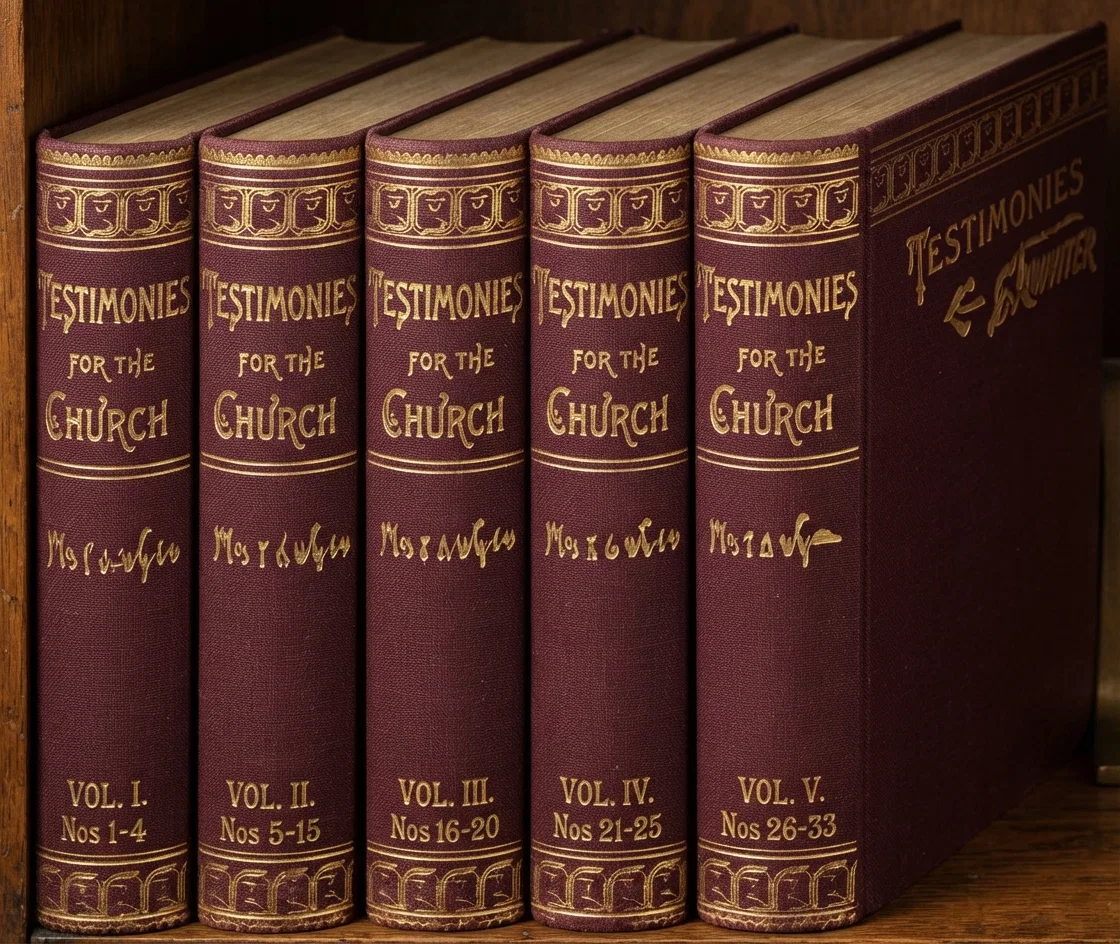
Testimonies for the Church

Nos. 1 to 33 Are now published in five volumes 2,904 pages
Cloth, $1.00 per volume; $5.00 per set Library, $1.50 " " $7.50 " "
Volume 5, containing Nos. 31 to 33, may be obtained on thin paper and bound in limp leather and colored edges, very convenient for workers, $1.50.
PACIFIC PRESS PUB. CO., Oakland, Cal. New York, N. Y. Kansas City, Mo.

Healthful Living

The above book treats on ventilation, appetite, diet, flesh foods, stimulants, heredity, cause of disease, colds, hygiene, organs of digestion, the lungs and respiration, self-poisoning, health, health reform, and many other kindred topics. It deserves careful study. Contains 324 pages and is bound in cloth. Price, 50 cents, post-paid.

Pacific Press Publishing Co.

39 Bond St. New York City | Oakland, Cal. | 18 West 5th St. Kansas City, Mo.
Continue reading: MEMORY