The Youth’s Instructor, Vol. 38, No. 9.

THE GOTHA CANAL

The Youth’s Instructor

Feb 26, 1890

S. D. A. Publishing Association · Battle Creek, Mich. · Feb 26, 1890

THE GOTHA CANAL.
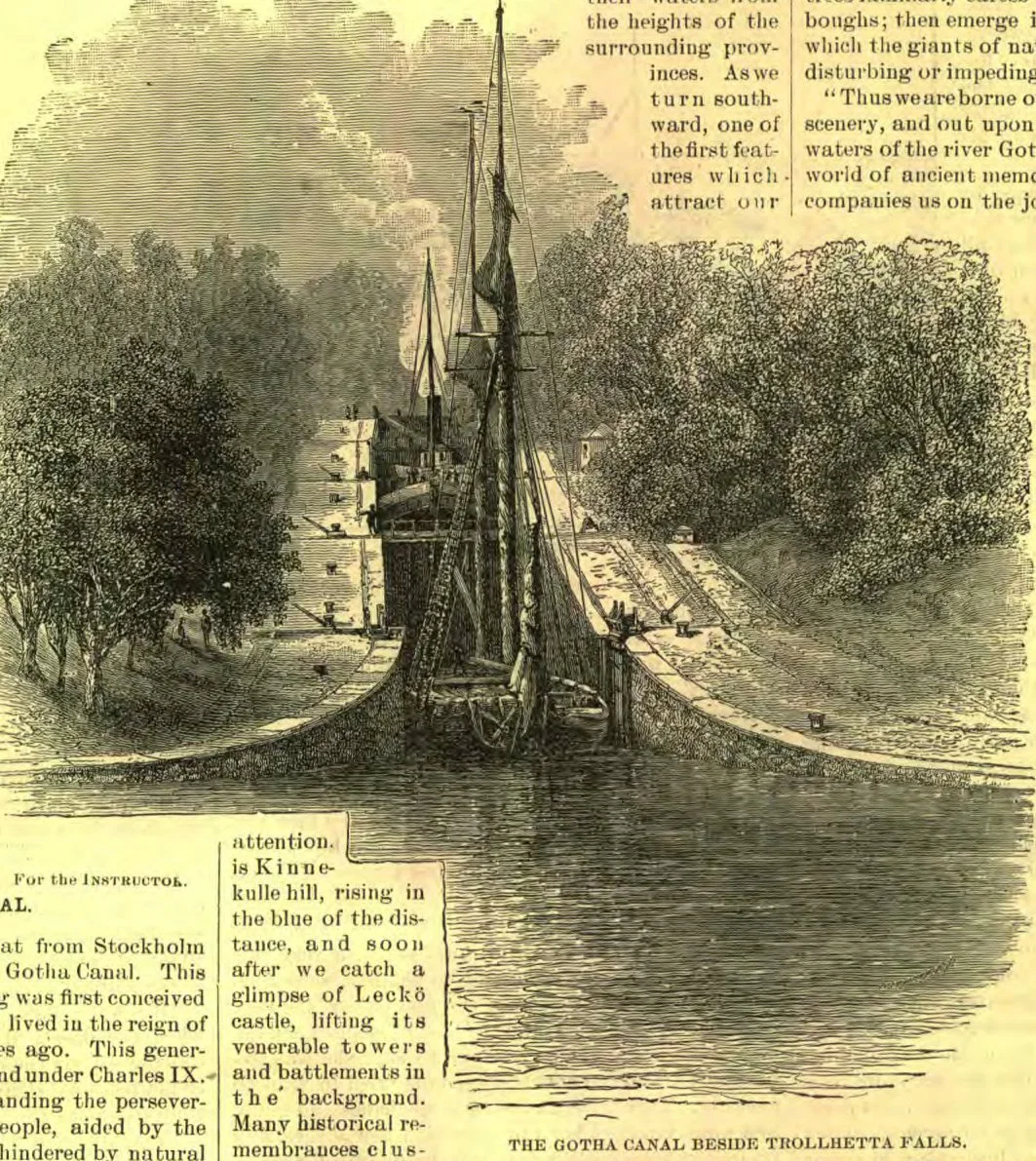
A MOST delightful trip is that from Stockholm to Guttenborg by way of the Gotha Canal. This wonderful piece of engineering was first conceived by a thoughtful bishop who lived in the reign of Gustaf Vasa, almost four centuries ago. This generous king favored the enterprise, and under Charles IX. the work was begun. Notwithstanding the persevering efforts of both king and people, aided by the highest genius, the work was so hindered by natural impediments, desolating war, and home discords, that it was not until the year 1800 that the first vessel passed through the canal. Since then, it has been enlarged and improved until large vessels may now be seen stalking through the country like apparitions. The canal is ten feet deep, generally forty-eight feet wide at the bottom and eighty-eight feet at the surface; and the locks, of which there are seventy-four in its entire course of about 260 miles, are one hundred and twenty-three feet in length and twenty-four in width. It opens up a lively commerce with the many cities and towns on its banks and on the shores of the great lakes through which it passes.
It is one of the most romantic water-courses in the world, and being thrown across the zone of the country from the Baltic on the east to the Cattagat on the west, is often called the “blue ribbon of Sweden.”
THE GOTHA CANAL BESIDE TROLHETTA FALLS.
From Stockholm we skirt along the southern shore of the beautiful Lake Mälar to Södertelge, then taking a course almost due south, we come in about two hours out upon the waters of the Baltic, whose salt breezes we enjoy for nearly sixty miles.
Turning inland again, we follow the windings of the canal through a wild yet beautiful country, and press steadily westward over beautiful lakes, past cities, towns, and mountains. Crossing Vettern, with its distant spires and fertile shores, and rapidly descending from one rocky plateau to another, we sail out on the broad expanse of Lake Vener, into which four-and-twenty rivers pour their waters from the heights of the surrounding provinces. As we turn southward, one of the first features which attract our attention is Kinne-kulle hill, rising in the blue of the distance, and soon after we catch a glimpse of Leckö castle, lifting its venerable towers and battlements in the background. Many historical remembrances cluster round this old castle, and as we approach, it seems to frown upon us with patriarchal dignity.
Passing through a rocky channel between two islands, we continue our journey to Venersborg at the southern extremity of the lake. Then gliding down the Gotha River, we come to the mouth of the canal that is to take us around the Trollhetta, one of the most beautiful series of falls and rapids in the Old World.
Entering the canal, we move quietly through parks and orchards, past little red farm-houses, tasty country residences embosomed in broad lawns studded with flower-beds and shrubbery, and stately mansions, while we listen to the distant roar of the cataract.
A better appreciation of that part of the route already passed over may be gained from the following beautiful description by Fredrika Bremer, the noted Swedish author. After calling the entire journey a poem, she says:—
“Through the interior of the country, where primeval mountains open for us their gates, we are borne up on invisible arms, higher and higher, from plateau to plateau, till we reach at length the uninhabited primeval forest, the bosom of wild mountain lakes. Then we silently break our way through the heart of the solid granite rocks, and are lowered from them into enchanting lakes which we had just seen lying like mirrors far below our feet, set in frames of fertile country gemmed with towers and castles and cottages; then speed on through glorious parks, whose leafy trees familiarly caress us in passing, with their green boughs; then emerge into a wide, wild country, in which the giants of nature wrestle, without, however, disturbing or impeding our way. “Thus we are borne on into the bosom of the loveliest scenery, and out upon the broad, calm, yet animated waters of the river Gotha; and all this whilst a whole world of ancient memories and present romance accompanies us on the journey with its vala-song; its battles; its runes, sagas, and legends; its heroes’ graves and landmarks; giant caldrons and holy wells; ancient castles, ruins, and so-called convents; or the erections of the present day, in factories and forts, splendid gentlemen’s seats, and small cottages beneath the shade of fir-trees—all in perpetual and ever-varying change.”
We have hardly stepped ashore at the town of Trollhetta, when a troop of little urchins surround and bewilder us, crying all in one breath, “Will Mister see the falls? I know the way everywhere; I can tell you about everything.” We scatter a few öre among the boys, and while they are scrambling to pick them up, we take a little foot-path leading to the falls.
Crossing a frail bridge, we find ourselves on the little isle of Gullö. What a feeling of awe and solemnity takes possession of us as we look up to the wood-covered mountains around us, and then down into the boiling, seething abyss below, where the powerful volumes of water seem struggling together, as they hiss and foam, and at last are dashed into spray and mist on the rocky bed below.
After spending a few moments contemplating this grand scene, we follow the stream for over half a mile, to view with wonder and admiration the Toppö and Helvete falls, and then return to our steamer, which we find ready to continue the journey. Below the falls we find the river as still as if never a ripple had stirred its quiet bosom, when in reality its waters have hardly ceased to hiss and boil for nearly a mile.
And thus we pass along between flowery banks and green meadows until we come in sight of the long, low line of hills that mark the sea-coast.
C. A. VIKMAN.

THE SIN OF OMISSION.

It isn't the thing you do, dear, It's the thing you leave undone, Which gives you a bit of a heart-ache At the setting of the sun,— The tender word forgotten, The letter you did not write, The flower you might have sent, dear, Are your haunting ghosts to-night; The stone you might have lifted Out of a brother's way, The bit of heartsome counsel You were hurried too much to say, The loving touch of the hand, dear, The gentle and winsome tone That you had no time nor thought for, With troubles enough of your own.
These little acts of kindness, So easily out of mind, These chances to be angels Which even mortals find,— They come in night and silence, Each chill, reproachful wraith, When hope is faint and flagging, And a blight has dropped on faith.
For life is all too short, dear, And sorrow is all too great, To suffer our slow compassion, That tarries until too late. And it's not the thing you do, dear, It's the thing you leave undone, Which gives you the bitter heart-ache At the setting of the sun. —Margaret E. Sangster.

Living So Slander Will Not Be Believed

PLATO, being told that he had many enemies who invariably spoke ill of him, said, “It is no matter; I shall endeavor to live so that none will believe them.”

ROUND THE WORLD.—9.

WHEN the Huguenot refugees first came to the Cape of Good Hope, the land was infested with wild animals of almost every description. And even now there are parts of the Orange Free State and the Transvaal where lions and tigers are found in large numbers. One of our party had the privilege of hearing an old lion-hunter relate some of his experiences. He stated that in one sense lions were perhaps not as dangerous as tigers; for when you meet a lion, it does not always mean that you must fight for your life, but with a tiger, a meeting means death either to him or to the hunter. If, upon meeting a lion that has not tasted human flesh, the hunter keeps perfectly quiet, not moving a muscle or raising his gun, the lion will frequently retire a few steps, and then make a bound, as if he were going to spring on his foe. But if the hunter looks him straight in the eye all the time, and keeps perfectly still, he will fall a few yards short in his leap. Then he will retire as before, only this time going back a little farther, and making another spring. This he will repeat several times, each time drawing farther away, till he has placed a goodly distance between him and his enemy, whereupon he will turn and run off. But if he means fight, there is only one chance of safety, that is to shoot him down the first shot. If wounded, he will close in deadly combat, and will fight as long as he can hold out, and that is generally long enough to dispose of his antagonist. His skull is so thick that only by chance will a bullet pierce it. There are two places, and only two, where, if he is hit, death will immediately follow; one is right in the eye, and the other behind the ear. The hunter generally goes alone, and relies on his sure shooting to save himself.
OFF FOR THE GOLD MINES.
In many cases the lion seems to take pity on mankind. We were told of one case where the family had all left the house, with the exception of a little child, who was playing on the floor with some coals of fire. All at once a lion entered, and began coolly to survey the premises. He approached the child, looked him all over, but did not harm him, and the little one, for no known reason, took up one of the dying embers and placed it on the lion’s head. The beast soon turned and went out, and the wind fanned the coal into a flame, so that his shaggy mane was soon on fire. Fire will terrify the lion, as it does all other animals, and he rushed off to the woods, leaving the child to continue its play.
African tigers regard man as their mortal enemy, and when they see him, they always spring, with the intention of striking him to the earth, and then dispatching him. When a lion springs on a man, it means death; he never misses. But the tiger is not so sure, and very often goes wide of the mark. Tigers frequently carry off sheep, and kill the cattle of farmers. They are very quick in their movements, and are exceedingly cunning and sly. They do not seem to possess the noble disposition of the lion, but will make an attack whether they are hungry or not. Many other wild animals formerly inhabited the colony, but with these two the early settlers had the greatest struggles.
There is a bird, a native of South Africa, called the secretary, which is noted for its method of disposing of snakes. When one is sighted, the secretary rises in the air, then comes down with a swoop on its prey, catches him in his bill, and begins to ascend. When the snake becomes too heavy for his captor, he drops him, makes another swoop, and seizes him again, working in this way till he has killed the snake.
Another curious bird is the honey guide. There are several species, and they belong to the cuckoo family. These birds are remarkable for the trust which they repose in mankind, and the manner in which they act as guides to the bee’s nest. When a Kaffer hears this bird utter a peculiar cry, sounding like “cherr, cherr,” he looks out for the singer, and goes in the direction of the voice. The bird, seeing that the man is following, approaches the bee’s nest, uttering its encouraging cry, and not ceasing till the nest is found. The Kaffer places great reliance on the bird, and never eats all the honey, but makes a point of leaving some for the bird who has directed him to that feast of which he is so fond.
The honey bird voluntarily seeks the aid of man, because otherwise it would be unable to get at the bee combs, which are made in hollow trees, and are thus protected in secure fortresses, which the bird could not penetrate without the assistance of some being stronger than itself. The bird would rather have the comb than the honey, a disposition which the Kaffer is very willing to make.
The honey bird does not always lead to honey. It sometimes leads the unsuspecting Kaffer to a lion or a tiger, but he can generally tell to what it is leading him. If it is to a nest, the bird will fly at a considerable height from the ground, but if to an animal, it keeps much nearer to the earth. There is also a large weasel, called the “honey ratel,” which acts in a similar way.
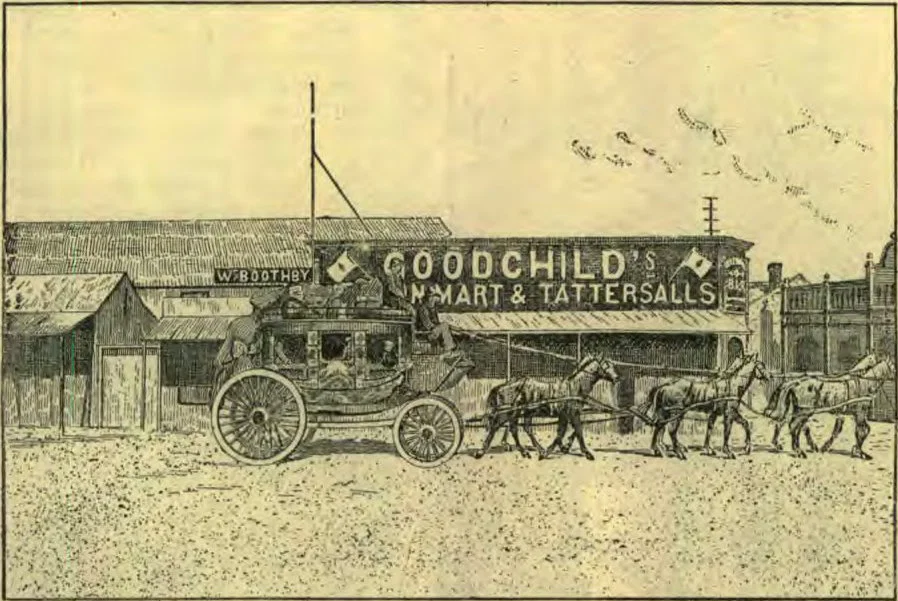
We took a sketch of an up-country coach, the only means of conveyance through the land whose animals we have been describing. F. T. M.

A QUEEN’S PRESCRIPTION.

“What is the matter, Alice?” asked Mrs. Temple. “Your face is flushed, and you seem to have no appetite.”
“There is nothing the matter, mother,” replied Alice, somewhat petulantly. “I don’t feel well, that’s all.”
“If you don’t feel well, you must feel ill,” persisted her mother, “and I must insist that you see Dr. Campus.”
“I think Alice ought to see the queen of Sweden’s doctor,” remarked Aunt Ellen, who was making a tidy in her big arm-chair.
“Who is the queen of Sweden’s doctor?” asked Alice in surprise. “Does he live here?”
“He lives in Sweden, I believe,” answered Aunt Ellen, with one of her queer smiles, “and his name is Metzger.”
Alice looked at her aunt in a puzzled way for a moment, and then broke into a laugh.
“Is it a story you want to tell?” she asked, interested at once.
Aunt Ellen, sixty years old, but with the face and figure of forty, was the life of the Temple household, and always had some quaint and interesting anecdote to relate.
“It is a story,” she replied, “but it is true. The queen of Sweden is, as you must know, a very rich woman. If any woman could be healthy, she could. She had the finest rooms in the fine palace, the very best of food and drink, and the best of medical attendance when she was ill. Strange to say, she was frequently ill, and the court physicians tried in vain to cure her. They tried all their old medicines and many new ones, tempted her appetite with new dishes, and bade her take daily rides, but the queen of Sweden kept getting worse. She was so nervous. Her rest was broken at night with horrid dreams, her temper became irritable, and life became a burden.”
“I don’t know whether Alice is that bad,” said Mrs. Temple, with a sigh, “but she isn’t far from it.”
Alice looked irritated at this remark, and said nothing.
“Well,” continued Aunt Ellen, with another smile, “the king of Sweden became very much alarmed, and sent for Dr. Metzger, who had been doctoring the empress of Austria. He came, had a long talk with the queen, and then gave her a prescription. It was not in Latin, but in plain Swedish, and it read: ‘No more carriage or horseback riding except on state occasions. If you want to go anywhere, you must walk.’”
“Oh, dear,” exclaimed Alice, “I always thought carriage riding and horseback riding were very healthful. I am sure I would hate to give them up.”
So did the queen of Sweden, but having placed herself in the doctor’s hands, she took the prescription like a sensible woman. But that was only a beginning; the next prescription was much more trying. The doctor laid out a space in the royal garden about forty feet square, and ordered the queen to prepare it for planting vegetables.”
“Dig it up with a spade!” cried Alice in amazement; “how could she do that?”
“She thought she couldn’t,” answered Aunt Ellen quietly; “but Dr. Metzger was firm, and the queen set to work in short skirts, bare arms, and thick-soled shoes. The first day’s digging, she said, nearly killed her; the second was not much better, and on the third she finished the job, and ate a large beef-steak with a wonderful appetite. The next day the doctor told her that she must dust and put in order her suite of rooms—five or six—every morning, and when that was done, he would find some other housework for her to do.”
“A queen doing housework?” said Mrs. Temple, incredulously. “Everybody would laugh at her.”
“Nobody laughs at queens in Europe,—at least not openly,” replied Aunt Ellen, smilingly; “and I presume very few people saw her engaged in these unusual occupations. The queen did not laugh at first; in fact, she cried many times, but she soon began to smile. Day by day she grew stronger. She could walk miles without fatigue; she slept well, and had a healthy appetite for healthful food.”
“And is she cured?” asked Alice.
“Not entirely. At any rate she is still taking Dr. Metzger’s prescriptions, but she is getting better every day.”
Alice was silent for a moment, and then she said, thoughtfully,—
“I suppose this story is aimed at me?”
“At you and girls like you,” answered Aunt Ellen, frankly. “My dear, I never took five cents’ worth of medicine since I was five years old, and your doctor’s bill is always a hundred dollars a year. I always walk in preference to riding. I insist upon keeping my own room in order, and when I am in the country, I work in the garden every day. I think I saw you yesterday looking on while John set out the geraniums and verbenas in the yard.”
“I’ll do it myself next time,” said Alice, remorsefully; “and I’ll begin Dr. Metzger’s prescription this very day by walking to and from the school.”
“If you do,” said Aunt Ellen, “you need not see Dr. Campus; it will be quite unnecessary. Earn a right to be healthy with hard work, and happiness will come in its train.”—Presbyterian Observer.

NOT LUCK.

A BARQUE was wrecked on the New Jersey coast one wild winter night, and the only persons saved were two boys who got to shore over the terrible billows on broken pieces of timber.
The dozen men of the crew of the doomed barque could not be saved, although the life-saving crew of a neighboring station did everything in human power to get lines or boats out to the ship, when she went to pieces scarcely a thousand yards from the shore.
“It’s boys’ luck,” said one of the life-saving crew, when the drenched boys came safely through the roaring surf on their piece of timber; let a boy alone to get ashore if there is a scrap of a shaving or a hen-coop to hang to.
“Specially if a fellow’s got sense enough left in his head to stick to his piece of timber,” said one of the rescued boys.
Then it came out that the captain and his crew were all under the influence of liquor when the gale began, and the greater the danger became, the more they drank, to lessen their sense of the peril.
“It was pretty tough to see such sailing, and not dare to open our mouths,” said the other boy. “We’d never have gone to pieces if they’d had their heads enough to hold her steady and off shore.”
“That’s just it,” said his companion. “They didn’t have their heads. A fellow’s got to be ‘all there,’ if he wants to make a port in a storm.”
Isn’t it a good thing to be sure that one has one’s head at all times? Many a young man has made shipwreck of his whole life, because in a time of danger and perplexity he has put into his mouth that which “steals the brains away.” It is not luck but pluck which wins, and it is the truest sort of pluck to refuse any truce with such an enemy.—Youth’s Companion.

FLORA'S PARTY.

“MAMMA,” exclaimed Flora Reynolds, “do come quick! If Aunt Margaret isn't the loveliest woman that ever was! Just see what she has sent me for my birthday,—a whole basketful of apples, oranges, pop-corn balls, and a few bunches of California grapes.”
Flora held up a beautiful basket of fruit for her mother to admire.
“How kind she is to remember you. I expect she knew that you would have few presents this year, and Aunt Margaret always tries to do her kind deeds to those who really need them. Truly, when she makes a feast, she calls in the poor.”
Flora looked at her mamma as though she was puzzled to know what she meant, and then said, “Now, mamma, I know what I will do. I don’t want to eat all this fruit alone. Can’t I have a party, and invite—let’s see—Nellie and Josie Ray, and Alice Brownwell? They are all such nice girls. I’ll take my little play table and dishes, and cut the fruit up, and we’ll have a splendid time. You know they always invite me to their parties.”
Mrs. Reynolds sat still, turning the fruit around slowly, and looking very sober.
“Please, mamma, why don’t you say ‘Yes’?” asked Flora, a little impatiently.
“Flora, I was thinking of your having your party somewhere else, and with somebody else, who very likely cannot invite you to a party.”
“What do you mean, mamma?”
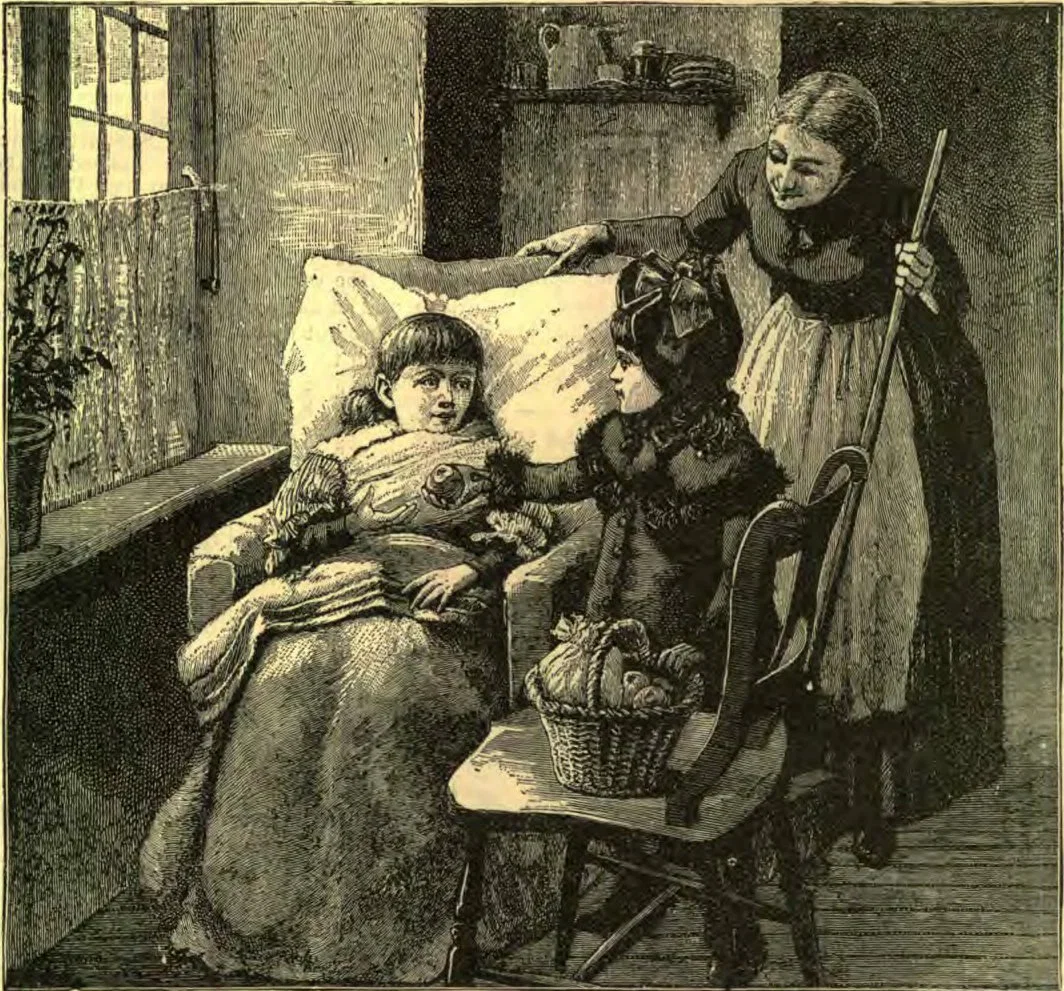
“Do you remember last week when we passed by our washerwoman’s house, how we saw a little pale face pressed up against the window? Do you remember what you said then,—how you wished you could do something to cheer up the little cripple? Seems to me I see a beautiful chance for you now.”
Mrs. Reynolds saw a shade of disappointment creep into Flora’s face.
“Do you mean that I ought to give her my fruit, and not have a party?” she asked.
“Yes; don’t you think it would really be a better way to dispose of these beautiful things to give them to a little girl who seldom sees such things, who has none of the pleasures you and these other girls have? They have plenty of nice fruit, and are not sick either. Why not go to Jessie Axtell’s, and have your party with her? I know it would do her good. But do just as you please. I don’t want to make you do it, if it does not please you; for it would only be a forced kindness, and that is very empty.”
Mrs. Reynolds went out to the kitchen, and Flora sat down by the window with her face on her hand. She looked gloomy and disappointed, and put her basket of fruit behind her.
“I wish Aunt Margaret hadn’t sent it,” she murmured. “I don’t want to give it to a girl I don’t know. Mamma might have thought of something else for her; for on birthdays people always ought to do as they please.”
“I gave my life for thee, My precious blood I shed, That thou might’st ransomed be, And rescued from the dead; I gave, I gave my life for thee, What hast thou given for me?”
Flora heard her mother singing the words at her work, and she felt still more uncomfortable.
“Well,” she said, “I guess I’d better give up my fruit. But if this isn’t giving up something for Him, I don’t think there are many folks that give up anything.”
Flora’s face was not very bright when she told her mother she was going to take her fruit to the little cripple.
“Of course I couldn’t have a good time now, anyhow, even if I kept it and had my party, because I should just be thinking about that pale face at the window all the time; but I don’t expect to have a good time anyway.” The tears filled her eyes, and Mrs. Reynolds’ face grew as sad as her daughter’s.
“My dear child,” she said, “you are not to give grudgingly nor of necessity. The Lord loveth a cheerful giver; that is what the good Book says. And it says, too, that when we make a feast, we are to call in those who cannot recompense us again. When Jesus has his great feast in heaven, he will not invite just the rich; but he will invite those who have had his sweet spirit, and who have followed him here on earth. Now, Flora, if Jesus had had this basket of fruit given to him, don’t you think he would have thought of little Jessie the first thing? And how do you know but what he put it into Aunt Margaret’s head to send it to you, so that you could carry his love and his gift to Jessie for him?”
“O mamma, do you think he did?”
“Yes, I do believe it. He says we are his stewards, that is, we are the ones who have charge of his goods, and he wants us to do the very best we can with them for him.”
Flora’s face began to grow brighter. “Well, then, mamma, I am not going to disappoint him to-day.”
Mrs. Reynolds smiled as she saw her little girl hurrying down the walk with a bright smile on her face. It did not take Flora long to reach the house where Mrs. Axtell lived. She was out of breath after she had climbed the stairs, and when Mrs. Axtell let her in, she had to sit down on a chair without saying what she had come for. After a little she told her that she had come to have a birthday party with Jessie.
Mrs. Axtell took her into the next room, where Jessie was sitting in a large chair by the window, looking so pale and sad.
“This is Flora Reynolds,” said Mrs. Axtell, “and she says she has come to have a birthday party with you.”
How the pale face did brighten as Flora uncovered her basket and put an orange into Jessie’s hand. Flora told her all about Aunt Margaret and about what her mother had said,—that maybe Jesus had given the fruit to her to carry to Jessie,—and what a splendid time they did have together!
Mrs. Axtell made them some cookies, and gave them some dishes, and Flora and Jessie cut up the apples and oranges and divided the grapes and pop-corn. They couldn’t eat all the fruit, but when Flora came away, she left it with Jessie. When she bade her good-by, Jessie put her arms around her neck and kissed her, and told her how much good she had done her.
“Of course I liked the apples and oranges, because I do believe, just as you say, that Jesus sent them to me; but I think he sent you with your love, and that has done me so much good right here,” she said, laying her hand on her heart.
Mrs. Axtell, too, thanked Flora for coming, and told her how lonely her little girl was sometimes. Flora told her she would come often after that; and when she bounded into her home that afternoon, her mother knew, before she had said a word, that she had had a good time.
“O mamma, she is just the dearest, sweetest child you ever saw, and I never had such a happy time in my life. I hope Jesus will send me lots of good things to carry to poor little Jessie. I think it’s splendid to be his steward, and I’m truly sorry I was so mean and selfish. Now I’m going to look over all my playthings, and find the nicest things I can to give away. And, mamma, I’m going to be a cheerful giver, too; for I love the Lord, and I want him to love me.”
FANNIE BOLTON.

THE EGYPTIAN BOY.

The boys in Egypt lead a very free and simple life. As the climate is warm, they need little clothing. If a little Egyptian boy has a cotton shirt and a fez, he is satisfied. The fez is a red cloth cap with a long tassel. His little brown face is as serious as that of an old man, and to look at it you would hardly think he had any fun and mischief in him; but he has plenty.
He has to go to school whether he wants to or not. But he does not have the nice books you have. All the book he has is a piece of wood painted white, on which the teacher writes the lesson with charcoal. When one lesson is learned, it is washed off, and a new one is written.
The school-room is a queer place. The boys all sit on the floor cross-legged, in front of the teacher. They hold their tablets in their hands, and rock back and forth as they study. They all study aloud, and make a great noise. You would think they were screaming and fighting instead of learning their lessons. When they have learned to read and repeat the Koran, which is their Bible, they need not go to school any more.
The missionaries in Egypt have schools where they teach the children better things than the Koran. They teach them our own Bible, and about Christ and heaven. But there are few missionaries and few schools and a great many boys. What shall we do for them?
They learn to carve bits of wood and make many curious little things which they sell for money, for they are very fond of money. They like to see curious things too. An American gentleman was once buying some things of these little peddlers, and took out his watch. At once a dozen pairs of eyes were bent upon it. The ticking excited the wildest surprise, and after the watch had been held to all their ears, it was in vain the gentleman assured them it was not alive. They thought it was a new kind of animal, and ran away to tell every one they saw about the strange little creature the gentleman carried in his pocket.—Selected.

GRANDMA'S HELP.

“GRANDMA sat by the window, Where the flowers looked out to the sun, Darning and darning from morning till night; I was sure she would never get done.
“So I drew up my stool close beside her, And chose a gray sock from the pile, And tied up the hole with a bit of red thread, So strong it would last for awhile.
“When grandpapa dressed that next Sabbath, He called out, ‘Why, grandma, see here! Have you had help in darning my stockings? They certainly look rather queer!’
“But he liked it. Yes, grandpapa liked it; For he gave me a hug and a kiss, And said, ‘All the years I’ve worn stockings, I never saw darning like this!’”
—Marjorie S. Henry.

UNCLE SAM'S BORDER LINE.

Do any of our young people ever query how the dividing line between the United States and the Dominion of Canada is marked, and how travelers in those wild regions northwest of the Great Lakes, can tell when they step from the domains of Uncle Sam into those of Queen Victoria?
For many years the question of boundary between the United States and the possessions of Great Britain was discussed, and at last, at the Convention of London held in 1818, the forty-ninth parallel of north latitude was decided upon. A parallel of latitude, however, being an imaginary line, is a very poor guide to a traveler, so the next thing to do was to mark that line so that all who passed that way should know where it was located. Accordingly, the country in that vicinity was surveyed, and monuments were set up at even mile intervals, the British placing one between every two of ours. These extend from the Lake of the Woods to the Rocky Mountains.
Where the line enters forests, the timber is cut down, and the ground cleared a rod wide; where it crosses small lakes, stone cairns have been built, sometimes being eighteen feet under water, and eight above; in other places earth mounds seven by fourteen feet have been built.
The most of these monuments, which number three hundred and eighty-eight in all, are of iron. It was found that the most solid wooden posts were not proof against the ravages of the Indians, prairie fires, and the weather, so that nothing but iron would do.
These pillars are hollow iron castings fitted over solid cedar posts, and well bolted through, and are sunk four feet in the ground.
They are eight feet high, eight inches square at the base and four at the top, and upon opposite sides facing north and south are the inscriptions, cast in letters two inches high, “Convention of London” and “Oct. 20, 1818.”
The pillars weigh two hundred and eighty-five pounds each, and were made at Detroit, Michigan. So you see Uncle Sam's border-line is very distinctly marked all the way from the Lakes to the summit of the Rocky Mountains.—Wide Awake.

ELEPHANTS PILING TIMBER.

A PHILADELPHIAN, traveling around the world, found nothing to interest him more than the celebrated trained elephants of India, which he saw at Moulmein, a sea-port town on the Bay of Bengal. In writing to a friend, he thus describes their wonderful intelligence:—
“Here you see the trained elephants at work, piling up teak timber in the numerous timber-yards that line the river. Their knowledge and intelligence are simply wonderful. They are guided by a native, called a mahout, who is perched on the neck, and who gives all the necessary orders, assisted by his heel and a sharp-pointed iron goad very much like a small pickaxe.
“The elephants thoroughly understand what is required of them. Think of their piling up square timber to the height of forty feet, every stick of which is in line and in its proper place, each piece weighing from two to three tons!
“They carry the timber on their tusks, holding it in place by their trunks, to the place of piling. When the pile is too high for them to build up comfortably, they build a staging for themselves out of the same material, and do not hesitate to mount it with their load.
“Mr. Findlay, the owner of one of the largest yards, had his force of elephants put through their various forms of work for our benefit, such as piling up the logs and tumbling them down, as well as drawing by chain harness and pushing with their trunks and tusks from three to five of these logs, end to end, tandem fashion. When drawing the logs, the elephants, at the word of command, unhitch the chain or hook, but cannot be made to couple it.
“When pulling down the timber he had just put in place, I thought one of them cast a suspicious eye in our direction, as much as to say, ‘You people are at the bottom of this.’
“They are at times very troublesome and dangerous, and great care is taken to keep strangers at a respectful distance. They are immense in size, and cost from 1,800 to 2,500 silver rupees each; that is to say, from $900 to $1,250 each.
“When the bell rings for dinner or quitting time, they quit at once what they are at, and cannot be induced to go on, but bolt immediately to their quarters for their meal. Woe to the feeder, should any of them be cut short in their food! They never forget it, and revenge themselves at the first opportunity.
“They bathe in the river every evening, and know as well as man when Sunday comes. On that day they make for the mud-pits, and, like pigs, wallow there all day.”—Selected.

HE FOUND THEM OUT IN PRISON.

You have seen statements about the number of verses in the Bible, the middle verse, the longest and shortest verses, etc. Did you ever read who it was that counted out all these curious matters about the Bible? He was the scholarly Prince of Granada, heir to the Spanish throne, who was cast out into the prison of Madrid, called the Place of Skulls, by a rival to the throne, and there he was kept for thirty-three years, until death came to his release.
After his death, the following inscription was found scratched on the rough walls of his cell. The work had been done with an old nail:—
“In the Bible the word Lord is found 1,853 times; the word Jehovah, 6,855 times; the word reverend but once, and that in the 9th verse of the 111th psalm; the 2d verse of the 117th psalm is the middle verse of the Bible; the 9th verse of the 8th chapter of Esther is the longest verse of the Bible; 35th verse, 11th chapter of John, is the shortest; in the 107th psalm, four verses are alike,—8th, 15th, 21st, and 31st; each verse of the 136th psalm ends alike; no names or words with more than six syllables are found in the Bible; the 30th chapter of Isaiah and the 19th chapter of 2d Kings are alike; the word girl occurs but once in the Bible, and that in the 3d verse and 3d chapter of Joel; there are found in both parts of the Bible 3,586,483 letters; 773,693 words, 31,373 verses, 1,179 chapters, and 66 books.”
Let us be thankful that we can study the word of God without being shut up in prison, and let us ponder it, not merely to find out curious facts, but especially to find the Redeemer who is offered to us as our Saviour.—Youth’s Evangelist.
Continue reading: CARRIER SWALLOWS