The Youth’s Instructor, Vol. 34, No. 14.

A MARRIAGE IN CANA

The Youth’s Instructor

Apr 7, 1886

S. D. A. Publishing Association · Battle Creek, Mich. · Apr 7, 1886
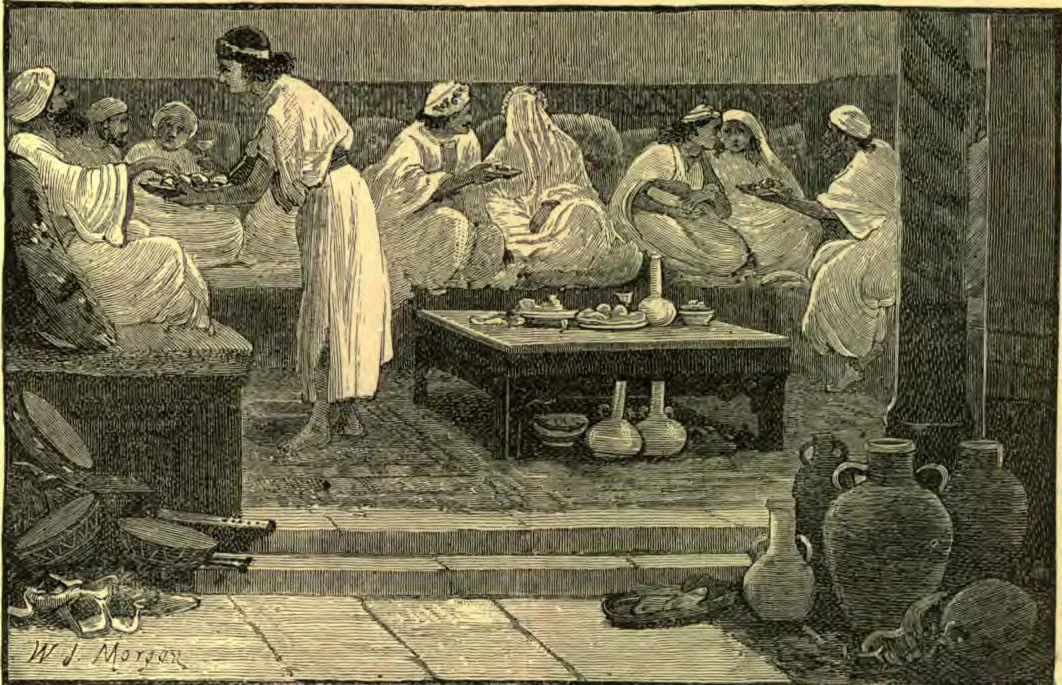
By permission of Cassell & Co.

“A MARRIAGE IN CANA.”

IT is night in Galilee. In the sky the stars shine out one by one, and the crescent moon, like a barque of pearl, rides on the deep blue of heaven. Suddenly, upon the still, clear air of evening, a sound of music and of revelry breaks forth, of tinkling cymbals and sweet-sounding instruments; and from an oriental home a company set forth. The torches, ten in number, throw a wierd, uncertain light over the revelers. It is a bridal procession; and the bridegroom, with the “children of the bride chamber,” is leading home his bride. As they near the house of the bridegroom, other guests join the procession, and the music grows louder and more joyous. Now they enter the door, and pass from sight.
No doubt there was such a procession “when there was a marriage in Cana of Galilee, and the mother of Jesus was there; and both Jesus was called, and his disciples, to the marriage.” The customs of the Eastern nations have changed so little in thousands of years that in many respects the ways of the people are now nearly the same as when Christ walked among the hills of Galilee.
After the ceremony,—the leading home of the bride,—there followed the marriage feast. In this house at Cana there were no doubt many guests; and we should have no trouble in distinguishing the bride by her long veil, that falls over her face, hiding her completely from public gaze, nor of the bridegroom with his elaborate robes and gay bridal turban. If the guests are many, no doubt the custom is followed of putting three of the low couches together in the form of a crescent, appointing one of the guests to take charge of the persons at these tables. This was the “governor of the feast.” All goes merrily, until an incident occurs that causes perplexity,—the wine has given out. It would be an unprecedented thing to have a marriage feast without wine; but what shall be done? It is too late to get more. Then the mother of Jesus, whom we may suppose was a relative of the bridegroom, turns to her divine Son, saying, “They have no wine.” “And there were set there six waterpots of stone, after the manner of the purifying of the Jews, containing two or three firkins apiece,” and Jesus, ever ready to contribute to the comfort and happiness of all, bids the servants to fill the waterpots with water, and to draw out and bear to the governor of the feast. And the astonished servants, obeying his command, behold the sparkling water turned to ruby wine.
If the revelers followed the usual custom, the festivities are kept up for seven days, and then the guests return to their usual occupations, and life for the bride and bridegroom flows on in its ordinary channel. Such were the wedding ceremonies from the days of the patriarchs down to the time of Christ; and such they are at the present day, with some modifications. D. E. H.

THE RELIGION OF SWEDEN.

The Christian religion was known in Sweden before it was preached by the missionaries. The inhabitants used to travel far and wide in order to trade; and they had brought many Christian slaves into the country, who had introduced Christianity. But the light shone dimly through the clouds of superstition, and idolatry held full sway.
About the year 830, Swedish embassadors came to the German emperor Louis, asking him to send teachers to their country. Ansgar had just returned from Denmark, and joyfully accepted the new mission, which no one could so well undertake as he; for he was already acquainted with the language and the habits of the northern people.
He was, however, exposed to many dangers, for wild pirates plundered him and his companions during their voyage, taking away the presents which the emperor had given him; and, greatest misfortune of all, he lost forty books that he had collected for use in church services. Yet he was thankful to have his life spared; and he continued his journey through a wilderness of woods, rivers, and lakes, until he arrived at the royal residence, situated on Björk Island in Malaren.
He was received very kindly by the king, who gave him full liberty to preach the gospel in his kingdom; and Ansgar staid in Sweden one year and a half. The missionaries were greeted as angels of light by the poor Christian slaves, who for so long a time had seen no kind brotherly face. Many of the heathens were converted, among whom was the powerful chief Herger, commander of Birka. He built the first Christian church in Sweden.
After Ansgar returned to Germany, Gauzbert continued to labor with great zeal for the spread of the Christian religion, and he became bishop of Sweden. But soon persecutions arose. Nithard, a relative of Gauzbert, was killed, and the bishop himself was put in prison, and was finally, in a shameful manner, driven out of the country.
After seven years, another preacher, Ansgar, was sent over; but he also had to leave Sweden, after having preached a short time. The pious Herger had died, and the people were exhorted by zealous heathen men to leave the new faith. They were reminded of the many blessings which they had obtained from their old gods, and if they thought that their power was not great enough, they could add to their number the valiant king Erik, who had died; he would fight for them much better than a foreign god. Then the people forgot their vows to the missionaries, and built a temple in honor of a mortal man, in place of honoring the immortal God.
In 853 Ansgar returned. At first he met strong opposition, but by his prudence he gained both the king and many of the people to his side. The king appointed a day when the chief men of his kingdom should assemble, and cast lots in the field, according to their ancient custom, to decide whether Ansgar should be permitted to labor in the kingdom. Ansgar fasted and prayed much; and a short time before the decisive day, he was filled with great confidence, and told his friends they need not fear at all, for the Lord had heard his prayer. And it was even so; for the lot turned out so clearly in his favor that all acknowledged it to be the will of God that the Christian religion should be established in Sweden.
The work progressed slowly, however, although Ansgar and his successors labored with great zeal. The people often mingled the name of Jesus with their drinking songs, and thought that they could honor Christ in connection with surfeiting and drunkenness. It is a pitiful fact that the great mass of the people have not advanced any farther. A thousand years of education in lifeless forms of religion have changed their ideas but very little, and there is still great need of true missionary labor.
For about five hundred years the Catholic religion reigned supreme, and then the Reformation was introduced in Sweden. By this time the clergy had become so powerful that the bishops had almost the entire control of the government and the wealth of the country. At a diet held in 1529, the king stated that the revenues of the crown, on account of the power and position of the clergy, amounted to only 24,000 marks annually, while its expenditures were 60,000 marks. No wonder that the king favored the Reformation.
The Reformation was aided greatly by a Swedish youth, named Gustaf Erikson Vasa, who had been sent to Denmark as a hostage. He was son of a minister of state, and had descended from an old family of great merit. He finally fled from Denmark into Germany, and after many adventures, came into the north-western part of Sweden, where he raised an army of one thousand men, and turning upon the Danes, quickly gained one victory after another, until he at length took Stockholm. Gustaf was now made king of Sweden.
This king soon became acquainted with Olaus Petri and his brother, who were friends of Luther. These two brothers somewhat resembled Luther and Melancthon. Laurentius was learned, thoughtful, and calm; while Olaus, by his powerful eloquence, everywhere aroused the people. For this reason he was often assailed with sticks and stones; for the Catholic priests incited the people, so that often Olaus barely escaped with his life. The king himself had become somewhat acquainted with the Lutheran doctrine while he was in Lübeck, and seeing the great need of overturning the Catholic policy, because the clergy had assumed all the power, and oppressed and impoverished the people, he favored the Reformation as the only means of saving the country from ruin. He therefore encouraged as much as possible those who labored to establish the Protestant faith; yet he proceeded with great caution, and weakened the Catholic party by degrees.
After some time, the Catholics made an effort to regain their power. This was under the reign of Johan III., whose wife was a Polish princess. She persuaded the king to favor the Jesuits. Through their effort the Catholic church was again partly established in 1575 and 1576. The king accepted the Catholic faith; and for several years the Catholics flourished, establishing Jesuit schools in Sweden, and sending young men to foreign countries to be educated in this faith.
The following king, Sigismund, also favored the Jesuits; but while he was absent, and the government was intrusted to duke Charles, a conference was called in Upsala, where it was decided that from henceforth the Holy Scriptures should be considered the only rule for man's faith.
Two years later it was decided that the Catholic institutions should no longer be allowed, and that the Catholic priests should leave the country within six weeks. In 1703 the Catholics were again permitted to hold religious services in Sweden, and since that time their numbers have increased fast, especially of late years.
The Baptists have become very numerous in Sweden. Their mission has in a great measure been sustained by the American Baptists, and they stand closely connected with them. The Methodists are less numerous, and they are also sustained from America. While the latter have been prospered most in Norway and Denmark, the former have prospered best in Sweden.
The most numerous society in Sweden at present, outside of the State church, is the Free Church, or Mission Society. They are not particular about what people believe, but want them to be converted and believe in Christ. They have built numerous mission-houses through the country.
The church councils in each town still have power to forbid all preaching considered dangerous to the State church; but the public sentiment of freedom of speech and conscience has become so strong that this power is very rarely used. Sometimes the priest is in favor of enforcing the law, but the other members of the board are opposed, and then he cannot do anything. As a general thing, the people in Sweden are quite willing to listen to the preaching of the Bible. J. G. MATTESON.
Copenhagen, Denmark.

AN APRIL WELCOME.

Come up, April, through the valley, In your robes of beauty drest, Come and wake your flowery children From their wintry beds of rest; Come and overflow them softly With the sweet breath of the south; Drop upon them, warm and loving, Tenderest kisses of your mouth.
Touch them with your rosy fingers, Wake them with your pleasant tread, Push away the leaf-brown covers, Over all their faces spread; Tell them how the sun is waiting Longer daily in the skies, Looking for the bright uplifting Of their softly fringèd eyes.
Call the crowfoot and the crocus, Call the pale anemone, Call the violet and daisy, Clothed with careful modesty; Seek the low and humble blossoms, Of their beauties unaware, Let the dandelion and fennel Show their shining yellow hair.
Bid the little homely sparrows Chirping in the cold and rain, Their impatient, sweet complaining, Sing out from their hearts again; Bid them set themselves to mating, Cooing love in softest words, Crowd their nests all cold and empty, Full of little callow birds.
Come up, April, through the valley, Where the fountain sleeps to-day, Let him, freed from icy fetters, Go rejoicing on his way; Through the flower-enameled meadows Let him run his laughing race, Making love to all the blossoms That o'erlean and kiss his face.
But not birds and blossoms only, Not alone the streams complain; Men and maidens too are calling, Come up, April, come again! Waiting with the sweet impatience Of a lover for the hours They shall set the tender beauty Of thy feet among the flowers!
—Phoebe Cary.

LITTLE MOZART AND HIS PRAYER.

Many years ago, in the town of Salzburg, Austria, two little children lived in a cot covered with vines, near a pleasant river. They both loved music, and when only six years old, Frederika could play well on the harpsichord. But from her little brother such strains of melody would resound through the humble cottage as were never before heard from so young a child. Their father was a teacher of music, and his own children were his best pupils.
There came times so hard that these children had scarcely enough to eat, but they loved each other, and were happy in the simple enjoyments that fell to their lot.
One day they took a walk through the woods; and stopping to rest in the shadow of trees, the boy said thoughtfully, “Sister, what a beautiful place this would be for prayer!”
Frederika asked wonderingly, “What should we pray for?”
“Why, for papa and mamma,” replied her brother. “You see how sad they look. Mamma hardly ever smiles now, and I know it must be because she has not always bread enough for us. Let us pray to God to help us.”
So these two children knelt down, and asked the heavenly Father to bless their parents and make them a help to them.
“But how can we help?” asked Frederika.
“Why, don’t you know?” replied Wolfgang. “My soul is full of music; and by and by I shall play before great people, and they will give me plenty of money, and I’ll give it to papa and mamma, and we’ll live in a fine house and be happy.”
At this a laugh astonished the boy, who did not know any one was near them. Turning, he saw a fine gentleman who had just come from the woods.
The stranger made inquiries, which Frederika answered, telling him, “Wolfgang means to be a great musician; he thinks he can earn money, so that we will not be poor any more.”
“He may do that when he has learned to play well enough,” replied the stranger.
Frederika answered, “He is six years old, and not only plays beautifully, but can compose pieces.”
“That cannot be,” replied the gentleman.
“Come to see us,” said the little boy, “and I will play for you.”
“I will go this evening,” answered the stranger.
“Then, as he turned to go, the boy took hold of his coat and said, ‘Do you think God will send us some dinner? We have asked him to.’”
“I think he will,” was the reply.
The children went home and told their story to their parents, who seemed much pleased and astonished.
Soon a loud knock was heard, and on opening the door the little family were surprised to see men bringing in baskets of food in variety and abundance. They had an ample feast that evening. Thus God answered the children’s prayer.
Soon after, while Wolfgang was playing a sonata which he had composed, the stranger entered, and stood astonished at the wondrous melody. The father recognized in his guest Francis I., emperor of Austria, who had been residing in the vicinity.
Not long after, the family were invited by the emperor to Vienna, where Wolfgang astonished the royal family by his wonderful powers. From that time the father and his children gave concerts in many cities of Germany and France.
At the age of fifteen, Wolfgang was acknowledged by all eminent composers as a master.
These are some incidents in the life of the most eminent musical genius the world has ever known.
He was good as well as great. The simple trust in God which he had learned in childhood never forsook him. In a letter to his father he says:—“I never lose sight of my God. I acknowledge his power and dread his wrath, but at the same time I love to admire his goodness and mercy to his creatures. He will never abandon his servant. By the fulfillment of his will mine is satisfied. I shall always make it my duty to follow punctually the counsels and commands you may have the goodness to give me.”—Well-Spring.

A BOY'S INVENTIONS.

A good many years ago a boy lived in England whose favorite playthings were tools, and whose chief amusement consisted in making curious and ingenious machines. At one time he made a clock, which was kept in motion by the dropping of water upon a wheel. The way to wind this clock was to supply it with the amount of water necessary to keep it running for twenty-four hours. This the young inventor attended to in person, always winding his clock upon getting out of bed. It ran down, or stopped rather, sometimes, when the little opening through which the water dropped became clogged by impurities. The trouble, you see, was with the water, not with the clock. But it served a very good purpose for all that, and was much prized by the family for whose benefit it was made.
Another invention by the same boy was a windmill, modeled after one which he watched the workmen putting up near his own home. Some one, who knew, said that this was “as clean and curious a piece of workmanship as the original.” It had one great defect, however, it would not work when there was no wind. So our boy added to it a contrivance by which it could be kept in motion by a mouse!
In an age when bicycles and tricycles were unknown, this busy boy built a four-wheeled carriage, which could be propelled by the person riding in it.
Noticing the shadows cast by the sun, he drove pegs into the side of the house, marking thus the hours and half-hours, and finally worked out a sun-dial, which is still to be seen.
This ingenious boy never tired of making pretty and useful things for his girl friends, such as little tables, chairs, wardrobes, dolls, and trinkets generally, which shows the kindness of his heart in his willingness to give pleasure.
On the day of the great Cromwell's death, in 1658, the young inventor had reached the age of sixteen. A great storm raged upon that day, and he chose it as a suitable time to perform his first strictly scientific experiment. To learn the force of the wind, he first jumped with it, and then against it. By comparing these distances with what he was able to do on a calm day, he was enabled to judge of the force of the storm. After that, when the wind was blowing, he used to say it was so many feet strong.
You may imagine that a boy who used his powers of observation and his ability to think to such good purpose, would be pretty likely to make a name for himself in the world. And so he did. If we were to tell you the old story of the young man lying under an apple-tree, and what grew out of his thoughts about the falling of an apple to the ground, you would say at once, “Oh, that was Sir Isaac Newton!”
Don't be afraid to use your brains, young people. They will bear a great deal more use than most of them get.
And remember that your eyes were made for seeing things large and small, and you should use them accordingly. The habit of observation can be cultivated to a wonderful extent, and it will open new avenues of interest and knowledge to you in many directions of which you do not now dream. Observe, think, study; and whether you become famous or not, you will be the wiser, stronger, and happier for it all your life.—S. S. Classmate.

HOW DO YOU VALUE THEM?

“More than my necessary food,” “I have esteemed the words of His mouth,” Job declared before those who accused him of sin. There is a depth of meaning to these words that our young friends may never have considered.
“Necessary food” is what is really essential to preserve life. Most all of us eat more food every day than our physical natures require; we could eat considerably less to advantage healthwise. Some, no doubt, would have a longer lease of life by reducing their portion of food; for overeating is detrimental to health, and life is sometimes actually shortened by excess in eating. But only those who have suffered the keen pangs of hunger know the sacrifice one makes in parting with the food necessary to the preservation of life.
In this light one can understand that when Job esteemed something more than his “necessary food,” it was prized beyond life. The word of God, sometimes called the “bread of life,” that which nourishes the soul, was more than life to him. Every word of God was a sweet morsel, upon which he feasted with as much greater satisfaction than upon his temporal food, as eternal life is more valuable than the present one.
Why did Job place such high estimate upon the words of God?—Because he had proved them. He had sought an acquaintance with their Author, and had discovered that everything else faded into insignificance before him and his word.
God’s promises are as sure, and his threatenings as certain, as in the days of Job. And although he is as strictly a God of justice, and cannot let the sinner go unpunished, he is the same merciful God to all who love him and keep his commandments.
Are the words of the Lord precious to you to-day, dear young friends? Have you acquainted yourselves with the beauties of Christ’s character, so that there is nothing you desire more than to be like him, and to know his Father’s will? Is the “bread of life” a satisfying portion, nourishing you, and fitting you to stand in this time of temptation, when we are being tested for eternity?
The fulfillment of God’s promises to the righteous is so much nearer than in Job’s time, that his words should increase in preciousness every day. Will you study them, dear reader? Will you square your life by them? Will you perfect a character that can be measured by them, that when this life is ended, you may live through the eternal ages? Would that we could hear the response from every reader of the INSTRUCTOR, “By God’s grace I will.” Oh, that each one of us may improve the little time that remains, as wise stewards of the bread of life!
M. J. C.

A HARD LESSON.

Socrates, the church historian, reports a story of one Pambo, a plain, ignorant man, who came to a learned man and desired him to teach him some psalm or other. He began to teach him the thirty-ninth psalm.
“I said, I will take heed to my ways, that I sin not with my tongue.”
Having finished this first verse, Pambo shut the book, and took his leave, saying that he would learn that point first. When he had absented himself for the space of some months, he was asked when he would go on with his lesson. He answered that he had not yet learned the old one; and he gave the very same answer to one that asked a like question, forty-nine years after.

Christ, the Crowning Grace of Character

A CHARACTER to be complete must be crowned, consummated, and glorified by union with this perfect man, Christ Jesus. Faith in him as an infinite Saviour is the climax of character, without which manhood is like a tower that may be broad at the base, symmetrically built, its sides elegantly wrought, but is unfinished at the top.

Learning Without Action Compared to Plowing Without Sowing

WHO learns, but acts not what he knows, Is one who plows but never sows.

IMPORTANT BIBLE SUBJECTS.

LESSON 1.—THE GIVING OF THE LAW.

1. To what place did the Israelites come about two months after they left Egypt? Ex. 19:1.
2. What did the Lord say he would do on the third day afterward? Ex. 19:11.
3. What preparation were the people required to make for this event? Ex. 19:10, 11.
4. What precaution was taken to keep the people from touching the mountain? Ex. 19:12, 23.
5. What was said would be the result if any one should touch it? Ex. 19:12, 13, 21.
6. What dreadful things did the people hear and see on the third day? Ex. 19:16.
7. What caused these things? Ex. 19:20.
8. How was the mountain affected by the presence of the Lord? Ex. 19:18.
9. Who attended the Lord on this occasion? Ps. 68:17.
10. For what purpose did the Lord thus come down on Mt. Sinai? Nehemiah 9:13; Deut. 33:2.
11. Where do we find that which the Lord spoke from Sinai? Ex. 20:1-17.
12. When the Lord had spoken these words, what did the people do? Ex. 20:18.
13. What request did they make? Ex. 20:19; Deut. 5:24-27; Heb. 12:19.
14. Did the Lord grant their request? Deut. 5:28.
15. In what manner did he give them subsequent instruction? Deut. 5:30, 31.

THE HAPPY ART OF ILLUSTRATION.

“You tell what things are, but never what they are like,” was the criticism that great preacher, Robert Hall, made once upon a brother minister.
This same criticism might be made upon many a teacher in the Sabbath-school. He knows the lesson, for he has studied it well, and he can tell what he knows in sentences which flow as clearly as a running brook; but somehow what he says runs through the mind of the scholar like water through a sieve, and leaves no trace behind. The truth is taught, but it is not made effective. The nail is driven, but it draws too easily out of the mind, and the labor is lost. Now, my dear teacher, learn to clinch the nail with a well-chosen illustration, and it will stay where it is driven.
For the mind, whether of the child or of the adult, delights in making comparisons. We want to know not only what a thing is, but also what it is like. We hold up as a torch that which is plain, so as to see that which is dark; and we compare truths in the spiritual world with objects which we see in the world of nature. In this way the field of truth is enlarged before our vision, and what we see is not soon forgotten. A word-picture is always a pleasant object to gaze upon, and the teacher who can draw it at will is apt to be the center of a charmed circle.
The fact is, every faculty of the mind can be cultivated if one only knows how, and has the spirit of perseverance. Let not the faithful teacher despair. He has imagination, and he can perceive the force and beauty of the illustrations which others use; and if so, he can, by perseverance, make some of his own.
The teacher would do well to study the method which was followed by the divine Teacher. He taught first by precepts, clearly and briefly stated, and then he added the parables. Hence “the common people heard him gladly.” The method of teaching by parable, which is but one form of illustration, has ever been a favorite method in the East, and there is a peculiar charm about it.
Let no man think that to teach by illustration is only a method for children. It is suited for them, and it is suited for all others. It breaks upon a subject like a burst of light through a storm-cloud, and sometimes it has all the force of an argument. It makes the theme linger in the memory. Never undervalue the art of illustration. Learn to practice the art, and then the dry and dreary desert of your instruction will blossom with flowers.—S. S. Journal.

The Sabbath-School Secretary's Role and Responsibility

Next to a superintendent, in the power of making and shaping a Sabbath-school, comes the secretary; indeed, no superintendent can do his best work in and for a Sabbath-school without the aid of a good secretary. The secretary’s work enables the superintendent to see his school as it is, both in its membership and in its habits; it also enables him to hold up before his teachers the dangers and the possibilities of the school. Without the work of a good secretary, any Sabbath-school is liable to lose scholars and teachers almost imperceptibly; with a good secretary, a Sabbath-school can be kept up to its own best standard of regularity in the attendance of both scholars and teachers. He who can fill a secretary’s place, may feel that his position is one of large responsibility and influence. And whoever would promote the best interests of a Sabbath-school, may feel that he is doing so when he co-operates heartily with the superintendent and the secretary of that school.—S. S. Times.

YOUR FRIEND.

The friend who holds a mirror to your face, And hiding none, is not afraid to trace Your faults, your smallest blemishes within; Who friendly warns, reproves you if you sin— Although it seems not so—he is your friend.
But he who, ever flattering, gives you praise, But ne’er rebukes, nor censures, nor delays To come with eagerness and grasp your hand, And pardon you, ere pardon you demand— He is your enemy, though he seem your friend.

RAILROADS FIFTY-THREE YEARS AGO.

WITH such a net-work of railroads as is stretched over our continent to-day, the young people can hardly realize that a little more than half a century ago there were no cars. The Boston Free Press says:—
“It is just fifty-three years ago since the first trip was taken on the Albany & Schenectady Railroad. The cars were coach-bodies from an Albany livery-stable, mounted on trucks. The trucks were coupled with chains, leaving two or three feet slack, so that when the train started, the passengers were jerked from their seats; and in stopping, were sent flying back. The locomotive fuel was pitch-pine, and a dense volume of the blackest smoke floated toward the train. Those on top of the coaches had to raise their umbrellas; but in less than a mile, the cloth was burned off, and the frames thrown away. The passengers spent the rest of the time in whipping each other’s clothes to put out the fire, the sparks from which were as big as one’s thumb-nail. Everybody had heard of the trip, and came thronging to the track as though a presidential candidate were on exhibition. They drove as close as they could get to the railroad, in order to secure a place to look at this new curiosity. The horses everywhere took fright, and the roads in the vicinity were strewn with the wrecks of vehicles. At first the stage custom of ‘booking’ passengers—entering their names—prevailed; but it fell into disuse. One list reads: ‘Boy, Lady, Stranger, Friend, Whiskers.’ A Boston paper said a railroad to that city would be as useless as one to the moon. A member of the Massachusetts Legislature opposed it on the ground that nobody ever heard of such a thing, and it would be improper to take people’s land for a project that no one knew about.”

THE BIRD AND THE MIRROR.

The following pleasing story, clipped from an exchange, matches well with Eld. Canright’s canary-bird story printed in a late INSTRUCTOR:—
“At Visalia, California, there is an open shed in the rear of a workshop, and in the shed is a shelf upon which stands a looking-glass. Not many weeks ago a bird flew by chance into the shed, and caught sight of its own image in the mirror. Doubtless the bird at first thought it was another winged creature of its kind, for it alighted in front of the glass, and approached it with caution. When it found that the image was harmless, it began to cut some very queer capers. It danced a jig, and then paused with uplifted wings to mark the effect of its antics. There stood the image in just the same attitude, and when the bird pecked at the image, the image pecked back at the bird. Then the bird tossed its tiny head from side to side, shook its pretty plumage, and did other coquettish things, much to its own gratification, and the amusement of some boys who stood behind a window-shade a few feet away. By-and-by one of the boys gave such a hearty laugh that the bird heard the noise and darted away like a flash. The next day, however, the little fellow returned, and every day since then it has reappeared before the mirror, and has gone through its capers. It is thought that the bird thinks he has found a mate in the phantom creature in the glass. The species to which the bird belongs is not mentioned by the local paper at Visalia, by which the story is told.”

THE STATUE OF PHARAOH.

As Bible students we are all interested in modern researches in Bible lands, and so we shall be in the recent discovery of what is claimed to be a statue of the Pharaoh who lived in the time of Moses. The account, as published in the Christian Union, is as follows:—
“A great red granite statue has been discovered about ten miles from Alexandria, Egypt, in the desert. It represents the famous Pharaoh who was responsible for all the Egyptian plagues, and on one side of it is a statue of a little baby, said to be that of the next Pharaoh, who perished in his rash attempt to drive through the Red Sea. The chief of the coast-guardsmen—Middlemas Bey—discovered it when hunting for smuggled tobacco, so he invited a number of gentlemen to go and see the old fellow raised to the light of day once more. It has been lying there 3,000 years. About eighteen persons met at the little station a short mile off in the desert, and after an hour’s crawl in the train, were landed forlornly in the sand, nearly two miles from their destination. They walked to the place and found the statue surrounded by about forty Arabs, who were putting it in readiness to be raised. While the work of preparation was going on, the party wandered about and explored a small staircase leading down into a diminutive chamber. They had a well-known Egyptian, a Mr. Willbor, to explain all the hieroglyphics, etc., and they discovered bits of mosaic pavements by scraping away the sand. All the wiseacres present were convinced it is the site of an ancient city, and that many interesting discoveries will be made when Middlemas Bey can set his men to work digging.”
“About twelve o’clock rumors went about that the old king was coming up out of his grave, and they all flocked back to welcome him to daylight again after a subterrestrial existence of 3,000 years. There are no end of hieroglyphics written on his back and up the sides. He is very well carved, and almost perfect, except for the nose, which has succumbed to the wear and tear of existence. The muscles on the arms are well shaped, and he is well shaped altogether, and considered by Mr. Willbor to be a very valuable ‘find.’”

STREET-CARS IN PARIS.

Should none of the readers of the INSTRUCTOR ever enjoy the luxury of a street-car ride in Paris, the knowledge that others are thus comfortably provided for should afford them satisfaction. The American Railroad Journal gives the following interesting description of the Paris street-car system:—
“The street-car system of Paris is as nearly perfect as human ingenuity can make it. The cars run on T-irons, about eight inches high, placed on concrete. This keeps them always even. Hence, riding on a Paris car is so noiseless that one can talk in a whisper, and you can read your paper without having it shaken from your hands every now and then. From the platform a steep stair-way leads to the top, where sixteen people can find seats, an iron railing serving as protection. As soon as a passenger steps on the platform, the fact is registered by the conductor. When every seat is full, a sign, ‘complete,’ is turned down, and no more will be admitted. Hence, no one ever rides in a Paris car without a seat. It makes no difference what has caused your delay, or how necessary that you should pursue your journey, you will just have to wait. Of course, in such a case one of the 15,000 cabs in the city will soon accommodate you for twenty-five cents. The fare is six cents inside and three cents on top of the cars. Every half mile there is a station where the car stops. When the weather is bad, the cars become quickly crowded, and you may see three or four of them go by with the tantalizing sign, ‘complete,’ hanging out. Then you go to the station and take a ticket with your number on it. When the car comes, the conductors call out, one, two, three, according to the number of places he has unoccupied. The remainder of the passengers have to wait for the next.”

A LARGE EARTHENWARE MOUND.

FRANK R. STOCKTON, in the November St. Nicholas, describes a curious mound lying off some distance from the modern portion of the city of Rome. He says:—
“It is a rounded, green hill, called Monte Testaccio. This hill is a very good example of how the surface of the ground can be gradually raised in the course of centuries. It is one hundred and sixty-four feet in height. It stands near the place where the ancient Roman wharves were situated, at which the ships bringing large jars and other pottery from Spain and Africa unloaded. Such jars as were broken were thrown or piled up here; and it is said that at the end of the second century the mound was about eighty feet high. The fragments of these jars and of other pottery that was landed here have thus gradually formed a little mountain as high as the top of a tall church-steeple. It has been cut into in many places and found everywhere to consist of the same material, and so it may be said to be the largest object in the world that is formed of earthenware. It is long since any broken pottery has been added to the pile, and it is now covered over with soil, on which the grass grows green and luxuriant.”
Continue reading: A MAMMOTH SAFE