A safe that is pronounced a marvel of mechanism has just been finished for the National Bank of Scotland by a London firm. This immense money-box, which is wholly of hard steel and weighs close upon one hundred tons, consumed seven months' time in building, and has no less than forty-eight locks. Each door weighs a ton, and the bolts thereon two hundred pounds apiece. The safe is said to be capable of holding five hundred and fifty million dollars in gold bullion.—Sel.
Yet notwithstanding its immense capacity and great strength, how insignificant in comparison with the treasure-safe in heaven!
AN INTERESTING RELIC.
The carriage in which the First Napoleon made his famous retreat from Moscow, and in which he, as emperor, set out from Paris in the campaign which closed at Waterloo, is now preserved in London among the effects of the Duke of Wellington. It is a two-seated conveyance, and the top, or cover, is lined with thin sheet-iron. There is also a front curtain of iron, which can be lowered at will. The wheels are large and heavy, and the steps at either side silver-finished and of curious design.
The rear seat was the one used by Napoleon. Under the cushion of the seat he carried blankets and pillows. The back of the front seat opens, and at the right hand forms a small cupboard, in which were tin plates, knives, spoons, water can, and a small fluid lamp. On the left is a long opening, extending forward nearly to the “dash board,” and into which the emperor of the first nation of Europe was wont to extend his feet and legs, in order that he might lie at full length. The blankets, pillows, spoons, knives, and lamps that were used by the emperor are still preserved.
The Longest Bridge in the World
The longest bridge in the world is stretched over an arm of the China Sea. Its length is claimed to be 26,000 Paris feet, and it comprises 3,000 arches, or more strictly speaking, openings of pillars. These are not overspread with arches, but there are placed above them large slabs of stone, which form the roadway, 70 feet broad.
INSECTS IN SNOW.
REV. W. D. WESTERVELT, of Denver, Colorado, writing to the Agassiz Association, says:—
“August 5 [1884], I was coming down one of the highest mountains of Colorado—Gray’s Peak. Near the summit was a large snow bank, far above timber-line, in which was a great number of living insects,—flies, mosquitoes, and bugs. Without moving, I counted over twelve different kinds. They were burrowing in the snow, and traveling around in their little caves. Are the banks the breeding-places for the mountain insects, the same as the ponds are the homes of the insects lower down?”
A writer in the St. Nicholas says:—
“I have seen new snow in Idaho black with little insects. People there call them snow-fleas. They are as lively as possible, and will darken your footprints, walk as fast as you may. They are found only on the high mountains, and are in very fresh and very deep snow. They of course do not annoy you in any way. They are infinitely smaller than the ordinary flea, but they are not a whit less lively in their locomotion.”
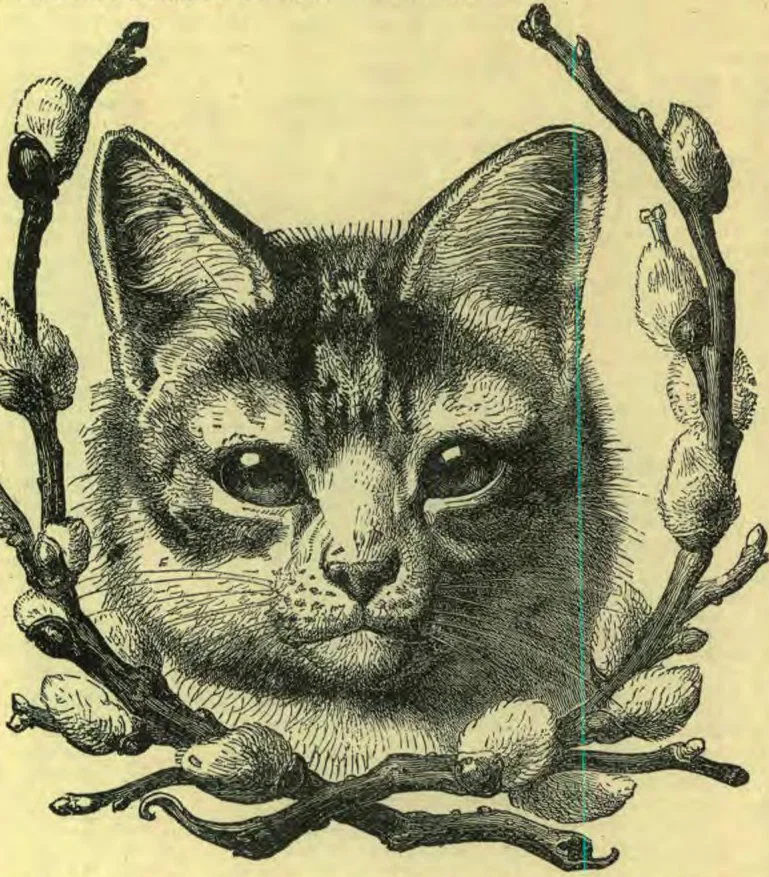
MADAME PUSSY WILLOW.
By The Little Christian
MADAME PUSSY WILLOW,
In gray garments neat,
Standing at the brook-side,
In the storm and sleet;
In furs so soft and silken,
Safe from bitter cold,
Warm as in tropic sunshine
Lies hid thy heart of gold.
Through the cold spring evenings
Do your kitties cry?
Do they spit and bristle
When the dogs go by?
Do you purr and soothe them
With your lullaby?
Pray, count for us your household:
“Ten thousand kits,” you say?
Why, where can you get milk enough
To feed them day by day?
What a fearful milk bill
You surely have to pay!
No lilies of the summer
In texture soft and rare,
Bring to the winter-weary
The joys these “pussies” bear.
They speak of winter dying,
They hail the breath of spring,
They hush all nature’s sighing,
And wake the world to sing.
Oh, may the Hand benignant
That keeps them from all ill,
Drive from our hearts all doubting
And winter’s worldly chill;
And make them warm and loving
With blessings from above,
To blossom in the spring-time
Of God’s eternal love.
—The Little Christian.
WHAT THE BIRD SANG TO MINNIE.
“I think I will not practice to-day,” said Minnie White. “I am tired of those old scales and exercises, and I do not feel a bit like it. There is nobody here to bother, so I will take it easy for once.”
“Nobody here to bother,” was only a way of saying that her mother was not at home, and she would not be disturbed by the old reminder, “Minnie, it is your practice hour.” She had been very anxious to take music lessons, and her father, who could not easily afford the expense, had nevertheless engaged a teacher and bought a piano for her. While it was a novelty, she had been very diligent, and had shown a good natural talent for the study. But as more difficult things were undertaken, she began to grow careless and lazy about her practicing.
To-day the rain pattered against the windows, and the arm-chair beside the glowing coal fire looked as inviting as the new story book on the table was tempting. So she turned her back upon the piano and the instruction book, and settled herself cozily to read. The story was a translation from the German, and the name of it was, “What the Bird Sang to the Children.”
I have not time to tell you all the queer things it sang, for it was a very remarkable bird, and taught the children many wonderful lessons.
There was one of them, however, that seemed to be especially for Minnie; and this was the lesson:—
“If a task is once begun,
Do not leave it till it’s done;
Be the labor great or small,
Do it well, or not at all.”
If Minnie had done her practicing before she began to read, this little song of the queer little German bird would not have disturbed her in the least. As it was, it made her uneasy; and when her own canary, hanging up in his cage before the window, began to sing, it seemed to Minnie as if he sang the very same words that were in the book,—
“Do it well, or not at all.”
She kept on reading, for the story was very interesting; but the canary kept on singing too, and the shrill, clear notes kept repeating, “Never leave it till it’s done!” “Do it well or not at all,” till Minnie could not stand it any longer.
“I do believe that bird is bewitched!” she said to herself. “I think I will do my practicing, after all.” And she put the book down, and went to the piano, and set herself to work with such a good will that the scales and exercises fairly ran off her fingers, and seemed to play themselves.
“Bravo! well done!” said some one behind her, after awhile. “That is the way I like to see you go to work—as if you meant business.” And there was her father, smiling as he looked over her shoulder.
Minnie did not know that he was in the house until he spoke; but his praise was very pleasant to her.
What the bird sang to Minnie, might very often be sung to other little girls; and I wish they would commit the song to memory.—Selected.
THE POWER OF GENTLENESS.
It is related that a belated stranger stayed all night at a farmer’s house. He noticed that a slender little girl, by her gentle ways, had a great influence in the house. She seemed to be a bringer of peace and good-will to the rough ones in the household.
The farmer was going to town next morning, and agreed to take the stranger with him. The family came out to see them start. The farmer gathered up the reins, and with a jerk, said: “Dick, go ’long!” But Dick didn’t “go ’long.” The whip cracked about the pony’s ear, and he shouted: “Dick, you rascal, get up!” It was of no avail. Then down came the whip with a heavy hand; but the stubborn beast only shook his head silently. A stout lad came out and seized the bridle, and pulled and yanked and kicked the rebellious pony; but not a step would he move.
At this crisis a sweet voice said: “Willie, don’t do so.” The voice was quickly recognized. And now the magic hand was laid on the neck of the seemingly incorrigible animal, and a simple, low word was spoken; instantly the rigid muscles relaxed, and the air of stubbornness vanished. “Poor Dick,” said the sweet voice, and she stroked and patted softly his neck with the child-like hand. “Now go ’long, you naughty fellow,” in a half-chiding, but in a tender voice, as she drew slightly on the bridle. The pony turned and rubbed his head against her arm for a moment, and started off at a cheerful trot, giving no further trouble that day.
The stranger remarked to the farmer: “What a wonderful power that hand possesses!” The reply was: “Oh, she’s good! Everybody and everything loves her.”—S. S. Advocate.
TWO GENTLEMEN.
I saw two gentlemen on a street-car to-day. One of them was grown up. He was nicely dressed in a gray business suit, and neatly fitting gloves and boots. The other was about twelve years old. His jacket had several patches, and needed more; and his shirt was of brown cotton, and not very clean. Do you wonder how I knew he was a gentleman? I will tell you.
The boy went through the car to give some message to the driver. As he returned he gave a little jump through the door, and his bare foot touched the grown gentleman’s knee, and left a little mud on it. Turning around on the platform he raised his straw hat, and said very politely, in a clear tone, “Please excuse me.” Then the other gentleman bowed in his turn, just as he would have done to one of his own age, and said, with a pleasant smile, “Certainly.”
The Iroquois Indians, many of whom are very fine gentlemen, say sometimes of a rude person, “His mother did not teach him manners when he was young.” I am inclined to think that the mothers of both these young gentlemen had taken a good deal of pains with their manners, because their politeness was so natural and easy.—Sel.
Better Budget.
The letters this week are all pretty long, but you will read them with interest. In the next paper we hope to give quite a number of shorter letters.
FIRST we have a letter from TILLIE M. RICH, of Oxford Co., Me. She writes: “I am eight years old, and am the youngest of eight children. My home is in a valley, between two mountains. It is very pleasant here in the summer, when we can play by the little brooks. Mamma and I went to Old Orchard beach last summer, and stayed two weeks. I had a nice time running on the beach, picking up shells, and chasing the waves. I would chase the waves out, and then turn and let them chase me back. It looks very pretty in the evening to see the fishing-smacks lighted up. One night we counted seventy-two lights, and the next morning we went out early, and there were seventy fishing-smacks in sight. I love to tend the little turkeys and chickens. Mamma says I may have a brood of missionary chickens. I went on a visit to my uncle’s, and he gave me a pair of guinea fowls. I like them ever so much. I want to tell the INSTRUCTOR family how I learned to write. I copied the written alphabet from my spelling book on to my slate, and then wrote it with a pencil on paper, and in this way I learned to write all myself. We have kept the Sabbath and taken the INSTRUCTOR four years. There is ever so much more I should like to write, but my letter is getting too long.”
You had a fine time at the beach, Lillie, and your “play by the little brooks” recalls many happy hours spent by the brook-side in our own childhood days. We hope the enjoyment of God’s beautiful gifts in nature leads you to love and honor the Author of them all. When that missionary brood is grown, you will surely write about it, and then you can tell the “ever so much more” you have for the Budget. Your letter was written very nicely.
HERE we have a letter from NEDDIE FERRY, of Clinton Co., Mich. He writes: “As I have never seen any letter from this place in the Budget, I thought I would write one. I am twelve years old. We live on a farm one mile from town, where we hold our meetings and Sabbath-school. My mamma and I go every Sabbath. I get my lessons in Book No. 6. I have kept the Sabbath with mamma and my sister Emma ever since I can remember. Emma has gone to the Chicago Mission now, and we miss her very much. Mamma says she could not consent to her going away from home for anything else than to work in the cause. I do not go to day school; my mamma teaches me at home. She thinks the influences there are not good. I want to get an education, so that I can work in the cause too. I love the INSTRUCTOR, and take great pleasure in reading it. I do not remember when we did not take it. I would like to see all the INSTRUCTOR family together. I send love to them all, and want them to pray that I may have a home with them in the new earth.”
It makes us all feel lonely to have our friends separated from us; but when they leave us to work for the Master, it would not become us very well to complain, because we think of the dear Saviour’s loneliness when away from his beautiful home trying to save us from eternal death. We are glad you have a sister to give to the cause, Neddie, and that you, too, are preparing yourself for usefulness.
ARTHUR FLINT, writing from Lincoln Co., Dakota, says: “I do not go to Sabbath-school, for it is ten miles to the church. Papa thinks it is too far to go. He takes the Review and the Signs, and the INSTRUCTOR for my sister and I. I am now thirteen years old. Five winters ago I lived with a family of Russians, who kept the Sabbath. These people all have large ovens made of mud brick. They are built as high as the ceiling, then plastered and whitewashed. In one end, at the bottom, is a door, where they cast the grass or hay into the oven, and there keep it burning until the whole wall of the oven is hot. By this heat the house is warmed, and in the oven they do their cooking. In winter it is heated twice a day, morning and evening. There are many ways of burning the grass. Some burn it in a common wood stove. We have burned nothing else since we came here. It makes a nice fire. We make it in twists about as long as a stick of wood. We take a large handful of grass and twist it, doubling it together as we twist, and then wind the loose ends around the twist and fasten, when it is ready for use.” In Matthew 6:30 we read: “Wherefore, if God so clothe the grass of the field, which to-day is, and to-morrow is cast into the oven,” etc. Was the grass cast into the oven at that time for the same purpose that I have cast it in? Papa thought it was, and he thought I would better write to the little readers of the INSTRUCTOR and tell them about it. We are trying to abide in the truth.”
We were a good deal interested in your description of the Russian ovens, and the Dakota method of heating houses. We have just read of a new way that has been adopted in your State for burning the grass. If the plan works, it will be a great saving of fuel, and a relief to the little boys and girls who have to twist the hay and tend the fires. Probably the Saviour referred to casting grass into ovens something as the Russians do.