Review and Herald Publishing Assn. · Takoma Park Station, Washington, D. C. · Jun 5, 1917
News Notes on Science, War, and Public Affairs
Paper pulp is being successfully used by a Danish physician in making artificial feet and legs.
Window boxes during the winter or summer boxes in city flats may be made to supply the table with lettuce, radishes, and parsley.
The honor of creating the first periscope used by submarines of the United States Navy is given to two Washingtonians by officials of the government.
During a recent month 717 airships were shot down on the western front. Of these the Germans lost 369, the French and Belgians 201, and the British 147.
Since May 9, by order of the British government, maize, barley, oats, and their products, together with tapioca, sago, and arrowroot, can be used only for seed and food.
The chancellor of Oxford University declared to the scholars of Great Britain that among the masters of English eloquence there was not one the equal of Lincoln, the American.
On May 1, a German submarine sank the “Rockingham,” the third of our armed vessels to be sunk, making eleven American ships that have been destroyed since the ruthless order was given by Germany.
Mr. Daniel Willard, president of the Baltimore and Ohio Railroad, has recently been elected chairman of the Advisory Commission to the Council of National Defense. Under Mr. Willard’s direction 175 of the country’s railroads are now being operated by the government.
Joseph H. Choate, former United States ambassador to the Court of St. James, died of heart disease on May 14, at the age of eighty-five. Mr. Choate, “Dean of the American Bar,” was one of the nation’s most distinguished citizens, and he also held a warm place in the heart of the English people. Mr. Choate’s too active participation in the recent receptions to the British and French missions, is given as the immediate occasion of his decease.
Reposing on the surface of Lake Sadawga, near Whitingham, Vermont, is a “floating island” of more than seventy-five acres, the strange body of unattached soil being held together by a vast network of roots of reeds and trees. The structure of the island is so compact that any part of it may be traversed with perfect safety; in fact, fishermen are in the habit of cutting holes through the island and fishing through them just as they fish through holes in ice in winter.
The new kind of prison is to be circular in its cell houses. Thus each cell will have an outside window looking out on a walled-in prison yard. The inner front will be glassed in, making each cell a room, and the roof will also be of glass. Sunshine will reach every cell. A set of steel bars will be on the inside of the glass casement, and another set on the outside. From the center of each house, in which there will be 250 cells, one man to a cell, there will rise an observation tower. A man will always be on guard, and he will keep watch through slits from a darkened interior, so that a convict will never know when he is being watched
The Housekeeper’s Alphabet
By Mary Lee
“LOOKING over some of grandmother’s papers, the other day, I came across what was called the ‘Housekeeper’s Alphabet.’ It was the most delicious mixture of moralizings and household helps that could be imagined. Let me read it to you,” said Mrs. Happy Homemaker.
“I am going to use the idea, and manufacture one that will be a little more coherent, but I know it will lack the old-fashioned charm of this one.
“Always be cheerful and patient, as well as industrious.
“Brooms hanging, instead of standing, will keep them soft and pliant.
“Canning: Do in the early part of the season, and early part of the day, to save the fruit and temper.
“Dish of hot water set in the oven prevents cakes from scorching.
“Economize time and health and means, and you will never beg.
“Flour: Keep cool and dry and securely covered.
“Glass: Clean with a quart of water mixed with a teaspoonful of ammonia.
“Happiness is not so much in doing what you want to, but in wanting to do what you have to.
“Ink stains: Wet with spirits of turpentine; after three hours, rub well.
“Jars: To keep cereals in good condition, always put in glass jars. To prevent jars in the family, always bring a smiling face to the breakfast table.
“Keep an account of all supplies, with cost and date of purchase.
“Love lightens labor.
“Money: Count carefully when and where you receive change.
“Nutmegs: Prick with a pin, and if good, oil will run out.
“Orange and lemon peel: Dry, pulverize, and keep in corked bottles to use for flavoring.
“Parsimony: Be careful lest what you call prudence and economy is really this.
“Quicksilver and white of eggs destroys cockroaches and bugs.
“Rise in the morning full of gratitude for a new day.
“Sunshine within and without is the best medicine.
“Try again, and conquer all obstacles.
“Undue haste makes waste.
“Vinegar never catches flies, but honey does.
“Wholesome advice is easy to give and hard to take.
“Yielding gracefully is a fine art.
“Zest is the secret of success.”—Mary Lee, in New York Globe.
There Is Always a Way
By Richard Burton
There is always a way to rise, my lad,
Always a way to advance;
But the road that leads to Mount Success
Does not pass by the way of Chance.
It goes through the stations of Work and Strife,
Through the Valley of Persevere,
And the man that succeeds while others fail
Must be willing to pay most dear.
For there's always a way to fail, my lad,
Always a way to slide.
And the men you find at the foot of the hill
All sought for an easy ride.
So on and up, though the road be rough,
And the storms come thick and fast;
There is room at the top for the fellow who tries,
And victory comes at last.
—Richard Burton.
The Spirit of Criticism
By G. B. Thompson
G. B. THOMPSON
If there were living in a community a man who, secretly yet deliberately, should poison a public drinking well, and through the contamination spread sickness and death in the neighborhood, such a dastardly act would not only subject the offender to the public execration of the people, but the hand of the civil law would be placed upon him to restrain him from further acts of the kind.
Those who constantly criticize others, who handle the reputation of their neighbors, friends, or brethren in such a way as to arouse suspicion against them, suspicion calculated to damage their influence and rob them of their good name, are doing a work similar in spirit to the one who poisons the public drinking fountain. One destroys the physical body; the other, with poisonous words and innuendoes, destroys the reputation and influence of the individual.
When this evil thing creeps into the church, and is clothed with a robe of false righteousness, it becomes all the more abhorrent and wicked. Such people usually attack their victim when he is absent, and cannot defend himself. By words and insinuations they sow among friends and acquaintances doubts concerning the honesty and integrity of the individual they criticize. That anything so extremely wicked and ungodly should be in the church, masquerading in the livery of heaven, would be almost beyond belief if it were not that its baneful work has actually been seen in the church, discouraging and darkening the souls of old and young, and extinguishing their hope of the life beyond.
Warnings from the Spirit of Prophecy
“An earnest effort should be made in every church to put away evil speaking and a censorious spirit as among the sins productive of the greatest evils in the church. Severity and faultfinding must be rebuked as the workings of Satan. Mutual love and confidence must be encouraged and strengthened in the members of the church.”—“Testimonies for the Church,” Vol. V, p. 609.
“Self-righteousness not only leads men to misrepresent God, but makes them cold-hearted and critical toward their brethren. The elder son, in his selfishness and jealousy, stood ready to watch his brother, to criticize every action, and to accuse him for the least deficiency. He would detect every mistake, and make the most of every wrong act. Thus he would seek to justify his own unforgiving spirit. Many today are doing the same thing.”—“Christ’s Object Lessons,” p. 210.
“He who is guilty of wrong, is the first to suspect wrong. By condemning another he is trying to conceal or excuse the evil of his own heart. It was through sin that men gained the knowledge of evil; no sooner had the first pair sinned than they began to accuse each other; and this is what human nature will inevitably do, when uncontrolled by the grace of Christ.”—“Thoughts from the Mount of Blessing,” pp. 181, 182.
None Are Sure of Escape
From the biting, slanderous tongue of those in the bondage of this demon of darkness, none can be sure of escape. Their own ideas and opinions they consider as an infallible guide, and those who do not measure up to the standard which they have raised, are criticized, and in many cases held up to the scorn and ridicule of others. No matter what may be their standing in the community or in the church, their motives are judged and their apparent failures paraded before the people. A stream of poison is thus poured forth to contaminate the minds of old and young, and to befoul the spiritual atmosphere which they breathe.
Usually no effort is made to visit the individual, to point out to him wherein he fails, but his delinquencies are paraded before a cold, unfeeling public, who have no knowledge of the situation, or the circumstances with which the individual is surrounded, or the struggles which are perchance straining the moral fiber of his soul. It would seem that a work so repugnant, so utterly contrary to every principle of righteousness, would of itself be sufficiently abhorrent to be shunned by all.
That the work of censuring and judging the acts and motives of others is from Satan himself is quite clear. The Bible declares him to be the “accuser of our brethren.” Those who engage in the work of criticizing others are working hand in hand with Lucifer. If those who do this work are professed followers of him, who once bade only those who themselves had no sin to throw stones, it is all the more deplorable.
It Is So Easy to Be Mistaken
A properly trained, refined, and cultured person will be exceedingly careful in his criticism of others. By being too free in ridiculing and criticizing others, we may advertise some weakness and failure of our own, and exhibit the fact that we are possessed of a small, narrow mind, incapable of weighing the work of others in unprejudiced scales. By being quick to call attention to something in the life of another which may not appear right to us, we may uncover to the gaze of others a cheapness in our own life that would4be very embarrassing if we could but see it. Things are not always what they appear, and it is not always safe to trust even the evidence of our own eyes; we may be very far from having a correct understanding of things.
“What looks to thy dim eyes a stain,
In God’s pure sight may only be
A scar brought from some well-won field,
Where thou wouldst only faint and yield.”
We should not criticize the actions of others, nor judge their motives, until we have made ourselves intelligent concerning all their circumstances and environment; and this we rarely if ever can do. Judging from appearances often leads to wrong conclusions. This is well illustrated by an incident which I heard recently.
An exemplary and Christian lady one day picked up, in a large department store, an umbrella belonging to another. Discovering her mistake almost at once, she restored the umbrella to the woman, apologizing to her. The woman, however, indicated by her attitude that there was a serious question in her mind as to whether her umbrella had been taken by mistake or intentionally. A few hours later the lady who exchanged umbrellas by mistake, was in the street car returning home. She had with her three or four umbrellas belonging to some friends who had decided to remain in the city for the evening, and had asked her to take them home with her. Across the aisle sat the woman whose umbrella she had picked up a few hours before. This woman looked at her, and remembering her own experience, said, “Well, I see you have been quite successful.” She believed the evidence conclusive that the woman who picked up her umbrella was a thief; while as a matter of fact she was an honest woman, burdening herself with the umbrellas of others in order to be kind and accommodating. Yet circumstantial evidence was all against her. This incident should teach us not to criticize others, at least until we are familiar with all the facts in the case. And usually when we know the facts, we shall have no desire to criticize; for “to know all is to forgive all.”
Proper Criticism
There is a form of criticism which is proper and helpful. It is that thoughtful investigation and candid criticism which is founded on an earnest longing to know what is right, and prompted by a desire to uncover truth. We may criticize ourselves, to see if we are holding up in the life the high and exalted standard that we should, and working consistently and faithfully toward achieving some noble work to which we have resolved that we would devote our life’s energies. It is proper to challenge that which comes before us claiming to be truth, and subject it to a searching, critical investigation. But candor is said to be the brightest gem of criticism; and as we apply the acid test of a critic, we should at all times keep the mind open for light, and be ready to accept the truth, even though it may overturn all our own preconceived ideas on the subject. No criticism is worth the name that is not governed by the law and the evidence.
Then, too, we should keep in mind that we may be wrong. We should review our own limitations, and not be unmindful of the fact that intellectual insight and long experience are valuable assets in making one a good critic in any matter. Generally the riper our experience, the wider will be our range in our criticism, whether in our search after truth, correct principles by which to govern the life, or in reviewing the lives of those about us; and the more modest and reserved we shall be concerning our own attainment, and in our statements.
“Physician, Heal Thyself”
By Meade MacGuire
SOME years ago a young man came to me seeking help. He was a fine, broad-shouldered, intelligent-looking young man, who gave no outward evidence of the life he had led. He stated at once that he must tell me his whole story, so that I could understand his situation, adding in a despairing manner, that if I could not help him he felt there was no hope.
He then proceeded to tell me a story of such terrible sin and depravity that I felt stunned and appalled. It did not seem possible that any young man who knew anything about religion, and especially about the message, could have lived such a life. As he portrayed so vividly his terrible struggles almost from childhood against the vices and wickedness taught him by his own relatives, my heart ached for him, but when he described with the deepest emotion how he had wrestled, and wept and prayed for hours at a time, and pleaded with God for victory, only to go down in utter defeat, I confess I was at a loss to know what to do. I had never before met such a case. Whatever experiences had been told me of sinful habits and temptations, I had always been able to say, “You must pray, and study the Bible, and resolve with greater determination to renounce your sins, and then trust the Lord to deliver you.”
But all this the young man before me had done many, many times, and there was no use in repeating the advice to him. I realized then for the first time that something very vital was lacking in the counsel I had to give to a lost sinner. One thing was evident: this young man had done over and over what I had for years been counseling the sinner to do, and yet he was not saved. I could not say, You must try harder; for he had tried and failed until he was in despair. I could not say, You must pray more earnestly; for he had prayed and resolved and wept for hours until exhausted.
Oh, how I wish I had known that day what I learned years later, that Jesus saves. All the wrestling, the struggling, and praying does not save; for there is but one remedy for sin, and that is Jesus himself, and “we need no human ingredient in the heavenly remedy.” We can never really know that he can set free the poor sinner who comes to us for help until Jesus Christ has set us free from our last besetting sin.
The devil has foisted upon the whole world a gigantic error, which nearly all men believe. It is that when a man dies, he is not dead, but is more conscious than when alive. An equally great and pernicious error from the same source, and one almost as universally believed, is that when Jesus saves a man, he is not saved, but must fight and struggle like a poor, drowning wretch, all the time hoping that sometime in the future he will be able to overcome.
To many people, salvation evidently means the forgiveness of sins and that alone. But if this is all, there is no hope of being free from sin except at the very moment of confession and pardon. But what says the Scripture?
“Jesus answered them, Verily, verily, I say unto you, Whosoever committeth sin is the servant of sin.”
“Ye shall know the truth, and the truth shall make you free.”
(Concluded on page thirteen)5
(Concluded from page four)
“If the Son therefore shall make you free, ye shall be free indeed.”
“God be thanked, that ye were the servants of sin, but ye have obeyed from the heart that form of doctrine which was delivered you. Being then made free from sin, ye became the servants of righteousness.”
“The religion of Christ means more than the forgiveness of sin; it means that sin is taken away and that the vacuum is filled with the Spirit.”
MEADE MACGUIRE.
THE BIBLE — IS IT A TRUE BOOK?
By Carlyle B. Haynes
Donald’s Faith in the Bible Confirmed
CARLYLE B. HAYNES
It was easy to be seen by the large number that gathered at the tent on Tuesday night to hear the talk on the inspiration of the Bible, that these meetings were the most popular religious services in town. Fully eight hundred persons were present during the song service, and their enthusiastic singing of some old favorites could be heard for blocks. As Donald Hunter looked around on the audience he saw some of the ministers of the town.
After an earnest prayer, Brother Harris began his sermon. He dealt in a most vigorous way with what he called “the poisonous evils of the destructive higher criticism, Spiritualism, Christian Science, and evolution,” which, he said, “were leading the people of God away from the great truths of the Bible, to put their trust in solely man-made teachings.”
It was one of the most forceful sermons Brother Harris had yet delivered, and the big crowd seemed thoroughly to enjoy it. The speaker said:
“The drift in the Christian world today is away from the simple truths of God’s Word. This is due to the fact that many false teachings have come into the church during recent years, all of them of purely human devising. These led men to place their trust and confidence for salvation in men, in human efforts, in man-made systems, instead of in God and his plan of salvation. In the minds of many persons these new theories take the place of the pure gospel of Christ. Among them are the teachings of Spiritualism, evolution, the destructive higher criticism, new thought, and Christian Science.
“These teachings are sweeping away the faith of the people in the Bible as the inspired word of God. And this attack upon the fundamental principles of Christianity is not, as in the past, from outside the church. It is from inside the church. Those who occupy positions of influence and power in the pulpits, in the theological seminaries, in the great religious publishing houses, are the leaders in this apostasy. Sapping the very foundation of its power, poisoning all the springs of its life, these forces are engaged in wrecking the church of Christ, while at the same time professing to be its friends. Like its divine Master, the church today is being ‘wounded in the house of its friends.’
“It therefore becomes important for Christians to become familiar with the teachings of the Bible, and learn the reasons for their belief that the Bible is inspired. The evidence of the inspiration of the Bible is so vast that it would take many nights to present it all, and we shall attempt to give only a small part of it this evening.
“In 1901 a Book was issued from the press, called the American Standard Version of the Bible. This was immediately circulated from end to end of the land. Yet it was not a new Book at all. When one came to examine it, he found that it was just the same as a Book which had been issued in 1881 called the Revised Version of the Bible. It is true there were some changes, some minor corrections, a little difference in punctuation, but the Book contained the same stories, the same epistles, the same gospels, and the same teachings as the earlier Book.
“On closer examination it was discovered that this Book had not been issued first in 1881, but it was the same Book that had been issued under the authority, by the command, and in the reign of King James of England, in the year 1611.
“So this Book printed in 1901 was not a new, but rather an old Book, more than three hundred years old at least. But when we get back to 1611, we have not reached the beginning of it. There are older copies than that. Before the great war there stood in the museum in Antwerp in Belgium the first printing press ever made, and alongside it a copy of the first Bible ever printed, which was in Latin. But even this is not the beginning of this Book. In the British Museum in London is a copy of Wycliffe’s translation of the Bible, made about 1380, before the art of printing was invented. While you would have some difficulty in reading your own language as it was then written, yet if you did read this translation, you would find in it the account of the wise men who came to Bethlehem, the shepherds feeding their flocks, the parable of the lost sheep, the true vine, the prodigal son, and all of the parables, miracles, and teachings of the Son of God, just as you have them in your Bible at home. So we know that this Book is more than five hundred years old.
“But it is much older than that. It was copied in other languages, and we now have many ancient manuscripts of the Bible, some in Greek, some in Coptic, some in Syriac, and some in Ethiopic. Many of these manuscripts are very, very old. ‘How do you know,’ you ask, ‘that they are not much more recent than they pretend to be?’ Well, in such things as writing books it is not easy to deceive. Let me illustrate.
“Away back in the year 79 after Christ, Mt. Vesuvius blew off its head, covered the cities of Pompeii and Herculaneum with lava and ashes, and for eighteen hundred years these cities have lain buried. During the past century scientists have made excavations in Herculaneum, and uncovered a large part of it. Among other things they found the library, and in it many thousands of books were discovered. These books were written in a peculiar way, a way in which we do not write books now. All the letters are capital letters, or what the scientists call uncial letters; the words all run together, there is no punctuation between the sentences, and there are no paragraphs, chapters, or verses.
“That is the way they wrote books eighteen centuries ago. We know they did, for these books have6been buried that long. Now, we have copies of the manuscripts of the Bible, especially of the New Testament, written in this same peculiar way, with capital letters, no separation between the words, sentences, verses, and paragraphs, and therefore we know that we have manuscripts which are very, very old. In the Hebrew manuscripts of the Old Testament even the vowels were omitted, as if we should write Genesis 1:1 thus: NTHBGNNNGGDCRTDTHHVNNDTHRTH.
“Some infidels are foolish enough to claim that the New Testament was compiled at the Council of Nicæa in 325 A. D., as if the Bible did not exist before that. The chief fault I have to find with that statement is that it is not true. Twenty-two years before this council, in 303, Diocletian, the emperor of Rome, issued his famous decree to destroy the churches and burn the Bibles. So the Bible dates farther back than the Council of Nicæa. And the emperor did not succeed in destroying the Bible. It still lives, though he is scarcely remembered.
“In the second century after Christ, a heathen philosopher by the name of Celsus wrote a book to prove that the Bible was not true; but about all he did was to prove that the Bible was then in existence.
“Now we have got back to the days of the men who wrote the Bible,—the days of Paul, Peter, James, and John. And as we study their writings we find each upholding the others. For instance, Peter declares that Paul had written certain epistles, and he compares them to the writings of the ancient prophets, and calls them all ‘Scriptures.’ 2 Peter 3:15-17. Paul (1 Tim. 5:18) quotes from the gospel by Luke (Luke 10:7), ‘The laborer is worthy of his reward,’ and says, ‘The Scripture saith.’ And Luke says (Acts 1:1) that he had written a ‘former treatise’ before he wrote the Acts, and in this former treatise he says he gave an account ‘of all that Jesus began both to do and teach.’
“When we turn to this former treatise, which was the gospel by Luke, we read that Luke there says (Luke 1:1-4) that others who were ‘eyewitnesses’ of the things they recorded, had ‘set forth in order a declaration of those things,’ meaning the writers of the other gospels.
“Thus the writers of the New Testament substantiate one another. They quote from one another, and acknowledge the others’ writings as Scripture. And they also substantiate the Old Testament, for they constantly quote from it. There are only three quotations in the New Testament from heathen writers. These are in Acts 17:28: ‘We are also his offspring;’ 1 Cor. 15:33: ‘Evil communications corrupt good manners;’ and Titus 1:12: ‘The Cretians are always liars, evil beasts, slow bellies.’ But there are in the New Testament hundreds of quotations and references from the Old Testament, taken from every book except Ezra, Esther, Nehemiah, and the Song of Solomon.
“When we get back to the Old Testament, we find the later writers quoting from the earlier, the prophets and the psalms quoting from the books of Moses. The last admonition in the Old Testament is, ‘Remember ye the law of Moses.’ Mal. 4:4. So they all stand together, each substantiating the rest, until we come to the very first book in the Bible. Here we find the account of creation, the beginning of man and the world. It is just like standing before some great building upon which many workmen had wrought, but over the entrance to which is written the name of the great Architect himself, in the first words of the Bible, ‘In the Beginning, God.’
And so it is, God in the beginning, God all through, and God in the ending of this old Book. No man without inspiration of God could have written the laws of Moses, the psalms of David, the poetry of Job, the proverbs of Solomon, the prophecies of Isaiah and Daniel, and the epistles of Paul. According to its enemies, this Book has been exploded, demolished, and shown to be all that is evil, untrue, foolish, and absurd; and yet it outlives those who fight against it, and marches in triumph over their graves. With all their assaults, those who oppose the Bible have made just about as much impression on it as a man with a pea shooter would make on the great dreadnaughts of the ocean.
“This Book is God’s Book. Study its principles, accept its teachings, obey its commands, bring your lives into harmony with it, and it will become the gateway to eternal life to you.”
Donald Hunter had believed the Bible before, but he went home that night with his faith in it strengthened and confirmed, as did hundreds of others.
The New World
WHEN the business matter was settled, the merchant leaned back in his chair and looked at young Harding. There were hard lines about the young man’s mouth, bitterness in his eyes.
“John,” the merchant said quietly, “you know what your father was to me. May I say a word to his son?”
The young man hesitated a moment — then nodded; but it was manifestly only courtesy to his father’s friend that made him yield. The old merchant looked past him out across the city.
“You were only a boy when your father died; he never told you about my black year, did he?”
“No, sir,” John Harding answered, wincing.
“It was a black year. First, I failed. It took ten years to climb back again; but I lost a whole year through my own weakness. Nervous breakdown, the doctor said; it was really spiritual worry and lack of grit. And in the midst of that, Amy died.”
“I know, sir,” John Harding said in a low voice. It had been a lonely house ever since he could remember.
The old man did not seem to hear. He went on slowly: “Your father stood by. I never can tell you how he stood by me through it all, or of the patience with which he met my rebellion. One night he was staying at the house with me when a heavy electric storm came up. In the midst of it there was a tremendous crash and two great oaks in front of the house went down. My grandfather had planted those oaks and I had inherited a love for them. It seemed to me then, warped as I was by my illness, another real calamity. But in the morning Jack called to me suddenly, ‘Look at your view, man, look at your view!’ And there before us lay the city, a thing of magic beauty in the early light, and beyond, the hills — miles and miles of them. Jack turned to me with deep eyes.
“‘It’s a parable of life, old fellow,’ he said. ‘There’s a whole world waiting.’
“I knew what he meant, and I resented it. But I couldn’t get away from that view and the parable of it. All my life I had been shut in by my own possessions. God had to strip me of them to open my eyes. It was a hard battle, but I surrendered at last, and went out to discover the world.”7
“You’ve found it, sir; every one knows that,” John Harding said.
“What I want to say to you, Jack, is that it is worth it. Looking back now, I would not dare give up what sorrow and trouble have given me. I wanted to tell you that God’s ways are big, Jack, even with our little lives. Trust him, and find your new world. It will be greater than the old.”
The two gripped hands, and then the young man was gone.—Youth’s Companion.
The Only Russian Church School in the World
By R. F. Farley
How striking a title, especially so when one stops to think that this school is to be found here in our own United States.
Our Only Russian Church School
About a quarter of a century ago there came to this country a fugitive from religious persecution in Russia. Because of his refusal to attend the services in the state church he was repeatedly brought before the civil authorities and punished in the most cruel manner. A heavy cherry staff, as thick as a thumb, was used to beat the poor man over the feet until the blood flowed in copious streams. This was repeated several times, all for the reason that he denied the efficacy of the services in the orthodox church. The freedom of America came to his knowledge, and hither he came, bringing with him his young wife, and their little family. He secured a farm in Virginia, near the town of Yale. Since then he has been joined by a number of his countrymen, so that there is at present in this neighborhood quite a colony of Russians. Brother Y'Shanko soon felt resting upon him the responsibility for the spiritual welfare of his people, so he began to hold services with them. The effect of his work was the organization of a Baptist Church. Not long after this he made a journey to the Dakotas where there are large numbers of Russians, and there he came in contact with the Mennonites. From this people he accepted the practice of foot washing. When he returned, he began immediately to preach this new truth to his flock. Then a Seventh-day Adventist Russian brother moved into the community, and began to preach and practice his faith. No little stir was caused, and later a tent was pitched. By the end of that notable summer, just a few years ago, practically the entire church stepped out on the new revelation of God's will, and were reorganized into a Seventh-day Adventist church.
They realized the dangers to which their children would be subjected, so they made provision for their education by establishing a church school, then and now the only Russian church school in the world. We are proud of our Russian church school, for it has been doing good work. A number of the young people have gone from here to the academy at Newmarket where they are securing a preparation to give the message to their own people. Several more are looking toward the higher schools, for they are making definite plans for entering the work of the ministry.
One of the largest contributing factors of the success of the school has been the Missionary Volunteer Society that has been a regular feature of the school work. Here the young people have been given their first experiences in public work, and in the work of gaining the victory over sin. Who can estimate properly the work of this Missionary Volunteer Society?
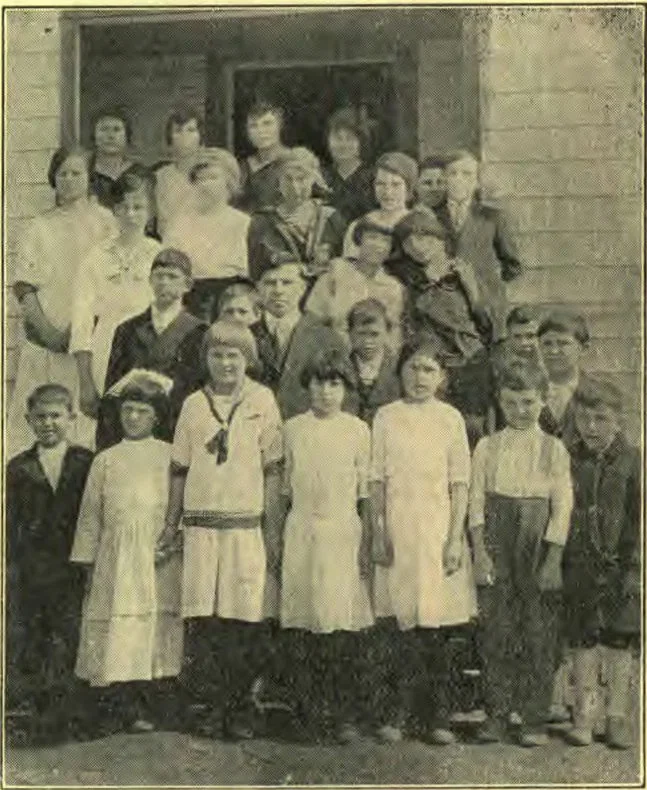
The accompanying picture shows the school as it was in session this past year. Brother Kritzky, the teacher, is seen in the center of the group.