In the March number of the National Geographic Magazine, Sydney Brooks gives an interesting detailed view of the part England has played in the great war.
The following paragraphs are some of the points cited by Mr. Brooks in his article:
Great Britain is to the Allied people like a great tower in the deep. They are trusting her rugged strength and great resources more and more.
The rally of the colonies of the British Empire "to the side of the motherland has, indeed, been one of the most marvelous and one of the most momentous episodes of the war. When the storm gathered, the Dominions said with one voice: ‘Whatever happens, we are with you.’ When it burst, they said: ‘Everything we have is yours.’"
“We do not advertise the feats of our armies. We have no aviation heroes. In fact, we rather make a point of having as few heroes of any kind as possible. Instead of the flashy prominence of a few men here and there, we are quite content to shelter behind the anonymous but incontestable superiority of our flying corps as a whole.”
The appearance of the “Deutschland” in American waters was regarded as one of the most remarkable achievements of the war. Few stopped to remember that near the beginning of the war ten British submarines crossed the Atlantic from Halifax to the British Isles—the first submarines in naval history to make the journey under their own power.
England publishes a list of all the vessels sunk by Prussian submarines, but says not a word about the U-boats whose careers she brings to a sudden stop. This tends to give a one-sided importance to the submarine warfare being waged.
“Defeat the British navy and the war will be over in six weeks,” says Mr. Brooks. The navy has made possible the following things: The Belgian army has been rearmed, reconstituted, and reëquipped. Serbian8forces have similarly been rescued and remade. Russia has been remunitioned; Italy has been enabled to overcome her natural deficiencies; and France, in spite of the loss of some of her most highly industrialized districts, is still, for purposes both of war and of commerce, a great manufacturing nation, and all the Allies can import freely what they need from the neutral world.
England has advanced to her Allies not less than $4,000,000,000. At the same time that she is rendering this service she is spending more in a month than the United States government, not by any means the most economical in the world, has been compelled to spend in the whole of the last year; her weekly outlay averages some $200,000,000; she has raised on credit over $250,000,000,000, or about five times the generally accepted estimate of the cost of the entire Civil War.
England has placed at the disposal of the Allies not less than five hundred British ships. “There are special factories in Great Britain solely devoted to meeting the armament needs of Russia, of France, and of Belgium.”
One third of England’s total production of shell steel goes to France. Three fourths of the steel-producing districts of France are occupied by the enemy, and France absolutely depends on England and on her command of the sea to procure the essential basis of all modern warfare. It is the same with other metals—for instance, copper, antimony, lead, tin, spelter, tungsten, mercury, high-speed steel, and other less vital substances.
There are many men in Great Britain paying out to the state more than half their income. The British people have raised for their own sufferers and for their Allies at least $500,000,000.
Over 4,500 firms, not one of which before the war even dreamed of making munitions, are now engaged in nothing else. The government has erected over 100 colossal factories for turning out shells, guns, powder, and the implements of trench warfare.
“Britain is working; has taken off her coat; has ceased to be a land of leisure, and has become a land of infinite labor. And to what effect she is working may be judged by the fact that in spite of the vast exodus from industry to the army and navy, and in spite of the concentration of the main labor force upon munitions, her exports of ordinary commercial commodities reached last year a value only once exceeded in the most prosperous times of peace.”
“The battle of the Somme was not only by far the biggest battle of the war; in duration, in the numbers engaged, and in the intensity of the artillery fire it was the biggest battle the world has yet seen.”
As a result of the war there will be a new England, so Mr. Brooks claims. He says:
“A political democracy we have long been. A social democracy before the war we were not. But we are now. Some six or seven million men, as I have said, have mingled with one another; have learned to understand and sympathize with one another in the new armies; have been trained into an equal brotherhood in the severest school of courage, efficiency, and discipline; have had most of the nonsense of social distinctions knocked out of them.
“Gone is the vicious consideration that wealth has always claimed and received in the plump security of the British Isles. Duke’s son and cook’s son are fighting shoulder to shoulder; great ladies do the waiting in the soldiers’ refreshment buffets, work like sewing maids in the Red Cross arsenals, like factory hands in the munition works; a shop walker and a grocer’s assistant wear the Victoria Cross—the new patent of nobility; for the convalescent wounded there is a boundless outpouring of hospitality and affection, free from the remotest tinge of condescension; the impulse to succor, to link hands, to know and understand one another is universal.
“We have learned from this war, and perhaps nothing else could have taught us, the nobility of sacrifice and of work.”
“This war will change many things; on the structure and machinery of the British Empire its mark will be indelible. No one after the experience of the first two and a half years can think it possible to maintain much longer the arrangement by which policies that affect the governments and people of the entire empire and involve them in unlooked-for perils, sacrifices, and responsibilities, are decided in London by the leaders of a single British political party, without any consultation whatever with the statesmen of the dominions. That is an anomaly which will have to go. But to uproot it, means not merely to alter, but to revolutionize the constitution of the British Empire.”
Scaring China into Health
By Charles M. Steele
In a land where for two thousand years the quack doctor with his horn spectacles has been the sole source of information on matters of health, Americans are now spreading abroad modern ideas of preventive medicine, private hygiene, and public sanitation. And the people, from mandarins down to coolies, “hear them gladly.”
Public health education in China is being carried on by the Council on Public Health, an organization formed for the specific purpose and representing three great institutions—the China Medical Missionary Association, the National Medical Association of China, and the Young Men’s Christian Association.
Like every other successful institution, the council does its work through an energetic, forceful individual. This man, Dr. W. W. Peter, is giving his time to public health education.
In fifteen of the leading cities of China, Dr. Peter has conducted “health campaigns” within the last year and a half. Between 175,000 and 200,000 people have attended the meetings and seen the exhibits. Officials have become deeply interested in the work, and are glad to lend their influence and active support to it. Leading men and organizations throughout the country are now sending to the Council on Public Health invitations to conduct campaigns in their cities and towns. In Peking, where 18,000 people attended forty-six meetings last May, there was a Public Health Campaign Committee organized under the auspices of the Ministry of the Interior. At one of the Nanking meetings for women, the governor’s wife, Mrs. Feng Kuo Chang, spoke for half an hour. It is an unprecedented thing in China for a woman to address a public meeting.
During the health campaign, meetings are held daily for a week. Admission is by ticket, which can be obtained from the police or through some other agency for distribution. Every morning and afternoon the people are invited to inspect an elaborate health exhibit, prepared by the lecture department of the Young9Men’s Christian Association, and set up in some large building. This health exhibit covers 680 linear feet of wall space—an eighth of a mile. There are about fifty sections, including placards, signs, diagrams, pictures, and mechanical devices. The mechanical devices used are exceedingly ingenious and effective. One of them is a model of a Chinese house. Out of it comes the figure of a man, who walks across his front yard and then falls into a coffin, whose lids open to receive him. The lids then close and the coffin disappears below the ground. This happens every eight seconds. Placards in Chinese and English explain that some one in the world dies of tuberculosis every eight seconds, and point the moral, “You can help stop this unnecessary procession to the grave.” This is a new idea. The Chinese, reading the placard, ask “How?” and the instructor explains.
Another mechanical exhibit consists of a bell which rings every thirty-seven seconds. A sign announces that every time this bell rings some one has died from tuberculosis in China. Still another and very startling mechanical display consists of a dial with a revolving hand pointing to numbers around the circumference. A bright light is fixed right over the dial, and the placard reads: “This counter was started when the conference opened, and has been counting the number of deaths from tuberculosis in the world ever since.”
After seeing the health exhibit, which always attracts great interest, the people are invited into a large auditorium to hear and see a demonstrated lecture on “Some Relations Between National Health and National Strength.” In the demonstrations human subjects are used, students acting parts to illustrate the points under discussion. Electrical and mechanical appliances are also freely used. Dr. Peter says that mentioning “National Strength” in the title and discussing it in the lecture always wins immediate attention. National strength, he says, is a thought that appeals to the Chinese. They know they are a weak nation among the powers of the world, and they are eager to learn anything that will help to bring them from a position of weakness to one of strength.
One day of the week’s campaign is reserved for women. On this day the health exhibit is explained as usual, but the lecture is entirely different. The subject is “The Care of Your Baby.” This lecture is demonstrated also. A real baby on the platform with different kinds of clothes, a bathtub, various kinds of foods, appliances for artificial feeding, nurses, and—more important than all—the mother of the baby herself, make the lecture of an hour and a half seem only thirty minutes long. The “baby lecture” is generally delivered by some local woman doctor, and has often assumed the form of a real play.
In the evening the exhibit and lectures just described give way to stereopticon talks on such subjects as these: “Sanitation of a Chinese City,” “Flies Kill People,” “Tuberculosis,” “Infectious Diseases.” These lectures are delivered both by Dr. Peter and by local physicians, native or foreign, who have been educated in America or Europe. So great are the crowds for the evening meetings that generally it is necessary to secure three or four extra halls in different parts of the city and hold several meetings at the same hour.
The tangible results of the campaigns are very interesting. In Hang-chau the campaign paved the way for a smallpox vaccination crusade. In Kai-feng, where the meetings were held in a large theater turned over to the committee, a Public Health Society was formed, having as its leaders the eight government physicians, who had the responsibility of caring for the health of many thousands of soldiers. In another city, the campaign was followed by a “clean-up week.” In Changsha, Hunan Province, where thirty-six meetings were attended by 30,000 people, the results of the campaign are now taking form in a $20,000 hospital for tuberculosis and contagious diseases, erected by public subscription.
At Hang-chau, in the gloomy halls of a Buddhist monastery, about 300 Buddhist monks, some of them already sufferers from the dread “coughing sickness,” listened to a lantern-slide talk and heard for the first time in their lives the teachings of modern science and the uses of air, light, soap, and water.
At Wei-huei, Hunan Province, an amusing incident occurred during the campaign. Following the lecture, in which the dangers of the fly had been emphasized, some Chinese ladies were being shown the health exhibit. One of the pictures showed a common house fly magnified many times. On seeing it, one of the ladies exclaimed, “Is that the kind of flies they have over in America? No wonder Dr. Peter talks about the danger. If we had such big flies here in China, we should have to be careful of them too.”
Besides the formal health campaigns conducted by Dr. Peter, the Council on Public Health extends its educational work throughout China through a Health Publicity Bureau and a National Lantern-Slide Exchange. The Publicity Bureau prepares newspaper articles on health subjects, and twice a month copy is sent out to as many newspapers and schools as agree to use it. At present about 150 newspapers are printing the articles, carrying the health message into scores of cities and towns. The Lantern-Slide Exchange lends slides on health subjects to schools, churches, local physicians, and other interested persons or organizations. These slides are traveling constantly, and reach parts of the country where the formal health campaigns have not yet been conducted.
Another special piece of work of the council is the circulation of an Antituberculosis Story Calendar. This is a large sheet, about twenty by thirty inches, printed in two colors and illustrated with pictures showing how tuberculosis is spread and how it may be prevented. Over 430,000 copies of this calendar have been distributed through the local Young Men’s Christian Associations and through the interest of public officials. In three instances officials have given as much as $100 each for this distribution.
Recently the council has conducted a national health essay contest. Three gold medals, or their equivalent in money, have been offered for the best essays on “Present Health Conditions in China and How They May be Further Improved.”
Dr. Peter said to the writer: “Some day I hope that public health education in China will be as attractive to Chinese and foreigners as Dr. Grenfell’s work in Labrador is to all reading people at the present time. We are now in the first stage of a pouring-in process. China is just acquiring an appetite for these so-called Western ideas. You and I may not be alive when the process of digestion is completed. But we hope that when this process is completed, China will be in possession of a health conscience, and will stand as an equal of other nations in making contributions to science, particularly to medical science.—Charles M. Steele, in the Christian Herald.”
Interesting Notes
The largest searchlight in the world has been placed recently on the roof of a Manhattan building. It is said that the light can be seen over thirty miles, and has a strength of 1,280,000,000 candlepower.
An Italian grape grower accidentally discovered that the presence of tomato plants in his vineyard made short work of the phylloxera, with which his vines were infested. This insect destroys both the root and the stem of the grapevine.
The ivory nut, when shelled, looks like a Brazil nut, except that it is larger, and when it has been through the drying process at the button factory, it looks like ivory and is just as hard. Large articles cannot be made from the nuts, because they are too small; yet a million and a half dollars' worth of them was imported into the United States last year. Esmeraldas, South America, exported thirteen and a half million pounds of tagua nuts.
To distinguish vegetable ivory from the genuine material, allow the doubtful article to soak for fifteen minutes in a little concentrated sulphuric acid. If it is a product of the ivory nut it will become rose-tinted. Real ivory is untouched by the acid. The tint can be washed off with water.
For the Finding-Out Club
1. Who was the Quaker poet?
2. Who is General Petain?
3. What noted American heads the American War Commission to Russia?
4. Who are the following-named men, and why has the American public been greatly interested in them recently?
Robert E. Lansing
Marshal Joffre
Gen. Hugh L. Scott
M. Rene Viviani
M. Jusserand
Rt. Hon. Arthur James Balfour
5. How large a war loan has Congress voted the Allies?
6. What two States in the Union have State police?
7. Into what six army districts has the United States been divided? Name the officers in command of each.
Answers to Questions in “Instructor” of May 8
PART I
1. Shakespeare
2. Longfellow
3. Poe (Poet)
4. Lamb
5. Tennyson (Tenn son)
6. Hood
7. Russell (rustle)
8. Wallace
9. William Cullen Bryant
10. Burns
11. Browning
ETHEL HUDSON.
PART II
1. Elysian Fields is supposed to be the abode of the souls of the good and of heroes exempt from death. It is described in ancient and classical mythology, and particularly by later poets, as a place of exceeding bliss. Some have thought it to be the center of the earth, some in the islands of the Blest, and others in the sun or mid-air. In the “Odyssey” it is a plain at the end of the earth “where life is easiest to man. No snow is there, nor yet great storm or any rain.” The name is also given to a region near the ancient town of Baiæ, Italy, which is particularly fertile and delightful.
2. River Styx. This is also a relic of Greek mythology, “the name of a mighty river, the tenth part of the water of Oceanus, which flows in the lower world.” The name is also given to a waterfall in Arcadia, and a river in southern Alabama.
3. The Pillars of Hercules. In ancient geography, the two opposite promontories, Calpe (Gibraltar) in Europe and Abyla (Ceuta) in Africa, situated at the eastern extremity of the Strait of Gibraltar, and Sentinels, as it were, at an outlet from the Mediterranean into the unknown Atlantic, were called by this name. According to one of several explanations of the name, they were supposed to have been torn asunder by Hercules, the mighty Greek hero originating in an ancient legend.
4. The Slough of Despond is a bog described in the first part of “The Pilgrim’s Progress,” by Bunyan.11
5. The Garden of the Gods is a remarkable national park near Colorado Springs, Colorado, comprising about five hundred acres, covered with extraordinary rock formations. No Colorado tourist should leave this wonderland of nature unvisited.
When Paul Sent a Runaway Home
By Harold Richards
ONE whole book of the Bible is a letter written by an old man in prison to a rich church member in a far-away city, concerning a heathen slave who had run away from home. The old man in prison was the apostle Paul, the church member was a Greek called Philemon, who lived in the city of Colossæ, and the slave was Onesimus.
Paul was confined in the great city of Rome, waiting for his trial before Cæsar, and preaching to those who came to see him in his rented house. While he was there, the slave, Onesimus, stole some money from his master, Philemon, and came to Rome; for he thought he would never be caught in such a large city. We do not know how it came about, but Onesimus heard Paul preach, and was converted, becoming one of the apostle’s best helpers.
Onesimus felt that he ought to go back to Philemon and make things right with him. Had not Philemon been a Christian, this would have been a fatal thing to do, for slaves were treated very cruelly in the Roman Empire. It is said that a Roman gentleman was walking in his garden with a visitor who stated that he had never seen a man die. The master thereupon called one of his slaves, and stabbed him with his sword, so that his friend could see him die. This gives an idea of the harshness and cruelty of the highest civilization that the ancient world produced.
So Paul wrote a letter to Philemon and sent it by Onesimus when he went home. This letter is the eighteenth book of the New Testament; it has only one chapter of twenty-five verses, records the names of ten men and one woman, and contains two texts of special interest to young people. The first is verse 15, on God’s providence, where Paul says it was no doubt so ordered that Onesimus ran away that he might be converted and return home a Christian. The second, verse 18, shows that Paul was businesslike as well as kind, telling Philemon to put on his account the debts Onesimus left when he ran away.
The book of Philemon is such a little book we are apt to overlook it, but in no other epistle does Paul show himself more human than in these twenty-five verses. They lend the touch of sympathy and practical wisdom which completes our picture of him as the greatest of all apostles. HAROLD RICHARDS.
Artesian Wells
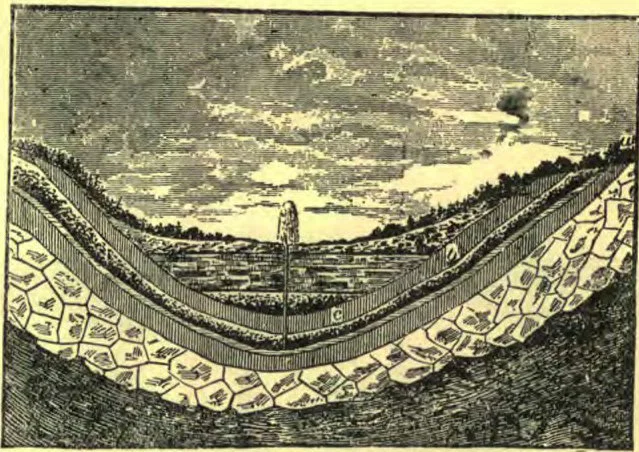
IN northern France is the province of Artois, anciently called Artesium, to which we are indebted for the name given to our flowing wells, for it was here that the boring peculiar to that used in artesian wells was first practiced. One of the wells of this region has been flowing since the twelfth century.
AN ARTESIAN WELL
Artesian wells are deep holes in the earth three to eight inches in diameter. Some are more than two thousand feet deep. The tendency of water to rise to the level of its source is the principle upon which the artesian well works. The accompanying cut clearly illustrates the idea. When the stream in the valley is tapped, the water will rise theoretically to the top of the hill, the source of the underground stream. If in search of an artesian well, look for a spot where the source of the water is higher than the place of boring; also look for alternate layers of porous earth and rock. The water percolates through the sand or gravel but cannot penetrate the rock layers, so it is held a prisoner, as it were, between the two layers of rock; but as soon as a hole is made through the upper layer of rock, the water gushes up to the height of the high ground.
While we are forced to give China the credit for being the first nation to use the artesian method for obtaining water and oil, such wells having been in use there for more than two thousand years, yet she is now far behind the rest of the world in this business, though in one of her provinces there are tens of thousands of such wells. Steam power and delicate and complicated machinery of western nations make the old drills and windlass of the pioneer nation altogether antiquated.
The capacity of artesian wells is almost incomprehensible. From three to five hundred thousand gallons a day is not unusual, and one well near Paris, France, delivers nearly six million gallons of water a day. Hotels, cities, ranches, and deserts are supplied with water through the service of artesian wells. The desert of the Sahara has at one place 170,000 palm trees that bear testimony to the blessings that flow from these wells.
Candidates for the Presidency
By Irving Bacheller
WHEN I was eight years old, I became a candidate for President of the United States. The nomination was a genuine surprise, for I had made no effort to secure it. As a matter of fact, there were many things that looked better to me; I would have preferred the position of bass drummer in the band at the county fair, but there were those who thought they knew what I wanted better than I did. We lived in the land of Silas Wright, who spent more time declining honors than did other statesmen in trying to get them. His party wanted him to run for President, but he wouldn’t. My father said that all I had to do was to be as good and as great as Silas Wright, and my election was sure. Governor Wright had been dead for twenty years. I soon learned that he was the greatest man that ever died—there is no distinction like that. I had no sooner got command of the theory and technique of one of his virtues than he assumed another. When I had acquired his gift of working all day and studying a part of the night, they told me that he always spent an hour in the garden, pulling weeds, before breakfast. I began to understand why he was dead, and also why he was so talented. Everybody was watching me and nobody was watching Silas. By and by I discovered that there were other candidates for President in the neighborhood. The Silas game had been tried on them also. We candidates got together one day over in Howard’s grove and discussed the issues. We were sick of the campaign—too many weeds in it. We all withdrew and ran away from school and spent a joyful afternoon at the old swimming hole. Next morning I came downstairs at breakfast time and found that the teacher had been there. I observed a general air of depression in the family.
My father said in a kindly tone: “I thought that you intended to be President.”
I told him that I had withdrawn.
Then he said: “Will you please come with me?”
I went. It was a beautiful summer morning, as calm as he. A song sparrow tried to hold up my heart. A squirrel looked down at me from a tree top as if he had a hole to recommend. I followed in silence through the garden walk and out under the orchard boughs. Not a word was spoken. My father stopped and cut a sprout from one of the trees, and then another, and trimmed them as he walked. He stopped and whittled, looking down thoughtfully. I stood near him. After a moment of silence he said:
“I suppose you know the object of this meeting?”
I admitted that I did.
Suddenly I heard a boy yelling down in the valley. It was the voice of an ex-candidate. In a minute he knew that I was with him. After all, what did this striving to be angels and presidents amount to? Not one of us was ever elected.—Irving Bacheller, in “Winning Declamations.”
Every Word of God Needed for Growth
“No one part of God’s Word will do; it is by every word of God that man is fed. No part of the Bible can be neglected without loss and detriment. As the plant robbed of sunshine and light becomes pale and weak, so it is with the Christian; if he does not accept all of God’s Word, he will not be able to grow up to the full stature in Christ Jesus.”
Keeping Busy to Avoid Becoming a Busy-Body
“ONE way to keep a body from becoming a busy-body is to keep a body busy.”
Aaron Pike’s Two Jokes
“When I was a young man,” began Amos Gray, “I used to clerk for Aaron Pike, over at the Harbor. He was as kind-hearted a man as you would wish to see; but he liked his joke, or, rather, his two jokes. I never knew of his having any more, but it was surprising how those two lasted him. When you come to think of it, there is a sight of wear in a joke.”
“One of ’em he always brought out in the latter part of December.
“‘Do you realize,’ he would say, some evening when there were a number of people in the store, ‘that Christmas and New Year don’t come the same day of the week this year?’”
Uncertain about the Desirability of This Familiarity
“Well, at that some one would be sure to begin to reckon up, and then like as not offer to buy peanuts for the crowd if Aaron wasn’t wrong. When Aaron had proved that he was right, he’d chuckle over it till closing-up time. Then he’d pack that joke away, so to speak, and have it out as good as new the next December.
“His other joke came in April. Aaron always had a daily paper at the store, and, of course, it was natural for people that came in to pick it up and read it. The first day of April, instead of that day’s paper he would have another one that he had been saving up lying on the counter. It would be dated April first and, whenever he could make it come right, the same day of the week; but it would be several years old.
“Well, year after year it never failed that some one, and often two or three, would read that paper without once realizing that it wasn’t fresh news.”
“One year we had a lot of fun hearing Joe Brown read out loud and make his sarcastic comments. Joe was on the opposite side in politics, and he had a good deal to say about the paper’s raking up dead issues to deceive the public.”
“Later in the day old Uncle Higgins came in for a quart of molasses, and I saw him pick up the paper and look at it for a minute. I was just going to speak to him about it, but he laid it down and seemed to be in a hurry for his molasses; so I said nothing.
“About an hour afterward young Seth Green, who had been loafing in the store half of the forenoon, came in again with a broad grin on his face.
“‘You’ve got another victim for your old newspaper joke, Aaron!’ he sang out before everybody in the store. Then he went on to say that Uncle Higgins had just started off in his cart for Bayport, to buy a secondhand wheel chair that Cole, the furniture dealer, had advertised for three dollars. ‘He was terribly afraid it would be sold before he got there,’ says Seth; ‘and when I asked him where he saw the ad., he said he found it in today’s paper at the store.’
“Then Seth haw-hawed right out, but nobody joined in. The picture of old Uncle Higgins, who was as poor as poverty, driving six miles to Bayport to buy a wheel chair for his bedridden wife, only to be disappointed when he got there, didn’t strike the rest of us as very comical.
“‘And you never told him the ad. was six years old?’ says Aaron.
“‘Why, no,’ says Seth, kind of taken aback. ‘I wasn’t going to spoil your joke.’
“‘Don’t you know that a joke ought to be spoiled before it gets to be a mean one?’ says Aaron. Then, after thinking a minute, he says, ‘I’ll see if I can’t spoil it myself;’ and at that he stepped to the telephone.
“‘This is Pike’s store at the Harbor,’ we heard him saying. ‘Got a secondhand wheel chair to sell? Well, a new one, then? What is your very lowest price to me? All right. Old Mr. Higgins from this place will be along later. When he asks to see the secondhand wheel chair that you advertised, show him the new one; and let him have it for three dollars—or two and a half if he beats you down. Charge the rest to me. Do you get it? Good-by.’
“Then Aaron took the old newspaper and tore it up. ‘This is getting to be a little too expensive,’ says he, ‘and I guess I’m done with it.’
“So after that, instead of two jokes, Aaron got along with one.” — Youth’s Companion.
The Rock Gibraltar
GIBRALTAR has been coveted by warriors and kings and admirals for hundreds of years. In 1309 the ruler of a small Spanish kingdom captured it from the Moors, and, in order to keep out invaders, he offered it as an asylum to thieves and murderers.13
In 1704 the allied British and Dutch fleets captured it in the interests of Charles, the archduke of Austria. But as the besieged gave way, it occurred to Sir George Rooke, the British admiral, that it would be wise for England to possess the rock. So, in a flash of intuition, he planted the English flag and presented Gibraltar to Queen Anne. She accepted it, and England has held it ever since, withstanding a hundred-odd years of protests and sieges from France and Spain.
The British have fortified Gibraltar with three tiers of 110-ton guns, in built-in long galleries that circle the upper wall of the rock. The firing is mathematically perfect, for the surrounding waters have been mapped into squares, each of which has a gun trained on it. At the foot of the rock sixty-four flat acres have been reclaimed from the sea, and these are covered with great dockyards that can repair and coal a large fleet.
Today it is said that, with its reservoirs for storing rain water, and its capacity for provisioning, Gibraltar can stand comfortably against a seven-year siege.—Every Week.
The Book That Never Grows Old
By Lula H. Ferris
At last the children were off to school and the morning work was done. But Mrs. Blankman felt somewhat blue and discouraged, for things had not gone smoothly that morning. “I believe I will return Mrs. Fuller’s pattern and have a chat with her,” she thought to herself. “That may help me to forget my troubles, for she is always so cheerful.”
In a few moments she was ascending the steps to her neighbor’s house, and heard Mrs. Fuller say in her usual cheery way, “Good morning, Mrs. Blankman, come right in.”
She noticed an open Bible on Mrs. Fuller’s lap, and after a few general remarks said, “Oh, you were reading your Bible again, weren’t you?”
“Yes,” replied Mrs. Fuller, “that is the stay of my life.”
“You must have read it through a number of times. I so often see you reading it.”
“O yes, I have read it through ten times, and now I am making a practice of reading it through each year.”
“Don’t you get tired of reading it over and over again? I should think it would be monotonous to reread it so many times. I shouldn’t care to read the same book through more than three or four times at the most; then I should want something different.”
“I should not care to read any of the ordinary books very many times either; but you know, Mrs. Blankman, the Bible is very different from any other book. No matter how many times I read it, I find something new in it, which I did not notice before. Even in studying a chapter many times, I always find some thought which had not especially impressed me before. The Bible is simple, yet deep and interesting. It is a remarkable book. The more I study it, the more interesting and wonderful it becomes to me.”
“Of course I have never read the Bible much,” said Mrs. Blankman; “I always supposed it was dry. How is it that you find it so interesting?”
“Well,” replied Mrs. Fuller, “when I was a child, my mother taught me Bible stories, and I was so much interested in them that I became anxious to read the Bible myself. As I grew older, I became interested in other portions of the Bible as well; so have continued to study it more and more; and find that it is helpful at all times. I might relate a little of my experience with it.”
“Yes, do.”
“When little Charlie was very ill and the doctors said he could not possibly live, I felt that I never could spare him; so I asked God to give me a scripture that would strengthen me to submit to his will; and I opened the Bible to Ps. 41:2, 3: ‘The Lord will preserve him, and keep him alive; and he shall be blessed upon the earth: and thou wilt not deliver him unto the will of his enemies. The Lord will strengthen him upon the bed of languishing: thou wilt make all his bed in his sickness.’ This inspired me with hope that he might live, and he did.”
“So many times, if I feel sad or discouraged, I turn to my Bible, and never fail to find something which strengthens and comforts me. I often come to verses which just suit the occasion, and which I do not remember to have seen before.”
“You know I enjoy studying history. I can always satisfy my desire by reading the Bible. It is the most ancient and authentic history that we have, for it takes us back to the time of creation. It also contains many songs, prayers, proverbs, exhortations, and rules for right living. In fact it deals with nearly every subject. If we could only live up to the Bible precepts, we should get along much better.”
“I enjoy studying the prophecies, and comparing them with history. It is wonderful to note how accurately they have been fulfilled. Then I never tire of studying about God’s plan of salvation, and the home he is preparing for the faithful. It is such a comfort to study the Bible and find how great is God’s love for us. It is like a letter from a father to his children, revealing his love and care for them. Oh, it is a precious book!”
“This is a revelation to me,” said Mrs. Blankman. “I believe I will begin to read this book that never grows old.” LULA H. FERRIS.
JOHN HOTTEL
By John Hottel
When we are converted to Christ, we are as “new-born babes.” We must grow up to the stature of men and women in Christ Jesus; or we may be likened to the good seed sown in the field, that is to grow up and bring forth fruit. But in order to grow to glorify God in our lives, we must partake of that spiritual food that God has provided. The plants and flowers grow, not by their own care, but by partaking of that which God has furnished to minister to their life,—air, sunshine, and food. What these gifts are to plant life, such is God’s Word to those who trust in him.
The real place for the Word should be in the heart rather than in the printed page.