The Youth’s Instructor, Vol. 35, No. 9.

THE DIVING-BELL SPIDER

The Youth’s Instructor

Mar 2, 1887

S. D. A. Publishing Association · Battle Creek, Mich. · Mar 2, 1887

THE DIVING-BELL SPIDER.
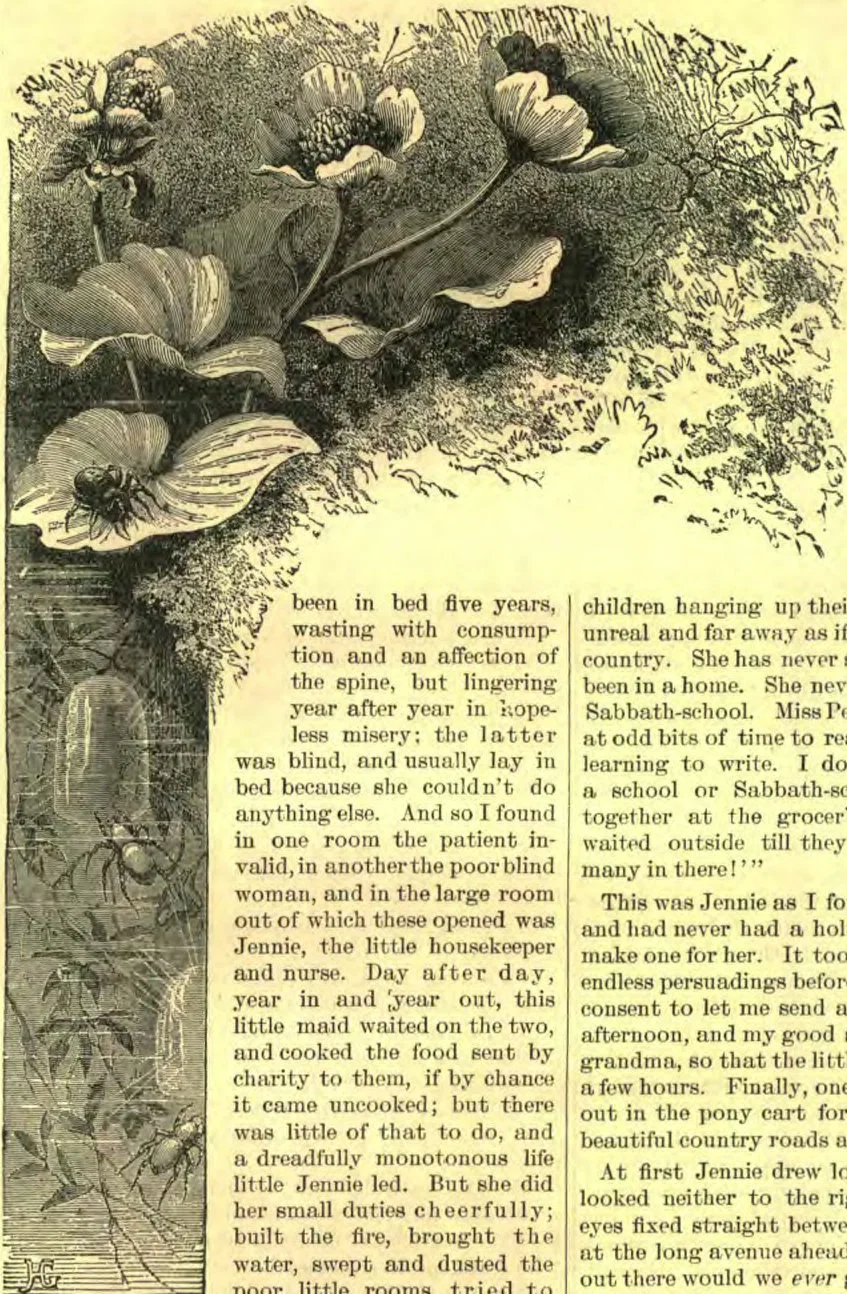
UGH! you horrid, ugly creature! But wait, and come a little closer, and you will forget its repulsive looks while admiring its wondrously beautiful web. See how delicate each thread, finer than the finest silk, and how industriously the spider works until the web is finished. Quickly he drops himself down, then as speedily mounts, hand over hand, like a sailor climbing to the topmost rigging of the mast. The web sways to and fro with his weight, but the threads are strong and do not break, or slip from the wall to which he has attached them, when he pauses so suddenly, as if stopping to rest before darting off again. You remember the verse in Proverbs, “The spider taketh hold with her hands, and is in king’s palaces.”
All this about the house spider. Now I wish to tell you about another kind, the diving-bell spider, and its curious home. Only think, its house is made of air, and built in the midst of the water; and this is the way she builds, for it seems to be the female that so skilfully plans and constructs the house where she may live under water without getting wet. First, she seeks for the leaf best adapted to her purpose, and when she has found one under water, she spins loose threads in various directions, fastening them firmly where she likes. Next, she covers these threads with a substance as clear as glass and as elastic as India rubber, so that a hole made in it would at once close up.
This done, she makes and fastens to herself a round ball of the same substance, and rises to the surface, where, by the curious machinery given her by the Creator, she gets a bubble of air under this ball. By means of a hole with tiny bristles around it, she can draw in air and pump it out, thus keeping the ball stretched and in place. When she has expanded the ball until it spreads around her like a gauzy mantle, she plunges beneath the water, and pumps the bubble of air, under the roof of her house, then up she rises again to the surface for another, and as quickly descends. This she repeats for ten or twelve times, until under the roof of her crystal palace there is air enough to let her live comfortably.
Here, safe and snug with her spider friends in their air-castles, she lives secure from the storms which lash the surface of the water into foam and spray, and from her feathered enemies, the birds. There she is ever in search of the bee, which comes to suck the honey from the water lilies; or the dragon-fly, dressed in coat of mail, darting hither and thither on wings of gauze, or the myriads of insects humming along their pathway, unconscious of the open bill, until, snap, and down they go to appease her hunger.
In autumn the diving-bell spider can be seen floating on the surface of the water, enjoying the warm sunbeams and the rocking of the ripples, until hunger sends it ashore to hunt for insects, and when it has caught its prey, quickly it plunges to the bottom.—Selected.

THE LITTLE GIRL WHO NEVER HAD A HOLIDAY.

WHEN I first knew Jennie Crawford she was twelve years old—a pale-faced, prematurely old child, living with her mother and grandmother. The former had been in bed five years, wasting with consumption and an affection of the spine, but lingering year after year in hopeless misery; the latter was blind, and usually lay in bed because she couldn’t do anything else. And so I found in one room the patient invalid, in another the poor blind woman, and in the large room out of which these opened was Jennie, the little housekeeper and nurse. Day after day, year in and year out, this little maid waited on the two, and cooked the food sent by charity to them, if by chance it came uncooked; but there was little of that to do, and a dreadfully monotonous life little Jennie led. But she did her small duties cheerfully; built the fire, brought the water, swept and dusted the poor little rooms, tried to keep the dear mother’s room and bed clean and bright, always pulling the shade to let in the sunlight, and never forgetting to tell grandma whether the day was clear or dull. The good old soul always gave thanks, whatever the weather. If it was bright, she would say the sun was needed to-day for warmth, or to bring out the grass; and if it rained, that it must be needed to lay the dust. She had learned the great lesson that in whatever state she was, therewith to be content, and never was the day so dark that she could not find something for which to give thanks.
When I first met and talked with her, I tried in a delicate way to condole with her over her blindness, but felt rebuked when she responded cheerily:— “Yes, dearie, I’ve been blind this twenty years, getting every year more helpless, till I have to just lie in bed. But I bless God I can hear your sweet voice, and I smell some posies somewhere about you, and I can feel right smart. I know Miss Perkins and Miss Flynn by the feel of their hands when they don’t speak. Why, many an old woman like me is deaf as a post and can’t smell nothing! And then I can talk. What would become of Jennie if I couldn’t keep up her heart talking to her? How good God is to us in giving us kind friends, who take care of us and keep us all together here, when we might be scattered—her mother in the hospital, me in the poor-house, and she, poor child, in the asylum!”
When I said it was a hard life for so young a child, she said: “Well, not as hard as if she had ever known any easier one. She never had no ‘holiday’ like I had when I was young; she don’t know what it means. Her Christmas is like any other day, only somebody brings her some books or candies. She reads in the books about the Christmas trees, and children hanging up their stockings, but it is all as unreal and far away as if it was going on in another country. She has never seen a family of children, or been in a home. She never could be spared to go to Sabbath-school. Miss Perkins learned her right here at odd bits of time to read and spell, and now she’s learning to write. I don’t know what she’d do in a school or Sabbath-school. She saw four girls together at the grocer’s the other day, and she waited outside till they came out, ‘There were so many in there!’”
This was Jennie as I found her. Twelve years old, and had never had a holiday! My first step was to make one for her. It took days of maneuvering and endless persuadings before I could gain the mother’s consent to let me send a nurse to stay with her one afternoon, and my good sister to stay and look after grandma, so that the little prisoner might be free for a few hours. Finally, one bright August day, we set out in the pony cart for a long drive through the beautiful country roads and lanes.
At first Jennie drew long breaths of delight, but looked neither to the right nor left. She kept her eyes fixed straight between the pony’s ears, looking at the long avenue ahead, and asked if we went way out there would we ever get back? After awhile she looked at the sky, and said, “There seems so much of it and nothing to hold it up.” She thought she would feel safer if I would turn back, “where the houses kept up each side of us.”
When we reached the country, and I told her we would get out and gather some flowers, her fear and astonishment knew no bounds. The grass was soft and springy, and she feared she would “sink in.” By degrees I coaxed her up a bank by the roadside covered with daisies and clover, and she gradually took in the beauty of the day and the scene, and then she began to cry for very joy, and said: “O, this is like what grandma tells me about; like the places she saw and lived in when she was young. I couldn’t think how it was. I never guessed any place was so big without houses on it; the pictures in the books don’t look so.”
I tried to think what Jennie’s feelings must be after living twelve years almost in one room, always in one street, her world bounded by a city square, to be suddenly taken out to this wide, wide field. My heart ached as I drove away after leaving her back in the old home with the heavy burden again on her young shoulders.
I “counted my mercies” over and over—and their name seemed Legion—and from that day to this, eighteen months to-morrow, I’ve counted among them the privilege I have had of giving this poor child many a bright holiday.—The Christian Advocate.

THIS WAY NO MORE.

'Tis not as though you had to travel back, The same old way; each step leads nearer Home; And soon along the rugged mountain-track Light from the ever-open door will come, And you shall see One standing at the gate, And hear him call: “Come in, my child! ’Tis late, And cold without,—the home-meal waits for you; And ah! your locks are wet with evening dew! But warmth and rest and comfort are within. Come in, my weary pilgrim child—come in!” And you will go so gladly, it shall be Small care of yours how rough the road did lie; Even the summer sunshine on the lea Shall pale before the radiance in His eye. And all things, good and ill alike, shall prove To have worked out for you a Father’s love.
—Well-Spring.

SNOW-FLAKES

WHERE do they go, The melting flakes of the bright, white snow? They go to nourish the April showers; They go to foster the Maytime flowers; Where the roots of the hidden grasses grow, There do they go.
How do they go? Drop after drop, in a silent flow. When the warm rain falls, and the winds are loud, And the swallow sings in the rift of the cloud, Through the frozen veins of the earth below They softly go.
Why do they go? Because Dame Nature will have it so! More than this, truly, I cannot tell; I am neither a seer nor an oracle! When all is answered, I only know That they come and go!
—Wide-Awake.

DAY DAWN IN NEW ZEALAND.

“God moves in a mysterious way his wonders to perform: He plants his footsteps on the sea, and rides upon the storm.”
We have now to tell you about a remarkable young man among the New Zealanders, who, by his energy and noble patriotism, did so much to open the way for the introduction of gospel light into this dark corner of the earth. All the New Zealanders were divided into nations, tribes, and families under chieftains graded according to their birth in the royal line. Tuatara, the chief of Rangiho, had learned about other countries from the white men who had visited New Zealand shores. He had an intense desire to see King George of England. Nothing could deter him from making the effort; and accordingly in the year 1805, at the age of eighteen, he left his native country for this purpose. He worked his way as a common sailor on the ship Anna, and after four weary years reached the docks of London. He passed through many adventures, and suffered much hardship, but his mind was set to carry out the desire of his heart. Instead, however, of being allowed to see the king, he was defrauded of his wages, and not even permitted to go on shore, but was placed on board a ship which was leaving for Sydney.
At this time England banished all her criminals to New South Wales, of which Sydney was the capital. But this custom has long since been abandoned, for there was nothing reformatory in such a course. To rob a man of all society that would tend to elevate him and make him more virtuous, and place him among more hardened criminals than himself, in a distant country from which he would never return, and where he would be loaded with chains and placed under task-masters often more cruel than the criminals themselves, would be worse than death. To be chaplain of this class of men would require a spirit of genuine, disinterested benevolence.
There was on board this ship a man of this class, Samuel Marsden, who had been appointed the principal chaplain of the penal colony of New South Wales. He was a man of God, and possessed a noble and generous spirit, but he longed to reach a more hopeful class than the banished criminals. He had become acquainted with many of the natives of New Zealand, who had visited Sydney, and he had entertained them at his house. The acquaintance he had formed with some of the chiefs had so enlisted his sympathies for this people that in 1810 he induced three lay missionaries to accompany him to that colony to labor for the people. At this time cannibalism was at its height; and the latest news received from the island was that an entire crew had been captured and eaten in the harbor of Wangaroa. As Mr. Marsden was about to sail to the island, the governor interfered and refused to permit him to expose his life and the lives of others to a race of savages.
Previous to this, Mr. Marsden made a voyage to England, after an absence of fourteen years, and providentially returned on the same ship with the young chief Tuatara. On the forecastle of this ship lay Tuatara, sick in body, crushed in spirit, and, to all human appearance, forsaken alike by God and man. After a few days’ sailing Mr. Marsden discovered and kindly cared for him until he was restored to health. Arriving at Sydney, Tuatara stayed at the chaplain’s house, and employed himself chiefly in learning agriculture. His acquaintance with the missionaries of Australia and what he had learned on his voyage to England gave him ideas of civilization which he readily grasped. He determined to carry some of these ideas into effect as soon as he should reach his native land. When he returned to New Zealand, he carried wheat with him, which he zealously endeavored to introduce among his countrymen. In a book “The Life of Marsden,” the writer says of this young chief:—
“He was indeed a noble specimen of human nature in its savage state. His character was cast in the mold of heroes. At the period of his death, after as much hardship, danger, and privation as nature could well bear, his courage was unsubdued, and his patriotism and ardor unabated.” At the time of his death “he said to Mr. Marsden, with an air of triumph, ‘I have now introduced wheat into New Zealand. It will become a great country. In two years more I shall be able to export wheat to Port Jackson (in Sydney) in exchange for hoes, axes, tea, and sugar.’ He had laid plans for farming on a large scale, and had formed his plans for building a new town with regular streets, after the European mode.” But he died without seeing his heart’s desire for his native land.
Tuatara longed to see the gospel taught to his countrymen, and a very warm attachment existed between him and his friend Mr. Marsden. But though he did not live to see this hope fulfilled, through him the door was opened for the entrance of Christian missionaries among this benighted people.
S. N. HASKELL.

A SMART BOY.

The impudence of American youth, though worn threadbare, is a subject which demands attention. If these impertinent young people could receive such a wholesome lesson as was taught to a lad in a village depot the other day, they might be effectually cured of their smartness.
The ladies’ room was well filled with passengers, waiting for the train, while, between his puffs of smoke, the self-important youth in the ticket-office gave surly answers to the civil questions they asked.
A few minutes before the train was due, an elderly lady, evidently unaccustomed to traveling, came hurrying in, and, after depositing her bundles on a chair, turned to the smart lad with the inquiry,—
“When will that train be here?”
“There’s a time-table behind you; if you can read, you can see for yourself,” was the rude answer.
The woman consulted the card on the wall for a few minutes, and then, apparently satisfied, asked:—
“What time is it now?”
“Half-past the corner, or thereabouts,” replied the bright boy, relighting his cigar.
“Sir,” said an old gentleman, who had come in during the colloquy, “why don’t you give the lady the information desired?”
“I do not keep an intelligence office,” was the pert rejoinder.
“It is your business to answer all civil questions, notwithstanding,” urged the stranger.
“I understand my business, sir. When I stand in need of your advice, I’ll let you know.”
“And what is your business, pray?”
“To make fools ask questions.”
“The company pays you for your impertinence, I presume.”
“Just so,” drawled out the smart boy.
“It does not pay you for smoking, at any rate,” said the gentleman, pointing to a poster that read: “No smoking allowed here.”
“I’m not in there, by a jug-full,” was the flippant retort.
“But your smoke is filling the room, and there are ladies here, to whom it is very offensive.”
“It is to some,” with a puff in the gentleman’s face.
“It is to me; and if you do not throw that cigar away, I will report you to the agent who employed you,” was the indignant response.
“Not so fast, daddy. If you don’t like the way things are done here, just take yourself outside, where you belong. That room is for the accommodation of ladies, and you do not seem to belong to the women.”
At this juncture the agent made his appearance, and taking the stranger by the hand, called him Mr. Mooney.
That cigar went out of the window in a hurry, and the knowing boy’s face underwent several changes during the greeting; for Mr. Mooney was superintendent of the road, and in a very few words gave him to understand that he was far too smart to be retained in the service of the company which he himself represented.—S. S. Classmate.

GETTING A GOOD PLACE.

I saw a young man in the office of a western railway superintendent. He was occupying a position that four hundred boys in the city would have wished to get. It was honorable, and it paid well, besides being in line of promotion. How did he get it? Not by having a rich father, for he was the son of a laborer. The secret was his accuracy. He began as an errand boy, and did his work accurately. His leisure time was used in perfecting his writing and arithmetic. At each step his employer commended his accuracy, and relied on what he did because he was sure it was just right. And it is thus with every occupation. The accurate boy is the favored one. Those who employ men do not wish to be on the constant look-out, as though they were rogues or fools. If a carpenter must stand at his journeyman’s elbow to be sure his work is right, or if the cashier must run over the book-keeper’s columns, he might as well do the work himself, as to employ another to do it in that way. It is certain that an employer will get rid of such an inaccurate workman as soon as possible.
I knew such a young man. He had a good chance to do well, but he was so inaccurate and unreliable the people were afraid to trust him. If he wrote a deed, or a mortgage, or a contract, he was sure to leave out something or put in something to make it an imperfect paper. He was a lawyer without business, because he lacked the noble quality of accuracy. Just across the street from him was another young lawyer, who was proverbial for accuracy. He was famous for searching titles, and when he wrote out the history of a title to a piece of property, it was taken for granted it was just so. His aim was absolute accuracy in everything. If he copied a conveyance, cited a legal authority, or made a statement, he aimed to do it exactly. The consequence is he is having a valuable practice at the bar, and is universally esteemed.
“But,” says some boy, “when I become a man, that is the way I shall do. I mean to be very accurate.”
Perhaps so. I could tell better if I knew just how you do your work now. There are several ways of getting a lesson. One is, to get it “tolerably well,” which does not cost much labor; the other way is to get it faultlessly well, which costs a great deal of labor. A boy can get a general idea of his lesson very soon, but to get it with accuracy is very hard, and requires both time and industry. If you, my boy, to-day are getting your lesson in the slipshod way, you will grow up a slipshod man; but if to-day your habit is to get every lesson with perfect accuracy, I will warrant you will do that way when you become a man. How is it?—Selected.

OUR THOUGHTS.

FOR from our thoughts our actions spring; So, if our thoughts are pure, Our words and deeds must blessings bring, For God's own word is sure. If there's bitterness within, Words and deeds will show Some of that same bitterness, And no blessing know.

The Joy of Doing Good

NEVER did any soul do good but it came readier to do the same again with more enjoyment. Never was love, or gratitude, or bounty, practiced but with increasing joy, which made the practicer still more in love with the fair act.—Shaftesbury.

DARE TO DO RIGHT.

CHILDREN, did you ever know of a person who did right whom sensible people despised? If no one says, “You have done right,” in words so we can hear it, the little voice we all carry within our minds will always say, “You did as you ought to.”
When Athens was governed by thirty men, called “tyrants,” they wanted a very rich man named Leon killed, so that they could have his riches. They wanted the great philosopher Socrates to help them; but he said, No; he would not engage in so great an “ill as to act unjustly.” You see he did right with thirty rulers over him, and all cruel men, too.
Christ was a greater philosopher than Socrates, and he taught us to “do as we would be done by.” If we follow that little rule, we shall always dare to do right. How much more of joy, and less of sorrow, there would be if everybody loved these words of the Saviour!

THE MINISTRATION OF ANGELS.

LESSON 7.—THEY ARE ALWAYS PRESENT WITH US.

1. WHEN Hagar once fled from her mistress, where did she go? Gen. 16:6, 7.
2. Who found her there and talked with her? Verses 7-12.
3. What did Hagar say? Verse 13.
4. What may we infer from this?—That angels often see us when we do not suspect it.
5. What happened to Hagar at another time? Gen. 21:14-16.
6. Who heard the voice of her child? Verse 17.
7. How did God answer him? Verses 17, 18.
8. What may this and other passages lead us to conclude?—That God generally employs angels in answering prayers.
9. Relate another instance where an angel appeared to a servant of God. Gen. 22:9-12.
10. Where did Jacob once tarry alone all night? Gen. 28:10, 11.
11. What did he see in his dream? Verse 12.
12. Who stood above the ladder? Verse 13.
13. When Jacob awoke from his dream, what did he say? Verse 16.
14. What did he say of the sacredness of the place? Verse 17.
15. What made these solemn impressions on his mind?
16. In what place does the Lord always meet with his children? Matt. 18:20.
17. How does it seem that this must be done?—By the ministry of the angels.
18. Does not Paul, in his directions about proper conduct in meetings, refer to the presence of the angels in their assemblies? 1 Cor. 11:10.
19. If, then, these holy angels are always present where God is worshiped, how should it affect our feelings and conduct while there?
20. How did Paul recognize the oversight of angels? 1 Cor. 4:9.

NOTE.

We are made a spectacle.—The theater or amphitheater of the ancients was composed of an arena, or level floor, on which the combatants fought, and which was surrounded by circular seats rising above one another to a great height, and capable of containing many thousand spectators. Paul represents himself as on this arena or stage, contending with foes and destined to death. Around him and above him are an immense host of men and angels, looking on at the conflict and awaiting the issue. He is not alone or unobserved. He is made public, and the universe gazes on the struggle. Angels and men denote the universe as gazing on the conflicts and struggles of the apostles. It is a vain inquiry here whether he means good or bad angels. The expression means that he was public in his trials, and that this was exhibited to the universe. The whole verse is designed to convey the idea that God had, for wise purposes, appointed them in the sight of the universe, to pains, and trials, and persecutions, and poverty, and want, which would terminate only in their death.—Barnes, on 1 Cor. 4:9.

TELEGRAPHY

When the telegraph is mentioned, how naturally the mind reverts to the wire stretched from pole to pole, over which the electric current can, in a moment, flash a message to great distances. But Webster defines the telegraph as an apparatus, or a process, for communicating intelligence rapidly between distant points, especially by means of visible signs or signals which have been previously agreed to, as well as by words and signs sent by electro-magnetism. Some method of communicating by signals has nearly always been in use, especially for purposes of war and defense. There was the Green fire-pot telegraph, Ænas telegraph, Bremner’s torch, the Beacon of the Hill-top, Gen. Washington’s flag, basket, and barrel signal, by which about fifty signals could be given; and still others might be named. Even the Indians had their fire and smoke signals. But it is understood that the most useful, by far, aside from electricity, is the semaphore, which, “aided by electricity, is used to the exclusion of all other methods on every line of railway in the world.” The following interesting paragraphs about this particular method we copy from the Christian Weekly:—
“Lord Murray, in 1795, invented what were called the semaphore-shutter or Louvre telegraph. It possessed the disadvantage that messages could only be sent during the daytime by its aid, and even then a fog rendered it useless. Upon one occasion news of one of Wellington’s victories was being telegraphed. It began, ‘Wellington defeated,’ when up rose a thick mist and put a stop to the signaling. In its mutilated form the message went up to London, a panic ensued upon the Stock Exchange, and everybody was in consternation, expecting the ‘Corsican Ogre,’ as he was invariably designated, to be the next moment knocking at their doors. The fog cleared, and the remainder of the message came, ‘Wellington defeated the French.’
“By this system, forty thousand signals could be sent at the rate of sixty-four from London to Dover in ten minutes, and till very lately news of the arrival of the mail from America continued to be sent from Holyhead to Liverpool by this means.”
“The honor of the invention of the practical semaphore belongs to two schoolboys. Two brothers in France, of the name of Chappé, were at different schools a mile and a half apart. They entertained a great affection for each other, and were inconsolable at not being able to communicate. Necessity, the mother of invention, set them at work, and they devised a method of talking with each other by means of pieces of wood exhibited at their respective back windows. By this means they were able to send 200 different messages.
“As they grew older, they improved the invention; but the French Revolution put an end, for a time, to their experiments. The ignorant revolutionists looked upon their invention as a part and parcel of the ill-doings of the aristocracy, destroyed the stations, smashed the semaphores, and the unfortunate inventors had to flee for their lives. This sort of thing happened more than once, but the persevering Chappés were lucky enough in 1793 to telegraph from the frontiers to Paris the news of a great victory.
“Forthwith they and their invention became the idols of the public, and telegraph stations were erected all over the Continent. England alone, with her hatred of everything French, refusing to countenance it. More than 80,000 signals could be sent by it, and a word could be telegraphed from Lille to Paris in two minutes. The Emperor Nicholas of Russia built a number of towers upon which to place the semaphores from the German frontier right through Warsaw to St. Petersburg. There were no less than 220 of these stations, with a service of more than 1300 men, and millions of pounds were spent in their construction. The entire line was only finished in 1858, and it was no sooner at work than the electric telegraph snuffed the whole arrangement out. There stand the towers at the present day, solitary and useless, except as a monument to the advancement of science.”

The Teacher of Little Children and the Drought

The Talmud tells us in one of those exquisite passages, which reveal the influence on Israel of the knowledge of God, that in a great drought the learned Rabbis prayed and wept for rain, but no rain came. At last one, not distinguished as a doctor of the law, prayed to Him who holds the winds in His hand, and who sends down the rain and the dew. The heavens became veiled with clouds, the precious rain soon abundantly fell. “Who is this?” they asked, “at whose prayer alone God has been propitious?” And the modest man replied, “I am a teacher of little children.” May the teachers of children ever be those who have power with God.

HOW THE INDIANS MADE SUGAR.

As the season for maple-sugar making arrives, it may be of interest to our young people to know how the first inhabitants of this country manufactured the article. Thomas Conant, an old resident of Canada, writes to the Toronto Globe what he knows about it. He says:—
“The Jesuit fathers, who were the first white men in this country among the Indians, tell us that the Indians made sugar regularly every spring by tapping the sugar-maple. They tapped the trees with their tomahawks, and inserted a spile in the incision to conduct the sap from the tree to their vessel beneath. Their spile was a piece of dry pine or cedar wood, grooved on its upper side for the sap to flow down. No doubt this process was extremely crude, still with all its crudities they succeeded in producing a considerable quantity of sugar each spring.
“Their buckets were made by taking a roll of birch bark, and sewing up the ends with deer sinews or roots. Thus they got a vessel capable of holding a pailful, and no doubt the sap caught in such vessels was just as sweet as that which we now gather in our bright tin-pails, at far greater expense and trouble.
“Gathering the sap from the birchen buckets, it was carried by the original red man to the boiling-place. At this boiling-place was a large cauldron made of large sheets of birch bark. Beside the cauldron, a fire was built, and in this fire was placed a lot of stones. As soon as the stones became heated to a red heat, they were dropped into the birchen cauldron, previously filled with sap. By taking out the cooled stones and putting in more hot ones, and repeating the process, even slow as it was, they got the sap to boiling. Once got to boiling, by reheating the extracted stones, they kept up the boiling, and so continued the process, until after a time they got the sap boiled down, and sugar was the result.
“That was making sugar without the aid of a kettle, nevertheless it is a fact that they manufactured it in this way; for my forefathers, who came to this province in the last century, have handed down in family traditions the story of the process just as I have narrated it. Indeed, they were eye-witnesses of the process themselves. With the advent of settlers, of course, the Indian soon learned better, and traded his furs with the fur-dealers for iron kettles, and then began making sugar much as the white man does now.”

FIERY COLUMNS IN THE SKY.

S. W. HALL, in the St. Nicholas, describes another beautiful scene “among the gas-wells,” occasioned by the burning gas. He says:—
“Often in the winter there may be seen in the gas region, far up in the sky at night, one or more faint white streaks, six or eight feet long. They look like comets, and the one first seen was quite generally mistaken for a comet. Each one of these is caused by a burning gas-well. The light of the well shines upon the small ice-crystals which quite often are floating in the air, far above us, and is by them reflected, or thrown down again, so that we see it, though the gas-well may be many miles from us. Every well furnishes but one ‘comet,’—as we may call it for want of a better name,—which always appears in the same place. When the lower air is also filled with ice-crystals, we do not see the comets, but great fiery streaks, the complete reflections, that reach from the points where the comets were, down across the sky to the horizon at the points where we see the glare of the distant gas-wells.
“We see something of the same kind below instead of above us, in the fiery belt which appears when we look across a wide, dark stream at a light upon the shore. But there is a unique strangeness and beauty about these fiery columns in the sky. They stand out boldly against the dark background, like great, fiery rods, a central bright streak, or spine, running through them, which shades off into a beautiful glowing red on each side. They are regular in shape, apparently about twenty inches wide, the sides straight, the top slightly rounded, and the bottom fading away, as it reaches the flame in the glare of the well.
“No description nor pictures of these comets and fiery columns can give a true idea of their strange beauty, which does not become commonplace by reason of a regular, every day—or rather, every night—appearance, as these phenomena are visible only under certain favorable conditions. Those still, chilly nights, when the sky has a hazy appearance, when a few scattering flakes of crisp, dry snow may be fluttering down, are the nights upon which the finest displays are seen; and several nights may intervene between these curious and beautiful exhibitions. Sometimes the comets will appear directly overhead, and the fiery columns often reach to a great height, depending, of course, on the distance of the observer from the source of illumination. Recently the top of one of these reflections was estimated to be six and a half miles above the burning well.
“As they stand thus in the sky, the effect is at first startling; indeed, there is a feeling akin to awe mingling with the sense of admiration as we look at them. We are reminded of the ‘pillar of fire,’ which led the Israelites out of Egypt; and if we stop to think of the great changes, the mighty forces, and the wonderful laws entering into the production of the strange scene before us, these modern pillars of fire will seem scarcely less remarkable to us than does the ancient miracle.”

AILSA CRAIG.

AILSA CRAIG is a remarkable island rock rising sheer out of the sea, at the mouth of the Firth of Clyde, ten miles off the coast of Ayrshire, Scotland. It is two miles in circumference, and rises abruptly to the height of 1,180 feet, being accessible only at one point. It is of gray stone, arranged in lofty columnar rocks, far exceeding in dimensions those of the far-famed Staffa, although not so regular in shape. A peculiar cave exists on one side of the rock, with the remains of an ancient stronghold containing several vaulted chambers. Large flocks of solan-geese [sea-fowls allied to the pelican] and innumerable rabbits are the sole tenants of this wild and romantic spot.—S. S. Classmate.

Sneezewood: A Remarkably Durable South African Timber

Among the remarkable woods of South Africa is sneezewood (pteroxylon utile), which in durability is said to surpass even lignum-vitæ, producing machine bearings which have been known to outlast those of both brass and iron.

Correction on the Lesson on Ministering Angels

By some means an erroneous statement crept into lesson one on the ministration of angels. It was said that the angels were mentioned in every book of the Bible; but this is not so.
As much controversy has arisen over the lesson on the parable of the ten virgins, we propose to print in our next number a brief article from Eld. Smith, explaining some of the controverted points.
Continue reading: ORDER