“Who turned my coat wrong side out, and flung it under the lounge?”
There you go, my boy! When you came home last evening, you flung your hat across the room, jumped out of your shoes and kicked them right and left, wriggled out of your coat and gave it a toss, and now you are annoyed because each article hasn’t gathered itself on to a chair to be ready for you when you dress in the morning.
Who cut those shoe-strings? You did it, to save one minute’s time in untying them! Your knife is under the bed, where it rolled when you hopped, skipped, and jumped out of your trousers. Your collar is down behind the bureau, one of your socks on the foot of the bed, and your vest may be in the kitchen wood-box for all you know.
Now, then, my way has always been the easiest way. I’d rather fling my hat down than to hang it up; I’d rather kick my boots under the lounge than place ’em in the hall; I’d rather run the risk of spoiling a new coat than to change it.
I own right up to being reckless and slovenly, but, ah, me! haven’t I had to pay for it ten times over? Now, set your foot right down, and determine to have order. It is a trait that can be acquired.
An orderly man can make two suits of clothes last longer and look better than a slovenly man can do with four. He can save an hour a day over the man who flings things helter-skelter. He stands twice the show to get a situation and keep it, and five times the show to conduct a business with profit.
An orderly man will be an accurate man. If he is a carpenter, every joint will fit. If he is a turner, his goods will look neat. If he is a merchant, his books will show neither blots nor errors. An orderly man is usually an economical man, and always a prudent one. If you ask me how to become rich, I answer, “Be orderly, be accurate.”—Detroit Free Press.
A LADDER FROM HEAVEN TO EARTH.
By Dudley Marvin Canright
THERE is a very interesting story in the Bible about how the angels once met Jacob out, in the wilderness, all alone. You remember that Jacob was the son of Isaac and the grandson of Abraham. He had a twin brother named Esau. Now Jacob and Esau did not agree very well; so Jacob’s parents thought best for him to leave home awhile, and go away off on a long journey to his uncle’s. He must have felt very sad in thus having to leave father and mother, his good home, and all his acquaintances, and start off on a long journey in a strange country and through a wilderness.
He traveled all day alone; and when the sun went down and night came on, he found himself in the wilderness where there were no houses nor any persons. He had no place to sleep. So he looked around and gathered up some stones and made a pillow of them, and lay down on the bare ground to sleep. That was not a very soft bed, was it? But it was a warm country, and probably he was not cold. However, there were wild beasts around. But he had learned to fear God and to pray to him and trust him, so no doubt he prayed that evening as he laid down to sleep. He must have felt very lonely, for all that.
In his sleep, the Lord appeared to him, and showed “a ladder set up on the earth, and the top of it reached to heaven, and behold, the angels of God ascending and descending on it. And behold, the Lord stood above it.” Then the Lord told Jacob that he was his God and the God of his fathers. He told Jacob that he would some time give him that land, and make his children very numerous. The Lord promised to go with Jacob, and to keep him. Jacob was very much astonished to see that ladder reaching from the earth into heaven. On this he saw the angels of God coming down to the earth and going back again. That was to show to Jacob that these angels had an interest in him, and that they could readily come down from heaven to earth, and go from earth back to heaven, though he could not see how they did it.
When Jacob awoke, he said: “Surely the Lord is in this place, and I knew it not.” You see, Jacob, though he believed in God just as we do, had not realized very deeply that the Lord was always with him everywhere he went, and that he saw everything that he did, so he said: “Surely the Lord is in this place, and I knew it not.” Children, that is just the way it is with us. Whether we stop to think of it or not, the Lord is always present with us wherever we go.
And then Jacob cried, “This is the gate of heaven.” Because he saw the angels thus coming from heaven to earth, Jacob was impressed that that must be the gate of heaven, where they all came out, and where they all went back. But the angels come just that way everywhere, even where we are. In the morning, Jacob built an altar and prayed to God. This vision of the angels helped Jacob very much to believe in God and trust him. And so it ought to inspire us with the same feeling of faith and devotion to our God; for those same angels come to earth now just as they did then. D. M. CANRIGHT.
Letter Budget.
IDA G. COLE, of Dakota Co., Neb., writes: “I am thirteen years old. This is my first letter to the Budget. I go to Sabbath-school, which is just three quarters of a mile from my home, and study in Book No. 2. Papa is my teacher. Our school has between seventy and eighty scholars, divided into four divisions. We live in the timber, in what is called ‘St. John’s Woods,’ on a new farm. We have a new church, nearly finished, built in the timber. The soil here is called ‘gumbo.’ It sticks like wax in wet weather, but in a dry time, it is as hard as stone. We live on the Missouri River bottom. The water is good, but hard. We raise corn, potatoes, and all kinds of garden stuff. I am trying to be a good girl, and I hope all the little boys and girls will live so we may meet in the new earth.”
What about your crops in time of drouth, Ida, when the soil dries so hard? Should think they would all dry up.
Next is a letter from MYRTLE A. ROBERTSON. She writes: “I am a little girl seven years old the second day of January. I have a large brother and sister, and one brother four years old, by the name of Floyd, and a baby sister three years old, named Maud. Papa and mamma are both trying to keep all of God’s commandments. I go to Sabbath-school when I can, and study Book No. 1. I try to help mamma by waiting on little Maud. Last summer I used to ride horse for papa to cultivate the corn and potatoes. We had so much dry weather that our crops were very poor; but the year before, I had six missionary hills of melons, and got thirty-five cents for them. We have many Indians here. May be they will camp on our land next spring. If they do, I will try to tell you some thing about them. I cannot write, so I got mamma to write this for me.”
It is only a little while until spring; don’t forget to pick up all you can that is interesting about the Indians, so you can write it to the Budget.
LEWEN JACOBS writes a letter from Adair Co., Iowa. He says: “I want to get acquainted with the editors, and all the INSTRUCTOR family, so I thought I would write you a letter. I am ten years old, and love so much to read the letters. I am trying to be a good boy, that the Lord may be pleased with me. I love the Sabbath-school, and haven’t missed going but three or four Sabbaths in the last five years. I hope we shall all try to be good, and do all of God’s commandments, that we may meet in the new earth. I have some chickens, and a blackberry patch. I pay tithes on all I raise. We have an artificial pond, with thousands of fish in it. Yesterday I went down where my uncle was cutting ice, and took out thirty little fish, which I put into a glass can. I feed them potatoes and bread. Should any of you ever come to this place, you must be sure to come and see us. My letter is all written with my left hand, as I have never learned to write with my right hand.”
How long did your fish live in the can? Did they like the change? Grown persons can often write well with either hand. Your letter was well written for a left-handed boy; it is quite interesting, too, and we feel sure all would be glad to accept your kind invitation to visit you.
GRACIE'S GOLD.
By S. Isadore Miner
PAPA had some money all in gold,
And he sent it far away to a land across the sea,
To the poor, benighted heathen; and he told
The children all about them as they clustered 'round his knee;
How they bowed to wood and stone,
How they knew not God's dear Son,
How the little heathen children never went to Sabbath-school;
But that gold would send them preachers,
Bibles, Sabbath-schools, and teachers:
Thus by sending his gold dollars, he obeyed the Saviour's rule.
Gracie listened to the story papa told,
And her heart was filled with pity for the children 'cross the sea;
And she thought if she could only find some gold,
To send them books and Bibles, how happy she would be!
And she wondered where it grew,
For wee Gracie only knew
That it was bright and yellow, and sparkled in the sun;
And she pondered more and more
If it was brought at the store;
If it was, she'd take her pennies, and surely buy her one.
“Children, children,” mamma said,
“It is time to go to bed.”
“Run away, then, baby gold-locks,” said papa to little Bess;
And a sudden, swift surprise
Lit up Gracie's thoughtful eyes,
For an answer to her questions she thought she now could guess.
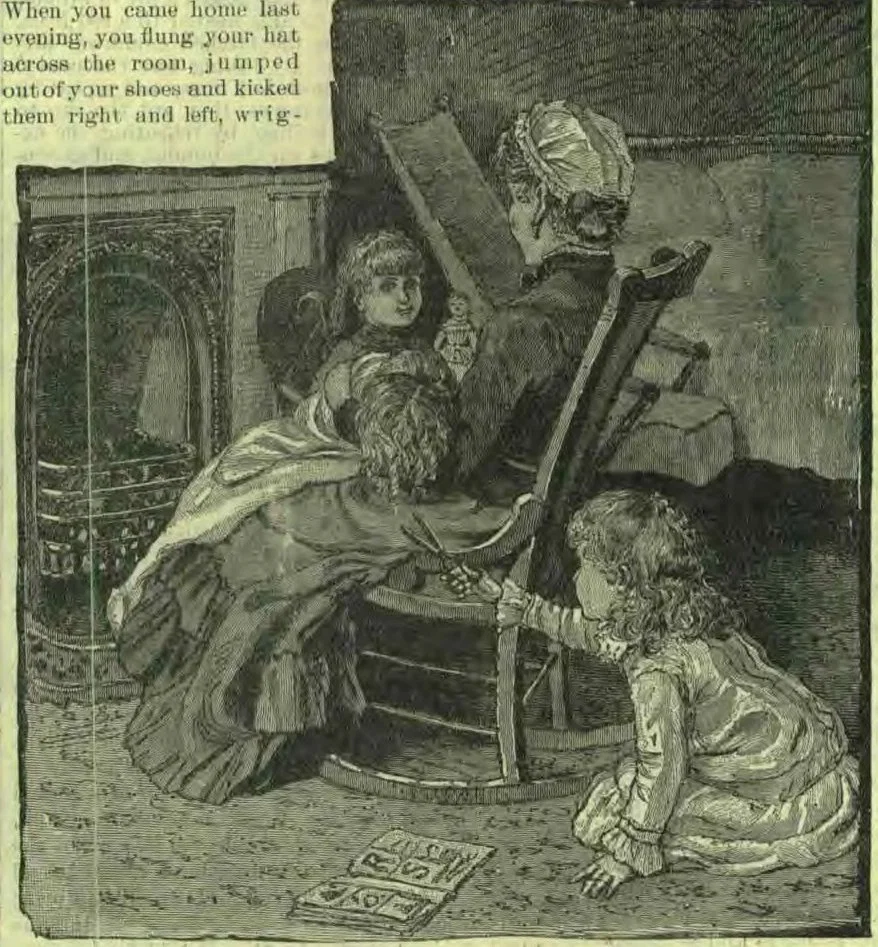
Quick she slipped up to the stand,
Something gleamed within her hand,
As she crouched with eager fingers by her mother's rocking-chair,
Where, in the firelight's ruddy glow,
Bessie's curls swayed to and fro—
Snip, snip, snip,—and on the floor lay shining threads of sunny hair.
At the scissors' snipping sound,
Papa quickly turned him round,
And the little frightened culprit through her tears lisped
“Please don't scold,
And I'll truly tell the reason—
Wanted it to mend the heathen—
For you know—I thought—you said—that Bessie's hair was made of gold.”