Your ShelfYour Projects

Signs of the Times, Vol. 23, No. 8.

The Touch of Faith
Earlier text: The Touch of Faith

THE KINGDOM OF GOD.

“Thy kingdom come. Thy will be done in earth, as it is in heaven.”

The Climax of the Controversy.

When Christ came, it was the climax of the controversy between him and Satan. If Satan shall be in any way able to turn Christ, the second Adam, the representative of the human race starting out again, aside, if he can by any means overcome him, he will triumph and establish his kingdom here. So upon Christ was brought to bear every possible temptation, and all the power of malignity that had been working in Satan for thousands of years. And to effect his purpose he followed Christ every step of the way from the manger to the cross. He was determined that Christ should not remain loyal to God while in his dominion. When it came to the cross of Christ’s experience, Satan instigated on the part of men everything that malignity could devise. He urged them on to overcome his human nature, that he might make him swerve from the path of loyalty. He tried to bribe him. “Acknowledge my right to the kingdom of the earth,” he said, “and I will give you all these kingdoms.” But this Christ could not do; for it was the very point of the controversy.
We come to the climax of the struggle in the death of Christ. Satan’s charge had been that God’s government was arbitrary and hard, and that he would give his subjects a better government. The universe looked on to see it worked out. The curse of disobedience rested on the earth, but Christ came to redeem it, “being made a curse for us.” Satan had urged on the Jews till they took his life, and thus Satan became the murderer of the Son of God. By his gift to the world God showed that he did desire his will—the law of love and filial obedience—to be done on earth as it is done in heaven, and in order to make it possible he was willing to give his only-begotten Son to die. Satan showed that he wanted his own way badly enough to be willing to become the murderer of the Son of God. All this was enacted before the universe, and how did it affect it?

God’s Government Vindicated before the Universe.

“And there were certain Greeks among them that came up to worship at the feast; the same came therefore to Philip, which was of Bethsaida of Galilee, and desired him, saying, Sir, we would see Jesus. Philip cometh and telleth Andrew; and again Andrew and Philip tell Jesus. And Jesus answered them, saying, The hour is come, that the Son of man should be glorified.” “Now is the judgment of this world; now shall the prince of this world be cast out. And I, if I be lifted up from the earth, will draw all unto me.” John 12: 20-32. And Jesus Christ, lifted up between heaven and earth on the cross, did draw both heaven and earth to him. Through death he destroyed him that had the power of death, that is, the devil. It is not often a king gains with his kingdom by dying, but Jesus Christ won both his kingdom and his subjects by dying, and he destroyed his enemy by death.
“Now shall the prince of this world be cast out. And I, if I be lifted up from the earth, will draw all unto me.” When he was lifted up on the cross, and when he said, “It is finished,” and gave up the ghost, all heaven heard; and wherever throughout the universe there had still been in minds thoughts of rebellion and lingering sympathy for Satan, that scene on the cross showed them that Satan’s government meant that nothing should stand in his way, and that to effect his purpose he was even ready to murder the Son of God. Thus they were drawn to God by his great love. Then the fate of Satan was sealed; he was cast out, and it was demonstrated that God is love, that he was governing by the power of love.

A Personal Question.

And think you that if Satan would not hesitate to take the life of the Son of God he will hesitate to take your life? Think you that his plan of government is any better now? Do you not see that it is loyalty to God or to Satan? Do you not see that we have either to put ourselves under Satan’s leadership and fight against Christ, or to put ourselves under the leadership of Christ to fight against Satan? Which side are you on? “Ye are a spectacle to the world, to angels, and to men.” Are you enrolled as fighting under the blood-stained banner of the Lamb, as a loyal subject of God; or as fighting under the black banner of Satan, against the government of God?
This question of the two kingdoms is going on till Christ shall come the second time to take his kingdom. We are very near that time now. All one has to do is to read the Scripture and the signs of the times to know that it is near. Little argument is needed to show any one who will read the Scripture and the signs of the times that the day of the Lord’s coming is near and hasteth greatly. The controversy is in its height. Tremendous power is being brought to bear to hold subjects in the kingdom of Satan. He is bringing upon people every device to hold them in the bonds of sin, to take their minds away from the realization of the near coming of Christ, and fill them with pleasure and self-seeking. But Christ is at work in the earth, and is to-day selecting those who will be loyal to him. And what does it mean to be loyal to him?—It means to

Obey the Laws of the Realm.

Christ has proclaimed the conditions of membership into his kingdom. He has sent his servants throughout the world, saying, “Go ye therefore, and teach all nations, baptizing them in the name of the Father, and of the Son, and of the Holy Ghost; teaching them to observe all things whatsoever I have commanded you.” Matt. 28: 19, 20. To-day they are preaching that the coming of his kingdom is near; and they are gathering out those who will be loyal to God.
It costs something to be loyal to God now. It cost Job something; but there is a power in the love of Jesus Christ to hold; there is something in his love that will satisfy every longing soul, and fill with fatness all who will come to him. The call is now, “Come out from among them, and be ye separate.”
The two kingdoms can not be joined together. And yet there has seemed to be a tendency to try to make them run together. You can not do it. They are perfectly opposed to each other; light and darkness will not mix. Love and hate are opposite characteristics, and will not co-mingle. At the crucifixion the cross of Jesus Christ made a separation between the repentant and the unrepentant, and to-day it makes the same division. And God is now sending forth

A Special Message.

urging loyalty to his law. He calls upon every one now who will, to yield himself to obey the laws of his realm; and more than that, he has set up in this last generation a wonderful sign of loyalty. There is a special call to that portion of his law which has been set aside. “Hallow my Sabbaths.” “They shall be a sign between me and you, that ye may know that I am the Lord your God.” Eze. 20: 20. In this generation the Lord has set up his Sabbath as a special sign that he created the heavens and the earth through Jesus Christ. “In the beginning was the Word, and the Word was with God, and the Word was God. The same was in the beginning with God. All things were made by him; and without him was not anything made that was made.” John 1: 1-3.
“The Sabbath is set up as a special sign of loyalty to God, of obedience to his laws, and of our belief in the creating power and the divinity of Jesus Christ our Lord. Shall we choose him as our Lord, and step from the kingdom of darkness into the kingdom of light? He is coming soon, and when he comes, he whose right it is to reign will reign. He has redeemed the earth, and he will save when he comes every one who has been obedient to his laws and has identified himself with Christ as leader.
“And I saw heaven opened, and behold a white horse; and he that sat upon him was called Faithful and True, and in righteousness he doth judge and make war. His eyes were as a flame of fire, and on his head were many crowns; and he had a name written, that no man knew, but he himself. And he was clothed with a vesture dipped in blood; and his name is called the Word of God. And the armies which were in heaven followed him upon white horses, clothed in fine linen, white and clean. And out of his mouth goeth a sharp sword, that with it he should smite the nations; and he shall rule them with a rod of iron; and he treadeth the winepress of the fierceness and wrath of Almighty God. And he hath on his vesture and on his thigh a name written, King of kings, and Lord of lords.” Rev. 19: 11-16. Is he our King and our Lord? Those who recognize him now as King of kings and Lord of lords, will be prepared, when he is revealed, to say, “Lo, this is our God; we have waited for him, and he will save us; this is the Lord; we have waited for him, we will be glad and rejoice in his salvation.” Isa. 25: 9.
W. W. PRESCOTT.

SIN EVER THE SAME.

God “will render to every man according to his deeds; to them who by patient continuance in well-doing seek for glory and honor and immortality, eternal life; but unto them that are contentious, and do not obey the truth, but obey unrighteousness, indignation and wrath, tribulation and anguish, upon every soul of man that doeth evil; of the Jew first, and also of the Gentile; but glory, honor, and peace, to every man that worketh good; to the Jew first, and also to the Gentile; for there is no respect of persons with God. For as many as have sinned without law shall also perish without law; and as many as have sinned in the law shall be judged by the law (for not the hearers of the law are just before God, but the doers of the law shall be justified . . . .); in the day when God shall judge the secrets of men by Jesus Christ according to my Gospel.” Rom. 2:6–16.
According to these declarations judgment will be rendered to every man according to his deeds. As regards his written law (the Decalogue), and those to whom it comes, a man's deeds shall decide whether or not he shall be justified. A man is not “just before God” as a hearer of the law, but the doer of the law “shall be justified.”
Thus, before entering upon his masterly argument establishing righteousness by faith, Paul plainly sets forth a justification that is dependent on works, and is to be applied to man in the day of judgment. This teaching coincides with that expressed by his fellow-laborer and apostle James: “But be ye doers of the word, and not hearers only, deceiving your own selves.” And “whoso looketh into the perfect law of liberty [the Decalogue], and continueth therein, he being not a forgetful hearer, but a doer of the work, this man shall be blessed in his deed [margin, “doing”].” Christ also set his seal to the essentiality of man's doing the will of God, that it may be possible for him to enter into the kingdom of heaven. Matt. 7:20, 21. Doing God's will is keeping his law. See Ps. 40:8.
Paul, therefore, in effect declares that there is justification that cometh by works, as regards God's law, and that it is imperatively demanded, and is absolutely effective; but only a little further on he declares that there is no doer. He proves that all are under sin, both the Jews who had, and rested in, the law, and Gentiles also, who “do by nature the things contained in the law,” declaring that “there is none righteous, no, not one; . . . there is none that doeth good, no, not one;” and he forcibly brings together not less than nine different portions of God's Word sustaining his declaration.
Up to this point Paul has made no reference to the law as relating to its office, or as an instrument applied to man in his lost estate. He has spoken of the doer and his prospects in the judgment as contrasted with the hearer. It is also made evident that there is no doer—that there is no righteousness in man as descended from Adam. Turning now to the law, he shows that it worketh wrath. After admitting that the doer of the law shall be justified, he now shows that the law is not the agent of justification. It is the instrument of condemnation. He says that by the deeds (doings) of the law, shall no flesh be justified in his sight, because the law (as a rule of conduct when applied to man) causes every mouth to be stopped, and all the world becomes “guilty before God,” or, as the margin reads, “subject to the judgment of God.” “By the law is the knowledge of sin.” It reveals sin. But now he declares the agent of justification. It is “His grace through the redemption that is in Christ Jesus; whom God hath set forth to be a propitiation through faith in his blood, to declare his righteousness for the remission of sins that are past, through the forbearance of God.”
The righteousness of God is now manifested without (apart from) the law, the law and the prophets witnessing to that righteousness. It is the same righteousness brought to view in chap. 2:5. It is manifested by faith in Jesus Christ unto all and upon all that believe.
There are four texts of Paul's writing that if associated together epitomize the whole subject: “The doers of the law shall be justified;” “By grace are ye saved;” “The just shall live by faith;” “We shall be saved by His life.”
The moral requirements, that in infinite justice must be the same to all men and in all ages, is God's law—a separation from the world—walking with God. The power to do this having been lost, God's free grace provides a motive power, faith, which expression of infinite mercy enables man to appropriate Christ's life, and by faith in him to have the righteousness of that life imputed to him. Christ in his life in the flesh did no sin. The law as applied to that life in its legitimate capacity as a searcher, a revealer of sin, found it spotless. The law testified in his case that his life was pure and faultless, and that it had no claims upon that life which had not been satisfied fully.
Now, there has been lived out one perfect life, and the testimony of God's great rule of judgment has declared that it is so. That righteousness wherein Adam failed, and which would have assured him life—life is inherent in obedience—was wrought out by Christ; and Christ was entitled to all the rewards and benefits inherent in, and coming from, that righteousness. As it is twice declared by God through Solomon, “Keep my commandments and live,” so Christ himself declared, “I have kept my Father's commandments, and abide in his love.” And Peter, in referring to Christ's resurrection, declares that God “loosed the pains of death, because it was not possible that he should be holden of it.”
Christ as a man did not have to die, and herein is the merit of Christ's sacrifice. He freely GAVE himself for us. He was made “to be sin for us who knew no sin, that we might be made the righteousness of God in him.” He suffered for the sins of the whole world freely and voluntarily, thus becoming a propitiation for the sins of the whole world. 1 John 2:2. The truth of that fact is further attested by Paul in Rom. 8:3. Christ by “a sacrifice for sin [margin] condemned sin in the flesh;” and for the same reason as given to the Corinthians, quoted above, but differently expressed, “that the righteousness of the law might be fulfilled in us,” etc. We thus see that by Christ's infinite sacrifice we are to be “made the righteousness of God,” and “that the righteousness of the law” is to be “fulfilled in us.” These two expressions are synonymous (see Isa. 51:7); and this condition is ours if by faith we accept the promise that Christ's life is imputed to us.
Thus we see the scope and purpose of the law in its two forms, engraved by the finger of God on tables of stone, and embodied in Christ's life. It is the same in both forms. In Christ's flesh, or life, it has all the power and prerogatives that it ever had. It is still the revealer of sin; indeed, Christ showed by his life and words the exceeding depth and comprehensiveness of every commandment. He abolished nothing; that which was sin (transgression of law), from the days of Adam down, was by his life condemned. He “condemned sin in the flesh,” and surely he did not lead a double life. What he condemned as sin, then, must constitute sin ever after. His life condemned stealing; it always was a sin, it will always be a sin, likewise adultery, murder, lying, blasphemy, idolatry, and Sabbath-breaking. All sin is comprehended in the transgression of God's Ten Commandments, which comprehend all duty. Eccl. 12:13. Sin is transgression of the law; where there is no law, there is no transgression. Christ fulfilled (kept) all the law, and thereby condemned all sin. By faith we are saved by his life; that is, his righteousness (right-doing) is imputed to us. We are accounted doers. Shall mortal man declare that Christ's righteousness clothed the man who by faith looked to him in ages long ago, differently from the man who accepts him now? Shall man by his teachings declare that God is to have one rule of judgment for the first four thousand years, and a different rule for the balance of time? W. L. WINNER.

A Clean Church Is Stronger

WHEN Jesus calls a fisherman, he chooses one with a clean net, tho worn and weak. The church has spent more pains in the effort to get a strong machine than a clean one, and that is why we have so many revivals and so few survivals.—J. G. Woolley.

Too Weak or Too Lazy

SOME people say they can't work for God because they are too weak. God likes to use weak things to confound the mighty. Don't say you're too weak. Say you're too lazy. That's what's the trouble.—Moody.

JEWISH CUSTOMS AND TRADITIONS.

(By an Israelite.)

The Gospel in the Sanctuary.

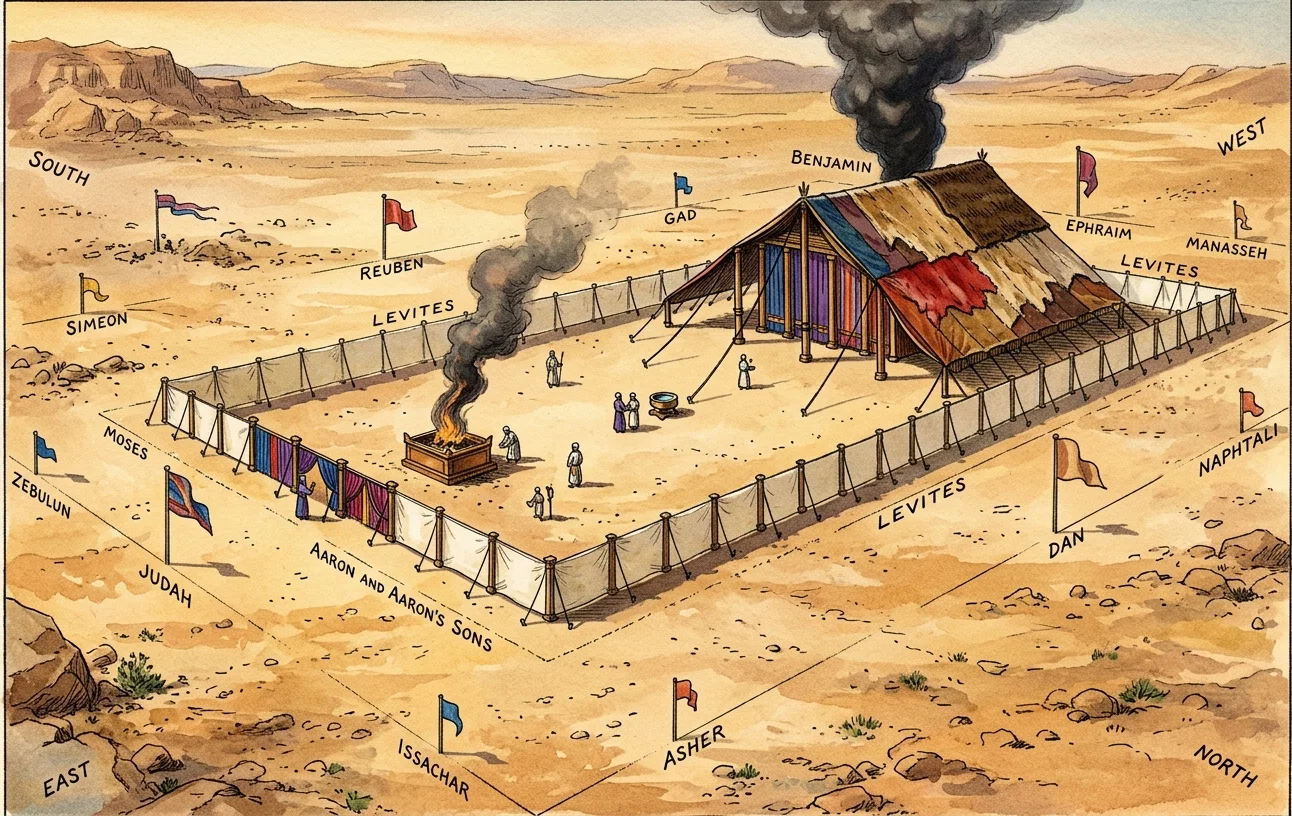
This subject is one worthy of careful study and consideration, as there is no part connected with it but what contains some deep spiritual truth. Even the manner in which the Lord ordered the bringing of the material together for its building is not devoid of importance. For it should ever be remembered that everything in connection with this building finds its fulfilment and completion in the Messiah, and in his work. As previously stated, it was the purpose of God to teach his ancient people that by this illustration they were to understand the working out of the salvation of God in the human soul, and the manner of his abiding with them.
For every high priest is ordained to offer gifts and sacrifices; wherefore it is of necessity that this Man have somewhat also to offer. For if He were on earth, He should not be a priest, seeing that there are priests that offer gifts according to the law; who serve unto the example and shadow of heavenly things, as Moses was admonished of God when he was about to make the tabernacle; for, See, saith He, that thou make all things according to the pattern showed to thee in the mount. But now hath He obtained a more excellent ministry, by how much also He is the mediator of a better covenant, which was established upon better promises.
It has been said that there may be danger in placing too much importance on the spiritual meaning of the tabernacle service, and that it might be possible to fall into the same error as did ancient Israel, looking more to the tabernacle itself rather than to the Pattern. But, dear reader, if we do as did Moses, endure as seeing Him who is invisible, we have nothing of which to fear. And while the work on the temple of God is being wrought out in our lives, let us keep our eyes fixed on the Pattern, even Christ Jesus, and not on the material, which is the clay that God is forming into his holy habitation. If our eyes are anointed with the eyesalve of his Spirit, and we seek to find out the truth as it is in him, we need entertain no fears of falling into the error of the ancient people; for God has furnished their record for us, that we should remember that they are an example to us. We want simply to work out that which God works in.
The fact is that there is not enough attention paid to the work of the wilderness service, and of the Old Testament teaching; for it should ever be held in remembrance that everything essential to life and salvation through Jesus Christ, was given to the ancient people of God, and this knowledge was largely wrapped up in connection with the sanctuary service. We do not value enough the Old Testament, which is God’s great treasure-house of truth. There are many scriptures which clearly show the work of salvation in connection with the above-mentioned statement.
“What advantage then hath the Jew? or what profit is there in circumcision? Much every way; chiefly, because that unto them were committed the oracles of God.” What, then, are these sacred oracles?—They certainly must be the Old Testament, part of which was the service in the wilderness. This the apostle well knew, and so taught the Hebrews; for we find in the book of Hebrews that he proves conclusively from the services of the sanctuary that the Jews themselves knew that Jesus is the Messiah; that all those things there performed by the priests daily and annually had no efficacy in themselves, as they could not forgive sin; yet it was the only thing they had there to teach them the way to God, and give them the knowledge of salvation and eternal life through the blessed Lord and Saviour. And the Master himself when on earth told the scribes and Pharisees that the reason they sought the Scriptures was because that in them they believed they had eternal life, and which also gave testimony of him. And this life, too, was found in him. See John 5:39, 40. And Paul, in writing to Timothy, told him that he was taught from a child the Scriptures, which were able to make him wise unto salvation through faith which was in Christ. See 2 Tim. 3:15.
It is true now as it always has been that the salvation of God comes in only one way, and that is through Christ. Acts 4:12. This salvation the apostle tells us is the Gospel, or God’s power to save men. Rom. 1:16. It is therefore important that people have the Gospel, for without it they can not be saved. And, too, wherever people have had the Gospel, there they have had salvation, for it is salvation. It is obvious to all that it can not affect any one merely to study the Gospel, and it is also evident that to rightly understand the Gospel, we must have the Spirit and power of the Gospel. Now the apostle, in speaking of the experiences of Israel, found in the latter part of the third and first part of the fourth chapters of Hebrews, says that those people with whom God dealt in the wilderness after the exode from Egypt, had the Gospel, and did not receive benefit from it because they did not have faith in it. Therefore it must be clear to all that Israel had forgiveness of sins back yonder, and had a knowledge of God’s method of salvation, and could have been saved by it if they would only have believed.
We then can study with profit the experiences of that people, and the work committed to them; for when we see the mistake that they made, and profit by that experience, we shall be saved from falling into the same grave error. For the people of God in these last days are taking up the real work of God where ancient Israel left it.
If, to the true people of God anciently, these oracles meant the way of life and salvation, and gave to them a knowledge of the Messiah and his work for them, giving them the privilege to delight their souls in the grace and saving power of the Anointed One, we can certainly benefit by a study of these things, in the light of the sweet Spirit of the Lord, and find much contained therein which will give sweet peace and comfort to the soul. Mines of treasure are there, which will more than pay the hungry soul longing after him—the blessed fulness of God—who will devote the time to see that these things are so. As the priest of old delighted to enter the “holy places” to do service therein (for to him it meant communion with his blessed Maker), so to the priest of to-day (for all are priests in his sight, yea, we are a kingdom of priests) who will but walk in this blessed tabernacle of old with the Master, and therein see every step of the way a new revelation of the working out of God’s plan in his own individual soul, much blessedness and an abundance of joy will be afforded; for it is always sweet to walk with Jesus, wherever we find him. F. C. GILBERT.

OBEDIENCE

We are told that without faith it is impossible to please God, and you will find that it is impossible to please God without obedience. “And being made perfect, he became the Author of eternal salvation unto all them that obey him.” Eternal salvation unto all them that obey him; not all that feel him, talk to him, that say, “Lord, Lord,” but them that obey him. Eternal salvation means eternal safety. Did you ever notice that all but the heart of man obeys God? If you look right through history, you will find that this is true. In the beginning God said, “Let the waters bring forth,” and the waters brought forth abundantly. And one of the proofs that Jesus Christ is God is that he spoke to nature, and nature obeyed him. At one time he spoke to the sea, and the sea recognized his voice and obeyed him. He spoke to the fig tree, and instantly it withered and died. It obeyed literally and at once. He spoke to the devils, and the devils fled. He spoke to the grave, and the grave obeyed him and gave back its dead. But when he speaks to man, man will not obey him; that is why man is out of harmony with God, and it will never be different until men learn to obey God. God wants obedience, and he will have it, else there will be no harmony. In the first epistle of John we read, “And the world passeth away, and the lust thereof; but he that doeth the will of God abideth forever.” He says in another place that if we obey his sayings we will never die.
Suppose I send my boy to school and he plays truant. He says, “I don’t want to go to school,” and he goes off and fishes all day. He knows I am very fond of trout, and he says, “I know I have been disobedient, but I can sell these trout for fifty cents; but I will take them home to my father.” Do you think that will please me?—Not by a good deal. I want obedience, and until my son obeys, his sacrifice is an abomination.
“Take the two Sauls. They lived about a thousand years apart. One started out well and ended poorly, and the other started out poorly and ended well. The first Saul got a kingdom and a crown; he had a lovely family, no father ever had a better son than Saul had in Jonathan; he had the friendship of Samuel, the best prophet there was on the face of the earth; and yet he lost the friendship of Samuel, lost his crown, his kingdom, and his life, all through an act of disobedience. God took the crown from his brow and put another man in his place. Why?—Because he disobeyed. All his kingly dignity and power could not excuse him. Now take the Saul of the New Testament. When God called him, he wasn’t disobedient to the heavenly vision, and he received a heavenly kingdom. One act of obedience. One act of disobedience. The act of obedience gained all, and the act of disobedience lost everything. And so you will find right through the Scriptures this is taking place constantly.” I believe the wreckedness and wo of our American cities to-day come from disobedience. If they won’t obey God as a nation, let us begin individually. Let us make up our minds that we will do it, cost us what it will, and we will have peace and joy.
People say, “Well, don’t you think it very unreasonable in God to punish Adam because he transgressed once?” Some years ago a superintendent telegraphed to a man not to turn the bridge over a certain river until a special train had passed. He waited and waited and stood firm until, finally, some one overpersuaded him and he opened the bridge. He thought he would have time to let the boats pass and swing the bridge back before the train came. But he hadn’t got it more than open before he heard the coming of the train. He hadn’t time to get the bridge back, and there was a tremendous accident, and lives were lost. The man went out of his mind and was sent to a madhouse, and his cry for years, until death released him, was, “If I only had! If I only had!” If he only had what?—If he only had obeyed, those lives would not have been lost. In England, not long ago, a switchman just turned the switch at the wrong time, and twenty men were hurled into eternity, and a good many were maimed and hurt for life. He only disobeyed once.—D. L. Moody, quoted in Independent.

THE FORCED PEACE.

A Third Alliance Wanted.

There now exists in Europe the Triple Alliance, between Germany, Italy, and Austria; the Dual Alliance, between France and Russia. And now the papers of England are demanding a Third Alliance, between England and the smaller powers, Denmark, Holland, Belgium, Switzerland, etc. These alliances have been formed for the ostensible purpose of keeping the peace; but every new alliance means new fears. The following from the conservative London Times represents English feeling:—
“The understanding between France and Russia can not be said to contain elements especially dangerous to the peace of Europe, but neither is it of special value to that peace. The Dual Alliance is solely a counterpoise to the Triple Alliance. The chances of a sudden war are as great to-day as in 1870. A third combination, therefore, is necessary to curb the warlike ambition of the great powers. This combination must be formed of the lesser States of Europe. In themselves Denmark, Holland, Belgium, Switzerland, etc., are powerless. Even England could not veto war. Peace, however, could be assured if all the States of Europe not already included in the Dual or Triple Alliance would unite under the leadership of England. Such a combination would command an army of some 1,100,000 men, and its navy would be very strong. Financially it would certainly not be inferior to the other combinations. If each State of this new alliance would promise to join in an attack upon the power that wantonly begins a war, peace would be assured. Belgium and Switzerland have been declared neutral by the great powers. Still, Belgium and Switzerland are forced to maintain a pretty large military armament in order to prevent their neutrality from being violated. Would it not be better for them to make their voices heard by adding their influence to a great peace league led by Great Britain?”
And if a third alliance is formed, what better will it be? There will be further combinations formed in secret, as between Germany and Russia. The “Peace of the World” is a flimsy wall, tense with expected war. Behind its puny strength are piling up new armaments, weapons, war ships, ammunition. Erelong the pent-up wrath will burst its frail barriers, the siren song of peace will be turned to a wail of agony and woe, and the great battle of Armageddon will be on. There is no more true peace in the world than exists in the hearts of men, and which comes from the Lord of peace because men are in harmony with him. There may be patched-up truces, but these are based on fear or policy, not on righteousness and love for one another. “Be not deceived.” “When they shall say, Peace and safety; then sudden destruction cometh upon them, and they shall not escape.”—1 Thess. 5:3.

CAN THE PROPHECIES BE UNDERSTOOD?

“All Scripture is given by inspiration of God, and is profitable.”—2 Tim. 3:16. The prophecies are a part of the Scriptures; but the Scriptures can be profitable only as they are understood and practised. If, therefore, we would become “wise unto salvation,” surely we must understand and obey the Scriptures.
The Scriptures are profitable, says Timothy, for “doctrine, for correction, for instruction in righteousness; that the man of God may be perfect.” How much of the Scriptures does it require to perfect a man in righteousness? Says Timothy, “all Scripture” is given for this purpose. As all Scripture includes the prophecies, it follows that the prophecies can and will be understood by such as shall become “thoroughly furnished unto all good works.” To this agree the words of Peter, “We have also a more sure word of prophecy; whereunto ye do well that ye take heed.”—2 Peter 1:19. The apostle’s language plainly implies that the prophecies can be understood; for it is manifest that we can not “take heed” to that which we do not understand.
“No prophecy of the Scripture is of any private interpretation. For the prophecy came not in old time by the will of man; but holy men of God spake as they were moved by the Holy Ghost.” It was not by the will of man, then, that the prophecies were written, but by the will of God; hence, it is but reasonable to conclude that divine inspiration gave them for some wise purpose. It would be both unscriptural and unreasonable to suppose that God would give a revelation to man that could not be understood. The declaration of Scripture is therefore in strict accordance with an enlightened reason when it says, “Surely the Lord God will do nothing, but he revealeth his secret unto his servants the prophets.”—Amos 3:7.
It is well understood that prophecy is history in advance. The rise and fall of nations have been foretold in prophecy; and the pen of the historian has been in the most perfect harmony with the predictions of God’s inspired prophets. Thus the Bible is proved to be that which it professes to be,—the infallible word of God.
By the light of prophecy, the world is forewarned of evils to come in time to make the needful preparation. It is also designed to inspire the people of God with fresh courage as they see the time of the full fruition of their hopes drawing nigh. And if from the uniform dealings of an unchangeable God with our world in the past, we may judge of the future, then we may confidently conclude that of the events yet to transpire, and above all the great event in which earth’s drama shall close,—the ushering in of the great day of the Lord, and the coming of the Son of man,—something will be known, and the world be faithfully warned thereof, ere they shall take place.
In calling attention to these things, we are sometimes accused of prying into the secrets of the Almighty. Of this charge we want no better vindication than the language of Moses: “The secret things belong unto the Lord our God, but those things which are revealed belong unto us, and to our children forever.”—Deut. 29:29. Prophecy belongs to that portion of the Bible which may properly be denominated a revelation. It is designed to reveal unto us things of which we could not in any other way gain information. Says the Saviour, referring directly to the prophecy of Daniel, “Whoso readeth let him understand.”
That the Bible reveals the day or hour of Christ’s coming, we do not pretend. But there are certain prophecies given, and signs foretold, which are to show us when the great day is at hand; and we are commanded when we see these things come to pass, to know that it (margin, he) is near, even at the doors. Matt. 24:33. And Paul gives assurance that Christians will possess a knowledge of these things when he says, “But ye, brethren, are not in darkness, that that day should overtake you as a thief.”—1 Thess. 5:4.
To deny that the prophecies can be understood is to affirm that some part of God’s word is not a revelation, which is infidelity. With the assurance that “the wise shall understand” (Dan. 12:10), and with the promise that if any man lack wisdom God will give liberally and upbraid not, if he will only ask of him, we are certain that the way is open for an understanding of these things before all those who are humble and teachable enough to ask and receive instruction of him, through the medium of his word and the agency of his Holy Spirit. CHAS. P. WHITFORD.

WHAT HUXLEY SAID OF AMERICA.

In an address given in Baltimore in 1876, after speaking in high terms of his admiration and of the greatness of this country, Professor Huxley said:—
“Do not suppose that I am pandering to what is commonly understood by national pride. I can not say that I am in the slightest degree impressed by your figures, or your material resources, as such. Size is not grandeur, and territory does not make a nation. The great issue, about which hangs a true sublimity, and the terror of overhanging fate, is what are you going to do with all of these things? What is to be the end to which these are to be the means? You are making a novel experiment in politics on the greatest scale which the world has yet seen. Forty millions at your first century, it is reasonably to be expected that, at the second, these States will be occupied by two hundred millions of English-speaking people, spread over an area as large as that of Europe, and with climates and interests as diverse as those of Spain and Scandinavia, England and Russia.
“You and your descendants have to ascertain whether this great mass will hold together under the forms of a republic, and the despotic reality of universal suffrage; whether State rights will hold out against centralization without separation; whether centralization will get the better, without actual or disguised monarchy; whether shifting corruption is better than a permanent bureaucracy; and as population thickens in your great cities, and the pressure of want is felt, the gaunt specter of pauperism will stalk among you, and communism and socialism will claim to be heard.
“Truly, America has a great future before her; great in toil, in care, and in responsibility; great in true glory if she can be guided in wisdom and righteousness; great in shame if she fail. I can not understand why other nations should envy you, or be blind to the fact that it is for the highest interest of mankind that you should succeed; but the one condition of success, your sole safeguard, is the moral worth and intellectual clearness of the individual citizen.”
But the problem is still unsolved, and at the rate the country has “progressed” the last few years, especially in the matters of division in classes on the basis of wealth, religious legislation, centralization of government, and rebellion against the central government, how long will it be ere failure is written in revolution all over the land? “Righteousness exalteth a nation,” but it does not come through multiplication of law, nor can it be brought about by religious legislation. It is possible only by having righteousness dwell in individual hearts, and this can only come by faith in Jesus Christ.
Continue reading: THE SEVEN WONDERS OF KOREA