The Youth’s Instructor, Vol. 54, No. 49.

At Honolulu, en route to China

The Youth’s Instructor

Dec 4, 1906

Review and Herald Publishing Assn. · Takoma Park Station, Washington, D. C. · Dec 4, 1906

At Honolulu, en route to China
If you look at your map of the Western hemisphere, you will find a group of islands known as the Sandwich Islands, lying within the northern tropic between 18° 54′ and 22° 15′ north latitude, and 154° 50′ and 160° 30′ longitude, west of Greenwich. The archipelago consists of eight inhabited islands,—Hawaii, Maui, Kohoolawe, Lanai, Molokai, Oahu, Kauai, and Niihau,—whose area includes 6,700 square miles, of which Hawaii occupies about two thirds.
The climate, in general, is cooler than any other place of the same latitude, being due largely to the trade winds of the Pacific. The ocean, too, is cooled by the return currents from the northern region, particularly from Behring Strait.
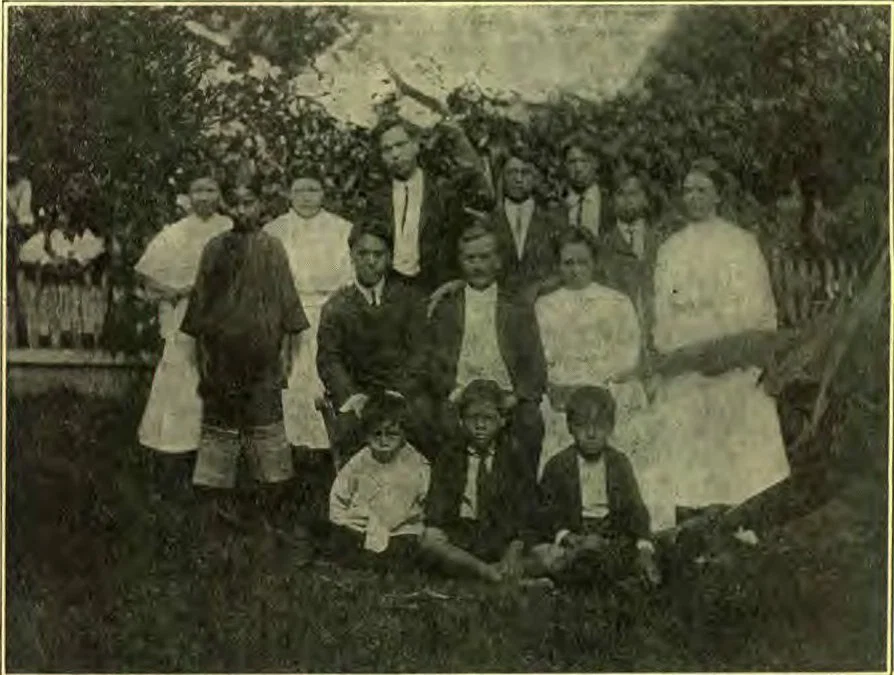
MEMBERS OF ELDER AND MRS. WILLIAMS' BIBLE CLASS AT HONOLULU
The islands have seldom, if ever, experienced cyclones, which are so prevalent in other parts of the mid-Pacific.
The soil, as a rule, is poor, its fertility being confined to the valleys, which are unfortunately limited in extent. Some extinct volcanoes are found in Honolulu, while Hawaii has two of the largest active volcanoes in the world—Kilauea and Mauna Loa. Both in Hawaii and in Maui large tracts of land are clothed with rugged lava with its fresh richness.
Honolulu is also noted for its tropical fruits—cocoanuts, breadfruit, bananas, alligator pears, pineapples, and taro, the last being daily bread for most of the Hawaiians. The prepared form as an article of food is called poi, unknown to most foreigners. It is prepared and eaten in such a manner that appreciation comes rather from actual observation than mere description. Sugar-canes are indigenous growing luxuriantly in plantations in country places.
The scenery of Honolulu is ideal, to say nothing of the other islands. While the day may be breathlessly hot, one is comforted as he anticipates the unfailing coolness of the evening, in which he may rest from a hot day’s labor. The evenness of temperature, the frequent visits of steamers from the Orient and the States, together with the equipment of every modern convenience, make the city quite a summer resort. The Diamond Head, as a monument of inspiration, overlooking the blue deep; the Punchbowl, as its name suggests, before which a bird’s-eye view of the whole city is admirably presented; the Bishop Museum, in which are found a large collection of curious native shells, sea products, and native life in idealized scenes; the Waikiki bathing resorts, where people are energized by the peculiar sea breezes and exhilarated by the salt water,—all these and many others afford an enjoyable visit to the tourist in the Paradise of the Pacific.
Our church here is comparatively small, its membership being only twenty-one. A few weeks ago an impressive baptismal service was conducted by Elder C. D. M. Williams, in which five Chinese young people participated. The regular membership of the Sabbath-school is forty-two, and the average attendance thirty-five. The old church building having been reclaimed by the owner, a tent is pitched temporarily in which to conduct our services until a new building is erected. Although interest in the truth is not shown in any marked degree, we all rest on the promise that God’s word shall not return unto him void, but it shall accomplish that which he pleases, and it shall prosper in the thing whereto he has sent it. And he whose promises are “yea” and “amen” will unfailingly give the increase, if we “faint not” in sowing the seeds of truth.
G. DOANE WONG.

Reliability

As we grow older, we gradually come to the belief that this is the best kind of ability. When we are young, we are fond of Roman candles; but as we get more experienced, we prefer ordinary candles, on the principle that a light in the hand is worth six in the sky. So, too, as civilization matures, reliability becomes of greater importance in the world. The more complicated and delicate the machine, the more essential it is that each wheel shall run true, and each rod be up to its calculated strength of material. The savage may be erratic. The civilized man can not, for he is a cog. The savage can lay off and take a vacation any time he wants to, but the man who runs the dynamo has to be around on time every night without fail. If he does not, he loses his job, and the next job, and the next, until he reforms his habits or gets into some place not yet systematized by civilization, where a little wobbling and lost motion is still permissible. England expects every man to do his duty much more positively in 1906 than she did in 1806.
The preacher grows to have a great respect for the man whom he is sure of seeing in his pew every Sunday morning, and for the woman who he knows will be at the mid-week service.
What the employer values most in his employees is reliability. He wants men he can depend upon to do a certain kind of work at a certain time and in a certain way, and to keep it up. Such steadiness of work does more than anything else to insure steadiness of employment and promotion. It always brings a little more than the market price. The employee puts a similar high value on reliability in his employer, but he is not so well able to enforce his desires.
It is a favorite subject of speculation with classes being graduated from college to test their powers of prophecy by “picking the winners” among themselves. Twenty years later the class roll arranged in the order of success in life is a very different one from that of the class prophet, the chief surprises being that some of the plodders have gone past the runners. The error in the original expectation is usually in underestimating the importance of the factor of reliability. Probably a class list arranged with reference to this alone would be less likely to be upset than one constructed solely on the basis of popularity, wealth, athletic achievement, brilliancy of intellect, fluency of words, or any of the other qualities usually considered. It is a great surprise to smart people to see duller people get ahead of them, just as much of a surprise as to see how much faster four per cent regularly compounded quarterly counts up than ten-per-cent speculative investments. Some very prominent men we know are doing a large business with a small mental capital.
But we must not fall into the common error of thinking reliability is an attribute of mediocrity. If geniuses are more erratic than ordinary people, it is because they are allowed to be. Their gifts make them privileged characters. They can afford to indulge failings that are too expensive for those less richly endowed by nature. All of us ordinary people are eccentric at heart. If we followed out all our impulses, we would qualify for admission to the volume on “The Eccentricities of Genius” with the worst of them. But many great men have been remarkable for their steadiness of purpose, unflagging industry, and continuity of effort, so much so as to give rise to the current definitions: “Genius is an infinite capacity for taking pains,” “genius is simply hard work,” “genius is not inspiration, but perspiration,” and similar semi-truths. It is a question anyway whether the reputation of geniuses for unreliability is not quite undeserved. The artists, authors, and orators we know are quite as much to be depended upon as the office boys, the tailors, and the plumbers of our acquaintance.
At any rate, it is fortunate that a quality of such great importance for success and usefulness, so highly valued in the commercial and industrial world, is within the reach of all of us. It is free, like air and light and water and the other good things of the world. We can not all sing or speak in public or paint pictures or grasp complicated business transactions, but then there is no great demand on us to do any or all these things, while we can all be faithful and dependable in whatever we can do, and for this there is always a great demand. The market is always short of reliable people. It is impossible to overstock it. They are wanted in every calling, legitimate and illegitimate. There are situations open for reliable workmen, reliable lawyers, reliable governors, reliable generals, reliable husbands.—Editor of the Independent.

A Love That Gives Zeal

WHEN the love of God takes full possession of a man, his words set on fire those who listen. Dr. Duff, one of the most noted of Scotch foreign missionaries, had spent twenty-five years in India, doing a grand work among the heathen. He came back broken down in health by his arduous labors. He was called to speak before the General Assembly in Edinburgh, appealing for men for the foreign field. After he had spoken for a while, he fainted from exhaustion. It took a long time to bring him back to consciousness. Then he roused himself and said: “I did not finish my speech; carry me back and let me finish it.”
The doctors told him that it would be at the peril of his life. But the old hero answered, “I will do it if I die.”
So they carried him back, and as he appeared again in Assembly Hall, every person sprang to his feet. When he again faced the great audience, he said:—
“Fathers and mothers of Scotland, is it true that you have no more sons to send to India to work for the Lord Jesus Christ? The call for help is growing louder and louder, but there are few coming forward to answer it. You have the money put away in the bank, but where are the laborers to go into the field? When Queen Victoria wants men to volunteer for her army in India, you freely give your sons. But when the Lord Jesus Christ is calling for laborers, Scotland is saying, ‘We have no more sons to give.’”
Turning to the president of the Assembly, he said:—
“Mr. Moderator, if it is true that Scotland has no more sons to give to the service of the Lord in India, although I have lost my health in that land and have come home to die, if there are none who will go and tell those heathen of Christ, then I will be off to-morrow, to let them know there is one old Scotchman who is ready to die for them. I will go back to the shores of the Ganges, and there lay down my life as a witness for the Son of God.”
This envelope, used in ordinary correspondence in New Zealand, is startlingly suggestive of the evils of the drink habit.
“Thou shalt love the Lord thy God with all thy heart, and thy neighbor as thyself.”—Sophia Bronson Titterington.

Uncle Sam’s Smallest Piece of Real Estate

THE tiniest piece of landed property owned by the United States is a wee island in the very heart of the Pacific Ocean, appropriately called Midway. Though Midway (first named Brooks Island, in honor of Capt. N. C. Brooks, of the United States Navy, its discoverer) has been in the possession of the United States since 1859, very few persons had heard of it prior to June of 1903. At that time the cable ships “Anglia” and “Colonia” landed there for the purpose of making it a repeating station on the cable line that now stretches from San Francisco to Manila, one of the greatest enterprises that has marked the new century. On this submarine telegraph line, known as the Commercial Pacific Cable, there are three intermediate or repeating stations — Honolulu, Midway, and Guam.
It is stated that another reason why Midway received its present name was because at the time it was discovered by Captain Brooks and his men, it was thought to be just half-way around the world, from Greenwich. Later investigations, however, have proved this to be incorrect. Midway, a recent report tells us, “lies about two and a half degrees from the one hundred and eightieth meridian.” It is situated a little more than twelve hundred miles southwest of Honolulu, and in about the same latitude as Galveston, Tex.
For some time after the discovery of Midway considerable fun was made at the expense of the United States with reference to this tiny island possession. Our government really had no use for it. At first it was thought it might serve as a coaling station for the ships of the Pacific Mail Company; but when it was learned how dangerous were the reefs surrounding the island, forbidding the near approach of large vessels, this project was abandoned. Thus for years the island, looking to ships at sea like a rope of glistening sand against the horizon, remained uninhabited save by the sea fowls and certain hardy Japanese fishermen, who resorted there from time to time to net fish and to slaughter large numbers of the birds, the wings of which had ready sale in Yokohama. Then all at once the company engaged in laying the Pacific cable saw the advantage of Midway as a repeating station.
Prior to the coming of the cable ships “Anglia” and “Colonia,” which had sailed from London to Manila by way of the Suez Canal April 10, the steamer “Hanalei” was dispatched to the island, having on board a company of fifteen operators and employees of the Pacific Cable Company. This little band was to form the first permanent inhabitants of Midway. The “Hanalei” reached Midway in the early morning of April 29, 1903. As soon as it was daylight, the men were up, and, seeking the deck, eagerly strained their eyes in the direction of their new home. The desolate stretch of white sand, we may believe, did not give them any pleasurable emotions.
Lumber had been brought with which to erect suitable buildings. To their joy the men found that by digging deep enough they could get a supply of fresh water; otherwise life on this tiny island, far away in mid ocean, would have been a serious problem.
They found countless numbers of birds, and some of them so tame that they allowed the men to handle them at will. The albatross and other large sea fowl made themselves quite at home, even invading the cabins of the operators. One built her nest in the corner of a door-step. Several times during a game of golf the birds approached so near that they were struck by the balls.
On June 3 Lieutenant Rodman, of our navy, who had been appointed governor of Midway, arrived at the island. With his coming a stop was put to the wholesale slaughter of birds, which had been carried on for so many years by certain Japanese. He kindly told the Japanese that the island was under the control of the United States, that he had been sent to take charge of it, and that the slaughter of birds must cease. There were upward of thirty Japanese on the island at the time; and when they went away, they took away with them thousands of stuffed birds, as well as countless numbers of wings of birds that had been sacrificed for this purpose alone.
The cable ship “Anglia” reached the island on June 16, and the “Colonia” two days later, the former having laid the cable from Manila to Guam and the latter from Guam to Midway. They were now ready to begin the laying of that portion of the line that reaches from Midway to Honolulu.
The coming of the cable ships was hailed with much joy by the little colony on the island. It was like a glimpse of the outside world. In addition to the friends aboard, the vessels brought newspapers and letters. There was also the feeling that very soon the last mile of the cable would be laid, and that the lonely little band on Midway would have a “talking intercourse,” at least, with the rest of the world.
By July 3 the “Anglia” had the cable laid to Honolulu, thus completing the circuit across the Pacific, requiring upward of eight thousand miles of cable. The following day, July 4, was a memorable one in the history of the Pacific Cable Company, for on that day President Roosevelt opened the line by sending the first message across the wires. It was to Governor Taft, of Manila.
Although Midway is usually spoken of as one island, it is really a group of three as tiny ones as can be found anywhere in the world. The largest of these is Sand, or Western, Island, on which are erected the buildings occupied by the employees of the Cable Company. It is no more than a mile and a half in length by three quarters of a mile in breadth. Its highest point is a sand hillock about forty feet above sea-level, though the buildings of the cable station are on a somewhat level spot no more than eight feet above the water line. The only verdure is a few thin stretches of stunted bushes. The other islands of the group are Eastern Island and Middlebrook, the latter island the tiniest of the three, and no doubt the tiniest island in the world.
A jagged coral reef almost entirely encircles the island, and thus prevents the near approach of vessels even of medium tonnage. Schooners and other small craft have to be used in transporting men and supplies between the large vessels and the island. This reef, however, which is five feet high and from twenty to twenty-five in width, is a blessing as well as a menace, since it guards the island from the ocean. Without its protection, the great waves would break over the island, completely submerging it. The whole surface of the island is a shifting floor of powdered coral, which shines with a dazzling whiteness in the sun’s rays, highly injurious to the eyes. The inhabitants of Midway have long since learned to use goggles.
The colony on Midway now numbers fourteen — twelve men and one woman, who is the wife of Mr. B. W. Colley, the superintendent, the fourteenth member being Don, the shepherd dog. It is, indeed, a dreary, lonely life they lead, far away from the regular routes of vessels, visited only now and then by a supply ship, and getting the mail from home perhaps twice a year. Yet, strange to say, this little colony, hundreds and hundreds of miles away, knows the news of the world before we do. When we are reading it fresh in our newspapers each morning, it is old news to them. A large portion of the press dispatches concerning the war between Japan and Russia, which were daily transmitted to us from the far East, passed through the hands of the cable operators on this lonely little island in mid ocean.—Annie M. Barnes.

My Foster-Land

How glorious is my foster-land! A land of sparkling, crystal fountains; A land of lofty, snow-clad mountains,— Like Titans all, they proudly stand. When falls the sunshine’s radiance tender, Ten thousand hills are bathed in splendor; When cloud-shapes o’er the fair skies loom, Ten thousand vales are wrapt in gloom!
How glorious is my foster-land! Uplifted o’er the foaming ocean, Unmindful of the waves’ commotion, Resisting e’er Time’s wasting hand. When o’er the fields the sunshine’s streaming, This land doth seem a warrior dreaming. How glorious is my Western home, Where riseth Hood’s far-shining dome!
J. FRED SANTEE.
Ridgefield, Washington.

Chats on Letter-Writing — No. 8

It may not be unprofitable to consider briefly the effects that may be produced by letters upon those for whom they are intended. A letter may have an effect little expected or intended by its writer. This may prove fortunate or regrettable, according to the circumstances; but it is always well to consider what the probable effect of a particular communication may be, or is almost certain to be.
Many instances are on record in which letters have proved the crisis, the turning-point, in the life of the recipient. Hence, we see that the writing of a letter is not a trivial matter, deserving but little attention.
Perhaps the letter reaches our correspondent when he is disheartened, and if the general spirit of the communication is inspiring, it may raise him from his gloomy state, and help him back into the sunlight. The receiver may be in perplexity, and some word of advice, caution, or sympathy may prove the torch that will show the way out, and lighten the reader’s heart. Indeed, we never can be sure in what circumstances, state, or condition the recipient will be; so we should endeavor always to write in such a manner and spirit that our letters will not convey an atmosphere of sadness or discouragement, nor suggest unwise and undesirable actions. There is as much power, either for good or for evil, in a letter, as in speech; and we should be as careful and guarded with the former as in the latter. Were this borne in mind more generally, letters would not be written with such indifference to their contents. Greater care would be taken lest some ill-advised statement find its way into them.
It is an excellent plan never to mail a letter without reading it through. Otherwise, slips may be allowed to go unnoticed, which afterward may result in heartache and regret, or even cause much trouble.
So, then, letter-writing imposes a degree of responsibility, which is not to be lightly regarded. A letter is not an insignificant matter, but, if considered as the right kind of correspondence should ever be, it becomes an important, valuable, and fertile source of good, both to sender and to receiver.
It is well also to remember that any letter may prove to be the last we shall ever write. This thought will help considerably in deciding what to put in or leave out, for we would be very careful what we were writing, did we know that it would be our last letter. This is a solemn suggestion, and may be of help in instances where one feels doubtful.
The more care we bestow upon the writing of any letter, the less likely we shall be of falling into error, either as regards imprudence of committing statements to paper, or of making mistakes that we may never be able to rectify.
HENRY W. ROSE.

A Chemical Trick

WHEN we happen to witness a phenomenon which seems to violate natural laws, we are not likely to forget its cause if it is explained to us. The following experiment, which I devised for my students, helped them to understand, as well as to remember, some chemical data.
A white cat, made of flexible pasteboard and imprisoned in a glass jar, is shown to the audience. The lecturer announces that, without opening the jar, or even touching it, he will cause the cat to undergo a zoological as well as a chemical transformation. He takes the support of the jar, and pushes it forward in full view of the students. The change occurs almost instantaneously. The cat takes a rich orange color on which black transversal stripes rapidly paint themselves. The cat has become a tiger.
The whole transformation is produced by emanations of hydrogen sulphid, which is generated in the jar itself without any visible apparatus. The cat has been previously coated with a solution of chlorid of antimony wherever the orange hue was to be produced, and with a solution of basic acetate of lead wherever the black stripes were to appear. Both solutions are colorless. After the coated cat has been introduced in his glass cage, a small piece of pasteboard is placed under the wooden support so as slightly to incline the jar forward. A few decigrams of pulverized sulphid of iron folded in a piece of blotting-paper are deposited behind the cat, on the elevated side of the bottom of the jar. Two or three cubic centimeters of diluted sulphuric acid are dropped with a pipette on the opposite side. When the performer wishes the transformation to take place, he takes the wooden support and pushes it forward as if he wanted to enable everybody to see better what is going to happen. By so doing he suppresses the slight inclination which kept the iron sulphid beyond the reach of the sulphuric acid. The gas is evolved, and the formation of the orange sulphid of antimony and black sulphid of lead takes place in a few seconds.—Gustave Michaud.

Trifles

What will it matter in a little while That for a day We met and gave a word, a touch, a smile Upon the way? What will it matter whether hearts were brave, And lives were true; That you gave me the sympathy I craved As I gave you? These trifles! Can it be they make or mar A human life? Are souls as lightly swayed as rushes are, By love or strife? Yea, yea! A look the fainting heart may break, Or make it whole, And just one word if said for love’s sweet sake, May save a soul.
— May Riley Smith.

Nellie Brown’s Jewels

“Such beautiful jewels as Nellie Brown wears!” said Edith Travers, dreamily.
“Jewels! Nellie Brown!” exclaimed Molly. “Why, Eda, she’s one of the most plainly dressed girls in our school. It’s a shame, too, for she might wear diamonds, if she would.”
“Nellie Brown is the best-dressed girl I know,” said brother Ned. “I don’t know about her jewels.”
“O Ned! What are you talking about?” cried Molly.
“Nellie wears the ‘pearl of great price,’” said mama. “Ned is quite right.”
“Well, I don’t know about that, mama,” said Ned, “but she always looks well, and no one ever knows what she has on. Isn’t that called the perfection of dressing? But come, Eda, tell us about the jewels.”
“Courtesy is one of the jewels. She is just as courteous and polite to the peevish old grandmother as if she were kind and gentle. Then, she treats the street-sweepers as politely as she does you or me. All the servants are very fond of her. ‘She is such a lady,’ they say.”
“Courtesy is a lovely jewel,” said mama. “‘Be courteous’ is one of the commands; but you said jewels, Edith.”
“She has many, I think, mama, but I’ll speak of only one — charity, the twin jewel of courtesy. Only kind, loving words fall from Nellie’s lips. Once when the girls were talking about another of whom they had heard an evil report, she said: ‘Of the dead and the absent speak only in love. We are not obliged to believe an evil against another,’ and I loved her for saying it. When one goes wrong, instead of loading her down with reproaches, she tries to win her back to the right. If all did so, there would be less wrong doing.”—Selected.

The Smoothers of the Way

“She always made things easier,” was the tribute given to a quiet woman not much known outside the four walls of her household and in a charity or two, but who yet left an aching void behind her when she passed away. No one who knew her could help recognizing the simple completeness of the statement. From her husband to her housemaid, every one in the family felt his daily way smoothed and straightened by her tact and system and gentleness. She was a living example of George Eliot’s saying: “What do we live for, if it is not to make life less difficult for one another?”
To some girls and women perhaps this seems a small end to live for. Yet that it is so often approached makes the hope and the happiness of home. Life is increasingly difficult, increasingly complex, in many communities to-day. The husband, the children, the friends, of the woman who “makes things easier,” more and more rise up and call her blessed. Her work is worth living for, because it continually makes every life within its influence seem better worth living. And when she is gone—how rugged the way, how heavy the burden, without her gentle ministry! We hear a great deal nowadays about the “superfluous” woman. Some branches of woman’s work may be overcrowded; but never, never, surely, the high vocation of the smoother of the way.—Harper’s Bazar.

Women Newspaper Sellers in Spain

“WOMEN sell newspapers on the streets of the cities of Spain, there being no newsboys in that country.”

Weekly Study Program

OPENING EXERCISES:—
Song.
Brief Scripture Reading.
Song.
BIBLE TOPIC: Ministering unto Others.
BIBLE READING:—
What was the mission of Jesus to this world? Matt. 20: 28.
How did he minister once in the home of Peter? Mark 1: 29-31.
At what time were many brought to him? Verse 32.
How did he minister to those who came to him? Verses 33, 34.
How did he prepare himself for his daily work? Verse 35.
Is Jesus as willing to help us now as to help the people at that time? Heb. 13: 8.
Whom did he come to help? Isa. 61: 1-3.
BOOK STUDY: “Ministry of Healing,” pages 29-50.

Topics and Questions

1. MINISTER TO THE PEOPLE:—
State the result of healing the mother of Peter’s wife. Page 29.
To what did Jesus endeavor to especially turn the minds of the people? Page 31, first paragraph.
Did he seek the world’s homage? Last paragraph.
What contrast appeared in the life of Christ and that of the Pharisees? Page 32.
2. HIS GLORY MANIFESTED:—
What question was asked him? How did he reply? Page 34.
What message did he send to John the Baptist? Page 35.
What are Christ’s followers to be? Page 36, third paragraph.
With what are believers endowed through the gift of Christ? Page 37, first paragraph.
To what extent can we be used in his work? Last paragraph.
3. WILL GATHER THE LAMBS:—
What attention did Jesus give to the children? Page 38.
What special instance is related? Page 41, first paragraph.
Has Jesus changed since he left the world? Last paragraph.
What encouragement is given mothers? Page 42, first and second paragraphs.
What did Jesus see in the children brought to him? Third paragraph.
4. THE BARLEY LOAVES:—
What command did Jesus give concerning the multitude? Page 45, second paragraph.
State Philip’s answer. Third paragraph.
Who alone of all present had food? Last paragraph.
What did Jesus design to teach through this miracle? Page 47, second paragraph.
What lesson was taught from the command to gather up the fragments? Page 48, first paragraph.
What is the means of communication between Christ and his people? Page 49, first paragraph.
How can we help the suffering? Third and fourth paragraphs.

Notes

The chapter outlined for study each week from “Ministry of Healing” should be carefully read during the week. A few suggestive questions are asked, but many others equally important will naturally suggest themselves.
It will be necessary for each member of the Society to bring his Bible with him to the weekly meeting. If you do not own a Bible of your own, buy one.
G. B. T.

What the Children Are Doing

I AM sending you an outline of what the little people are doing in the Sabbath-school at Washington, Pa., to increase their Sabbath-school donations. Some time ago the superintendent gave the children five cents apiece, and each one was asked to see how much he could cause it to increase. One little boy bought the Sunday paper, and in four Sundays made two dollars. Another is selling beeswax. One is blacking shoes; and a little girl is selling lead-pencils, and when she has sold enough, she is going to buy a sack of flour.
The membership of this little school is twenty-seven, and their donations to missions the last quarter was $27.50. They have adopted the plan of sending all to missions. They say this coming quarter they want to have fifty dollars to send to missions.
FANNIE FONDERSMITH.

Courage: A Verse on Trusting the Way

“Courage! faint heart, be brave, be bold. What if thy way be dark and cold, So it but lead thee to the fold?”

A Working Society

OUR Society was organized September 8 of this year, but I thought a report of our beginning might be interesting to others.
We have fifteen members, five of whom are married, and three are less than twelve years of age. Our officers are but little past childhood, but are making a good beginning; one is fifteen, one fourteen, and one twelve.
Our resolve is to bring this entire Reservation into the truth. Will not some Society kindly supply us with papers and tracts for distribution to help in this resolve? Since our organization, we have invited people to meetings every time we met them. We have given four hundred and sixty-nine verbal invitations to church and Sabbath-school; distributed three hundred and sixteen copies of The Family Bible Teacher, and given away seven hundred and fifty-five papers, including the Signs, INSTRUCTOR, Little Friend, and Review. We have also given away one hundred and fifty tracts. So far three conversions can be traced to the work of our Society.
Our members are all learning to take charge of meetings and to lead in prayer. Even the youngest have taken part in prayer.
Our programs consist of singing, reports of missionary work, a Bible reading, selections from our denominational papers or books, sometimes a talk on some topic of interest, relating experiences in meeting people with papers, and prayer. Our outline for work is as follows: Invite people to meetings; distribute The Family Bible Teacher; give away papers; give away tracts and leaflets; loan or sell our denominational books whenever possible; read as many of our books as we can buy or borrow; make missionary visits; write missionary letters; get new pupils for school and Sabbath-school. We have succeeded in nearly doubling the attendance at Sabbath-school already.
We like to see the reports from other Societies, as they urge us on to better work, and give us ideas we might not otherwise gain.
KANYENGAH SOCIETY.
Six Nations' Indian Reserve, Ontario.

Bible Questions from Africa

THE following persons sent in answers to the twenty questions that appeared in the INSTRUCTOR dated Oct. 2, 1906:—
Elmer Anderson Mrs. S. A. Orcutt
Edythe G. Manby Ella Verney
Anna Grundset Bessie Stanfield
Florence Hoxie Ruth Beebe
Zella Schmaltz Harold O. Lewis
Willie Herrell Lawrence Northrup
Donald Nowlen Ilone Bennett
May Nowlen Lizzie Bennett
Welcome Laing E. A. Laive Esterby
Meda Laing C. P. Clark
Glen Willhelm Bessie Woodruff
Esther Renstrom Minerva Wammack
Eva Sammer Vesta Sammer
Lou Smith Lewis R. Wammack
Norah V. Boyle Mildred Weick
Fannie Stanford Frank Bennett
Iva Dean Clarence Edwards
Annie M. Stone Lawrence Edwards

Tithing

1. What is the tithe?
“And concerning the tithe of the herd, or of the flock, even of whatsoever passeth under the rod, the tenth shall be holy unto the Lord.” Lev. 27: 32.
2. To whom does this tenth belong?
“And all the tithe of the land, whether of the seed of the land, or of the fruit of the tree, is the Lord’s: it is holy unto the Lord.” Verse 30.
3. How were the people of Israel to use the tithe?
“And, behold, I have given the children of Levi all the tenth in Israel for an inheritance, for their service which they serve, even the service of the tabernacle of the congregation. . . . But the tithes of the children of Israel, . . . I have given to the Levites to inherit.” Num. 18: 21-24.
4. How are the ministers of to-day to be supported?
“Do ye not know that they which minister about holy things live of the things of the temple? and they which wait at the altar are partakers with the altar? Even so hath the Lord ordained that they which preach the gospel should live of the gospel.” 1 Cor. 9: 13, 14.
5. What does the Lord say people do who withhold their tithe?
“Will a man rob God? Yet ye have robbed me. But ye say, Wherein have we robbed thee? In tithes and offerings.” Mal. 3: 8.
6. What is pronounced upon those who rob God?
“Ye are cursed with a curse: for ye have robbed me, even this whole nation.” Verse 9.
7. What promise is made to all who bring their tithes to the Lord’s treasury?
“Bring ye all the tithes into the storehouse, that there may be meat in mine house, and prove me now herewith, saith the Lord of hosts, if I will not open you the windows of heaven, and pour you out a blessing, that there shall not be room enough to receive it. And I will rebuke the devourer for your sakes, and he shall not destroy the fruits of your ground; neither shall your vine cast her fruit before the time in the field, saith the Lord of hosts.” Verses 10 and 11.
EMMA S. NEWCOMER.

Heaven Given Away: Reflections on Free Grace

“’Tis only heaven that is given away, ’Tis only God may be had for the asking.”
Continue reading: The Value of Small Things