“Didn’t I hear you say that such a little thing couldn’t amount to much?” asked Uncle Ben, as he came into the sitting-room where Roy and Bud were engaged in an earnest conversation.
“Yes, uncle,” replied Roy, “I was just trying to talk Bud out of a motion he has in his head. I say such little things waste too much valuable time.”
“Ah, they do, you think,” replied their uncle, smiling, as he took a chair near the window. “Just let me tell you a few little things which counted, and more than made up for the time used in planning them. You see this rubber erasing tip on the end of this pencil, do you not?” continued Uncle Ben, taking a lead-pencil from his inside pocket.
“Yes, sir,” responded the boys, looking a little surprised.
“Very well. The New Jersey man who hit upon the idea of putting this tip to the lead pencils is worth two hundred thousand dollars. It all came from this little idea.”
“You don’t mean it, uncle?” exclaimed Roy.
“Indeed I do, my boy,” said Uncle Ben. “Yes, and furthermore, the man who thought of the6metal plates that are used to protect the heels and soles of rough shoes realized two hundred and fifty thousand dollars in ten years from it, while the inventor of the roller-skate has made one million dollars from his invention. The man who made the returning ball—the little ball with the rubber string—didn’t think he would ever become a millionaire by so small an invention; and the minister in England, who made an odd toy that danced by winding it with a string, didn’t realize the value of small things until he was five hundred thousand dollars richer by his small idea. I tell you, boys, it always has been, and always will be, the little things that count for most in this life.”—Violet St. Johns, in Boys and Girls.
A School in Far-Off Japan
By Edison Driver
If you will use your paints and brushes and color the round space in this little flag a bright red, you will have, as my Japanese friend told me, a true representation of the flag that floated so proudly over the strange little school he attended as a child far-away in Japan.
“I will not try,” he said to me, one day, “to tell you the whole of the ways we do in our school, for they are too many; but something about a few of them will perhaps be strange and interesting to you who have gone only to American schools.
“At the door of my school I take off my shoes, before I enter, and I must leave the shoes there, just as American children leave their rain-shoes outside. When I walk inside, there is no ‘stamp, stamp,’ of heavy shoes, but just the soft ‘pat, pat,’ of the stockinged feet.
“But do not think for a minute that there is no noise; for every child in that whole room, sitting there on the floor, is reading aloud with all his might. And what a din it is! The louder every one reads, the better the teacher likes it, for it tells him that they are all hard at work, and will have good lessons by and by; and just as soon as a boy or girl stops reading, his quick ear knows it, and he calls upon that one to study. So when a boy gets tired of his dull lessons and wants to play, or catch flies, or draw funny pictures of his teacher, he can not stop reading, but instead remembers part of the words and repeats them over and over while he is at play.
“By and by the teacher calls me up to recite, but I do not look at him—oh, no, indeed! for I must bow and then stand respectfully with my back to him, and read over what I have been studying in my place on the floor. When I have finished, I go back to my place of study, and my little comrades, one by one, take my place by the teacher.
“We had no pencils or pens with which to write when I was at school, but instead we had little brushes, so that we could paint our figures and words. The paint comes in a little hard black stick, which we have to rub in a dish with a few drops of water until some of it, mixing with the water, makes good black ink. To learn how to make the ink exactly right, and how to use the fine little brush, is one of the important things we have to learn.”
“And do you have to learn an alphabet, as the American children do?” I asked.
“Yes, we do,” he replied; “for we have forty-seven letters that we must learn, and besides this there are a great many other word and sentence characters. It takes us a very long time to learn so many, and some of the word and sentence signs are never learned at all by the common people.
“Now the Japanese are famed for their politeness; and that is because we are trained to it all our lives. When we enter school in the morning, we must bow to the teacher, and we bow again when we leave in the afternoon, and many times between. We do not mind it, for it comes natural to us. We say ‘thank you’ or ‘please’ a hundred times where American boys would not say it once, perhaps. And so we are taught always to be kind and polite, and when we grow old and go to other lands, people say, ‘How polite he is!’”
“The children of Japan are said to receive more love from their parents than those of any other nation, and American writers have said that the children of Japan are the happiest children in all the world.
“I do not think that saying is true of the Japanese,” continued my friend, “at least when they grow to be older than mere children; for we have not Jesus and the knowledge of him there as you have here, and I know for myself that it requires Jesus to make any one really and lastingly happy.”
EDISON DRIVER.
“Please, Sir, I Would Rather Not”
By E. Payson Hammond
An old sailor tells the following story of a boy who suffered much in resisting temptation:—
“When offered a drink, the lad said, ‘Excuse me; I would rather not.’
“They laughed at him, but they never could get him to drink liquor. The captain said to the boy, ‘You must learn to drink grog if you are to be a sailor.’
“‘Please excuse me, captain, but I would rather not.’
“‘Take that rope,’ commanded the captain to a sailor, ‘and lay it on; that will teach him to obey orders.’
“The sailor took the rope, and beat the boy most cruelly.
“‘Now, drink that grog,’ said the captain.
“‘Please, sir, I would rather not.’
“‘Then go into the foretop and stay all night.’
“The poor boy looked away up to the masthead, trembling at the thought of spending the night there, but he had to obey.
“In the morning the captain, in walking the deck, looked up, and cried, ‘Hallo, up there!’
“No answer.
“‘Come down!’
“Still no answer.
“One of the sailors was sent up, and what do you think he found? The poor boy was nearly frozen. He had lashed himself to the mast, so that when the ship rolled, he might not fall into the sea. He brought him down in his arms, and they worked upon him until he showed signs of life. Then, when he was able to sit up, the captain poured out some liquor and said: ‘Now, drink that grog!’
“‘Please, sir, I would rather not. Let me tell you why, and do not be angry. In our home in the cottage we were so happy, but father took to drink. He had no money to get us bread, and at last we had to sell the little house we had lived in, and everything we had, and it broke my poor mother’s heart. In sorrow she pined away—till, at last, before she died, she called me to her bedside, and said: “Jamie, you know what drink has made of your father. I want you to promise your dying mother that you will never taste drink. I want you to be free from that curse that has ruined your father.” ‘O, sir,’ continued the little fellow, ‘would you have me break the promise I made to my dying mother? I can not, and I will not do it.’
“These words touched the heart of the captain. Tears came into his eyes. He stooped down, and, folding the boy in his arms, said: ‘No, no, my little hero! Keep your promise, and if any one tries again to make you drink, come to me, and I’ll protect you.’”—E. Payson Hammond.
The Man in the Boy
In the acorn is wrapped the forest,
In the little brook, the sea;
The twig that will sway with the sparrow
to-day
Is to-morrow’s sturdy tree.
There is hope in a mother’s joy,
Like a peach in its blossom furled;
And a noble boy, a gentle boy,
A manly boy, is king of the world.
The power that will never fail us
Is the soul of simple truth;
The oak that defies the stormiest skies
Was upright in its youth:
The beauty no time can destroy
In the pure young heart is furled;
And a worthy boy, a tender boy,
A faithful boy, is king of the world.
The cub of the royal lion
Is regal in his play;
The eaglet’s pride is as fiery-eyed
As the old bird’s, bald and gray:
The nerve that heroes employ
In the child’s young arm is furled;
And a gallant boy, a truthful boy,
A brave, pure boy, is king of the world.
— Selected.
Biggest Bug in the World
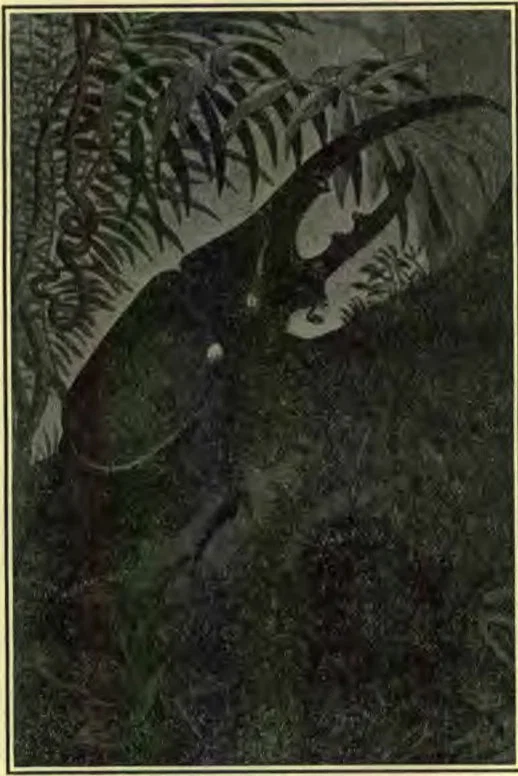
To the Hercules-beetle, a giant among insects which is found in certain portions of Central and South America, as well as in the island of Dominica, one of the British West Indies, belongs the distinction of being the “biggest bug” in the world. In appearance this creature is anything but prepossessing.
It is a common trait of tourists and travelers to make little of anything seen in foreign lands, especially in the little West Indian Islands, and to declare that similar things of greater size or better quality occur in their home land. When they run across the Hercules-beetle, however, they are obliged to acknowledge themselves beaten.
Although so formidable in appearance, this insect is perfectly harmless. It lives in the heavy forests, and feeds on the sweetish sap or gum of native trees. The larva, or grub, is about four inches long and as thick as a man’s thumb. It is considered a delicacy by the native negroes and Caribs, who roast it in hot ashes, and say that it tastes like roasted nuts.
Clumsy in appearance, the Hercules-beetle possesses great power of flight, and in the outlying villages it is not uncommon for one of these huge creatures to enter the native houses, being attracted thereto by the light. The invariable result is a prompt extinguishing of the candle by the wind created by the beetle’s buzzing wings, accompanied by screams of the inmates of the house, who imagine a jumble, or evil spirit, has invaded their dwelling.
A popular belief among the natives is that the Hercules-beetle saws off limbs of trees by grasping them between the two horn-like appendages and flying round and round. This is a manifest impossibility, as the insect has but little power in the horns; and, moreover, the upper one is lined with soft, velvety hair, which would rub off by friction.—Searchlight.
The Errors of the Educated
Mrs. I-know-it-all.—Our French teacher will be back next week, and I suppose we shall have to organize our class for the season.
Mrs. Up-to-date.—I hardly think that I shall join the class this year, for I really feel that I should study English instead; and I haven't time for both studies.
Mrs. I-know-it-all.—Study English! How absurd! Pardon me; but you speak as correctly as I do, and I can detect the slightest error in another's speech. I am sure that you never use bad grammar.
THE HERCULES BEETLE
Mrs. Up-to-date.—Thank you; but I know that I do not merit your compliment, for although I have given the subject of English much attention, I now see that I am only on the threshold, so to speak, of an understanding of what constitutes correct diction.
Mrs. I-know-it-all.—You ought not to feel that way about it. For my part, I should feel very badly if I thought that I needed the magazine to which you refer. After devoting all the time that we did to grammar when in school, it would be discouraging indeed to think we needed to continue the study now. It is certainly no use to take up English after one leaves school, providing, of course, that one has had the right kind of a teacher.
Mrs. Up-to-date.—Oh! you know, in school we study grammar, but we do not pay much attention to the application of its rules and principles. Then, again, there are many objectionable forms of diction to which no reference whatever is made in any text-book on grammar.
Mrs. I-know-it-all.—Yes; but if grammar does not compass all points involved in correct diction, rhetoric certainly supplements the rules of grammar, so that the ground is completely covered.
Mrs. Up-to-date.—You are right so far as general rules and principles are involved; but we must not forget that these rules and principles are, after all, only general in their application, and that unless we study words, individually, we can never learn how to speak and write correctly.
Mrs. I-know-it-all.—I wish that you would explain your meaning. I don't hardly think I understand you.
Mrs. Up-to-date.—It is like this. As we both know, there is a rule in rhetoric, under Precision, that requires the use of the word that shall best express the meaning; but in order to conform to this rule, one must study words and their uses. Now, no text-book on either grammar or rhetoric can cover this phase of the subject,—the right word in the right place; and in this respect, I find the magazine Correct English most helpful, for it is continually telling us what to say and what not to say.
Mrs. I-know-it-all.—Notwithstanding your enthusiasm, I shall still feel that if one has had a collegiate education,—has studied both grammar and rhetoric under excellent teachers,—and if in addition to this, one's associations are with cultured people, one will be liable to use correct English at all times.
There's Plenty to Do in This World
“There’s plenty to do in this world of ours: There are weeds to pluck from among its flowers; There are fields to sow; there are fields to reap. There’s an ensign to plant on the heights by the sea; There’s work for the millions—for you and for me.”
A Wise Crow
IN a town in Indiana is a year-old crow, jet black, which has been raised in a family, and has become quite human in many of its ways. It can speak a large number of words, and is very fond of the children. It follows them to school, and when they enter, it will perch near the door, shouting after them the injunction, “Now be right good, and come home as soon as school is out.” It does not follow its own advice always, but will sometimes linger around the school building, flying from window-sill to window-sill.
At other times it will go home and play with the cat and dog and with the chickens. It knows every chicken, and is fond of frightening away strange chickens when they come to the house. At night it roosts with the chickens.
Whenever it sees the master or mistress of the house, it gives the pert greeting, “Hello, pa!” or “Hello, ma!”—Round Table.
XI — Signs of His Coming
(December 15)
MEMORY VERSE: “Watch ye therefore, and pray always, that ye may be accounted worthy to escape all these things that shall come to pass, and to stand before the Son of man.” Luke 21:36.
REVIEW: As Jesus sat on — the — asked him —. Jesus told them to take heed lest —. He answered their question by telling them that —. Joel says of the same signs —. The sun was darkened —. Noah Webster says —. The moon looked like — the night —. These signs were given — years ago. The stars fell —. This remarkable sign could be seen —. As the stars fell, they looked like —. Many thought — had come. If Jesus tarries after the signs appear, he tells us to —.
Questions
What will be the condition of the nations in the last days? Luke 21:25, 26.
What is said of the sea? For what will men be looking? How did they feel?
For what will the nations prepare? Joel 3:9-13. What will they do with their plows and pruning knives?
At what time will all this take place? Verse 13. When does the harvest come? Matt. 13:39.
Why will the last days be perilous? 2 Tim. 3:1-5. What sins will be common among men? What will they love more than God?
To what time did Jesus compare the last days? Matt. 24:37-39. What were people doing then? Was it wrong to do those things? Did they know the flood was coming? Why not?
To what other time are the last days compared? Luke 17:28-30. How did the people of Sodom spend their time? Were they warned that Sodom would be destroyed? What lesson should we learn from their history?
What parable did Jesus give in reference to his coming? Luke 21:29-33.
When we see leaves appearing on the trees, what do we know? How may we know when the coming of the Lord is near?
What will not pass away till all is fulfilled? How sure are the words of Christ concerning this matter?
What should we do that we may be ready for the coming of the Lord? Luke 21:34-36. How will that day come to some?
What caution is given that we be not taken in the snare? For what should we be watching? For what should we pray?
Lesson Story
After giving the signs that would appear in the sun, moon, and stars, Jesus said that upon the earth there would be perplexity, the sea and the waves would roar, and men’s hearts would fail them for fear, and for looking after those things which are coming on the earth.
Joel says of this time: “Proclaim ye this among the Gentiles: Prepare war, wake up the mighty men, let all the men of war draw near; let them come up: beat your plowshares into swords, and your pruning-hooks into spears: let the weak say, I am strong. . . . Put ye in the sickle, for the harvest is ripe: come, get you down; for the press is full, the fats overflow; for their wickedness is great.” Joel’s prophecy applies in the last days, for Jesus said, “The harvest is the end of the world.”
“This know also, that in the last days perilous times shall come. For men shall be lovers of their own selves, covetous, boasters, proud, blasphemers, disobedient to parents, unthankful, unholy, without natural affection, truce-breakers, false accusers, incontinent, fierce, despisers of those that are good, traitors, heady, high-minded, lovers of pleasures more than lovers of God.”
“But as the days of Noah were, so shall also the coming of the Son of man be. For as in the days that were before the flood they were eating and drinking, marrying and giving in marriage, until the day that Noah entered into the ark, and knew not until the flood came, and took them all away; so shall also the coming of the Son of man be.”
“Likewise also as it was in the days of Lot; they did eat, they drank, they bought, they sold, they planted, they builded; but the same day that Lot went out of Sodom it rained fire and brimstone from heaven, and destroyed them all. Even thus shall it be in the day when the Son of man is revealed.”
“Now learn a parable of the fig tree: When his branch is yet tender, and putteth forth leaves, ye know that summer is nigh: so likewise ye, when ye shall see all these things, know that it is near, even at the doors. Verily I say unto you, This generation shall not pass, till all these things be fulfilled. Heaven and earth shall pass away, but my words shall not pass away.”
“And take heed to yourselves, lest at any time your hearts be overcharged with surfeiting, and drunkenness, and the cares of this life, and so that day come upon you unawares. For as a snare shall it come on all them that dwell on the face of the whole earth. Watch ye therefore, and pray always, that ye may be accounted worthy to escape all these things that shall come to pass, and to stand before the Son of man.”
The Books of the Bible
If you can not repeat the names of the books of the Bible in order, why not learn them now?
Old Testament
Genesis
Proverbs
Exodus
Ecclesiastes
Leviticus
Song of Solomon
Numbers
Isaiah
Deuteronomy
Jeremiah
Joshua
Lamentations
Judges
Ezekiel
Ruth
Daniel
1 Samuel
Hosea
2 Samuel
Joel
1 Kings
Amos
2 Kings
Obadiah
1 Chronicles
Jonah
2 Chronicles
Micah
Ezra
Nahum
Nehemiah
Habakkuk
Esther
Zephaniah
Job
Haggai
Psalms
Zechariah
Malachi
New Testament
Matthew
2 Thessalonians
Mark
1 Timothy
Luke
2 Timothy
John
Titus
The Acts
Philemon
Romans
Hebrews
1 Corinthians
James
2 Corinthians
1 Peter
Galatians
2 Peter
Ephesians
1 John
Philippians
2 John
Colossians
3 John
1 Thessalonians
Jude
The Revelation
XI — The Ministry
(December 15)
MEMORY VERSE: “For we are laborers together with God.” 1 Cor. 3:9.
2. With whom is he a colaborer in this great work? Verse 19; 2 Cor. 6:1.
3. What does the faithful minister thus become? 2 Cor. 5:20.
4. What message does he carry to the people? Verses 20, 21.
5. From what source alone may he have grace to do this work effectually? Verse 14.
6. How should he stand before his flock? 2 Cor. 6:3.
7. Name some of the characteristics that will mark the true minister. Verses 4–7.
8. How will the every-day trials of life affect him? Verses 8–10.
9. How will he handle the Word of God? 2 Cor. 4:2.
10. What alone will he preach? Verse 5.
11. What is the source of his light? Verse 6.
12. Why does he have this treasure in earthen vessels? Verse 7.
13. What confidence encourages him in his work? Verse 14; note 1.
14. What is the constant experience of the true minister? Verses 16, 17.
15. Only on what conditions is this true? Verse 18; note 2.
Notes
1. He who preaches should not only believe what he teaches, but should conscientiously practise the same. The most effectual way of preaching is by practising. Rom. 2:21–23.
The teaching of Christ was the expression of an inwrought conviction and experience, and those who learn of him become teachers after the same divine order. The word of God, spoken by one who is himself sanctified through it, has a life-giving power that makes it attractive to the hearers, and convicts them that it is a living reality.—“Desire of Ages,” page 142.
2. While these scriptures apply especially to the minister of the gospel, not one believer is excluded. To each one, young and old, has been given the ministry of reconciliation. Every promise in our lesson to-day is just as much the promise of the most humble believer as of the most successful minister, if he takes God at his word.
The Letter Box
LOS ANGELES, CAL., Oct. 20, 1906.
DEAR EDITOR: This is my first letter to the INSTRUCTOR. I like to read the paper very much. I will be twelve years old in March. I am in the seventh grade at church-school. We have been in California about three months. My father does not keep the Sabbath. I have one brother in the Philippine Islands. He is a soldier, and has been converted by reading his Bible. I attend a large Sabbath-school.
MARIE THAYER.
DAYLIGHT, TENN., Oct. 27, 1905.
DEAR EDITOR: This is my first letter to the YOUTH’S INSTRUCTOR. I was twelve years old last June. I have a sister seventeen and a brother twenty-three.
We go six miles to church, so can’t go every Sabbath. We came here three months ago, from North Yakima, Wash. I like it very well, but sister doesn’t. She wants to go back. I had an opossum and a land terrapin for pets, but my “possum” died, and my terrapin has dug down into the ground. Papa says he will come out next spring. I will close with love and best wishes to the editor and the readers of the INSTRUCTOR.
ETHEL E. BURNELL.
Railroad Wrecks, Weather Service, and Gutenberg's Vision
THE Interstate Commerce Commission in its latest accident bulletin, reports 3,103 railroad wrecks for the three months ending June 30, an average of more than one an hour.
Of Justin M’Carthy it has been said that “his mind seems as incapable of harboring an unworthy thought as the soil of Ireland is of harboring a snake.” “Thinketh no evil!”—this is the ideal life for us all.
THE total cost of the Weather Bureau is about $1,400,000 a year, and by careful investigation the annual saving to the people of the United States by the telephone and telegraph weather service is estimated to be $30,000,000. Forty-five minutes after the determination of a storm warning at Washington, it is brought to the notice of every sea captain in every lake and ocean port of the United States.
THE inventor of printing, Johann Gutenberg, desired more than all else that his invention should be used in giving the Word of God to the people everywhere. He said:—
God suffers in the multitude of souls his Word can not reach. Religious truth is imprisoned in numbers of manuscripts which confine instead of spread the public treasures. Let us break the seal of holy things, and give wings to truth in order that she may win every soul that comes into the world by her word, no longer writ at great expense by hands easily palsied, but multiplied like the wind by an untiring machine. From my press shall flow in inexhaustible streams the most marvelous liquor to relieve the thirst of man. Through it God will spread his Word, and a spring of truth shall flow from it.
Many Catholics Apostatizing
DURING the last eight years, 38,031 members of the Roman Catholic Church in Austria have left the mother church and joined the Lutheran or the Calvinistic fold. Various reasons are assigned for this movement away from the Catholic Church, some ascribing it to political reasons, and some to the ignorance of the Catholic clergy. But whatever is the occasion, it shows that there is a dissatisfaction with Rome.
While this great egress is a matter of much concern to the Catholic Church, it should be an encouraging omen to all who have a knowledge of the gospel as it is in Jesus. It should inspire many to step in at this opportune time and give the people the pure Bible truth for the last days.
The Mended Doll
Up the gravel path to the doctor's office trudged a little tot of four years. Under her arm she carried her doll, and in her hand its head. The good-natured doctor, seeing her from his window as she walked demurely down the path, met her at the door, and said: “Well, my little one, what can I do for you to-day?” The child, with a very solicitous look on her little face, replied: “Muvver said you mended arms, and I’se boke my dolly’s head; ’spose you could put it on again?” The doctor asked, as he took the doll, “Wouldn’t a new dolly do as well?” He received a very quick response: “No, no, my Nancy Ann is my bestest dolly; please do make her whole again.” The good doctor therefore at once set about doing the best he could to restore Miss Nancy Ann to her former condition. In a few moments he was able to return her whole again, much to the delight and satisfaction of the little mistress, who began searching through her pockets for the doctor’s fee. At last she produced a penny, and as she handed it to her benefactor, said, “Here’s your pay.” The doctor took a kiss instead of the proffered money, and the happy little maid with her “bestest dolly” marched off for home.
Novel Uses of Electricity
QUILTS for beds, warmed by fine wires inside, through which flows a current of electricity, are now in use. A constant temperature is maintained by a simple regulator, and it has been suggested that personal clothing of the same kind will soon be at the service of invalids and chilly mortals, more especially to make them comfortable on their travels. Another device places an electric heater inside a hot-water bag, thus keeping it at a uniform temperature for sick-room and hospital use.
A Score of Letters Wanted
By Editor
OUR series of articles on Letter-Writing has given many helpful suggestions. Now is the time to begin to put these suggestions into practise. For one month after the series closes, letters from various writers will appear in the different issues of the INSTRUCTOR. Let boys and girls, young men and women, write letters. Do not sign your own name unless you wish to do so; for as many letters as we have space for will be printed with criticism, whether good or ill. Let us hear from some of the students in our schools.
Fifty Novel Uses of Paper
BARLEY, oats, rice, corn, peas, beans, alfalfa, pine-needles, sugar-cane refuse, jute, moss, seaweed, tobacco, lichens, leaves and bark of trees, beets, potatoes, and other equally strange things are now used in the manufacture of paper. The best quality, however, is made from the flax fiber, but the largest amount from wood. The trees yielding the best returns of wood pulp are the poplar, pine, oak, and walnut.
Paper in the form of papier-mâché is now substituted for metal, stone, and wood, while paper fabrics are used for linen, cotton, or silk. Mr. Albert Maire in an article gives the following interesting list of the many uses to which paper is put at the present time:—
With compressed paper are made wheels, rails, cannon, horse-shoes, polishers for gems, bicycles, asphalted tubes for gas or electric wires. With wood pulp and zinc sulphate there has been an attempt, in Berlin, to make artificial bricks for paving. After subjecting them to a pressure of two thousand tons per cubic centimeter they are baked for forty-eight hours. In similar fashion are made roofing-tiles and water-pipes. Telegraph-poles made of rolled sheets of paper are hollow, lighter than wood, and resist weather well.
In Japan they make o paper, clothing, window-frames, lanterns, umbrellas, handkerchiefs, artificial leather, etc. . . . In the United States, and even in Germany, are made paper coffins. In Germany they make paper barrels, vases, and milk bottles.
Straw hats may now be bought into which enters not an atom of straw. They are made of narrow paper strips, dyed yellow. Artificial sponges are made of cellulose or paper-pulp. In England paper matches are commonly used. Mr. Claviez has taken out a patent for paper thread to be used in sewing shoes, and Chardonnet’s artificial silk is made on a basis of paper-pulp.
The use of paper in industry may be indefinitely extended. It is employed to make imitation porcelain, for bullets, shoes, billiard-table cloth, sails for boats, boards for building, impermeable bags for cement and powdered substances, boats, vessels for water. There has even been made a paper stove, which is said to have stood the fire well. Cellulose may be used to prepare a water-proof coating that may be applied like paint. . . . Whole houses have been built of paper; . . . in Norway there is a church, holding one thousand persons, built entirely of it, even to the belfry.
Farthest North
NATURALLY America rejoices over the success of Commander Peary in reaching a point farther north than any other explorer. The Duke of Abruzzi, an Italian, in 1900 achieved the latitude of 86° 34′; while Mr. Peary has reached latitude 87° 6′ north. His unprecedented sledge journey of more than four hundred miles over polar ice and snow fields still leaves him two hundred miles from the pole. But Mr. Peary has not given up his original purpose. He means to stand yet with the north star in his zenith. Though he wins no further laurels, he will ever be known as America’s persevering and plucky explorer, having already made nine polar expeditions.
He is now on his way home. In a recent communication to the Peary Arctic Club, he pronounced the “Roosevelt” a magnificent ice-fighter and sea-boat. There were no deaths nor illness in the expedition; but the men were driven to eating the dogs and musk-oxen.