Your ShelfYour Projects

Signs of the Times, Vol. 24, No. 19.

THE HEALING GOSPEL
Earlier text: The Intense War Spirit

A MILITARY PEOPLE.

The San Francisco Call has this editorial paragraph:—
“The rapidity with which the various States are filling their quotas for the volunteer army is a new proof that while we have commercial habits we are at heart and in spirit a military people. It does not take much to get the average American to leave his plow, his yardstick, or hammer, to get his gun and follow the flag.”
Yes, the present war with Spain is manifesting the fact most significantly that the United States is filled with those who “are at heart and in spirit a military people.” Then where is the long promised “universal peace”? And is it not something of an anomaly, to say the least, for one of the “foremost Christian nations” to be also “at heart and in spirit a military people”? Where is there anything in all the life of Christ that would show Him to be anything else than the Prince of Peace?
Do not lay this war spirit at the door of Christianity. The Gospel commission does not send men into the world to take life, but, like their divine Lord, His followers are to seek to save life. T.

Money Is King

The following parody on the hymn of America, “My country, ’tis of thee,” strays across our path without the author’s name attached:—
“My pocketbook, it is of thee, sweet means of liberty—of thee I sing. I love thy bulging sides, where my loved wad resides. My love in thee abides, great purse, my king!”
It is becoming more and more manifest that money is “king,” not of America alone, but of all the world. And, notwithstanding the boasts of nineteenth-century civilization, all the wars that are talked of to-day are not in the interests of humanity, but of commerce. Even the present United States war with Spain, while it presents its humane side, has a commercial side also. If men would stop scrambling for money that they can never use, should they get it, how much better the world would be off in these times!

Public Officials and Gambling

Public officials, if even only a small part of the newspaper accounts are true, are giving themselves more and more to the various sorts of “sport” which is only a polite way of covering up real gambling. Accounts that certainly are corroborated by the court records are given of several men in public life in San Francisco alone who have recently either been sent to prison or committed suicide because of their failures at the horse-races. They bet on the races and lost; and, hoping to win the next time, they committed frauds in order to bet again. Finally the suicide’s grave or the prison cell is their abode. And the corruption in San Francisco, in this direction of betting on the races, is growing all too common everywhere. These are surely not yet the times of millennial honesty.

Train Robbery and Last-Day Lawlessness

So another passenger train has just been “held up.” This time it is in Texas, and $20,000 were taken by the highwaymen. The ever-increasing crime and generally-growing lawlessness in the world is causing many serious reflections. There should be no mistaking the fact that we are in the “perilous times” of the “last days,” as foretold in Scripture.

England’s Naval Preparations

England is reported to have about one hundred war ships of the various types in preparation. Is it any wonder then that her war department should ask for $127,750,000 to spend on her navy during 1898?

IMPATIENCE.—

One of the marked characteristics of these last days of the nineteenth century is its impatience, its restlessness, its discontent.—Rev. Frank L. Phalen, Congregationalist, Louisville, Ky.

CHRYSANTHEMUM

It was away down south, in a little, tumble-down old house, that Mrs. Carew, a city missionary, first found Sukey, sick and delirious with typhoid fever. Sukey’s small, thin, dark face, lying on the hard pillow that was covered with a highly-colored print slip, had touched her with its beauty and pathos. The lustrous, dark eyes looked so large, and so like the eye of some frightened doe of the forest, that Mrs. Carew felt her heart softened with compassionate feeling. Sukey’s dark face had a very gentle, attractive beauty, that was even more apparent as the flesh wasted under the fever. Mrs. Carew took her into her heart, as one of the dear Lord’s lost lambs, and tenderly cared for her until she was convalescent. But as she visited her from time to time afterwards, she was perplexed in finding Sukey in the same languid condition.
“Not getting on well, are you, Sukey? What is the trouble?”
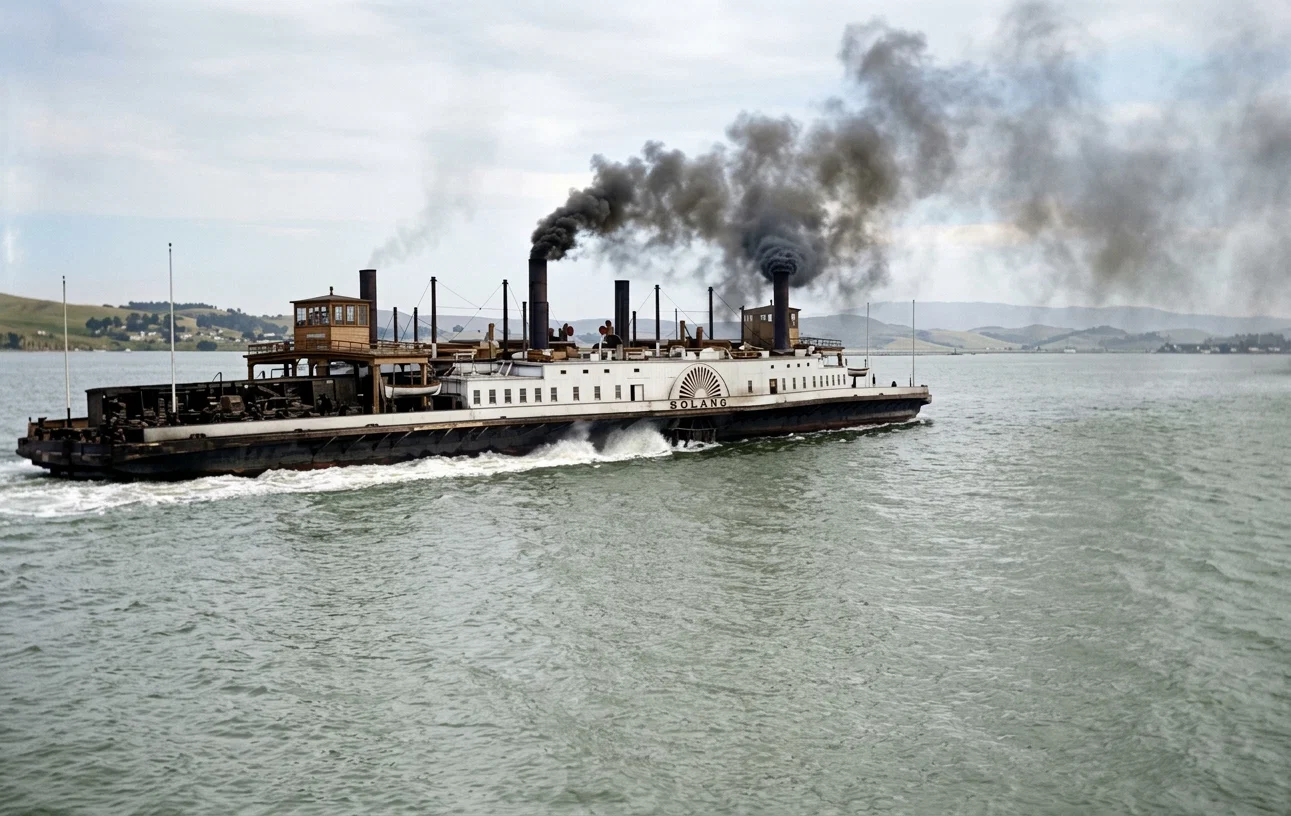
CALIFORNIA SCENERY, No. 17.—California is noted for big things, good and bad. Our illustration is from a photograph of the monster ferry-boat SOLANO, the largest in the world. It is practically the moving bridge on the Southern Pacific Railway line from Sacramento to Oakland, crossing the Straits of Carquinez from Benicia to Port Costa, a distance of a mile. The SOLANO is 424 feet long, and sufficiently wide to take four trains of cars abreast, the capacity being 24 passenger coaches with two engines, or 48 freight cars. She carries daily from 300 to 600 cars, and the usual time of running the cars from the land to the boat, or vice versa, is but little if any longer than it would be to switch the same cars to the same relative positions on land. One needs to be on the boat to appreciate its size.
“Dat’s what I kan’t understand nohow,” said Sukey’s mother, slamming a heavy flat-iron on the ironing-board. “We’se been a-doin’ what you said for her,—gettin’ her all sorts of nick-nacks and notions”—
“Don’t gib her any mo’ notions for de land sake,” said Bob, who was sitting by the kitchen fire, smoking a dirty clay pipe. “Neber did see such a notional piece in my life, Mis’ Carew. Lor! if it hadn’t ha’ been for mam, I belib I’d gib her a spankin’, and tuk it outen her. What you t’ink, Mis’ Carew? She says she kan’t sleep nohow, if de clock am tickin’, and de oder night she hops up and puts my ’larm clock into de oben. Haw! haw! haw!” guffawed Bob. “An’ a feller kan’t walk across de flo’, nor shet de do’, nor rattle de newspapah, nor eben blow his nose, athout you see her cringin’ as tho’ yo’ had gib her a lick.”
“Well, it hurts,” said Sukey. “It does hurt, and it hain’t no notion.” Two tears stood in Sukey’s black eyes and splashed over her brown face.
“Pooh!” said Bob, “all your wants is another serenade like de boys gib you las’ night.”
“Naw, Bob,” said her mother deprecatingly, “Sukey’s been sick, and we must mek allowance fur her.”
“What kind of a serenade did they give you, Sukey?” said Mrs. Carew.
Sukey shuddered. “O Mis’ Carew, it was worse dan ’lection night when de ol’ mill whistle sounded lik’ as if de debil was blowin’ off steam outen his boilers. Bob gadered up a whole crowd wid horns and combs and tin pans, and gib me a reg’lar shibberee, jest as if I’d done ben foolish enuf to git up an’ git married.”
“Yes, it was a shibberee, I can tell you. Dat gal sot an’ shibbered, ’til I thought she’d fall off de cheer. Den bimeby she keeled ober in a kind ob a faint, an’ I skeered dem boys away. Dar Sukey,” said her mother soothingly, “if dey come a’gin, I’ll frow hot water ober de fence on dem.”
Mrs. Carew’s face turned pale. “It is a wonder Sukey is alive. Bob,” she said severely, “go and put that old pipe away, and then come back. I have a word for you. Do you know that you might have killed your sister with your nonsense? You don’t deserve to have a sister. You never was sick and
nervous, and don’t know what it means to have noise hurt. Thank the Lord, I do. Now, Sukey, you shall come home with me this very afternoon, and I am going to see if we can not get you a place in the Convalescence Hospital until you are stronger.”
Bob’s face looked quite serious now. “Do you really t’ink de noise hurts her, Mis’ Carew?”
“Certainly, I do. It’s a wonder the child hasn’t had a relapse and died.”
“Fer de land’s sake!” exclaimed Bob. “Well, I’se powerful sorry.”
Mrs. Carew’s heart suddenly warmed to the great, untaught boy, in pity for his ignorance.
“Yes, you ought to be sorry, and I am sorry for you. It was not because you were wicked but ignorant that you came so near breaking your sister’s slender thread of life. However, she is to go home with me. So run out and hire a cab for me, and have it here within twenty minutes.”
Sukey’s mother looked her astonishment, and Sukey her delight.
“It’s a lucky thing I washed all her clothes yesterday, but dey hain’t all i’oned yet.”
“Never mind that. I will iron them myself. Let’s gather Sukey’s things together, and get her ready as quietly as possible.”

Among the Pillows.

“’Pears like, Mis’ Carew, jest as if I’d got to de borders ob de kingdom, it’s so still, an’ eberyt’ing is white and clean, an’ dar ain’t no bad smells ob de boys’ boots, nor de cabbage an’ onions boilin’, an’ dars de blue sky outen de windah, an’ de pictures on de wall, an’ de books, an’ de pianer, an’ de smell ob dose flowers is jest as if angels was walking ’round somewhere.”
“Yes, dear, I am so glad I brought you home with me! If I only could get the time to nurse you, you should stay right here till you are well.” Sukey’s lip looked a little quivery, but Mrs. Carew lifted her up, placed a white serviette on a little tray, and a glass of egg-nog daintily flavored thereon.
“There, eat this, my pet.”
Sukey took up the spoon and began to eat, with a look of increasing wonder on her face.
“I neber knew dey could make such nice t’ings dis side ob de kingdom,” said Sukey.
Mrs. Carew laughed. “You’re a funny little thing,” she said, “but you are one of the Lord’s lambs, I believe.”
“Do you t’ink so, Mis’ Carew? All de time you was away dis mornin’, I was lookin’ at dose pictures der, wid the lamb in His arms, an’ de sheep follerin’, an’ den at de oder where de Shepherd am lookin’ at de cross, an’ de sheep am strayin’ around. Since you told me about de cross, Mis’ Carew, my heart’s been bery still. ’Pears like I could b’ar no mo’ noise nowhere, ’cept it was singin’ in de chu’ch. O Mis’ Carew, you came so still an’ gentle, an’ now He’s come so still an’ gentle, an’ eberyt’ing dat’s nice an’ so quiet! Kin I be still an’ gentle? an’ what kin I do to be His little lamb?”
“Why, you are already, you poor little thin thing! Just now you must feed beside the still waters, and in the green pastures.”
“How lubly dat sounds, Mis’ Carew. But what kin I do when I git well? Will I be goin’ back to de noise ob de washin’ an’ i’onin’ an’ de rows? ’Pears like I couldn’t.”
“What would you like to do, pet?”
“Well, I don’t ’pear to know ’xactly, but I wish I could go whar dar was sick folks, an’ keep all de do’s from bangin’, an’ all de’ windows from ratilin’, an’ jest make ’em feel like I do, as ef dey was on de border of de kingdom.”
“Well, maybe you can. The dear Shepherd will lead you right, but now, hush!” said Mrs. Carew, pulling down the blinds; “you must go to sleep; for you are going to the hospital this afternoon. It will be quiet there, too, so quiet!”

In the Hospital.

Sukey sat up in her bed at the hospital, after Mrs. Carew and the nurse had folded her few clothes away, and stowed them in the drawers beside her bed. She looked around her at the long, high room. How quiet it was! Yes, there were the two Shepherd pictures, and there were texts on the wall, too. “He leadeth me;” “In quietness and confidence shall be your strength,” and over the mantel, “Emmanuel, God with us.” Sukey spelled out the texts, and then her dark eyes roved over the rows of beds on either side. There were not many patients in them now; but she could see them through the door out on the veranda, wrapped up, and sitting in their big chairs. Then the nurses would trip in and out so quietly. How pretty they were! Sukey’s eyes followed them up and down, in and out. My! if she was only a white girl, she said to herself, and had such pretty hair and rosy cheeks, and could wear such a nice dress, long white apron, and pretty little caps—“Well, she wasn’t, and couldn’t, and so”—Sukey sighed so heavily that the nurse turned to look at her.
“You’re a new patient, aren’t you?” questioned one of the pretty nurses as she rolled up some bandages.
“I ’spect I is patient, an’ sumpin’ new to me, too,” said Sukey. “But I kan’t help wonderin’ how anybody could be cross when eberyt’ing is so still and kind. I ’spect it’s dat way ’cause dat Shepherd am here, an’ you all are His sheep. I’se only a new one, you see, jest one ob de little lambs.” But a smile broke over Sukey’s face as she pointed to the picture: “He carries the lambs. So how could I be anyt’ing but new an’ patient?”
The nurse looked wonderingly at her. Perhaps the little dark girl was still in her fever. No, her head and hands were cool, and Sukey took the gentle touch to mean a touch of love, so new to her that it seemed to her, as it is, like something angelic and heavenly.
The bright, peaceful days passed so quietly, and Sukey grew rapidly better, and was soon able to walk about. What a pet they made of her! What a little missionary lamb she was, telling old and young of the gentle Shepherd and the quiet pastures “jest like de green fields by de riber”!
The ladies who visited the hospital every Sunday and Wednesday, found her a very unique piece of originality.
“The loikes of you will be loiking flowers, I’ll venture,” said an old Irish lady, who was recovering from a broken arm.
“Yes, mam,” said Sukey; “I like to look at ’em f’rew de fences, but I’se neber had none ob my own.”
“Well, yez’ll be havin’ some of yer own the day thin.”
Sure enough, what a day it was for flowers! The greenhouse man had sent over a wagon load of chrysanthemums for the hospital. Some were in large cut bouquets, and were distributed by young ladies throughout the hospital to the eager patients; but the most glorious ones were in pots, and they would bloom through Christmas. How lucky it was that Sukey’s bed was just near the table where they were to stand! There were white ones, “snowy as snow,” said Sukey; and red ones, “like folks dressed up in velvet,” but it was the yellow ones that took deepest hold of Sukey’s heart. “’Pears like dey’s jest ketched de sunshine, and boiled it down fer de winter, don’t it now?”
“Well, yes, they look full of it.”
“What makes dat one have flowers so much bigger dan de oders? Yes, an’ de leaves look so starchy up like, only softer, more like velvet.”
“It’s because the gardener cut back the buds, and let the plant give all its strength to those few great beauties,” said one of the nurses.
“You don’t say!” said Sukey.
“Yes, the gardener deals with his flowers just as our heavenly Gardener deals with His human flowers, you and me, Sukey.”
“Do you mean He’ll nip off de buds ob t’ings to make us flower up a better kind ob flower?”
“Yes, you’ve got it.”
“But I wonder He didn’t make us flower jest as He wanted us to flower at de first. Den He wouldn’t have needed to have nipped us back.”
“Well, He did,” said the nurse. “He made us to bloom love, gentleness, goodness, and peace by the Spirit He put into us. Then His enemy came along, and we let his wicked spirit in to fight out the good Spirit; but when we cry to the great Gardener, He takes us in training again. He won’t nip us back unless we want Him to. He will let us flower out just what we want to. But if we want a rare flower, why, He’ll see to it that it will come, only we must submit to the process.”
“What’s dat?”
“Tribulation worketh patience, and patience experience, and experience hope, and hope maketh not ashamed, because the love of God is shed abroad in our hearts by the Holy Ghost which is given unto us.”
Sukey looked puzzled. “There, pet,” said the nurse, “learn your lesson from the flowers, and God will teach you the rest. As for chrysanthemums, it seems to me they are like what our lives ought to be anyway, whether they have specially beautiful flowers or not.”
“Why, Miss Nurse?”
“Because they bloom when other flowers are dead. They brighten up our homes and hearts, when fall and winter set in; and so, dear, when people find the pleasures of earth have failed them, when health is gone, and sorrow and affliction overtake them, God means that they shall find sweet souls so full of His love that they will be like chrysanthemums when the leaves fall.”
“There is no getting Sukey away from the flowers,” said the Irish patient. “Poor little thing, she makes me think for all the world of a brown butterfly, or a bit of a hummin’-bird, over thin things, an’ she is that lovin’ and gentle that if she was white, I would be for callin’ her an angel without wings.”
• FRANCES EUGENIA BOLTON.
(Concluded next week.)

THE WORD SHE REMEMBERED.

“You remember the sermon you heard, my dear?” The little one blushed and dropped her eyes, Then lifted them bravely with look of cheer— Eyes that were blue as the summer skies.
“I’m afraid I forgot what the minister said, He said so much to grown-up men, And the pulpit was ’way up over my head; But I told mama that he said, ‘Amen.’”
“And ‘amen,’ you know, means ‘let it be,’ Whatever our Lord may please to do, And that is sermon enough for me, If I mind and feel so the whole week through.”
I took the little one’s word to heart, I wish I could carry it all day long, The “amen” spirit, which hides the art To meet each cross with a happy song. —Anon.

JOTTINGS FROM PALESTINE.

From Haifa to Nazareth.
HERE we are on Mt. Carmel. It is the first week in January, when most of the Christian world are in regions of snow and ice; but on Carmel the farmers in their shirt sleeves are working in the fields and gardens. The day is bright and sunny, like May in Switzerland, and here and there wild flowers in full bloom remind one of the departed glories of Carmel. But the sun now sinking down into the blue Mediterranean, reminds me that I must return to my hotel, or run the risk of an unsafe encounter with Arabs after dark. As we descend the slopes of Carmel to the north, before us stretches the fine bay of Acre, and ten miles across on the opposite shore nestles the city of Acre (Accho), while far in the distance Mt. Hermon pushes up its hoary head into the region of eternal snows. Our winding path down Carmel leads through vineyards of the German colony. Carmel wine has a fair reputation and sells at a good price in Europe, and hence is a source of gain to the colonists.
Next morning we were to start for the interior; it was planned to go horseback; but the wind from the northeast was blowing too strong, so we concluded to go with a coach. A tolerable road has been built from Carmel to the Sea of Galilee by way of Nazareth; but in the rainy season portions of it are almost impassable. At Haifa there are several Arab teamsters who make frequent trips to Nazareth; but their wagons are better for freight than for passengers. Some of the German colonists have imported extra strong-built spring wagons from America; with these one can make a comfortable journey. A fixed price is charged for the trip; hence the greater the number of passengers, the less the individual fare.
Altho we began early in the morning, it took till noon to muster a company of four. One was a German just come from the Transvaal; another, a Jewish professor whose purpose was to establish a school at Tiberias; and the third was a German who is engaged in building a hotel on the banks of Galilee.
At last we are off! And now for our first ride through Palestine! How freighted is every step with thrilling memories! Could all past events of each locality pass in panorama before us, what scenes would we behold! Soon we have made our way through the narrow, crooked streets of Haifa. Our road leads along the north side of Carmel. At our left is the sandy beach of the Mediterranean, sweeping in a curve northward to Accho (in Christ’s time, Accho was called Ptolemais, where Paul spent one day, Acts 21:7); to the northeast is the low, marshy plain of Accho, through which the brook Kishon flows to the Mediterranean; near the sea are many palm trees. For some distance the land to the north of our road is low and marshy; to the right, on the slopes of Carmel, are some wretched Arab huts.
For about two hours our course is beside a railway, which is finished for several miles from Haifa. It was begun by an English company, and was laid out from Carmel to Damascus, its course being through the plain of Jezreel, and over the Jordan just south of Galilee, through the country of the Gadarenes, and to the east of Mt. Hermon. But this company having had an experience somewhat similar to the Panama Canal Company, the work is for the present at a standstill.
In consequence of long neglect, the plain of Accho has become the abode of malarial poisons. To drink of its water, or to sleep on it overnight, is sure to saturate one with fever germs.
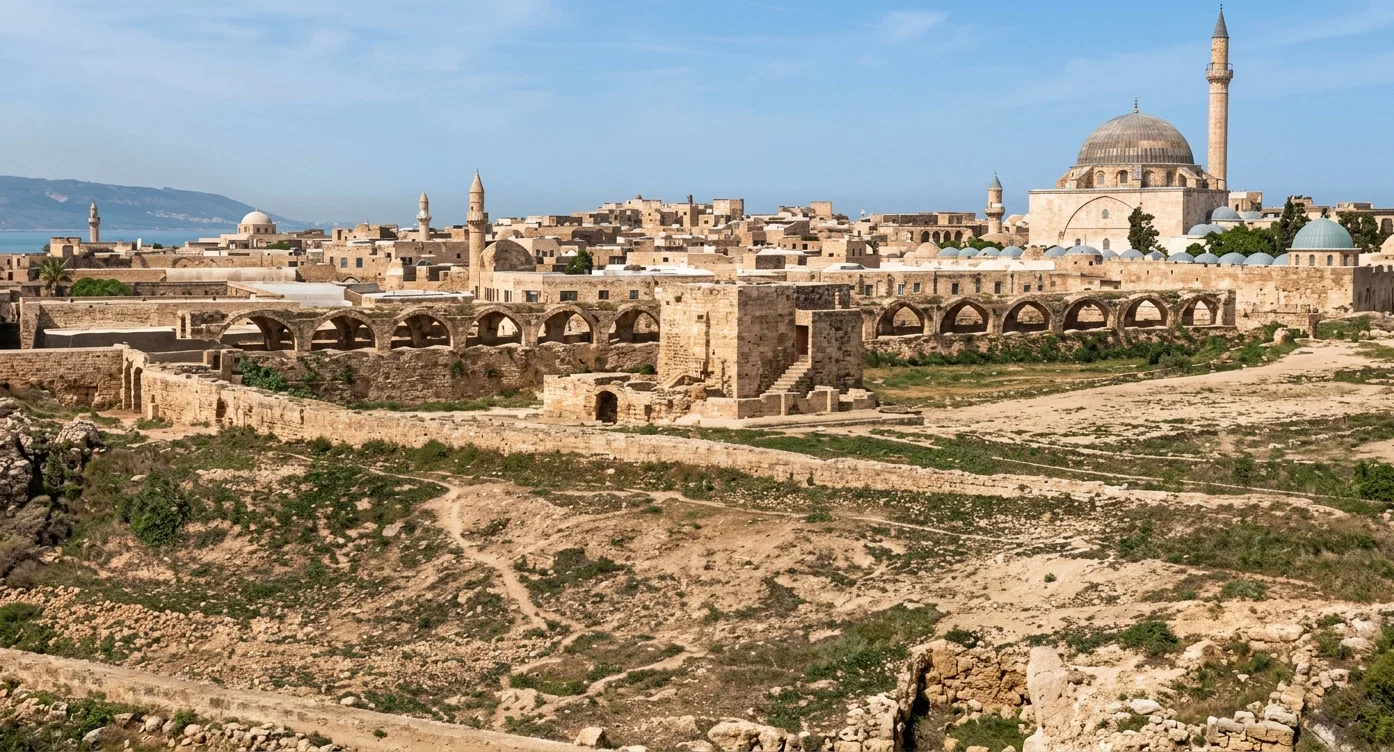
VIEW OF ACCHO, OR ST. JEAN D'ACRE, WITH MT. CARMEL IN THE BACKGROUND TO THE LEFT.
A few miles to the east of Haifa the plain narrows down between Carmel and the foot-hills of Galilee. Here the Kishon flows from the valley of Jezreel to the plain of Accho. At this point we leave the foot-hills of Carmel and cross to the hills of Galilee, which is not an easy undertaking at this season of the year.
A short distance ahead of us is a group of Bedouins. As we draw nearer, we see that in crossing a slough the wagon has fallen into the mud so deep that the horses can not pull it out. Fearing a similar fate, we all leave our coach, and pick our way across on foot; and with the lighter wagon, our teamster succeeds in crossing. However, the worst is not yet passed; after a short distance, all attempts to make a road have been abandoned, and each driver avoids the track of others in the hope of sinking less deeply into the mud. For some distance our three horses patiently wallow through the mire; the rank grass is grown up thick as high as our vehicle. At last we are through, and begin to ascend the foot-hills of Galilee.
On the first hill is an Arab village; it is composed of one long house, each family having a small portion, sometimes without a partition between them. A large tract of land here is owned by a rich Arab, who rents to the poor fellahs, or farmers.
On the summit of this hill, we pause to take in the surrounding view. To the west is a clear view of the plain and city of Accho, Haifa, Mt. Carmel, and the sea; to the southeast stretches the large triangular plain of Jezreel, called Esdraelon in the Greek; along the south of this, the greatest plain of Israel, extend Mt. Carmel and the hills of Samaria; on the north are the hills of Galilee; and to the east, between Jezreel and the Jordan, are the hills of Gilboa, Little Hermon, and Mt. Tabor.
Our course now lies southeast, over the foot-hills of Galilee and bays of the plain of Jezreel. On portions of the hills which we cross are forests of oak; the trees are rather low and scrubby; the acorns are narrow and long. In the valleys, birds are quite plenty, specially the snipe, plover, ravens, and sparrows. Here and there a scarecrow, dressed a la Arabe, indicates that the birds to-day, as in the time of Christ, are at the heels of the sower, as mentioned in the parable.
Some of the land is cultivated, the old-fashioned wood plow, with iron point and one handle, being used. Generally, the plow is drawn by one yoke of oxen. Large portions of the land are overgrown with weeds. Along the road in places are hedges of huge cacti. Among the weeds on the plain we saw two jackals, called foxes in Eze. 13:4, in illustration of the tricky prophets of Israel. One of the passengers, having his gun along, attempted to shoot one; but the moment he began to level his piece, the jackal took the hint and lost no time in increasing the distance between us. As we saw him scampering through the weeds, we thought of his progenitors which Samson caught, and, having tied flaming torches to their tails, liberated them in the wheat-fields of the Philistines. The jackal looks very much like the red fox, and is about the same in size. Soon after dark we heard them yelping in the distance, first on one side, then on the other. Evidently, they are quite numerous here.
When the roads are fair, the trip from Haifa to Nazareth is made in six hours; but at this season of the year, it required eight hours. Nazareth lies in the hills of Samaria, about an hour from the plain of Jezreel, at considerable altitude above the plain. It being situated on the slope of the hill facing the southeast, when approaching it from the west, the town is not seen till one is right upon it. As we reach the hill-top, all at once the town bursts upon the view, presenting a pleasing picture. As we arrive quite late, we will retire for the night, and at another time take a glimpse at Nazareth.
H. P. H.

The Sun and the Mountain-Tops

“WHILE the world lasts, the sun will gild the mountain-tops before it shines upon the plain.”

A HERO HE.

A HERO he at labor's heat Who toils his best courageously, And fails, yet somehow braves defeat: A hero he.
When skies are flecked with cloudlets free, And life lies rugged, incomplete; When bitter-sweet blooms waywardly, And Croesus bows at others' feet, That man embittered not, we greet: A hero he.
—Anna A. Williams.

NOTES FROM OUR HELPING HAND MISSION.

[BRETHREN B. F. RICHARDS AND G. W. REASER IN CHARGE.]
On the evening of April the 10th, a man was knocked down in front of the Mission, the object of the one who made the assault being robbery, but he was foiled in his purpose. The same night a Chinaman got into an altercation near the Mission, and with a dagger attempted to commit murder, but by the interposition of the bystanders, was prevented from plunging the deadly weapon into the body of his fellow-man. Not far from the same date, as we were leaving the Mission after the evening service, we heard the rattle of a policeman’s club on the stone pavement, on the opposite side of the street, and on looking around to ascertain the cause, saw a man running as fast as he could, and a policeman in hot pursuit. These incidents, and many more that might be related, are evidence of the need of the Mission, and also of the fact that the Lord directed in the matter of securing the buildings which are occupied by the Mission, in this particular location. It is one of Satan’s vineyards. There is as much need of work in the locality of the Mission, for fallen women as there is for fallen men; for it is observed that, altho we do not see many of the former class on the streets during the day, nor during the early part of the night, yet from midnight onward till the dawn of day, there are many women of the lowest type out on the streets, some of them staggering under the influence of liquor, and fully demonstrating the depths to which they have fallen, by engaging in street fights, and in the use of such vile language as would seem impossible to come from the lips of womankind. We are glad that a home has been established by the Mission board for the purpose of saving some of these, “as brands from the burning.”
Notwithstanding the fact that we are located in the midst of so much sin, confusion, and outbreaking crime, it is a subject of remark by many who visit the Mission that throughout the entire building there is an atmosphere of peace and quiet. One man, an unbeliever, said that the tranquillity of the home did not seem like hypnotism, but was to him an unexplainable influence. Truly “the natural man receiveth not the things of the Spirit of God, . . . neither can he know them, because they are spiritually discerned.”
A man with a powerful physique, made the following statement in a recent meeting: “I am satisfied that you have a power with you that I haven’t got, and I want it. I have given myself to the Lord to-night.” We are glad to have men see and acknowledge that God is the source of power, and that the Gospel “is the power of God unto salvation, to every one that believeth.”
The same evening another said: “There is something that my heart longs for that I haven’t got. I think it is Jesus that my soul is longing for. I’ve come to-night to give my heart to Him.”
Two other of the new converts gave the following testimonies: “I praise God, not only for His saving power, but also for His keeping power.”
“I praise God for His saving power. I’m a sinner saved by grace.”
In order to supply the demand for sleeping accommodations, we have recently added forty more beds, so that we now have 140 beds in which weary men can rest.
The work is the Lord’s, the power is His, we are His, and to Him we give the glory for all that is done, and praise Him for the privilege of being connected with the work of saving souls.

LESSON IX.—SABBATH, MAY 28, 1898

ON THE JOURNEY TO ROME.

24 “And as he thus made his defense, Festus saith with a loud voice, Paul, thou art mad; thy much learning doth turn thee to madness. But Paul saith, I am not mad, most excellent Festus; but speak forth words of truth and soberness. For the king knoweth of these things, unto whom also I speak freely; for I am persuaded that none of these things is hidden from him; for this hath not been done in a corner. King Agrippa, believest thou the prophets? I know that thou believest. And Agrippa said unto Paul, With but little persuasion thou wouldest fain make me a Christian. And Paul said, I would to God, that whether with little or with much, not thou only, but also all that hear me this day, might become such as I am, except these bonds.
30 “And the king rose up, and the governor, and Bernice, and they that sat with them; and when they had withdrawn, they spake one to another, saying, This man doeth nothing worthy of death or of bonds. And Agrippa said unto Festus, This man might have been set at liberty, if he had not appealed unto Cæsar.”
1 “And when it was determined that we should sail for Italy, they delivered Paul and certain other prisoners to a centurion named Julius, of the Augustan band. And embarking in a ship of Adramyttium, which was about to sail unto the places on the coast of Asia, we put to sea, Aristarchus, a Macedonian of Thessalonica, being with us. And the next day we touched at Sidon; and Julius treated Paul kindly, and gave him leave to go unto his friends and refresh himself. And putting to sea from thence, we sailed under the lee of Cyprus, because the winds were contrary. And when we had sailed across the sea which is off Cilicia and Pamphylia, we came to Myra, a city of Lycia. And there the centurion found a ship of Alexandria sailing for Italy; and he put us therein. And when we had sailed slowly many days, and were come with difficulty over against Cnidus, the wind not further suffering us, we sailed under the lee of Crete, over against Salmone; and with difficulty coasting along it we came unto a certain place called Fair Havens; nigh whereunto was the city of Lasea.
9 “And when much time was spent, and the voyage was now dangerous, because the Fast was now already gone by, Paul admonished them, and said unto them, Sirs, I perceive that the voyage will be with injury and much loss, not only of the lading and the ship, but also of our lives. But the centurion gave more heed to the master and to the owner of the ship, than to those things which were spoken by Paul. And because the haven was not commodious to winter in, the more part advised to put to sea from thence, if by any means they could reach Phoenix, and winter there; which is a haven of Crete, looking northeast and southeast. And when the south wind blew softly, supposing that they had obtained their purpose, they weighed anchor and sailed along Crete, close in shore. But after no long time there beat down from it a tempestuous wind, which is called Euraquilo; and when the ship was caught, and could not face the wind, we gave way to it, and were driven. And running under the lee of a small island called Cauda, we were able, with difficulty, to secure the boat; and when they had hoisted it up, they used helps, undergirding the ship; and, fearing lest they should be cast upon the Syrtis, they lowered the gear, and so were driven. And as we labored exceedingly with the storm, the next day they began to throw the freight overboard; and the third day they cast out with their own hands the tackling of the ship. And when neither sun nor stars shone upon us for many days, and no small tempest lay on us, all hope that we should be saved was now taken away.”

QUESTIONS

(1) Give a summary of Paul’s speech before King Agrippa. (2) What important, vital truths does it contain? (3) While he was speaking, by whom was he interrupted? What was the Roman governor’s idea of all that Paul had said? V. 24. (4) What was Paul’s reply? V. 25. (5) To whom did he refer to substantiate his statement that he was speaking sober truth? What did Paul say as to the openness of all these things? V. 26. (6) What personal appeal did he then make to Agrippa? V. 27. (7) How did Agrippa receive this personal turn to the address? V. 28. (8) Repeat Paul’s beautiful reply. V. 29. (9) How did the rulers signify that they did not care to hear any more? V. 30. (10) As they went out, what testimony did they give to Paul’s innocence? V. 31. (11) What was Agrippa’s verdict? V. 32. (12) To whom was Paul delivered for conveyance to Rome? Chapter 27:1. (13) Who accompanied him? V. 2. (14) What was their first stopping-place? How was Paul treated by this centurion? V. 3. (15) What was their course from Sidon? What trouble did they experience? Vs. 4, 5. (16) At what place did they change to another ship? V. 6. (17) What kind of passage did they have from this place? What was their course? V. 7. (18) To what place did they at last come? V. 8. (19) What is said of the sailing? Why? V. 9. What “fast” is referred to? What time of the year was it? (20) What warning did Paul give? V. 10. (21) Why was it not heeded? Verse 11. (22) What else induced the master of the ship to continue the voyage? To what place did they hope to come? V. 12. (23) By what were they deceived? Vs. 13. (24) What soon followed? V. 14. (25) What were they obliged to do? V. 15. (26) Of what did they take advantage to secure their small boat? V. 16. (27) Having secured it, what did they do? In what danger were they now? V. 17. (28) What did they do the next day? What else did they do the next day? Vs. 18, 19. (29) What was the state of the weather for many days? Under these circumstances, what was their hope of escape? V. 20.

NOTE.

In studying this lesson, no one should fail to avail himself of the advantage to be derived from the difference of expression in the Revised Version.
Continue reading: OUR WORK AND WORKERS