ONE of those peculiarly indispensable and sympathetic aunts, common in so many families, to whom the children go for sympathy and advice when it is difficult to apply even to a parent, tells in the Youth's Companion how she first came to “specialize in sympathy,” and thus to make herself valuable to the young people whom she touched in her ministrations. The story has a moral of value to others besides children; for the principle brought out has much of the universal in it.
The writer tells how as a girl she was at one time very forlorn in a strange city, and was peculiarly in need of sympathy. The persons she was living with were not unkind; but they were not quick to see the unhappiness of others, nor did they understand how to meet the need of the unhappy, even if they did see the unhappiness. So the teller of the story wandered into a public park, sat on one of the benches, and in some self-pity she cried a little to herself. A shadow fell across the park bench, and a gray-haired woman, kind of face and of manner, dropped a pink rosebud into the child’s lap, and said:—
“My dear, you are unhappy. I wish I had time to hear your troubles, but I must catch a train. I have only time to give you one word, but it contains all that I have learned from a deep experience of my own. The best thing for your own trouble is to comfort other people in their troubles.”
She went on, and the girl never saw her again, but the incident had given her thoughts a right-about-face. From that time on she forgot her own troubles in thinking a little more about the troubles of other people. In fact, she became a “specialist in sympathy,” and people grew more and more to love her, and to turn to her in their perplexities and griefs. In that useful way she lost most of her sorrows.—Selected.
Our Noise Producers
A HOUSEHOLDER was dismayed one night by the sudden extinguishment of the electric lights in his house. In a little while it became apparent that the darkness would probably continue through the night unless the break could be located and corrected. Unable at that hour to secure the services of an expert electrician, the householder hit upon the happy scheme of detaching the batteries from his doorbells and connecting them with his electric feed wires. But no light resulted. Next day the experts came to remedy the trouble, and seeing the hapless expedient of the owner, remarked:—
“Don’t you know that it takes five hundred times more power to produce light than it takes to produce noise?”—Selected.
“Isaac Peral,” the Greatest Submarine Yet Built
By P. G. Britain
J. P. HOLLAND, of Paterson, New Jersey, designed the first submarine, which was named the “Holland,” and was launched in 1900. Of the “Holland,” the late Admiral Dewey said:
“If they had had two of those things at Manila, I could never have held it with the squadron I had.”
The first submarines built were approximately sixty feet long, twelve feet wide, and had a displacement of one hundred and fifty tons; the surface speed was five knots an hour — submerged, four to six knots. Their cruising radius was three hundred miles.
The feat of the “Deutschland” and other German submarines in crossing the Atlantic Ocean, elicited the admiration of fair-minded persons, and yet the United States has just completed a submarine which is superior to any of the great undersea craft sent to the Western continent by Germany.
Three years ago, at Provincetown, Massachusetts, work began on the submarine “Isaac Peral,” and a few weeks ago the vessel was sent to Spain, for which country it had been built. Apparently the “Isaac Peral” is the last word in submarine construction. From stern to stern it measures 196 feet; beam, 18½ feet; displacement, 700 tons; weight, equivalent to 22,400 cubic feet of water; speed on surface, 18 knots an hour — submerged, 12 knots. It is a block long, and as wide as two Pullman cars.
Compare this Spanish boat with the “Santa Maria,” on which Christopher Columbus set sail for the New World. The “Santa Maria” was but sixty-three feet long, and had a displacement of but two hundred tons. The “Isaac Peral” is more than three times as long, weighs three times as much, and has a cruising radius of 10,000 miles.
The captain of the “Deutschland” boasted that his vessel remained an entire night on the bottom of the English channel, to avoid British warships; the Spanish submarine can submerge to a depth of nearly four hundred feet, and remain submerged for three weeks. The “Isaac Peral” could cruise to the Dardanelles and back without replenishing so much as a drop of water. The boat could establish a regular schedule between New York and Oklahoma, and not stop on the way. And this wonder in submarine craft was built in this country for a foreign power.
The torpedoes carried by the “Peral” are themselves small submarines. They are twenty-one feet long, twenty-one inches wide, and are driven by air compressed in their own tanks at a pressure of 1,350 pounds to the square inch. As the torpedo leaves the tube, a motor is started, enabling the torpedo to travel under its own power. The torpedo is divided into six compartments.
The “Isaac Peral” carries eight of these torpedoes, four on each side of the torpedo room, arranged in tiers of two.
Uncle Sam still has the supremacy in submarine building, and did he own half a hundred such craft as the one he has just sent to Spain, his coast would be reasonably secure from invasion. Uncle Sam has the faculty of giving to others things he should keep; for example, the Lewis gun and the “Isaac Peral.”
P. G. BRITAIN.
Our Snake Visitors
By Mrs. L. Hunt
WE spent last year in connection with the sanitarium at St. Helena, California. We lived about one mile from the sanitarium, in a secluded spot at the foot of the mountains. It was a beautiful place. Often we were reminded of the one hundred and twenty-first psalm.
Our living-room and bedrooms were out under the lovely pine and manzanita trees. One Sabbath morning, not being able to attend Sabbath services, my little girl, three years old, and I remained out in the open to enjoy the beautiful mountain breeze, and the evidences of God’s goodness to us.
The shrieks of a baby chicken by the door sent me in search of the cause. I found a rattlesnake coiled around the chicken. With the aid of a pitchfork and10hoe I finally succeeded in ending its life. It had seven rattles.
Baby and I were accustomed to spending our afternoons under the trees. A few days after this, we were having our afternoon rest, when, as usual, I returned to the house, leaving her asleep. Somehow this time I felt impressed to go back and get her. I could not get away from the thought. Obeying the impression, I found her just ready to come to the house. As we stepped upon the steps she said, “Mamma, there is a big snake!” Looking where she pointed, I saw a large rattler, with ten rattles. I evidently had walked over it in going to the child. If I had not obeyed the voice, she would have come upon the snake alone. Placing her upon the porch, I made an effort to kill the snake. Though I struck him with the hoe, the earth being mellow, I could not hold him. He hastily fled under the house, but told me by his rattles that he was ready to fight if necessary.
After my son and daughter returned from school, they began playing on the piano and violin in the parlor. I told the children our experience that day with the snake. My daughter said some one told her if one would put sweet milk out where the snakes could get it, they would come to it; so she took a pan of milk out on the side of the house by the parlor, and accidentally set the pan on the same old fellow. There he lay enjoying the music; her hands even touched him. He immediately coiled for fight. There being several of us, in our excitement we failed to capture him. After he wearied of rattling at us, he crawled back under the house.
One morning early I had been out in the woods for meditation and prayer. As I went back to the house, I encountered in the pathway a rattlesnake. I did not see it till it was coiled around my ankle. But without fright or excitement, I lifted my foot and stepped to one side. It coiled up tighter, but by making use of some near-by rocks I soon killed it.
Every few days we were visited by rattlesnakes, but God’s protecting care was over us, so that no harm came to us. By the advice of neighbors, we concluded to forego our outdoor slumbers. But we do love the solitary places. We know that by learning to love nature, and learning to be quiet in this life of excitement, hurry, and bustle, we shall be more likely to hear God’s voice speaking to us.
MRS. L. HUNT.
What Sugar Is Made Of
SOMETIMES you hear a person say that such and such a thing is as “white as sugar.” And to convey another idea, we frequently remark that something is as “black as a coal.”
To those unfamiliar with chemistry it will be a shock to learn that pure white sugar itself is made up of nothing but black carbon (the principal part of coal) and water.
The chemical symbol for sugar is written thus: C₁₂ H₂₂ O₁₁, which simply means that each tiny crystal of sugar consists of twelve parts of carbon, twenty-two parts of hydrogen gas, and eleven parts of oxygen gas.
Now water is composed of hydrogen and oxygen gas in the proportion of two parts of hydrogen to every one of oxygen.
Thus if sugar has twenty-two parts of hydrogen and eleven parts of oxygen, we see that this is the equal of eleven parts of plain water, for the proportion of hydrogen to oxygen is two to one multiplied by eleven.
So sugar consists of twelve parts of carbon to eleven parts of water. Of course, we could not very well mix carbon and water in this proportion and expect to get sugar. Chemistry works in its own peculiar way, and, to form sugar, the various particles of the substances composing it must be joined together in its own peculiar fashion.
But we may readily prove that carbon is a part of sugar, for when we throw a pinch of sugar on a hot stove the water is driven out and the coal-black carbon remains.—St. Nicholas.
Why Not “Hold” Your Own Eggs?
As the shell of the egg is porous, if left exposed to the air, part of the water evaporates. Air containing bacteria gets in, and in a short time we have a spoiled egg. In order to prevent this the shell should be coated over, thus filling the pores and excluding the air. This is best accomplished by putting the eggs in a solution of water glass (sodium silicate). To ten quarts of cold boiled rain water add one quart of water glass. Place clean, strictly fresh eggs in jars, small ends down, and cover them with the water-glass mixture. They may also be preserved by packing them, small ends down, in bran, sawdust, lime, or sand, or by coating with fat. So, when eggs are inexpensive, why not plan to “hold” them for the time when prices are high?—Gleaned from a Florida bulletin on “Foods and Their Preparation.”
Notes of Progress
An electric current applied to freshly cut timber will have the same effect on the wood that months of ordinary drying could bring about. England is responsible for this new timber-curing process.
Cherry pits that have been a source of annoyance and expense to hundreds of canneries, and which amounted to hundreds of tons, it is said, are now being made to yield a valuable oil and also a meal for feeding cattle, according to specialists of the United States Department of Agriculture.
Arizona has just attracted national notice by the discovery of asbestos in the Sierra Ancha. It is the long-fibered kind, which can be woven into form for various uses. Heretofore, eighty-five per cent of that kind of asbestos used in this country has come from Canada, which supply has been cut off by the war. The find of the substance in Arizona is a good fortune to the nation, especially at this time.
The gasoline problem has been termed the “burning question” of the day. When we stop to think that there are about 3,250,000 automobiles, 300,000 motor boats, 40,000 farm tractors, innumerable stationary engines, and a few aeroplanes dependent upon gasoline for their service, we can see that the fuel question is a real problem now confronting us. We need to utilize new processes of distillation, and we need to conserve our present supply. “We waste many millions of gallons each year by evaporation from open tanks and well mouths, and we are only now commencing to realize that in one year we lost approximately 300,000,000 gallons that might readily have been obtained from natural gas which was permitted to escape into the atmosphere.” We need also to find a cheap, but reliable fuel that may share with gasoline the responsibility of keeping the world of wheels moving.
A father seemed incapable of conveying to his daughter’s mind the value of money. He explained a check, he explained how money was earned, but to no avail. And yet she was an earnest girl. One day she greatly desired a necklace, and the fact that it cost twelve hundred dollars seemed to mean little or nothing to her. When she asked her father whether she might have it, he replied: “Yes, if you will go and buy it. I’ll send you the money for it tomorrow.” The next day messenger after messenger, each with a bag of money, came from different banks to the girl until she was fairly bewildered. Then the value of money came to her when she saw it in bags of quarters, halves, and full dollars! A check had simply conveyed nothing to her mind except that it was a piece of paper.
To encourage home production, the British government will guarantee prices of agricultural products for three years, and will establish a minimum wage for agricultural laborers. The breaking up and planting of unnecessary pasture land will also be forced. Imports of certain fruits are to be prohibited, and others are to be restricted to 25 per cent of the 1915 imports. Tea, coffee, and cocoa, except India tea in reduced quantities, are prohibited, and other beverages are greatly restricted. Meats and foodstuffs are to be restricted, and by all these reductions in unnecessary foods and beverages it is hoped to release 900,000 tons of cargo space for other uses. Paper imports are to be cut in half, to 640,000 tons annually.
The largest electric motor in the world is soon to be delivered to a steel mill, where it will be used for driving the main rolls, in which white-hot steel ingots are reduced to bars and plates. Its power exceeds that of the combined energy of 120,000 men, yet it is controlled by a single man at a small switch. This motor is the first of a series of similar machines now under construction in the shops of one of the largest electrical manufacturing concerns in America. These electric giants have been called into being by the extraordinary steel conditions in America today.
An artificial milk, delicious in taste, nutritious as cow’s milk, and easily digested, has at last made its appearance. It is an emulsion of almonds and Brazil nuts, containing carbohydrates, protein, and mineral matter in suspension in the proportions in which they occur in cow’s milk. The production of this vegetable milk is still a matter of scientific rather than commercial interest; but undoubtedly the time is not far distant when the use of artificial milk will be as commonplace as is the use of artificial butter today.
Two Letters from Florence Montgomery
By Francis McKinnon Morton
The Helping Hand Class of the Barnes Chapel Sunday school were preparing a box for a struggling mission church in a far-away frontier town.
The girls were eager and earnest in the task, and a great deal of young love and faith and hope was being put into the preparation of the box. There were no buttonless clothes, no half-worn shoes, no last year’s hats, and no worthless books being brought in for this precious box. The loyal packers were bringing of their best and bringing with that loving spirit of self-sacrifice which blesses and increases the lowliest gift a thousandfold and more.
Some of the girls in the class were poor and worked for small salaries on which there were many demands. None of them were so rich as not to feel, in some measure, the sacrifice they were making in the gift of the box—that is, none of them save one, and she was away from home at the time the girls began to get the box ready, and one of them had written to her of the undertaking.
“I think one of you should write to Florence,” Mrs. Murphy, their teacher, had said to them one day when they were sewing at her house. “I am sure she would like to know about it and to help in some way.”
“Oh, I don’t think so,” said Grace Merchant, the class president. “Florence doesn’t believe in missions, and if she sent us anything for the box it would just be some money that she doesn’t need and couldn’t think of any other way of spending. When Florence gives us any missionary money, I always feel as if we were beggars, and she had tossed us a penny and driven on, leaving us to find it in the dust of the roadside. I don’t like to feel that way, and, besides, we just love the dear little minister’s wife to whom we are sending these things. Everything we’ve found out about her makes us love her a little more, and we don’t want our little love offering spoiled by any indifferent charity.”
Mrs. Murphy gave Grace a smile, warm and winning, that said very plainly that she understood and appreciated Grace’s feelings; but she still insisted that Florence must be written to and told.
“She is one of us, you know, dear,—one of our Father’s own children,—and perhaps this time he means us to sanctify the gift by our love to Florence as well as to the minister’s little family. You know we have no right to sit in judgment on one another or to deny one of our number the sweet privilege of serving the Master’s work. Write to her, Grace, and tell her about the box and give her a chance to help. Who knows through what channel of service the Master will one day touch her heart!”
After that Grace could no longer refuse to write to Florence, so that night the letter was written, and into its pages the girl put all she could of the ardor of her loving enthusiasm for the work they were doing. She told some of the things they had found out about the barren little prairie town on the frontier, and of the brave young minister and his sweet and gifted wife, who was also his helper in the work, and of the tiny baby that had come to bless the little frontier home where these brave and faithful workers were living to carry on the King’s business. She did not omit saying that they wanted only willing and loving service to go into the making and the giving of the things that their gift-box should hold. When the letter was all written, Grace sealed it and posted it with a little prayer that the beauty and the sweetness of the service would touch the heart of this other girl as it had her own.
But in this she was disappointed, for the letter that came back in reply was only a short note accompanying a check.
“Dear Grace, and all the rest of you,” the letter said. “Of course I am willing to pay my part of anything that the class undertakes,—you know I never refuse to do that,—but you can’t expect me to enthuse over doing it when you know how I feel about missions.”
“I don’t believe in doing for people what they ought to do for themselves, and I don’t think people have any business with a church and a minister until they can support them—people value things so much more when they get them by their own efforts. I know you think that’s a very cold-hearted way to speak of what means so much to the rest of you, but it’s practical. I believe in running the church on a business basis, and I never could see any reason in sending our own church money away across the continent to do for people the things that they ought to do for themselves.”
“I inclose a check for twenty-five dollars; take it and get anything you like with it, only be sure and remember that I don’t approve of missionary boxes. As ever, FLORENCE.”
“P. S. Always let me know when you need money for anything, for of course I will pay my part of anything you girls undertake.”
“There! Didn’t I tell you how she’d make me feel?” exclaimed Grace when she had read the letter to the class. “I hate to take her twenty-five dollars.”
“It is the Master’s treasure, and not ours,” breathed Mrs. Murphy softly. “Let us send it just as it is to the little minister’s wife, and leave her to use it as she thinks best. She need not know how it came, and we can each one send with it an earnest prayer that it may prove a white-winged messenger of grace to Florence herself as well as to the minister and his little family.”12
Then, there in the beautiful drawing-room of Mrs. Murphy’s quiet home, they all knelt together while she led them in a fervent prayer for the awakening of the indifferent Florence, and for increase and blessing on the offering that she had so carelessly tossed into the King’s treasury.
The missionary box that represented so much labor and love from the class was soon finished, packed, and ready to be sent away, and the letter that went ahead to herald its arrival carried in it the prayer-laden check for twenty-five dollars.
Then came back from the little home on the frontier a letter of thanks and appreciation breathing so noble a spirit of love and devotion that there were few dry eyes in the class while the letter was being read.
After that there followed a period of silence between the busy class of city girls and the busy workers in the far-away little frontier town. So many calls to new and ever-new duties kept calling them all that they had too little time to write.
Then in the midst of the other activities of the class came a fat and very startling letter from Florence—Florence the practical, the businesslike, the unsentimental, the girl who believed, because she was rich and thought herself happy, that all should bear their own burdens, and who forgot that the very spirit of Christ is burden-bearing, healing, and the giving by the strong to the weak.
“Dear Grace, and all of you,” the new letter said. “I know you’ll be startled when I tell you that I’m doing home mission work, and that I was never really so happy in my life as I am right now, away off here on the edge of the world and in the poorest and lonesomest little town you could ever imagine.”
“It is all the most wonderful story—far stranger than any story out of a book, and I’m so eager to tell it all to you that I hardly know where I’d best begin; and wherever I do begin and wherever I leave off, I’m very sure to feel that I’ve left unsaid a lot of the things I most wanted to say.”
“You knew, I suppose, that father and I were spending the winter in the Southwest, but you didn’t know that we were making motor trips to all sorts of little out-of-the-way country places in this lonesome frontier land.”
“The natural roads over the prairie counties are lovely when it is dry, and as it is dry most of the time we have felt pretty safe in making our trips. Father loves to run his own car, and being out that way was so good for him that he was getting as strong and brown as a cowboy.”
“One day, away down near the border, we met a heavy rain, and in a very short time the roads that had been as smooth and shiny as glass were simply bogs of sticky, black mud.”
“We didn’t mind the rain very much, for the car was fixed for all kinds of weather, and we knew by our map that we were near a little town. We thought we could get accommodations there until we could start out again, and so we might have done, only as we were chugging lamely along the muddy road that turned into the main street of the little town, our engine lost a screw and short-circuited, and left us standing still and gradually sinking deeper into the black, sticky mud.”
“Father got out quickly to try to fix the machine, and then because everything was so wet from the rain he slipped and fell, breaking his leg right above the ankle and striking his head on the running board of the car. It was such a hard fall and the pain from the fracture was so severe, that father fainted away, and you may well believe that I was frightened and didn’t know what to do or which way to turn for help, when suddenly the door of a quaint little brown house just at the side of the road flew open, and out came as fine-looking a young man as one could find in any part of the world.”
“He was not exactly handsome, but fine and strong and good to look at. His face showed lines of culture, and his bearing was that of a man who can do things out in the world. He ran straight on toward us, bare-headed, and in the pouring rain, and almost before I knew what he was doing he had picked up father from the road and was carrying him right into the little brown house, while I was meekly following. Before we reached the door it was opened by the man’s wife, one of the sweetest and most charming little women I ever saw. She had seen the accident, and by the time we arrived, had made ready a bed all spread with fresh linen, and looking as smooth and nice as if it had been made by a trained nurse in the best hospital. The whole atmosphere of the place and the people seemed to be just right to inspire one with faith and hope, and it was hard to believe that we were stranded and strangers—we felt as if we were among relatives or friends, and that God was still in heaven and everything was going to be all right.”
“The young man ran out to get the doctor, and then the baby waked up, and the young mother picked him up and gave him to me to hold—just the daintiest, dearest little darling you could imagine. She asked me to keep him quiet while she did what she could for father. She flew about, bringing cold water and hot water in so short a time that she seemed to work by magic, and all the time she was as gentle and tender as could be, and yet as definite and skilful as the finest of trained nurses. I could not keep my eyes off her. Her sleeves were turned back from firm, white arms, and her low-cut collar showed a sweet, round, singing throat. Her hair was soft and brown, and her eyes a dark blue-gray.”
“Although I was so shaken by the accident and so concerned about father, I could not keep myself from wondering how such people as they came to be buried out here in this little frontier town. The baby ‘goo-ed’ and gurgled and cuddled up to me in the most engaging way, and I was so distracted by his loveliness and the wonder of his mother and father that it really seemed almost no time before she had father perfectly conscious and trying to sit up in bed, though she firmly refused to let him do that. He begged to be sent to a hotel, but she said there was none worth the name in town, and assured us that she would be pained to have us do anything but remain with them until we were ready to travel again.”
“By that time her husband had come back with the doctor, another splendid, earnest-looking young man, who approved of all that Mrs. Campbell had done. He said the fracture was a very slight one, and would soon be healed, but he looked rather grave over the wound on the head, and said very positively that father was not to be moved for several days, anyway.”
“And now that I have written the name Campbell, I suppose you have guessed my secret, and I might as well tell it at once. It was all so wonderful to me,—these splendid, cultured young people out here away from things that we grow up to think we must have—that I suppose I asked a good many questions, and then I found out that the charming Campbell family in the little brown house were the very persons to15whom you girls had sent the missionary gift-box.”
“The pretty house dress that Mrs. Campbell was wearing, and the dainty things that helped to make the baby look such a dear, were the work of your own loving hands. And oh, these dear people have been so good to us, and taken us right into their hearts and their home as if we were indeed ‘angels unawares,’ that it makes me feel like wanting to be one!”
“She told me that night all about the box, and how sweet it was to have such lovely things, and feel every time she looked at them that you girls had just reached out a kind hand toward her loneliness and given her a loving caress. And now that brings me to the most personal part of my story—the part that proves how good God is to let an unworthy person do good unawares and then reap the blessed reward of it. When we were telling them our names I noticed Mrs. Campbell exchange wondering glances with her husband, and then when she went with me to take off my hat and coat, she said, ‘I’ll have to put you to stay in your namesake’s room,’ and with that she led the way into what is to me now one of the most sacred little corners of the world. It was just a plain little room with a grass rug on a painted floor, white curtains at the windows, and a wicker couch and a few chairs scattered about; but right there in that little room is where my soul waked up to what missionary work really is, and what a blessed privilege it is to be able to help in it. Over in one corner of the room stood a plain homemade bookcase, and on the wall above it was a banner that said ‘The Florence Montgomery Library.’”
“‘Isn’t it nice?’ the minister’s wife asked simply, as she glowed and beamed about the little room; ‘and it is a little strange that the first guest should have the same name as the giver.’”
“‘The very same given name,’ I answered as bravely as I could, for I meant right then and there to confess to her the whole story of that miserable twenty-five dollars, and how disagreeably I had thrown it at you girls; but she was so happy to meet me, and so cordial in her belief in me and so eager to tell me of all the good my offering had brought to her young people, that I felt as if it would be cruel to hurt her, so I just sat there and let my conscience torture me while she told me about their work and about what she had done with that accusing twenty-five dollars.”
“She had written the story of my generosity(?) to other friends in other churches, and more books had come in to increase my little store until now they have a splendid little library of good books, not a worthless or a doubtful one in the whole bookcase; and she says that the reading of those books and the little clubs that have been formed right there in that little room are changing the social life of that town. Some of the boys and girls are working hard to go to college, and others are planning various careers, but all are earnest and looking at life with a new vision.”
“Now I suppose you wonder what I am doing about all this. Well, I have talked it all over with father, and he understands exactly how I feel, and he is letting me build a new library, with lovely reading-rooms and a central hall, just as Mr. Campbell planned it, and as Mrs. Campbell says she has dreamed it until she could actually see every brick and stone in the walls before the foundation was even dug,—and oh, girls, I am trying with all my small power to be what these good people and the boys and girls of this town believed of me when they got that twenty-five dollars!”
“Isn’t it wonderful that God would let an unhallowed gift like that come back home to bless me in such rich measure? Or did you girls sanctify the gift with your prayers before you sent it out here? If you did, God has answered your prayers and kindled my heart with the same flame that burns in yours. I can say that truly, and that I’m going to make up for lost time too.”
“We are going to stay here until our library is finished, and when I do come home in the spring, I’m going to try to thank all of you for the Christian tenderness with which you clung to me and let me help you even when I did it so ungraciously. You may certainly count on me for missionary work, for I have found out that the things of the Spirit are the most real things in the world, and the only things that last over from this world into the next. When you try to count the results in character and influence, it seems as if missionary work pays the biggest per cent of any investment in the world.”
“Lovingly,
“Florence.”
“Thank God for Florence Montgomery and her consecrated gifts,” breathed Mrs. Murphy devoutly, when Grace had read aloud this second letter, “and may God bless and use her labor and ours for the good of his world and ours.”—Francis McKinnon Morton, in the Young Pilgrim.
Interesting Games
The Game of Quick-Sight
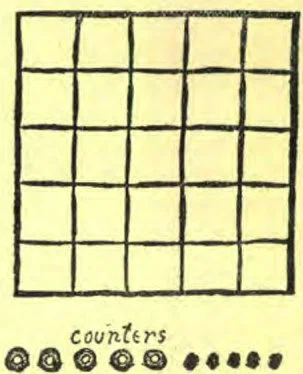
TAKE two boards about a foot square, divide each into twenty-five squares; get ten nuts and ten pebbles. Give to one player one board, five nuts, and five pebbles. She places these on the squares in any pattern she fancies, and when ready, the other player is allowed to see it for five seconds. Then it is covered up, and from the memory of what she saw the second player must reproduce the pattern on her own board. She counts one for each that was right, and takes off one for each that was wrong. They take turn and turn about.
Quicksight Game
This game wonderfully develops the power to see and memorize quickly.
Chinese Tag
This game is like the regular game of tag with this difference: the one who is tagged must keep her hand on that part which was hit when she was tagged, thus making only one free arm.—The Woodcraft Manual.
Showing Interest Before Expecting It
“Don’t expect interest if you are not ready to show it.”