THE healthy, happy infant or little child is the type of the most blissful and enjoyable condition which ever falls to the lot of mortals. Such a little one rejoices in the beautiful and pleasant things in this world. For its especial delight the bright sun shines; the moon at night and the stars light up the darkness for its especial enjoyment. It may even feel such a sense of possession of those beautiful things as to want to lay hold on them, and to desire its mother to give it the lamp, or climb up and bring it a star. It has full faith in every one around it, and not until it has been deceived does it begin to be haunted by doubt and unbelief. It loves the blue sky, the bright-colored flowers, and all things that speak of health and brightness. It is thus that the all-wise Creator would have human existence begin.
The little child is also a mirror of the words and actions of the home life, and no looking-glass, be it ever so perfect a reflector, can equal the plastic mind of infancy for absorbing and reflecting in after life either the bright, happy, loving home life, where peace dwelt, and all were kind and loving, or the home where fierce quarrels and discord made up the daily routine of words and deeds, where the little one soon learned that to escape punishment it must prevaricate and conceal its acts, especially if its parents or guardians were angry or out of temper.
This is often the first step in the wrong direction. From concealment soon comes direct falsehood. The little one who lives in a selfish home atmosphere will have a double life, and all manner of bad traits of character will grow with his mental and physical strength. He soon learns to deal out to others the same treatment that he receives. Knowing that he will deceive others if he can, he naturally thinks that others are trying to deceive and get the better of him. All this has not only a bad effect on the mind and morals, but it affects the physical being as well. The action of the heart is depressed, the digestion hindered, and assimilation and the building up of tissues become imperfect. The wastes are retained in the body because of the defective elimination, and an imperfect body is the result. When the mind is buoyant, and the hopes are stimulated by a prospect of present bliss and future enjoyment, it is like the stimulating effects of the spring sunshine to the animal and vegetable world.
Sunshine for the body, and sunshine of happiness in the heart are the birthright of infancy and childhood, if it is sought to cultivate healthy human plants. In this day of painstaking, scientific research to find the cause of every result, we often meet with the term “degenerate.” Often the word is passed over without a thought. What is it to be degenerate? — In one sense, the whole human race are degenerates from the perfect type in the garden of Eden. But even to-day there is an ideal of human perfection recognized as attainable, and deviations from this are said to be more or less degenerate,—less perfect in form and structure, weaker mentally, and more or less debased morally. In fact, a man’s degeneracy may be measured by the amount of injury he does the world he lives in, and the amount of evil influences he leaves to work after him.
Let the human plants, then, have their springtime of life and activity warmed with the sunshine of love and hope and faith. It is to prepare them to bring forth fruit to bless their fellow men in after life, and to forward the Master’s work in the earth. It is the time when the growing body should lay up a store of physical strength to fit it for its life work, and enable it to withstand all the harmful influences that tend to cause disease and to injure the human body.
Teach the children to respect the body and to treat it well because it is sacred, made to be the temple of the Holy Ghost. Teach them that it is their duty to be happy and active, to live to serve God and to help their fellow men. In the garden of Eden man knew only good. Because of his desire to know evil came the fall. Every child of Adam must sooner or later meet evil; but give the little ones a chance to become acquainted with all the good possible, so that they may have a reserve of health and strength and courage to make a successful battle of life’s warfare. Help them to improve body, mind, and morals. Talk to them of health and happiness, truth and beauty, and “whatsoever things are pure” and “lovely.” All these are the language of health. “A merry heart doeth good like a medicine.”
Who Is the Owner?
“You use tobacco?” said one man to another. “No,” was the answer, “tobacco uses me.” And a great many men might say, “Tobacco uses me, and is fast using me up.”
It is written that they who use this world, should use it as not abusing it. It is also desirable that this world be kept under control, so that it will not abuse the men who do abuse it. It is well to drive business, it is ill to have business drive you. Prosperity is good, but sometimes a prosperous business venture, a fruitful season, or a great wheat crop, has hindered the work of the Lord, excited people to extravagance, and has caused them to forget God and duty to his cause.
God has given man the earth that he may till the soil and earn his daily bread; but many men have added farm to farm and acre to acre, till they have worked themselves to death, and worked their wives to death, and worked their children till they were dead, or sick, or discouraged, and ready to curse the farm on which they had toiled as under a taskmaster, and to go anywhere to escape from such a house of bondage as their home had been.
Many a man wearies his life out “taking care of things,” which are of no earthly use to him or his.
When a man becomes thus entangled in this world’s gearing, there seems to be no stopping the machine. Thus a farmer takes his money and buys land, and raises corn, and feeds hogs, and makes pork, and sells it to get more money, to buy more land, to raise more corn, to feed more hogs, to make more pork, and get more money to buy more land for the same purpose; and so he goes on, until by and by it becomes a question whether the man owns the hogs, or the hogs own the man. Many a man works like a galley slave to tend and care for hogs, cattle, horses, mules, and donkeys,—being himself the biggest donkey of them all, a beast of burden, a servant of dumb brutes. He thinks he is their owner; in fact he is their slave.
Let men who have been bought with12blood, learn to whom they belong; let them sell and give alms, and sunder the fetters that bind them; let them break away from their beggarly bondage, and be no longer like the prodigal, feeding swine in a far-off land, but let them arise and go to their Father’s house, and live no longer as the bond-slaves of a passing and perishing world, but as the children of the King, heirs of God, and joint heirs with Jesus Christ,—as they who use this world without abusing it.—The Christian.
Should Women Train for Medical Missionary Work?
By Mamie Wilde Paulson
MAMIE WILDE PAULSON, M. D.
When a woman contemplates beginning a medical course, her reasons for so doing must differ somewhat from those which induce a man to take up this work. It would not be reasonable to suppose that women could take the place of men in this field. If a woman is called to the work of a medical missionary, some need must appeal to her which she recognizes as one that can be filled only by women; otherwise, why should not the medical profession be left entirely to men? It is not necessary for a woman to take up this trying and most responsible work in order to find an avenue through which she can help humanity. The woman who presides over a Christian home, and renders such assistance as she can to those about her who are in need, is doing magnificent missionary work.
Yet as we view the field, we must admit that there is a place for woman in medical missionary work. There comes to her ears the cry of the many thousands of women in foreign fields whom no man is allowed to help. They must remain within the inclosure, with body and soul sick, and yet no hand be extended to help them; or what is still more distressing, no one can come close enough to give words of sympathy and consolation. The lady physician can freely enter such homes, and impart to these women just the help that they need.
She also hears the cries of her helpless and discouraged sisters in the homeland. The woman who practices medicine in this country, yet, not seeing the many opportunities of coming close to the heart of her patient, whether she be of high or low rank, does not put new inspiration into her life, nor teach her better things about the care of her children, or about a more helpful mode of dress and better ways of preparing food, is failing to accomplish her mission. This opportunity is found not only among the poor and outcast of our large cities, but also in our sanitariums and medical institutions. How often have women said to me, “How glad I am that I can have a woman physician; it enables me to talk more freely and ask questions which I would not feel free to ask a man.” When once the door to the heart is opened, no one can measure the good that the truly consecrated missionary lady physician may be able to do.
However, the woman who enters a medical school feeling that, in order to be successful in her work, she must imitate the men in the profession, comes far short of accomplishing her work. We have met such lady physicians, and have felt that they were neither true ladies nor physicians. The young woman who enters our medical missionary college should so clearly feel the need which calls her to this work that during her course of training she will never for one moment lose sight of it. Such a one will accomplish much for her sisters that no gentleman physician could ever do.
Dr. Kate Bushnell, who was for many years a medical missionary in China, was a great inspiration to me when I first contemplated taking up this work; for she was a true example of what a lady medical missionary should be. No one could be in her presence for a few moments without receiving higher ideals and a greater inspiration. Yet she was a true woman among women, and at the same time she was a great physician.
If God calls you, my sister, into this work, do not waver for one moment, but seek to prepare yourself in the most thorough manner possible, and keep ever before you the great possibilities and opportunities that may be yours. If God does not call you into this work, do not enter it because it is popular, nor because of some fancied financial gain, nor because some friend urges you to do so.
The Contented Pansy
THERE is a story told of a certain king who had a large garden, and one day heard all the plants and trees talking together. They were all sad. The oak murmured because it could not bear sweet flowers, the rose lamented because she did not bear luscious fruit like the vine, and the vine was sad because it had to cling to a wall, and could cast no shadow of its own.
“I am no use since I cannot add sweetness to life,” said the oak.
“And I might as well die, as I cannot bear luscious fruit,” sighed the rose.
And the vine, more despondent than all, groaned wearily: “What possible good can I do in the world?”
Then the king looked round and saw a gay little pansy, which looked up and smiled, while all the other plants and trees were sad.
“What makes you so cheerful when all the rest are so gloomy?” he asked.
“I thought,” said the pansy, “that you wanted me here, for you planted me here; and because you planted me, I thought you loved me, so I just made up my mind to try to be the best little pansy that could be.” — Selected.
Satan's Winding Stairs: A Warning Against Compromise
MANY have yielded to go a mile with Satan who never intended to go two. He leads poor creatures down into the depths by winding stairs, and does not let them see the bottom, where they are going.—D. L. Moody.
Canning Vegetables
By Mrs. F. C. Rice
CONWAY, MASS., July 19, 1902.
EDITORS OF REVIEW AND HERALD: Seeing a request in the REVIEW for directions for canning peas and string beans for winter use, I will try to explain my method, which has proved very successful.
Fill the glass jars, either “Mason” or “Lightning,” with the peas or string beans, well shaken down to get in as many as possible, then pour in cold water until the jars are filled to the shoulder, which will be about three fourths of an inch from the top. Screw on the tops without the rubbers, and set in a kettle of cold water, bring to a boil, and continue boiling for two hours. Then take out one jar at a time, fill to the brim with boiling water, put on the rubber, screw on the top as tightly as possible, set back in the kettle of boiling water, and boil one hour longer.
When cold, put away in a dark place if you have one. As my cellar is light, and I have no dark closet in it, I wrap my jars in several thicknesses of newspaper to exclude the light, which I think hurts the flavor of either fruit or vegetables, even if it does not spoil them entirely.
For the benefit of any one who may never have canned fruit in the manner described, I will add more minute directions.
Any one having a number of cans ready at once can put them to boil in the wash boiler; but whatever vessel is used, there must be something put on the bottom so that the jars will not rest on it. Some put in a layer of straw. I have two iron spikes which I lay on either end of the bottom, and on which I rest a piece of board which fits easily into my boiler, then I put my jars on the board, and put in sufficient water to come about half way to the top of the jars.
Green corn scraped off the cob raw and put into glass jars, may be treated in the same way as the peas and beans, with the exception that it must be boiled four hours instead of two before the rubbers are put on, and one hour afterward, the same as the others.
A quicker way of preserving corn for winter, and one which I use, is to boil the corn on the ears for ten minutes, then, when cold, with a sharp knife cut off just the tops of the kernels, and scrape out the pulp, spread thinly on plates, put into a moderate oven with the door ajar, and dry thoroughly. When wanted for use, boil one hour, or more, in water, letting the water waste away, and before serving add cream or rich milk sufficient to suit. A large cupful of the dried corn will make sufficient for a family of six.
I hope this is explicit, and I desire to express my appreciation of other recipes found in our good paper, and am glad to be able to contribute my mite for the benefit of others. MRS. F. C. RICE.
[Other responses have been received, which have been sent to the sister who made the inquiry. This reply is printed for general information.—ED.]
The Gospel in China
By J. N. Anderson
J. N. ANDERSON
This great world empire, with a national history spanning millennia, occupying an area of the earth’s surface exceeding that of the United States, and teeming with one fourth of the world’s population, has come to be the problem of this generation politically and religiously. Here, beyond a peradventure, the temporal and spiritual forces will be arrayed for the last decisive campaign. As Napoleon once said, “When China moves, the world will move.” And what will the next great world movement bring but the rightful King and his kingdom?
THE GREAT WALL OF CHINA
Fifty years ago the world’s political center was Constantinople, and the equilibrium was maintained by guaranteeing the integrity of Turkey; and it must be admitted that it still ranks first as a strategic point. But while that is true, it is equally true that China, for so many thousand years practically unknown, stands to-day as a great center of interest and importance politically, and that its fate may in the near future be the cause of a changed map of both Europe and Asia. This is, however, a matter that lies beyond our ken, and we can only know for a certainty that God will stay or direct the winds of political strife in the interest of his own divine purpose—“this gospel of the kingdom.” And this is the aspect of the question which involves the most serious problems for our times, and with which we are in this study chiefly concerned.
The introduction of Christianity into China is by no means a modern event; and it is quite impossible for us to estimate the amount of gospel light that has been shed upon this ancient empire by different missionaries during the Christian era. A lithograph which tells of the introduction of the gospel into China before the end of the seventh century, may be seen in the Congregational House library in Boston. This was taken from a monument found in Singan-fu, a city in one of the northwestern provinces, where the Chinese court was then located.
A Nestorian tradition reads as follows: “By St. Thomas hath the kingdom of heaven taken unto itself wings, and passed even unto China.” The history of these Nestorian missions covers a period of about one and one-half centuries, between the early part of the seventh and the last part of the eighth centuries. From the monument already mentioned, it is seen that these missions were both popular and prosperous, so much so that several of the reigning emperors were favorable to Christianity; but after a time both Buddhism and Christianity were proscribed, and now nothing remains of the Nestorian missions except the monument of Singan-fu.
After this reaction in China against foreign religions, it was not until the eleventh century that missionaries again sought to enter the land of Sinim. The mission established at this time lasted about four hundred years, being overthrown by the infamous Jenghiz Khan, who, by his bloody conquests, caused the destruction of five million human beings, and so won for himself the distinction of being called a scourge of the earth.
A second mission was started among the Tartars north of the Hoang-Ho and east of the Caspian Sea, who were nominally made Christians by their ruler, who sent to Bagdad for Nestorian missionaries. As a result of this enterprise, a large Nestorian church was established, claiming a membership of two hundred thousand among the Tartars. This work flourished until it was swept away by a flood of destruction brought on by Tamerlane, 1334 to 1405.
Our first modern knowledge of China comes to us from a follower of Francis Assisi, one John of Planocarpini (1245) who at the age of twenty-five made a journey of ten thousand miles through central Asia.
Kooblai Khan, the most famous of Mongolian emperors, the patron of Marco Polo, the Venetian, removed the capital to Peking, in 1282; and although he was not a Christian, nevertheless he showed his interest in the gospel by sending to the pope for one hundred learned men to come to China and preach the Christian religion and instruct in Western knowledge, but the quarrel over the election of a new pope delayed the matter until Rome’s opportunity was passed.
About this time, however, John of Monte Carvino, who is called the Apostle to the Moguls, at the age of fifty years inaugurated a great work in Peking. He mastered the Chinese language , translated the Psalms and the New Testament, and at the same time opened numerous schools in the Chinese capital. A generation after his death the work he started was well-nigh obliterated by a severe persecution following upon the overthrow of the Moguls in China.
Modern missions in China date from the year 1582, when the learned Jesuit, Father Ricci, and his associates opened a vigorous crusade. Zeal, earnestness, tact, and learning all combined to give them a large measure of apparent success; and there was even a prospect that the great Emperor Kanghi would adopt the new faith. Ricci’s knowledge of mathematics and his ability to draw beautiful maps gave him a warm place at court. With rare skill he decorated his maps with Bible texts and symbols, and asked the privilege of preaching Christianity as the only price of his maps. He supplemented his preaching with literature, and his success was so great that descendants of his converts are still to be found in China. The good effect of this mission enterprise was seriously lessened by the entrance of other rival Catholic societies, and the contradictory decisions and conduct of the popes of that period; and over and above all, their teachings and practices were then, as now, corrupt and superstitious.
In 1724 an edict forbidding the propagation of the Christian faith was issued by the emperor Yung Cheng. This edict was called forth by the fierce antagonisms of the religious orders, and, by the contradictory decisions of the popes, as already mentioned. A few missionaries concealed themselves, but most of them were sent out of the country. This brings us to the year of modern missions as carried on by Protestant missionaries and societies.
Hongkong, China.
A Visit to Saba
By A. J. Haysmer
A. J. HAYSMER
Saba belongs to the Dutch government, and is a rocky island about nine miles in circumference, rising abruptly from the sea to a considerable height, the highest peak being about three thousand feet.
The latest statistics give the population as about twenty-five hundred. They are mostly white, and live in five small villages.
The majority of the men are sailors, and are away from home most of the time. The women make straw hats, drawn needlework, raise fowls, etc. Milk, eggs, and onions, as well as tropical fruits and vegetables, are abundant. The climate is almost perfect.
In going from the other West Indies to Saba there are a few things that especially impress the visitor,—the industrial habits of the people, their neat homes, their hospitality, and a higher standard of morality. Most of the people belong to either the Anglican or the Roman Catholic church.
Within the last two years a sect of14no-law missionaries has been working there, and has succeeded in perverting the Bible truths, and in securing quite a following.
May 6, Brother and Sister S. A. Wellman and the writer started from St. Kitts in a small sloop to visit the island of Saba, about thirty-five miles to the westward. We had had many invitations to visit this place, but could not do so before. We landed about three o’clock in the morning, and walked up a steep, rocky path about one and one-half miles to the home of Brother James Hassel, the only representative of the third angel’s message in the island.
THE PRINCIPAL VILLAGE ON THE ISLAND OF SABA
This brother accepted the truth about two years ago, while engaged as a captain on one of the Royal Mail Steam Packet Company’s coast steamers at St. Lucia. In order to live the truth, he had to resign his position. He returned to his home in Saba, and began to clear off and work the rocky soil in order to provide food for his family. He has had many hardships and trials, but has stood firm, knowing that the reward is almost in sight. He has been preaching the truth not so much by words as by a quiet, godly life.
We found a comfortable house in readiness for us, and appointments out for meetings. We remained about thirteen days, having from two to three meetings daily in the best homes in the island. We could not begin to fill the calls to visit and hold meetings. We took our small organ with us, from village to village. We sold several dollars’ worth of our small books, and distributed tracts and leaflets.
The governor attended every meeting that we held in his village (shown in the accompanying illustration), and gave us an urgent invitation to return as soon as possible.
We believe that the Lord has honest souls in this island, and we were reluctant to leave; but other work demanded our attention, so we had to go, promising either to return or to send some one as soon as possible.
Many of these little islands are unwarned. How important that we hasten to bring this last message to them, that they may have an opportunity to accept it before being cut off by the terrible visitations that threaten all of these islands.
May we have your prayers and support for the work in this field?
Canvassing in the River Plate Conference
By N. Z. Town
N. Z. TOWN
Ever since we returned to this field from the last General Conference, it has been our purpose to revive the canvassing work, if possible, and we have always believed it possible. But with our general meetings, visiting the churches to become acquainted with them, making out our yearly reports, etc., the time has passed, and only recently have I been able to take up the canvassing work.
The canvassing that has been done in this field has been principally among foreigners; namely, Englishmen, Frenchmen, Germans, and Scandinavians. The impression has prevailed that among the Catholic Spanish-speaking population very little could be done in selling books. While it is true that one finds it more difficult, especially with our large books, yet we believe that there is success for the canvasser even here in these Catholic countries.
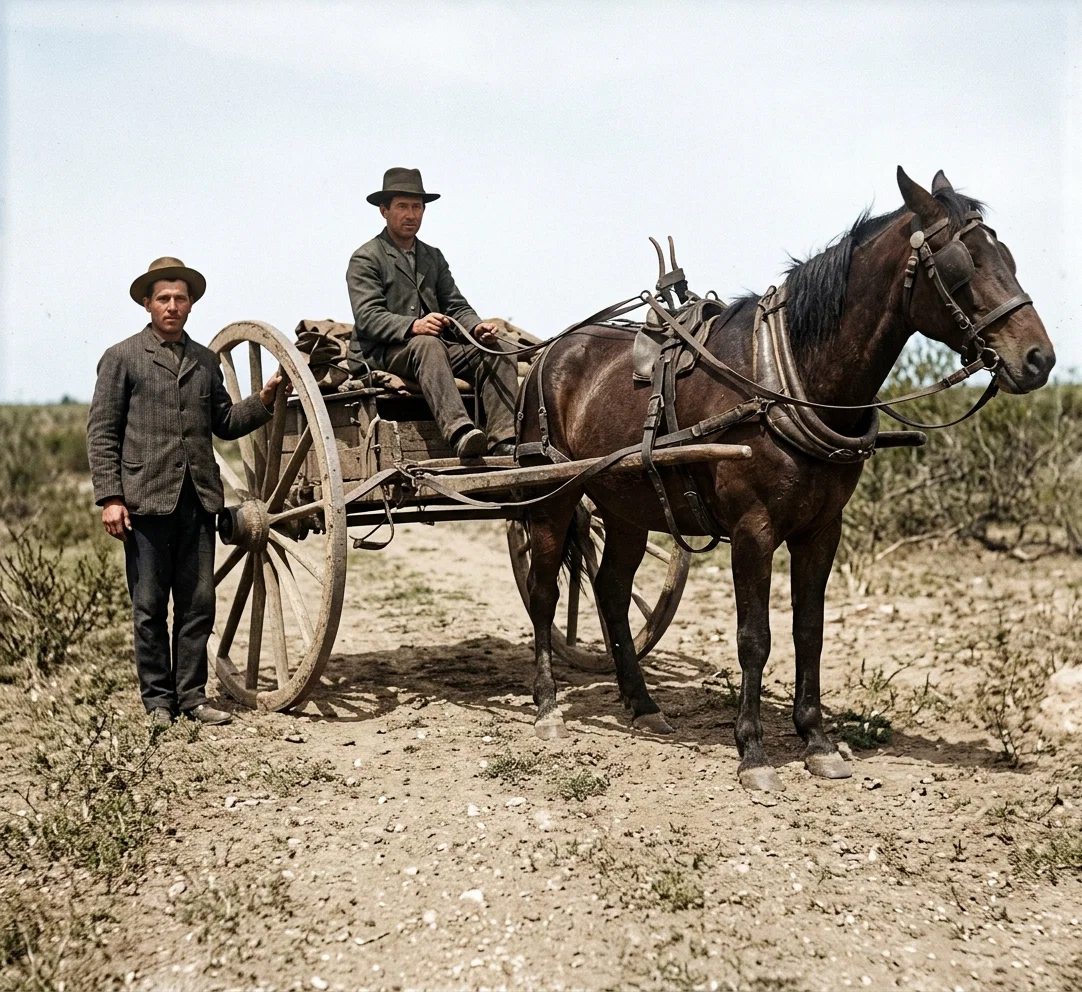
The first attempt in this work since we returned, I made recently in Uruguay in company with Brother Luis Ernst, one of our native laborers. We worked together two days and a half in the country, principally among Italians, with horses and cart, taking with us a supply of “Christ Our Saviour,” “Steps to Christ,” “Gospel Primer,” and a quantity of tracts and Testaments, all in Spanish. During the time mentioned we sold for cash twelve copies of “Christ Our Saviour,” three of “Steps to Christ,” five of “Gospel Primer,” two Testaments, and several packages of tracts. Our receipts were $12.40, gold. This is small in comparison with what our canvassers at home do; but under the circumstances, we feel much encouraged. With the proper training, we see no reason why our canvassers here may not continue to meet with as much success as we had during the time we were together.
The accompanying picture shows the “rig” with which two of our colporteurs worked for some time. The one Brother Ernst and I had was similar, except that the horses were not so thin. Our supply of books we carry behind and under the seat.
On account of the long distances between houses, and also the state of the roads, lack of bridges, etc., it is not practicable to canvass in the country here on foot. Then, too, we find that the most successful way to work is to carry a supply of our small books, and sell for cash as we go. To do this kind of work, our canvassers need horses and wagons. We have determined to make a special effort to push this branch of the work, but at the outset the question of how to supply the canvassers with the necessary outfits confronts us. Besides the horses and wagons that are needed, there is a tax to pay on each wagon, and another tax for the privilege of selling. The young men who desire to give themselves to this work are not able to meet all these expenses, and must have help from some source. I have already presented this matter to some of the churches here, and the brethren are willing to help as far as they are able. We shall have no difficulty in getting all the horses we need from among the brethren here. As vehicles suitable for this work are all imported, and consequently are very dear, we have requested the Mission Board to send us three good, strong buckboards in case contributions come in to pay for them. We believe that some one will respond.
In a few months, when our school closes, several young men will be ready to enter the work. We hope to be prepared to set them all at work as soon as they leave school.
The Dwarfs of Central Africa
The Rev. Melvin Fraser tells of an interesting visit he paid to a dwarf village, and gives the following interesting particulars regarding these people: “In conversation I learned that parts of three tribes made up the company, each tribe retaining its own head man. There was a large proportion of children. A new-born babe in her mother’s arms was the smallest specimen of humanity I ever saw. Some of the adults were of fair size, but the average was decidedly small of stature. An average-sized woman did not touch my arm held horizontally over her head. There was no uniformity of color. Some were quite black, but more were of a full-stone brown. They had a cast of countenance not common. They seemed impressionable and responsive, had a kindly bearing, and seemed clannish and fond of one another. They wear fetish amulets. They hunt game, utilize crude growths of the bush, and15are said to stay much up in trees hunting food, both animal and vegetable. All fear and distrust on the part of the dwarfs of this camp seemed to be removed. On account of this and the goodly number whom I was able to reach in one place, the opportunity was a rare one for giving these quaint little sons and daughters of the wild bush a gospel message. For the first time in Africa I offered prayer through an interpreter, during which some of the adults covered the eyes of some of the children with one hand and their own with the other. When I had said good-by and was walking out of town, one head man was dramatic and vociferous in repeating the good-by and telling me to ‘walk well.’” — Faithful Witness.