The Youth’s Instructor, Vol. 33, No. 12.

THE CHRIST-BEARER

The Youth’s Instructor

Apr 8, 1885

S. D. A. Publishing Association · Battle Creek, Mich. · Apr 8, 1885

THE CHRIST-BEARER.

THERE does not seem to be much in a name now-a-days. In the good old times, when folks lived more simply, children were given names that had some meaning to them; and frequently after-life proved them to be most fitting. Let us see how one name got its meaning.
As the legend runs, Offerus, a great giant, who was stronger than all men living, determined to work for no one who acknowledged a superior. He served in turn all the kings of the earth, but he found the mightiest of them afraid of the devil. And the devil trembled at the name of Christ. So Offerus searched the land for Christ, whom all powers revered; but he could not find him, for there were few who had the love of him in their hearts. He at last built him a hermitage by a deep, swift river, and tried to serve the Christ by carrying weary pilgrims across the bridgeless stream. One wild night, he heard a plaintive voice calling. He crossed the swift torrent, to find on the farther side a fair-haired child, holding in one hand a cross, and in the other a globe. Lifting the little one up on his broad shoulders, the kind-hearted giant started across. The light burden grew heavier and heavier, till it seemed that both must perish in the flood. As he staggered up the bank, he found that he had borne on his shoulders the master he had so long looked for,—the Saviour of the world. Then men called him no more Offerus, but Christopher, or Christ-bearer.
In a magnificent seaport of Italy, called Genoa the Superb, was born in the early part of the fifteenth century a boy named Christopher Columbus. Now we will find out how he exemplified the meaning that attaches to the name Christopher, and how he made it famous for all time.
He had learned from the few voyagers who had ventured around the southern point of Africa, that to the far east lay a country of exceeding magnificence. The half of its riches could not be told. There were said to be mountains of turquoises, lakes of pearls, and rivers whose beds were spangled with gold. Such was the far Cathay,—the land from which Columbus thought Solomon must have obtained his wealth.
Everybody believed that there was such a land. The great problem to be solved was to find a short and easy way to this wealth. Most people thought that the world was flat, and that if any one traveled far enough, he would come to the end of it. “If the world were round,” they sneeringly said, “the men on the opposite side of the globe would of course have to walk with their heels above their heads; trees would grow downward; and rain and snow fall upward. Such things were impossible.”
But Columbus had broader views; he firmly believed that the earth was round, and that if he sailed westward, he would a great deal more quickly reach this land of promise than by sailing east.
He was exceedingly anxious to reach this country. The fabulous wealth had some attractions for him; but it was not alone the love of gain or the hope of glory that impelled him to so hazardous an undertaking as to sail in the frail crafts of those days across unknown seas. He was a very devout man, and a diligent student of the Bible. He believed that there were millions of souls on the other side of the wide waters, who were wholly ignorant of Christ; and that God had laid on him the burden of carrying to them the glad tidings of a Saviour born. He was to be the “Christ-bearer” to those who had no knowledge of Him.
His share of the wealth that he hoped to find was all to be used in raising armies to rescue the holy sepulchre from the hands of the infidel Mohammedans. “Before the end of the world,” he said, “all the prophecies must be fulfilled, the gospel must be preached all over the world, and the holy city restored to the Church.”
It was this faith that made him persevere in the face of ridicule; this faith that sustained him while a humble suppliant at the courts of kings. In poverty and obscurity he toiled on for eighteen years. When one court refused to listen longer to his appeals, or to grant him aid, he turned, undaunted, to another. He would not give up. He had faith of the kind that removed mountains.
He did not find the eastern coast of India, neither did he find the wealth he looked for. He found, instead, a land rich in resources, but uncultivated, and inhabited by wild savages whose language he could not understand. He was a “Christ-bearer,” but not in the sense that he expected to be. There were no highly civilized people, waiting for some one to bring them the Light of the world—only the savages, and an unknown country. But he opened the way for others to follow, and lay the foundations for a broad republic, where liberty of conscience might be vouchsafed to the people.
W. E. L.

THE STORY OF ULEDI.

THE poor Africans are much abused, and often treated as if they had no noble elements of character, and were more like animals than men. Mr. Stanley tells a story which shows quite the contrary. In his heroic journey across Africa, with his faithful band of followers, he arrived at Mowa, on the Congo River, sad, weary, and anxious; for they had little food left, and their supply of beads and cloth for buying things of the natives was nearly used up. He was therefore much distressed, one day, to discover that a large bag had been opened, and nearly all the beads stolen! He still more grieved to find, on inquiry, that the culprit was Uledi, the coxswain of the boat—a brave, generous man, much beloved by the others, several of whom he had rescued from drowning.
A council was called to determine what should be done to the man who had committed such a crime, and at such a time, when the lives of all depended on these stores. “It is a hard case,” said Manwa Sera, when urged to give his views of the matter; “for this is Uledi, whom we all love. Had it been another, I would have said we should hang a great stone to his neck, and pitch him into the river. But it is Uledi; let him receive a thorough flogging, to deter others from repeating the crime.” Many agreed to this, and cried out for “flogging.”
Then Stanley turned to the boat’s crew, and said, “Now you, boys, who know Uledi so well, and have followed him through a hundred rough scenes, speak. What shall be done with him?”
Mpwapwa, one of the most reliable and steady men, replied: “Well, master, it is a hard question; Uledi is like our elder brother. I think he should be beaten—only, master, for our sakes, beat him just a little!” Another, who had special reason to be grateful to the culprit, assented to this; but he added, touchingly, “Remember, it is Uledi.”
Shumari, Uledi’s younger brother, a kind-hearted boy, was next appealed to, and after pleading earnestly, concluded by saying, “But please, master, as the chiefs say he must be flogged, give me half of it; and knowing it is for Uledi’s sake, I shall not feel it.”
Last of all, the question was put to Saywa, his cousin, who threw himself at Stanley’s feet, and said, “The master is wise; all things that happen he writes in a book. The master forgets nothing. Perhaps if he looks in his book, he may see something about Uledi,—how he saved many men; how he worked harder than any; how he has been the first to listen to your voice always; how he has been the father of the boat-boys. Uledi is my cousin. If, as the chiefs think, he must be punished, Shumari says he will take half the punishment; then give Saywa the other half, and set Uledi free.”
Stanley could not but consent to these touching requests, and said, “Uledi, by the voice of the people is condemned; but as Shumari and Saywa have promised to take the punishment on themselves, Uledi is free!” And feeling unable to punish the two substitutes, he added, “Shumari and Saywa are pardoned.”
Uledi, on being released, came forward penitent and humbled by the conduct of the two generous-hearted boys. “It was the devil which entered into Uledi’s heart. Uledi will be good in future; and if he pleased his master before, he will please his master much more in time to come.”
“Thus Jesus took the sinner’s place, To set the sinner free; And God provided, by his grace, A substitute for me. Then, Lord, released from Satan’s power, In humble, joyful love, Help me to serve thee every hour, My gratitude to prove.”
—Missionary Review.

MARCH

THE stormy March is come at last, With wind, and cloud, and changing skies; I hear the rushing of the blast, That through the snowy valley flies.
Ah, passing few are they who speak, Wild, stormy month! in praise of thee; Yet though thy winds are loud and bleak, Thou art a welcome month to me.
For thou, to northern lands, again The glad and glorious sun dost bring; And thou hast joined the gentle train; And wear'st the gentle name of Spring.
And in thy reign of blast and storm Smiles many a long, bright, sunny day, When the changed winds are soft and warm, And heaven puts on the blue of May.
Then sing aloud the gushing rills In joy that they again are free, And, brightly leaping down the hills, Renew their journey to the sea.
The year's departing beauty hides Of wintry storms the sullen threat; But in thy sternest frown abides A look of kindly promise yet.
Thou bring'st the hope of those calm skies, And that soft time of sunny showers, When the wide bloom, on earth that lies, Seems of a brighter world than ours.
— W. C. Bryant.

THE WAY TO GROW WISE.

After reading a book, or an article, or an item of information from any reliable source, before turning your attention to other things, give two or three minutes’ quiet thought to the subject that has just been presented to your mind. See how much you can remember concerning it; and if there were any new ideas, instructive facts, or points of special interest that impressed you as you read, force yourself to recall them. It may be a little troublesome at first, until your mind gets under control and learns to obey your will; but the very effort to think it all out will engrave the facts deeply upon the memory, so deeply that they will not be effaced by the rushing in of a new and different set of ideas; whereas, if the matter be given no further consideration at all, the impressions you have received will fade away so entirely that within a few weeks you will be totally unable to remember more than a dim outline of them.
Form the good habit, then, of always reviewing what has just been read. It exercises and disciplines the mental faculties, strengthens the memory, and teaches concentration of thought. You will soon learn, in this way, to think and reason intelligently, to separate and classify different kinds of information; and in time the mind, instead of being a lumber-room in which the various contents are thrown together in careless confusion and disorder, will become a store-house where each special class or item of knowledge, neatly labeled, has its own particular place, and is ready for use the instant there is need of it.—St. Nicholas.

WALKS ABOUT BOSTON.—3.

Another of the most noted buildings in Boston is Faneuil Hall, universally known as the “Cradle of Liberty.” It stands on Dock Square, not far from the Old State House. It was built in 1762, and was used by the city for public meetings. Here the old patriots met, and listened to revolutionary speeches by the leading men of the day. On these floors have stood many of the great orators of the last hundred years.
The most conspicuous object in Boston is Bunker Hill monument, towering high above everything else. It was erected to commemorate the celebrated battle of Bunker Hill, the first real battle of the Revolution. It stands in the center of Monument Square, on Breed’s Hill, where the embankment was thrown up by the Americans, on the night before the battle. It is two hundred and twenty-one and one-sixth feet high, built of granite. The base is thirty feet square, and the column tapers gradually to fifteen and two-fifths feet at the top. It is ascended by winding stairs on the inside, consisting of two hundred and ninety-five stone steps. It is a long and tiresome undertaking to climb up these two hundred and ninety-five steps, lifting one’s self two hundred and twenty-one feet straight up! I presume that Fred and Herbie, and May and Minnie think they could run up them in a jiffy. But I have seen some of these little folks try it. Their zeal and their little legs give out at about the one hundred and fiftieth step. Panting and dizzy, you hear them say, “O my! its an awful ways up. How high is it yet!” Then they want papa to help them. But once up there, it pays for all the effort. You find a chamber eleven feet square, from which you have a grand view of the city and bay, the rivers, and the surrounding country.
Here are cannon from the Revolution, with other ancient things. The corner-stone of the monument was laid by Gen. Lafayette, June 17, 1825. Daniel Webster was the orator. At its foot is a slab marking the spot where Gen. Warren fell. I was much interested in the old burying grounds, some of the oldest of which are situated right in the heart of the city. King’s Chapel burying-ground is the oldest one. It is in the busy part of the city, crowded on every side, lying under the shadow of the quaint old chapel, where meetings were held in those olden times. Here lie the ashes of some of the first inhabitants of Boston, John Winthrop, the first governor, being among them.
The Old Granary burying-ground, on Fremont street, dates from 1660. It contains the graves of many of the famous men of the Revolution. Here lie the parents of Benjamin Franklin, the five victims of the Boston Massacre of 1770, eight of the early governors of Boston, and Paul Revere. Who has not heard of the famous ride of Paul Revere? When did he take that ride? and what was it for? It had much to do with that memorable fight at Concord and Lexington. Three of the signers of the Declaration of Independence lie here,—Hancock, Adams, and R. T. Paine.
The tombstones are of blue slate, old, weather-beaten, and moss-covered. It is with difficulty that you can read the inscription upon them. Many of them have stood there over two hundred years. Standing here in solemn meditation beside the silent dead, the illustrious men of two hundred years ago, one deeply realizes the shortness of life, the certainty of death, and the vanity of the world. “We die, we perish, we all perish.” Num. 17: 12. How many of these dead will come up to live with God? That is the all-important question.
In Copp’s Hill burying-ground there are stones bearing date of 1625,—two hundred and sixty years old. Here stands a willow brought from Napoleon’s grave at St. Helena. Who was Napoleon? Where is St. Helena? And why was he there? The British soldiers used to fire bullets at these gravestones, the marks of which can still be seen on them. Besides these, there are several other burial grounds, most of them of later date.
D. M. CANRIGHT.

SMALL COURTESIES.

“HARRY is such a polite little boy, mother,” said his sister Carrie. “He never pretends to be any better than the others at school, but someway he is the politest one of all.”
“How did you find it out?” asked Mrs. Brown. “How do you know that he is more polite than Joe Eller, Charlie Graves, or Will Mead?”
Carrie thought a moment, and then declared she didn’t know how it was; but still she insisted that her brother Harry was the most polite of all the boys at school. “And all the other girls think so too,” she said confidently.
Her mother was pleased to hear her boy praised so generously by his sister.
“I want you to notice to-morrow,” she said, “what great thing it is that Harry does to win your praise and that of the other girls. Will you, Carrie?”
Carrie was ready to do as her mother said, and, to tell the truth, a little curious herself to find out how Harry had won the title of “the politest boy in school.” The next day her eyes and ears were prepared to prove that she had been right in what she said.
Some of the scholars were gathered near the fire, just before the time for school to open. Half a dozen of the boys came rushing in from out of doors, bringing a gust of cold air. The girls shivered, and one of them remarked pettishly, “Boys always leave the door open.” Before the sentence was finished, Harry Brown, who was at the other end of the room had sprung to the door, and it was closed quickly and gently.
“That wasn’t much to do,” thought Carrie.
While the geography lesson was going on, the teacher had occasion to reprove a pupil at the back of the room. Instantly, as if by clock-work, the scholars turned around to see who it was, increasing the discomfort of the offender—all but Harry, who kept his eyes on his book. Carrie noticed this.
After recess, the boys and girls came trooping into the school-room. Harry was just ahead of Carrie and her friends; and as they reached the door, he held it open for the girls to pass in first. Carrie saw the pleased looks of her school-mates, and heard one of them say to another,—
“There isn’t another boy in school who would do that!”
Before the day was over, Carrie had noticed that her brother always said, “Thank you,” for any little kindness; that he did not interrupt the teacher; that he did not contradict others; that he was willing to do anything asked of him, without grumbling; and that he was ready to offer his services when they were needed.
“I think I know how it is, mother,” she said when she reached home, “that Harry has won his good name. He is courteous in small things.”
“And those make up life,” responded her mother.—Selected.

BEAUTIFUL

BEAUTIFUL feet are those that go On loving ministries to and fro.
Beautiful arms are those that bear Burdens for those who are pressed with care.
Beautiful hands are those that give Blessings to those who in poverty live.
Beautiful lips are those that speak Words to comfort the sad and weak.
Beautiful brows are those that wear Virtue’s signet engraven there.
Beautiful deeds are those that tell That the Spirit of Christ in the heart doth dwell.
Beautiful lives are those that shine With love for the holy, the pure, divine.
Beautiful angels such beauties see, And chant them over the jasper sea.
Beautiful mansions the Lord will give To those who beautiful lives will live.
J. M. HOPKINS.

IMPORTANT BIBLE SUBJECTS.

LESSON 39.—INHERITANCE OF THE SAINTS.

CONTINUED.

[NOTE TO THE STUDENT.—Do not consider the lesson learned until you can give at least the substance of every text, with the correct reference for each. The references in black letters indicate those texts that should be committed to memory. A little diligent application each day will enable you to do this.]
  1. WHAT did Adam lose by his transgression?
  2. By whom is the dominion to be restored? Give the proof already learned.
  3. State another result of Adam’s transgression? Rom. 5:12.
  4. Who has the power of death? Heb. 2:14.
  5. Then what did Adam receive from Satan, as the price of his dominion?
  6. What, then, was the curse which Adam’s sin brought on the human race? Rom. 5:12.
  7. Besides recovering the lost dominion, what else does Christ do for man? 2 Tim. 1:10.
  8. By what means does Christ destroy death? Heb. 2:14.
  9. Who alone are freed from this curse? John 3:36.
  10. In consequence of Adam’s sin, what was pronounced upon the earth? Gen. 3:17.
  11. What was this curse? Verse 18.
  12. In order to redeem man from his curse, what was it necessary for Christ to undergo? Gal. 3:13.
  13. Then if Christ redeems the earth from its curse, what must he also bear?
  14. How and when did Christ bear the curse of the earth? Matt. 27:29, 30.

NOTES.

SATAN has the power of death. Heb. 2:14. It was he who tempted our first parents to sin (Gen. 3), by which they brought death upon the whole human race. So it may truly be said that they exchanged their beautiful dominion for death. They went into the service of Satan, and he gave them all that he has to bestow.
In order to redeem man from this curse, Christ endured the same curse (Gal. 3:13; Heb. 2:14, 15); so in order to win back the dominion which man had forfeited, he bore the curse (Matt. 27:29, 30) which man’s sin had brought upon the earth.
AFTER all, there is no book but the Bible to give us real knowledge or real comfort concerning the things of God. The relative value of other writings on spiritual themes is according to their power in bringing us back to the sure word of God for instruction and cheer on the points at issue. If we put any dependence on uninspired words about matters of which the Bible treats, we misuse them. Their value to us depends on their not being overvalued. When Boswell asked Dr. Johnson what harm there was in conjecture about the employments of heaven, the gruff old sage replied, “Sir, there is no harm. What philosophy suggests to us on this topic, is probable: what Scripture tells us, is certain. Dr. Henry More has carried it as far as philosophy can. You may buy both his theological and philosophical works, in two volumes folio, for about eight shillings.” And that was a good statement of the case. All that the wisdom of this world tells us about the future life is worth about “eight shillings.” That which God has disclosed to us in his book is of such value that when a man realizes its worth, for joy thereof he goeth and selleth all that he hath, and buyeth that knowledge.—S. S. Times.
THAT balky horse that delayed forty or fifty cars on a city horse-railway the other day was a great success as a hindrance, and yet at his proper work of pulling he had not strength enough to draw a single car. What a good illustration of the hindering power of a balky teacher! His power to advance the school by direct effort may be very small, but his ability to hinder the progress of others may be very great. The best thing to do with the balky worker in any department of Christian activity is to put a good substitute in his place,—and the sooner the better.

WHEN MATCHES CAME INTO USE

Written for the INSTRUCTOR.

WHEN MATCHES CAME INTO USE.

[Every boy and girl knows how to strike fire with a match; but it is not every one who knows how to do so without one. It is not every one who knows the early history of matches. To look at, a match is a very simple contrivance; but being made of material that catches fire readily, and that will burn until it is consumed, it is of great value to the human family. Matches are now in such common use you may never have thought that less than a century ago, when your parents or grandparents were young, these little “fire-bringers” were not in use in this country. An elderly gentleman, who loves to read the INSTRUCTOR, and who has an interest in all its youthful readers, has written out for you what he knew about matches many years ago, when he was a boy.—ED.]
It is said that the lucifer match was invented in 1829, by Mr John Walker, a chemist in England; but the first matches I ever saw were made by a man who was fishing on the shores of Lake Champlain, fifty-three years ago, or in 1832. They were inclosed in a round, paper box, one and one-fourth inches in diameter, and four or five inches long. Each box contained about twenty matches, or little sticks, one end of which had been dipped in brimstone. It also contained a small vial of phosphorus, into which a match would be thrust instantly, and withdrawn as quickly, blazing. It was necessary always to cork the vial immediately after withdrawing the match, or the phosphorus would soon lose its strength, or power to ignite the match.
One year afterward, at a jeweler’s store at Burlington, Vt., I obtained a small pasteboard box of imported matches. Upon the box there was a label attached, warning everybody not to imitate or make anything of the like. No penalty was attached, and none could be; for we were a free and independent nation. There was a piece of sandpaper in each box, to be used in lighting the matches; but some of them were so poor they would not burn; hence these imported matches were but little better than those first described.
In less than a year, matches of American manufacture appeared; and though poor at first, they have continually improved, until now there is scarcely one among the thousands made that will not ignite at the first scratch.
Previous to the manufacture of matches, other methods of striking fire were common. One was the use of a piece of steel crooked to the hand, with a flint, and tinder. Punk, or rotten wood, was generally used as tinder, because it would catch the spark quickly. In the absence of the crooked steel, a jackknife served the same purpose.
At other times a gun with a flint-lock and powder were used to bring fire. Arrangements would be so made that when the powder flashed, it would catch into tow, and then into paper or fine splints, ready for further service.
About the time matches came into use, percussion caps began to be used; but, like matches, some were poor; and to the chagrin of many a hunter, his game was frequently out of his reach when he felt most sure of seizing it. I am now aged, and have not used a gun much in many years; but I presume gun caps may have become as perfect as have matches.
HENRY HILLIARD.

WHERE DO THEY COME FROM?

WHY are the toads so plentiful after a thunder shower? All my life long, no one has been able to answer that question. Why, after a heavy shower, and in the midst of it, do such multitudes of toads, especially little ones, hop about the gravel walk? For many years I believed they rained down, and I suppose some think so still. I asked an explanation of this of a thoughtful woman. Her reply was that toads came out during the shower to get water. This, however, is not the fact. I have discovered that they come out not to get water. I deluged a flower-bed the other night with pailful after pailful of water. Immediately the toads came out of their holes to escape drowning, by tens and twenties and fifties. The big ones fled in a ridiculous streak of hopping, and the little ones sprang about in the wildest confusion. The toad is just like any other land animal; when his hole is full of water, he quits it.—Charles Dudley Warner.

A BRAVE LITTLE DAUGHTER.

THERE is a pretty little story by Miss Strickland, in her “Queens of England,” of a little girl who saved her father’s life.
It was in the time of Queen Mary, and Lord Preston, the father of the child, was condemned to death for conspiring to bring back the exiled King James to the throne. Her name was Lady Catherine Graham, and she was only nine years old. The poor child was, during the trial of her father, left in the Queen’s apartments in Windsor Castle. The day after the condemnation of Lord Preston, the Queen found little Lady Catherine in St. George’s gallery, gazing on the whole-length picture of James II., which still remains there. Struck with the mournful expression on the young girl’s face, Mary asked her hastily what she saw in that picture which made her look on it so particularly.
“I was thinking,” said the innocent child, “how hard it is that my father must die for loving yours.”
The queen, pricked in conscience by this artless reply, immediately signed the pardon of Lord Preston.

Seeming Good Versus Being Good

Now the best way in the world to seem to be anything, is really to be what we seem to be. Besides that, it is many times as troublesome to make good the pretence of a good quality as to have it; and if a man have it not, it is ten to one but he is discovered to want it, and then all his pains and labor to seem to have it are lost.

A CHAT WITH THE LITTLE ONES.

Do our little friends remember how glad they all were a few months ago to see the first snow and ice? Out came their sleds and skates, and they have had many a fine time coasting and skating. Not much did they mind cold toes and fingers when engaged in such sport.
But the cold weather has lasted so long you are tired of this kind of play, and we hear you wishing spring would begin. Well, March is the first spring month, and in a very few days more it will be gone, and April will be here with its spring showers, to start the May flowers. As the days grow longer, they will become warmer. Spring has already come; and spring weather, spring flowers and the little birds are just now knocking at the door. If ever we welcomed these visitors, we shall surely all do so now.
All who pattern after nature are very busy at this time. If, as we hope, you are going to have a little flower and vegetable garden, there is much to be done, surely. Didn’t you succeed very well last year? Well, perhaps you did not begin early enough to make your plans. It is true you gain nothing by putting your seeds into the ground until it is warm enough to make them sprout quickly; but there is much work of preparation to do,—getting the soil ready, and studying up the best way to cultivate this and that flower and vegetable. If this work is put off until garden time, you will get confused, and make failures.
Perhaps the trouble was that you did not give your garden enough care after it was planted. Very much depends upon that. But when you do succeed in making a fine garden, you will be delighted, and every member of the family will enjoy it with you. A little experience will make good gardeners of any who are determined to be such, just as it makes one perfect in anything else.
Talking of making your gardens grow, makes us query how many of our little boys and girls are growing, themselves. You know you don’t have to wait until warm weather before you can grow, as the trees and plants do; but in cold or heat, with proper care, both body and mind may grow. But it is the mind and soul growth we are querying about. During the long, cold winter, have you been cultivating the graces? Have you become better and wiser each day?
Some day the books will tell; so be very thorough, and do this work so well that there will be no failures discovered after harvest. Seek the Lord to have the heart soil mellowed, and the good seed quickened by his Holy Spirit, that you may be plants of your heavenly Father’s planting, and so never be plucked up.
When you write for the Budget, we would be glad to have you tell how your two gardens are thriving. Tell us, too, what difficulties you meet with, and may be we can help you. May the Lord bless you all! M. J. C.

Letter Budget.

ADA A. DICKERSON writes from Morrow Co., Ohio. She says: “I am eight years old. My papa and mamma don’t keep the Sabbath. I go with my uncle and aunt to Sabbath-school nearly every Sabbath. I like to go very much. My lesson to-day was about Moses in the land of Midian. I gave a synopsis of it. I read in the Third Reader.”
The Sabbath-school is a good place, Ada, and we are glad you love to attend it; but above all, we hope you may there receive instruction which will make you shine as a star in the kingdom of God.
OLLIE MUSSELMAN writes from Auglaize Co., Ohio. She says: “I am a little orphan girl, eleven years old. I was at the orphan asylum last April. I came to live with two old people that I like very much. I call them pa and mamma. My new mamma is a Sabbath-keeper. I go to Sabbath-school with her, and study Book No. 2. I want the INSTRUCTOR family to pray for me, that I may be a good girl.”
We hope Ollie may be a blessing in her new home, so that her new parents may never have occasion to be sorry that they adopted her.
LOUESIA AND OLIVE McGLOTHLIN write from Wisconsin. They say: “Having never seen a letter in the INSTRUCTOR from this place, we thought we would write one. There is a company of seventeen here, who are trying to keep all the commandments. We have a Sabbath-school, Bible-readings, prayer and social meeting. Our pa is superintendent of our Sabbath-school. We had thought we would try to canvass some for the INSTRUCTOR, and get other children interested in our good paper. We send our love to the INSTRUCTOR family. We hope to meet them all, and rejoice with them in the new earth.”
We shall like to hear what success you have in canvassing. The names of many new subscribers have come in of late from our young canvassers, and now that spring is coming, all will have a better chance to do this kind of work.
We here print a letter from Arkansas, which has no name signed to it. It reads: “I have been wanting to write a letter to the INSTRUCTOR for a long time, but never had an opportunity until now. I live in the Mississippi Valley. It is a very pleasant country where I live. I am fourteen years old, and am trying to walk in the path that Jesus trod, so when he comes again, I shall have the ‘Well done’ said to me. I am the only one in our family that keeps the Sabbath, and it is hard for me to do so; but Jesus helps me. I want you to pray that my pa and ma may accept the truth, and be saved. I live on a farm, one mile from Sabbath-school.”

Keeping God's Word Safe in the Heart

The best place to put anything to keep it safe is in your heart. If you put it in your pocket, you might lose it; or in the drawer, somebody might steal it. So it won't do to have a Bible, and then think it is all that is needed.
First you must get it in your head, by studying it; and then in your heart, by loving it. Then you will delight to do God's will.

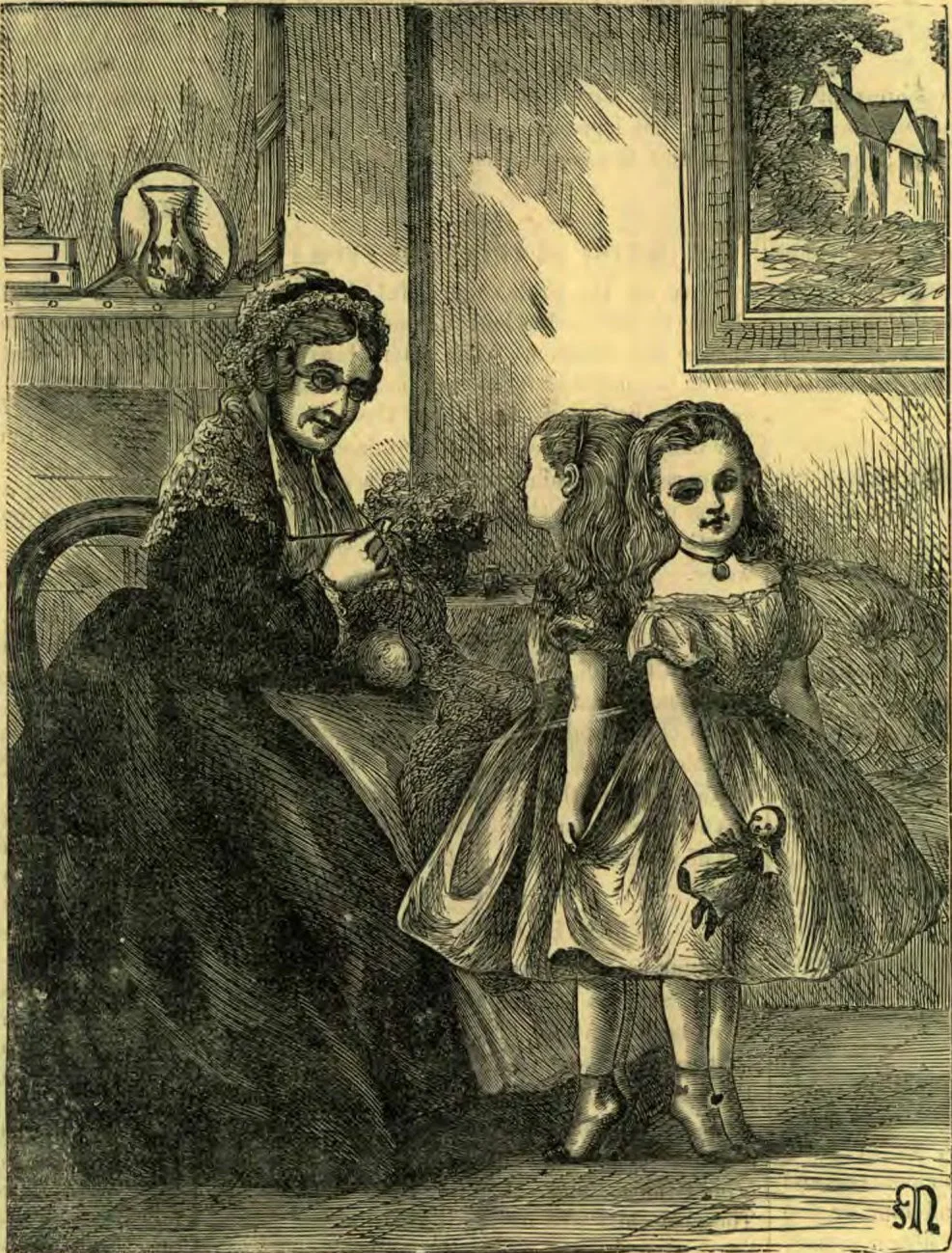
Twin Sisters Measuring Heights, a Grandmother's Smile

“But come, let’s have grandma tell us;” So they stood up, back to back, With their curly heads together, And their toes on a certain crack.
Now, each of those little twin sisters Thought, “I’ll be ever so sly. I’ll stand on the very tips of my toes, And stretch up ever so high;
“I’m sure then she’ll say that I’m taller.” And both of them wondered why She said, “Just the same,” with a very queer smile, And the funniest look in her eye. S. ISADORE MINER.

WHICH WAS THE TALLER?

WHEN will we be as tall, grandma, As tall and as nice as you? When will we wear such pretty, white caps, And glasses as you do!
“’T won’t be very long, I’m thinking, Before I’ll need a long dress. You’re tall enough for that, Lizzie; And I’m taller than you, I guess.”
“I’m not so sure about that, Lucy,” Cried Lizzie in much glee; “For I can see things over your head, And I don’t see how that could be.

You have reached the end of this edition.

The Youth’s Instructor · Apr 8, 1885