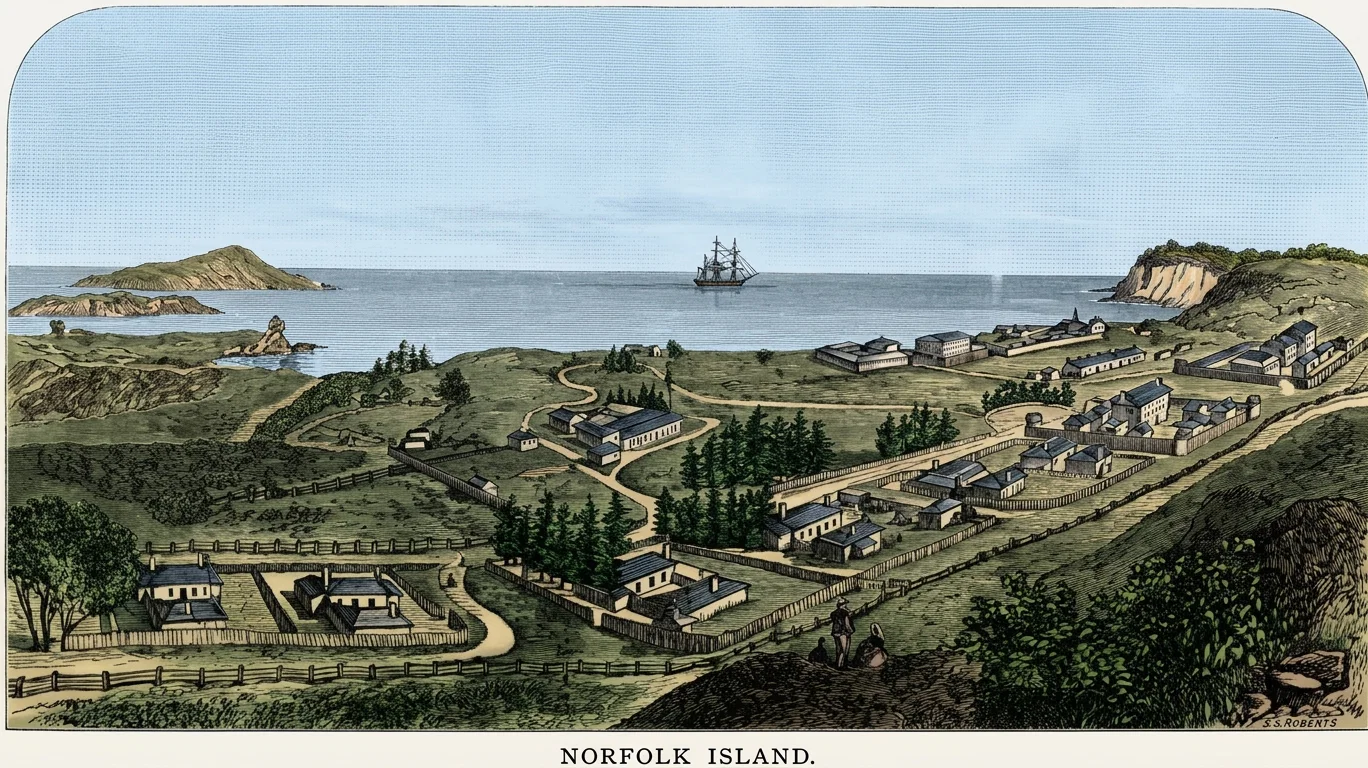
WE have already told the readers of the SIGNS about the first social experiment on Norfolk Island, how a community of convicts were conveyed there by the English Government, including all classes of criminals from petty sneak thieves to the most hardened robbers and murderers, where, instead of reforming under the banishment from the outer world, they only became worse desperadoes than before, the most wicked criminals making villains of the others, till the island paradise, overspread with all the beauties of nature and art, became a den of vice and crime, where bloodshed and suicide were the common occurrence and increasing in frequency, thus proving the first experiment a miserable failure.
The descendants from the mutineers of the Bounty were the subjects of the second social experiment. The progeny of rebellious sailors and half savage Tahitians would hardly seem like good material for making a good community, but the grace of God had interfered, and, through the instrumentality of John Adams, who instructed them, the race had become changed from a riotous, self-destroying people to a gentle, industrious community.
Good John Adams died in 1829, and his death was a terrible loss and grief to the Pitcairn islanders, but they continued to train their children, bestowing care upon the little ones, as he had taught them. As the population increased, the resources of the island became too small for its inhabitants, and they were persuaded by the British Government to remove to Tahiti. They were not happy there, however, and soon went back again. In 1856 they were removed to Norfolk Island, and there they remain still, with the exception of a few who became so homesick that they made their way back once more to Pitcairn Island, and formed the community which now dwells there.
Of course there was much of inherent indolence and depravity which had to be fought in their descendants for generations, and even to the present day. It was a community like this, with all the inherited tendencies of a past generation, well reformed individually, and controlled by their simple, paternal form of government, that was conveyed to Norfolk Island in 1856 to take charge of the land just vacated and furnish the material for a second social experiment.
The venture was unique, one hundred and ninety-four paupers, having no useful trades, possessed of no household furniture, with minds scarcely more far-reaching than the breadth of the little island they had left, taken by the great, and to them awe-inspiring government, and put upon an island which, though really only about twenty miles in circumference, seemed to them a vast expanse of territory, well-nigh inexplorable. Here they were made independently rich, being presented with a bewildering extent of land, twenty-five acres each, and a large stone house to each family,—a wonderful exchange for their little thatched huts and small garden plots on Pitcairn.
Besides this, they were made possessors of public works which had cost thousands of dollars. There was a well-built pier and breakwater, affording a comparatively safe landing for boats; there were miles and miles of well-surveyed roads, built across the island in all directions, winding around hills, crossing well-bridged rivulets, and extending over level tracts of land. The gigantic Norfolk pines (Araucaria excelsa), which stood in rows on either side of the roads and covered the high hills, were grand indeed, some measuring over thirty feet in circumference and towering to a height of over one hundred and fifty feet. Here was a huge corn mill, run by wind power, and, in the deep valley, a sawmill, run by water power. Here for the first time they saw herds of cattle and flocks of sheep. Wherever they looked, on the hills or in the valleys, on the well-built town or on the fertile country tracts, there was untold wealth, and all was theirs. It seemed like a fairy tale or a dream, their transition was so sudden from poverty to wealth.
NORFOLK ISLAND.
But it must be remembered that the people so suddenly transported, while a virtuous community, not only had no useful trades, but they had not experienced hardships, in their almost tropical home, sufficient to develop in them the habits of industry necessary for a prosperous residence on such a well-organized island. A few tradesmen were left for a short time to instruct them in the use of the mills, but, as readily could be seen, this was insufficient to establish permanent industry, so necessary for the systematic maintenance and prosperity of the island.
The immediate government of the island was vested in a magistrate and two councillors, chosen from among their own number, and under the general control of the governor of New South Wales.
Naturally enough, the people, thus left to themselves, with no outside example or influence in the sterner duties of life, and being from the first puerile, soon allowed their fine island home to deteriorate till it became irrecoverable. Increased possessions developed traits of character which had before lain dormant; some of the more energetic became ambitious, while many others became indolent. Avarice, which before their increased wealth was almost unknown, now spread like a blight. Some, moved either by cupidity or debt, sold their twenty-five acres allotment of land, reducing themselves and families to pauperism, while others bought it for a fraction of its value.
A public fund for the support of the clergyman and doctor was created by disposing of a number of the sheep and cattle and the sale of one thousand acres of land for the establishment of the Melanesian Mission.
These functionaries, supported by a public fund, have not always benefited the people as they should, although some of the men filling these positions have made themselves noble exceptions to the rule.
As the population increased, the distinction between the rich and the poor became more marked, and vice and crime became more prominent. The laws were made more stringent, but as no distinction was made between crime and sin, the executive, perhaps encouraged by the clergy, often spent all its time and effort in trying to define and punish the latter, which belongs only to God (Deut. 32:35), while the former, the restraint of which devolves upon the government, was usually passed lightly by, partly because crime was considered of less moment than sin, and partly because the governors and governed were all relatives, ofttimes requiring a man to pronounce judgment against his father or mother, or perhaps his grandparents, brothers, cousins, uncles, or aunts, which he would seldom do unless he had some grudge or ill feeling against them, when an excellent opportunity was offered to retaliate. A chapter at once sad and amusing might be written on this phase of the experiment alone. Thus the solemn vows of executive and legislative offices came to be lightly esteemed.
The community, which at the present writing numbers about five hundred people, has but few traits which mark it as related to the smaller but more virtuous community on Pitcairn Island.
They are decidedly a pleasure-loving people. Picnics, attended by a greater or less number of men, women, and children, are held for almost every occasion, birthdays, weddings, and other anniversaries, holidays, etc. They occur almost every week, and in some seasons nearly every day. Sometimes a trip will be made to Philip Island or Napean Island, two small isles near by, where the day is spent in fishing, hunting wild rabbits, paroquets, and sea birds' eggs. The latter are found in abundance at the right season, and are considered a fine article of food, being the principal diet upon which some families subsist for about two months in the year. Riding parties are common, some of the young people being expert horseback riders. Dancing is also a favorite pastime, the ballroom attracting both old and young alike.
At Christmas time one whole week is given over to games and making merry. The principal industries are whaling and sheep raising. The old mills, which might have been made a means of establishing permanent industries, have long since gone into disuse and decay.
Agriculture is the only other resource, but as there is connection with the outer world only by a slow sailing vessel, and that only61once in three months, even this resource does not avail. The young people are taught no useful trades, and receive, as a rule, only the most meager education.
The religious belief of the islanders seems to be undergoing a metamorphosis. Many of the adherents of the Church of England are becoming more and more dissatisfied as the so-called High Church forms and ceremonies of recent adoption are introduced.
Within the past six years, through the labors of a Mr. Phelps, a lay member of the Methodist Church, who came on a whaling vessel, about twenty professed conversion and formed themselves into a Methodist Church, and afterwards professed holiness. At the present time this church numbers many more. As the result of our visit, quite a number became interested in the views of Seventh-day Adventists, and, though it was not deemed wise to make any public effort there, yet there were twenty-one who have purposed to stand for the truth, and a number of others expressed themselves in harmony with our views.
On the part of many of the islanders, as well as most of the Europeans dwelling among them, there seems to be a general feeling of discouragement and despondency; their formal worship does not give them peace; their crops and the few industries of the island do not remunerate them sufficiently to supply their needs, and many of them are in debt.
Their children have not the industrial and school advantages they should have, and, upon the whole, the island and the people are deteriorating. They consequently feel that, while the social experiment has not proved a failure, yet some other impetus is necessary to make it a success.
OPPORTUNITY.
MASTER of human destinies am I!
Fame, love, and fortune on my footsteps wait.
Cities and fields I walk; I penetrate
Deserts and seas remote, and, passing by
Hovel and mart and palace, soon or late
I knock unbidden once at every gate.
If sleeping, wake; if feasting, rise before
I turn away. It is the hour of fate,
And they who follow me reach every state
Mortals desire, and conquer every foe
Save death, but those who doubt or hesitate,
Condemned to failure, penury, and woe,
Seek me in vain and uselessly implore;
I answer not, and I return no more.
—Selected.
OUR COLLEGE IN SOUTH AFRICA.
By Editor
IN the Cape Town Argus of October 7 we find a complimentary report of our new college building, from which we extract the following:—
Just as quietly and unostentatiously as they built and furnished one of the neatest and most substantial churches in the peninsula, so the Seventh-day Adventist community have erected at Kennilworth the college which they promised twelve months ago, and which is going to make a distinct impression upon the education of the Cape, to say nothing of the creation of a township in one of the most beautiful of the suburbs. Having purchased from Mr. Ernest Ingle a farm of 23 acres last year, the Board of Trustees proceeded to draw their own plans, preferring to be independent in this matter, as in the matter of finances, and having called in the aid of Mr. Robert Green, contractor, Claremont, have built a college, the dimensions of which will be gathered from the fact that, in addition to a dining room 68 feet by 25 feet, and accommodation for the entire teaching staff, it contains 38 roomy bedrooms and the requisite day accommodation for 60 or 70 scholars. The college is situated on what is known as the One Hundred Feet Road, but which, to judge from a recent report of the proceedings of the Claremont Municipal Council, will be named the College Road. Though severely plain in its exterior, it has been so built as to supply the maximum of stability and convenience to be obtained without an extravagant expenditure. Although for the present a portion of the building has been set apart for scholastic purposes, the ultimate purpose of the present building is the College "Home," for within the next year or two, perhaps at an earlier date, a college proper will be erected on an adjoining site, already the property of the community, wherein the occupants of the Home will be educated.
Prof. E. B. Miller, formerly of Battle Creek (Mich.) College, is principal. Sister Miller, Professor Lindsay, and Sister Peck, also of Battle Creek, are assistants. Teachers in Dutch and other special branches are to be added as occasion demands.
FIELD NOTES.
By Editor
ELDER J. B. GOODRICH reports six additions to the church at South Norridgewock, Maine, October 15.
ELDER F. PEABODY reports the baptism of three persons at North Warren, and six at Bear Lake, Pennsylvania.
THE church at South Lancaster, Mass., now numbers 218, eighteen having been added in the latter part of October.
As a result of meetings at Luce, Michigan, Brother W. H. Falconer reports twenty accessions to the faith, and meetings were being continued in a schoolhouse.
ELDER PAUL E. GROS reports the baptism of four persons at Robinson, Wisconsin, with four or five more to follow soon, and a good degree of earnestness on the part of the little company there.
AT Poseyville, Indiana, Elder D. H. Oberholzer was granted the best hall in the place, in which to hold meetings, free of charge. Four were baptized. Later, he reports a prosperous work at Marion, same State.
IT is designed to organize a South African Conference during the coming month of December. This not only indicates the growth of the work in that comparatively new field, but it will add much to the convenience of management.
CAPTAIN C. ELDRIDGE, manager of Review and Herald Publishing Company, arrived in Oakland on the 16th inst., on business connected with the outfitting of the missionary ship Pitcairn for its second voyage among the islands of the South Pacific.
ELDER C. SANTEE reports the organization of a church of sixteen members at Carthage, Missouri. Also an organization at Schell City, with twenty members, to be known as Clear Creek church. Here the brethren have subscribed sufficient means to build a house of worship.
ELDER R. G. GARRETT has been holding a series of meetings in the Baptist Church at Rockbridge, Tennessee. He says: "This county [Sumner] is very much in need of missionary labor, and anyone who desires to help in this work can do so by sending reading matter, in the form of pamphlets, tracts, or periodicals, to my address here. I will also furnish names to any who desire to send reading direct to them."
OF the work of Elder J. S. Washburn, in Bath, England, the Herald of that city (Oct. 31) says: "The very large congregations at the addresses given by Mr. Washburn on the book of Daniel, at the Assembly Rooms, yesterday, evidenced an increasing interest. The special studies were on the insane king, the feast of Belshazzar, with its mysterious handwriting and most tragic end, and the wonderful deliverances from the fiery furnace and the den of lions. One of the special lessons drawn from the latter was that Church and State always flourish best when separate, and that their union only works ill to both, that civil government should not interfere in any way with religion, and that religious tests and enforced religious observances only develop hypocrisy and work injustice."
AT Luray, Virginia, Elder T. H. Painter met with strong opposition from the Baptist and Lutheran ministers. They warned their members not to "follow Jews and devils." Brother Painter says: "The preachers and others have warned all who had houses or halls to rent, not to rent to us, and to keep these Jews out of town. We tried to get the schoolhouses, and other rooms that would do to hold our Sabbath school and other meetings in, but we failed."
OF the work in Tahiti Elder A. J. Read writes September 29: "Our first and greatest work is to get a literature into the native language, and, though I have been here only five weeks, yet, by the help of our friends here, we have several Bible readings ready to be printed, and will send them for that purpose by this mail." They are not allowed by law to hold public meetings of more than twenty persons in an audience, therefore the work must be done mainly by personal conversation and the distribution of literature.
BROTHER J. R. McCOY recently received letters from friends on Pitcairn Island, dated August 26. They report having had abundant rains, and also bear the good tidings that Elder Gates was improving in health. He was conducting a school, in which the principal studies were Bible and grammar. His labors for the benefit of the islanders are highly appreciated. People who are not surfeited with privileges are generally appreciative. The people were preparing to build him a house, and were doing all they could to make him comfortable. He was taking frequent salt-water baths, which appeared to be benefiting him physically.
ADDRESSES OF CANVASSING AGENTS.
F. L. Mead, general agent, Battle Creek, Mich.
E. M. Morrison, 451 Holloway Road, London, N., England.
N. Z. Towne, 451 Holloway Road, London, N., England.
James Harris, Bank's Terrace, Wellington, New Zealand.
Charles Michaels, Echo Office, N. Fitzroy, Victoria, Australia.
Z. Sherrig, 18 Werder St., Chicago, Ill.
DISTRICT No. 1.
E. E. Miles, South Lancaster, Mass.
A. E. Taylor, South Stukely, P. Q., Canada.
F. W. Morse, Moncton, N. B.
J. W. Hazeltine, Burnham, Me.
P. F. Bicknell, Essex Junction, Vt.
J. R. Calkins, 317 West Bloomfield St., Rome, N. Y.
F. W. Spies, Box 644, Williamsport, Pa.
C. F. Parmele, 43 Bond St., New York City.
U. P. Long, Newburg, Preston Co., W. Va.
DISTRICT No. 2.
A. F. Harrison, 661 East Fair St., Atlanta, Ga.
J. A. Parker, cor, 11th & Russell St., Nashville, Tenn.
S. T. Page, Williston, Fla.
D. Graber, 826 Second Ave., Birmingham, Ala.
C. D. Wolf, 837 S. Elm Street, Greensborough, N. C.
S. H. Shaw, Evergreen, La.
DISTRICT No. 3.
R. B. Craig, 187 Archer St., Indianapolis, Ind.
A. J. Olsen, 28 College Place, Chicago, Ill.
I. S. Lloyd, 122 Buckle St., Indianapolis, Ind.
Nelson N. Hay, 74 Kinsman St., Cleveland, Ohio.
D. E. Wellman, Hillsdale, Mich.
Byron Hazel, 20 Melbourne Ave., Toronto, Ontario.
DISTRICT No. 4.
F. L. Mead, Battle Creek, Mich.
S. M. Jacobs, Fontanelle, Iowa,
James Hackett, Verndale, Minn.
J. J. Devereaux, 1505 E St., Lincoln, Neb.
G. A. Wheeler, Vilas, South Dak.
C. M. Everest, Box 989, Minneapolis, Minn.
W. H. Thurston, 865, Fifth St., Milwaukee, Wis.
DISTRICT No. 5.
N. P. Dixon, 821 W. Fifth St., Topeka, Kan.
H. L. Hoover, 6th & City, Mo.
S. C. Osborne, Ottawa, Kan.
L. C. Sommerville, Van Buren, Ark. Care H. C. Griffin.
W. W. Eastman, Oak Cliff, Texas.
W. J. Keele, 920 W. Sixth Ave., Denver, Colo.
DISTRICT No. 6.
G. H. Derrick, 131 1/2 Haight St., San Francisco, Cal.
A. D. Guthrie, 228 Ash St., Seattle, Wash.
TENTS! TENTS! TENTS!
RICHARD KORN, 1121 CHESTNUT STREET, OAKLAND, CAL., will make new Tents or repair damaged Tents, cheaper than anyone else in the State. Good work guaranteed. Give him a trial.
FOR SALE.
HOUSE AND LOT, in same block with the Pacific Press, Oakland Cal., also 100 ACRES OF LAND in Napa County. The above I will sell at a bargain. For further information, address MRS. J. GOTZIAN, St. Helena, Cal.
International S. S. Lessons.
"So they read in the book in the law of God distinctly, and gave the sense, and caused them to understand the reading."—Neh. 8:8
LESSON XI.—DECEMBER 11, 1892.
THE APOSTOLIC COUNCIL.
[NOTE.—The questions which follow are merely suggestive for the student on the leading points of the lesson; it is presumed that the thorough student will think of many more as he studies the subject. References, where verses alone are given, always refer to the lesson scripture printed above. All other references are given in book, chapter, and verse. The text in this is the Revised Version, and it is especially preferred, not because it is not found in every family, as is the common version.]
And certain men came down from Judea and taught the brethren, saying, Except ye be circumcised after the custom of Moses, ye cannot be saved.
And when Paul and Barnabas had no small dissension and questioning with them, the brethren appointed that Paul and Barnabas, and certain other of them, should go up to Jerusalem unto the apostles and elders about this question.
They therefore, being brought on their way by the church, passed through both Phœnicia and Samaria, declaring the conversion of the Gentiles; and they caused great joy unto all the brethren.
And when they were come to Jerusalem, they were received of the church and the apostles and the elders, and they rehearsed all things that God had done with them.
But there rose up certain of the sect of the Pharisees who believed, saying, It is needful to circumcise them, and to charge them to keep the law of Moses.
And the apostles and the elders were gathered together to consider of this matter.
And when there had been much questioning, Peter rose up, and said unto them, Brethren, ye know how that a good while ago God made choice among you, that by my mouth the Gentiles should hear the word of the gospel, and believe.
And God, which knoweth the heart, bare them witness, giving them the Holy Ghost, even as he did unto us;
And he made no distinction between us and them, cleansing their hearts by faith.
Now therefore why tempt ye God, that ye should put a yoke upon the neck of the disciples, which neither our fathers nor we were able to bear?
But we believe that we shall be saved through the grace of the Lord Jesus, in like manner as they.
(MEMORY VERSES, 8-11.)
Golden Text.—"We believe that we shall be saved through the grace of the Lord Jesus, in like manner as they." Acts 15:11.
SUGGESTIVE QUESTIONS.
To what place did Paul and Barnabas return to labor after their missionary trip?—To Antioch, see Acts 14:25-28.
While they were there, what was taught the disciples by men who came from Judea? Verse 1. Note 1.
What standing had these men in the church?
It seemed good unto us, having come to one accord, to choose out men and send them unto you with our beloved Barnabas and Paul, men that have hazarded their lives for the name of our Lord Jesus Christ. Acts 15:25, 26.
4. How did the apostle Paul characterize them?
And that because of the false brethren privily brought in, who came in privily to spy out our liberty which we have in Christ Jesus, that they might bring us into bondage. Gal. 2:4.
How was their work received by Paul and Barnabas? Verse 2, first part.
Why did Paul and Barnabas thus oppose them?
To whom we gave place in the way of subjection, no, not for an hour; that the truth of the gospel might continue with you. Gal. 2:5.
7. Then of what must the teachings of these men have been subversive?
Which is not another gospel; only there are some that trouble you, and would pervert the gospel of Christ. Gal. 1:7. Forasmuch as we have heard that certain which went out from us have troubled you with words, subverting your souls; to whom we gave no commandment. Acts 15:24. Note 2.
8. What would their teaching do for the disciples? Verse 10.
Forasmuch as we have heard that certain which went out from us have troubled you with words, subverting your souls; to whom we gave no commandment. Acts 15:24.
What was finally determined to be done in the matter? Verse 2.
Was it the decision of the church alone that caused Paul to go up?
Then after the space of fourteen years I went up again to Jerusalem with Barnabas, taking Titus also with me. And I went up by revelation; and I laid before them the gospel which I preach among the Gentiles, but privately before them who were of repute, lest by any means I should be running, or had run, in vain. Gal. 2:1, 2.
What is said of their journey to Jerusalem? Verse 3.
What did they do when they got to Jerusalem? Verse 4.
And I went up by revelation; and I laid before them the gospel which I preach among the Gentiles, but privately before them who were of repute, lest by any means I should be running, or had run, in vain. Gal. 2:2.
13. Did Paul have to learn anything of the apostles and elders assembled at Jerusalem?
But from those who were reputed to be somewhat (whatsoever they were, it maketh no matter to me; God accepteth not man's person)—they, I say, who were of repute imparted nothing to me; but contrariwise. Gal. 2:6. For I make known to you, brethren, as touching the gospel which was preached by me, that it is not after man. For neither did I receive it from man, nor was I taught it, but it came to me through revelation of Jesus Christ. Gal. 1:11, 12.
When there had been much disputing in the council, to what did Peter call their attention? Verses 6, 7.
What had God done for the Gentiles when the gospel was first preached to them by Peter? Verse 8.
While Peter yet spake these words, the Holy Ghost fell on all them which heard the word. Acts 10:44.
16. What was it concerning which God made no difference between the Jews and the Gentiles? Verse 9.
Even the righteousness of God through faith in Jesus Christ unto all them that believe. Rom. 3:22. Note 3.
17. Why does God make no difference between the Jews and the Gentiles in the matter of purifying the heart? Verse 8, first part.
Even the righteousness of God through faith in Jesus Christ unto all them that believe; for there is no distinction; for all have sinned, and fall short of the glory of God. Rom. 3:22, 23.
What did Peter say would be put upon the disciples, if the teaching of the false brethren was adopted? Verse 10.
How only are all men to be saved? Verse 11.
Even the righteousness of God through faith in Jesus Christ unto all them that believe; for there is no distinction; for all have sinned, and fall short of the glory of God; being justified freely by his grace through the redemption that is in Christ Jesus. Rom. 3:22-24.
NOTES ON THE LESSON.
1. And certain men.—It is quite necessary to note the character of the men who made the trouble at Antioch and elsewhere. The apostles and elders at Jerusalem said of them that "certain which went out from us have troubled you with words; subverting your souls; to whom we gave no commandment." Verse 24, Revised Version. It will be noticed that in the Old Version "such" is a supplied word. Thus these men were irresponsible persons who did not represent the church. The apostles were not in sympathy with them. Their work was to subvert souls. This they did by preaching a perverted gospel (Gal. 1:7), for they were doing the same work that was afterwards done by the men who tried to overthrow Paul's work in Galatia. They professed to represent the church of Christ, but only that they might the more readily gain access to the disciples, to subvert them. They were "false brethren," from whose malice Paul was often in peril. See 2 Cor. 11:26.
2. Pervert the gospel—subverting your souls.—It should be specially borne in mind that the subject of the controversy was the gospel. That was what made the question a vital one. It was concerning how men must be saved. Paul and Barnabas preached salvation by faith; these men taught salvation by man's work. If men must be circumcised in order to be saved, then faith in Christ would be proved to be insufficient. But faith in Christ is sufficient; that comprehends all; therefore something additional for justification was a perversion of the gospel, and also a subverting of the souls of those led away by the delusion. As Paul afterward wrote, "If righteousness came by the law, then is Christ dead in vain." Gal. 2:21. Moreover, the fact that the gospel was the subject of dispute is shown by Paul's statement that he resisted those men in order that the truth of the gospel might remain with his converts. Gal. 2:5. These false brethren professed to have the gospel, because they set forth what they claimed was the way of salvation; but there was no truth in their gospel. The truth of the gospel is that "through the grace of our Lord Jesus Christ we shall be saved," and that "there is none other name under heaven given among men, whereby we must be saved." See also Rom. 10:6-10; Titus 3:2-6.
3. Cleansing their hearts by faith.—Peter declared that in the matter of the cleansing of the heart God made no difference between the Jews and the Gentiles. This is proof of the statement that the subject under discussion was the vital one of salvation. The fact that God "put no difference between us and them" was shown in his giving to uncircumcised Gentiles the gift of the Holy Ghost, even as he did to the apostles and brethren on Pentecost. And the reason why God thus put no difference between the Jews and the Gentiles, in the matter of justification, was that "he knoweth the hearts." There is no difference between the heart of the Jew and the heart of the Gentile, because all alike have sinned. Rom. 3:9, 22, 23. Men, judging by the outward appearances, often make a difference between men, but God, who looks upon the heart, knows that all are alike; therefore he puts no difference between men in the matter of cleansing the heart.
RISE AND PROGRESS
By John Norton Loughborough
—OF—
Seventh-Day Adventists.
Tokens of God's Hand in the Movement, and Brief Sketch of the Advent Cause from 1831 to 1844.
By J. N. LOUGHBOROUGH.
This new book, fresh from the pen of one of the oldest ministers in the advent movement, cannot but be of great interest to all, and especially to those who have become Seventh-Day Adventists in recent years and know but little of the early history of the cause and its leaders.
The following are some of the chapter headings: Extent of the Advent Proclamation; The Tarrying Time; The Midnight Cry; The Disappointment; Fresh Tokens of Divine Guidance; Perils, Reproaches, Victories; New Features in the Work; Providence of God in the Publishing Work; Organization; Rapid Advancement; Though Workers Faint, God's Work Advances; Truth Advanced Even by Opposition.
The book contains nearly 400 pages, with 50 illustrations, several of them full page, and is neatly bound in cloth, and furnished in two styles.