Your ShelfYour Projects

Review and Herald, Vol. 81, No. 44.

November and December
Earlier text: The Resounding Call to Service

North Michigan Conference Proceedings

The second annual session of the North Michigan Conference was held at Mancelona, Mich., on the camp-ground, Sept. 1-12, 1904. Eight meetings were held in all.
The treasurer's report was presented, as follows, and adopted by vote:—

RECEIPTS

Amount on hand, July 1, 1903. $ 446 13 Tithe .................... 6,684 05 Lake Union Conference .... 383 00 West Michigan Conference .. 753 00 Total ..................... $8,266 18

DISBURSEMENTS

Labor and traveling expenses.. $7,000 75 Expenses ..................... 220 32 Lake Union Conference ....... 720 86 One-third cost of mimeograph. 16 42 Tract society bank .......... 307 83 Total ....................... $8,266 18
The Clarence and Whittemore churches were received into the conference by vote, each having twenty members.
The Chair was empowered to appoint the committees, and the following persons were named: On resolutions, Ethel Peters, Lillie Warren, and T. S. Parmalee; on credentials and licenses, Andrew Maples, M. C. Guild, James O'Reilly, W. R. Matthews, and J. J. Irwin; on nominations, C. A. Hansen, D. B. Voorheis, M. Stephens, C. Wood, and J. A. Conklin.
The following recommendations and resolutions were adopted:—
“Whereas, The blessing of God has attended the work of establishing this new conference from its very beginning until now, and,—
“Whereas, An encouraging degree of success has attended its workers, therefore,—
“1. Resolved, That we hereby express our sincere gratitude to God for his blessing; and humbly acknowledge our entire dependence upon his mercy for every blessing that we enjoy.
“2. Resolved, That in response to the request of the Superior Mission field for the North Michigan Conference to consider the advisability of uniting our interests in one conference, thereby eliminating the expense of conducting one conference, we hereby do heartily express ourselves in favor of such a move, and petition the Lake Union Conference Committee to consummate such a union.
“3. Resolved, That we will follow up every opportunity to establish church-schools and provide for the education of our people, especially the children and youth.
“4. Resolved, That Sabbath-school secretaries purchase their supplies as far as possible from the home tract society, and that the surplus donations be sent through the regular channel to the conference treasurer.
“5. Resolved, That we encourage our Sabbath-schools to take the Sabbath School Worker; and that we ask our conference workers to take a special interest in building up the Sabbath-schools wherever they go.
“6. Resolved, That as the Testimonies inform us that there is no more important work than getting our literature into the hands of the people, our efforts in this direction be not allowed to slacken; but that earnest, systematic effort be put forth to persuade all the old canvassers to re-enter the field, and to enlist all others who ought to be in the work.
“7. Resolved, That inasmuch as God has prospered Seventh-day Adventists and others in this territory, that many be encouraged to enter the work and become self-supporting missionaries.
“8. Resolved, That the annual meeting for the election of church officers be held in the beginning of the fourth quarter.
“9. Resolved, That we encourage our people to adopt the envelope plan for the collection of the weekly offerings for foreign missions.
“10. Resolved, That pains be taken to discover and encourage talent; that every means possible be used to develop workers, and that we stand ready to furnish means and workers as the needs of the whole field may require.
“11. Resolved, That, in harmony with the recommendation passed by the Lake Union Conference at its last biennial session, the term of the office of educational secretary expire with the calendar year.
“12. Resolved, That the Almira church be called the Cedar Run church.
“13. Resolved, That all the laborers and church officers in the conference co-operate in urging our people to report to the librarians, and the librarians to promptly report to the secretary.
“14. Resolved, That we earnestly co-operate with the committee appointed by the General Conference to arrange for a missionary campaign this winter, and that this campaign be opened by a missionary convention in each church the first Sabbath in November, and that at these conventions plans be laid for each to devote as much time as possible to missionary work, using the literature that will be especially prepared for this campaign, as well as other literature.
“15. Resolved, That we believe the taking of our church paper to be an indispensable means of keeping in harmony with the advance of the third angel's message, and of avoiding perplexing mistakes, and that we will not be satisfied with our work of extending its circulation until the REVIEW AND HERALD is in every family of our people.
“16. Resolved, That every proper means be taken to pay our share of the General Conference Association debt as speedily as possible, and that we raise at least three hundred and fifty dollars this conference year.”
The following officers were elected for the ensuing year: President, S. E. Wight; Secretary, Edith McClellan; Treasurer of Conference and Secretary of Tract Society, E. A. Bristol; Educational Secretary, Myrta M. Kellogg; Field Secretary, to be filled by the conference committee; Executive Committee, S. E. Wight, W. R. Matthews, M. C. Guild, Andrew Maples, C. A. Hansen; North Michigan Conference Association Committee, S. E. Wight, J. J. Irwin, E. A. Bristol, W. R. Matthews, M. W. Lewis.
Ministerial credentials were granted to S. E. Wight, W. R. Matthews, M. C. Guild, J. J. Irwin, C. Wood, C. A. Hansen; ministerial licenses to O. Montgomery, T. G. Lewis, E. A. Bristol; missionary licenses to E. Jenny Lane, Nellie Clough, Ethel Peters, Mrs. M. M. Faulkner, Myrta M. Kellogg, Edith McClellan; canvasser's licenses to Moses Whitmarsh, Nellie Whitmarsh, A. M. Byers, C. J. Tolf, Anna Jorgensen, W. S. Wilson, Myrtle House, Effie Walker; church-school teacher's licenses to Mrs. C. J. Tolf, Amy Du Bois, Nona Carr, Zona Carr, Mable Griffin; church-school teacher's permits to Mina Rickerd and Gertrude Wahl.
The last day of the meeting forty were baptized.
S. E. WIGHT, President, E. A. BRISTOL, Secretary.

Giving Away God’s Blessing

“THE only way to keep the blessing of God is to give it away.”

First Annual Meeting of the International Publishing Association

This meeting convened, according to appointment, in the Seventh-day Adventist Tabernacle in College View, Neb., at 10:30 A. M., Sept. 13, 1904. Elder E. T. Russell presided during the eleven sessions that were held.
The members of the General Conference Committee and the General Publishing Committee were invited to meet with us and to participate in the deliberations of the meeting. During the sessions a majority of these members, as well as the board of trustees and most of the members of the advisory committee of the International Publishing Association, were present, and took part in the business transacted.
At the second session Elder Russell read a memorial, in which he presented the condition and circumstances of the International Publishing Association, and outlined some suggestions regarding future policy. From this memorial it appeared that only $2,870 had been received from the general collection on Feb. 6, 1904, instead of $6,000, which was called for. On account of this, the institution had been financially embarrassed, and had not been able to do as aggressive work as it had been expected to do. The Board had followed a conservative policy, not wishing to involve the institution any more than was absolutely necessary to carry on the work that had to be done. The chairman expressed the belief that the International Publishing Association should be regarded as a sister institution of the other publishing houses, and be granted a definitely outlined territory for the sale of its own foreign subscription books as well as English books. If such a plan could be brought about, the institution would be assured of a steady revenue of a sufficient proportion to insure financial success. This suggestion did not, however, meet with favor, as may be seen by the resolutions that were adopted.
The following committees were appointed: On plans, H. H. Hall, S. N. Curtiss, C. M. Everest, S. Mortenson, W. C. White, J. Staby; on nominations, W. C. White, G. F. Haffner, Allen Moon, Lewis Johnson, J. J. Graf; on by-laws, I. H. Evans, H. W. Cottrell, C. N. Woodward, N. P. Nelson, and E. T. Russell.
The committee on plans brought in some resolutions, which after considerable discussion and one substitution, were adopted in the following form:—
“Resolved, That we approve the action of the board of trustees of the International Publishing Association in buying and fitting up the premises now occupied by this house.
“Resolved, That we approve of the efforts to issue new tracts and a portion of ‘Testimonies for the Church,’ Vol. VIII, in pamphlet form, in the German and Scandinavian languages.
“Whereas, In an effort to secure control of the German and Scandinavian book business throughout the United States, the entire stock of foreign books at the Review and Herald, in Battle Creek, together with the plates for the same, exclusive of the publications of Mrs. E. G. White, has been purchased by this association for twelve thousand dollars, and negotiations have been pending for the purchase of the stock of Mrs. White’s books, published by the Review and Herald, to the amount of about five thousand dollars, and,—
“Whereas, The difficulties of handling the subscription-book business by this association are considerable, and the necessary capital required is large,—
“Resolved, That we recommend that the regularly equipped publishing houses of the denomination receive with favor a proposition from the International Publishing Association to turn over its stock of books and plates bought of the Review and Herald Publishing Co., except such tracts, pamphlets, and trade books as the International Publishing Association may wish to keep in stock; and that the publishing house purchasing the stock assume the indebtedness now held against the stock, after deducting the value of sales since its purchase, also the amount of stock retained, at wholesale rates.
“Resolved, That the Review and Herald, the Pacific Press Publishing Co., the Southern Publishing Association, and our European publishing houses be requested to join us in an earnest effort to dispose, during the coming missionary campaign, of a large portion of the foreign books now on hand.
“Resolved, That a careful study be given to the various publications issued in Europe, and that, where consistent, such publications be imported instead of being printed in this country.
“Resolved, That a committee of five be appointed annually by this body to suggest translations, revisions, publication, and retirement of foreign literature.
“Resolved, That we issue in November four special numbers of our German, Swedish, and Danish-Norwegian papers, to contain similar matter, and to be used simultaneously with and upon the same general plan as is proposed for the four special numbers of The Signs of the Times.
“Resolved, That we recommend the publication of a series of religious liberty tracts, similar to those being brought out in the English language in Washington, in the German, Swedish, and Danish-Norwegian languages.”
The committee on by-laws drew up some articles which, after some suggestions and changes, were adopted in the following form:—

ARTICLE I—NAME

“The name of this corporation is, ‘International Publishing Association.’ The religious body with which this corporation is connected is:—
“(a) Denomination — Seventh-day Adventists.
“(b) Religious body — The General Conference of Seventh-day Adventists, an unincorporated body.”

ARTICLE II—LOCATION

“The principal office of this corporation is located at College View, Neb.”

ARTICLE III—OBJECT

“The particular objects for which this corporation is formed are as follows; namely, to print, publish, and circulate literature in all languages deemed advisable by the Board of Trustees; to secure and hold copyrights of periodicals, tracts, pamphlets, and books; to disseminate by all legitimate agencies whatsoever religious knowledge and instruction; to receive gifts, legacies, and donations from every source whatsoever; to make gifts and appropriations from any and all of its resources from time to time to carry out the objects specified above.”

ARTICLE IV—MEMBERSHIP

“SECTION 1.—The membership of this corporation shall consist of the following persons; namely, The executive committee of the General Conference of Seventh-day Adventists, the executive committee of the Central Union Conference of Seventh-day Adventists, the executive committee of the Northern Union Conference of Seventh-day Adventists, the executive committee of the Southwestern Union Conference of Seventh-day Adventists, the board of trustees of the International Publishing Association, the seventeen counselors of the International Publishing Association, and the editors of the foreign periodicals published by the International Publishing Association.
“SEC. 2.—A quorum for the transaction of business shall consist of not less than twenty persons.”

ARTICLE V—TRUSTEES

“SEC. 1.—The members of this corporation shall elect annually seven trustees for this corporation, who shall hold their office until their successors are duly elected, and appear to enter upon their duties.
“SEC. 2.—The trustees shall have the ordering of all affairs of this corporation, the management and disposal of all its property as hereinafter specified, and the execution of all trusts confided to it.
“SEC. 3.—A quorum to do business shall consist of not less than four trustees.
“SEC. 4.—The trustees shall elect annually a President, a Vice-President, a Secretary, and a Treasurer. The President and Vice-President shall be members of the Board of Trustees. The Secretary and Treasurer may or may not be members of the Board of Trustees.
“SEC. 5.—The Board of Trustees shall elect a competent auditor who shall audit the books of this corporation, and submit an itemized report to the members of the corporation annually, or at such times as may be required by the Board.
“SEC. 6.—The trustees shall have power to fill any vacancy occurring in their membership.”

ARTICLE VI—FUNDS

“SEC. 1.—The trustees of this association are hereby instructed to annually pay a tithe of their net earnings to the General Conference of Seventh-day Adventists.
“SEC. 2.—All assets and earnings of this corporation shall be held for the furthering of the objects of this corporation, and any amount of its earnings and profits from any source may be appropriated to the work of the General Conference of Seventh-day Adventists by a majority vote at any regular meeting of its members.”

ARTICLE VII

“The duties of the officers of this corporation shall be such as usually pertain to their respective offices.”

ARTICLE VIII — SEAL

“The Board of Trustees shall provide a seal the ordinary size, and inscribed as follows: The “International Publishing Association,” the same to describe an outer circle enclosing the word “seal” and the word “incorporated.”

ARTICLE IX — MEETINGS

“SEC. 1.—Every regular or special meeting of the members of this corporation shall be called by a notice published three times successively previous to the time of the meeting, in THE ADVENT REVIEW AND SABBATH HERALD, a weekly paper published in Washington, D. C.
“SEC. 2.—The trustees are always in session, no adjournment ever taking place, and may hold meetings at any time a quorum is present.
“SEC. 3.—When not otherwise especially provided, all votes of the members of this corporation for the election of trustees, or for the deciding of other questions, shall be taken viva voce.
“SEC. 4.—Each voter, whether member or trustee, shall have one vote, and only one, on any question.”

ARTICLE X — AMENDMENTS

“These By-Laws may be amended by a two-thirds vote of the members of the corporation present at any regular meeting of said members, when the proposed amendment does not conflict with the articles of incorporation of this association. When it is proposed to change the By-Laws at any special meeting of the members of the corporation, notice shall be given to this effect in the call for the meeting, and the nature of the proposed amendment shall be stated.”
The committee on nominations presented the following report, which was adopted by considering each item separately:—
Trustees: E. T. Russell, A. T. Robinson, J. J. Graf, A. Swedberg, Lewis Johnson, D. R. Callahan, G. A. Grauer.
Counselors: T. Valentiner, L. A. Hoopes, S. F. Svensson, S. Mortenson, James Cochran, G. F. Haffner, C. J. Hermann, P. E. Berthelsen, N. P. Nelson, Henry Shultz, C. A. Thorpe, R. A. Underwood, H. R. Johnson, L. F. Starr, J. C. Christian, C. M. Everest, R. C. Porter.
During the last meeting, the following resolution, introduced by Elder Henry Shultz at a previous meeting, was discussed and carried:—
“Whereas, The papers published by the International Publishing Association are missionary papers, and are used for missionary purposes in every part of the world where those languages are spoken, and as there is a deficit on these papers from Dec. 31, 1903, to the present time, therefore,—
“We recommend, That the General Conference, the Lake Union Conference, and the Central Union Conference share equally in making up the deficit, and in the future pay one half of the wages of the three editors, until such time as the papers in question shall become self-supporting.”
This recommendation was subsequently approved by the General Conference Council, with the exception of the part pertaining to the wages of the three editors, which was struck out.
At a subsequent meeting of the new board of directors, the proposition tendered by the Pacific Press Publishing Co. to take over all our stock of foreign subscription books was considered and accepted. By this step our foreign publishing house in College View will confine its operations in the future to the publication and sale of tracts, pamphlets, and trade books, and to the issue and circulation of its periodicals in the Swedish, Danish-Norwegian, and German languages. The new board hopes to be able to put this work upon such a basis that the institution may be run to its full capacity and be made self-supporting.
From the financial statement of the institution we glean the following items:—
ASSETS Building and lots ............ $2,779 06 Personal accounts receivable .. 2,198 43 Cash on hand ................. 144 13 Merchandise on hand .......... 11,409 11 Furniture and fixtures ....... 876 48 Fuel on hand ................. 20 00 Insurance (unexpired) ........ 93 06 Type and press department .... 6,239 39 Library ...................... 114 77 Stationary ................... 25 00 Paper on hand ................ 100 00 Total ......................... $23,999 43
LIABILITIES Personal accounts payable .... $1,748 44 Bills payable ............... 12,500 00 Various trust funds ......... 2,408 84 Overdrawn on treasurer ...... 194 76 Loan from Cent. Union Conf. . 200 00 Unexpired subscriptions on papers ........ 1,115 00 Present worth ............... 5,832 39 Total ......................... $23,999 43
E. T. RUSSELL, Chairman, A. SWEDBERG, Secretary.

The Work Among the Colored People

The Mission Schools

THIS line of work has proved a very important branch of the work for the colored people. We have been told that the best way to reach them is through these mission schools. Experience has proved this statement correct. The Southern Missionary Society has had several of these schools in operation for some time, and reports that every mission school established has resulted in the organization of a church. This has been a cause of great rejoicing to us, and demonstrates the correctness of the statement that this is one of the best ways of reaching the colored people with the third angel's message.
Up to the present time, these schools have been operated almost entirely in the State of Mississippi, but we have felt that in the vicinity of the school at Huntsville, Ala., and in the vicinity of the headquarters at Nashville, Tenn., pioneer work should be begun along these lines this season, and efforts are being made to accomplish this result. The expense of these schools is small, and the results seem to be even greater for the amount expended than have been realized in any other way. It is hoped that several new schools may be started this fall, and that this branch of the work will be made more prominent than ever before. Not only are these mission schools our best medium for bringing the message before the people, but they are practically essential in developing young people for attendance at our training-school at Huntsville, Ala.

The Huntsville School

This school was established several years ago by the General Conference. It has never been properly equipped for its work. Our schools in the North know how difficult it is to make any school self-supporting, and but few under the most favorable circumstances have succeeded in meeting expenses. The attendance at the Huntsville school is largely made up of those who find it difficult to raise the means necessary to pay their traveling expenses to the school, hence are obliged to rely upon their labor for their support and expenses while in the school. The day may come when this school will be put on a basis where it is self-supporting, but there are many repairs to be made upon the buildings, and many facilities to be added, which require the liberality of our people for the present, to say the least.

The Nashville Colored Sanitarium

The instruction received through the testimonies is very explicit as to the pressing need for sanitarium and medical missionary work in the Southern field. This is especially true as regards the colored people. Nashville was specially pointed out as a place where a colored sanitarium should be located.
According to this instruction the Southern Missionary Society, about three years ago, established treatment rooms, which, it was expected, would develop into regular sanitarium work. In connection with the sanitarium work, it was designed to have a training-school where colored medical missionaries could be developed, who could go out among their people, and help them to live cleaner and better lives, and bring help to those who were sick and suffering. It was thought that Nashville was well adapted to this work, as those who were studying to become medical missionaries could have a practical experience in the homes of thousands of colored people right in Nashville.
We were fortunate in securing the services of Dr. Isabel, a colored physician who was graduated with high honors from the American Medical Missionary College. Her success has been remarkable, and we can but believe that in some cases the Lord has especially worked in a miraculous manner in connection with the helpful remedies employed by the sanitarium. Her reputation among the physicians of Nashville is good, but the work of Dr. Isabel has been very much hampered because the institution was not able to secure a nurse or some one to give treatment; so she has been obliged to give many of the treatments herself.
Now when we remember that this institution is the only hygienic colored sanitarium in the world, and that it is the only institution of the kind ever undertaken by Seventh-day Adventists, it would seem that this should appeal especially to the liberality of our people, to place the institution on such a basis as will enable it to successfully carry forward the work that its mission demands. We ask our people to consider this special branch of the work, and in their liberality remember that it takes considerable money to establish and equip properly a sanitarium in any locality.

Work Along Other Lines

The evangelical work for colored people in the South is greatly in need of assistance. For years the Southern Missionary Society has been compelled to support ministers and Bible workers engaged in evangelical work. There are struggling schools in other parts of the South that need help, and the colored work is in need of strong assistance in all its work.
November 5, 1904
Now, brethren and sisters, on November 5 a collection is to be taken up for the benefit of this work, and we appeal to you to consider carefully and prayerfully the needs of this field, and on this day to come with a liberal contribution that will make glad the hearts of those who are laboring earnestly in this field.
J. E. WHITE.

From Oakland to Mountain View

Over a quarter of a century ago the Pacific Press Publishing Company was incorporated, and established its business at Oakland, Cal. Since that time there has been a wonderful growth, both in the business of the company and in the city itself. When the buildings were erected at the corner of Twelfth and Castro Streets, they seemed to be out in the country, as there were but very few houses within several blocks. But the place has grown, and now they are in the heart of a large city, with San Francisco just across the Bay.
In the early stages of the work it seemed necessary to take in some commercial work in order to keep the employees busy and the machinery moving. This served a good purpose by way of instruction and financial assistance, but several years ago it was seen that the commercial work was assuming such large proportions that it was interfering more or less with our denominational business. More than that, it was bringing into the office a spirit of worldliness and commercialism, which was anything but desirable.
For over two years messages have been coming to the managers, urging them to “cut away” commercial work, and move the office to some rural district, away from the demoralizing influences of these large cities.
At the annual meeting of the stockholders, held in Oakland, Cal., April 28, 1902, the following action was taken:—
“Resolved, That we instruct the incoming board of directors to make a continuous effort to reduce commercial work, and to develop the publication of religious, educational, and health literature.
“We recommend that the incoming board of directors dispose of the plant as a whole, or in part, as Providence may open the way.
“We also recommend that in case the plant is sold, a smaller plant be established in some rural district convenient for our denominational work, for the training and education of missionaries.”
The foregoing action was reaffirmed at the annual meeting of the stockholders held last year.
Until quite recently we have felt that we could not move into the country until we sold this plant, buildings and all, but, the way to do this being hedged up, we finally decided to consider the advisability of moving the plant (machinery, etc.), and selling the buildings when we could. This plan was approved at the last annual meeting of the stockholders. As this question was agitated, different places were suggested by different ones, and all received careful consideration.
In making a move of this kind, several points had to be taken into consideration:—
First, we were instructed to establish our plant in some rural district, away from the large cities, with their temptations, surroundings, and trouble that is coming upon them.
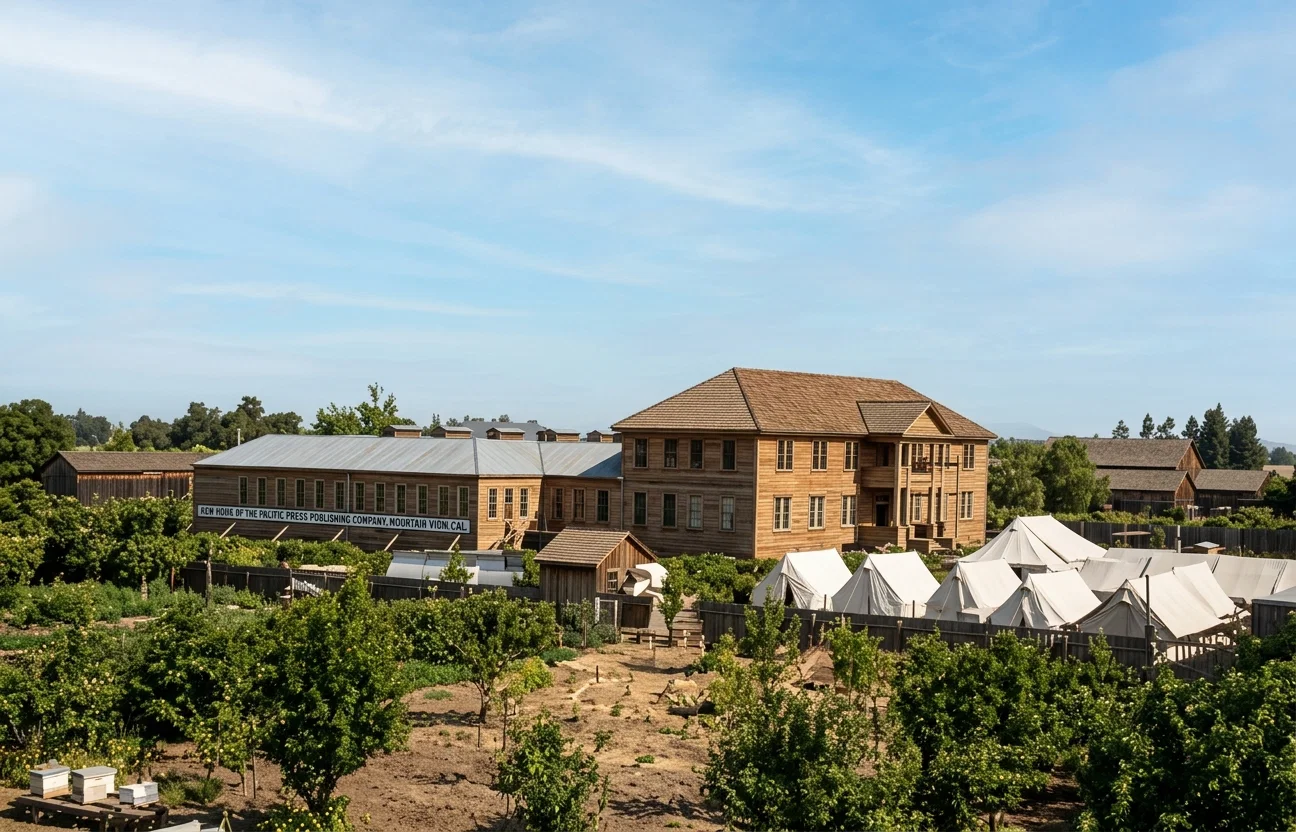
NEW HOME OF THE PACIFIC PRESS PUBLISHING COMPANY, MOUNTAIN VIEW, CAL.
Second, railroad facilities must be regarded; for at the present time we are using nearly two car-loads of paper a
month. Our mail and express business is also quite heavy, and must be handled promptly. Banking privileges should also receive consideration.
Third, while we are looking out for the interests of the institution, we must also bear in mind the interests and welfare of our employees. We might find some place quite suitable for the factory, so far as shipping facilities, etc., are concerned, but not at all desirable for our employees.
In the investigations that have been made, all these questions were borne in mind, and the directors finally decided to locate the plant at Mountain View, Cal. This is a small place about thirty-nine miles south of San Francisco, and eleven miles from San Jose, on the main line of the Southern Pacific Railroad running into San Francisco. It is a rural district, and a very desirable location, not only for the plant, but also for our employees, as it is right in the fruit belt of the famous Santa Clara Valley.
The incorporated town of Mountain View has only about eight hundred inhabitants, but it is surrounded by small holdings of five, ten, fifteen, and twenty acre tracts, and settled with a good class of people. Fruit of all kinds, and of the finest varieties, is raised in this valley.
We have been very fortunate in securing for the factory a tract of five acres, fronting on the main line of the Southern Pacific Railroad, and near the station. The citizens of Mountain View have raised money to purchase this land and put in a switch and side-track. This property has been donated to the Pacific Press Publishing Company. The citizens have also donated two hundred dollars toward purchasing a lot on which to build our church.
To further show the interest on the part of the citizens of Mountain View in this matter, we quote the following from a letter received from the board of trade of that place:—
“Pacific Press Pub. Co., “Oakland, Cal. “DEAR SIRS: The board of trade of Mountain View desires to express to you its pleasure in the knowledge of the fact that your publishing plant is to be removed to Mountain View in the near future, and that you are to become permanent residents of our thriving town.
At its regular meeting held Thursday evening, January 21, the following resolutions were unanimously adopted:—
“Whereas, The Pacific Press Publishing Company, of Oakland, has decided to move its entire publishing plant to this city,—
“Resolved, That we hereby extend to them a cordial welcome as members of our community, that we shall at all times be ready and willing to extend to them every courtesy and consideration, collectively and individually.
“That the secretary be instructed to mail a copy of these resolutions to the Pacific Press Publishing Company.
“Respectfully yours, “H. G. Copeland, “Secretary.”
Mountain View is near the lower end of San Francisco Bay, and there is a little inlet that runs up to within two miles of the city, capable of floating two hundred-ton boats, thus giving us water competition. Ten passenger trains in both directions stop at Mountain View every day.
After fully deciding to move our plant, much study and earnest thought were given to perfecting plans for our new building by persons fully acquainted with the demands of the business; and in the plans finally adopted, a view of which is given herewith, we feel that we have a model factory.
The main building is of brick, and is about one hundred and seventy-five feet square, all one story except the front, forty by one hundred and twenty-five feet, which contains the offices, editorial rooms, chapel, etc. The roof over the work rooms is built on the saw-tooth plan, with plenty of skylights, thus giving an abundance of light. There are but few partitions, and the rooms are so arranged that the product all moves forward from start to finish, thus effecting a great saving in time and labor.
We have a private switch from the main line of the Southern Pacific Company, so that stock, etc., can be unloaded directly from the cars into the factory, thus saving the expense and delay of hauling. All our machines are run by electric motors, and we have our own plant for generating electricity.
The contract for putting up this building was let to Brother W. E. Whalin for the sum of $26,800. We have sunk a well on this property to the depth of two hundred and eighty feet, and have an abundance of good, soft water. Indeed, it is really a flowing well; for when we are not pumping, the water runs over the top of the casing just above the ground.
For the past three months the work of moving our large plant has been going on. It was a tremendous undertaking, and the strain upon all our employees has been a heavy one; but all have taken hold of the work heartily and cheerfully, putting up with many inconveniences, believing we were moving in the order of the Lord. Car-load after car-load of heavy machinery has been taken from the building, and the work of moving accomplished with no serious accidents, and with but little interruption to our regular work. Surely the hand of the Lord has been with us, and we praise his name for his protecting care.
We are now comfortably housed in our new factory, situated in a rural district, away from the noise, confusion, and temptations of a large city, and where we can carry out the special instructions which have been given concerning our work.
Mountain View being a small place, there are but very few houses to rent, and at the present time many of our employees are living in tents, waiting for the boarding-house and other houses to be built. These tents are pitched in a group near the office, and look very much like a camp-meeting. In one of the large tents we have a first-class hygienic restaurant, which is liberally patronized, not only by our own people but by some of the townfolk as well.
It is our purpose from this time on to give special attention to our own denominational business, and make this institution just what God intended it should be—“a training-school for workers.”
In changing the location of the office, we have decided that it would also be well to change the form of organization from a stock company to a membership corporation, thus bringing our work into
harmony with the recommendations of the late General Conference; and steps have already been taken to bring this about.
As before stated, in moving our plant to Mountain View, it is our purpose to eliminate commercial work, at least to a great extent, and give our whole time and attention to extending and building up our denominational business. In doing this, it can readily be seen that it will be absolutely necessary so to arrange matters that this business will be placed upon a paying basis.
Heretofore we have depended largely upon our commercial work to furnish the funds necessary for carrying on the denominational business on which there was almost invariably a loss. This must now be changed; for we know that our brethren and sisters do not want to see the office running behind from year to year.
Plans have already been inaugurated with a view to placing the work on a paying basis, and we now ask for the hearty co-operation of our brethren and sisters and conference workers in helping to make them effective. And above all, we want your prayers and your counsel. The work is one, and we desire to unite our efforts with yours in trying to get this truth before the people in the shortest possible time. We believe that the “pillar of cloud is rising,” and it is time for God’s people to “move forward.”
One of the first great efforts we shall make at our new location is the publishing of the four special numbers of The Signs of the Times, on the subject of the Third Angel’s Message. In these numbers it is our purpose to cover all the leading points of present truth, and we hope and expect that our people everywhere will do their utmost to give them a wide circulation. This will not only be a great encouragement to the workers here, but will bring the truth to many souls.
In reference to the importance of moving our institutions out of the large cities, we quote the following from “Testimonies for the Church,” Vol. VII:—
“‘Out of the cities,’ is my message, . . . The time is near when the large cities will be visited by the judgments of God. In a little while the cities will be terribly shaken. . . . The ungodly cities of our world are to be swept away by the bosom of destruction.”
“For years I have been given special light that we are not to center our work in the cities. The turmoil and confusion that fill these cities, the conditions brought about by the labor unions and the strikes, would prove a great hindrance to our work. Men are seeking to bring those engaged in the different trades under bondage to certain unions. This is not God’s planning, but the planning of a power that we should in no wise acknowledge. God’s Word is fulfilling; the wicked are binding themselves up in bundles ready to be burned.”
“Light has been given me that the cities will be filled with confusion and violence, and crime, and that these things will increase till the end of this earth’s history.”
Already we see this prophecy being fulfilled in our land, and is it not time to heed the warning? We believe that our brethren and sisters everywhere will
rejoice with us in the move which the Pacific Press has made.
C. H. Jones, General Manager.
Continue reading: The One Hundred Thousand Dollar Fund