“The entrance of thy words giveth light.”—Ps. 119: 130.
TITHES AND OFFERINGS.
LESSON 5.—GRATITUDE APPRECIATED,
(Sabbath, Aug. 3, 1889.)
Questions, with Scripture Texts.
1.What does God require of all?
“He hath showed thee, O man, what is good; and what doth the Lord require of thee, but to do justly, and to love mercy, and to walk humbly with thy God?” Micah 6: 8.
2.What is of more value than burnt-offerings and sacrifices?
“And to love him with all the heart, and with all the understanding, and with all the soul, and with all the strength, and to love his neighbor as himself, is more than all whole burnt-offerings and sacrifices.” Mark 12: 33.
3.What called forth these words?
“And Jesus answered him, The first of all the commandments, Hear, O Israel; The Lord our God is one Lord: and thou shalt love the Lord thy God with all thy heart, and with all thy soul, and with all thy mind, and with all thy strength: this is the first commandment. And the second is like, namely this, Thou shalt love thy neighbor as thyself. There is none other commandment greater than these.” Verses 29–31.
4.Because the scribe discerned these principles, what did the Saviour say to him?
“And when Jesus saw that he answered discreetly, he said unto him, Thou art not far from the kingdom of God. And no man after that durst ask him any question.” Verse 34.
5.What sacrifice must be the foundation of all other sacrifices?
“The sacrifices of God are a broken spirit: a broken and a contrite heart, O God, thou wilt not despise.” Ps. 51: 17.
6.In whose heart has God promised to dwell?
“For thus saith the high and lofty One that inhabiteth eternity, whose name is Holy; I dwell in the high and holy place, with him also that is of a contrite and humble spirit, to revive the spirit of the humble, and to revive the heart of the contrite ones.” Isa. 57: 15.
7.How will such a heart be affected by God’s word?
“For all those things hath mine hand made, and all those things have been, saith the Lord: but to this man will I look, even to him that is poor and of a contrite spirit, and trembleth at my word.” Isa. 66: 2.
8.How does the prophet speak of those who cannot discern the sacredness of divine things?
“He that killeth an ox is as if he slew a man; he that sacrificeth a lamb, as if he cut off a dog’s neck; he that offereth an oblation, as if he offered swine’s blood; he that burneth incense, as if he blessed an idol. Yea, they have chosen their own ways, and their soul delighteth in their abominations. I also will choose their delusions, and will bring their fears upon them; because when I called, none did answer; when I spake, they did not hear: but they did evil before mine eyes, and chose that in which I delighted not.” Verses 3, 4.
9.Can these things be in the heart, and not be seen in the life?
“Ye shall know them by their fruits. Do men gather grapes of thorns, or figs of thistles? Even so every good tree bringeth forth good fruit; but a corrupt tree bringeth forth evil fruit. A good tree cannot bring forth evil fruit, neither can a corrupt tree478bring forth good fruit. Every tree that bringeth not forth good fruit is hewn down, and cast into the fire. Wherefore by their fruits ye shall know them.” Matt. 7: 16–20.
10.What did David say when he saw the judgment of God upon the people on account of his sin?
“And David spake unto the Lord when he saw the angel that smote the people, and said, Lo, I have sinned, and I have done wickedly: but these sheep, what have they done? let thine hand, I pray thee, be against me, and against my father’s house.” 2 Sam. 24: 17.
11.What response did God make to his repentance?
“And Gad came that day to David, and said unto him, Go up, rear an altar unto the Lord in the threshing-floor of Araunah the Jebusite.” Verse 18.
12.With what reception did David meet when he went to make his sacrifice?
“And Araunah looked, and saw the king and his servants coming on toward him: and Araunah went out, and bowed himself before the king on his face upon the ground. And Araunah said, Wherefore is my lord the king come to his servant? And David said, To buy the threshing-floor of thee, to build an altar unto the Lord, that the plague may be stayed from the people. And Araunah said unto David, Let my lord the king take and offer up what seemeth good unto him: behold, here be oxen for burnt sacrifice, and threshing instruments and other instruments of the oxen for wood. All these things did Araunah, as a king, give unto the king. And Araunah said unto the king, The Lord thy God accept thee.” Verses 20–23.
13.Did David accept this offer?
“And the king said unto Araunah, Nay; but I will surely buy it of thee at a price: neither will I offer burnt-offerings unto the Lord my God of that which doth cost me nothing. So David bought the threshing-floor and the oxen for fifty shekels of silver.” Verse 24.
14.Did God accept David’s offering?
“And David built there an altar unto the Lord, and offered burnt-offerings and peace-offerings. So the Lord was intreated for the land, and the plague was stayed from Israel.” Verse 25.
15.What important lesson is drawn from this?
16.What did David do after he was forbidden to build the temple?
“Now I have prepared with all my might for the house of my God the gold for things to be made of gold, and the silver for things of silver, and the brass for things of brass, the iron for things of iron, and wood for things of wood; onyx stones, and stones to be set, glistering stones, and of divers colors, and all manner of precious stones, and marble stones in abundance.” 1 Chron. 29: 2.
17.What did he ask of the others?
“The gold for things of gold, and the silver for things of silver, and for all manner of work to be made by the hands of artificers. And who then is willing to consecrate his service this day unto the Lord?” Verse 5, last clause.
18.What effect did this have on the leading men in Israel?
“Then the chief of the fathers and princes of the tribes of Israel, and the captains of thousands and of hundreds, with the rulers of the king’s work, offered willingly.” Verse 6.
19.How did the people show their interest?
“And they with whom precious stones were found gave them to the treasure of the house of the Lord, by the hand of Jehiel the Gershonite.” Verse 8.
20.How were they affected by this move?
“Then the people rejoiced, for that they offered willingly, because with perfect heart they offered willingly to the Lord: and David the king also rejoiced with great joy.” Verse 9.
21.Whom did David acknowledge as the real owner of all the gifts which they had made?
“But who am I, and what is my people, that we should be able to offer so willingly after this sort? for all things come of thee, and of thine own have we given thee. For we are strangers before thee, and sojourners, as were all our fathers: our days on the earth are as a shadow, and there is none abiding. O Lord our God, all this store that we have prepared to build thee a house for thine holy name cometh of thine hand, and is all thine own.” Verses 14–16.
22.What was the design of God’s providence in bringing about circumstances where means were required of the people to build God’s house?
“I know also, my God, that thou triest the heart, and hast pleasure in uprightness. As for me, in the uprightness of mine heart I have willingly offered all these things: and now have I seen with joy thy people, which are present here, to offer willingly unto thee.” Verse 17.
23.Does our work see the same spirit in the heart toward the wants of the cause at the present time?
Special Notices.
By Dan T. Jones
THE MISSOURI CAMP-MEETING.
The annual camp-meeting for Missouri will be held this year at Kingsville, forty-six miles south-east of Kansas City, on the main line of the Mo. Pac. R. R. The time—Aug. 13-20—is about six weeks earlier than our annual camp-meeting has been held for several years in the past. There are a number of reasons for this change in the time of holding the meeting. For several years there has been a strong desire on the part of a number of leading brethren in the State, to have the meeting in August; it is usually quite cool, and we often have heavy rains the last of September and first of October; and August is a month of as much leisure as any of the season for the majority of our people. Therefore, taking all things into consideration, we thought it would be well to have the meeting in August, and we hope this decision will meet the hearty approval of all.
A workers’ meeting will be held, beginning the 6th, one week before the camp-meeting. Eld. R. S. Owen, of California, will be present to assist in giving instruction. We very much desire a large attendance at the workers’ meeting. Bro. Owen will make a specialty of laboring for the young people and in the Sabbath-school work.
It is customary to say each year, “This will be the most important meeting we have ever had.” But the issues before us certainly make the meetings this year seasons of great importance to all our people. As the work of those who oppose the truth increases in magnitude and power, the Lord draws near to those who meet together and seek him with their whole hearts. His rich blessing is poured out upon those who take hold by a living faith on Him who is able to help. While we all need this experience, we also need instruction in regard to how to work.
The meeting is located in as central a place as could be selected. Last year our meeting was held in Kansas City; this year it will be in a small village. All trains on the Mo. Pac. R. R. will stop during the meeting. The usual reduction in railroad fare is expected. An interesting program will be prepared for the workers’ meeting. We hope all will begin at once to lay their plans to attend.
The Auditing Committee has been appointed, and will do the auditing during the workers’ meeting. All who have accounts against the Conference should send them in early. Those wishing to rent tents, should send their orders to Eld. R. S. Donnell, Kingsville, Mo., at once, giving the number and sizes wanted. DAN T JONES.
NOTICE FOR MAINE.
By J. B. Goodrich
At our general meeting at Canaan, it was thought best to hold our camp-meeting this year in the central part of the State, and raise the camp-meeting fund in the usual manner. We hope our churches will be prompt in responding to the call of the committee. Let all send in their tithes to I. C. Choat, South Norridgewock, Somerset Co., Me. The usual reduction of fare on the Maine Central R. R. is expected.
Notice of the place of holding the meeting will be given as soon as decided upon. We hope our people will make a special effort to attend our yearly gathering this year. The General Conference Committee will do the best they can to furnish us good help, and we need more than ever the benefits of the instruction given. Let no one stay at home that can possibly attend our camp-meeting this year, Aug 20–27. J. B. GOODRICH.
TO THE BRETHREN IN KANSAS.
By Dan T. Jones
At the late Kansas camp-meeting arrangements were made, at the suggestion of Elds. Olsen and White, to transfer the territory of New Mexico from the Kansas Conference to the Colorado Conference. This was done because Kansas was not willing to take the financial responsibility of the work in that field. It was done with the understanding, also, that the pledges taken by Eld. Sharp, in Kansas, to assist in starting the work in New Mexico, should be collected and applied, as originally designed, toward defraying the expenses of opening up the work in New Mexico. The Colorado Conference is not strong, but it has a wide extent of territory; and it was with some reluctance that the Colorado Conference Committee consented to take the oversight of the work in New Mexico, and assume the financial responsibility of it even with the understanding that there were several hundred dollars pledged for the maintenance of that work by the brethren in Kansas. As yet, only a small part of these pledges have been paid. Eld. Sharp now has his tent pitched in East Las Vegas, with a fair interest. The funds pledged by the brethren in Kansas are now needed badly in the work there. Those who have pledges for that work, yet unpaid, are requested to send the money at once to L. Dyo Chambers, 821 W. 5th St., Topeka, Kan., or to Eld. Smith Sharp, E. Las Vegas, New Mexico. There has perhaps been a misunderstanding on account of the transfer of this field to the Colorado Conference that has caused the delay.
DAN T. JONES, Sec. Gen. Conf.
Obituary Notices.
“Blessed are the dead which die in the Lord from henceforth.”—Rev. 14:13.
FROST.—Died in Bushnell, Mich., July 1, 1889, from injuries received by a horse only thirty-two hours before, William F. Frost, aged fifty years. Bro. F. leaves a wife and two children. A. O. BURRELL.
SUTTON.—Died in Washington, Mich., July 12, 1889, Thomas M. Sutton, aged fifty years. While unloading hay with his son, he was injured, and lived only a few hours. When a mere boy he came from England to the United States. Although he never made a profession of religion, he believed the truth, and was very ready to assist his wife to attend meetings. He was very much respected in the community in which he lived. He leaves a wife and two children. A. O. BURRELL.
HUMPHRIS.—Died at Mesopotamia, Trumbull Co., Ohio, June 21, 1889, Mrs. Ann Humphris, aged 76 years, 7 months, and 24 days. Sister Humphris was born at Kings Sutton, Northamptonshire, England. She was formerly a Baptist, but accepted the truths of the third angel’s message through the labors of Eld. J. H. Waggoner about twenty-five years ago. She was a kind, indulgent mother, and her family deeply feel their loss. We believe she sleeps in Jesus. Funeral services were conducted by the writer. R. A. UNDERWOOD.
HOAGE.—Died at North Liberty, St. Joseph Co., Ind., June 19, 1889, Joseph Harvey Hoage, aged 16 years, 9 months, and 27 days. He leaves a mother, brother, and sister, besides other relatives and a large circle of friends, to mourn his loss. During his last sickness he expressed faith in God, and prayed to Jesus to help him bear his affliction. We have hopes of meeting him at the first resurrection. Words of comfort and instruction to the young, many of whom were present at the funeral, were spoken by the writer. Text: Eccl. 12:1. WM. HILL.
PRICE.—Died in Woodland, Cal., June 19, 1889, Martha J., wife of J. W. Price, aged 50 years and 28 days. Sister Price gave her heart to Jesus in early years, and during life endeavored to walk in the light. With her husband, she heard and accepted present truth at Winterset, Iowa, in 1878, during a tent-meeting held by Eld. G. I. Butler and others. For many years she was an invalid, and her death was not unexpected. She leaves a husband, and a son of thirteen years. We feel that she has died the death of the righteous, and will soon be called forth from the grave, clothed in immortality. The last clause of Num. 23:10 was used as the basis of a short discourse. J. G. SMITH.
GIBBS.—Died at St. Helena, Cal., June 19, 1889, Maria A. Gibbs, wife of Dr. J. S. Gibbs. The deceased was born in the town of Groton, N. Y., Feb. 3, 1853, and was therefore 36 years, 4 months, and 16 days of age. She became a member of the Baptist church of East Lansing, N. Y., at the early479age of fourteen. She was married to Dr. J. S. Gibbs, May 1, 1878, uniting after her marriage with the Baptist church of Groton, of which her husband was then a member. She continued a devoted Baptist till July, 1888, when she accepted the truths held by us as a people. As she expressed it to a friend, “I have accepted of all the truth with all my heart.” These truths she observed till her death. In 1887 the deceased came to California, hoping that her health, which had always been feeble from inherited and incurable disease,—tuberculosis,—would improve; but in this she was disappointed. For the last year of her life she was confined to her bed, being a great sufferer much of the time. She was loved by those who knew her, having a kind word for rich and poor alike. But her sufferings are ended, and she sleeps in peace. A husband, father, mother, brother, and sister are left to mourn her loss; but they sorrow not without hope. She expressed a firm confidence in Christ her Saviour till the last. Remarks by the writer, from John 14:6. M. C. W.
ARNOLD.—Died of paralysis, at Mount Vernon, Oswego Co., N. Y., June 11, 1889, David Arnold, in the eighty-fourth year of his age. Bro. Arnold was born at Lenox, Mass., in 1805. When eleven years old, he moved to New York State with his parents, where he remained till the time of his death. At the age of sixteen, he joined the M. E. Church, of which he was a consistent and prominent member until the first message began to be preached. He then united his voice, with others, in proclaiming, “The hour of God’s judgment is come.” Though disappointed at that time, he held on to the true foundation, and was prepared to accept new light as it was developed, and for years, by voice and pen, as well as by his life, he tried to teach its importance, making many sacrifices for the furtherance of the message. The first Conference of S. D. Adventists in New York State was held in his barn, which still stands on the homestead. For several months before his death he had, at times, been troubled with numbness, which probably found its culmination in a shock of paralysis May 29, just sixty-four years to the hour from the time of his marriage. From that time until his death his sufferings were intense. His last words were full of trust in Christ. He leaves a wife and daughter to mourn his loss. Remarks by the writer at the funeral, from Rev. 14:13. A. E. PLACE.
News of the Week.
FOR WEEK ENDING JULY 20.
DOMESTIC.
—Heavy rains throughout Kansas have put the corn crop beyond danger from hot winds in the future.
—New York City on Thursday transferred $250,000 and Philadelphia $500,000 to the Conemaugh Flood Commission.
—The Centlivre Brewery, near Fort Wayne, Ind., was destroyed by fire Tuesday night. The loss is estimated at $350,000.
—On the farm of Joshua Warfield, near Florence, Md., Saturday, three horses were killed, and eight men stunned by a stroke of lightning.
—A loop-hole has been discovered in the Sunday-closing ordinance of Kansas City, that permits saloonists to keep the side doors open.
—The stables of the Lowell Horse Railroad, at Lowell, Mass., were burned Wednesday, together with 120 horses and forty cars. Loss, $150,000.
—W. B. Tate, a wealthy Tennessee bachelor, on Thursday distributed $20,000 among forty one-legged and one-armed Confederate soldiers of East Tennessee.
—A contest over the property of Thomas H. Blythe, begun at San Francisco, Cal., Monday, has brought out over 200 claimants. The estate is valued at $4,000,000.
—Earthquake shocks of sufficient severity to shake dwellings and badly frighten their inhabitants, are reported from Memphis and Covington, Tenn., Friday evening.
—Insurance men will endeavor to recover the $200,000 in specie which went down with the steamer “Granada, wrecked twenty-five miles south of Manzanillo, on June 22.
—Messrs. Anderson, of London, have signed a contract to build a fleet of steamers for a new Atlantic mail service, the steamers to travel from Quebec to Plymouth in six days.
—During a performance of Bristol’s circus at Milford, Mass., Tuesday evening, several tiers of seats fell. Some 1,300 people went down, many of whom were bruised, and a few seriously hurt.
—The Johnstown committee at Pittsburg, Pa., has decided to wind up its affairs, and leave the State Commission in charge. Tuesday the committee voted $400,000 of the funds on hand for distribution by the commission.
—There is a shortage in the wheat crop of Dakota, of from 20,000,000 to 30,000,000 bushels, and in many counties there has been an almost total failure. Business men held a meeting Thursday at Lakota, to devise means to provide for the needy.
—Ex-State Senator Creighton, who was convicted of jury-bribing at San Francisco two years ago, and escaped before sentence was pronounced, returned Monday night, and gave himself up, having worked his passage over from Australia.
—A bill to enact a license law was reported in the joint special session of the Rhode Island Legislature at Providence Tuesday. There are no sub-clauses of license provided for, and parties who handle liquor must pay wholesalers’s or retailers’s fee.
—Silver has been discovered in New Mexico in rich quantities. A dispatch from Kansas City, Mo., says: “A large cave near the Hermosa mining camp, sixty miles from Las Cruces, N. M., has been opened up. Its interior is lined with veins of almost pure silver.
—The advisability of holding an international exposition at New York in 1892 is to be considered. Mayor Grant on Wednesday sent a request to prominent men, representing over $1,500,000,000, to be present at a meeting for the purpose of considering the subject.
FOREIGN.
—Sixty Russian engineers are surveying the Austrian frontier in the vicinity of Wocoylzk.
—The mackerel catch along the Canadian sea-board this year is said to be proving a failure.
—Persia has granted to Russia the exclusive right to build a railroad from the Caspian Sea to the Indian Ocean.
—People are certainly visiting the Paris exposition. In one day, dead-heads aside, there were 341,000 tickets sold.
—The ship, “The Premier,” from Stanton, arrived off Quebec Tuesday. Her captain was dead, and two of the sailors were down with yellow fever. She will be ordered to Grosse Isle for quarantine.
—Specimens of the first paper money ever issued in Siam have been sent to the Secretary of State at Washington. Its issue is sanctioned by the king, and, it is thought, will be beneficial to the country.
—The London Daily News says that communications between the English and American governments have resulted in an understanding which will avert any serious trouble in Behring Sea during the seal-fishing season.
—Violent storms, accompanied by whirlwinds, prevailed throughout Austria-Hungary on the 15th. Heavy losses of life and property are reported. Many bridges were destroyed, and railway traffic is seriously interrupted.
—An American was recently arrested on the Austrian frontier for having in his luggage “unmistakable dynamite bombs.” On further investigation they proved to be cocoa-nuts, something that the Austrian authorities had never seen.
—Gladstone is said to be considering the question whether it would be practicable to take the British Empire to pieces, and then put it together again in such a manner that its separate nationalities would hold to the Crown a relation similar to that which the various States of the United States bear to the Union.
—The immense amount of money spent in Paris by the visitors attracted to that city by the exposition, has put the rate of exchange on London down to 25 francs 15 centimes for the pound sterling, the usual rate being from 25.25 to 25.35, and gold is flowing into the banks of France at the rate of $4,000,000 a week.
—A new Panama Canal Company has been formed, and there is talk of an early resumption of work on the abandoned ditch of De Lesseps, under the superintendence of Commodore H. B. Slaven, president of the American Contracting and Dredging Company. Four years from Jan. 1, 1890, are thought to be sufficient for the completion of the work, and $200,000,000 a sufficient sum for expenses.
—A discovery is said to have been recently made on the line of the new Sahara Railroad, now being constructed by France, which goes to show that the great desert has not always retained its waste and barren aspect. M. Tarry, one of the engineers, digging into a mound of sand which he had chanced upon, uncovered a dome, which proved to be the top of a tower. Continuing his researches, he has already uncovered nine houses and a water-course, the latter of which is of great value, and will be used for irrigation.
RELIGIOUS.
—Philadelphia barbers have organized, and will close all shops on Sunday.
—Not less than a thousand applications for medical aid are said to have been received by a missionary on a journey above Canton.
—Mayor Mosby, of Cincinnati, in his recent proclamation for Sunday (?) closing, designates the day on which places of business are to be closed as “the seventh day of the week, commonly called Sunday.”
—A writer in the Sabbath Recorder points out a defect in the late Blair Sunday Rest bill which would have rendered the law inoperative had one been passed embodying its demands. The bill called for a suspension of labor on “the first day of the week,” but not “on Sunday”; therefore, according to the interpretation given the fourth commandment law by eminent modern divines, that the “seventh day” is not a particular day, but “any one day in seven,” the “first day” would not be a particular day, and might fall on Saturday or Sunday, or some other day, according to the plan of selecting any seven days for the week.
Travelers' Guide.
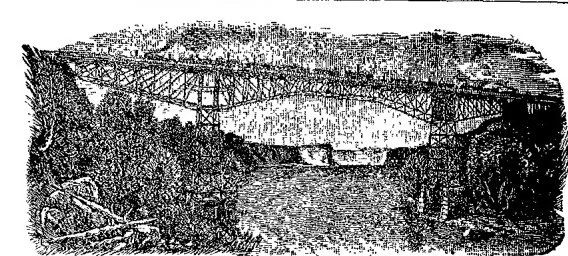
MICHIGAN CENTRAL NEW CANTILEVER BRIDGE, NIAGARA FALLS.
O. W. RUGGLES, General Pass. & Ticket Agent, Chicago. O. E. JONES, Ticket Agent, Battle Creek.
Chicago & Grand Trunk R. R.
Time Table, in effect June 23, 1889.
GOING WEST. Lmtd Exp.
Mail
Day Exp.
Pacific Exp.
Pacific Exp.
B.Crk Pass.
STATIONS.
Mail
Lmtd Exp.
Atl'to Exp.
Lmtd Exp.
Pt'H'n Pass.
GOING EAST.
pm 12.45
am 7.15
am 6.40
pm 7.45
pm 8.55
pm 4.10
Dep. Port Huron Arr.
pm 7.20
am 11.15
am 7.35
am 12.00
am 10.50
—
8.48
8.05
9.08
10.20
5.40
Lapeer
8.20
11.58
6.??
9.??
9.17
2.25
9.23
8.36
9.45
10.55
6.20
Flint
7.55
11.27
5.40
11.15
8.36
2.55
10.00
9.05
11.35
11.37
7.15
Durand
7.15
10.58
6.03
9.40
8.00
3.45
11.05
9.55
11.40
12.37
8.32
Lansing
5.20
10.07
4.00
8.55
6.35
—
11.42
10.21
1.11
1.09
9.08
Charlotte
4.42
9.37
3.25
—
6.02
a 4.55
12.35
11.00
12.55
1.55
10.05
† Battle Creek
3.45
8.55
3.25
7.45
5.15
d 5.00
12.45
11.18
1.00
2.00
—
3.45
8.50
2.50
7.40
—
—
1.28
11.51
1.48
2.50
—
Vicksburg
2.58
8.11
1.48
—
—
—
1.38
—
2.00
—
—
Schoolcraft
2.48
—
1.33
—
—
—
6.19
2.23
12.33
2.50
3.45
Cassopolis
2.05
7.26
2.45
6.19
—
6.50
6.50
5.05
1.05
3.35
4.25
South Bend
1.25
6.52
12.00
5.45
—
—
4.15
—
1.52
—
—
Haskell's
12.05
—
1.35
—
—
8.10
4.20
2.30
5.10
5.55
6.55
Valparaiso
11.50
5.30
10.30
4.30
—
10.10
7.00
4.45
7.30
8.10
9.45
Chicago
9.05
3.25
8.75
2.55
—
pm
pm
pm
am
am
am
am
pm
pm
pm
pm
Dep. / Arr.
Stops only on signal. Where no time is given, train does not stop. Trains run by Central Standard Time. Valparaiso Accommodation, Battle Creek Passenger, Port Huron Passenger, and Mail trains, daily except Sunday. Pacific, Limited, Day, and Atlantic Expresses, daily. Sunday Passenger, Sunday only.
GEO. B. REEVE, Traffic Manager. W. J. SPICER, General Manager.
BIBLE READINGS FOR THE HOME CIRCLE
COMPRISES ONE HUNDRED AND SIXTY-TWO READINGS FOR PUBLIC AND PRIVATE STUDY, AND ANSWERS NEARLY THREE THOUSAND QUESTIONS ON RELIGIOUS TOPICS, PRACTICAL, HISTORICAL, AND PROPHETICAL.
The readings are contributed by more than a score of Bible students, and give brief, pointed answers to the questions, quoting directly from the Scriptures, from history, and the writings of eminent commentators of modern times.
THE BOOK IS DESIGNED FOR ALL CLASSES OF SOCIETY. It embraces readings on the subjects of Conversion, Sanctification, Temperance, How to Make Home Happy, Social Purity, Justification by Faith, Faith Healing, Promises for the Children, the Atonement, the Judgment, History of Satan, the Law of God, the Second Coming of Christ, the Millennium, Home of the Saved, and numerous Readings on the prophecies of both the Old and New Testaments, accompanied by many choice hymns and poetical selections, and concluding with the impressive pictorial allegory, “The Game of Life,” in three parts. The work is—
PROFUSELY AND BEAUTIFULLY ILLUSTRATED,
and contains 600 octavo pages, printed from new type, on a superior quality of tinted paper, embellished with 57 full-page engravings, and 170 ornamental headings, many of which were designed and engraved, at great expense, especially for the book, together with 10 full-page scriptural and prophetic diagrams, 3 colored plates, and other attractive features, and will be sold by subscription.
THE BINDINGS ARE ELEGANT AND SUBSTANTIAL.
Olive cloth, embossed in red and brown, marbled edges, $2.00; Blue cloth, silk finish, embossed in gold and brown, gilt edges, $2.50; Library, full sheep, marbled edges, $3.00; Half morocco, gold side and back, extra marbled edges, $3.50; Full turkey morocco, gold side and back, gilt edges, superior finish, $4.25. Cheap edition, 400 pages, solid type, no illustrations or colored plates, no poetry, thin paper, bound in brown cloth, plain edges, $1.00.
AGENTS WANTED IN EVERY TOWN AND COUNTY IN THE UNITED STATES.
Sample copies will be sent by mail, in territory not occupied by an agent.
Address, REVIEW AND HERALD, Battle Creek, Mich.; 26 and 28 College Place, Chicago, Ill.; or Toronto, Ontario.
YEAR BOOK OF S. D. ADVENTISTS, FOR 1889.
Containing a complete workers' directory, and statistics of the General Conference and other organizations, with condensed business proceedings of anniversary meetings held at Minneapolis, Minn., Oct. 17 to Nov. 8, 1888, also giving brief sketches of publishing-houses, colleges, foreign missions, etc., handsomely illustrated with new drawings and zinc etchings. The work also contains valuable reference matter of a general character, aside from that which pertains to denominational work. Every family should have one.
Price, 15 cents, post-paid. Address, REVIEW AND HERALD, or any State tract society.
PARABLE OF THE TEN VIRGINS.
A NEW TRACT, BY URIAH SMITH,
Designed to give a better understanding of this parable, showing its past and present application, and defining the “shut door.” 24 pp. Price, 3 cents.
Address, REVIEW & HERALD,
Battle Creek, Mich.; 26 and 28 College Place, Chicago, Ill.; or Toronto, Ontario.
VIEWS OF NATIONAL REFORM.
PACKAGE NO. 1, THIN PAPER EDITION, 112 PAGES,
SIZE 6½ x 3¾, 10 CENTS.
This package contains thirteen tracts treating upon the various phases of the National Reform movement, as follows:—
NO. PAGES.
Evils of Religious Legislation, 4
Religious Liberty, 8
National Reform and the Rights of Conscience, 8
The American Papacy, 8
Bold and Base Avowal, 8
National Reform Is Church and State, 8
Purity of National Religion, 4
The Salem Witchcraft, 8
What Think Ye of Christ? 4
National Reformed Constitution and the American
Hierarchy, 16
The Republic of Israel, 4
National Reformed Presbyterianism, 24
The National Reform Movement an Absurdity, 8
The same matter printed on a better quality of paper, 184 pages, 5½ x 3⅝ inches, 20 cents.
Address, REVIEW AND HERALD,
Battle Creek, Mich.; 26 and 28 College Place, Chicago, Ill.; or Toronto, Ontario.
THE YOUTH'S INSTRUCTOR.
AN ILLUSTRATED WEEKLY PAPER FOR CHILDREN AND YOUTH,
Devoted to moral and mental culture, and especially designed as a companion to Bible study. It is the best paper in the world for youthful readers, being free from modern fables and sentimentalism.
The publishers design that the Instructor shall contain the choicest illustrations and reading matter that can be secured, suitable for young minds; and while the size of the paper is unchanged, the price for single copies has been reduced from 75 cents to—