Your ShelfYour Projects

Signs of the Times, Vol. 30, No. 3.

THE LESSON OF NAZARETH
Earlier text: Question Corner

BURIED UNDER A MOUNTAIN OF GOLD.

YEARS ago, while on a visit to New York City, I was invited to dine with one of her millionaire citizens. Next to me at the table sat an old friend, a very rich man, president of one of our Southern railroads. He seemed unusually sad. All at once, laying down his knife and fork, he turned to me, and said, "I am the most miserable man the sun shines on to-day."
I expressed my surprise, as he had "more than heart could wish," and was both a successful and a popular man.
"Yes," he said, "that is all true, but let me explain. When I began life I began poor. I worked hard, but I was happy. I belonged to the church, enjoyed my religion, and life was a delight to me. But, alas! in an evil hour I resolved to be rich. I engaged in mining speculations, and became rich beyond my highest expectations. I heaped up a mountain of gold, but was buried beneath it. Naturally, I want to keep it for my children, and I find this harder to do than it was to accumulate it. It seems constantly trying to slip away. Consequently it has reduced me to a slavery more galling than that of the Roman galleys. I know no rest, no Sundays, but day and night from year's end to year's end I toil on. I am miserable. It is killing me. It will not be long till you hear of my death, and you can say I died of a broken heart, because my foolish desire to be rich succeeded."
It was not more than a year afterward when the telegraphic wires flashed the news of his death.
Time rolled on. Several years afterward, one day, as I was taking the train to go to Mississippi to hold some meetings, I noticed a ragged stranger at the brakes. I asked the conductor who he was. He replied, "He is the son of our former president." "What," I said, "I thought he left his family rich." "He did," said the conductor, "but the boys were dissipated and have squandered it all. We have given this one this place as brakeman because of his father, but it is doubtful if we can keep him, he is so trifling." Had my friend been deceived by riches? Alas, yes.
Riches proved to be a deadly snare to that man.—W. A. Montgomery.

AN ACCUSER SILENCED.

TWO FELLOW-TRAVELERS were seated together in a railway carriage engaged in earnest conversation. It was of a religious nature, and one of them, a skeptic, was evidently seeking to excuse his skepticism by expatiating on the various evils which afflict Christendom. He was detailing, with manifest pleasure, the hypocrisy and the craft and the covetousness and the divisions found in the professing church, and then he pointed to some of the leaders, as the most markedly corrupt of the whole.
In front of them sat a Christian who was compelled to hear all this. Had he felt the accusations to be false, he might have suffered them all, as a part of the hatred the world bears towards Christ, and been truly happy in so suffering; but he knew them to be true—too true to be concealed from the most charitable mind, so all he could do was to bow his head and bear the deserved reproach.
Soon, however, the accuser, anxious to extend the circle of his audience, addressed this fellow-passenger in front of him.
"I see you are quick to detect evil," answered the Christian, "and you read character pretty well. You have been uncovering here the abominable things which have turned Christendom into a wreck, and are fast ripening it for the judgment of God. You have spared none, but given all a good measure. Now I am a Christian, and I love the Lord Jesus and His people. Not a word shall I offer in defense, but I here solemnly challenge you to speak the first word against the Lord Jesus Christ Himself."
The skeptic was surprised. He seemed almost frightened, and sheepishly replied, "Well, no; I couldn't find fault with Him. He was perfect."
"Just so," said the Christian; "and therefore was my heart attracted to Him; and the more I looked at Him, the more I found I wasn't like Him at all, but only a poor, sinful, guilty man. But tell me yourself if I hadn't a right to be happy and to love Him when I found out that He had died for me? Ever since then I truly love Him, and all the evil which professed followers of His may do, can not turn me away from Him. My salvation hangs on what He has done, and not on what they are doing."
—Horatius Bonar.

THE MAN WHO MAKES MISTAKES.

[H. Irving Hancock, in the November Success.]
It is by no means a new conception in commercial circles that the man who makes mistakes, and who therefore finds himself an object of censure from his employer, may be a very valuable employee. Yet it has probably occurred to but few people who toil for success that there is a corollary to the effect that he who goes on in his placid business way year after year, without being guilty of a single error, is a positive menace to the well-being of the one who engages his services.
No American business man understood this latter proposition better than the late Eben D. Jordan, of Boston, founder of the great dry-goods house of Jordan, Marsh and Company. During one of his daily strolls through the store Mr. Jordan's glance fell upon one of his men who, for ten years, had been at the head of a certain department.
"That reminds me," mused Mr. Jordan, "that I made a note yesterday to look into the record of this Mr. Smith. I'll do so to-day."
Returning to his private office he sent for one of his head men and inquired:—
"What sort of a fellow is Smith?"
"The very best sort, I consider him," replied the subordinate.
"I am very glad to hear that," quoth Mr. Jordan. "He has had charge of his department for ten years, I believe."
"Yes, sir, and he has a unique record. He has never made a mistake."
"Eh? What's that? Discharge him at once."
"Sir?" stammered the surprised subordinate.
"No, on second thought," continued Mr. Jordan, "you needn't discharge him right away. I'll give him another chance. Send him in to me."
Smith came, entering the private office with some trepidation.
"Sit down, Smith," said Mr. Jordan, kindly; "I have been told that you have had charge of your department for ten years, and that you have never committed a blunder."
"Such, I believe, has been my record, sir," replied Smith, who now saw his way to certain promotion.
"I want you to mend your ways, Mr. Smith," went on his employer.
"But I don't understand you, sir," was the astounded man's reply.
"I dare say you don't. That's what I wanted to see you about, Mr. Smith. I don't like men who never make mistakes. What I need here is a progressive man—one with plenty of push and enterprise. Now, a man who is full of zeal for me and primed with ambition for himself is sure to make a mistake now and then. The man who never blunders is too cautious, too slow to be worth much here. Recently I had a statement made out showing me the percentage of increase or decrease in the business of each department. I am sorry to say that your department is the only one that causes me any uneasiness. I find the reason to be that you are altogether too cautious. You never make any mistakes! Unless you can soon show some changes in your methods, Mr. Smith, you will not be a candidate for continued employment in this establishment."
"Then you want me to make mistakes hereafter?" cried the dazed department manager.
"There, again, you have failed to get the idea. The man who makes a lot of senseless blunders is an expensive luxury. The man who never does anything foolish is equally useless. Provided you blunder once in a while, yet show me that your department is becoming increasingly profitable to me, I shall consider you a valuable man. Think over what I have said to you, Mr. Smith. It is equally applicable to any business that calls for progressive men and methods. If at any time you are in doubt, come to me for advice. Remember that in my life of striving and struggling I have made plenty of blunders, and yet have made some money, too. It is restless zeal that counts. Go back to your department, Mr. Smith. I will give you two months in which to redeem yourself."
It is worth while recording that Smith lost, with reason, much of his complacency about the absence of mistakes in his work, but he showed an improved balance sheet, and retained his position.

INTERFUSED.

We can not lie every morning, and repent the lie at night; We can not blacken our souls all day, and each day wash them white; Tho the pardoning blood availeth to cleanse the mortal stain, For the sin that goes on sinning, that blood was shed in vain.
We must buy and sell in the market, we must earn our daily bread; But just in the doing these useful acts may the soul be helped and fed. It is not in keeping the day's work and the day's prayer separate so, But by mixing the prayer with the labor that the soul is taught to grow.
Then none may deem it wasted time, who stands in a humble spot, And digs and waters a little space, which the hurrying world heeds not; For the Lord of the harvest equally sends His blessed sun and rain On the large work and the little work, and none of it is in vain. —Susan Coolidge.

WHAT BECAME OF THEM?

FIFTY years ago a gentleman of Ohio noted down ten drinkers, six young men and four boys. "I saw the boys," he says, "drink beer and buy cigars in what was then called a 'grocery' or 'doggery.' I expressed my disapprobation, and the seller gave a coarse reply. He continued the business, and in fifteen years he died of delirium tremens, not leaving five dollars.
"I never lost sight of these ten, only as the clods of the valley hid their bodies from human vision. Of the six young men, one died of delirium tremens, and one in a drunken fit; two died of disease produced by their excesses before they reached the meridian of life. Two of these left families not provided for, and two sons are drunkards. Of the remaining, one is a miserable wreck, and the other a drinker in some better condition."
Of the four boys, one, who had a good mother, grew up a sober man; one was killed by a club in a drunken brawl; one has served two terms in the penitentiary; and one has drunk himself into an offensive dote whose family has to provide for him."

THE DREADFULNESS OF BOYS.

MUCH of the dreadfulness of boys from six to sixteen is due to the fact that in so very few homes a boy can be natural without disturbing everything and everybody, says a writer in Good Housekeeping. But who ever thinks of providing a place for the boys in which to keep their treasures undisturbed, where they can make all the noise they like? If a man needs a den to relax in, and every one seems to grant that he does—how much more does a growing boy! Is it not dreadful to think of a live boy in an elaborately furnished room, and all the other members of the family nagging him to keep still?
If mothers would give anything like the amount of study and pains to their boys and the conditions which will bring the best results, that those do who succeed with house plants, we might have growing boys instead of what we most often see, boys hard and indifferent to every one.

THE STRANGERS AT YOUR DOOR.

BY K. DOI.
THE song, "If you can not cross the ocean and the heathen land explore, you can find them nearer, and you can help them at your door," is a most fitting suggestion to us. There are thousands of foreigners here from all parts of the world, and we find many heathen among them who have never heard the Gospel of Christ.
As it is said that in the last days people shall go to and fro to seek the words of the Lord, I believe some hungering souls are here at our doors in search of His words; and, if we should fail to aid in their search, it will be a great disappointment to them. It rests with us who have received the knowledge of God to impart it to them, and aid in their search. Yet it seems so little effort is being made, so little work is being done among them.
In the oriental hemisphere there are millions of human beings who have never seen the light of the Gospel. One can not imagine how pitiable are the conditions in those darkened lands, unless he has been right there. Thousands upon thousands of sin-stricken souls are perishing without any knowledge of redemption. How pitiable, how sad a condition it is! Should they not be made "partakers of the divine nature"? Should not they be "fellow-heirs of the same body"?—Surely, they have an equal right with us in the Saviour's mercy.
Christians, the strangers of those darkened lands are here at your door. Why not let them in, and tell them the story of salvation? Is it not a precious opportunity that we need not cross the ocean to find heathens? We can and should, even while at home, co-operate with our workers in foreign lands in the advancement of the Gospel of the last days.
Our workers in various parts of the field are in great need of native workers, in order to reach the people more readily, and come into closer touch with them. Native interpreters and translators of our own faith are so much needed in every foreign field.
How important it is, then, to work among those foreigners who are here in this country to prepare them for these needs, and also to save them.
Our country has long been blessed with the light of the Gospel, and is known as a Christian nation; a great portion of its inhabitants have not yielded to its influence, and do not possess a Christian conscience. Such seem to think it a matter of patriotism to maltreat foreigners, especially when their skin is of a different pigment from their own. They should remember that they themselves were strangers in this country only a few hundred years ago. This reminds us that the Lord told the Israelites that "Thou shalt neither vex a stranger, nor oppress him; for ye were strangers in the land of Egypt." Moreover, are we not all strangers on life's journey? Whatever others may do or feel, the Christian must make it known that he considers his brethren his equals, no matter what the nationality; for do we not all have the same Father?
If there was ever a time when the educating spirit of the Third Angel's Message was needed, it is now. Now is most high time to proclaim the last message to every nation and kindred and tongue and people.
Here is a splendid opportunity for our stay-at-home people who desire a part in the Lord's work. Let each one ask his own heart whether he shall undertake the work or shirk the responsibility. I pray that our brethren may become deeply interested in this work so dear to my own heart.

SOME GRAVE MISSIONARY PROBLEMS.

[Rev. A. T. Pierson in Missionary Review of the World.]
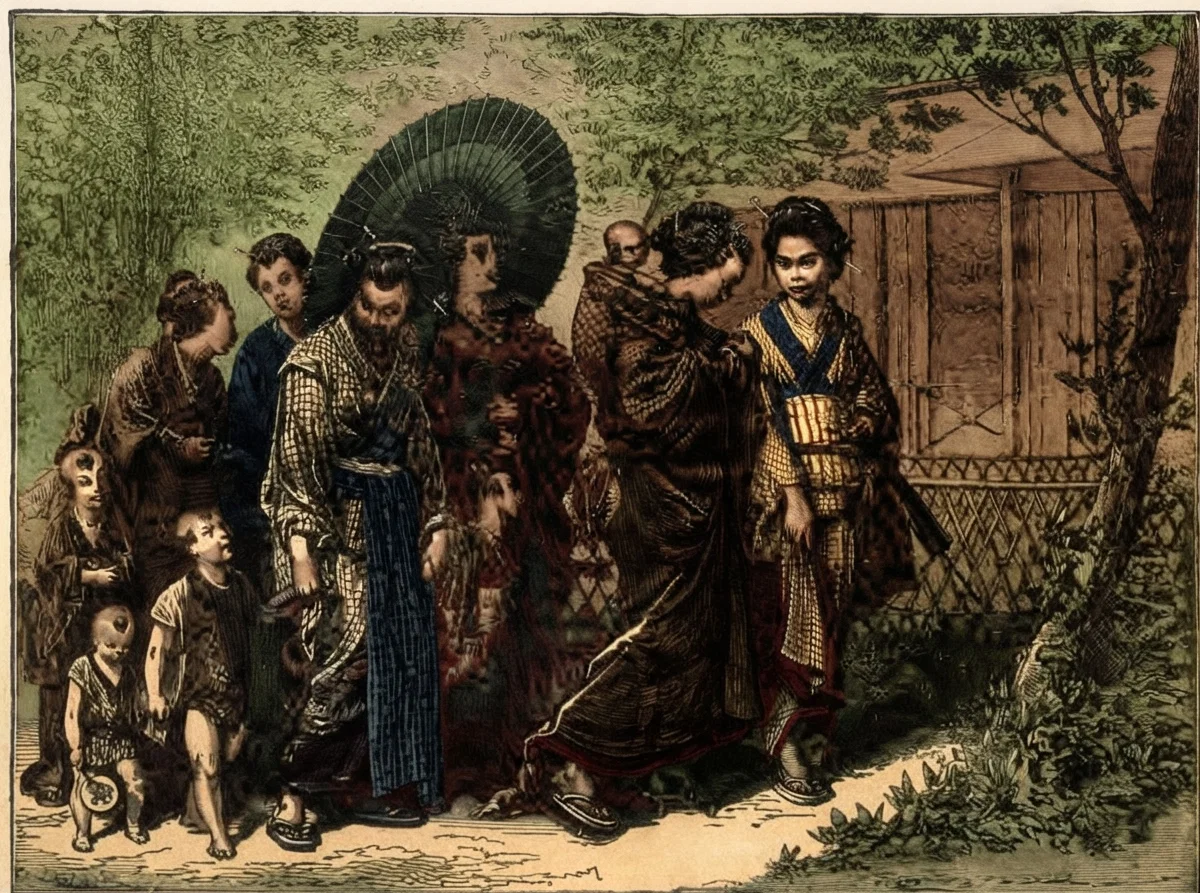
Home Life in Japan,
Home Life in Japan,
ONE chapter in the Second Book of the Kings (2 Kings 23: 1-24) contains a brief epitome of the greatest reformation recorded in Hebrew history. Josiah found at least ten forms of idolatry and iniquity polluting the Temple and people: Worship of Baal and Astarte; Asherah, or Phallic, abominations; Sodomites; Tophet, or Moloch; Chemosh of Moab; Milcom, of Ammon; Bethel, with Calf Worship, and the consulting of familiar spirits, and the offering of incense in high places. He destroyed all existing relics of idolatry, defiled idol altars and sites, and degraded priests of Jehovah who had corrupted His worship.
Turn, now, to confront the evils of our own day which call for a new reformation, and the problems which demand practical solution. First looking at the Orient, we find three generic forms of false faith:—
  1. ANCESTRAL—Worship of deceased ancestors, including all human heroes lifted to divine honors.
  2. ASTRAL—Sun, moon, stars, including the natural forces of the universe, and the material creation.
  3. ANIMAL—Various forms of animal life, originally probably used as symbols of Divine creative power, etc., like the Egyptian Apis.
Under these three forms all false faiths may be arranged, as, for example: Under Ancestral, Confucianism, Mohammedanism, Buddhism; under Astral, Parseeism, etc.; under Animal, Brahmanism, Fetishism, etc.
For convenience in studying the great missionary problems, we may divide the world field into two parts—the Orient and the Occident; the one representing the territory where the dominant false faiths prevail and the latter the territory of at least a nominal Christianity, whence must come the missionary forces or the great campaign of the kingdom of Christ.
In oriental lands we find several gigantic obstacles to the spread of the Gospel, and, while various systems of heathen religion have certain features in common, like polytheism and idolatry, each has some one or more conspicuous characteristics which differentiate it from the others. For instance, Fetishism, the lowest form of idolatry, is one of the grossest forms of the worships of nature, as Parseeism, or fire-worship, is the most refined. Brahmanism is specially marked by its iron system of caste, and Buddhism by its essential deification of man, in Buddha. Mohammedanism is comparatively a pure system of belief, but corrupted by sensuality; and modern Judaism is a pure religion perverted into denial of the Messiahship of the very Christ which it foretold. Confucianism is a lofty, ethical system tainted with the worship of ancestors. Thus, every system has one or more distinguishing features which render it especially difficult to meet and overcome by the modern missionary forces.
In the Occident, even among the nominal people of God, more or less exact counterparts to these errors are found, constituting the main hindrances to missions at home, if indeed they are not more formidable than those encountered abroad. For example:—
The virtual worship of nature in scientific materialism and naturalism. The Caste Spirit, in race prejudice, class antagonism, and social hatred. The Rejection of Christ's Deity in Unitarianism and philosophic skepticism. The Counterpart of Confucianism in dependence on ethical systems, tradition, etc.
Modern idolatry, as it appears in Christian lands, may be classified, therefore, substantially under three main heads:—
  1. Worship of matter—materialism.
  2. Worship of Mammon—wealth and worldly enterprise.
  3. Worship of man—self-interest and self-indulgence.
In Christendom there is the Self Life as a principal motive, with this world as its field of operation, and present time as its period of opportunity; while, per contra, God commends unselfish love as the principal motive of missions, with the whole race of man as its field of operation, and with all eternity as its harvest hope and reward.
It is a remarkable fact, which should be emphasized as most significant, that, when we turn to these occidental lands and study the hindrances which, among so-called Christian peoples, impede or prevent the missionary conquest, we thus find every obstacle confronted abroad, to have its almost exact counterpart at home. The worship of nature corresponds to materialism, sometimes gross, sometimes refined, as in scientific skepticism; the caste system is reflected in race prejudice and class antagonism; the deification of Buddha, in hero worship; the sensuality of Mohammedanism corresponds to the awful corruption of sensual vice; Judaism, with its rejection of the Messiah, to the Christless creeds of a nominal Christianity. Ancestral worship has its counterpart in blind reverence for tradition; and idolatry generally, in the worship of Mammon. It is as if Christendom had imported the idols, superstitions, and debasing practices of heathendom, modified them, and called them by other names, still giving them a shrine and throne in the temple of God, as the Jews did with the strange deities of the heathen. It is another example of the repetitions of history. There is nothing new under the sun. The human nature which is in the heathen and pagan reappears in the Christian, and, so far as unsanctified, brings forth similar, if not essentially identical, fruit.
Some heathen obstacles are peculiarly formidable. Mohammedanism, called also Islam, Resignation, is theoretically entire submission to the will and word of God; practically it is fatalism, not faith. It has two fundamental creedal statements: "There is no God but God, and Mohammed is God's apostle." God has no offspring—"begetteth not, nor is begotten." Jesus Christ is a great prophet, and will come again to establish Islam everywhere. Angels are mediators between God and man. There are four archangels: Gabriel, Angel of Revelations, the Holy Spirit; Michael, Guardian of the Jews; Azrael or Raphael, Angel of death; Uriel, the Trumpeter of Resurrection. The duties are four: prayer, almsgiving, fasting, and pilgrimage. Prayer, five times in every twenty-four hours; almsgiving, legal and voluntary; fasting, during the whole month of Ramadan, from sunrise to sunset (they may eat from sunset to sunrise), and pilgrimage to Mecca.
Caste is a term applied chiefly to class divisions in India—"a system of cellular structure, where the cells do not penetrate or communicate." It makes subdivision of labor so rigid that to go outside of the limits of one's employment is a forfeiture of social rank. In some cases even the touch of a lower caste defiles, and some sorts of food are defiled when the shadow of an inferior caste passes or falls over them. In India the principal castes are four—priestly, military, mercantile, and servile, with numerous subdivisions; and so stringent are the caste rules that Dr. Judson declared that to get a convert to accept Christ and come out for Him was like pulling the eye-tooth of a live tiger!

THE BIBLE.

MOST wondrous Book, bright candle of the Lord, Star of eternity! the only star By which the bark of man could navigate The sea of life, and gain the coast of bliss Securely; only star which rose on time, And, on its dark and troubled billows still, A generation, drifting swiftly by, Succeeded generation, threw a ray Of heaven's own light, and to the hills of God, The everlasting hills, pointed the sinner's eye. This Book, this glorious Book, on every line Marked with the seal of high divinity; On every leaf bedewed with drops of love Divine, and with the eternal heraldry And signature of God Almighty stamped From first to last, this ray of sacred light, The lamp from off the everlasting throne, Mercy took down, and in the light of time Stood, casting on the dark her gracious bow; And even now beseeching men, with tears And earnest sighs, to read, believe, and live. —Pollock.

OUR WORK AND WORKERS.

THREE candidates were baptized in Laguna Street church, San Francisco, on the evening of the 3d inst., by Brother B. F. Richards.
As a result of a week's meetings at Lake Village, Ark., by Brother S. S. Ryles, two persons were baptized, and a church of eight members was organized.
BROTHER F. H. CONWAY reports that eight young people have recently taken their stand for the faith at Perry, O. T., and that seven had started in the Christian life at Lone Elm.
BROTHER HENRY JOHNSON writes from Sheyenne, N. D., that he has held meetings in a hall for a few weeks, and a family of four have accepted the truth, while others are deeply interested.
WE notice in the Southwestern Union Record that some brethren in Arkansas who have been selling the special SIGNS are following it up with canvassing for the regular issues. This is what ought to be done everywhere; in fact, this is where the greatest benefit of the great edition comes in.
ABOUT four years ago the General Conference commenced publishing the Christian Record, a monthly magazine for the blind. It is set in two well-known systems, the American Braille and the New York Point. Its patronage has demonstrated that the paper has a mission and a field. There are more than eighty thousand educated blind people in America, besides many thousands who, on account of impaired vision, are excluded from the public schools. When the Lord says, "Preach the Gospel to every creature," these blind people are included, and they are entitled to the last message of the pure Gospel. From whom shall they get it?—It must necessarily be from those, and from those only, who know the message themselves. The Record is $2.00 a year, which is a very low price, considering the great expense of preparing such a paper. Send all donations and subscriptions to the office of the General Conference, 222 N. Capitol St., Wash., D. C.
WRITING from the Gold Coast, West Africa, Brother J. M. Hyatt says: "We can see that some [of the native ministers] are getting stirred and we hope for good. Several are reading the SIGNS. We receive the club of ten that some one is sending us. It was through the good influence of the SIGNS that we obtained the location that we have. Several are keeping the Sabbath with us. Our largest attendance at Sabbath-school is fifty-five, while at our weekly meetings the number is often three times as large. This can not be called a Sabbath-school in the true sense of the word, as our numbers greatly fluctuate. Some, we think, are about ready for baptism, and we hope for others soon. Some of the most influential people are interested in our work. Some come from twelve to sixty miles to get our books. Far more people here are able to read than is generally reckoned, and we hope to get many of our books and papers out among them. They like very much anything that is readable that comes from 'America.' In fact, we fear that they learn the 'American' way sooner than the truth. One would be surprised to see the literature that comes in on every steamer, the larger part from the United States, almost everything from a cheap work on Hypnotism to a standard reference book. Several of the American colored people have been on the West Coast, from Free Town to Lagos, hence the desire for things that are 'American.' The truth that we carry is not 'American,' but still better, so we must try to give it to the people."

IN THE NEW HEBRIDES.

[John G. Paton, in Missionary Review.]
THE converts at the mission stations in Malekula have built a Christian village, in which they live. All are clothed. They begin and close every day with praise and prayer, and are very happy with each other, giving a daily object-lesson of their joy and peace of Christianity. To their village they welcome all new converts, teach them, and help to protect them; and if they resolve to live there, all unite and assist in building a new house for them after a given plan on straight streets running parallel with each other and with streets at right angles.
All houses are built on strong wood foundations, wattled and plastered with lime, and whitewashed. The cottages are neat, and are all kept clean—a great contrast to the heathen villages. The village is on a healthy site, bought for the purpose near the mission house, so that they may have the help and advice of the missionary in all difficulties raised by the heathen, and may also help the missionary in his work, and receive his constant teaching and care.

WANTED FOR MISSIONARY WORK.

(Always prepay postage.)
LATE, clean copies of any of our publications. Address, Box 424 Roswell, N. M.
SIGNS, Sentinels, Health Journals, tracts, etc., in English and Spanish. Please send well wrapped. Address, S. B. Taft, Post Wheelwright, Fort Ringgold, Starr County, Tex.

WANTED.

A FIRST-CLASS COOK. Also students for training-class for nurses. Extra inducements. Address, stating age, qualifications, etc., Garden City Sanitarium, San Jose, Cal.

RIPE OLIVES AND OLIVE OIL.

I HAVE about four hundred gallons of nice, pickled olives nearly all ripe. They are nicely cured and would sell ordinarily for 75 cents per gallon wholesale.
I hope to sell out and go to Mexico, and am offering these olives while they last at the extremely low price of 40 cents per gallon in 50-gallon barrels; 50 cents per gallon less than barrel lots down to two gallons. I also have some genuine unadulterated olive oil, which I will sell, while it lasts, at $3.00 per gallon. Marysville, Cal. A. E. Crist,
FERRY'S SEEDS MEET ALL NEEDS Experience has established it as a fact. Sold by all dealers. You sow—they grow. 1904 Seed Annual postpaid free to all applicants. D. M. FERRY & CO. DETROIT, MICH.

I Can Sell Your Real Estate

no matter where it is or what it is worth. Send description, state price and learn my wonderfully successful plan. W. M. OSTRANDER 379 North American Building, PHILADELPHIA

Talent for Bearing the Gospel

THERE is no grade of talent in any homeland too good to be utilized in bearing the message of salvation to those who sit in darkness and the shadow of death.—Indian Witness.

MEXICO AND THE RELIGIOUS ORDERS.

The reform laws of Mexico prohibit religious communities. We spent most of the Lenten season of 1877 in San Antonio, Texas, where and in the neighboring town of Séguin the expelled monks congregated, and we read with special interest the action of the authorities in Mexico City a few weeks ago. The Department of the Interior having been informed that a monastery of Carmelite friars existed in a building attached to the Church of Our Lady of Mount Carmel, in the City of Mexico, it communicated the fact to the first district judge. The Mexican Herald surmises that the existence of the monastery was revealed by the Mexican friars who were turned out of the monastery soon after the arrival of a Spanish friar. When religious houses flourished in Mexico there was always a certain animosity between the Spanish and the Creole or Mexican members of the various communities. The house was specially equipped with means of exit in case of a sudden domiciliary visit, consisting of corridors in various directions, and spiral staircases. Two friars were arrested. The others, to the number of ten or twelve, it is said, made good their escape. The building externally looked like a private house and had a family in it, "no doubt to throw suspicion off the scent." A small oratory had been fitted up, the central figure of which was the Carmelite Madonna, whose feast was celebrated no longer ago than July 16. It will be remembered that the Virgin of Carmel was the favorite of the late Pope. He had hoped that he might die on the day of her "festa," July 16, but, weak as he was, his conviction that he would die that day did not overcome his remarkable endurance.—N. Y. Christian Advocate.

Christian Life, Not Christian Philosophy

A HINDU editor in India, in conversation with a missionary, said he had read several "Lives of Christ" and the New Testament, and had attended the Haskell lectures, given by Dr. Barrows, Dr. Fairbairn, and Dr. Hall, but these had not persuaded him. He said, "India does not need to be instructed in the philosophy of the Christian religion, but to see a Christian life."

LESSON 5.—JANUARY 31.—JESUS CALLS FOUR DISCIPLES.

Lesson Scripture, Luke 5: 1-11, A. R. V.
(1) "Now it came to pass, while the multitude pressed upon Him and heard the Word of God, that He was standing by the lake of Gennesaret; (2) and He saw two boats standing by the lake: but the fishermen had gone out of them, and were washing their nets. (3) And He entered into one of the boats, which was Simon's, and asked him to put out a little from the land. And He sat down and taught the multitudes out of the boat. (4) And when He had left speaking, He said unto Simon, Put out into the deep, and let down your nets for a draught. (5) And Simon answered and said, Master, we toiled all night, and took nothing: but at Thy word I will let down the nets. (6) And when they had done this, they inclosed a great multitude of fishes; and their nets were breaking; (7) and they beckoned unto their partners in the other boat, that they should come and help them. And they came, and filled both the boats, so that they began to sink. (8) But Simon Peter, when he saw it, fell down at Jesus' knees, saying, Depart from me; for I am a sinful man, O Lord. (9) For he was amazed, and all that were with him, at the draught of the fishes which they had taken; (10) and so were also James and John, sons of Zebedee, who were partners with Simon. And Jesus said unto Simon, Fear not; from henceforth thou shalt catch men. (11) And when they had brought their boats to land, they left all, and followed Him."
Golden Text.—"If ye continue in My Word, then are ye My disciples, indeed. John 8:31."

SUGGESTIVE QUESTIONS.

(1) Where was the scene of the circumstances that constitute our lesson to-day? Where was the home of Jesus at this time? Verse 1. Note 1. (2) What was standing by the shore of the lake? What were the owners doing? Verse 2. (3) As the crowd pressed upon Jesus, what did He do? Whose boat was it? After pushing the boat out from the land, what did Jesus do? Verse 3. Note 2. (4) When He had finished speaking, what did Jesus request Simon to do? Verse 4. (5) How did Simon answer the Lord's request? Verse 5. Note 3. (6) What was the result of their obedience? What disaster was threatened? Verse 6. Note 4. (7) What then did the men do who had cast the net? What is said of the quantity of fish? Verse 7. Note 5. (8) When Simon saw the miracle, what did he do? What did he say? Verse 8. Note 6. (9) How had the miracle affected those who were with Simon? Verse 9. (10) Also James and John? How did Jesus reply to their amazement? Verse 10. Note 7. (11) After bringing their boats to land, what did the four partners do? Verse 11. Note 8.

NOTES.

1. Jesus had now fully entered upon His ministry, and His fame drew crowds to His side wherever He went. His miracles manifested a singular power, and His teaching betokened an authority that demanded attention. The cities by the Sea of Galilee were now the center of His activities, Capernaum being His temporary home. Matt. 4:13.
2. Simon and his brother Andrew were among the first of the disciples of Jesus (John 1:40-42), but had not yet been formally called to constant companionship with Him. When Jesus went on board the boat He knew that He was on the premises of a friend, and would be welcome to use the property as He pleased. The owners of the boat afterward showed their willingness to sacrifice all for Christ, and that was one trait that qualified them for leaders in the Gospel work.
3. "At Thy word."—Notwithstanding an all-night practical demonstration that they could not catch any fish in that particular spot, the word of Jesus had sufficient weight with Peter to warrant him in trying once more. He would at least be obedient to the One in whom he had professed to believe. This was reasonable and consistent, even tho he did not expect to get any fish. This was another point of qualification for discipleship.
4. The reward of obedience was, in this instance, instantaneous. Faith will bear more severe test as it grows in strength. We are to go on "from faith to faith" (Rom. 1:17) until the whole life is lived "by the faith of the Son of God" (Gal. 2:20).
5. "Beckoned unto their partners," not only to help them secure the prize, but to share in the wonderful catch. So the Gospel invitation is to share in both the privileges and responsibilities of the Master's cause. We are first to be "laborers together with God" (1 Cor. 3:9), and then be sharers in the reward—"heirs of God through Christ" (Gal. 4:7). The sequel proved that there was abundance for all. So God's blessings in His creatures are limited only by the capacity to receive. See 2 Kings 4:1-6.
6. A new light seems to have flashed over the mind of Peter as he contemplated the great miracle. He had believed that Jesus was the Messiah—a great man who had arisen to deliver Israel from their bondage—but now he seems to have recognized something of His divine nature and power; and as he did so he recognized his own sinful condition. This was but a natural consequence, as the conviction of sin came of his obedience to the Word in letting down the nets. That conviction was his greatest need. Yet his request, "Depart from me," showed that he had yet to learn a very essential lesson, namely, that it is nearness to Christ that the sinner needs.
7. The partners of Simon also partook of his fear and amazement, but, as he was the one to voice the sentiment of all, Jesus replied to him personally, the reply being for all. Instead of departing, as the bewildered man requested, Jesus allayed his fears, and took him into even closer relationship. So, many times, the impetuous, thoughtless prayers of well-meaning people are ignored and something better supplied. It is well that we have One that "helpeth our infirmities" in the matter of prayer. Rom. 8:26.
8. "Left all, and followed Him."—This was a further obedience of the divine Word, which they were just learning to obey. Matthew and Mark both tell us that they left all "immediately." But, according to Mark, the father of James and John and some "hired men" were left to care for the boats and fish. This great catch of fish was no doubt a great help to those who were dependent upon the labors of the disciples who were called to follow the Lord in the work of the Gospel. The Master did not forget the needs of their families and dependents. And "your Father knoweth what things ye have need of;" so do not be afraid to make any sacrifice that the Master may demand, tho it be to forsake all. He will look out for the consequences of all the demands that He makes.
Continue reading: LESSON V.—THE TWO THOUSAND THREE HUNDRED DAYS