A UNIQUE case now before the United States Supreme Court involves a Chinese inheritance. The justices must decipher characters written on two tablets from a temple in Amoy, China. The complication comes in the fact that Chinese interpreters do not agree as to the story the tablets tell. About $300,000 depends on the decision.
For Glory and for Beauty
By Worthie Harris Holden
WORTHIE HARRIS HOLDEN
’Twas “for glory and for beauty”
Israel’s priests were clad of old,
And the fashion of their garments
To the seer the Angel told;
For the broidered work of linen
And for special craftsman skill
Willing hearts were granted wisdom
Heaven’s edict to fulfil.
Day by day we weave apparel
We shall wear on streets of gold,
Then, as priests, to worlds unfallen
God’s redemption plan unfold.
Have we here a holy unction
And the wisdom from on high
To design for heaven’s glory
And the beauty of the sky?
When triumphal towers have crumbled
And earth crowns become decay,
When the marvelous art of nations
Has been banished, and for aye,
These — the triumphs of the ages —
Characters of God’s design
Through the cycles of forever
Like the wondrous stars will shine.
Our Work in British East Africa
By Julius R. Conradi
J. R. CONRADI
WHEN we started our first mission in East Africa some nine years ago, our minds had already been directed toward the country about the largest sweet-water inland sea of the Dark Continent—the Victoria Nyanza—right under the equator. The southern half of this lake is German, while the northern half is British. At that time we had our minds turned to the country southwest of the lake, but we were informed by the German government that the Catholics were in that section, so we began our mission work in the South Pare District, near the coast of German East Africa.
Two years later, as we were planning our first mission in British East Africa, Brethren A. A. Carscallen and A. C. Enns selected a site in the Kavirondo country, on the northeast corner of the lake. All the eastern side of the lake from Kisumu, in British East Africa, to Nassa, in German East Africa, was practically unoccupied. The Roman Catholics had had a station or two in there, but had left the field. Four years ago when I visited the lake and made a nine days' trip around it, I was thoroughly convinced that the eastern side of the lake would not only give us a splendid field for the British Mission, but for the development of a large German mission as well.
When I then visited the field Brother Enns had again returned to the Pare District, and Brother J. D. Baker and his wife had joined Brother and Sister Carscallen. The dwelling-house and the school building at Gendia were only partially erected. There were not so many in the school, but the brethren were busy learning the language. We marched across the British territory, and selected a second station at Wire Hill. We also spent several days at Karungu, which had formerly been a British military station and was still occupied by British officials. Even then there was some talk of the place being sold to us by the government for a third mission site. Though no other mission had really been in this territory on the British side, for some reason we had been unable to secure any stations other than Gendia and Wire Hill.
We had sent out a number of workers: Brother and Sister B. L. Morse, Brother and Sister Horace Brooks, Brother and Sister F. A. Spearing, Brethren L. Lane and E. Phillips, and Brother H. Sparks, who had gone out on his own initiative. These were all present at the meeting in Gendia, save Brother and Sister Brooks, who had to return home on account of Brother Brooks's failing health. Just before our arrival the way seemed to open before us, and the six buildings at Karungu were sold to us at the reasonable price of $1,137. Several new stations have also been taken possession of by our workers, hoping we may secure final rights to them. There seems no question but that the Roman Catholics have been working against us here for years, but seemingly this influence has been broken of late, and the way is opening for our securing new stations.
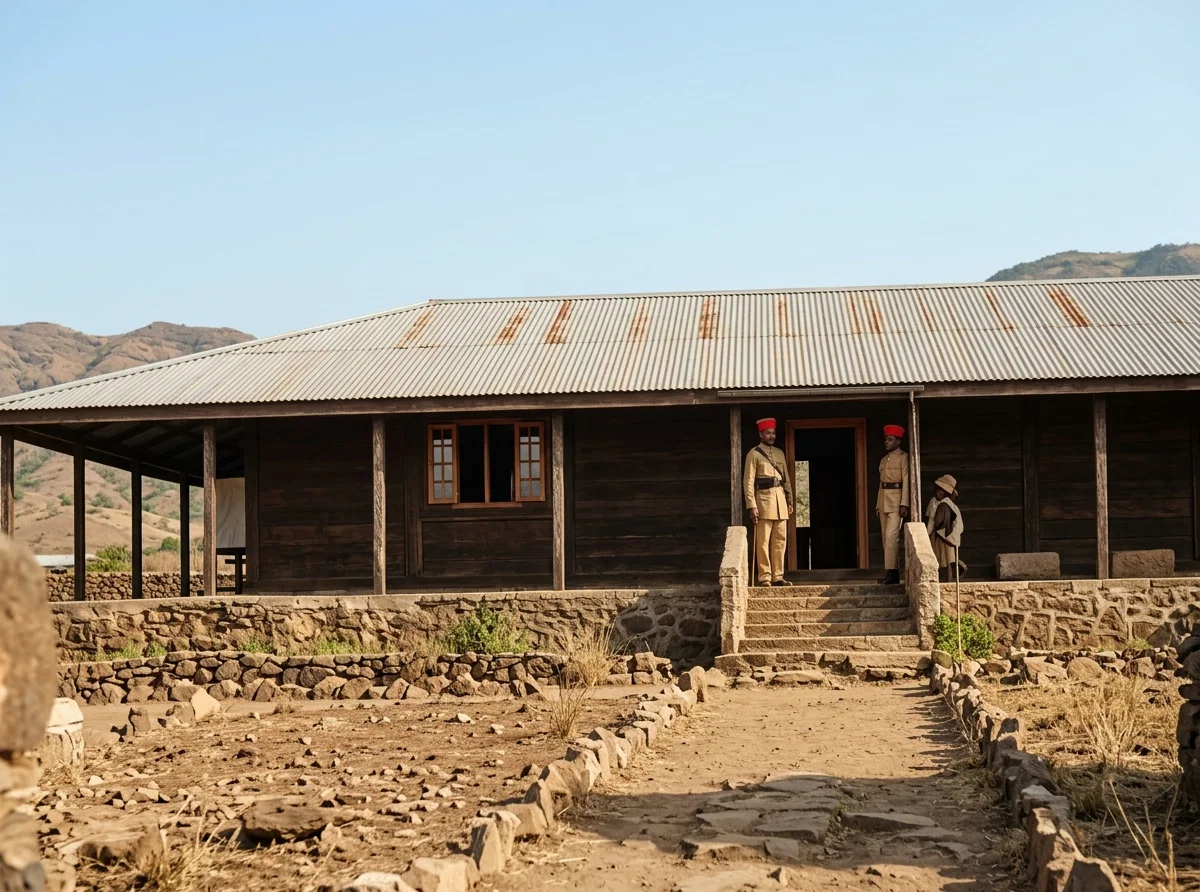
MISSION STATION AT KARUNGU
Recently purchased of British government, and now occupied by Seventh-day Adventists.
We are much pleased to see the progress made in the upbuilding of the two stations. Gendia now has a roomy burnt-brick dwelling, which furnishes accommodations for several families, as there are six good rooms, a bath-room, and two kitchens. There is also on the place a large school and chapel easily accommodating four hundred persons. In addition to these are the native huts and the workshop.
The Wire Hill station impressed us very favorably, being located on a plot of nice land that we were able to secure. The dwelling-house there is also a substantial burnt-brick structure, containing three rooms and a kitchen. There is a good workshop and a boys' dormitory, while the old dwelling now serves as a school and chapel.
At Karungu we have secured six good buildings, the best of which is the dwelling that had been recently renovated and painted. The hospital building had the roof flown off, but otherwise with very little repair to the buildings we shall have a good station here near the regular steamer landing.
However, our hearts were not rejoiced most at the material progress in putting up substantial buildings on the part of the missionaries, but rather at what God has wrought in the spiritual upbuilding of the natives. Two years ago we secured our first converts in both Wire Hill and Gendia, and last year we had a second baptism, so that now forty promising young persons have been baptized. We hope to have another baptism after our return to British East Africa from the German field, when some sixteen will probably go forward in this rite. The school is also well attended. Our brethren have made good progress in the study of the Luo language, so that they are not only able to begin the preparation of grammars and dictionaries, but also to translate portions of the Scriptures. We had no difficulty in securing ready translators from the English into the native tongue.
Our program was so arranged that of the six days we spent in the British field, four days were passed at Gendia and two days in going to and returning from Wire Hill. As we had Brethren B. Ohme and E. Kotz with our British workers, the time was fully taken up in an interchange of ideas and the laying of broader plans for the future. Some of the important points discussed were: A uniform course of study for the school, and for the native teachers; acknowledgment of the native workers by the local committee; progressive language study on the part of our missionaries; the manner of erecting mission buildings; the cost of each station; the estimates for 1913; the production of literature; church organization; distribution and relation of the workers to each other and to missionaries of other denominations.12
Thus every moment of our time was occupied with very weighty questions, and all felt that it is indeed profitable for us from the home land to meet with the workers right on the field who have had experience in various parts of Africa, to plan for the upbuilding of the work. In addition to the council meetings, we had regular sessions with our native and white missionaries.
Sabbath was an especially good day. About three hundred were out to the services. First we had the Sabbath-school, and later the preaching service to the natives, which was followed by the ordination of Brethren Baker and Morse to the ministry. These brethren had rendered good service in the school and in assisting Brother Carscallen in the conversion of the natives, and it was the voice of all present that they be set apart for the gospel ministry.
On Sunday morning, Dec. 8, 1912, we organized the Gendia church with thirty-nine members and the Wire Hill church with ten, Brother Morse being selected as elder at the former and Brother Baker at the latter.
One important matter was the distribution of the workers. Brother Carscallen had been in the field six years, and the time had come for his furlough. Sister Carscallen had already gone to her home in Scotland in October, while Elder Carscallen remained until after our visit to the field. He will return to Europe with us. It is expected that he will attend the coming General Conference, visit his people in America, and return to British East Africa next autumn. Brother Baker will have charge of the field during Brother Carscallen's absence, but plans to begin his furlough as soon as Brother Carscallen is in the field again. Brother Baker remains at Wire Hill, while Brother Morse will be in local charge of the Gendia station. As to the newly acquired station at Karungu, Brother Lane is to be located there, and Brother Phillips assists him temporarily. However, Brethren Lane and Sparks had already started two new sites, and as soon as a married man can be provided for Karungu we hope to have sufficient help for six stations.
In the afternoon of Sunday, December 8, Brethren Ohme, Carscallen, Kotz, and Dail and I, with Brethren Lane and Phillips and twenty-one natives, embarked on the British East African Mission boat, the “Kavirondo,” with considerable luggage, and departed for German territory. As the regular steamer service has become very irregular, we appreciate having our own sailing craft, although we must needs experience what it is to be dependent on the wind to move. Soon after midnight we were in open sea, and by Monday afternoon we had reached Karungu. Four years ago we made a three days' march of sixty-five miles in reaching the same place from Gendia. At Karungu we looked over the land and buildings, left some of the native help with Brethren Lane and Phillips, and by ten o'clock at night the anchor was lifted, and we quietly sailed away toward Schirati, German East Africa.
Swatow, China
By W. F. Hills
W. F. HILLS
MANY of our friends are writing to know how we are getting along. As it is impossible for us to write to each one, we shall answer all together through the REVIEW. First, I shall say that we are all well and very happy. The past year has been the fullest and the best year of our lives. Not for one minute have we regretted our move to China. We know that Jesus has verified his promise to be with us all the way, in every instance. Truly angels that excel in strength have hedged us about in times of grave danger. Our city was bathed in blood during the war, and several times we were warned to leave. They even sent word at midnight to flee, yet we have never stayed away from our home a night for protection. The sweet assurance that we are under the protection of the armies of heaven removes all fear from our hearts.
About three months ago we rented a larger chapel here in Swatow, since which time our work has nearly doubled. A Chinese evangelist of another denomination came to our house four months ago covered with boils. To make the story short, I shall say that at the end of about two weeks he returned to his congregation in the interior, not alone keeping the Sabbath, but with a glad message to his congregation—that Jesus is to return soon. Two weeks later we had to go to visit them, for they sent him down after us; and I never shall forget what I saw there. This minister with thirty-five of his congregation assembled to keep the Sabbath, and their faces filled with the joyous hope of seeing Jesus soon. They have stood firm, every one of them, and this month we have added the name of this worker to our pay-roll. He has been preaching in another mission for over fourteen years, is a strong man, and has a very good education. We believe that he will develop into a strong worker. We have rented the building where he formerly preached, and now its doors are open on the Sabbath, and all his company are preparing to meet our Saviour when he comes.
Seven earnest native evangelists are now associated with me in the work in this place. Some of them are strong men. Our work has made a great stir in this section, and we expect great things in the future. A number are now ready for baptism, and many more are on the point of stepping out. One woman who has an excellent education (which is rare in China) has asked to unite with us. Her husband also is a minister in another mission. He, too, is deeply stirred, and admits that it is hard for him to preach Sunday sermons any more. I could tell you of many very interesting incidents, and if I could picture them before you in their true light, I am sure that you would better understand why we pray so earnestly to God to keep us in health so that we may stay here until the warfare is ended. I am sure that then your prayers and your money would go out to these dear people who plead so earnestly for help.
I must mention briefly our school, which we opened three months ago. It seemed quite an undertaking for us to open a school when we had been here only a year. The needs were so pressing that we could not but go ahead. We knew that what we lacked in experience and in the language our Heavenly Father would supply. When the people who are members of other missions accept the truth and begin the observance of the Sabbath, their children are thrown out of school. Some of these children have been in school several years and are pretty well along. It was a problem that we could not meet without starting a school of our own. Trusting the promises of our Master, we rented a building, hired a teacher, and bought a few second-hand desks. We planned to take in about twenty pupils, but the room was overcrowded at once, and the teacher could not handle them; so we had to go another step, hire another teacher, fit up another room, etc. We now have both rooms full to overflowing, three sitting on some of the benches that are none too wide for two. We had to turn some bright ones away, as we could not crowd them in. This is a hard thing to do. We hope that it will be different another year. Mrs. Hills had to shoulder the school responsibility, as I had no time to give to it. She and her two assistants are getting along very well. It would do your hearts good to visit this school, which numbers about fifty. These children are not of the lower class, but are select and very bright. We had to send a few of our large boys to Amoy to school, but we want them here another year. Swatow was not placed on the General Conference map last year, but we hope it will be this year, and that all of you will reach out a little farther so as to take us in with all the rest of the needy places. We praise God daily for the school that he has given us, and we believe that he will continue to supply our growing needs.
Korean Maxims
“He who obeys God lives; he who disobeys him dies.”
“Secret words that men whisper to one another God hears as a clap of thunder; dark designs plotted within the inner chamber he sees as a flash of lightning.”
“When you sow cucumbers, you reap cucumbers; when you sow beans, you reap beans. The meshes of God’s fishing-net seem very wide, yet none of us shall ever slip through them.”
“Life and death are ordered by God; so also are riches and poverty.”
“God never made a man without supplying his need.”
Patent Foods
By A. B. Olsen
A. B. OLSEN, M. D., D. P. H.
All patent and proprietary foods and drinks, including baby foods, belong with very few exceptions to the category of expensive and sometimes harmful luxuries. There are lactated, albuminized, peptonized, malted, and dextrinized foods of all sorts; there are proteid foods, animal and vegetable, almost without number; and there are infant foods in abundance, most of which are too farinaceous to be wholesome or to form anything like an adequate diet for the baby. And then we have innumerable medicated foods, brain foods, nerve foods, muscle foods, skin foods, hair foods, etc. It seems unnecessary to say that there is no necessity for all these more or less artificial preparations, and that the plain, simple foods, prepared fresh in the home and from known ingredients, are not only far cheaper, but in the vast majority of cases also the most wholesome and satisfying. Simplicity in the selection and preparation of food is always the key-note to good digestion, and we seldom find an abstemious person living on frugal fare who is not fit for service and in possession of exceptional health and strength.
Infant Foods
The natural food of an infant is breast milk, and there is no “perfect substitute for mother's milk,” a common description of patent baby foods. The wise mother will not allow herself to be deceived, for she understands that at best anything but breast milk is only an artificial substitute. The composition of human milk is as follows:—
PER CENT
Water .................... 88.3
Proteid .................. 1.5 Fat ..................... 3.5
Sugar .................... 6.5
Mineral matter ........... .2
This is the standard of baby food. Undoubtedly the best substitute is humanized or modified pure, clean cow's milk; but if this is not obtainable, the best brands of condensed whole milk, without the addition of any form of preservative, is the next best substitute.
Dried breast milk contains,—
PER CENT
Proteid .................. 12.2
Fat ...................... 26.4
Sugar .................... 52.4
Mineral matter ........... 2.1
When offered proprietary infant foods, it is well to note their composition, and compare them with these figures.
Of the numerous more or less farinaceous proprietary baby foods on the market, most of them contain too much sugar and starch, too little fat, and often a varying quantity of indigestible starch. An infant is not capable of digesting starch in the early months of life, and its presence in the food accounts for much of the colic and other forms of indigestion from which the little one suffers when artificially fed. The analyses of proprietary foods, although honest enough, rarely give anything like a true picture of what is likely to take place in the stomach when the food is eaten, and it is well to bear in mind that “the human brain and the human stomach are the only analysts which never make mistakes.”
Wiederhofer tells us that “the numerous infant foods, although much be-puffed, are of no value whatever.” A strong statement, but not very far from the truth.
Breakfast Foods
There has been a marked increase during the past few years in the consumption of so-called breakfast foods, and their number, as well as the vast sums spent in advertising them, indicates an enormous sale. We recognize that many of these breakfast foods are perfectly wholesome as well as nutritious, and that they are easily and quickly prepared for the table, and usually possess a pleasant flavor which makes them attractive to both children and adults, but they are none the less expensive luxuries, and the same amount of nutrition can easily be obtained from the plain cereals. Most if not all proprietary foods are purely money-making adventures, and little attention is paid to the selection of the material from which they are prepared, except to obtain it as cheaply as possible. Few recognize that an ideal health bread can be readily prepared in any home. All that is necessary is to cut stale bread, Graham, whole-meal, or white, into slices of suitable thickness, anywhere from one fourth to half an inch, and toast them in a slow oven. Bread prepared in this way is dextrinized, and therefore more easily digested than ordinary bread. This toasting can often be accomplished by piling the bread slices loosely in the oven after removing the dinner, so that there will be no additional fuel expense.
Furthermore, by the aid of an ordinary coffee- or nut-mill it is possible to reduce the toasted bread, which is called zwieback, to crumbs of uniform size, and this makes an ideal breakfast food which is nutritious and tasty, and at the same time inexpensive. Fresh and crisp from the oven and served with milk, cream, or stewed fruit, it forms one of the most appetizing and valuable breakfast dishes.
Nut Foods
During the past twenty years much attention has been given to the use of nuts as a food, and many factories are now turning out immense quantities of prepared nut foods. For the most part, peanuts form the foundation of the majority of proprietary nut foods, probably because they are both cheap and rich in proteid and oil; but walnuts, hazelnuts, pine-kernels, and pecans are also utilized for the same purpose. For those who are wanting in good grinding teeth, or who find ordinary nuts indigestible, some of the best of these nut preparations are very acceptable. There is no doubt, however, that most of them are commercial enterprises, but little attention being paid to quality of nuts and cleanliness in preparation; and the most satisfactory way is to buy the nuts and prepare them in the home. Peanuts are readily ground in an inexpensive nut-mill, and can be cooked and made up into numerous tasty and wholesome dishes. We believe, however, that those who have good teeth will prefer the fresh nuts in their natural state. Most forms of cooking neutralize or destroy to a large extent the delightful flavors of nuts. Nuts should be considered an important part of the daily fare. They are natural substitutes for animal flesh, since they are rich in both proteid and fat. Being concentrated foods, they should be taken sparingly.
Artificial Proteid Foods
Many extravagant and sometimes fraudulent claims are made in behalf of various proprietary proteid foods, which are being manufactured in increasing quantities each year. Most of these are prepared from animal flesh, milk, or eggs, and the best of them from milk, in my opinion. If they are anything like what is claimed for them, they are concentrated foods; and when added to the ordinary diet, provide more proteid than is desirable for health. An ordinary natural diet, including cereals, breads, nuts, fruits, vegetables, and the dairy products, contains all the proteid that the average person requires or can use to advantage.326Much of the gluten that is sold on the market is a fraud, and contains little more proteid than the best whole-meal bread. A good grade of macaroni, containing from sixteen to eighteen per cent of pure gluten, is superior to many brands of more or less expensive gluten. It is well to bear in mind that anything like a pure gluten meal or gluten bread or biscuit is necessarily very expensive. But the price alone is by no means a safe criterion.
The basis of a large number of proteid foods is simply dried skimmed milk, which is not an expensive preparation until it has been given a new and strange name and advertised extensively. There seems to be no objection to using dried skimmed milk or whole milk in moderation in place of fresh milk when the latter is not obtainable. Indeed, dried milk possesses at least one great advantage over the fresh milk in that it is sterile.
Medicated Foods
Of all proprietary foods the so-called medicated foods are the most expensive, and also the most dangerous. It is astonishing to see how readily people are humbugged by the extravagant and fraudulent claims that are made on behalf of these expensive preparations. In truth, there is no such thing as a brain food per se, or skin food, or hair food, or any other special food for certain tissues or organs. All useful and wholesome food nourishes the entire body alike, the brain as well as the muscles, the nerves and the skin. My counsel is to strictly avoid all medicated foods, no matter what claims are made for them.
Medicated Wines
Medicated wines are even more dangerous than medicated foods, for they invariably contain a considerable amount of alcohol, and it is a well-known fact that they have been the means of creating the alcohol habit in many persons who otherwise would never have acquired it. Unfortunately, a large number of ignorant persons have taken these medicated wines as a medicine, and have failed to realize that their chief influence is that of an alcoholic beverage.
Caterham, England.
PHYLLIS LEE
By Phyllis Lee
Supplication
PHYLLIS LEE
FATHER of life and light,
Teach me to know thy might;
Help me to cling to right
Whatever comes,
Help me to do thy will,
To follow thee, until
My heart with joy shall fill
At sight of home.
Lead me, thou Holy One;
Then when life's race is run,
And when my work is done,
The journey past,
Lead me from out the cold
Into thy glorious fold,
Where there is joy untold,
In heaven at last.
Mental Food for Our Children
By Kathrina B. Wilcox
KATHRINA B. WILCOX
(Editor of Our Little Friend)
ASSOCIATED with the spirit of every true home is the love of children. Home without children gives one the feeling of coldness and selfishness, while the voices of happy children playing around the fireside at once kindles in the home-loving heart a longing for a name and place there. The cultivation of plants, flowers, and other beautiful things is interesting and profitable. But the mental, physical, and spiritual culture of the child, entered into as our Father designed, is educating, expanding, and beautifying. It is a subject which would bear much more instruction and discussion than it now receives among us as a people.
By observation I note that many parents seem to think that if they feed and clothe and house their children well, and give them opportunities for a good all-round education, their part is done. We would ask such parents, Are you aware what your child is doing at all hours of the day? Does he come straight home from school, or does he stop for a while with some of his young friends at the public library? If he attends public school, what does he find to read there? Do you know what he reads at home in the evening or at other spare moments? or are you so absorbed in other duties that you are satisfied as long as he is occupied?
A mother was once boasting of her child's fondness for reading. “She is such a bookworm. I can not call her away from her reading to help me,” she said. But upon careful investigation it was discovered that the child's studiousness consisted in the reading of cheap, sensational fiction.
Parents will do well to look carefully into the reading of their children. If some of the popular works of fiction and the detective stories so prevalent are not considered proper food for the criminals confined in our national and State prisons and reformatories, what about the tender, plastic minds of the growing children who are making character? It is just such reading-matter that helps to fill our jails and prisons. Are we educating criminals in our own homes?
As a man “thinketh in his heart, so is he.” What thoughts does the children's reading awaken within their hearts and minds? Are they pure, uplifting, soul-inspiring thoughts, which will make them grow to noble men and women? The literature may seem to be harmless, but unless it is helpful, discard it.
Parents, take time to read with them, to look carefully into what they read, and weigh it for its effect on their minds and characters.
We are endeavoring to make Our Little Friend at least partially fill the need that is felt by parents for good, wholesome reading-matter for the children. We have introduced from time to time different departments, which add to its interest and meet the needs of nearly all. Some of these are Natural History—Birds and Animals; How to Make Things—What a Boy Can Do and What a Girl Can Do; also Cooking, Sewing, Help One Another Club, Mothers' Helpers, Fathers' Minutemen, Society for the Prevention of Cruelty to Animals, Bible Band, Puzzles, as well as our leading subjects, such as the Bible and Nature Studies, Our Missionary Studies, and helpful Bible, missionary, and uplifting stories.
One mother, in speaking of the Help One Another Club and our Society for the Prevention of Cruelty to Animals, writes:—
“I am delighted to send in this good report and letter of courage and good cheer from these helping hands and willing hearts. It does my heart good to see the interest the children and youth take. I feel these bands are such a help, not only to the children, but to all who will allow themselves to take an interest. These bands are a great encouragement to me, and help me to live more with my children, and become better acquainted with God's Word and works.”
“My boy has spent many hours planning and studying the dumb creatures, which would have been lonely hours or hours of evil learning, as we live in the city, and so close are boys who do not regard right at all. I hope to continue these studies of nature until he is yet more tender-hearted and kind.”
The editors and publishers are planning to issue the middle of May a children's missionary number of Our Little Friend. We want to do our part to keep alive in the hearts of the children a true missionary spirit, and we ask the co-operation of the parents in this work. Our plan is to issue a double number with a colored cover, which will sell for five cents a copy, the proceeds to go to the child widows of India.
Where the children attend church-schools, they will, we trust, form little bands to sell the paper, under the direction and supervision of their teachers.
And, parents, where your children do not attend church-schools, we earnestly request you to supervise their work with the paper unless it is taken up by some church officer. It is not well to let a child go out without careful instruction and direction as to where to go. Neither should he go to our own people.
We expect to make the paper so attractive that it will sell readily, and we hope the orders will come in early.
The Noon-Hour Prayer
“Evening, and morning, and at noon, will I pray, and cry aloud: and he shall hear my voice.” “And the Lord turned the captivity of Job, when he prayed for his friends.”
From Bishop Taylor we quote the following helpful thoughts:—
“More things are wrought by prayer than this world dreams of.”
“Prayer can obtain everything; can open the windows of heaven and shut the gates of hell; can detain an angel till he leaves a blessing; can open the treasures of rain, and soften the iron ribs of rocks till they melt into a flowing river; can arrest the sun in his course, and send the winds upon our errands.”
“It draws gifts from heaven. It fills the empty soul. It brings strength to the weak, true riches to the poor, grace to the feeble. It is a bank of wealth, a mine of mercies, a store of blessings. It flies where the eagle never flew. It travels farther than the light. Well might Mary, queen of Scotland, say, ‘I fear John Knox’s prayers more than an army of ten thousand men.’”
Requests for Prayer
161. A friend in New York desires prayer for the healing of her mother.
162. From the State of Washington a sister who is just now passing15through very severe trials asks us to pray for her.
163. A brother who is blind sends the request that we pray for his healing.
164. A Pennsylvania sister desires healing from heart trouble.
165. From Michigan a sister sends a request for prayer in behalf of the healing of a little girl who is crippled and about to be sent to a home for the feeble-minded.
166. A sister in the same State (Michigan) asks us to pray that she may be healed, if it is God’s will.
167. An anxious mother in Illinois begs that God’s people pray for her boy who is being ruined by the tobacco habit.
168. Writing from Alabama a sister requests prayer for the healing of a dear friend who has just accepted the truth.
169. “Please pray that I may be healed from nervousness and insomnia,” is the earnest appeal which comes from a Canada sister.
West Pennsylvania Conference
By B. F. Kneeland
THE eleventh annual session of the West Pennsylvania Conference was held at Altoona, Pa., March 4-9, 1913. A most excellent spirit prevailed throughout the meeting. The first service was marked by a hearty renewal of consecration vows, and the Sabbath service, conducted by Elder W. A. Spicer, was one long to be remembered because of the presence of the Holy Spirit.
Forty-eight regular delegates and twenty-one delegates at large were present to participate in the deliberations. The reports of the various officers were encouraging. There were seventy baptisms, and a net gain of fifty-five in membership during the year. One new church was added to the conference and one was reported as disbanded. The report of the treasurer showed that the tithe had increased nearly $2,000 during the year, while the donations to foreign missions had nearly doubled during the same time. There was also a marked increase in the membership and donations of the Sabbath-schools, while the tract society department had a good year, the sales of literature being over $15,000.
Strong resolutions were enthusiastically voted indorsing the new 20-cent-a-week plan, urging the importance of special consecration services in the Sabbath-schools, and pledging hearty support to the efforts being made in our large cities. Another resolution which received most cordial indorsement read as follows:—
Whereas, Christ commissioned the church not only to preach the gospel, but also to bring people to the place where they should be baptized; and,—
Whereas, The Lord lays the responsibility for bringing in new converts upon individual members; therefore,—
Resolved, That we pledge ourselves to earnest and continual prayer to the Lord of the harvest that the number of new converts and baptisms for 1913 be not less than two hundred.
The organization of special prayer bands in the churches and young people's societies was suggested as a means of bringing about the results called for in this resolution.
All the conference workers were present, and, in addition, we were favored with the presence and counsels of Elders W. A. Spicer, B. G. Wilkinson, N. S. Ashton, and I. G. Bigelow. A large theater building was secured for the meetings on Sunday afternoon and evening, where very attentive audiences listened to sermons on the millennium and the Eastern question. Considerable interest was aroused in the city by the meetings, and the daily papers gave most excellent reports of all proceedings. The officers of the conference remain the same, with the exception of two changes on the executive committee.
We believe that the Lord has good things in store for us during 1913. We feel that the call for special prayer for converts is a most timely one. We have wandered in the wilderness long enough. It is now time that we should be taking some Jerichos, and thus be preparing to enter into the enjoyment of the heavenly Canaan. The end is coming upon us so swiftly that we scarcely realize the true situation. Are two hundred souls too many for God to give us during 1913? Let us pray that the number may include some of our own loved ones and friends who are now strangers to God. What is your church going to do in this great campaign for converts? What are you going to do about it? We must have only those who are truly converted. Any others would only be Achans to bring defeat. “Who then is willing to consecrate his service this day unto the Lord?” B. F. KNEELAND, President.
A Year in Panama
By B. E. Connerly
It is now a year since our company was organized into a church, and what a happy, prosperous twelve months it has been!
The initial impulse of our success as a church may be traced to an abiding faith in the speedy triumph of the advent message, and harmony and unity in its propagation among our radically cosmopolitan population. We have been encouraged by the inspiring watchword, “Every man to his work, each to do his best.”
Some items carried by our delegate to the annual session of the West Caribbean Conference were: membership increased from sixteen to forty; tithe, $432.90; Sabbath-school increased from thirty-seven to seventy members, with donations to foreign missions $75. The work of our young people’s society has been the most interesting branch of the work. In the hospitals and prisons, among the poor and in the highways and hedges, by word and deed, we have tried to minister faithfully to the unfortunate ones for whom Christ died. We have distributed 4,000 Bibles and portions of Bibles in seven different languages. Among rich and poor we have sold and given away more than 13,000 of our papers in five different languages, fifty per cent of which were our ten-cent magazines. Though none of us are regular canvassers, we have sold during the year $2,459.27 worth of our denominational literature.
For more than six months of the year we have conducted a prosperous church-school with an enrolment of ninety.
Our regret is that though in a Spanish country our work has been so largely in English. We have, however, conducted a little Spanish Sabbath-school on Sabbath afternoons.
We are now busy collecting funds for328a church building. As the enormity of the work undone looms up before us, we are sure that there is no needier field than Panama, and we earnestly desire an interest in the prayers of God’s people. B. E. CONNERLY.
No Wearying of His Patience
By Pearl Waggoner
PEARL WAGGONER
There’s no wearying of his patience,
No repressing of his love;
You can never draw too freely
From the living Fount above.
You can never come so often
As your welcome to outwear;
Love, long-suffering, and patience
You will find forever there.
There’s no wearying of his patience
Though you come in deepest need:
Souls most thirsty, hearts most hungry,
Are his chief delight to feed.
To the Fountain ever flowing
You may come and draw each day;
And the emptier the vessel,
It can take the more away.
There’s no wearying of his patience;
O, how sweet to know it’s so!
If there were,—if he should weary,
Unto whom then could we go?
For earth’s dearest and earth’s truest
Can not fill the heart’s desire;
Who could blame them should they sometimes
Of our many failings tire?
There’s no wearying of his patience;
Though we ofttimes weary grow
Of ourselves, yet he is changeless,
And he loves us even so,—
Loves us in our sin and weakness,
Loves in spite of failings all,
Meets our e’en unspoken yearnings,
Waits to hear the faintest call.
There’s no wearying of his patience;
We shall find him aye the same:
We can never come too often,
Calling on the Saviour’s name.
We can never cling too closely,
Or his heart of love annoy;
Our dependence is his pleasure,
To supply our need his joy.
There’s no wearying of his patience,
Nay, he longs to have us near;
We with boldness may approach him,
Feeling never doubt nor fear.
Let us come, then, still more often
To the place of secret prayer;
Love and sympathy most patient
We shall find forever there.