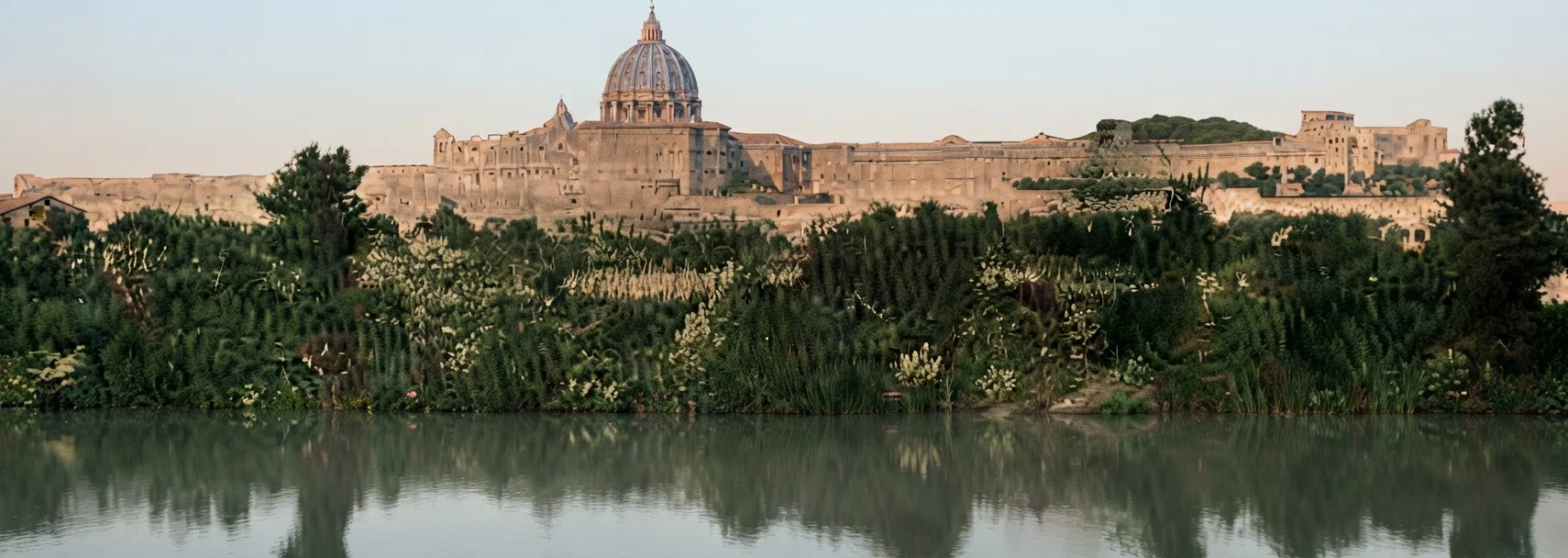
"Attached to the great temple [St. Peter's] is the palace of his successors. A palace of some 11,000 or 12,000 rooms, or chambers, and containing enormous wealth and untold treasures, it is not unworthy for the successors of the greatest of kings and the mightiest palaces of the emperors of old Rome; such is the Vatican."
THE above quotation from a recently-published book, altho somewhat exaggerated in its account of the number of rooms which the Vatican contains, yet gives a good idea of the papal palace. If history has taught us anything, it has surely established this fact, that great luxury and riches go hand in hand with corruption. That the Vatican is no exception to this rule, we shall endeavor to show in the present article; and being a point quite well conceded, our task will be rendered more easy.
Constantine's Influence.
For the first three centuries of the Christian era there were no edifices dedicated solely and expressly to church purposes. During this time the Christians were largely subject to persecution, and therefore were not able to erect permanent buildings for worship. Hence we read, in the Bible, of churches held in private houses; and even at Rome, the capital of the empire, the church met in the house of Acquila and Priscilla. But with the so-called conversion of Constantine to the Christian religion, and the union of the Roman state with apostate Christianity, there began for the church a period of great material prosperity. The original edifices of the largest churches of Rome, such as St. Peter's, St. Paul's, St. John Lateran, St. Lorenzo, etc., were founded by Constantine himself.
Constantine not only caused numberless churches to spring up in Rome, but wrote letters offering both political and financial reward to the other cities of the empire, proposing to build them churches at public expense, and give them large sums of money for the maintenance of the poor if they would forsake the pagan religion. The heathen were not slow to take advantage of these offers, not from a religious, but wholly from a material, point of view. And as political honors also became associated with the profession of the Christian faith, the statesmen and politicians vied with each other to do homage to the new religion. As a consequence, the influence and friendship of the bishops and priests were greatly sought after, and these persons grew in importance and riches by leaps and bounds. The bishop of Rome, being in the capital of the empire, exerted an extraordinary power in the affairs of the state, and consequently "became a prince of the empire, and lived in a style of luxury and pomp that awakened the envy and just indignation of the heathen writer Marcellinus. He rode through the streets of Rome in a stately chariot, and clothed in gorgeous attire; his table was supplied with a profusion more than imperial; the proudest women of Rome loaded him with lavish donations, and followed him with their flatteries and attention." Is it any wonder that a heathen exclaimed, "Make me bishop of Rome, and I will be a Christian"?
Luxury and Corruption, Strife and Violence.
This pomp and luxury carried with it a flood of corruption and immorality, so that merely to name the dark and debasing sins committed in private life, and the terrible abuses practised in public life, by these self-styled successors of Peter, would fill volumes. I shall endeavor, therefore, to stir up but slightly the murky and slimy waters of the pontifical history, in order not to contaminate the air too much with the horrible stench and poisonous fumes of the bottomless pit of papal corruption.
As we have already noticed, the bishopric of Rome carried with it great influence, luxury, and riches, and hence it became a position highly sought after by ambitious and corrupt men. As a consequence, the election of the pope from very early times was an occasion of bloodshed and riot on the part of the different factions that supported their aspirant to the papal chair. The same bloody scenes that in the time of Pagan Rome were enacted on the occasion of the election of the consuls were repeated in the election of the popes. As for example, in the year 366 there were two candidates, Ursicinus and Damasus, who had been elected to the bishopric of Rome, and the contest for the supremacy lasted for several years, until finally the latter succeeded in taking undisputed possession of the See. But during this time "churches were garrisoned, churches besieged, churches stormed and deluged with blood." And Damasus himself, who is recognized by the church of Rome as a prominent pope, "at the head of a gang of gladiators, charioteers, and laborers with axes, swords, and clubs, stormed the church [of Liberious]; a hundred and sixty of both sexes were barbarously killed." And yet this pope has been canonized, and is among the so-called saints to whom the Catholics pray.
Thus we see that the papal chair became, early in its history, the object of contention and bloodshed, and it continued to be so for centuries. More than once, therefore, in its history the Catholic Church has beheld the spectacle of two popes reigning at once, and has seen even five popes at one time that endeavored to preserve the papal continuity.
Some Pages of Papal History.
As the subject under consideration is very vast, and our space is limited, we shall only take some incidents here and there throughout the papal history, and let them serve to give an idea of the epoch from which they are drawn. Having considered the corruption existing at the beginning of the union of church and state, let us open a page of the papal history of the ninth century. Without stopping to speak of John VIII., who rewarded with gold the bishop of Naples,—a man that, after putting out the eyes of his own brother, sent him to be imprisoned at Rome because he was allied to the Turks;—and passing over the account of this pope's order to the same bishop to decapitate twenty-two Neopolitan prisoners, allies of the Turks, together with the captains of the Saracens, let us speak of Stephen VII., who ascended the papal throne in 896. This pope hated Formosus, one of his predecessors on the papal throne, because he had hindered him from ascending earlier to the pontificate. But Formosus was dead. As Stephen could not wreak his vengeance upon him in life, he attacked his corpse. The body of Formosus was disinterred, placed on trial, and adjudged guilty of simony, the head was then cut off, and also the three fingers with which he had blessed the people; and the poor corpse was thrown into the River Tiber,10and all the pontifical decrees enacted by Formosus were annulled.
The historian comments thus on this incident:
"A very strange example of cruelty and revenge from which one can see that the wrath of the priest wreaks vengeance even on putrid flesh, and his ire reaches even beyond the tomb."
The friends of Pope Formosus, greatly indignant at such horrible proceedings, arose in rebellion and strangled Stephen VII. And thus perished two of the so-called infallible guides of the Roman Church.
A Female Pope-Maker.
Shortly after this time the power in Rome lay largely in the hands of a woman, by name Marozia, who, together with her son, Alberic, elected and deposed popes according to her will. She caused her son to be elected pope, who assumed the title of John XI. "After the death of John, Alberic caused to be elected successively the popes, Leo VII., Stephen IX., Marinus II., and Agapetus II." And when he was near his death, he made the nobility swear that they would put his son on the papal throne when the ruling pope should die. And, in fact, when Agapetus died, the son of Alberic succeeded to the pontificate under the name of John XII. He was only a youth of eighteen years when elected pope, and he "devoted himself wholly to hunting, reveling, and women." "He made use of his power to satisfy every wickedness and vice; so much so, that during his pontificate the women of other cities had to refrain from visiting the tomb of the apostle for fear that the successor of Peter might violate their honor and virtue." I might observe in passing that it is evident the Holy Spirit had no part in electing the popes, as the Catholic Church claims. For, as we see in this instance, there were at least six popes put into the papal chair by a harlot, assisted by her son, a corrupt nobleman.
During the reign of this last-named pontiff, the emperor of Germany came against the city of Rome, and the pope fled from the city. The emperor instituted an inquiry into the affairs of his pontificate, and he found it corruption personified. "It was found that there were rioting with women, and practises of incest, to the extent of reducing the Vatican to a brothel. The pope had caused to be mutilated, blinded, and killed, bishops and cardinals; he had made a child of ten years old bishop, and had drunk in honor of the pagan idols and of demons." To cut the account of his reign short, we shall mention that on his return to Rome he visited cruel vengeance everywhere, but was finally killed by a citizen who surprised him in the outskirts of the city in illicit relationship with his wife. And thus perished another self-styled successor of Peter.
A Page from the Fourteenth Century.
Let us pause by this seat of corruption no longer, but open a page of papal history of the last part of the fourteenth century. Dante, the great Italian poet, has described the Papacy of his time in clear words as follows: "O the day that the church of Rome, uniting in itself two powers, fell into the mud and bedaubed itself and its load!" And again the same poet represents Peter as saying, "Those that have in earth usurped my place, have rendered it devoid of the presence of the Son of God, have made my tomb a pool of blood and stench, where the perverse one who fell from Paradise to earth finds himself consoled."
This expression reminds one of the fact that "the dragon gave the beast his power and seat and great authority."
The poet further likens the Papacy to a beast "that has a nature so wicked and malicious that it can not satiate its evil desire, and after its repast has more hunger than before." And, in fact, he even goes so far as to compare the Papacy to the woman seated upon the scarlet-colored beast of Revelation 17, as follows: "Your avarice has made the world sad, treading down the good, and elevating the depraved. Of you, shepherds, did the evangelist prophecy, when she who sits upon the waters fornicating with the kings, was seen by him." Again he says, "You have made yourselves gods of gold and silver, and in what do you differ from the idolators, if not in that where he has one, you adore a hundred." The famous poet Petrarch, writing of the same period from Avignon, where was then situated the papal throne, writes: "I am in the land of Gaul; the western Babylon, a place more contaminated than which the sun does not look upon; and the cruel Rhone, which resembles the boiling Cocytus and the Tartarean Acheron; where the head of the fishermen, poor at one time, and now in a marvelous way forgetful of his principles, possesses a kingdom which he says he has by heredity. It amazes one to think back upon the apostles, and then to look on those loaded down with gold, clad in purple, proudly adorned with rich spoils which they have robbed from princes and people."
And of the moral condition of the time, the bishop of Orvieto, writing concerning Rome in 1362, says: "I believe that in no city has there ever been so many fallen women as there are in Rome in our days. Here are gathered from far and near those that are married and those that are nuns, consecrated to God; here they are maintained, nourished, and defended as fallen women, and recognized as such, because from these they derive benefit, advantage, and an enormous revenue." The bishop concluded by saying that "one understands that the papal government does not want sheep without wool." These are strong words regarding the papal corruption, especially coming from a bishop of the same church.
Rome, Italy. C. E. MILTON.
(To be continued.)
The Basilica of St. Peter and the Vatican from the Tiber.
PRESENT TRUTH AND PRESENT DUTY.
By W. S. Sadler
"Wherefore I will not be negligent to put you always in remembrance of these things, tho ye know them, and be established in the present truth." 2 Peter 1:12.
WITH present truth comes at the same time a present duty,—a duty to give it to others. We can be well posted on present truth, yet not necessarily be well established in it. It is quite possible, even, to be thoroughly well posted in all the theories of the Third Angel's Message, while being but poorly established in it. It is one thing to hold truths in the mind, but a totally-different thing to have those truths so much a part of one's character that in our daily lives may be seen their purifying and sanctifying influence. Not only should we be able to give a reason for the hope within us, but our lives should actually be such as will lead our associates to recognize that we have been with Christ and have learned of Him. In these perilous times, those alone who, knowing the truths for these times, become thoroughly established in them, can reasonably expect to triumph with the present truth.
Who can measure the power that would accompany this truth if in the life of every individual professing to accept and follow it, there could be seen a manifestation of the truth equal to his knowledge of it? Instead of endeavoring to practise what we preach, would it not be better were we to preach what we practise? The Master Himself said "I must work the works of Him that sent Me, while it is day; the night cometh, when no man can work." Not alone must His disciples work, but the Saviour Himself recognized that He must work, too. O that every one of us would realize his responsibility to work the works of Him who has sent us! And we must work along Christ's lines, while the day lasts, for the time is rapidly approaching when "no man can work."
If our lives were flavored with the spirit of truth, and our time were occupied with wisely-directed efforts to lead others into the light, God's Spirit would prepare the way for us, and open the hearts of honest seekers after truth, for the reception of the rays of light and the seeds of truth we could take to them. We have been entrusted with a great message, a solemn and vital truth, which the world is sadly in need of just now. This light and truth we know is due to the world, and it is our bounden duty, our solemn obligation, to carry to those who sit in darkness, who are in the very shadow of death, that message which has been entrusted to us. Shall we neglect this duty?
"Freely have ye received; freely give," said Christ. Those words apply to us to-day. We have been made debtors to the world for every ray of light, every bit of truth, that we have received. And there is no way of discharging our debt, other than by faithfully giving to those around us, that which we ourselves have received. Paul said, "Wo is me, if I preach not the Gospel." Every soul who knows the stirring truths for these last days, yet fails to pass them along, will sooner or later become lukewarm and indifferent; it is certain to come.
How to Become Established.
We can not become established in the present truth unless we have the experience and make the effort to give it to others. If we would avoid being shaken and tossed about by every wind of doctrine that blows we must become firmly established upon the firm foundation of truth. Surely those who have bravely taken their stand for the truth for the present11time, are not those who will turn their backs upon the duty that comes with it. Every individual who has accepted the Third Angel's Message, has a duty to perform in spreading the truth and warning the world. We must do the work Heaven left for us to do. Christ is spoken of in the Bible as being represented by a man who took a journey into a far country, and left "to every man his work." So, whether we be ministers, Bible workers, medical missionaries, or none of these, each of us has a part to perform that we alone can do. And if we are willing to do our part, the Holy Spirit will be ready to show us what we are to do. So let us all, with cheerful heart and willing mind, do what our hands find to do, and set about it without delay.
Now is "the accepted time," to-day is the day to begin. We can not learn how to work for souls by waiting. Ask God earnestly for the wisdom He promises to those who seek it; walk in all the light you have; and God will bless and give force to the words you speak, publicly or in private, and send home to the hearts of your listeners the words of truth and the seeds of righteousness. God's Spirit will accompany and bless every honest, humble effort put forth to spread the truth and to save souls for the kingdom. A ship that is standing still can not be steered. But start the vessel, and the captain can steer it aright. Far better is it to be doing something, even tho it may be marred by some mistakes, than not to do anything, and be standing idle when there is much to be done in the vineyard of the Lord. If we have first a willing mind, and a humble heart, with sincere and earnest purpose, the One at the helm will guide our little bark aright, even tho we may have started in the wrong direction.
Have you some truth or light that your neighbors have not yet found? That fact is in itself your commission to go and tell them about it. What it has done for you, is the best proof of its genuineness, and constitutes the credentials of Heaven that you are warranted in giving it to those who know it not. While we may not have many great or wonderful opportunities for proclaiming the truth, yet all around us, on every hand, are small openings for the dissemination of truth, and the scattering of seeds of heavenly light. Let us pray for faithfulness and wisdom that we may know how best to improve these opportunities and step into the openings that come to us; for if we are faithful, we may be sure God will attend to our being successful. The Word says, "Well done, good and faithful servant."
How Begin?
A natural question which is likely to be asked is, How can I begin? Reader, it is difficult to answer this question, for the work of seeking souls, and doing heart to heart soul-winning, is so diversified, that no set rules can be given. But at the very outset, one thing is of vital and all-important necessity—that we have the missionary spirit. None but those who have such a spirit can ever become truly successful soul-winners. Nor is this missionary spirit to be obtained by months of theoretical study of books, or a certain period of years spent in some college. It comes as a gift from Him who was the world's greatest Missionary. Are we actuated by this spirit, the true missionary desire and longing to bring sinners to Jesus? Then our lives will be absorbed by the restless desire to see souls saved. Brother, sister, do you really want to possess this desire, if you do not at present? Ask God for it, and He will grant it to you. Ask Jesus to give you for a moment one glimpse of the misery and wo of earth's multitudes, and your heart will be so touched that nothing will content you other than that your life shall be devoted to laboring for your fellow men. How very true it is, that "the whole creation groaneth and travaileth in pain." Could we but behold the darkness, the suffering, and the sorrow of this old world to-day, we should surely want to use all our energy of mind and heart in an effort to seek and save the lost.
Is there not enough power in present truth to enable us to see our duty regarding it? Surely the privilege of taking light and truth to those who have it not but need it greatly, is one of the grandest ever given to fallen man. Angels are to help us in this work. God's Spirit is ready to direct our minds and to soften and prepare the hearts of those for whom we labor. Let us go forth, then, in the Spirit's power, to practise this truth, to teach it, to carry it to the homes of the people. Feed their hungry souls, enlighten their darkened minds. If every individual who loves this present truth, were endued with power from on high, and working earnestly to spread it, the time would be hastened when the work would be finally closed, and those who had been true to their trust would triumph gloriously with it.
Missionaries are made by doing missionary work; that alone will give the essential experience which constitutes the practical soul-winner. And if we expect ever to become a missionary, we must begin some time. To-day, the Master says, to all who are not actively engaged in His vineyard: "Why stand ye here idle?" Let us answer, willingly, gladly, "Here am I; send me;" then, having consecrated all our energies to Him, labor, and watch, and pray.
W. S. SADLER.
I COME.
By Marianne Haern
JUST as I am, Thine own to be,
Friend of the young, who lovest me;
To consecrate myself to Thee,
O blessed Lord, I come.
In this glad morn of life's brief day,
My life to give, my vows to pay,
With no reserve and no delay,
With all my heart I come.
Just as I am, young, strong, and free,
To be the best that I can be
For God and right, for truth and Thee,
O Lord of life, I come.
For Thy dear sake to win renown,
To take the conque'ror's glorious crown,
And at Thy feet to cast it down,
O Jesus, Lord, I come.
MARIANNE HAERN.
The Harmony of the Saints
By Jenkyn
THE whole company of saints is like to a well-tuned instrument, the strings whereof, tho not all of one note, but some higher, some lower, yet all together make a sweet harmony, nor can the loudest be without the smallest. —Jenkyn.
OBSERVING DAYS.
By A. Carter
"Ye observe days, and months, and times, and years." Gal. 4:10.
THE Christian who has become convinced of his duty to observe the Sabbath of the fourth commandment, is quite liable to have this text quoted to him by people who judge him to be guilty of the fault of the Galatians. Let us see if this scripture does not apply even more forcibly to those Christians who observe Sunday.
In the Roman Catholic Church the following events in the life of our Saviour are commemorated: The time of His incarnation, His birth, the visit of the wise men, the circumcision of Jesus, the forty days' fast, the institution of the sacrament, Christ's entry into Jerusalem, His agony in the garden, His death, resurrection, and ascension.
In honor of the virgin Mary, the following six events are commemorated: Her conception, birth, purification, presentation at the temple, her visitation, and her death.
The angels also are remembered in Michaelmas Day, the apparition of St. Michael, and the Day of our Guardian Angels.
Reckoning Sundays and the feast days of the various saints, and about one hundred fifty fast days in the year, the Roman Church observes 217 days in the year.
Not one of these days is of divine appointment.
And some Protestants observe in some way over two hundred days annually, all of which are also of human origin, 178 being the same as those observed by Rome.
The Jews observe forty-three days, not reckoning the Sabbath.
Seventh-day Adventists observe only the weekly Sabbath, fifty-two days in the year, and these are of direct, divine appointment—from the beginning of earth's history. The foregoing facts show that they are hardly to be deemed the class to whom the apostle's reproof applies. A. CARTER.
COMPULSORY RELIGION.
RELIGION is chiefly, as it ought to be, a matter of compulsion. The flesh and the devil urge us to let life be controlled by our feelings. God gives us a will, and says, Use your will to compel yourself to do right whether you feel like it or not. The devil sees to it that we do not "feel like it" a large part of the time. Of course good deeds ought to be done "willingly"—that is, as the result of our will. To be willing to do right is to will to do right; and we must often will to do what we do not want to do.—Sunday-School Times.
OWNERSHIP OF THE EARTH.
1. To whom does the earth belong?
"The earth is the Lord's, and the fulness thereof; the world, and they that dwell therein." Ps. 24:1.
2. To whom did the Lord promise the world?
"The promise, that he should be the heir of the world, was not to Abraham, or to his seed, through the law, but through the righteousness of faith." Rom. 4:13.
3. Who are the seed of Abraham?
"They which are of faith, the same are the children of Abraham."
"If ye be Christ's, then are ye Abraham's seed, and heirs according to the promise." Gal. 3:7, 29.
4. What special character do the future possessors of the earth manifest?
"Blessed are the meek; for they shall inherit the earth." Matt. 5:5.
5. Why will not the present land monopolists and their heirs continue to hold possession?
Because "evil-doers shall be cut off; but those that wait upon the Lord, they shall inherit the earth. For yet a little while, and the wicked shall not be; yea, thou shalt diligently consider his place, and it shall not be. But the meek shall inherit the earth; and shall delight themselves in the abundance of peace." Ps. 37:9-11.
6. By what process will this great change be brought about?
"The heavens and the earth, which are now," are "reserved unto fire against the day of judgment and perdition of ungodly men." At the coming of the "day of God," "the heavens being on fire shall be dissolved, and the elements shall melt with fervent heat." Because of this purifying process, "we, according to His promise, look for new heavens and a new earth, wherein dwelleth righteousness." 2 Peter 3:3-13; also Rev. 21:1-5.
7. With what spirit should believers look forward to their inheritance?
"Be patient therefore, brethren, unto the coming of the Lord. Behold, the husbandman waiteth for the precious fruit of the earth, and hath long patience for it, until he receive the early and latter rain. Be ye also patient; stablish your hearts; for the coming of the Lord draweth nigh." James 5:7, 8.
CHINA DURING THE PAST YEAR.
By J. N. Anderson
STILL another year—a most eventful year—has been added to the millenniums of Chinese history. It is marked by tremendous events which definitely and solemnly predict great consequences affecting the spiritual and material well-being of this race. The world at large has experienced mighty changes during the past year, but in a pre-eminent sense China must be looked upon as having been the world's storm-center where a few very troublesome world problems have been settled, at least temporarily. In it all, let us believe and be thankful, men and nations have unconsciously been fulfilling the purpose of Him who "ruleth in the kingdom of men."
The War.
The great outstanding event in the far East during the past year has been the fierce struggle between Russia and Japan. No well-informed person can seriously doubt that in the final analysis China was the real cause of this war, she was the apple of discord, the bone of contention. The seat of the war was not only within the limits of the empire, but in the very home of the reigning dynasty. The grave fears entertained by many that China herself would be involved, were by no means fanciful or unnatural. This serious eventuality was, however, in the overruling providence of God, warded off; and while it is true the war spirit did in some instances assert itself, yet it remains a fact that outside the immediate theater of war operations, all business interests and missionary activity went forward without serious interruption.
For the present, the war clouds have passed out of the political heavens of the far East, and tranquillity again prevails after the furious storm. Humanly speaking, the after effects of this terrible struggle seem to promise peace, at least for the time being. By a series of unbroken successes, granted in the wise purpose of God to Japan, emphasized by the overwhelming defeat of the Russian arms at Mukden, and later by the annihilation of the Baltic fleet in the straits of Tsushima, the whole world has come to realize that new forces are at work in the Orient, and that new voices must be heard in the councils of the great powers. However it may effect the world commercially, it seems clear that politically China's integrity [[FIGURE]] and the world's equilibrium are guaranteed for some time. The Russian advance has been checked, China has been saved politically, and Japan has assumed the leadership of the far East. And all these results are made secure by the Anglo-Japanese alliance which followed close upon the termination of the war.
General Status of China.
The internal state of China has been that of general tranquillity, tho some local disturbances have taken place, arising from a variety of causes; in the main, however, evincing an anti-foreign spirit. The most serious of these was the massacre of five American missionaries at Lienchow, in the province of Quangtung, October 28. Riots at Amoy and Shanghai, in which something like a score of Chinese lost their lives, are painful reminders of the ill will engendered by the foreigners, either consciously or unconsciously. A wide-spread and bitter boycott against American goods, having its origin in Honolulu, if reports are reliable, has swept over large portions of China, especially along the seaboard, and is still vigorously prosecuted in some parts. No doubt, this is one of the after effects of the late war, and in a large measure indicates the spirit and aim of the Chinese people. China, deep down in her heart, wishes to be free of all foreigners.
Of calamity and distress, arising from natural causes, China has, during the past year, as in all the past ages, had her full share. Drought, floods, storms, have brought waste and destruction of property and life in different parts, tho perhaps not in a greater degree than in any former years.
Modern Ideas.
The past year has witnessed the passing away of China's age-honored educational system. That which more than any other one thing has made China what she is, has as it were been swept away with a single stroke of the imperial pen. No longer will literary degrees based upon the wisdom of the ancient sages entitle a man to civil or military office. A few years ago this change would have been looked upon as a sure step to the complete downfall of the entire Chinese economy. So essential a part of China's civilization was this educational system. But in these days of China's awakening, this whole matter has quietly been displaced by modern educational methods and subjects; and that, too, with the apparent consent of all classes. Examination halls, temples, and other buildings are fast being made over into public schools, conducted along modern lines both as to method and matter. Nor is this in one province or two, but in all the provinces of the empire. No less than thirteen, out of the eighteen provincial capitals have now colleges of Western learning. Not less than 10,000 Chinese students are in Japan pursuing advanced courses, while the coast ports have thousands of Chinese boys and young men all bent on the same object. These are facts full of meaning, and require no comment.13
Foreign Literature.
Foreign literature as never before is in demand throughout the entire empire. Journalism in China is of recent years, but at present no less than 150 daily, weekly, and monthly periodicals are issued in the ports; and inland cities are fast adopting this modern way. The literature pouring forth into China can indeed be called a veritable flood, which is exerting a mighty influence in leavening this great mass of humanity. The last report of the Defusion Society puts the figure at 2,361 as the actual number of different books issued within the last year. These books, let it be remembered, are modern, and deal with foreign subjects as contrasted with things purely Chinese. One thousand of these, published by Chinese houses as a commercial undertaking, deal solely with secular subjects. Of this thousand, 120 deal with the subject of war, being the largest number devoted to any one subject; 299 are by the Roman Catholics and deal mostly with religious topics from their own point of view; more than 600 are by missionary bodies or societies of allied purposes. China is a land of books, and now that she is casting aside the old, and eagerly turning to the West for something better, she should have a literature laden with the mighty truth of God. Here is a door of almost infinite opportunity swung wide open to us.
New Forces.
The hitherto latent energies of this race are asserting themselves in a variety of ways. The Times (English), in its issue of September 6, has the following editorial statement: "The war between Japan and Russia, its immediate and tangible results, and its probable and possible consequences in the future, are without parallel in the record of mankind." This war seems to have let loose a multitude of new forces. This is seen in the founding of military schools and academies, in the rapid extension of railways and the postal system, in the anti-foot-binding crusade, the increasing demand for modern education, and, perhaps most of all, in the pronounced efforts of Japan to conquer China commercially and intellectually. Very active Buddhistic propaganda is being carried on in several of the provinces of China under Japanese influence; and a large Japanese literature of very questionable character has recently found its way into China. Within the last year the Chinese Government has come to see as never before the value of railways, and, largely through the influence of the merchants of Hunan and Quantung the concession for the Hankow-Canton Railway, originally given to the Americans, but afterward practically bought up by the Belgium Government, has been redeemed by China for £1,350,000. By imperial edict a commission of Chinese is visiting Japan and western countries to study the government system and political economy of those nations, that China may intelligently advance with the modern world. Still another edict refers to an intention on the part of the Chinese Government to establish a representative parliament to come twelve years' time, and with this in mind a Chinese commission is to make a tour of the world to study the parliamentary systems of other countries.
Mission Work.
Fortunately this awakening on the part of China is not confined to material and worldly interests. The past year has witnessed an increased interest in the things of God. Missionaries of large experience testify that much of the prejudice of former years is fast passing away, especially among the official and educated classes. A constant stream of Christian literature is flowing to the different parts of the entire empire.
Manifestly this is a critical time for China by reason of the deep intensity that has laid hold upon the whole nation. The new forces that struggle for recognition have within themselves tremendous possibilities either for good or evil. This is China's day of visitation. The opportunities for carrying the truth are simply unbounded. How long this door of entrance will remain open no one can say. Every opening providence invites us, and every sign warns us, to enter upon this work without delay, and with no divided heart. What have you done, and what are you now doing, to answer this call?
J. N. ANDERSON.
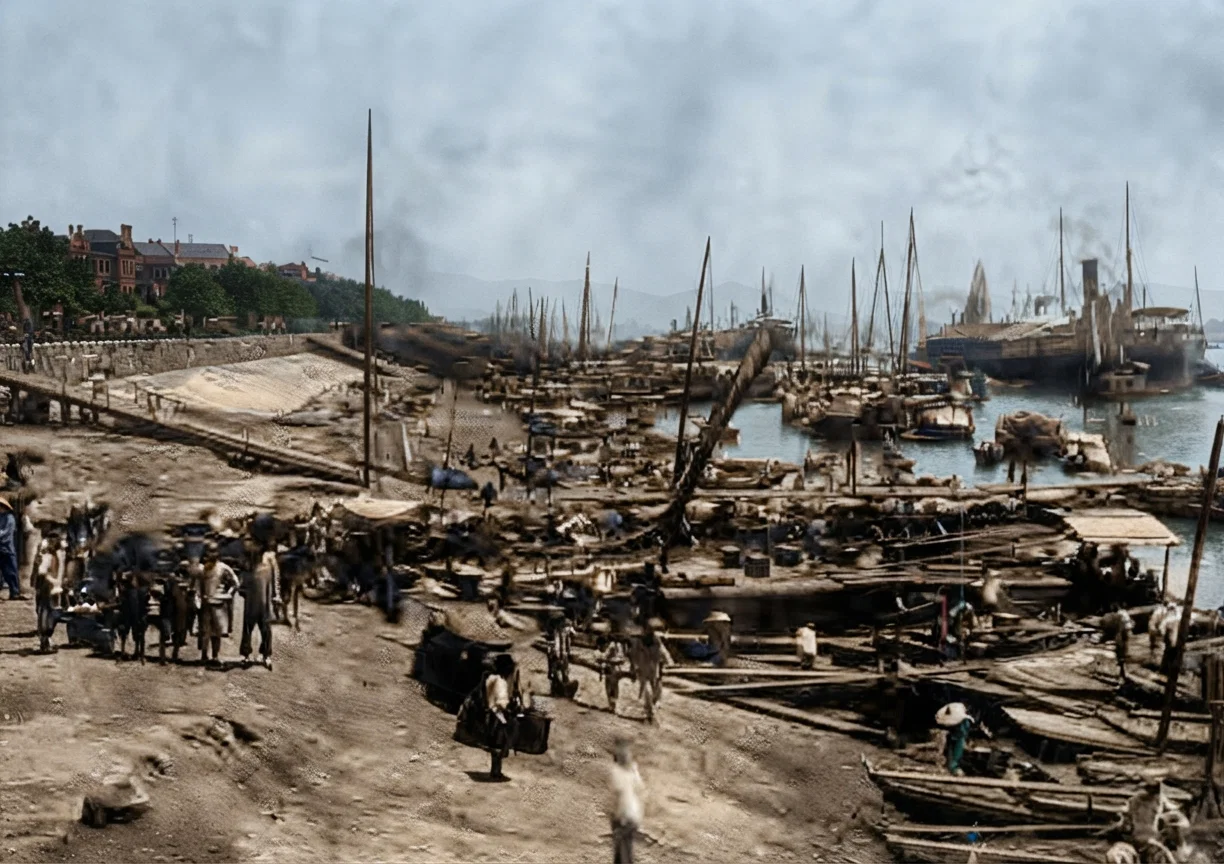
Hankow Bund and Shipping, China.
THE ROAD LEADS HOME.
By The British Weekly
O PILGRIM, as you journey, do you ever gladly say,
In spite of heavy burdens and the roughness of the way,
That it does not surely matter—all the strange and bitter stress,
Heat and cold, and toil and sorrow—'twill be healed with blessedness,
For the road leads home?
Home! the safe and blissful shelter where is glad and full content,
And companionship of kindred; and the treasures early rent
From your holding shall be given back more precious than before.
O! you will not mind the journey with such blessedness in store,
When the road leads home.
O! you will not mind the roughness nor the steepness of the way,
Nor the chill, unrested morning, nor the dreariness of the day,
And you will not take a turning to the left or to the right,
But go straight ahead, nor tremble at the coming of the night,
For the road leads home.
And often for your comfort you will read the Guide and Chart,
It has wisdom for the mind, and sweet solace for the heart;
It will serve you as a mentor, it will guide you sure and straight,
All the time that you will journey, be the ending soon or late—
And the road leads home.
—The British Weekly.