The Youth’s Instructor, Vol. L, No. 30

God's Love

The Youth’s Instructor

July 24, 1902

Review and Herald Publishing Company · Battle Creek, Mich. · July 24, 1902

God's Love

In every plant and flower God's power and love we see; But greater far, he sent his Son To die for you and me.
Oh, shall not we accept This love so freely given, And daily walk with him on earth, And reign with him in heaven?
PAULINA M. A. ANDERSON.

The Story of Our Matabele Mission

The First Sabbath in Camp

After traveling only a few miles, a far better stream and camping-ground were found free for all. Here the company spent their first Sabbath after the real journey had been begun, and their little Sabbath-school and meeting were heartily enjoyed by all. Friends at home were remembered, and the blessing that the brethren enjoyed made them sure that these same friends were remembering them at the throne of grace. Many times on their trip, when the blessing of the Lord was present in a marked manner, and their own hearts were watered and refreshed, they wrote that they were confident that friends in Cape Town, and in America as well, were pleading with their Heavenly Father in their behalf.
Even the animals seemed to enjoy this Sabbath of rest. The trip thus far had been a hard one. At about three o’clock in the afternoon an unfortunate experience occurred. The one who was watching the oxen had fallen asleep, and the oxen wandered away, and could not be found. This caused quite a stir in the camp. One ran this way, and another that, but all search was fruitless. Not a trace of the bullocks could be discovered in any direction. At this juncture two Kafirs came into the camp, and reported that oxen had been seen about fourteen miles back, on the road over which the party had just passed. Two of the brethren had already started back to Vryburg on foot, and the rest, after tying the horses and mules securely to the wagon wheels, retired for the night, feeling confident that even in a material sense the Master’s injunction, “Watch,” should be faithfully heeded.
In the morning they were compelled to hire a cart, at ten shillings a day; and, inspanning the mules, two more started back in search of the oxen. As there were fourteen of them, and they constituted the main means of transporting the freight, no further progress could be made until they were either found or replaced.
Four of the company were gone, and Brother Druillard was left alone. What made matters even worse, in the general haste and confusion, the loaded wagons were left standing near the stream. Now, with the oxen lost, the mules gone, and a rain-storm threatening, he had no way of moving the wagons; and by the lay of the ground he knew that if a storm should come, the goods would certainly be lost, as the stream would rise to such a height that the wagons would go floating off down the country.
He carried the sugar, salt, bread, flour, and other perishable articles to a little knoll some distance from the wagons, and made every preparation to save as much as possible. The fact that they were in the Lord’s work, and that the goods were his, and that he was able to care for them, gave him courage.
He spent the entire day carrying the goods where they would be secure, but heard nothing from the oxen or the hunters. Night came on, and still no one came to break the monotony of his lonely watch in the wilderness. In mentioning this experience, he says that although he did not at first thought relish the idea of sleeping alone in this wild country, with all the goods unprotected, after thinking the matter over, he was convinced that he had done all that he could, and that God was able and more than willing to do the rest. So, after committing all to his care, he lay down, and slept as soundly and as securely as if he had been in his own home at Cape Town, guarded by Her Majesty’s standing army.
The morning dawned bright and clear, and the rain-storm had passed around, so all was safe. In the afternoon at four o’clock the brethren returned with the mules and cart. The oxen were found where they had been raised. Without waiting for rest for either teams or men, the party immediately struck camp, and was ready for the “trek,” as the Dutch call it. Although all the teams but the horses had traveled over one hundred and seventy-five miles, the party was now only seventy-five miles from Vryburg, whence they had begun their journey about one week before. The delay had given opportunity, however, to pack the wagons in better shape. The washing was also done, plenty of ox-bows had been made, and everything was in good condition to resume the journey.
ESTELLA HOUSER.
(To be continued)

Search the Scriptures

THIS is the word that comes to us from Christ. Had it been essential for us to search the Fathers, he would have told us to do so. But the Fathers do not all speak the same thing. Which of them should we choose as a guide? There is no need for us to trust to such uncertainty. We pass by the Fathers to learn of God out of his word. This is life eternal, to know God. O, how thankful we should be that the Bible is the inspired word of God! Holy men of old wrote this word as they were moved by the Spirit.
The commentaries written about the word do not all agree. God does not ask us to be guided by them. It is his word with which we have to deal. All can search this word for themselves, knowing that the teaching of this precious book is unchangeable. The opinions of human beings differ, but the Bible always says the same thing. The word of God is from everlasting to everlasting.
God did not leave his word to be preserved in the memory of men, and handed down from generation to generation by oral transmission and traditional unfolding. Had he done this, the word would gradually have been added to by men, and we should have been asked to receive the teachings of men. Let us thank God for his written word.
The Bible was not given for ministers and learned men only. The poor man needs it as much as the rich man, the unlearned as much as the learned. Every person, young and old alike, should read the Bible for himself. Do not depend on the minister to read it for you. The Bible is God’s word to you. And Christ has made this word so plain that in reading it no one need stumble. Let the humble cottager read and understand the word given by the wisest Teacher the world has ever known; for among kings, governors, statesmen, and the world’s most highly educated men, there is none greater than he.
“Search the Scriptures; for in them ye think ye have eternal life.” To search means to look diligently for something which has been lost. Search for the hidden treasures in God’s word. You can not afford to be without them. Study the difficult passages, comparing verse with verse, and you will find that scripture is the key which unlocks scripture. Those who prayerfully study the Bible go from each search wiser than they were before. Some of their difficulties have been solved; for the Holy Spirit has done the work spoken of in the fourteenth chapter of John: “The Comforter, which is the Holy Ghost, whom the Father will send in my name, he shall teach you all things, and bring all things to your remembrance, whatsoever I have said unto you.”
Nothing worth having is obtained without earnest, persevering effort. In business, only those who have a will to do, see successful results. Without earnest toil we can not expect to obtain a knowledge of spiritual things. Those who obtain the jewels of truth must dig for them as a miner digs for the precious ore hidden in the earth. Those who work indifferently and half-heartedly will never succeed. Young and old should read the word of God; and not only should they read it, but they should study it with diligent earnestness, praying, believing, and searching. Thus they will find the hidden treasure; for the Lord will quicken their understanding.
In your study of the word, lay at the door of investigation your preconceived opinions and your hereditary and cultivated ideas. You will never reach the truth if you study the Scriptures to vindicate your own ideas. Leave these at the door, and with a contrite heart go in to hear what the Lord has to say to you. As the humble seeker for truth sits at Christ’s feet, and learns of him, the word gives him understanding. To those who are too wise in their own conceit to study the Bible, Christ says, You must become meek and lowly in heart if you desire to become wise unto salvation.
Do not read the word in the light of former opinions; but with a mind free from prejudice, search it carefully and prayerfully. If, as you read, conviction comes, and you see that your cherished opinions are not in harmony with the word, do not try to make the word fit these opinions. Make your opinions fit the word. Do not allow what you have believed or practised in the past to control your understanding. Open the eyes of your mind to behold wondrous things out of the law. Find out what is written, and then plant your feet on the eternal Rock.
Our salvation depends upon our knowledge of God’s will as it is contained in his word. Never cease asking and searching for truth. You need to know your duty. You need to know what you must do to be saved. And it is God’s will that you shall know what he has said to you. But you must exercise faith. As you search the Scriptures, you must believe that God is, and that he rewards those who diligently seek him.
O search the Bible with a heart hungry for spiritual food! Dig into the word as a miner digs into the earth to find the veins of gold. Do not give up your search till you have learned your relation to God and his will concerning you.
MRS. E. G. WHITE.

Look Ahead

I WOULDN’T go back, if I were you, To the town of Used-to-Be; For you’d be too late to enter the gate, And no one could find the key.
I’d go straight forward, if I were you, To the city of Wideawake, Where the great crowd pours through the open doors, Its place in the world to make.
Try to forget Disappointment Vale, And the glade of Ne’er-Do-Well, And make up your mind not to look behind Where the doubts and shadows dwell.
Lift up your eyes to the future, lad, With a manly gaze and true, And hasten along with a hopeful song, For the world has need of you.
FRANK WALCOTT HUTT.

The Chemistry of Thought

In the laboratory of nature, both liquids and solids are made up of molecules, composed of atoms of various elements combined in certain definite proportions. Thus, two atoms of hydrogen and one of oxygen combine to form one molecule of oxide of hydrogen, or water, indicated by the familiar symbol H²O; while two atoms of hydrogen and two of oxygen combine to form peroxide of hydrogen (H²O²), a powerful germicide. Some substances combine in such proportions as to form deadly poisons and terrific explosives.
Comparatively few people make a comprehensive study of natural chemistry; but in the laboratory of thought every human being is a student, and every one finds practical work awaiting him at the very threshold of life. Each brain has its own natural combinations, and only the great Master Chemist is able to eradicate that which is evil. The menstruum (the medium in which a substance is dissolved) of divine grace will dissolve all the solids of sin; for He has promised to take away the stony heart.
In natural chemistry, flame is employed to purge the dross, and filtering paper to separate the sediment. So in mental chemistry, the Spirit of God will consume the dross of sin, and his love will separate the smallest sediment of evil. The Master Chemist has committed to us the symbols of heaven, and has instructed us just how to combine them in the formation of a beautiful character. But the trouble is, we deliberately permit wrong combinations in the laboratory of thought, and as a result our mental equations are out of harmony with those of heaven. The reaction of our selfish mixtures is destructive to the test-tube of patience, and we are wont to become discouraged over our failures. How natural it is to fancy that we are slighted, that others do not pay us the deference which our importance deserves. How easy it is to permit a few molecules of jealousy to combine with a like proportion of self-esteem, and ere we are aware, to find that there is formed in the mind the deadly poison of hatred, which, if permitted to remain, will penetrate the entire being, and accomplish its ultimate ruin.
“Out of the heart proceed evil thoughts;” and O how deadly are their combinations! From these come all the results of sin. And yet in the laboratory of human minds is constantly being worked out the long list of direful experiments whose results are seen in the myriad forms of evil all about us. “Let the wicked forsake his way, and the unrighteous man his thoughts: and let him return unto the Lord, and he will have mercy upon him: and to our God, for he will abundantly pardon.”
How different the combinations formed in the mental laboratory of him who chooses only such elements as are found in the laboratory of heaven: “Whatsoever things are true, whatsoever things are honest, whatsoever things are just, whatsoever things are pure, whatsoever things are lovely, whatsoever things are of good report; if there be any virtue, and if there be any praise, think on these things.”
In that mind which keeps in store only such elements as these, no poisonous nor explosive reactions can occur. “Thou wilt keep him in perfect peace, whose thought [margin] is stayed on thee.”
Humanity to-day needs the administration of the oil of sympathy, the tonic of faith, and the stimulant of hope. And he whose thoughts are all combined in the mortar of love, triturated with the pestle of self-sacrifice, and liquefied by the efficacy of fervent prayer, will be able to dispense the true elixir vitae to all about him.
How beautiful the life of that individual whose mind is filled with beautiful thoughts. One can judge of the inner workings of such a mind from the outward demonstrations of loving service to others. What a halo of blessedness surrounds his pathway from dawn to eventide! And how sweet the thought, He “shall be mine, saith the Lord of hosts, in that day when I make up my jewels.”
My young friends, look well to the chemistry of your thoughts. Be sure to shun the very appearance of evil. Give no storage to such dangerous mental chemicals as selfishness, hatred, variance, strife, emulation, envy, etc., etc.; but keep constantly on hand a good supply of “love, joy, peace, long-suffering, gentleness, goodness, faith, meekness, temperance.” “And the peace of God, which passeth all understanding, shall keep your hearts and minds through Christ Jesus.”
MRS. M. A. LOPER.

The Cost of a Boy and His Dividends

Some one has been making calculations concerning the cost of a boy. This writer computes that by the time he has reached the age of fifteen, a good boy, enjoying the advantages of life, costs, including compound interest on the annual investment, not less than five thousand dollars. If the boy continues at school and goes to college, he will cost not less than five thousand dollars more by the time he is twenty-one.
In making this calculation, it is supposed that everything is included which properly goes into the expense account. There is the item of living—what it would cost if all had to be paid for in money at so much a week. Then there is the hire of a nurse through the years of babyhood, and of teachers from the time the child is old enough to be taught. All this, of course, the mother does, giving her days and nights to it, nor even thinking of putting a valuation of dollars and cents on what she does with such unwearying love. Nevertheless, there is a money value in all this material service; at least, if there were no mother, and if it all had to be hired and paid for at regular rates, the cost, year after year, would be very great. There is also the cost of clothing, of doctors’ bills, of education, of books, and of all that is done for the boy in the home during the years.
It is only the pecuniary cost that is included in this interesting computation. There is another cost which never can be put into figures. No price is put upon the mother’s love and solicitude and care and tears and prayers, and the father’s toil, struggle, self-denial, and self-sacrifice. There is no computing the value of such services, and yet these make up by far the greater part of the cost of the boy’s bringing up.
Thus a boy, by the time he comes to young manhood, represents a large investment of money, love, and service. In matters of business, men seek for reasonable returns from their investments. When there has been an outlay of ten or twenty thousand dollars in a boy, what kind of return should be expected? A great many fathers and mothers put all they have into their boys. They have no lands nor houses, no stocks nor bonds, no accumulation in the bank,—they have toiled hard for many years, and all the results have been invested in their children. Surely they have a right to look for a return. What sort of return should this kind of investment pay?
First of all there should be love. This is the only return that really brings satisfaction to the hearts of parents after they have toiled, suffered, and sacrificed for their children. One of the bitterest disappointments of life is when a boy who has had done for him all that love could do, and has had lavished upon him all that love could bestow, through years of infancy and youth, fails to give to his father and mother the love that their hearts crave. No matter how brilliant he may be, how well he may succeed in the world, how his name may be honored among men, no prosperity and no fame will make up in satisfaction to his parents for the want of filial affection. To honor father and mother is the first duty of every one who has been reared in love. The first dividend that should be paid on the parental investments in the boy is love.
There should also be a repayment in character and work. When thousands of dollars have been spent on a boy in order to fit him for starting hopefully and with advantage in life, the least that can be expected of him is that he shall enter upon an honorable and worthy career. It certainly is a most unfit return when the boy neglects his studies, throws away his opportunities for learning, and turns to waste the money his parents have gathered at such cost to educate him. It is a sore disappointment, also, when, instead of realizing their dreams and visions for his character, the boy sets out in wrong ways, choosing evil companions, indulging in sinful pleasures, making for himself a tarnished name and a spotted character.
It surely is the duty of every boy to make his life beautiful and good, realizing in it “whatsoever things are true, whatsoever things are honest, whatsoever things are just, whatsoever things are pure, whatsoever things are lovely, whatsoever things are of good report.” Children hold in their hands the happiness or unhappiness of their parents. A son who does well is not only an honor to his father and mother, but a joy and a pride as well. The memory of their love and of all that that love has done for him should inspire him to strive after all that is best in character, attainment, and achievement.—Well Spring.

The Forming of a Waterspout

A FEW years ago I watched the formation of a mammoth waterspout at sea. We had left Gibraltar well behind, and were passing out from under the coast of Granada into the open Mediterranean. A thunder-storm was passing to the northward, darkening the sea and sky. Suddenly a shadowy form appeared beneath the storm-clouds, as we watched. A fellow passenger and I thought it a sailing-vessel, enveloped in mist, and we fixed our eyes upon it closely, to see how it was meeting the storm.
Just then the changing lights showed us that we were watching the formation of a waterspout. The sheet of misty cloud hung over the sea a moment. Then the darker clouds above reached down a cone-like finger into the mist. The answering sea lifted a whirling wave skyward. The wave and the cloud clasped hands, the bank of mist swept into the broadening pillar, and we saw the giant waterspout go twisting and reeling over the sea. Thankful enough were we on shipboard that the unwelcome visitor was headed away from our path. But it churned up the sea until I, for one, went below, not to get out of my berth again until the sandy shores of Egypt greeted me from without the porthole.
W. A. SPICER.

MARY M. CURRIER

Evening

Now stately Evening cometh down From haunts of evergreen; That smooth the mountains’ rugged steeps, And fill the vales between.
She sitteth down beside the pool; The dragonflies are still, The little winds forsake their play, And slumber on the hill.
She husheth every eager voice That jangled all day long; And far away a whippoorwill Begins his mournful song.

MARY M. CURRIER

Don't Look Back

A crowd of noisy school-children were climbing the long stairs that led to the top of the courthouse dome. Up, up, up, they went; but as the last winding flight was reached,—the worst of them all,—one little girl declared that she could go no higher; she knew she would become dizzy and fall.
“O, no, you won’t,” said a man who was standing near. “Don’t look back; just look ahead, and tend to the step you are on, and you will be all right.” Thus encouraged, she went bravely and easily up the stairway to join her companions in the very top.
Look back! What for? There’s little to look back for except mistakes and failures. What happens when we look back from the high resolve made just now, to those blunders?—We grow dizzy with humiliation, we feel depressed, and it is just as easy to fall from a high resolve then as it is from a high elevation. What matter the bad experiences of the past? The future lies before us, the present is with us, and God has promised strength enough to live it well. What you have done in the past is no gage of what you can do now. God has promised success. Let us keep our eyes on the steps of to-day, and the future and the past alike will take care of themselves.
EDISON DRIVER.

Honey-Locust Scent

Just a dozen rods due southward, Lifts a honey-locust tree, Dwarfed beside a huge box-alder, Gnarled by storms, and ill to see Till June hides its faults with garments Which its ferny leaves invent, While its creamy, swaying censers Waft the honey-locust scent.
In the dusk of morn and evening, Plainly the light blossoms spring From their ground of leaves and shadows, Where they bend and toss and swing (On another fair creation, Nature’s hand has never spent Greater art than that is published By the honey-locust scent);
But beneath day’s fullest glory, White and green merge into one; Leaves and blossoms, both transparent, Freely pass the noonday sun: Thus they hide till eve untangles Bloom from leaves so closely blent, While we only know its presence By the honey-locust scent.
Lingering by the open window, In the hour we all love best, For a final breath of freshness, Ere I go in search of rest, Cool and sweet, in unseen pulses, With the summer moonlight blent, Like a fragrant benediction, Comes the honey-locust scent.
Minnie Rosilla Stevens.

The Buttercups

Early Buttercup (Ranunculus Fascicularis)

Description.—About six inches high; leaves numerous, mostly radical, much divided, and borne on long, slender petioles; cauline leaves sessile; flowers perfect and complete, each borne on a separate peduncle; petals bright-yellow, rather narrow and distant, and much larger than the sepals; roots fasciculate, some of them thickened and fleshy.
Cauline leaves are those which grow from the stem (caulis) above the base. Some plants have only cauline leaves, some only radical leaves, and others have both sorts. Sessile leaves are those that are attached to the stem by the base of the leaf blade, without an intervening petiole. The petals of the early buttercup are said to be distant because they are separated so that they do not touch one another. Fasciculate roots are those that are arranged in a bundle (fascicle).
Ranunculus Fascicularis
They may be either thickened or not. Thickened roots, like those of the early buttercup, are strong and durable, containing a large amount of nourishment stored up for future use. At the approach of cold weather, the plant dies down to the ground; but the roots and base of the stem live on year after year through the storms and frosts of winter. As soon as the sun warms the earth in spring, the plant begins the development of its new leaves and flowers and fruit, the process being hastened by the abundant supply of food material stored up in the thickened roots.
Plants that live year after year through an indefinite period are said to be perennial. All trees and shrubs are perennials, as are also many of the herbs, although in the temperate and cooler climates the stems of herbs die down to the ground every year.
The species here described is the earliest of all the buttercups, decking the woods and rocky hills with its bright-yellow flowers during the month of April.

Bulbous Buttercup (Ranunculus Bulbous)
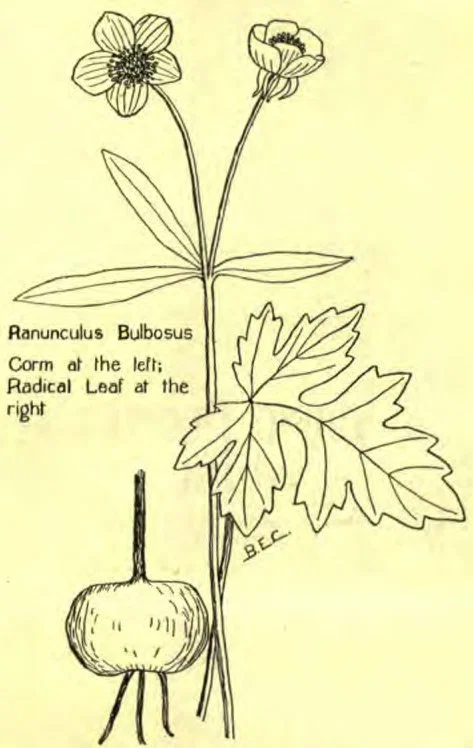
Description.—Stem about one foot high, springing from a solid bulbous base nearly as large as a hickory-nut; leaves mostly radical, long-petioled, ternately parted (incisions extending nearly to the midrib) or ternately divided (incisions extending quite to the midrib); flowers single on long, slender, grooved peduncles; petals broad, rounded, and of a shiny golden color, forming a cup-shaped corolla; sepals reflexed (bent backward).
Ranunculus Bulbosus
Corm at the left;
Radical Leaf at the
right
Ranunculus Bulbosus Corm at the left; Radical Leaf at the right
The bulbous buttercup is common in New England, but quite rare farther west. The blossoms appear during the month of May, adorning the meadows and hilly pastures with their bright, golden cups.
This species is considered “pre-eminently the true buttercup.” It is about twice as tall as the early buttercup, and the stem is more erect.
The enlarged base of the stem is sometimes called a bulb, but more properly a corm, which is a solid, bulb-like stem, and not made up of scales, as is the onion. The very short and thick subterranean stem of cyclamen and of Indian turnip are excellent examples of the corm.
The corm of the bulbous buttercup in its fresh state is acrid and emetic, and is sometimes used in medicine. The leaves and stems also contain acrid properties, which serve as a means of protection to the plant. Cattle seem to understand its nature, as it remains unmolested, even in closely cropped pastures.

Other Buttercups

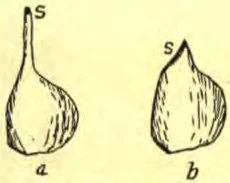
There are two species of creeping buttercups, one of which, Ranunculus septentrionalis, is common almost everywhere in wet or moist places, flowering in spring and summer. The other, Ranunculus repens, is somewhat less common. They differ principally in the styles and stigmas. In the first the styles are long and slender, and the stigma occupies only the top of the style. In the second the styles are short, with a broad base and a sharp-pointed apex, and the stigma occupies the inner edge. The accompanying illustrations will help to make this plain.
Ranunculus acris, the tall buttercup, grows two or three feet high. The stem has no bulbous base, and the peduncles are round and not grooved. These characteristics make it easily distinguishable from the other buttercups. A full double-flowered variety of this species is sometimes cultivated in flower gardens.
Those who have read this article through carefully, should now be able to answer the following questions:—

Questions

  1. Define fasciculate and cauline.
  2. What are perennial plants?
  3. Which is the earliest of all the buttercups? and when does it bloom?
  4. Define reflexed.
  5. Which species is “pre-eminently the true buttercup”?
  6. Where is it most abundant? When does it bloom?
  7. What is a corm?
  8. How are the different species of buttercups distinguished?
B. E. Crawford.

M. C. WILCOX

CHRIST is a loving friend. He will not upbraid you because you are foolish. He will not blame you because you are weak. He will not mock your grief. He will not condemn you, though you are sinful. He will put his great, strong, tender, loving arms about you, and bear you up.
Let him be your friend. He knows all. He has all power. He loves you with infinite love. Enter into his blessed companionship, and find purity and power, righteousness and rest.

M. C. WILCOX

A Prayer

GRANT US, O Lord, the grace to bear The little, pricking thorn; The hasty word that seems unfair; The twang of truths well worn; The jest that makes our weakness plain; The darling plan o’erturned; The careless touch upon our pain; The slight we have not earned; The rasp of care. Dear Lord, to-day, Lest all these fretting things Make needless grief, O give, we pray, The heart that trusts and sings. — Elizabeth Lincoln Gould.

ANNA MYRBERG

From Seattle, Washington

It is now nearly six months since the young people here in Seattle organized a Young People's Society. There were eight of us when we organized; some who joined then have moved away, but others have been added to our numbers, and altogether we have fourteen members at present, with the hope that others will join soon. We generally have a fairly good attendance, some of the older members of the church coming, and outsiders, too.
We are following the lessons given in the YOUTH'S INSTRUCTOR, with an occasional reading from the Testimonies or some magazine, and we always have a social meeting. These meetings have been a great help to me, and I have heard several others say the same. I am glad these Young People's Societies have started, and I want to see them prosper; for we realize that it is the younger people who are to spread the third angel's message. It is time we were at work; for it will not be long before it will be too late, and I know we all want a part in the closing work, and to help hasten the coming of the Lord.
I do not think I ever enjoyed any meeting we have had more than the one held last Friday night. There seemed such interest; everybody took part, and we all felt encouraged; for the Lord was with us. All through the social meeting there seemed to be but the one desire of each one, and that was to work more earnestly for the Lord, to devote more time to his service, to be his light-bearers, shedding bright light wherever the ways of life may lead. Remember us and our work here in your prayers.

ANNA MYRBERG

Witenhage Church School, South Africa

At the beginning of the year I came to this pretty little town of about six thousand inhabitants to prepare for the opening of a church school. As I was here fully two weeks before school opened, and had time to look around, I have been thinking that the readers of the INSTRUCTOR might be interested in the place in which the third of our South African church schools is situated.
Here, says the nature-loving teacher, is a place greatly to be desired for the instruction of children. Streams of clear, sparkling water, from a natural spring, trickle down the hillside, and irrigate the town. No matter how hot the summer's day, on every street is a cool, refreshing little stream, bubbling along over the stones, and singing its water-song of praise to the Giver of all good gifts. However, in the heart of the town, where business laws and regulations are supreme, it is not allowed so much freedom, but goes slipping and sliding down the asphalt gutters without a sound.
But do not imagine a picturesque little schoolroom in a valley, surrounded with beautiful trees and refreshing lakes. I am sorry to say that our schoolroom is situated in a very matter-of-fact street. It is a newly made street, too, and builders have taken such a fancy to it that it looks as if every nook and corner would soon be taken up with buildings.
But we have not far to go for scenery. A very short walk brings us to the top of a low hill, carpeted in every direction with the most velvety green. From the hill can be had a bird's-eye view of the city, and it is indeed a pretty sight.
The schoolroom is partitioned off from our neat, newly built church, by a red baize curtain, and will seat from forty to fifty children. The enrollment at present is twenty-seven. This is encouraging, as only six of these are Seventh-day Adventist children.
The children are bright and attentive; and although, owing to the lack of discipline in the school here, inclined at first to be unruly, have at this time, the beginning of the second term, settled down quietly to hard work. Some of the indolently inclined find the work taxing; but the teacher can not lessen their labors, knowing by seven years' experience that mischief is always the result of idleness, and, if the children's minds and hands are constantly kept busy, they have no time to think of evil, and are not easily tempted.
As a whole the children are anxious to make advancement in their studies, and all attended school Easter week, in spite of the fact that the other schools in the place had ten days' holidays. INA L. AUSTIN.

Membership Cards

Membership Cards for newly organized Young People's Societies, giving the object of the Society, the plan of organization, the motto, aim, and simple pledge, may be obtained of the Secretary of the Sabbath-school Department, Mrs. L. Flora Plummer, 705 Northwestern Building, Minneapolis, Minn. The price is one cent each, postpaid.
Continue reading: Battles between Truth and Falsehood