How to Study These Lessons.— (1) Read the lesson story; (2) try to recall or find scriptures in proof of each statement; (3) study the texts; (4) see how many missing links you can supply; (5) give the lesson to some one else. You will keep only what you give away.
Jesus not only redeemed man from slavery, but he also bought back man's property — the earth.
The Lord told Abraham to look in every direction, and he would give all the land he could see to him and to his children forever. By faith Abraham saw around the world that day. This promise was renewed to Isaac and Jacob.
Many years later, Stephen said these promises had not been kept. Not even a foot of land had been given to Abraham. He even had to buy a place to bury his wife. Isaac, Jacob, and an innumerable company of their children all died, but the promise was still unfulfilled.
Has the promise failed?—No. God can not lie. Is God slack in keeping his promises?—Not in the way men are slack. In mercy he waits, hoping to save others, who would be lost but for his waiting. However, in God's sight the promise was made less than a week ago.
But if Abraham, Isaac, and Jacob are dead, how can they have a part in the promise?—Because God will raise the dead, put them in their own land, and say to those who trusted him, “Now, you see, I have done just as I said I would.”
Outline
The Lord promised Abraham and his seed (children) all the land he could see. Gen. 13: 14–17.
By faith Abraham saw all around the world. Rom. 4: 13.
God did not give a foot of land to Abraham during his lifetime. Acts 7: 2–5.
An innumerable company of “heirs” died without receiving the promise. Heb. 11: 8, 9, 12, 13.
However, God's “slackness” is not like that of men. 2 Peter 3:9.
God will keep his promise by raising the dead, and putting them in their own land. Eze. 37: 11–14.
From the time God made the promise to Abraham, it will be less than a week till it is fulfilled. 2 Peter 3:8.
Of the Young People's work in Manitoba Mrs. Jessie L. Adams writes as follows:—
“We now have one more Young People's Society at Roden, with a membership of about twelve. Here in Winnipeg, things are encouraging. We have ordered a club of the Life Boat to use, and already have the Signs and Good Health. Three of the little girls have sold about a dozen copies of Good Health, and enjoy the work. Not long ago we had a good missionary meeting on foreign missions, conducted by the young people. We planned a surprise for the older members about two weeks ago. Our Society decided to buy a curtain to separate the two divisions of the Sabbath-school during recitation. We planned to get the curtain, make it, and put it up, without saying a word to the older folks. It was our secret, and I was really a little surprised at the way they all kept it. We bought a handsome curtain, and have had it up one Sabbath. The older members enjoyed the surprise, and of course we did, too. We have our plans for several other improvements, as this was appreciated so much.”
Performing Small Acts with Ardent Love
By Francis
We have not always an opportunity of doing great things; but we can hourly perform insignificant actions with an ardent love.—Francis.
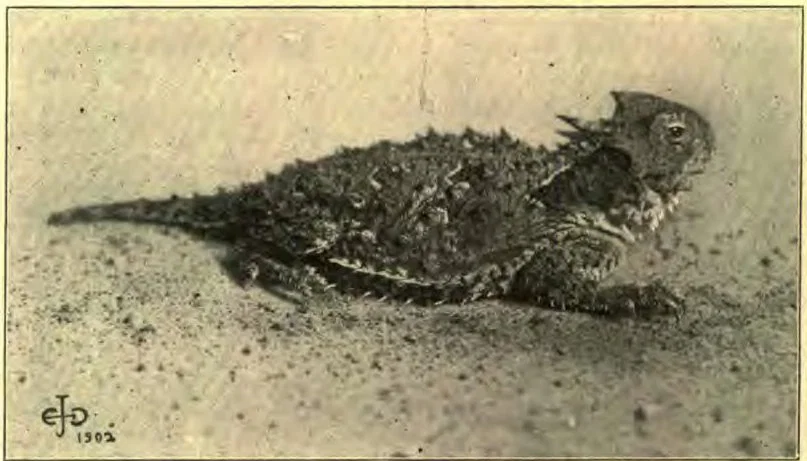
Jim, the Horned Toad
By Edison Driver
O, how he ran! The short little legs carried him so fast over the cloddy vineyard that chubby Walter had fallen down twice in the race already And who wouldn’t run, with a great creature a thousand times as big as himself running after him, and yelling like an Indian! Of course the little horned toad thought he would be eaten as soon as the big giant caught him; so with him it was a race for life, and not till he was completely tired out, could the little boy touch him.
When finally he was caught; tired to death, apparently, he sat motionless, with eyes shut, on the hand that held him.
“O, is he really dead, Auntie?” asked Walter, looking sorrowfully at his little captive.
“Put him on the ground a minute, and see,” advised Aunt Rose, smiling Placing him tenderly on the ground, Walter stepped back a few paces, and waited. Soon the little lizard (the horned toad is really a sort of lizard) opened his eyes, and raised his head a wee bit. Nobody moved; so he became bolder still, and turned his head quite around. Then he ran for dear life again, twisting here and there among the big clods, and stopping so suddenly in the shade of one of them that Walter thought he had vanished, like a ghost. But Master Toad was soon found, and stowed safely away on top of some marbles and molasses candy in Master Walter’s coat pocket, with a good-sized handkerchief on top of him. That kept him safe till Walter and Auntie reached home.
“What does he eat, Uncle John,” asked the little boy, turning Master Horned Toad out on the porch.
“Mostly flies and gnats, I think,” answered his uncle. “But get a long piece of strong linen thread, and we will see in a day or two just what he does like best.”
So they made a halter for little Jim, as they named him, and tied him out in the back yard to a tiny stake. At first his only thought was to get loose. He ran with all his might, till the string threw him back, then tried it again in another direction, and another, till Walter was afraid he would break his neck. Failing to get away by running, Jim had recourse to his old trick of “playing possum.” He made-believe dead for a few moments, and then sprang away so quickly as, he thought, to catch the old string napping. But somehow, no matter how quickly he ran, or how well he made-believe, the halter was always in the way when the side of the ring was reached. I have no doubt it puzzled Jimmie a good bit, but in a few days he seemed to become used to it, and contented with his new pasture.
One thing puzzled Walter a great deal. When he first brought his horned toad home, it was as gray as could be, but two days later it was brown, just the color of the sand in the back yard. By and by Walter learned that horned toads, in common with some other members of the lizard family, have the power of changing their color to match their surroundings, in a very few hours. That is their method of protection,—to become so nearly the color of the rocks or ground that they escape notice unless they move.
JIM, THE HORNED TOAD
Jimmie was only a young toad; and as he grew older, he became more tame, till finally he would eat while Walter and others were watching. There was one weed in his pasture that suited him particularly well as a dining-table. Early in the morning he would station himself by it, and sit there motionless as a clod, till an early fly alighted to brush his wings and bask in the sunshine. If he was near enough, Jim simply opened his mouth, shot out a long, sticky tongue quick as a flash, and pulled in the dainty morsel. If he was quite a distance away, and flies happened to be scarce, Jimmie would make a short run, then a shot of the tongue, all so much at once that Mr. Fly didn’t have time to think about getting away till it was altogether too late. It was really astonishing how true and quick Jimmie’s aim was. He never missed a fly, so far as I could tell.
If there were no flies, then Jimmie would take bugs, or even ants. But mosquitoes, gnats, and flies were his favorites.
Before the summer was over, he became really tame, and followed Walter about as far as his halter allowed, ate flies out of his hands, and showed by many signs that he knew him from the rest of us.
All went well till one morning a dog came into the yard, and so frightened Jimmie that he ran as hard as he could to the end of his rope. This time it did not jerk him back, for it was rotten but snapped short near his neck, and he was free. Walter never saw his pet again; only the dog-tracks and the broken thread remained to tell the story when he came home from school that day.
EDISON DRIVER.
How Jimmy Learned to Be Kind to Toads
COMING along our street the other day, I saw three little boys stoning a toad. Before I could speak, Professor Selton came by, and said, “Why, Jimmy, what have you there? A common toad? Just what I want to-morrow for my lecture at the summer school,” and he skillfully picked up the toad. “By the way,” he added, “to-morrow I shall need some help with my toads. Can’t you three come down to the university and help me?”
I never saw Jimmy look more surprised, but he managed to say he could, while the others barely nodded. “The work is easy,” the professor said. “Come to my office at a quarter before three sharp, and I’ll tell you what to do.”
I was disappointed that he did not speak to the boys about their cruelty, but decided he thought it better to wait until he should have them alone.
When I went to the lecture the next day, I expected to meet those boys coming out of Professor Selton’s office looking so ashamed, and so sorry, and—well, looking as if they never wanted to see a toad again. Surely Professor Selton, fond as he was of toads, would talk to them, I thought.
The very first thing I did see when I entered the university was those same boys, not, however, hurrying out of the side door, but in a little procession entering the lecture-room, and, yes, actually mounting the platform! Professor Selton himself was at the head of the line! Each boy carried in his hands a large box made of glass and wire netting. Every box had a toad in it, and each boy put his box on the table, and took a chair which Professor Selton placed in front of the box.
I could not see that the boys were the least help; they watched the toads, to be sure, but what was the use of doing that? The toads couldn’t get out. Just as Professor Selton was ready to begin his lecture, his assistant came in with an insect-net and two small boxes. The end of the insect-net was black with flies, which he emptied into Jimmy’s box. Lifting the glass top of each of the others, he put in something from the pasteboard boxes, but I could not see what it was.
Professor Selton told us a great many interesting things about toads; but those boys simply sat and stared at their toads. Jimmy Ashley looked up only once, and that was when the professor said something I could hardly believe. “If housekeepers would keep tame toads,” he said, “they would do away with their endless bother about flies. Toads are better than all the fly-traps and insect-powders ever invented.”
Very soon after saying that, he closed his lecture, and turned to the table. “These boys,” he said to the class, “have been keeping count of what their toads have eaten during the hour. Johnny’s toad has potato-bugs in the box. How many has he eaten, Johnny?”238
“Not any,” answered Johnny, despondently.
“Tom’s has elm beetles. What is his record?”
“Twenty-eight,” was the reply.
“And Jimmy’s has flies. Has he eaten many?”
“Sixty-six!” said Jimmy, triumphantly.
Then Jimmy got up, and sidled over to the professor. “He ate something else,” he said, in a loud, impressive whisper. “He ate his skin!”
“When? This last hour? Why didn’t you tell us?” asked the professor, eagerly.
“I couldn’t stop,” answered Jimmy. “I was afraid I’d lose a fly.”
The professor looked a bit disappointed; then he laughed. “Never mind,” he said. “You have seen something that perhaps none of the class have ever seen. Tell us about it.”
“It wasn’t much,” said Jimmy. “His old skin began to crack,—began right on the back of his head,—and it cracked all down his back, and then it came off.”
“In strips?” asked the professor. “Or was it in little pieces?”
“Oh, no; like—like—like a glove,” said Jimmy. “Then he rolled it up, and swallowed it.” The children were listening eagerly.
“That’s all right,” said the professor. “It is just what toads do. When they outgrow a suit, they take it off, and pack it away in that easy fashion.” Then he wrote on the blackboard the records, and for Jimmy’s toad he wrote:—
66 Flies.
1 Spring Suit.
Everybody laughed, even Jimmy.
As I was leaving the lecture-room, I heard Jimmy ask the professor about taming toads.
“The best way, I think,” said Professor Selton, “would be to take a piece of wire-screen cloth, and roll it to make a circular pen about a foot and a half across, and of the same height. If you put that down on the ground by the back screen door, your toad will eat the flies so that you will not have half the bother about that door you do now.” As he said this, his eyes were merry.
Jimmy smiled. How did the professor know his trials over that door?
“You’ll have to be careful about food and a bathing-place, you know,” added the professor.
“Yes, sir,” said Jimmy, “but all that wouldn’t be so much bother as keeping out the flies without the toad’s help. May I take the toad with the summer suit on? I’ll take real good care of him and bring him over whenever you want him.”— Selected.
How the Woodpecker Knows
How does he know where to dig his hole,
The woodpecker there, on the elm-tree bole?
How does he know what kind of limb
To use for a drum, or to burrow in?
How does he find where the young grubs grow,
I’d like to know.
The woodpecker flew to a maple limb,
And drummed a tattoo that was fun for him.
“No breakfast here! It’s too hard for that,”
He said, as down on his tail he sat;
“Just listen to this—Rrrrr-rat-tat-tat!”
Away to the pear-tree out of sight,
With a cheery call and a jumping flight!
He hopped around till he found a stub:
“Ah, here’s the place to look for a grub!
’Tis moist and dead—Rrrrr-rub-dub-dub.”
To a branch of the apple-tree Downy hied,
And hung by his toes on the under side.
“’Twill be sunny here in this hollow trunk,
It’s dry and soft, with a heart of punk,
Just the place for a nest—Rrrrr-runk-tunk-tunk.”
“I see,” said the boy, “just a tap or two,
Then listen, as any bright boy might do;
You can tell ripe melons and garden-stuff
In the very same way—it’s easy enough.”
— Youth’s Companion.
The Kidnapping of the Princes of Saxony
More than four hundred years ago there lived, in the castle of Altenburg in Saxony, Kurfuerst Friedrich der Sanftmuthige,—that is, the electoral Prince Fredric, the tender-hearted,—with his wife Margarethe and his children.
In those times, war was the principal business of the princes and the nobles. The Germans, first of all, loved and developed war to a fine art. Then their country was divided into many more little parts than it is now; each part, or county, was governed by a prince, duke, or count, and over them all ruled the emperor.
When there were no Crusades, or war with Italy or Turkey, they were fighting among themselves. Then these princes, with their counts, barons, and plain noblemen, and these again followed by their bondsmen and mercenaries, would meet in battle array, burn towns and villages, kill, plunder, and make prisoners.
Kurfuerst Friedrich, though gentle, had to fight with his own brother. When peace was restored, one of his followers, the knight Kunz von Kaufungen, whose estates had been ruined (in this war), claimed damages. The Kurfuerst promised to settle the matter by law; but Kunz, who, like the rest of the noblemen, could neither read nor write, did not believe in anything that was written. He preferred to settle all differences with and by the sword. After much delay, Kunz resolved to take revenge upon his sovereign, who, he chose to think, had deeply wronged him.
For some time Kunz had held the position as castellan at Altenburg; consequently the ins and outs of the palace were well known to him. As only few men like to remain quite alone in a wicked work, he got two others to help him, the knights Von Mosen and Von Schoenfels, who, too, imagined that they had been wronged by the Kurfuerst. A few days before his exploit, Kunz lived in hiding near the castle, and even made an accomplice of the kitchen boy, Hans Schwalbe, who betrayed to him that in the night of the eighth of July (it was the year 1455) the Kurfuerst would leave for Leipsic, and the other gentlemen of the castle would be at a banquet in the town of Altenburg. This night Kunz chose for the act of revenge.
When evening set in, when the castle was unguarded, when the princess, her maids, and her children had all retired to their rooms, which were in the upper story of the castle, the three knights put rope-ladders to the windows, which in summer, of course, were open, and in a minute they had entered the castle. They bolted the doors of the rooms occupied by the women, took the princes out of their beds, and carried them down. Von Mosen by mistake had taken the little Count Barby, who happened to be on a visit at the castle. Kunz found out his mistake and carried him back, and drew Prince Albrecht, the younger, out of his hiding-place (at the entrance of the robbers the little boy had crept under the bed). Kunz carried him down, put him on his horse, which he too mounted, and followed by his two bondsmen made his escape in full speed over the frontier into Bohemia, where he had a castle of his own, while the other two knights with Prince Ernest rode east.
Though the Kurfuerstin was locked up, and no male assistance at hand, she found means to order that the alarm-bells all over the country be sounded to proclaim the crime, and to restore to a mother’s heart the treasures she valued higher than crowns and riches.
Prince Albrecht was not only a very pretty, but also a very bright boy, who had eyes to see and ears to hear. Little as he was, nine or ten years old, he knew the difference between his father and the knight, who certainly for no good had taken him and his brother out of their beds so suddenly, and was now riding with him through a dark forest. He made no efforts to escape. What could a little boy do against a tall, strong man, clad in iron from head to foot, on a charger as quick as lightning? Nor did he cry or scream. No; the little fellow began to think and to look around. Soon he saw in the forest a charcoal burner at his work. He asked Kunz to let him have a drink. The latter, believing himself altogether safe beyond the frontier, alighted with his charge, and ordered his men to gather berries for the prince.
The sudden appearance of the three men on horseback and the noble-looking boy scantily dressed roused the suspicion of the plain forester, who, too, had heard the alarm, and he asked the knight where he was going. In a whisper Kunz told him that the boy had run away from home, and he was now restoring him to his parents.
At the same time the prince found means to make himself known to the plain man. Most unluckily, Kunz’s spurs were caught in some brambles, and he fell to the ground. This gave the charcoal-man and his fellows an opportunity to give the knight a sound thrashing. They, for their part, certainly had grievances against knights in general, who treated the lower class worse than they did their cattle. This done, the workingmen bound the knight with his bondsmen, and brought them to the next convent, whence the abbot sent them to the mayor of the town of Zwickau, who kept them in custody, while the charcoal-man carried the prince back in triumph to his parents. In gratitude for his bravery and loyalty, the Kurfuerst presented him (George Schmidt was his name) with a farm.
When the knights Von Mosen and Von Schoenfels heard the alarm ring, they with Prince Ernest took refuge in a cave near the Mulde, a tributary of the Elbe, near Hartenstein, and sent word to the Kurfuerst that they were willing to give up the prince if they were pardoned, otherwise they would kill him.
This pardon was granted, and after three days’ absence Prince Ernest was also restored to his parents. The knights left the country, where they never again could regain their lost honor.
The princes Ernest and Albrecht grew up to manhood. They inherited their father’s and also their uncle’s country, lived always in peace with each other, and became the ancestors of the two princely lines Ernest and Albrecht, which up to this very day rule over the various counties of Saxony in Germany. Prince Ernest was the father of Kurfuerst Friedrich der Weise (Electoral Prince Friedrich the Wise Man), the friend and patronizer of Martin Luther, and in direct line the ancestor of the father of the present king of England, Edward VII, the son of Queen Victoria and Prince Albert of Coburg (Saxe-Coburg).—S. S. Times.
The Grumble Bee
“Oh, dear me!” sighed the grumble bee,
As he buzzed from flower to flower,
“’Tis weary work to constantly
Improve each shining hour;
I wish I were that butterfly,
Who leads a life of pleasure
From morning until night, while I
Have not a moment’s leisure.”
“Good-morning, Mr. Grumble Bee,”
Remarked a nodding clover,
“I hope you’ve time to visit me —
With sweets I’m brimming over.
To you I freely offer them
If by this way you’ll roam, sir;
You see, I’m fastened to my stem,
And always am at home, sir.
“It must be nice to be a-wing
And wander where one pleases,
But I can nod and sway and swing
And curt’sy to the breezes;
So, though I lack the pleasant power
To fly and gather honey,
I am content to be a flower
Within my corner sunny.”
The clover’s little homily
Fulfilled a happy mission,
For sulky Mr. Grumble Bee —
So says the old tradition —
Forgot straightway his discontent,
And ceased at once to grumble;
And by and by with one consent
They changed his name to Humble.
— Woman’s Home Companion.
Count the Cost
No one knows the anguish of a great sacrifice except he who has made it. Such an experience enters into the deepest depths of being; it grips the very pulses of the heart. We talk easily and often about the beauty of sacrifice; now let us hear of the bitter agony of sacrifice.
For no man can really enter the Garden of Renunciation without sweating his life blood, and without having his soul torn by such suffering as is given to but few to know.
Sacrifice costs. It costs tremendously, and in dearest things. It cost Jesus his very life; aye, more, for a season it cost him the Father's smile of approval.
Whoever, then, would truly enter into this profoundest of human experiences should count well the cost. It is a sorrowful way; but it is the way of the royal life.—Well Spring.
MEMORY VERSE: “While the earth remaineth, seed-time and harvest, and cold and heat, and summer and winter, and day and night shall not cease.” Gen. 8:22.
(The chapter given as the Lesson Scripture is the lesson to be studied. Read this every day, and think over it until you know just what it teaches. Then the following notes, which should be read several times, will help to a fuller understanding of the lesson. Lastly, go over the questions carefully, and be sure that you can answer each in the words of Scripture.)
The raven, the bird which Noah sent forth to see if the waters were abated, is a bird of strong wing and quick scent, and this was no doubt the reason it was chosen. But the raven seems not to have returned to him into the ark; but it flew to and fro until the waters were abated. The gentle dove, when she found no place for the sole of her foot, came back to be taken into the ark. When she returned no more, Noah knew that the waters were abated.
But as God had shut him in the ark, he waited until God told him to go forth again with his family and all the living things that were with him. How glad they must all have been to escape from captivity!
The first thing Noah did was to build an altar, and offer a sacrifice of thanksgiving and praise to God, who had kept them safe through all that terrible time. This was pleasing to God; the gratitude of Noah’s heart came up as incense before him, “and the Lord smelled a sweet savor.” It was then that he made the promise we have in our memory verse. Because of this word of God, day and night, and the seasons of the year, have followed each other in their regular order, and it will be so until the heavens and the earth pass away; for the word of the Lord can not fail.
Although it was not the plan of God in the beginning, men had already begun to eat the flesh of some of the animals, and God now gave them permission to do this.
The Lord put the fear and dread of man upon the animals, because they were no longer gentle, and controlled by love for him; so God made them fear man, to keep them from destroying him.
You have already learned that before the flood there were no dark clouds, such as we now see in the heavens, neither had the rain ever fallen from the sky. “But there went up a mist from the earth, and watered the whole face of the ground.” At the time of the flood a change took place in the air, and since then the heavy vapors in it can be seen in the form of clouds.
Lest the people should fear when they saw the clouds, and think that the falling rain might be the beginning of another flood, God made the cloud itself the means of reminding them of his mercy, and his promise never to send another flood. He set the rainbow in the cloud as a sign.
The cloud separates the rays of light that shine upon it, and shows us all that we are able to see of its beautiful colors. The seven colors of the rainbow show us something of the beauty of light. But you have learned that all light comes from God, and is the shining of his glory. So the rainbow really shows us a little of the beauty of the Lord.
It was God’s own bow that he set in the cloud. The prophet Ezekiel, who looked into heaven and saw the glory of God, said that the brightness round about the throne was “as the appearance of the bow that is in the cloud in the day of rain.” “This was the appearance of the likeness of the glory of the Lord.” So in the beauty of the rainbow we see “the likeness of the glory of the Lord.”
Moses once asked God to let him see his glory. And in answer to his prayer, God showed him all his goodness. He passed by before Moses, and proclaimed, “The Lord God, merciful and gracious, long-suffering and abundant in goodness and truth, keeping mercy for thousands, forgiving iniquity and transgression and sin.”
The glory that shines out from God is the beauty of his goodness that makes him forgive sin and save the sinner. So the beautiful rainbow, the likeness of his glory, that shines forth in the light, tells us of the forgiving love and mercy of our God. It tells us of his long-suffering to the children of men, that he spares us and bears long with us, although the earth is full of wickedness.
Questions
Where did the ark rest after the flood?
How did Noah try to find out if the waters were abated? Why did he choose a raven?
What bird did he next send forth? With what result?
Why did not Noah at once leave the ark?
What was the first thing he did when he came out?
How did God look upon his act of worship?
What promise did God make, showing that there should not be another flood of water?
What is it that brings the day and night and the seasons in their appointed time? Gen. 1:16-18; verse 22.
What did God now give men permission to do that was not his plan in the beginning? Chapter 9:3.
How did God show that the life of the animals was sacred? Verses 4, 5.
What did God put upon the animals, and why? Verse 2.
With whom did God make a covenant? Verses 8, 10.
What is the covenant? What is the sign of it? Verses 11-13.
Where does the rainbow get its colors? Who is the Light of the world? John 8:12.
Then whose beauty is it that we see in the rainbow? What does it teach us?
V—Daniel's First Test
(August 2)
MEMORY VERSE: “If any man defile the temple of God, him shall God destroy; for the temple of God is holy, which temple ye are.” 1 Cor. 3:17.
When Daniel knew that a certain portion of the king's meat and drink was appointed him, what did he do?
What steps did he take to carry out his decision?
What had God done to pave the way for Daniel?
What was the name of the prince of the eunuchs?
Why would he not grant Daniel's request?
What unfavorable result did he fear from a change in Daniel's diet?
What would the impetuous Nebuchadnezzar have done to Ashpenaz if Daniel and his fellows had not thrived under his care?
To whom did Daniel next appeal?
What was Melzar's position?
What did Daniel propose to him?
At the end of the ten days, what would determine the diet which the four Hebrew children should have?
What answer did Melzar make to Daniel's proposition?
What was the result of the trial?
With whom were the faces of Daniel and his fellows compared?
When Melzar saw the result, what did he do?
The fear of whom ruled the heart of the prince of the eunuchs?
The fear of whom controlled the desires of Daniel?
Why would not Daniel eat from the table of Nebuchadnezzar? See note 2.
When Daniel had made up his mind not to eat the food apportioned him, what method did he use to carry out his purpose? Notice that he first purposed, and then requested.
Notes
1. The prophet Daniel was a man concerning whom no mistakes have been recorded. When very young, he was placed in a heathen court, surrounded with every temptation. His methods of resistance are worth following. Among those chosen by Ashpenaz there were other Hebrew children besides Daniel and his fellows. What had been their education?—Surely not like Daniel's, and ten days in Nebuchadnezzar's court showed a great difference.
2. “When the people of Israel, their king, nobles, and priests, were carried into captivity, four of their number were selected to serve in the court of the king of Babylon. One of these was Daniel, who early gave promise of the remarkable ability developed in later years. These youth were all of princely birth, and are described as “children in whom was no blemish, but well-favored, and skillful in all wisdom, and understanding science, and such as had ability in them.” Perceiving the superior talents of these youthful captives, King Nebuchadnezzar determined to prepare them to fill important positions in his kingdom. That they might be fully qualified for their life at court, according to oriental custom, they were to be taught the language of the Chaldeans, and to be subjected three years to a thorough course of physical and intellectual discipline.
“The youth in this school of training were not only to be admitted to the royal palace, but it was provided that they should eat of the meat, and drink of the wine, which came from the king's table. In all this the king considered that he was not only bestowing great honor upon them, but securing to them the best physical and mental development that could be attained.
“Among the viands placed before the king were swine's flesh and other meats which were declared unclean by the law of Moses, and which the Hebrews had been expressly forbidden to eat. Here Daniel was brought to a severe test. Should he adhere to the teachings of his fathers concerning meats and drinks, and offend the king, and probably lose not only his position but his life? or should he disregard the commandment of the Lord, and retain the favor of the king, thus securing great intellectual advantages and the most flattering worldly prospects? Daniel did not long hesitate. He decided to stand firm in his integrity, let the result be what it might.
“There are many professed Christians to-day who would decide that Daniel was too particular, and would pronounce him narrow and bigoted. They consider the matter of eating and drinking as of too little consequence to require such a decided stand,—one involving the probable sacrifice of every earthly advantage. But those who reason thus will find in the day of judgment that they turned from God's express requirements, and set up their own opinion as a standard of right and wrong. They will find that what seemed to them unimportant was not so regarded of God. His requirements should be sacredly obeyed. . . .
“What if Daniel and his companions had made a compromise with those heathen officers, and had yielded to the pressure of the occasion, by eating and drinking as was customary with the Babylonians? That single instance of departure from principle would have weakened their sense of right and their abhorrence of wrong. Indulgence of appetite would have involved the sacrifice of physical vigor, clearness of intellect, and spiritual power. One wrong step would probably have led to others, until, their connection with Heaven being severed, they would have been swept away by temptation.”—Mrs. E. G. White.
Keep at Work
Do not stop work to become an expert stenographer. We successfully teach by correspondence the Graham System of Shorthand by a new method, which enables the stenographer more quickly to attain practical speed than by any former method. Easy to learn, easy to retain. Highly recommended by oldest official court reporters. Complete course for beginners. Special course for advanced writers who desire to become expert. Write to-day for full particulars to the—
FIRESIDE CORRESPONDENCE SCHOOL,
Battle Creek, Mich.
SOLID THROUGH TRAINS OF WIDE VESTIBULE COACHES and PULLMAN SLEEPING CARS BETWEEN
Battle Creek and Chicago, Buffalo, New York, Philadelphia, Toronto, Montreal, Boston
For time-tables, descriptive matter, and information, apply to any representative of the company.
Toronto, Montreal, Boston
Making and Unmaking a Drunkard
By David Paulson
A DRUNKARD is no more an accidental circumstance than is a college professor. It takes time and effort to produce either a physical wreck or a mental giant. On the other hand, if a drunkard or a drug fiend is willing to co-operate, the Lord will work miracles of transformation upon his mind and body so that he may become a fit subject not only for a useful career, but also finally to enjoy a place in the realms of bliss.
The August number of the Life Boat will be devoted to the consideration of this great problem. Some of the leading temperance workers will contribute to its pages the results of their experiences. It will be filled from cover to cover with helpful suggestions and stirring experiences of those who have been miraculously saved from the demon of strong drink.
Send us at once the names and addresses of all the victims of liquor and drug habits that you know of, inclosing a two-cent stamp for each name, and we will mail to each a copy of the August Life Boat. This number will be the means in God’s hands of delivering many a poor drunkard from his bondage. Do you want a share in this work? Address the Life Boat, 28 Thirty-Third Place, Chicago.