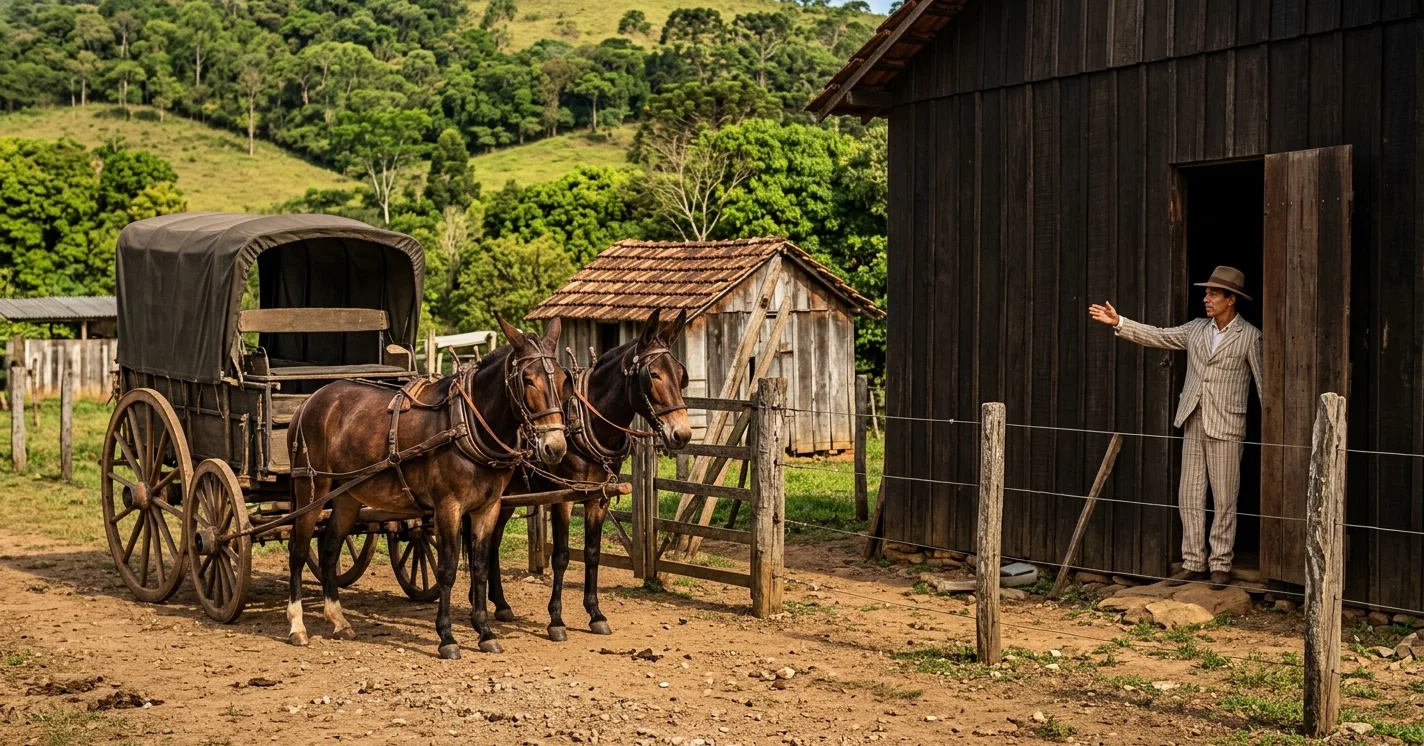
I LEFT home October 8 in company with one of my former students, to make a trip into the interior of our state by wagon. Our wagon, or cart, is pulled by three strong mules. On good roads such as are found in the States and in Germany, we would not need three mules. But here in Brazil we have to pass over roads that are seldom if ever repaired. We carry our saddles with us. When we get into territory where we find only mule paths, where no wagon can pass, we leave the wagon in a safe place, and go on muleback.
STARTING FOR THE INTERIOR OF BRAZIL
The first day was very unpleasant for us on account of the rain and the bad roads. We were disappointed not to be able to reach the place of our destination in time. On Sunday we came to our brethren in the colony of Candelaria, where are a few who seem to be doing well. About ten months had passed since a minister had visited them. One of the former students of our Taquary school, is teaching there, but earns very little money. She has been a great help in various ways. The next Sabbath we baptized six souls at Rio Pardense, and organized a church of twenty-five members at Candelaria. We hope more souls will be added in the near future. In a little more than two days we made the trip from there to the colony of Sao Angelo, where we visited our scattered German brethren. The following Sabbath we celebrated the ordinances with them. The next visit we paid to our brethren at the colony of Sao Miguel. Here we heard of an interest among the Brazilians, which one of our German brethren had created by circulating literature and making visits. News that reached me here made it necessary to leave the brethren the next morning to go to Sao Miguel to follow up the interest. At Sta. Maria I took the train for the colony of Sao Pedro, where Brother Brack had labored for some time without much result. The existing prejudice caused by the work of some unscrupulous men has hindered greatly. But we were glad to find one soul with courage to go forward, who seems to be converted. A change noted by all is seen in the life of this man. We hope in time to find souls in this place willing to follow the truth.
On muleback I returned to Sta. Maria, where I took the train for Cruz Alta. Six hours' ride in a farm wagon brought me to our brethren in the colony of Ijuhy, where we had baptism and celebrated the ordinances. The brethren there are anxious to have a school. They had decided to build a schoolhouse. I promised to see that they have a teacher by the time their house is ready.
After another trip by train, wagon, and horseback, I arrived at Naometoque, a German colony far in the interior. Here we have a church of eighty members, composed of Brazilians and Germans. This is a wide-awake church. It did my soul good to remain a few days with them. The meetings we held there were blessed by the presence of the Spirit of God. I could stay only a few days. After a trip of about four days by wagon, train, and steamer, I reached home again, having been absent six weeks. Three days and a half I could stay at home to do the necessary conference work; only a little time each day I could spend with my family. The work in the field must be done.
The following Sabbath I spent with the brethren at Taquary, where I baptized five souls and celebrated the ordinances with them. At this place we had a local conference last year, which was the beginning of a good work, as gradually souls came into the truth. The Lord seems to work there in a special manner. Some of the inhabitants wish to have a good German school. One of our young men who recently came from Germany is going to open a school. Prominent men will send their children. We hope the school will be the means of converting souls to the truth. We rejoice to see that the work in our state is constantly progressing, and we hope for greater results in the future.
The Barotseland Mission, British Central Africa
By W. H. ANDERSON
W. H. ANDERSON
I ARRIVED in Kimberley on Tuesday evening, and went directly to the church for prayer-meeting. I spent the evening telling them some of the good things that we enjoyed at the conference. The key-note of the conference — unity and work — met a hearty response from them. We had a pleasant time together. I spent the rest of the evening visiting and looking after some business which I had there. I returned to Brother J. V. Willson's place, and retired at half-past twelve.
Wednesday morning I went out to Brother Honey's, and had a good time with them for the day. The dry weather had continued so long that Brother Honey's cattle and sheep were dying, and his fruit will be almost a failure. I did what I could to encourage him with a good report of the conference. He was quite pleased with the turn things had taken. When I told him of the return of Professor Elffers and his company, tears of joy filled his eyes. I left them in the evening, and joined Brother M. C. Sturdevant, en route to the Solusi Mission.
We arrived at the mission on Friday about two hours before the rain. Things were very dry, and the grain has suffered. While I was there, they had good rains, and the crops looked much better when I left. Brother Sturdevant spent the time Friday evening telling them of the good things that we enjoyed at the conference. There was a spirit of consecration in the meeting. I had the service on the Sabbath, and dwelt on the needs of the natives in this field, and how each one present could help.
After consulting with Brother Sturdevant, I chose five of the boys from Solusi for the work at Pemba. Two of them are married, and the other three will be as soon as it can be arranged. I brought the two married boys home with me, and suggested that their wives remain at Solusi to harvest the crops, and then, when the others are married, come on with them. I think they will be able to come about the first of May.
I then went to Bulawayo on Monday, catching a train on Tuesday for the Falls. At the Falls I visited the French Protestant Mission. This school is closed for the present on account of the scarcity of food. Mealies are 32s. 6d. [eight dollars] a bag. Many of the natives have starved to death, and there is no relief for another month yet. I hope13to shoot some game here for them next week. I visited the patients at the hospital. Livingstone is a dreary, sandy waste, and absolutely undesirable for a home or town. I saw one novel sight while there. While walking from the mission to the town, I saw a herd of game. There in the bush were oxen, giraffe, wildebeeste, pookoo, litchwe impala, sitatunga, and antelope all herding together. It was a pretty sight. While in Livingstone I met Mr. Horton, an American and the cattle king of the country. In conversation he asked me if I needed any oxen to work on the farm. I told him, Yes; and he kindly offered me thirty-six (two span) for two years. I was glad to get them, and on reaching home sent the boys to bring them from his farm, about one hundred miles away.
Sabbath morning I took the train for home. There was a drunken lot of men on the train, and when the guard saw me, he took me into a first-class compartment, and I had that alone for the whole journey. I did appreciate being free from drink and smoke during the journey.
I arrived at Monze Siding Sunday noon, in the midst of a heavy rain-storm. I donned my oil-skin suit, and walked home. Some of the boys were there to meet me, but they did not bring the ox for me to ride home. It had been raining hard all the day and night before, and the water was often knee-deep in the path. When I came to the river, which the boys had swum in the morning, I found that it had gone down, and I was able to wade it. The water came up only to my waist. I found a nice dinner awaiting me,—new potatoes, turnips, green beans, cucumbers, and bread and butter. I enjoyed this very much after living from a lunch basket for nearly two weeks. There have been heavy rains here ever since I went away. The boys tell me that it has missed raining only one day since I left. Everything has grown well.
I found all well at home except the child of one of my teachers. It has a rather severe attack of fever. I am treating it, and think it will be better soon. This has been a bad year for fever, the rains have been so heavy. I am all right here at home, but I do dread the trip I must make to the outstation next week. I hope that it will clear up before then. It will be disagreeable and dangerous to be wet all the time.
The school here has an attendance of over one hundred. I can assure you it means a lot of work to see to them all. While I was away, twelve girls came. I do not know what to do with them. I have no huts for them, and they have been sleeping on the veranda of my house since their arrival. They move around from side to side to escape the rain. I can not send them home, and I do not see how I can keep them. It is one of the hardest problems that we have to face in the missions.
Pemba.
Visit to Shikoku, Japan
By Walter L. Foster
WALTER L. FOSTER
SHIKOKU is one of the large islands of Japan. The fourth in size, it is a little less than two hundred miles in length, and not quite one hundred miles wide. It is so mountainous that there are no railways, except several narrow-gauge lines, only a few miles in length. There are some good ’riksha or wagon roads, but these are disconnected in many places by high mountains, over which a traveler can pass only by walking.
The island is divided into four provinces, and has a population of approximately four millions. On account of their separation from foreigners of all classes and the remainder of Japan, the people are comparatively simple, and not so greedy and dishonest as those who have come in touch with the foreigners.
For several months I have desired to visit Shikoku. We have never had a worker there, and I felt called to go. Consequently, when the committee met in February, they decided to let me visit the island.
There is a small body of water between Shikoku and the main island, called the Inland Sea. In this small sea are hundreds of little islands, many of them inhabited; and as the steamer passed among them, stopping at many towns on the coast of Shikoku, it was indeed a pleasing picture; for scenery more beautiful than any painting, seemed everywhere to greet our eyes.
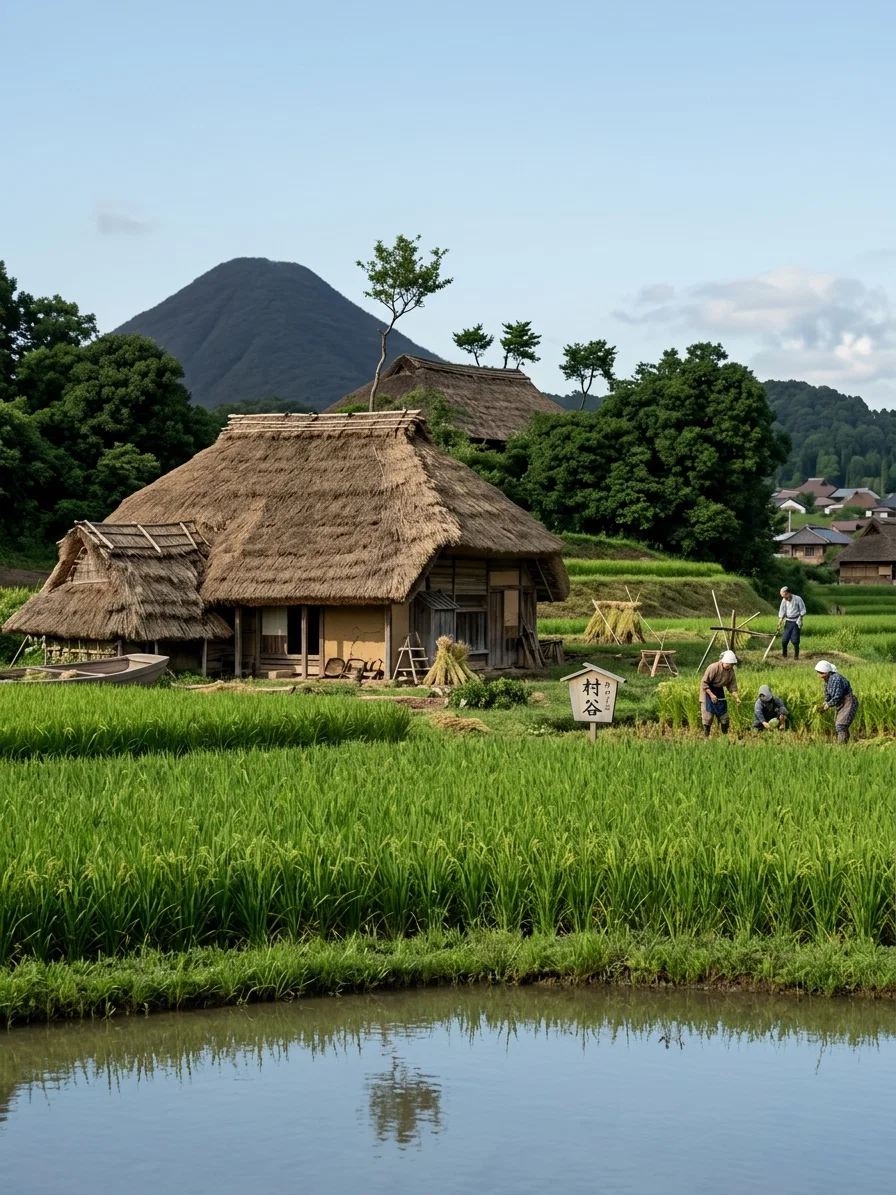
When well down on the north coast, I left the steamer to make a short trip inland. In passing up the valley, we went through many villages. Some of these have a population of several thousand. Most of the houses have thatched roofs, and walls of straw or bamboo and mud. After a ride of about ten miles in the ’riksha, we came to a village of at least five thousand. This is entirely surrounded by mountains, and has a beautiful stream of water passing through it. The town appeared to be very old, and in one part is a high bluff overlooking the river. On this hill once stood a castle, the home or stronghold of a feudal lord. During the afternoon, I decided to continue my journey by land over the range, and get a still better idea of native life. Tourists who have spent only a few months in Japan during the best season and visited no places but the large cities on the railroads, or some of the famous temples, are inclined to give their friends in America the impression that there is nothing in Japan but cherry blossoms. There are some14cherry blossoms here; but tourists fail to see the extreme poverty, the terrible misery, and the gross darkness that enshroud the people. They see only the conveniences, because they are careful to remain where these can be had. One missionary said to me, “You are the first foreigner I have seen for five months. Our bishop visited us then, and before that I do not remember when a foreigner was in this town, and I have lived here twelve years.”
A JAPANESE THATCHED COTTAGE
On my first trip by land I rode and walked about thirty-five miles through the country, and much of the time a heavy rain was falling. The steamer then passed down the west coast, stopping at many villages and towns. It was necessary to change boats several times, in order to see the more important places.
Several times I was warned to keep off the small boats. But as the larger boats all turn back at a village called Sukumo, because of the many rocks and big waves on the south coast; and as I wanted to pass around the islands, for the ’riksha fare was too high from Sukumo to where I could take the large steamers, there remained nothing to do but take a small steamer, or return the way I came. Within half an hour our little steamer was on her way to face the open sea. Progress was slow, however, and about dark we passed into a small inlet for the night. That evening the captain and his sailors came into my cabin, to spend the time talking and asking questions. The room was nine by six feet, a door in each end, tatami on the floor, and hibachi (box for coals) in the middle of the room. All night the boat kept up an uneasy motion, which did not help my seasickness. At three o’clock in the morning we started. It was raining. The wind became strong as the boat passed the first point of rocks. I could see a storm was approaching. It soon struck us. The sea was lashed to foam; the steamer was tossed about like a cork on the water; and the waves sounded like the roar of thunder on the rocky shore. I could see the water turn white as it dashed itself over the many rocks in the distance.
My seasickness continued to increase as we passed on, but I had no fear, for I realized the nearness of help. As we came to several villages, attempts were made to get some of the passengers ashore, but were unsuccessful. Some of the Japanese thought I was dying, and I thought so, too. No doubt in that condition I saw things in a somewhat exaggerated light. Our boat was only sixteen feet wide, the deck had only a canvas cover, and the rain beat in from both sides.
At my first opportunity, I went ashore. After resting one hour, I rode in a ’riksha nine miles, passing through a fine country on the way. The rain continued to fall; consequently, the roads were bad. There were many mountains. The ’riksha man refused to go farther. I was unable to find another ’riksha, so walked, and carried a thirty-pound suit case, through a heavy rain, from eleven until eight o’clock in the evening. The roads were rough, and it took one hour and a half to climb one mountain. During that twenty-five mile walk, I passed through many towns and villages. Many of the people seemed like children, and often twenty or more men, women, and children would follow along, all wishing to talk to me at once, except a few more timid ones, who perhaps saw a foreigner for the first time.
That night was spent at a very simple hotel by the roadside. The building was poor and old, but I had eaten nothing for two days, for I was still a little sick. For supper I had a few dried minnows, tofu (bean curd), and a bowl of rice, which contained one part of pebbles to six of rice. The people had all retired when I arrived at this village of twelve huts, but in a short time all of them but a ’riksha man had come in to see the foreigner. For more than an hour I answered their childlike questions. Many times during the trip, among other questions, those poor people asked, “What god do you worship?” They worship the sun, moon, an idol, a sacred mountain, the emperor, their ancestors, or the nation’s heroes.
I will not tell more of the little experiences that attended the journey, but I long to be among the people. I long for the time when I can freely speak their strange tongue; when this weak instrument can fully understand their dark sentences; when these eyes shall see some waiting for the kingdom of God. Can those who read this say, “I can do no more this year than I did last for missions”? Perhaps you did nothing last year. But if you saw thousands of poverty-stricken people every day,—people in the depths of sin, with not a warning of their approaching doom,—tell me, could you say, “I can do no more”? Now, in this time when the glory of earthly powers is passing away, remember the missions in your prayers and offerings. Meditate upon these things: “For what is a man profited, if he shall gain the whole world, and lose his own soul?” “Render . . . unto God the things that are God’s.” “For we brought nothing into this world, and it is certain we can carry nothing out.”
Kobe.
Danish West Indies
By H. C. J. WALLEKER
H. C. J. WALLEKER
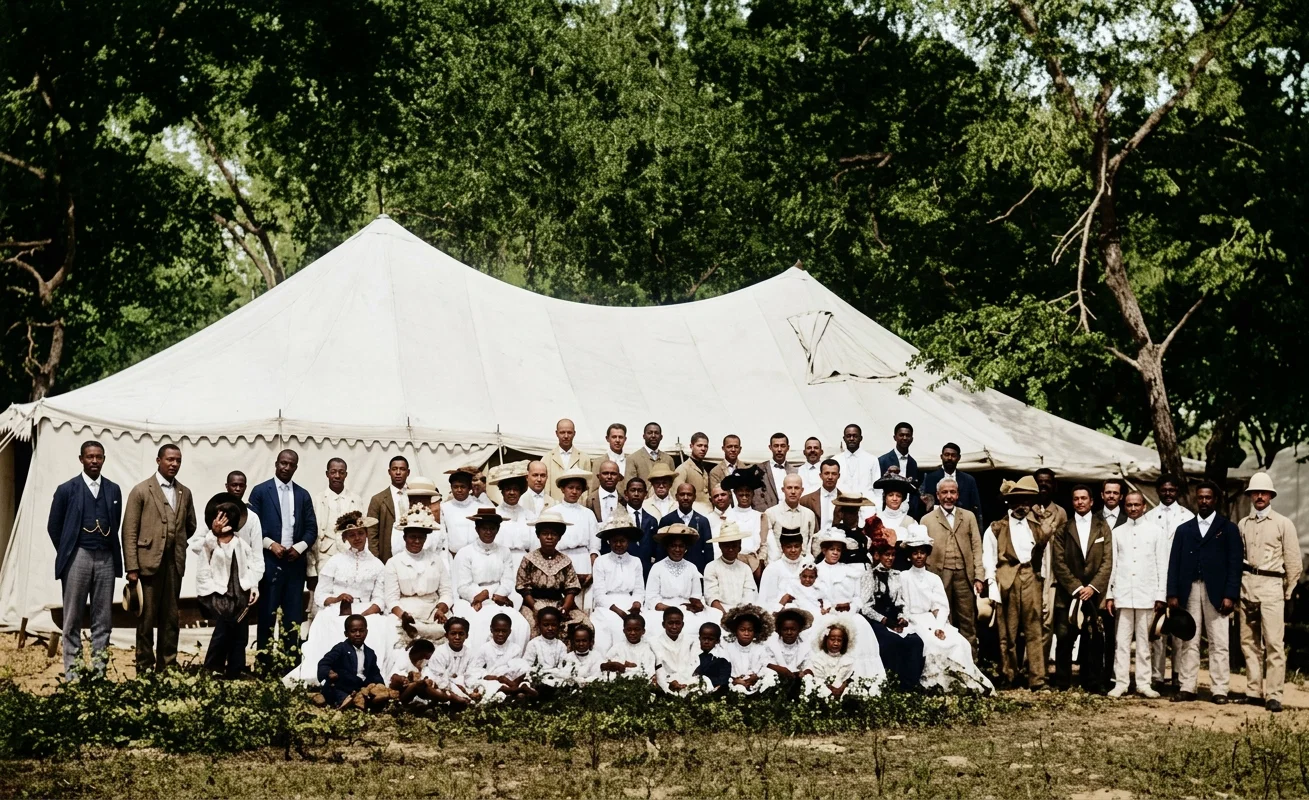
The work here is moving steadily forward. After a two-months' tent effort in St. Croix, we took down the tent February 1, and rented a hall. The attendance at our meetings was excellent from first to last, the interest never seeming to wane. Twenty-nine have been baptized, and a church has been organized, which is not fully officered as yet. Many more are keeping the Sabbath, some of whom will soon go forward in baptism. Elder James H. Matthews continues the work there in my absence, holding meetings three times a week, besides Sabbath services and prayer-meetings. This is the first work ever done on this island in a public effort, and no Sabbath-keepers were there when we began our labor.
TENT AND CONGREGATION AT ST. CROIX, D. W. I.
The town where we held the meetings is a place of about five or six thousand inhabitants. There is another town on the other end of the island, about the same size, which we expect to work later.
Since closing the tent-meetings at St. Croix, I have baptized two persons at St. Thomas, and held quarterly meeting with this church; have made one trip to St. John in my motor boat, and am planning for another trip to St. John, Tortola, Anegada, and St. Croix, before starting for General Conference. There are some at St. John who are awaiting baptism, whom I expect to baptize on this trip. Brethren, pray for the work in this island field.
St. Croix.
A Christian Colony in the Himalayas
There is a place in India that stands as a perpetual memorial to the fact that God hears prayer. It is three miles from the border of the “sealed land” of Tibet, in the heart of the Himalaya Mountains. It contains three thousand acres of land, and is owned by the American Himalayan Christian Colony (undenominational), incorporated under the laws of the State of Illinois. Gorham Tufts is the founder and head of the colony.
This land was purchased through prayer, and is maintained and all its departments kept going by prayer. Yet they are not visionaries, these men and women who compose this colony of Christian missionary farmers. Nothing could be more practical than their plans and their manner of carrying them out. The work is divided into different departments, that is, training-school, village work, orphanage, and the industrial department. The last mentioned has several subdivisions, and is considered of great importance. Dissatisfaction is often occasioned by the idleness and inefficiency of the Christianized natives of foreign lands. “What to do with the converts” has become a problem. The Himalayan colony has been enabled partially to solve this problem by putting its converts to work. “Labor is honorable, and idleness a disgrace to any people,” is the teaching given to both adult converts and the children in the orphanage. The climatic and agricultural conditions are almost perfect. The soil is adapted to nearly all fruits, vegetables, and grains. Already there are sugar-cane, rice, wheat, and barley under cultivation. Cattle, sheep, and goats are being raised by the colony, and the dairy products find a ready market.
Mr. Tufts and his associates believe that native teachers are destined to be an important aid in the evangelization of India. They thoroughly understand the people; they know the language, are acclimated, and can be supported at little cost.
All the needs of the Christian colony have thus far been supplied by voluntary contributions.—The Christian Herald.
Medical Missionary Work for the Colored People
By James Edson White
At the present time a special effort is being made to place upon vantage-ground the three sanitariums for colored people,—at Nashville, Tenn.; Huntsville, Ala.; and Atlanta, Ga. We believe this is as it should be, and that these institutions should be speedily freed from debt, and fully equipped.
The plans for these institutions are, however, very modest, as the total cost of the three, when placed in running order, will not be so great as that usually expended on one of our smaller sanitariums provided for the white people.
SIDE VIEW OF NASHVILLE (TENN.) SANITARIUM
When we came to the South about thirteen years ago, we expected to find the colored people a strong, sturdy race, largely immune to the many ills so common to the white man. Our surprise was great when we found that, owing to surroundings, habits of life, and a most pernicious diet, disease, sickness, and suffering are the rule, and strong, sturdy, healthful manhood and womanhood the exception.
The poverty of the people, especially in the great black cotton belt, often makes it impossible to secure the services of a physician, even in critical cases. Especially is this true on the plantations located at considerable distance from the cities, where the fee of a single visit usually ranges from ten to twenty dollars—cash in advance. Under such conditions thousands are compelled to suffer without the attendance of a nurse or a physician.
As a result of our labors for this people, in many places and under almost all conditions, we were early impressed with the fact that medical missionary work should go hand in hand with our other efforts. But to make such an effort successful, a corps of medical missionary workers must be trained to accompany the teacher or Bible worker. More than this, we believe that all teachers and workers should receive sufficient training in healthful housekeeping, hygienic cooking, and simple treatments to qualify for the uplifting of those among whom they labor, and to relieve many sufferers who would otherwise be utterly neglected. Such relief work will gain the gratitude and secure the confidence of the people. It will open the doors to thousands of homes that would be otherwise closed to the truth. The medical missionary work can easily double the efficiency of our efforts for this people.
It is to the sanitariums that we must look for the education and training of workers along medical missionary lines. And it is largely to prepare for this training work that the three sanitariums previously mentioned have been undertaken.
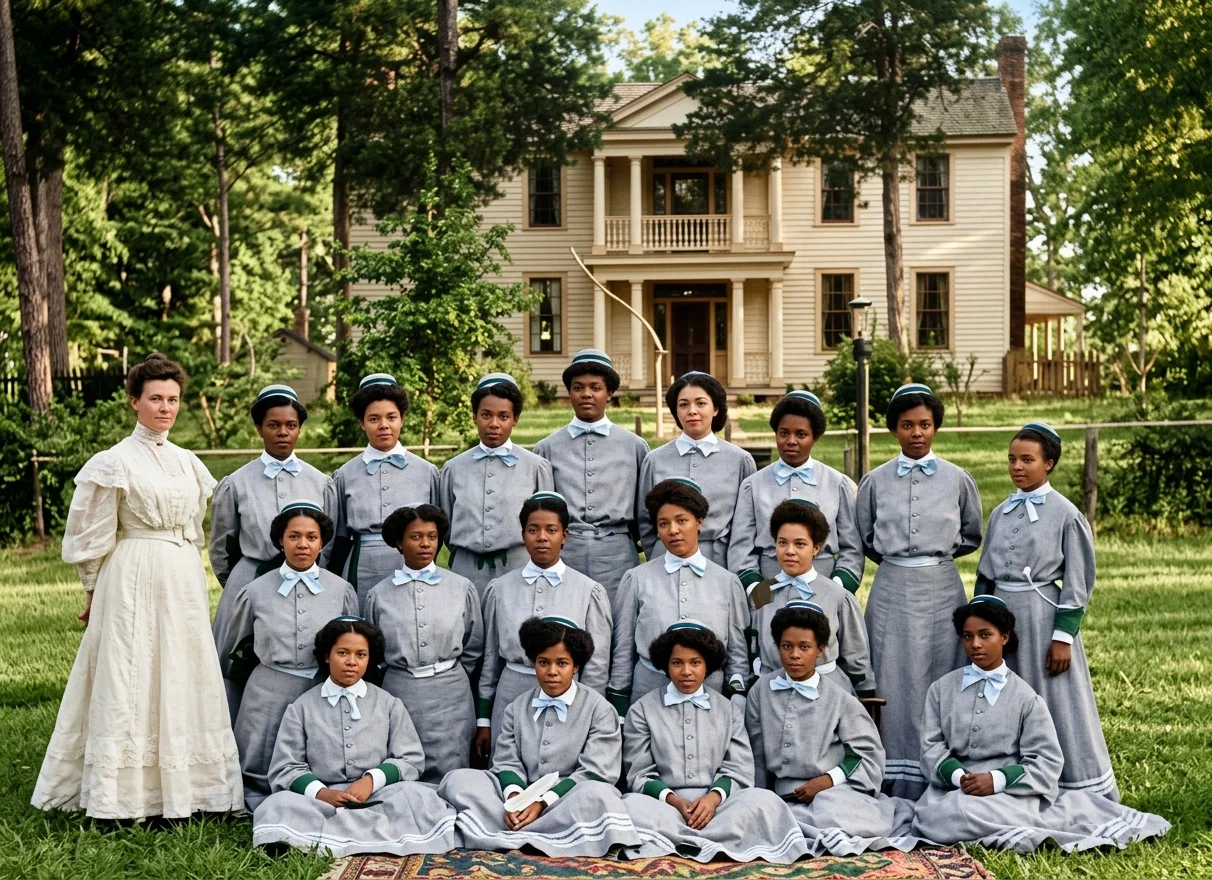
NURSES’ CLASS, HUNTSVILLE (ALA.) SANITARIUM
At Nashville a beautiful and appropriate property has been purchased. The main building was formerly the home of one of the aristocratic families of Nashville. But gradually the homes of the colored people had been coming nearer and nearer to it, until it stood upon the border line between the residences of the white and the colored. For this reason the property was secured at a very reasonable price.
Built before the war, the house is, as would be expected, old fashioned, but comfortable and roomy. It is located on the corner, with one hundred seven feet front on Foster Street, and a side of two hundred ten feet on Stewart Street. The grounds are elevated several feet above the street level, and are beautified by several magnificent shade trees. All features unite to make this a delightful location for the Rock City Sanitarium.
It was early realized that the central training-school for medical missionary workers must be located in some large city like Nashville, where the school instruction can be combined with actual, practical work in the needy homes of the thousands of colored people. It has therefore been planned that this sanitarium shall be the leading training-school for this field, and that, as far as possible, the classes at the other sanitariums and the leading schools shall come to Nashville for their final, practical work in completing their course as nurses.
In equipping the building it was found that there was no suitable place for treatment-rooms. Hence a modest addition has just been completed, containing bath-rooms below and surgical operating room and wards above. A side view of the sanitarium from Stewart Street is given in the oval picture, showing this addition in the rear of the sanitarium building.
The buildings now ready for use fit the sanitarium for a limited number of patients, but do not provide for helpers and students. Before its real training work can be properly undertaken, a dormitory must be erected.
When finished and equipped, with dormitory as mentioned, the total cost will reach close to ten thousand dollars. Certainly this is a modest sum when all the facilities so secured are considered. It is but a drop in the bucket when compared with our large sanitariums, yet this small investment will fully equip this institution for a work which will mark a new era in the mission work for the colored people. This entire sum should be raised as quickly as possible. The dormitory is needed as soon as it can be completed.
The funds to carry this enterprise to the present time have been supplied by the Southern Missionary Society. But this society can not carry the burden of purchasing, equipping, and maintaining an institution of this kind. The field of this society is the mission school work. Already its legitimate work is handicapped because of the money it has advanced to this institution. This burden should be removed at once by the raising of a fund sufficient to cover the entire cost of the purchase and equipment of the Rock City Sanitarium, thus placing it on vantage ground.
The Huntsville school is now completing a modest, but well-equipped sanitarium of two stories, with basement for treatment-rooms. For two years a class of intelligent young colored persons have been taking the nurses’ training course. The group in the accompanying picture shows the present class. The first graduating class of five will finish their course next year. They should spend a few weeks in actual practise in Nashville before going to their field.
At Atlanta another small sanitarium is being completed on the lot in the rear of the church and school building recently purchased for the benefit of the colored people.
Certainly the work for the colored race in the South is onward, and it is hoped that the more favored and better financially endowed people of the North will lend a helping hand to this important work.
J. E. WHITE.