The Youth’s Instructor, Vol. 48, No. 21.

A SONG OF THE SEASON

The Youth’s Instructor

May 24, 1900

Review and Herald Publishing Company · Battle Creek, Mich. · May 24, 1900

A SONG OF THE SEASON
The twitter of a mockingbird Among the tender leaves; The swallow's summer home begun Beneath the cottage eaves; The sobbing of the turtle-dove, That sits alone and grieves; The scent of wild crabapple bloom Upon a sunny bank; Blue iris crowding into bud Down in the marshes dank; Sweet clover and bright buttercups, That every roadside flank; The gurgle of the little brook Beside each stepping stone; Rain dashing down—a torrent swift The little brook has grown, That roars a while, and then regains Its former gentle tone; The shout of children romping near, With tender, bare, white feet; The tiny lambkins frisking round The pasture green and sweet; Gray squirrels in the tree-tops tall, Where shade and sunshine meet,— All speak to us of summer-time, In language pure and strong: The morn is full of harmony, The eve is full of song. Ah! earth was surely beautiful, Ere marred by sin and wrong! And spring-time in new Eden fair Can never be too long!
MINNIE ROSILLA STEVENS.

BEAUTIES OF SOUTHERN CALIFORNIA

VI

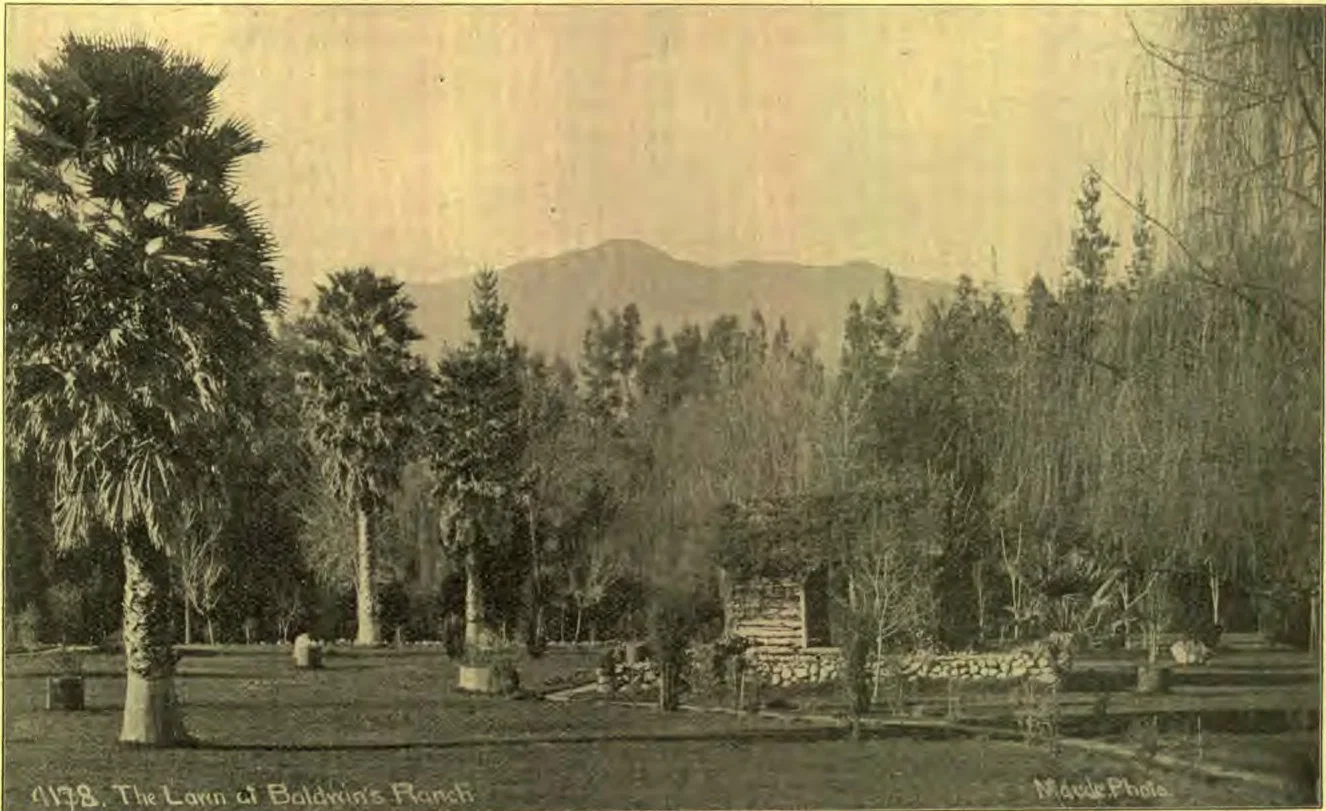
STILL another famous spot visited by thousands of tourists, and a pleasure-resort for those living in the surrounding cities, is Baldwin’s ranch. In California the term “ranch” is applied, in general, to any tract of land used as a farm; but in the early days it was given to Spanish grants comprising thousands of acres. If size be any criterion, the term is not misapplied in this case. The ranch of J. E. Baldwin covers an area of sixty-five thousand acres, and stretches from the foothills of the Sierra Madre Mountains to Whittier, a distance of seventeen miles. It is nearly all under cultivation. The home ranch alone, upon which stands the magnificent home of the owner, includes fifteen thousand acres. This large tract of land, with much more, which has since been sold, was purchased of the Spaniards in the early sixties. It is not a free-for-all picnic-ground; but one wishing to enter buys a ticket at Oakwood Station, which permits him to pass in. He may spend the day as he chooses anywhere about the place, admiring the flowers in the garden, driving through the vast parks of live-oaks; or sauntering about Oakwood Hotel, where he is entitled to a dinner of whatever he wishes, provided the order is sent in early.
In the vicinity of Mr. Baldwin’s private residence are gardens of tropical fruits and foliage, acres of stately cypress and palm, and in every direction broad avenues leading to many places of interest. Within its bounds may be found lakes alive with beautiful and rare fishes; groves filled with gay-colored tropical birds, and melodious with bird-songs; forests whose thickets furnish safe retreats for deer and many other woodland creatures; and a race-track where may be seen in daily exercise some of the finest trotting horses in the world.
There are also a grocery store and a post-office for the accommodation of the workers who help keep the vast place in order, and who live in the surrounding dwellings.
Both the Southern Pacific and the Santa Fé Railroad pass through this ranch, and Mr. Baldwin has built his own stations. Santa Anita Station, five miles from Pasadena, is named for his daughter. He has his own irrigating system; hence his beautiful orange groves and vineyards are kept fresh during the entire dry season by the water flowing in abundance from the broad ditches that intersect the land in every direction. The large orange packing-house, in which the golden fruit is stored away by the car-load, is a scene of interest. The fruit-drier and winery give employment to many persons during the season of the smaller fruits; and the work of the dairy goes on without interruption the year round.
It is not an unusual sight in the fall to see seventy or eighty teams plowing, dragging, and sowing in the immense grain fields. In the spring, when the ripening grain moves to and fro in the breeze, like the waves of the ocean, these fields are indeed a beautiful sight.
The original home of Mr. Baldwin was a little log cabin that he himself built. It still stands on the lawn, only a short distance from his modern mansion. It is carefully preserved as a relic of early days, and adds a picturesque touch to the landscape.
When we see how this earth, which rests under the curse, can be beautified by man, we can not but wonder what it will be like when restored to its Edenic beauty, and when sinless beings shall plant and train vineyards, gather the flowers that never fade, and eat of the fruit of the tree of life.
MRS. KATHLEEN WAGNER-GILMORE.

USE OF COLOR IN NATURE

There is nothing more beautiful and attractive than color in nature. Did you ever stop to think what this world would be like if the blue were taken from the sky, the gold from the sunshine, the green from the leaves, the flush from the cheek,—in short, what the world would be like without color?
Let us heed the suggestion to— 'Go forth under the open sky, And list to nature’s teachings,’ when choosing colors for our dress and decorating our homes. Notice what colors nature uses in great masses. Look at the immense rocks. What color are they? Look at the woods and clouds, and observe how nature has given them those gray tints that serve as a background to bring out the rest. Now look at the bright colors, and see how they are used. It would not be pleasing to see a great mass of bright colors together; therefore they are used in small dashes. Notice the clouds at evening, and see the great mass of gray tinged with the glow of sunset.
Can we go on day after day without making use of the color combinations that are given us in nature? Why not seek nature as a guide to aid us in making our surroundings pleasant and beautiful? Alice Barkley.

ELEMENTARY PHOTOGRAPHY

CONTACT PRINTING WITH BROMIDE PAPER

Bromide paper is coated with an emulsion similar to that used in the manufacture of dry-plates. It is not nearly so sensitive as an ordinary plate, but the sensitiveness of different makes varies greatly. “Standard” bromide paper is about one twentieth as sensitive as a “Seed’s 26x” plate. It is especially adapted to the making of enlargements, but within the last few years it has been extensively used in making contact prints.
There are now a considerable number of bromide papers that are made especially for contact printing. They are not usually called “bromide” papers, but are known by some trade name. Of this class Velox is the pioneer, and still holds the lead; but there are others just as good, and one, Vinco, that is sold at a much lower price.
The natural tone of bromide paper is black. It may be varied somewhat by different treatment, either during or after development; but with the majority of pictures the black tone gives the most satisfactory results.
The standard bromide paper must be handled in the dark-room, though it will bear light that would hopelessly fog a dry-plate. Both sides of the paper will look alike; but the film side will curl in, so there will be no difficulty in distinguishing between them.
Artificial light is best for printing. If daylight is used, there will be great danger of over-exposure, and it will be almost impossible to make uniform exposures. The time will depend upon the density of the negative and the intensity of the light. A negative of moderate density, held one foot from a number two kerosene burner, should print in about twelve seconds. It is quite difficult to count seconds accurately; but by practicing by the second-hand of a clock or watch, the knack may be acquired. A pendulum thirty-nine or forty inches long will beat seconds very nearly. The exact length required varies with the latitude, but this is near enough for all practical purposes.
If your lantern is made according to the plan suggested in one of the articles of this series, it will be just the thing to print bromide paper by. Place the printing-frame where the light of your lamp will fall upon it when the sliding door of the lantern is raised. When the necessary time has passed, the light can be instantly shut off by sliding the door into place again. The paper may then be removed from the frame, and developed.
The manufacturers of bromide paper usually recommend an iron developer. But iron is very difficult for a novice to handle. When properly and successfully used, it gives beautiful results; otherwise it gives complete failures. Almost any developer, except pyro., may be used with more uniform success than iron. But for beautiful, “snappy” prints, with shadows that are black, and high lights that are white, our standard developer, diluted with two parts of water, can not be improved. The development is carried on just as with a plate, except that the print must be examined by reflected instead of transmitted light. After development, the print is immersed for ten minutes in a fixing-bath made by dissolving one ounce of hypo. in five ounces of water. Now wash the prints through twelve changes of water, allowing them to soak five minutes in each, or wash one hour in running water. Then they may be mounted or dried just like print-out paper.
Unmounted prints usually curl badly in drying. They may be straightened by scraping the back with a rule, the corner of the print being lifted behind the ruler as it passes along.
Over-timed prints will have greenish-black shadows and stained high lights. If they are under-timed, the shadows will be gray instead of black, and the half-tones will be very weak. Pin-holes may usually be spotted out with a lead-pencil. Over-developed prints may be reduced in the same manner that negatives are; but it is best to use a weaker bath, to guard against over-reduction. Sometimes failures will occur from other causes than those mentioned; but it is usually better to throw away the print and make another, than to attempt to doctor it.
For many subjects bromide paper may be substituted for dry-plates in making the negative. As it is sold at about one third of the price of dry-plates, the economy of its use is apparent. The necessary exposure will be about fifteen or twenty times as long as the time required by a first-class dry-plate. The paper negative is developed, fixed, and washed in the ordinary manner. It must of course be dried unmounted. When dry, it is immersed in melted paraffin wax to hide the grain of the paper, and make it translucent, so that it will print more rapidly. It may then be hung in a warm place until the surplus wax drips from it, when it will be ready for the printing-frame.
Bromide paper can not be successfully used in portraiture; but for landscapes and architectural subjects it is in many cases quite as good as dry-plates. J. EDGAR ROSS.

“THE VIOLENT TAKE IT BY FORCE”

II
THERE is need of earnest work, that we may have strength from God to resist the enemy when he shall come in like a flood. We must agonize in order to subdue self; for self-ease and self-indulgence are the most deceptive of sins, stupefying the conscience and blinding the understanding. Oh, that those who have heard the testing message would awake from their sleep, and no longer remain in careless indifference! We need the earnest desire of the importunate widow and the Syrophenician woman,—a determination that will not be repulsed.
Many, very many, are making a fatal mistake by failing to heed this lesson of God’s providence. Peace and rest can be secured only by conflict. The powers of light and darkness are in array, and we must individually take a part in the struggle. Jacob wrestled all night with God before he gained the victory. As he pleaded with God in prayer, he felt a strong hand laid upon him; and thinking it to be the hand of an enemy, he put forth all his strength to resist him. He wrestled for hours, but gained nothing over his opponent, and he dared not relax his efforts for one moment, lest he should be overcome and lose his life. Thus the contest went on until the dawn of day, and neither had gained the victory. Then the stranger brought the conflict to a close. He touched the thigh of Jacob, and the wrestler’s strength was paralyzed. It was not until then that Jacob learned who his opponent really was; and, falling crippled and weeping on his neck, he pleaded for his life.
The angel could easily have released himself from the grasp of Jacob, but he did not do this. “Let me go,” he pleaded, “for the day breaketh.” But the answer came from the suffering but determined Jacob, “I will not let thee go, except thou bless me.” The suppliant’s tears and prayers gained for him what he struggled in vain to obtain. “What is thy name?” the angel asked. “And he said, Jacob. And he said, Thy name shall no more be called Jacob, but Israel: for as a prince hast thou power with God and with men, and hast prevailed. . . . And he blessed him there.”
Jacob was in fear and distress while he sought in his own strength to obtain the victory. He mistook the divine visitor for an enemy, and contended with him while he had any strength left. But when he cast himself upon the mercy of God, he found that instead of being in the hands of an enemy, he was encircled in the arms of infinite love. He saw God face to face, and his sins were pardoned.
“The kingdom of heaven suffereth violence, and the violent take it by force.” This violence takes in the whole heart. To be double minded is to be unstable. Resolution, self-denial, and consecrated effort are required for the work of preparation. The understanding and the conscience may be united; but if the will is not set to work, we shall make a failure. Every faculty and feeling must be engaged. Ardor and earnest prayer must take the place of listlessness and indifference. Only by earnest, determined effort and faith in the merits of Christ can we overcome, and gain the kingdom of heaven. Our time for work is short. Christ is soon to come the second time. May God help those who have heard the warning message to remember that “the kingdom of heaven suffereth violence, and the violent take it by force.”
MRS. E. G. WHITE.

KEEP THE KEY WITH YOU

A gust of wind had blown to the door. The spring-lock was on, the key was indoors, there was no other means of entrance. It was useless to beat against the panels with clenched fists, useless to complain. If only the key had been in the pocket of the one who stood helplessly outside, the trick of the mischievous breeze would not have been worth noticing.
There are a great many hearts that close with a spring-lock. A gust of anger or pride or envy blows them to; and when they are shut, they are locked. But though a “trifle light as air” closed them fast, a giant’s strength could not force them open. These doors can not be battered down. There is no mechanical contrivance for forcing the lock. The only safe thing is to keep the key with you.
Try the key of love on these locked hearts, and if it turns with difficulty, use the oil of tact. Never give up just because the door is fast. Every lock supposes a key, and no heart will remain closed to one who brings to it honest sympathy and unselfish love. — Selected.

THE ONWARD WAY

Our life is one long journey, and the road Is sometimes rough and rugged; but our God Who loveth us, his children, knows the way, And he will gently lead us, day by day. We meet with certain milestones on our way, That help to cheer us onward; for they say, "Our God hath kept you so far, year by year; Then will you dread the future? Will you fear?" How can we, when he holds us by the hand, And promises to lead us to his land? Then let us simply trust him, nor allow One single shade of doubt to vex us now. — Charlotte Murray.

The Coming Eclipse

ASTRONOMICAL STUDY—NO. VII

The Coming Eclipse
ON Monday morning, May 28, is to occur the eclipse of the sun to which all our class have been looking for some time as an opportunity for observing the wonders of the heavens. It will be well to secure pieces of glass,—pieces of broken window-glass will do nicely,—and smoke them over a lamp in time to be ready to look at the sun when the eclipse occurs.
As our family is scattered all over the United States, we will not take the space to tell at just what time the eclipse will appear in each separate locality: you can look this up in your almanacs for yourselves. Suffice it to say that in Battle Creek, Mich., where the INSTRUCTOR is published, it will begin about 6:40, and end about 8:50, A. M.; and we hope it will be a clear morning with no clouds to obstruct the view.
As all have studied the article in last week’s INSTRUCTOR, and understand how the positions of the sun, moon, and earth as they will be at that time produce this special kind of eclipse, we will now speak more fully of how it will appear. The sun will be in the center of the constellation Taurus. The small picture in last week’s paper shows the position of three of our sister planets,—Venus being somewhat above, and, of course, to this side, of the sun; Mercury at the farther side, and to the right, of the sun; while Mars, though considerably distant beyond the sun, shows still farther to the right and above.
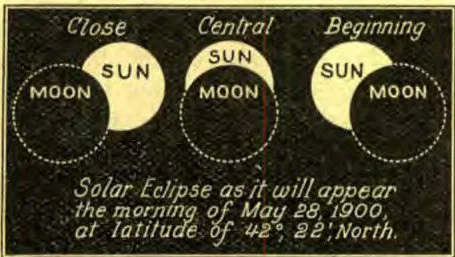
Solar Eclipse as it will appear the morning of May 28, 1900, at latitude of 42° 2' North.
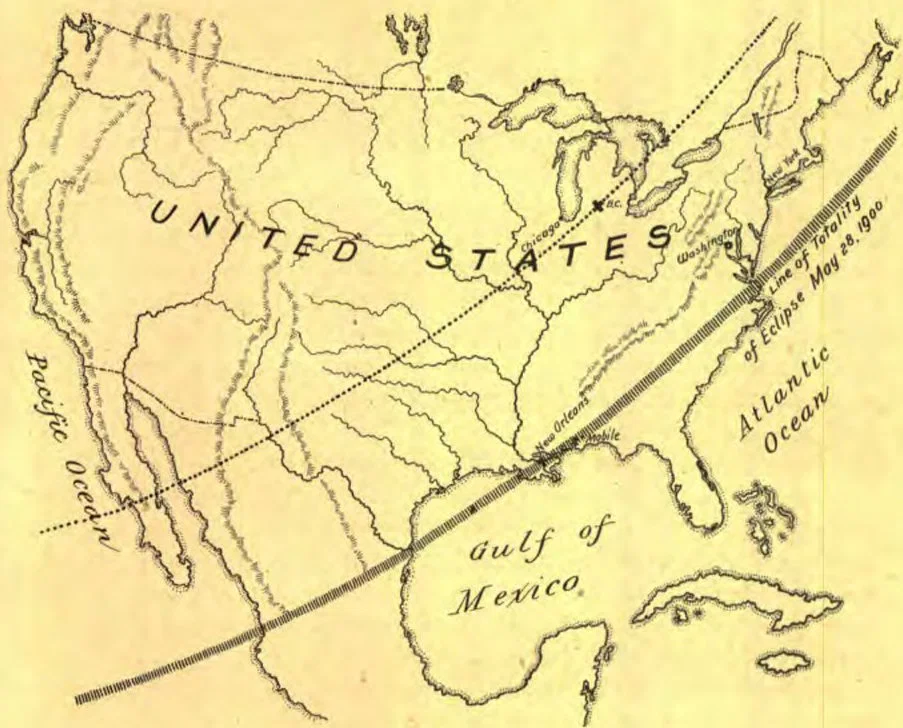
To those living in the extreme southern and eastern parts of our country, the eclipse will be total; that is, the whole face of the sun will be covered by the moon passing centrally between them and the sun. To illustrate this, we have drawn an outline map of the United States, in which is a heavy dotted line running along our Eastern border, down through the Southern States, across the upper portion of the Gulf of Mexico, through Mexico, and on out into the Pacific Ocean, showing over what part of our country the shadow of the moon will sweep, and where the eclipse will be total. To those living in that portion of the country represented as lying to the north and west of that line, the upper portion of the sun will appear above the moon; while to those living to the south and east of it the lower portion of the sun will show below the moon. The farther we are either way from the path of this dotted line, the less of the sun’s disk will be eclipsed to us. To such it will present the appearance of a partial eclipse.
The small illustration shows the sun as it will appear to those living in Battle Creek, whose latitude is about 42°, 42′, N. In the large illustration we have drawn a slight dotted line passing through Battle Creek, and running parallel with the heavy dotted line of totality. Now although your latitude may not be that of Battle Creek, still if you live in any portion of the country traversed by the light dotted line passing through Battle Creek, you may expect to see the eclipse very much as it appears in the small illustration. If you live in that portion of the country which the map locates as being between the two dotted lines, the eclipse will be more nearly total to you than the illustration shows it to be; if, on the other hand, your home is farther to the north and west, you will see less of the sun eclipsed. All, however, will see it eclipsed to some degree; for by reference to the diagram shown in last week’s lesson it will be seen that the eclipse reaches far into the polar regions.
If we are favored with a shower, especially if it is attended by lightning, the day or evening before the morning of the eclipse, we may expect some beautiful colorings along the edges of the moon, these shadings partaking of the lighter orange and copper colors; but if it is dusty, warm, and humid, the somber shades will predominate.
Oh, the beauties of the handiwork of God! The heavens declare his glory; and why do not we have our eyes open to see more of his loveliness in the workings of nature around us? One can not study these subjects, with a mind to see God, without being drawn nearer to him. My very being thrills as I watch the onward progress of these mighty orbs, and realize that the same loving Hand that guides them in their courses, watches also over my soul. He that keeps these worlds, their satellites and suns, forever within the bounds of their trackless paths, will also keep my feet within the path that leads heavenward.
Remember that while you are looking at this eclipse, the most eminent astronomers, with the mightiest telescopes in the world, are also carefully surveying this interesting phenomenon. Thousands of dollars have already been spent in preparing to make the most of this scene. Astronomers are determined to find out, if possible, whether there is an intra-Mercurial planet. The belief that there is another world belonging to our solar system has found acceptance in the minds of so many that scientific men are bending all their energies to settle this perplexing question at this time. It is hoped that with our improved instruments it can be decided whether Vulcan really does exist, except in the minds of imaginative astronomers. If he is found, it is proposed to take his picture, and give him a proper installation in the grand brotherhood of our solar associates, and no longer look upon him as a merely hypothetical creation, at whose door the responsibility of so many of the storms that sweep across our continent are laid.
Dr. O. C. GODSMARK.

THE MYSTERIOUS GEGENSCHEIN

THERE is visible in the night sky, under favorable circumstances, a faint light, rounded in outline, and situated always exactly opposite to the place of the sun. It is called the “gegenschein,” and is one of the most inexplicable objects known to astronomers. Recently Prof. W. E. Pickering has suggested a new explanation of the gegenschein. According to him, it may be “a sort of cometary or meteoric satellite” attending the earth. He supposes it to be composed of a cloud of meteors, situated about one million miles from the earth, and revolving around it in a period of just one year, so that the sun and the meteors are always on opposite sides of the earth. He estimates that the size of this ghostly satellite may be nearly the same as that of the planet Jupiter,—eighty-six thousand miles in diameter.—Selected.

AFTER ALL

Earth is sweet, but heaven is sweeter; Love complete, but faith completer. Close beside our wandering ways, Through dark nights and weary days, Stand the angels with bright eyes; And the shadow of the cross Falls upon and sanctifies All our pain and all our loss. Though we stumble, though we fall, God is helping, after all!
Sigh then, soul, but sing in sighing, To the happier things replying; Dry the tears that dim thy seeing, Give glad thoughts for life and being! Time is but the little entry To eternity’s large dwelling, And the heavenly guards keep sentry Urging, guiding, half compelling Till, the puzzling way quite past Thou shalt enter in, at last.
— Sydney Methodist

THE BLACKSMITH’S SONG

I PLAYED about a flaming forge Full twenty years ago, And watched the red sparks upward fly, And heard the bellows blow.
The blacksmith stood beside the fire, His hammer in his hand, His feet upon the bellows rope, And watched the fire he fanned;
And when the iron was creamy white, And on the anvil laid, His well-aimed blows fell thick and fast, While sparks around him played.
And as I watched with boyish pride This hero of my youth, He’d sing to me this simple rhyme, So full of homely truth:—
*Strike while the iron is hot, my boy! And never miss your blow; And you will always have success As through the world you go.*
How oft since then, in life’s stern strife, I’ve struck with truer aim For having stood and watched the sparks That from the anvil came!
H. G. KELLEY.

THE NEW TESTAMENT PARALYTIC

If you put your finger on a piece of ice, you get an impression of coldness by means of a little, hollow, thread-like structure connecting the tip of your finger with the brain. Branching all over the surface of the body under the skin, and curving through the interior organs, these delicate filaments are to be found. They are called “nerves.” Those of them that tell about the size and shape of objects, whether bodies are cold or hot, letting us know also when we hurt ourselves, are called “sensory nerves.”
But there is another kind of nerve that performs a different office. You are thirsty. There is a glass of water on the table beside you. How do you appropriate it?—Not by the sensory nerves, but by means of the motor nerves. These, which connect in the brain with the sensory nerves, carry the order or wish of your mind to the muscles of your palms and fingers, with the result that you grasp the tumbler of water, and convey it to your lips.
In the disease called paralysis the nerves do not perform their function properly. Sometimes a set of motor nerves will not act at all, but become deadened, and the muscles through which they course shrink from inactivity. If, for instance, one’s limbs were affected in this way, he might die of thirst with water close beside him. He would wish and will and suffer, but would have no power to perform the act necessary to alleviate his distress.
One may be partially paralyzed, and still be able to do a little to help himself. But the case of the paralytic whom Jesus healed in Capernaum, as set forth in the second chapter of Mark’s Gospel, was evidently one of the worst kind. The man was helpless, and had to be carried on his bed to the house where Jesus was.
Let us stop and think a little about the bearers of that bed. There were four of them. Somehow one feels sure they were all friends of the paralytic: otherwise they might not have been so persistent; for we are told that the press was great. Hired helpers might have said: “We can’t get in the door. No use trying. We’ll go back, and wait until some time when the Master is less engaged.”
This is not what the friends of the paralytic said. Perhaps one of them, for all we know, then originated the proverb, “Where there’s a will, there’s a way.” At any rate they acted upon it. And at the same time they also illustrated another of our modern truisms,—“There’s room at the top.”
Very likely they did not get to the top any easier than people get to the top now. They must have had difficulty in reaching the foot of the outside steps, which, in the houses of that period, led to the roof. As they lumbered up, bearing the litter, possibly they were remonstrated with, and laughed at and jeered, by those around the door, who never dreamed of their purpose.
Successful people are often asked: “How did you manage? What is the secret of your success?” The best answers name three things,—perseverance, pluck, and faith in God. All these were possessed by the four bearers of the litter. They were successful men, as the sequel shows.
To us of to-day the miracles of Jesus are object-lessons teaching his willingness and ability to save us from sin. Perhaps the disease most typical of sin is this one of paralysis. Frequent yielding to temptation deadens one’s power to resist evil influences. Sin withers the soul: this is moral palsy. But there is encouragement in knowing that one’s desire to be kept from sin is a sure sign that one is very much alive. Let us remember, too, that Jesus can heal the worst case of moral paralysis, and that no press of circumstances need keep any one away from him.
That wonderful, mysterious something that conveys the will from the brain to the muscles through the nerve-tube is called by physiologists “nerve-force.” Corresponding to this nerve-force there is in the healthy spiritual life something that we may call “God-force.” No one has yet analyzed nerve-force. Science acknowledges to being ignorant of its properties. We do not even know if it is matter. But God-force we know. It is love—the love that keeps us in such close union with Jesus that we gladly obey his will.
JANE ELLIS JOY.

A PRAIRIE FIRE IN SOUTH DAKOTA

THE fire, the result of firing a strawstack, had been smoldering for three days. The ground was covered with snow when the fire was set, and therefore was not thought to be dangerous; but the sun melted the snow, the wind blew a gale from the northeast, and about 2:30 P. M. the fire leaped into action.
A teacher and seven boys, hastily seizing material for fighting fire, started for the blaze. The only hope lay in keeping the fire from crossing the railroad grade, over a mile distant, and thither the crew hastened. But the fire, driven by the high wind, soon swept over the grade. Most of the help was sent back to put out the fire as it advanced, while two “back-fired” in order to save buildings on the southeast. Soon half a dozen new hands arrived, with a lumber wagon and water. Then, crossing the grade, we began to work southeastward.
A swab made of cloths hung upon a rope, and kept wet, was dragged over the fire, and was of much use in putting it out. From two to four men, with frequent changes, are required to do this work. One man keeps the swab wet; he is followed by several others, who put out any fire that may have escaped.
On one side the men were nearly blinded with smoke, and changes were necessary. About twenty men were soon at work, supported by a stone-boat carrying a barrel of water, a lumber wagon with water, and a hay rack. Then three men and a boy hastened southward, in a buggy, to where others were backfiring in order to save a haystack. A systematic effort to extinguish the fire was continued for some time, but soon to the southeast a granary and a barn were wrapped in flames. Reaching these buildings, we found that there was no hope of saving them, so after a short halt we returned. The fire had run, in a direct line, about five miles, and in spite of all we could do, was still advancing beyond us.
This incident shows the folly of setting fires without adequate protection. And as passions are much like fire, we may learn that it is not safe to trifle with sin in any form.
J. C. ANDERSON.

THE BOY AND THE SPARROW

“Some persons think they are too young, too weak, or too ignorant to do anything until they reach a time of life when they are too old; and then they suddenly realize that it is too late.”

THE BOY AND THE SPARROW

ONCE a sweet boy sat and swung on a limb; On the ground stood a sparrow bird, looking at him. Now the boy, he was good, but the sparrow was bad, So it shied a big stone at the head of the lad; And it killed the poor boy; and the sparrow was glad.
Then the little boy's mother flew over the trees. “Tell me, where is my little boy, sparrow-bird, please?” “He is safe in my pocket,” the sparrow-bird said; And another stone shied at the fond mother's head; And she fell at the feet of the wicked bird, dead.
You imagine, no doubt, that the tale I have mixed; But it wasn't by me that the story was fixed. 'Twas a dream a boy had after killing a bird; And he dreamed it so loud that I heard every word, And I jotted it down as it really occurred. — Good Words.

Rest Is Not Quitting

Rest is not quitting The busy career: Rest is the fitting The soul to its sphere. — Selected.

A BUTTERFLY FARM

In spite of their beautiful coloring, most gardeners are not anxious to have too many butterflies among their flowers and trees; but in a suburb of Brooklyn, N. Y., there is a garden devoted especially to raising butterflies and moths. All sorts of trees, shrubs, herbs, and vines grow in this garden to provide food for the delicate creatures; for butterflies, like persons, can not all eat the same kinds of food. Wire-covered frames sometimes inclose whole bushes, protecting the butterflies from their enemies; and kept fresh in water are branches and twigs upon which are feeding caterpillars in all stages of growth.
Mr. Doll, the owner of this novel garden, is connected with the entomological department of the Brooklyn Institute, and has furnished many of the large collectors of butterflies and moths with their rarest specimens. He speaks thus of some of the difficulties he meets in his work:—
“Caterpillars are hard to raise. They are subject to epidemics. If one occupant of a cage dies, you may expect all the rest to follow in a day or two, no matter how vigilant you may be. Then there are the ichneumon flies, some of which resemble wasps, and some giant house-flies.
“These are the greatest foes of the caterpillar, which is always in danger from them. The fly lays its eggs upon the body of the caterpillar; and when the almost microscopical worm is hatched, it bores its way into the caterpillar’s body, but with seeming intelligence avoids the organs necessary to the caterpillar’s life until the chrysalis is completed. Then it falls to and consumes the pupa completely, and thus becomes sole proprietor and occupant.
“Many a time I have watched a chrysalis for the appearance of some valuable specimen, only to see a very common fly walk out. I once sent home from Arizona, to a person who had ordered them, three hundred chrysalises that had cost me great labor. Not long afterward I received a letter from the gentleman, saying: ‘What did you send me? I have three hundred ichneumon flies, and nothing else.’”
Continue reading: HOW THEY CROSSED THE STREAM