The Youth’s Instructor, Vol. 48, No. 30.

UNDER THE STARS

The Youth’s Instructor

Jul 26, 1900

Review and Herald Publishing Company · Battle Creek, Mich. · Jul 26, 1900

UNDER THE STARS

WHEN the sun is set, and the stars come out, And night's holy breathings are all about, Then the sounds of earth seem to faint and die, And the soul opes windows toward the sky.
Beneath those orbs, which have shed their beams While ages roll, how like nothing seems This present world, with its doings small;— The great eternity, all in all.
Then the gate of heaven wide open swings, And we feel the brooding of angels' wings As they pass to earth, o'er the ladder bright, Which Jacob saw in a dream one night.
O toiling one! with the fevered breast, Who art sad and weary, and longst for rest, Go forth at night, 'neath the stars, and feel Their blessed peace o'er thy spirit steal.
VIOLA E. SMITH.

THE TEMPLE OF MUSIC

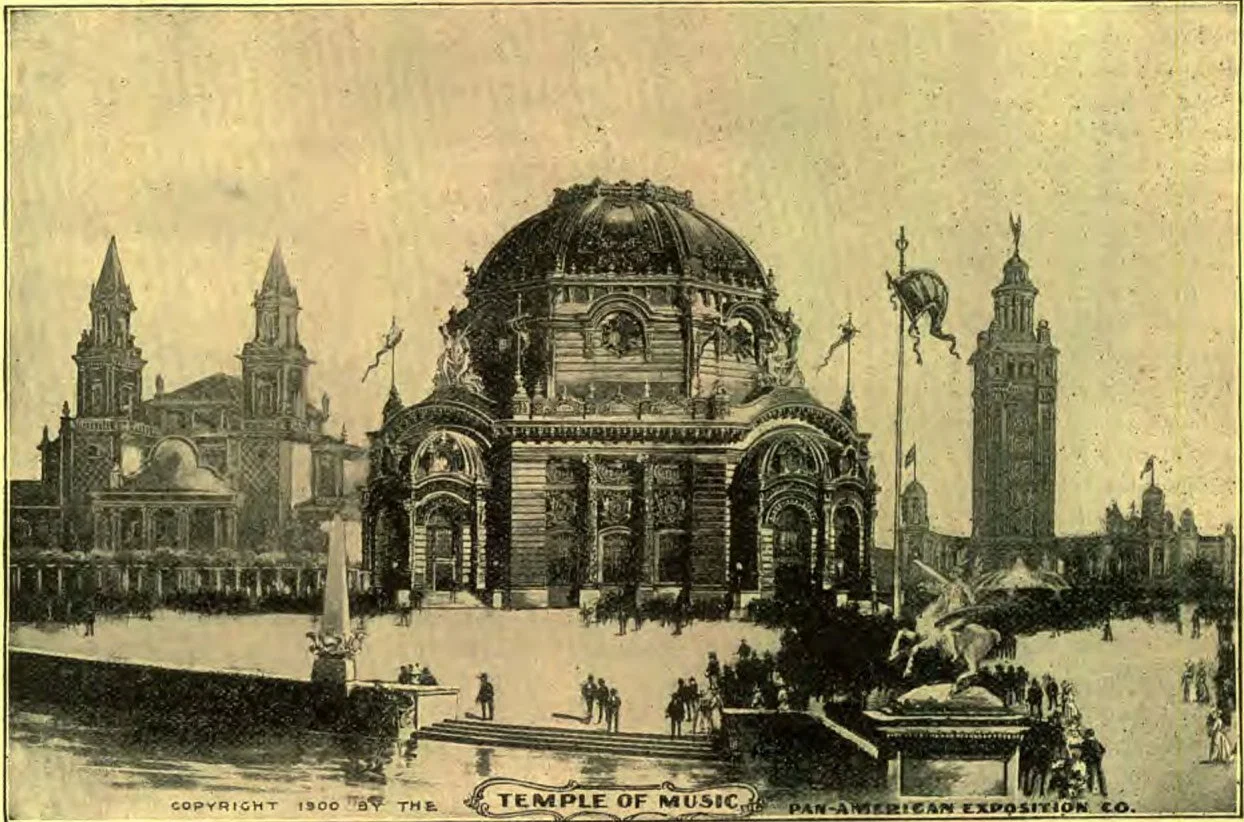
The Temple of Music for the Pan-American Exposition will cover a plot of ground one hundred and fifty feet square, and will be situated on the northwest corner of the Esplanade and Court of Fountains. The exterior of this handsome building will be treated architecturally after the style of the Spanish Renaissance. It will be octagonal in shape, with octangle pavilions at each corner. The main entrance will be through the pavilion on the corner of the Esplanade and Court of Fountains. Each of the façades of the main building will have a richly ornamented colonnade. Between the columns will be large window openings and ornamental panels, each bearing a portrait bust of some musical composer. The cornice, frieze, and balustrade of the main building will be designed in a florid adaptation of the Spanish Renaissance, and the balustrade will carry tablets bearing the names of noted musicians and composers. On the corners above the pavilions will be groups of statuary representing music, dancing, etc.
The chief features of the drum of the dome will be star-shaped windows resembling those seen in the ancient Spanish mission buildings. These windows will light the interior of the auditorium. The dome and the roofs of the pavilions will be richly gilded. Gold and brilliant coloring will be freely used in all the exterior decoration. The crown of the dome will be one hundred and thirty-six feet above the grade of the Court of Fountains, and the Temple and its pavilions will form a very attractive part of the landscape scheme of the entire group of Exposition buildings.
The auditorium, which will seat twelve hundred persons, will be a few steps up from the grade of the building, and in addition the restaurants and balconies will give a further seating accommodation for sixteen hundred persons. The other pavilions, in addition to the one used for the main entrance, will be occupied by the stage and by a fully equipped restaurant.
TEMPLE OF MUSIC
TEMPLE OF MUSIC
The flat-domed roof of the auditorium will be supported by eight massive piers. Between the piers will be large arches opening into the galleries, to the main entrance, and leading to the stage. Over each of the eight large arches will be a cartouch bearing an inscription indicating one of the grand divisions of music,—Oratorio, Grand Opera, Symphonic Music, Lyric Music, etc. The front of the galleries will be decorated with a frieze of singing cherubs.
In the Temple of Music will be erected one of the largest and finest organs in the United States. It will be an exceedingly beautiful and complete instrument, with all the latest improvements in organ-building. It will have four manuals and about fifty speaking stops, and will be voiced on three different wind-pressures. The action will be the most complete style of tubular pneumatic. The mechanical contrivances and combinations will be complete, and will include many varieties not hitherto used. There will be a number of couplers, pedal movements, and adjustable combinations of modern type. The case will be of Gothic design, to harmonize with the architecture and decorations of St. Louis Church, Buffalo, for which the organ is intended after serving its purpose in the Exposition.
An elaborate and complete system of heating and ventilating will be adopted for this building. Numerous and commodious entrances and exits will be provided, so that absolute safety to visitors will be assured. The interior as well as the exterior of the Temple of Music will be treated with a view to securing the best architectural effects.

POISON GERMS

The minister was coming slowly down the village street; the sunshine glinted on his white hair and kindly face, his people thought, as if it, too, loved him.
Miss Katty saw him through her kitchen window. “He's out making pastoral calls!” she said to herself. “Well, this house is ready for him! He won't find another as clean in the town!”
She looked around in triumph. Her whole day was given to scrubbing. Every board in the four rooms of the little house was white, every pane of glass shone. In the deepest recesses of cupboard and drawer not a grain of dust hid.
Miss Katty drew up all the blinds, that the cleanliness of the house might strike the eye of the visitor. “For all his mild ways, he can be sharp enough rebukin' laziness or dirt! and so he ought to be!” she said, sitting down formally to receive the visit. Not a gray hair was loose in the knot at the back of her head, and her gingham dress fairly rustled with cleanliness.
The old man came in, sat down, and looked about him, smiling kindly. “No chance for poisonous microbes or germs here!” he said.
“I hope not, doctor. I do my best to keep decent. It takes all my time. Five o'clock never sees me in bed. I wish I could say the same of some other folks. There's Jane Robb, across the road. That woman drags herself up at seven, if you'll credit the words I speak!”
“Mrs. Robb has a weak spine. She often does not sleep until near morning, with the acute pain she has to bear,” said the minister, gently.
“Oh, sakes! Spine, indeed! I have pains enough, but I'm not one to parade my troubles. Speakin' of that, doctor, when is Mary Atkins goin' to lay off her crape? It's four years since her husband died. I call it flyin' against Providence to go on mournin' as them that have no hope. You ought to put a stop to it!”
“That is not true of Mary. Her hope is firm and high. If it comforts her to wear the signs of grief, I shall not meddle with her.”
“Oh, just as you think best! I'd rather see Mary's black crape, I confess, than the finery of them Staffords. Silks and furs and gay ribbons! I hold that them things is the livery of the devil, and is worn by his servants!”
“The Stafford family,” said the doctor, “have always lived in the city, where it is the custom to dress more richly than here. I believe both mother and daughter to be earnest, good women—the servants of Christ, not of the devil.”
Miss Katty was tired of these interruptions. Her conversation usually was a monologue. She now raised her voice, and spoke so rapidly as to silence the doctor. He sat dumb, unable to check the torrent of doubts, malignant hints, and downright abuse that Miss Katty poured upon her neighbors. She brought in the Pratts guilty of drunkenness, the Coxes of cruelty to their children, the Smiths of lying, and against some of the others she suggested suspicions still blacker and more shameful.
At last the old minister, pale and anxious, rose to go.
“I wish you'd look into these things, doctor,” she said. “It grieves me to see the wickedness around me; but for me, I can do nothing. I'm a home-keeper. I don't mix with them. It takes all my time to keep my house in order—wash, scrub, dust, polish. You see the result!” with a triumphant wave of the hand.
“There is one thing, Katty,” said the old man, “which you have forgotten to clean. It is full of poisonous germs, which go forth to scatter disease and death.”
“Here!—in my house!” exclaimed the woman. “What do you mean?”
“Go to your closet,” he said; “and when you have shut the door, ask God what it is he gave you to keep pure and sweet. Ask yourself how much time you give to its cleansing.”
He left her. Miss Katty stood motionless, lost in thought. Then she heaved a great sigh, and the tears started.
“God be merciful to me, a sinner!” she said, humbly.— Youth's Companion.

THE CIRCULATION OF THE BLOOD

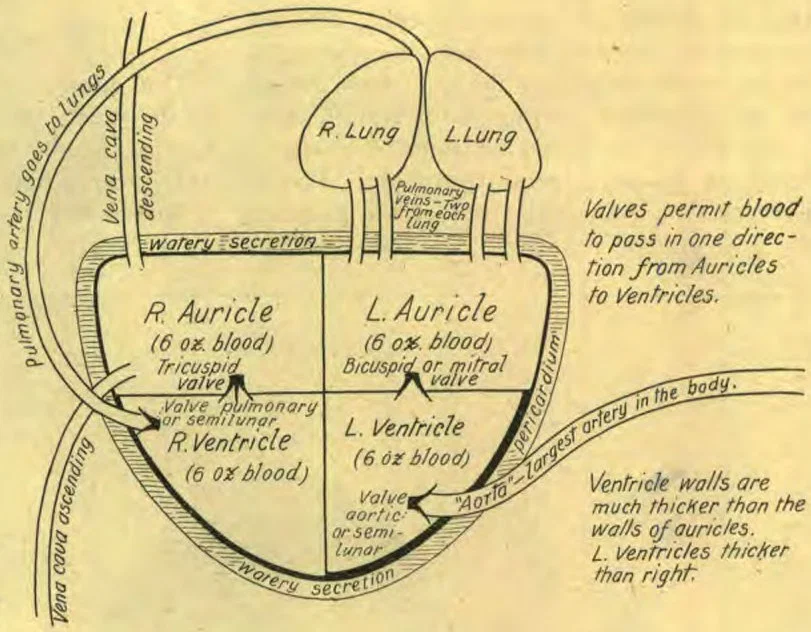
THE accompanying diagram shows the passage of the blood through the heart. The diagram is not strictly an accurate representation of the heart; but it was thought that as our young people are not all scientists, they might be able to grasp the idea more readily by a rough outline than by a finished sketch. Imagine, then, the heart cut in two, and the inner section laid open before you.
At each heart-beat the ventricles lift into the arteries about twelve ounces of blood, or about three hundred barrels in twenty-four hours. The blood enters the right and left auricles by the veins, and passes thence to the ventricles. The arteries receive the blood purified, and distribute it throughout the body.
It will be easy to understand the diagram when we remember that veins bring blood to the heart, and arteries carry blood from the heart.
The aorta, the largest artery of the body, leaves the heart at the left ventricle, and sends off branches to different parts. These, in turn, branch off until they become so tiny as to be invisible to the naked eye, and finally end in a network of small blood-vessels called capillaries. A “skeleton leaf” is an excellent illustration of the way the veins are thus divided into a network of capillaries. These capillaries are very short, and they soon begin to grow into little trunks, becoming larger and larger until they form veins. These unite as they come near the heart, until two great veins are formed,—the vena cava ascending, which comes from the lower part of the body, and the vena cava descending ing, which comes from the upper part.
This explains the working of the blood in the heart. Now to consider the circulation through the body, we must first know that there are three circulatory systems,—the Systemic, the Pulmonary, and the Portal. We have already briefly noticed the Systemic system, but will emphasize a few special points. As the blood leaves the left ventricle, it passes through the arteries to the capillaries all over the body. Then the veins gather it up, and return it to the heart.
The blood sent from the left ventricle travels all through the body, returning to the heart again at the right auricle, from which it passes into the right ventricle. This movement of the blood from the left to the right ventricle is called the Systemic circulation.
The blood sent out by the right ventricle goes to the lungs through the pulmonary artery. It then goes through the four pulmonary veins into the left auricle, and thence into the left ventricle. This course of the blood—from the right ventricle through the lungs to the left ventricle—is called the Pulmonary circulation. Some of the blood that leaves the left ventricle by way of the Systemic circulation does not return directly from the capillaries to the heart.
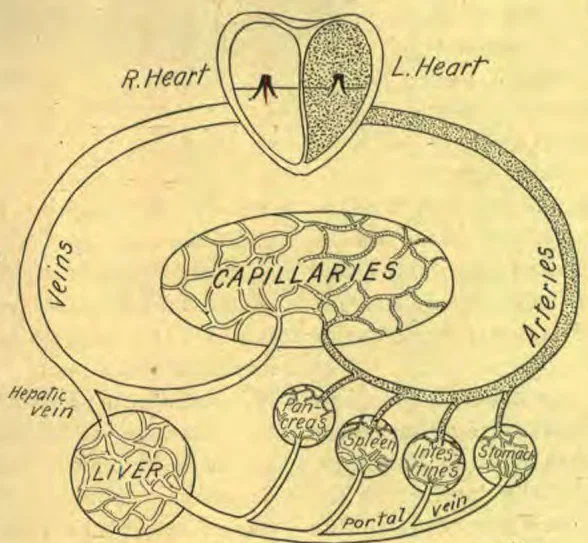
A single large vein, called the portal vein, gathers up the blood that goes to the stomach, pancreas, spleen, and intestines, and carries it to the liver, where another capillary system is found. Here the blood is filtered, and, passing through the liver capillaries, joins the Systemic circulation through the hepatic vein. So you see that the blood passes through two sets of capillaries in its course from the left to the right side of the heart. This is the Portal circulation.
We are awed by the wonders revealed by this study, and our hearts must bow in reverence before the great Being who so wonderfully planned and executed his design in creating man. We ought to study what to eat to nourish this wonderful body, and how best to clothe it. We are our own keepers, in one sense, and we should know what goes into our stomachs—the great chemical laboratory where are prepared from the material furnished the elements that go to make good blood, that will carry nourishment to all parts of the body.
Exercise increases the strength of the heart, as all muscular power increases by action. The quality of the blood depends directly upon the character of the food. Fermented foods and drinks so paralyze the blood corpuscles that they can not work successfully. Tea and coffee seriously affect the nerves of the heart, causing palpitation, or fluttering. As many of the large veins of the extremities lie near the surface, the clothing should not be tight. Tight shoes or boots, as well as any tight bands about the arms, legs, waist, or neck, are very injurious.
One should be careful to get sufficient sleep, too, as during sleep the red corpuscles worn out during the day are replaced.
Diagram Showing Portal Circulation.
Violent emotions affect the heart seriously. Persons often drop dead in a fit of anger, or under the stress of some great excitement . We should learn to keep our emotions and our passions well controlled, following the wise Scriptural rule to be “temperate in all things,” and to let our “moderation be known to all men.”
MRS. M. D. McKEE.

18 — PEPPERGRASS

This week we present a drawing of a plant that is quite well known. The Peppergrass is a close relative of the Bishop’s Purse, recently described. In this plant the seed-pouches are nearly round, or disk-shaped, those of Bishop’s Purse being triangular. Otherwise one can detect a very similar arrangement of the plant, and of the seed-pouches along the top of the stem. Sweet Alyssum is another plant of this same family, with seed-pouches arranged in much the same way on the stem.
If the heads of the Peppergrass, especially the seed-pouches, are chewed, one is at once conscious of a strong peppery taste, which, upon a moment’s consideration, will be found to be more like radish than pepper. The radish belongs to the same order as the Peppergrass, as does also the wild mustard.
I have heard this plant called Tongue-grass, — a name it has received, I suppose, from the stinging sensation it causes when taken upon the tongue.
As much as Peppergrass and Bishop’s Purse resemble each other, and though they belong to the same order, it is difficult to find them growing in the same locality. Either may be found by the roadsides. L. A. REED.

OUR WORDS

SPEECH is one of the great gifts of God. It is the means by which the thoughts of the heart are communicated. It is with the tongue that we offer prayer and praise to God. With the tongue we convince and persuade. With the tongue we comfort and bless, soothing the bruised, wounded soul. With the tongue we may make known the wonders of the grace of God. With the tongue we may also utter perverse things, speaking words which sting like an adder.
The tongue is a little member, but the words it frames have great power. The Lord declares, “The tongue can no man tame.” It has set nation against nation, and has caused battle and bloodshed. Words have kindled fires that have been hard to quench. They have also brought joy and gladness to many hearts. And when words are spoken because God says, “Speak unto them my words,” they often cause sorrow unto repentance.
Of the unsanctified tongue the apostle James writes: “The tongue is a fire, a world of iniquity: so is the tongue among our members, that it defileth the whole body, and setteth on fire the course of nature; and it is set on fire of hell.” Satan puts into the mind thoughts that the Christian should never utter. The scornful retort, the bitter, passionate utterance, the cruel, suspicious charge, are from him. How many words are spoken that do only harm to those who speak and those who hear! Hard words beat upon the heart, awaking to life its worst passions. Those who do evil with their tongues, who sow discord by selfish, jealous words, grieve the Holy Spirit; for they are working at cross-purposes with God. They are working on lines marked out by the enemy of all good.
The inspired apostle, seeing the inclination to abuse the gift of speech, gives directions concerning its use. “Let no corrupt communication proceed out of your mouth,” he says, “but that which is good to the use of edifying.” The word “corrupt” means here any word that would make an impression detrimental to holy principles and undefiled religion, any communication that would obscure the view of Christ, and blot from the mind true sympathy and love. It includes impure hints, which, unless instantly resisted, lead to great sin. Upon every one is laid the work of barring the way against corrupt speech.
It is God’s purpose that the glory of Christ shall appear in his children. In all his teaching, Christ presented pure principles. He did no sin, neither was guile found in his mouth. Constantly there flowed from his lips holy, ennobling truths. He spoke as never man spoke, with a pathos that touched the heart. He was filled with holy wrath as he saw the Jewish leaders teaching for doctrine the commandments of men, and he spoke to them with the authority of greatness. With terrible power he denounced all artful intrigue, all dishonest practices. He cleansed the temple from its pollution, as he desires to cleanse our hearts from everything bearing any resemblance to fraud. The truth never languished on his lips. With fearlessness he exposed the hypocrisy of priest and ruler, Pharisee and Sadducee. He entered into conversation with high and low, learned and unlearned. He encountered malice, misrepresentation, opposition, and falsehood, yet his whole life was without a flaw. He could say to his enemies, “Which of you convinceth me of sin?”
Guard well the talent of speech; for it is a mighty power for evil as well as for good. You can not be too careful of what you say; for the words you utter show what power is controlling the heart. If Christ rules there, your words will reveal the purity, beauty, and fragrance of a character molded and fashioned by his will. But if you are under the guidance of the enemy of all good, your words will echo his sentiments.
The great responsibility bound up in the use of the gift of speech is plainly made known by the word of God. “By thy words thou shalt be justified, and by thy words thou shalt be condemned,” Christ declared. And the psalmist asks: “Lord, who shall abide in thy tabernacle? who shall dwell in thy holy hill? He that walketh uprightly, and worketh righteousness, and speaketh the truth in his heart. He that backbiteth not with his tongue, nor doeth evil to his neighbor, nor taketh up a reproach against his neighbor. In whose eyes a vile person is contemned, but he honoreth them that fear the Lord. He that sweareth to his own hurt, and changeth not. He that putteth not out his money to usury, nor taketh reward against the innocent. He that doeth these things shall never be moved.”
“Keep thy tongue from evil, and thy lips from speaking guile.” The wild beast of the forest may be tamed; “but the tongue can no man tame.” Only through Christ can we gain the victory over the desire to speak hasty, unchristlike words. When, in his strength, we refuse to give utterance to Satan’s suggestions, the plant of bitterness in our hearts withers and dies. The Holy Spirit can make the tongue a savor of life unto life.
MRS. E. G. WHITE.

The Selfishness of Sharing Our Sorrows

THE most selfish man in the world is the one who is most unselfish—with his sorrows. He does not leave a single misery of his untold to you; he gives you all of them. The world becomes to him a syndicate, formed to take stock in his private cares, worries, and trials. His mistake is in forming a syndicate: he should organize a trust, and control it all himself; then he could keep every one from getting any of his misery.—Kingship of Self Control.

Only a True Life Helps Others

“ONLY he who lives a true life can help the lives of others.”

“NONE SO DEAF AS THOSE WHO WILL NOT HEAR”

Old Uncle Jeff Was somewhat deaf, At least upon occasion; But all who knew the good man well Still of his gentle kindness tell With love and admiration.
The dear old soul Had such control Of every mood and action You could not tell, by look or word, What thought he had, e'en when he heard Some villainous detraction.
For when 't was bad, He always had Great trouble with his hearing; But when you told him something good, 'T was always quickly understood, His deafness scarce appearing.
He had no dread Of what folks said; Abuse, he did not fear it; And Scandal's tongue, though raging red, Was silent; for he always said He simply would not hear it.
— Selected.

AUGUST STUDY OF THE FIELD

PART I: “THE NEEDS OF MEXICO”

  • (July 29 to August 4) *
1. Origin of Mexico City.—For several centuries the Aztecs wandered from their original home near Lake Chapala, or the Gulf of California, in search of a permanent dwelling-place. The story of how they fixed upon its position has often been told. The priests declared that their great god had decreed for the situation of their abiding city a cactus, growing from a rock, upon which should be sitting an eagle with a snake in its mouth. In the fourteenth century they reached lakes Texcuco, Xochimilco, Chalco, and Xaltocan, then much larger than they are now. Here, tradition says, they came upon the very combination of objects that the priests had declared should mark the preordained spot. A number of them saw a cactus growing on a rock on an island, and upon the cactus stood an eagle devouring a snake. They immediately founded a city, which was first named Tenochtitlan,—cactus on a stone,—but was afterward changed to Mexico, in honor of the war-god, Mexitli. An eagle perched on a cactus, and holding a snake in its beak, is the coat-of-arms of the Mexican nation. Having decided upon the site of their city, the first care of the Aztecs was to build a cabin of mud and reeds, which they called a temple, to shelter the image of their protecting god. Around the temple, for want of more solid materials, they constructed groups of simple huts made of earth and reeds. Such was the humble origin of this great city, which was destined to become the head of a vast kingdom, and whose magnificence was one day to fill its conquerors with wonder. With the progress of Aztec culture, the city rapidly improved, and in another century the old mud and rush houses had given place to solid stone structures, erected partly on piles amid the islets of Texcuco. The city had reached its highest splendor on the arrival of the Spaniards in 1519, when it contained from fifty to sixty thousand houses, with perhaps five hundred thousand inhabitants, and seemed to Cortez “like a thing of fairy creation, rather than the work of mortal hands.”
2. The Mexican Haciendas are the large farms. These are interesting, many of the larger ones comprising all that goes to make up an ordinary village. Every fruit known to the tropics thrives in Mexico. Indeed, the farmer of that country can compete with the farmer of almost any other region of the earth. The flora is proportionately rich. Upon the table-lands the products of the cooler climates thrive, although some do not attain the same degree of perfection and abundance as in more northerly latitudes. As a consequence of these natural advantages, and in the absence of extensive commercial or industrial enterprises, many Mexican fortunes have been made, and many invested, in haciendas. In the past, the houses on these large farms were built not only to accommodate the inmates, but to resist armed bands, against which the government could not be relied upon for protection. They are imposing in appearance, on account of their size rather than the architectural design. Usually built around a large court, they convey the impression, whether of one or two stories, of having been erected solidly, with a view to durability and spaciousness. They are invariably made of stone or sun-baked bricks, plastered and painted, and in most cases present an even elevation, broken only by grated windows, a porte cochere, and loop-holes for musketry. This structure contains the offices, apartments for the owner, for two or three of his principal employees and their families, and for the servants; storerooms; stables for saddle and carriage horses; carriage space; and an indefinite number of spare rooms, according to circumstances. Conveniently situated in relation to the main building are the habitations of employees; the huts of peons; sometimes an inn for the accommodation of travelers; the church; the store, where every commodity of peasant life is for sale; the vast stable for horses, mules, and oxen; storehouse for the produce of the hacienda, and others for agricultural implements; the wheelwright, blacksmith, and carpenter plants; the saddler’s and cobbler’s shops; the loom; the bakery;—in sum, all the attributes of a village, which a hacienda of this class really is.
3. Religious Condition of Mexico.—“The educated classes conform to the outward ceremonies and ordinances of the church, while inwardly believing little or nothing of its dogmas. The lower grades of society are, on the other hand, steeped in the most groveling superstition, intensified by many traditional Indian reminiscences. This section of the community yields a blind obedience to the clergy. As recently as 1874 a genuine case of witch-burning occurred in Mexico.” It is conceded that the native races of Mexico are capable of development. There is still a wide field open in Mexico for teaching the impressionable native the simple truths of the gospel of Christ. All persons born in the republic are free; and freedom of education, of thought, and of the press are guaranteed.
4. Some Results.—Arcadia Morales, a native minister, has been called “the Moody of Mexico.” His life history is a serial story, illustrating the power of the gospel to convert the heart, develop the intellect, and build up the character. Like many others, he was converted by the reading of the Bible, and by convincing himself that Roman Christianity had widely departed from Christ’s teachings. He labored largely among the college students in different Protestant institutions throughout Mexico, also as a revivalist in many parts of the republic. Another notable conversion illustrating the power of the gospel to transform the character is seen in the case of Ines Moreno, “the plowman evangelist.” “His garb after becoming an evangelist was just what it had been when he raised crops of corn, or brought his burros laden with wood to the market.” The story of his conversion is herewith condensed from an account in the Missionary Review. Two missionaries began work in the mining city of Zacatecas. The priests, in order to frighten their ignorant parishioners from hearing the gospel, graphically portrayed the American missionaries as incarnations of the evil one himself. These stories served simply to arouse the curiosity of many, and they determined to see for themselves the disreputable séance. On entering the hall they were astounded to hear the sound of beautiful hymns, and the preaching of the love of Christ, by men of like passions as themselves. The ranchmen understood at once that their priest had lied, and they felt that the gospel that these strangers preached was what their priests had denied to them. Ines Moreno at once secured a Bible, and set to work to study it with the help of the slight knowledge of reading which he had acquired as a boy. He became a devoted Bible student, and an earnest Christian, and spent much of his time evangelizing the villages in a large circuit in the neighborhood of his home; sometimes on foot, and sometimes on horseback. One year he reported more conversions than any other laborer in the church with which he had identified himself.
5. Summary.—These two cases show what transformations of character the gospel will make even in Mexico. The resources of the country invite the self supporting laborer. The government has done much to check the power of Rome and encourage the entrance of Christians, but we have been slow to improve these opportunities. Mexico, although lying at our very door, has been neglected. Is it not high time that some of the young persons who have consecrated themselves to the Master for service in the regions beyond should be preparing to enter this dark land, with its population of twelve millions? True, the Spanish language must be mastered; but almost thirty years ago the message came that “young men [and this includes young women as well] should be qualifying themselves by becoming familiar with other languages, that God may use them as mediums to communicate his saving truth to those of other nations.” “To every man is given his work; not one is excused.”

MISSIONARY GOSPEL

The first apostolic sermon was a missionary sermon. Acts 2:17-39.
Christ’s great reason for Christian love was a missionary reason. John 13:35.
Christ’s great reason for unity was a missionary reason. John 17:21.
The first coming of Christ was a missionary work. Luke 4:18-21.
The second coming of Christ is to be hastened by missionary work. Matt. 24:14.
Our Saviour’s last wish on earth was a missionary wish. Matt. 28:19.—Selected.

WITH SHEAVES ALL BOUND

We know not when the Lord will say, “Thy work is ended—come away.” What matters it, if we are found With sheaves all bound?
This, and this only, can we know— God’s harvest waits. He bids us go And toil for him as best we may This harvest day.
We dare not linger, dare not shirk, When he, the Master, bids us work At binding sheaves of ripening grain On hill and plain.
They may be few, they may be small; But if we find and bind them all, Then will he say, at set of sun, “Well done. Well done!”
So, that he may not come, and find His work undone, let’s reap and bind, And do with willing hand and heart A gleaner’s part.
Then, if he cometh late or soon, At nightfall, or at morn, or noon, It matters not: we shall be found With sheaves all bound.
— Eben E. Rexford.
Continue reading: PICTURES FROM REAL LIFE IN CHINA