The Youth’s Instructor, Vol. 48, No. 30.

UNDER THE STARS
Earlier text: UNDER THE STARS

PICTURES FROM REAL LIFE IN CHINA

The New Year
CHINA’s greatest national festival, the New Year, is approaching. The Chinaman’s eyes, at other times so devoid of expression, seem to brighten at the thought of what is coming. Energy, long dormant, rises to war with the usual ruling indifference, comes off conqueror, and treads seeming impossibilities underfoot. Every nerve is strung to its utmost tension in the usually calm Chinaman, and the effect on his disposition is wonderful. His pulse beats faster; the blood rushes to his head, and carries away, in part at least, that which has hindered his thought from dwelling upon the comforts of life during the year. He realizes that the New Year must be celebrated,—that it would never do for a son of the great and holy kingdom to break the rule of etiquette, and place a stain on his otherwise good name (?).
Even the most ignorant know what Konien means. The thought of the approaching festival passes like an electric current through great and small. The rich in his comfortable home, as well as the beggar in his cold, uninviting hut, makes it his object to celebrate the New Year properly. Each one tries his best to obtain a short period of pleasure and rest in his often dreary and comfortless life. None of us will think this strange; for all enjoy seasons of rest and gladness. I do not envy the Chinese all the happiness they can get.
Preparations for the New Year’s festival begin two weeks beforehand. Plans are laid by which to obtain money for needed decorations. One’s purse must be consulted to some degree; but in most cases this is overlooked, and any and every means for obtaining money for the festival are resorted to. Those who have nothing in their homes that they can sell, go off to find something to dispose of. One seems to think the woodwork on the temple suitable for a New Year’s fire, so he goes at it with saw and ax, and carries home what he needs. The more respectable steal chickens, which they afterward sell. Those who can put their hands on nothing else, steal cats and dogs, which to them are a double blessing, as the flesh is used for a New Year’s roast, and the skin is sold to the highest bidder. In this way they obtain money for the most “necessary” things for the festival.
There are also other means by which money is obtained for this occasion. The honest farmer is seen coming to town with grain, straw, cabbages, and other vegetables. All these are sold for cash. Now and then the wife and mother and one or two of the boys are allowed to go with the husband and father to the city. It may also happen that one of the girls, who has been good and obedient for a few days, will be seen with the company, provided the father is in the right mood. The mother is often obliged to go under these circumstances, as a number of articles must be purchased, and in many cases she is the better judge as to the right color of wall-paper for the sitting-room, etc. She must also have a new god for the kitchen, as the old one will soon have finished its service. The father goes about as a well-to-do man, selecting a nice tsie-shen-ie (“god of riches”); and should he perchance find the right one, he would even then be deceived. A visit to the meat market is not forgotten. “We must have a large slice of the fat pig hanging in that corner,” says the husband. Red pepper and oil are added to the list, together with vinegar, wine, spices, and, what is most important, ja-pien-ien (opium). Tallow, colored paper, and other small articles must also be purchased. U-ir and Luh-ir will perhaps each get a new hat.
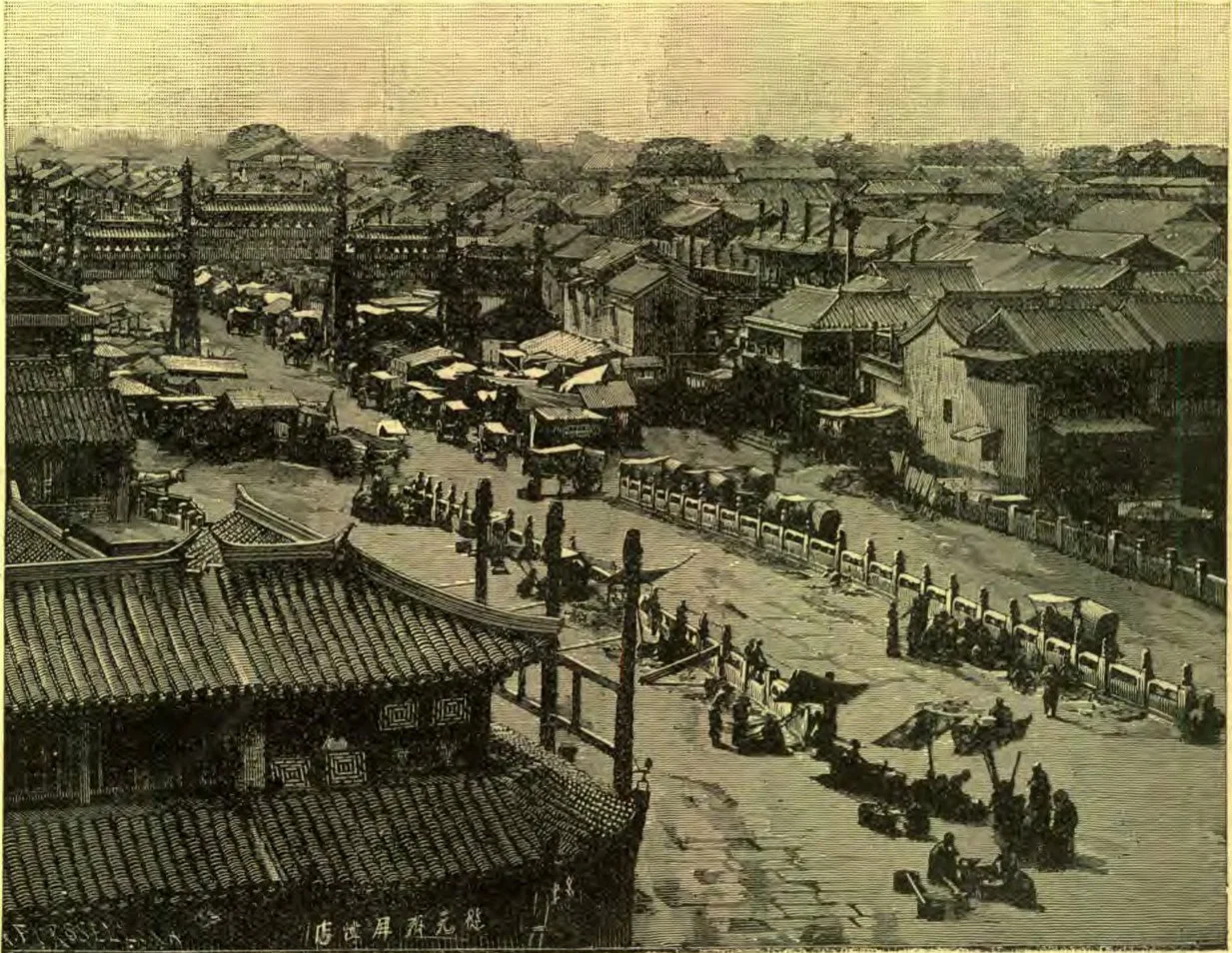
STREET SCENE IN PEKING
Thus, well supplied with that which, according to their idea, goes toward making the New Year’s festival pleasant and inviting, the homeward journey begins, the usual means of conveyance being a rude cart drawn by a cow. Into this cart the happy company bestow themselves, jostling among the newly bought articles, till at last they reach their humble abode, soon to be robed in festive attire.
Then begins a time of general house-cleaning. The dust and filth that have accumulated on the walls and ceiling during the year are removed. The spider is no longer left in peace; its silken web is destroyed. Cockroaches are brought forth from their hiding places, and make no delay in escaping for their lives. These guests are no doubt displeased with the New Year’s cleaning, but they are obliged to submit to a higher power. Large and small, old and young, assist in the work. Dust may be seen whirling in all directions until it finally lands in a dark corner, where no one is supposed to see it. The old paper is torn from the window, and new pasted on in its place. Everything is set in order. New Year’s day is regarded as a pattern for the whole year. On the outside of the doors are pasted strips of red paper, on which are written expressions of good wishes. Passers-by always stop and read these, and thus learn of their neighbor’s virtues, on paper at least. Above the door is generally found the motto, U-fuh lin-men, which means: “May all blessings tumble down at our door.” The five blessings are long life, riches, honor, virtue, and peaceful death.
Attention is paid to the kitchen god, the god of riches, and other inferior gods, which have served faithfully during the year; and they are replaced by new ones. The god that has constantly looked down in the not always clean kettle during the year must now be brought low or exalted, whichever way you take it. As a rule, all gods made of paper are gathered together, sugar is rubbed on their mouths, and they are then sent through the flames up to Nirvana, to speak well for the home in which they have spent their earthly existence. The new gods, seen everywhere, will no doubt render as acceptable service as have the old ones.
The poor do their best to prepare for the New Year. They have few comforts and pleasures, and go about down-hearted and sad as they see those in better circumstances going to their homes with an abundance of good things for the festival; while they do not have money enough to buy even the red paper needed to ornament the door of their hut.
In the city the poorer classes will be seen pawning their clothes and furniture in order to obtain money. One will be seen taking the tiles from the roof of his house, and doing his best to sell them. Another thinks he has too many girls, and will gladly sell one if a purchaser can be found. A small sum is asked, hence the better the chance to sell. The child is “only a girl,” any way. One man in whose house I stayed sold his wife for four dollars in order to be able to celebrate the New Year’s festival. Nothing is too costly, nothing too dear, to be sacrificed in order to insure a pleasant New Year’s festival.
All the shops in town are gorgeously decorated the day preceding New Year’s. Inside and out are hung papers in all imaginable colors. The whole scene presents a striking contrast to the otherwise dull and uninteresting view. Colored lanterns are found in great abundance. These, with lighted tallow candles inside, are hung everywhere—in the yards, over the doors, on the streets, by the roadside, etc.
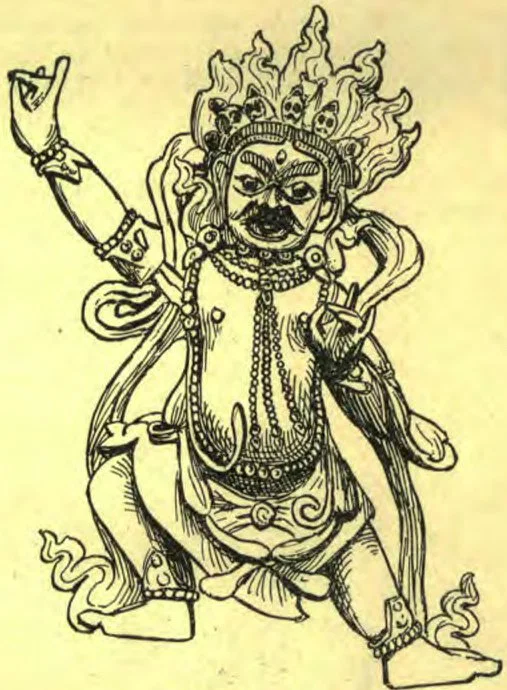
A CHINESE IDOL
A CHINESE IDOL
New Year’s night has drawn its black veil over valley and hill. Everything is quiet. The sound of the weary traveler’s footsteps has died away in the distance. All the doors in the shops as well as private houses are closed. No sound of man is heard, either in country or in town, only the sound of stray dogs here and there. It is New Year’s night, and everything breathes quiet and rest.
In the next article we will tell what is going on within during the still hours of the night.
E. PIQUIET.

MISSION OFFERINGS

LITTLE hands can gather treasure, Though it may be very small; Better far to give a little Than to bring no gift at all.
How would any bit of money Ever find its own way in? With some thought and self-denial Every offering must begin.
’T is not for ourselves we give it, But for Christ, our Lord and King; ’T is to speed the heavenly tidings That our gifts we gladly bring.
For the heathen in their darkness, We have brought our offering small; God himself can multiply it; He will take and use it all.
— Selected.

LANTERN-SLIDES

The “magic” lantern has long been a valuable aid to the lecturer in bringing before an audience pictures illustrating his subject. But the term “magic lantern” is a misnomer. There is nothing magical about the apparatus. A sixteen-year-old boy possessing any mechanical ability, can, with a little study and a good deal of patient labor, make a magic lantern, even to grinding the lenses. The instruments are also often miscalled stereopticons; but the word is unwieldy, even if it were allowable. In common parlance the word “magic” is dropped from the old name, and the instruments are called simply “lanterns.” But the lantern itself is foreign to the subject of photography, so I must confine this paper to instruction for making the slides.
Three and one-fourth by four is the standard size of lantern-slides, and all but the toy instruments are made to use that size. Excellent slides may often be made with common dry-plates; but the special lantern-slide plates are much better, and should be used whenever possible. These plates, being slower than the common ones, admit of greater latitude of exposure.
If negatives of the exact size are to be used to make the slides, you will not need a camera. The plate and negative may be placed in contact in the printing-frame, and the printing be done by artificial light, just as you would handle bromide paper. Some photographers use the camera in making slides, even when the size is not to be changed; but I prefer to print by contact whenever possible.
If the camera is three and one-fourth by four and one-fourth, you may succeed in making the plates stay in the holder without a kit; but if it is four by five or larger, you must either buy or make one. They are usually made of wood, but thick cardboard will do just as well, and will be much easier to make.
Before using plates smaller than your ground-glass, whether in making negatives or lantern-slides, it is well to mark your ground-glass so that you can see at a glance what part of the image will fall on the plate when it is in position. To do this, lay a plate of the size you intend to use in the proper position on the ground side of the glass, and trace around it with a lead-pencil. These marks will not interfere with the focusing when using a larger plate; but if you desire to remove them, they may be wiped off with a damp cloth.
Take a board about eighteen inches wide, and as long as the width of the north window chosen for your work, and in the center of it cut an opening somewhat smaller than the negatives from which you are going to make the slides. Cover this opening on one side of the board with ground-glass or white tissue-paper. If the former is used, it may be fastened in position with tacks; if the latter, it should be pasted on.
Stand this board on edge on the window-sill, with the covered side of the opening outward, and fasten it there in any convenient way. Drive two tacks at the bottom, and one at each side, of the opening. They should be so close to the edge of the opening that the negative will just slip in between them, and be held in position by the tack-heads.
Draw down the shade till it covers the top of the board; and if there is another window in the room, draw the shade of that window also; so all the direct light entering the room will come through the opening in the board and the negative that covers it.
Now you are ready to begin work; and a number of slides may be made from different negatives almost as easily as one.
Place your camera on the tripod in front of the negative, and adjust the size by moving it back and forth, and the height by moving it up and down. Do not tilt the camera, as it will give a distorted image. Be sure to get an accurate focus. If you have one, a reading-glass will be a great help in this.
The exposure of lantern-slides will vary under different circumstances just as will the exposure of plates and bromide paper. With a fair light and a negative of moderate intensity, fifteen seconds will be a safe time on which to make the first test.
Lantern-slides require concentrated developer, strongly restrained. Otherwise the development and subsequent treatment are similar to other dry-plates. Our “standard” developer, diluted with an equal part of water, is excellent. With the addition of six drops of a ten-per-cent solution of bromide of potash to each ounce of the mixed developer, it will usually be sufficiently restrained to keep the high lights clear.
Do not overdevelop. When all the detail is out, the slide is ready for the fixing-bath.
When the plate is dry, the film side is furnished with a mat of appropriate size and shape, and then covered with a plain glass, to protect it from scratches. The plate and cover are then bound together with strips of adhesive paper, and the slide is ready for exhibition in the lantern. J. EDGAR ROSS.

REVIEW OF GALATIANS 1

(Aug. 4, 1900)
Memory Verses.—Rom. 1:16, 17.

SUGGESTIONS FOR STUDY

In reviewing this chapter, let us first notice its main divisions. The first division, or paragraph, including verses 1-5, is the introduction, preface, or greeting. It gives the name of the writer, and tells to whom the epistle was written. Paul salutes the brethren, and invokes the divine blessing and grace upon them.
The next paragraph includes verses 6-10. Paul expresses his surprise that they have so soon departed from the gospel. Vs. 6, 7. He then pronounces a curse upon those who thus pervert the gospel. Vs. 8, 9. In verse 10 he declares himself a servant of Christ, not a man-pleaser.
The third paragraph includes verses 11-17. In verses 11, 12, Paul tells whence he received the gospel. In verses 13, 14, he refers to his experience in the Jews’ religion. In verses 15-17 he speaks of his conversion, and of the course he took at that time.
The remaining paragraph, including verses 18-24, gives an account of how he spent the next three years. In verses 18, 19, he speaks of his visit to Jerusalem, and makes it plain that he did not receive the gospel from the other apostles. The remaining verses mention his leaving Jerusalem, and the report concerning him that went out among the churches.
After studying the four lessons on this chapter, you should be very familiar with the text, and be able to answer questions on it without being directed to the particular verses containing the answers. Study the chapter as a whole till you can answer the following questions:—

QUESTIONS

1. By whom was the book of Galatians written? From whom did Paul receive his apostleship? What blessing did he invoke upon those to whom this epistle is addressed?
2. What cause of astonishment had Paul discovered? What had occasioned their separation from the One who had called them? What would be the result to those who should preach another gospel? How does Paul express the fact that the gospel which he preached was from God?
3. How had Paul shown his zeal in the Jews’ religion? In this how did he compare with others of that faith? When Paul received his call to preach, with whom did he confer? To what country did he go, and how long did he remain? At the end of that time, to what city did he go? Which of the apostles did he see there?
4. How does Paul certify to the truthfulness of his testimony? Into what regions did Paul afterward go? How only had the churches in Judea been acquainted with Paul? How did this report affect the churches?
5. Review of memory verses: What does God do with our sins when we confess them? Isa. 44:22. In what name only is there salvation? Acts 4:12. What is the mystery of God? Col. 1:26, 27. What work is given to the gospel minister? Eph. 2:8. How is the gospel defined in Rom. 1:16, 17?

TAUGHT BY A SPIDER

“I was spinning a web in the rose-vine,” said the spider, “and the little girl was sewing patchwork on the doorstep. Her thread knotted, and her needle broke, and her eyes were full of tears. ‘I can’t do it,’ she said. ‘I can’t! I can’t!’”
“Then her mother came, and bade her look at me. Now, every time I spun a nice, silky thread, and tried to fasten it from one branch to another, the wind blew, and tore it away.”
“This happened many times; but at last I made one that did not break, and fastened it close, and spun other threads to join it. Then the mother smiled.”
“‘What a patient spider!’ she said.”
“The little girl smiled too, and took up her work. And when the sun went down, there was a beautiful web in the rose-vine, and a square of beautiful patchwork on the step.”
— Babyland.

Conformity to the World Will Never Convert It

CONFORMITY to the world will never convert it.—Theodore L. Cuyler, D. D.

Christ's Kingdom Grows One Soul at a Time

“CHRIST’S kingdom grows by the process of addition. No matter how great the efforts put forth, nor how magnificent the results attained, souls are saved one by one.”

Sorrow Brings Out Life's Sweetest Songs

It is often in sorrow that our lives are taught their sweetest songs. There is a story of a German baron who stretched wires from tower to tower of his castle to make a great Æolian harp. Then he waited and listened to hear the music from it. For a time the air was still, and no sound was heard. The wires hung silent in the air. After a while came gentle breezes, and the harp sang softly. At length came the stern winter winds, strong in their forces. Then the wires gave forth majestic music, which was heard far and near. There are human lives that never, in the calm of quiet days, yield the music that is in them. When the breezes of common care sweep over them, they give out soft murmurings of song. But it is only when the storms of adversity blow upon them, that they answer in notes of noble victory. It takes trouble to bring out the best that is in them.—J. R. Miller.

Making Home Peaceful

By Mrs. L. D. Avery-Stuttle.

A Happy Sequel to Making Home Happy.

The purpose of the author has been to show the reader, by means of a happily conceived object-lesson, how the true Christ-love can be given tangible expression in every-day home life, and how the incoming of that love will transform a joyless abode into a happy home.
The book is well bound and illustrated. Price, bound in cloth, 50 cents; in paper covers, 25 cents.
The cloth-bound 50-cent book will be sent, post-paid, for three new yearly subscriptions to the YOUTH'S INSTRUCTOR; or with the INSTRUCTOR one year for only $1.00.

To Reach BATTLE CREEK

FROM
CHICAGO, BUFFALO, DETROIT, OR TOLEDO,
Purchase Tickets Reading over the MICHIGAN CENTRAL
“The Niagara Falls Route.”
A First-class Line for First-class Travel between Chicago and New York and Boston. Elegantly equipped through trains pass Battle Creek in each direction daily.
R. N. R. WHEELER, Ticket Agent, Battle Creek.
O. W. RUGGLES, Gen’l P. and T. Agt., Chicago, Ill.

TAKE THE Canadian Pacific Railway

for . . . CHATHAM, OTTAWA, MONTREAL, LONDON, GALT, QUEBEC, WOODSTOCK, TORONTO, BOSTON, PORTLAND, and
All points in New England, the Maritime Provinces, Great Britain, and the Continent.
Illustrated literature, time-tables, and full particulars, upon application to—
J. FRANCIS LEE, GEN. AGENT,
Passenger Dep't. 228 SOUTH CLARK ST., CHICAGO.
Branch Offices: 76 Ottawa St., Grand Rapids, Mich.; Room D, Chamber of Commerce, Cincinnati, Ohio; 315 Chestnut St., St. Louis, Mo.

Cincinnati Northern Railroad Co.

TIME TABLE NO. 3.

IN EFFECT SEPT. 24, 1899.
Trains Pass Battle Creek, as follows:

WEST-BOUND.

No. 21, Mail and Express ........................ 6.58 P. M.
No. 23, Accommodation .......................... 2.07 P. M.
No. 27, Local Freight .......................... 8.25 A. M.

EAST-BOUND.

No. 22, Mail and Express ........................ 8.25 A. M.
No. 24, Accommodation .......................... 1.45 P. M.
No. 28, Local Freight .......................... 5.30 P. M.
Direct connections are made at Toledo with all roads diverging. Close connections for Detroit and Cincinnati.
J. L. BEADE, Ticket Agt., Battle Creek.
E. R. SMITH, City Pass. Agt., 6 West Main St.
E. W. Meddaugh and Henry B. Joy, Receivers.

CHICAGO & GRAND TRUNK RY.

Trains arrive and leave Battle Creek.

WEST-BOUND FROM BATTLE CREEK.

No. 9, Mail and Express, to Chicago — 12.15 P. M. No. 1, Chicago Express, to Chicago — 9.00 A. M. No. 3, Lehigh Valley Express, to Chicago — 3.40 P. M. No. 5, Pacific Express, to Chicago, with sleeper — 1.10 A. M. No. 75, Mixed, to South Bend — 8.20 A. M. Nos. 9 and 75, daily, except Sunday. Nos. 1, 3, and 5, daily.

EAST-BOUND FROM BATTLE CREEK.

No. 8, Mail and Express, to Pt. Huron, East, and Detroit — 3.45 P. M. No. 4, Lehigh Express, to Port Huron, and East — 8.27 P. M. No. 6, Atlantic Express, to Port Huron, East, and Detroit — 2.25 A. M. No. 2, Leh. Exp., to Saginaw, Bay City, Pt. Huron, and East — 6.50 A. M. No. 74, Mixed, to Durand (starts at Nichols) — 7.15 A. M. Nos. 8 and 74, daily, except Sunday. Nos. 4, 6, and 2, daily.
A. S. PARKER, Ticket Agent, Battle Creek

Self-Pronouncing S. S. Teachers’ Reference Bible.
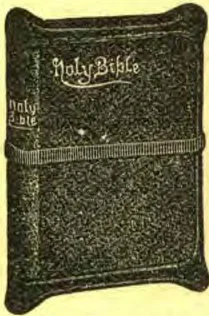
CONTAINS the celebrated Teachers’ Helps, comprising nearly 400 pages. Also a complete series of fifteen new maps.
Description. — Imperial Seal Binding, Tuck Edges, known as “Divinity Circuit,” Rounded Corners, Full Red under Gilt Edges.
We offer this Bible, post-paid, for only SIX NEW YEARLY SUBSCRIPTIONS at 75 cents; or TWELVE NEW SIX MONTHS’ SUBSCRIPTIONS at 40 cents.
We will also send it, post-paid, with the INSTRUCTOR one year for $2.25. For 20 cents extra we will stamp your name in gold upon the cover.

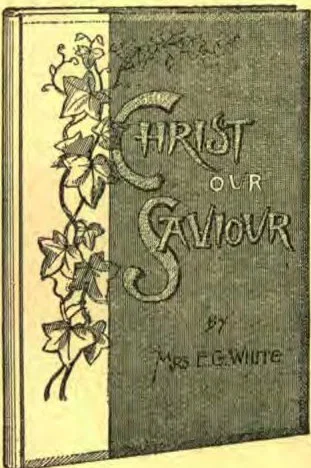
Christ Our Saviour....

Gives a graphic description of the birth, early training, baptism, ministry, death, resurrection, and ascension of Christ our Saviour. The book contains 160 pages, profusely illustrated, handsomely bound in three styles of binding. Prices, $1.25, 75, and 50 cents.
We offer this book, post-paid, to INSTRUCTOR subscribers at the following rates:—
Cloth back, board cover, for three new yearly subscriptions, at 75 cents each; or with the INSTRUCTOR one year for $1.00.
Fine English cloth, for four new subscriptions, at 75 cents each; or with the INSTRUCTOR one year for $1.25.
Presentation edition, for five new yearly subscriptions at 75 cents each, or with the INSTRUCTOR one year for $1.50.

Making Home Happy.

By Mrs. L. D. Avery-Stuttle.
This subject is presented in an interesting story form, and every reader will feel inspired to strive to make his home cheerful. Happy homes are needed everywhere, and “Making Home Happy” is a good little book to help bring about this result.
The book contains 206 pages, with four full-page illustrations, besides smaller ones. Price, bound in cloth, 50 cents.
We will send it, post-paid, for three new yearly subscriptions to the INSTRUCTOR at 75 cents each; or with the INSTRUCTOR one year for $1.00.

“Beautiful Joe.”

An Autobiography
By
Marshall Saunders.
Beautiful Joe is a real dog, and “Beautiful Joe” is his real name. He belonged during the first part of his life to a cruel master, who mutilated him in the manner described in the story. He was rescued from him, and is now living in a happy home, with pleasant surroundings, and enjoys a wide local celebrity.—Author’s Preface.
This story awakens the interest of the reader in the first chapter, and sustains it to the end. It must make an impression for good, and in the interests of kindness and gentleness, upon all who read it.
The book is well bound in cloth, with gilt side-stamp; 304 pages; illustrated. Price, 60 cents. Smaller edition, cloth, without illustrations, 25 cents.
The 60-cent book will be sent, post-paid, for four new yearly subscriptions to the YOUTH’S INSTRUCTOR, at 75 cents each; or with the INSTRUCTOR one year for only $1.25. The 25-cent book will be sent with the INSTRUCTOR one year for $.90.

FOR EVERY DAY OF THE WEEK

Sunday:

“Remember the Sabbath day, to keep it holy.” Ex. 20:8.

Monday:

This is the day of rest, Our failing strength renew; On weary brain and troubled breast Send thou thy freshening dew. —John Ellerton.

Tuesday:

Through the week we go down into the valleys of care and shadow. Our Sabbaths should be hills of light and joy in God’s presence; and so, as time rolls by, we shall go on from mountain-top to mountain-top, till at last we catch the glory of the gate, and enter in to go no more out forever.—Beecher.

Wednesday:

The Sabbath means rest—the quiet mind that is stayed on God. It is the Lord’s Day—that means meditation and communion, but not these alone. Christ is Lord of the Sabbath rest, and we read of his doing works of charity and healing in its hallowed time. The true disciple never loses sight of ministry.—Closet and Altar.

Thursday:

“Oh, let these earthly Sabbaths, Lord, Be to our lasting welfare blessed! The purest comfort here afford, And fit us for eternal rest.”

Friday:

“The gate of the inner temple that looketh toward the east shall be shut the six working days; but on the Sabbath it shall be opened,” writes Ezekiel in his wonderful vision; and we, in our nineteenth-century world, find a precious meaning in the words. The inner court of our life has its gate, which the burdens and toils, the anxious cares and busy plans, of the “working days” keep shut; but when the rest day comes, with its lull and pause, the gate toward heaven swings open. We catch again the promise of the beautiful morn that is coming; we hear once more the music that has been shut out through the week; and hope, comfort, and fresh courage come to strengthen us for our task. The narrow view of the busy week gives place to a wider outlook. Values change when light from that gateway falls upon our efforts and ambitions, and we are stronger and purer for the onlook and uplook the Sabbath brings.—Well-Spring.

Sabbath:

“If thou turn away thy foot from the Sabbath, from doing thy pleasure on my holy day; and call the Sabbath a delight, the holy of the Lord, honorable; and shalt honor him, not doing thine own ways, nor finding thine own pleasure, nor speaking thine own words: then shalt thou delight thyself in the Lord; and I will cause thee to ride upon the high places of the earth, and feed thee with the heritage of Jacob thy father: for the mouth of the Lord hath spoken it.” Isa. 58:13, 14.
Continue reading: Subscription Renewal Notice for August 1900