Your ShelfYour Projects

Signs of the Times, Vol. 22, No. 27.

Contrition
Earlier text: Contrition

THE SONG OF THE CHURCH.

BY CLYDE SCOTT CHASE.
The violet peeping from its mossy bed, Reflecting the pure azure of the sky, Or wild rose, in its veil of crimson red, Wooing the senses, with its magic sly, Has not the sweetness of my True Love’s lips, Nor half the brightness of his loving eye.
Oft when discouraged, sick and travel-worn, Lay I my weary head upon his breast, All in my garments stained and briar-torn, And feel a blessed and life-giving rest; And know that, among all the things of earth, To lean upon his loving heart is best.
I can not speak the happiness he brought To this marred image of his Father’s child When, with true, pitying tenderness, he sought The harlot roaming in the desert wild, And, through a night of suffering and pain, Bade me behold the morning sweet and mild
My eyes, o’erswimming with repentant tears, See not the beauty of that promised home To which, in fulness of appointed years, He in immortal tones will bid me come, And take me, his fresh-robed and happy bride, Forever from the paths where now I roam.
But in my dreams I dimly can behold The shadow of a mansion grand and fair. It stands beside a street of shining gold, Above which hangs a pure and peaceful air; And, like the reflex of a silver cloud, Bright, flying angel forms are mirrored there.
Seattle, Wash.

What Is the Cleansing of the Sanctuary?
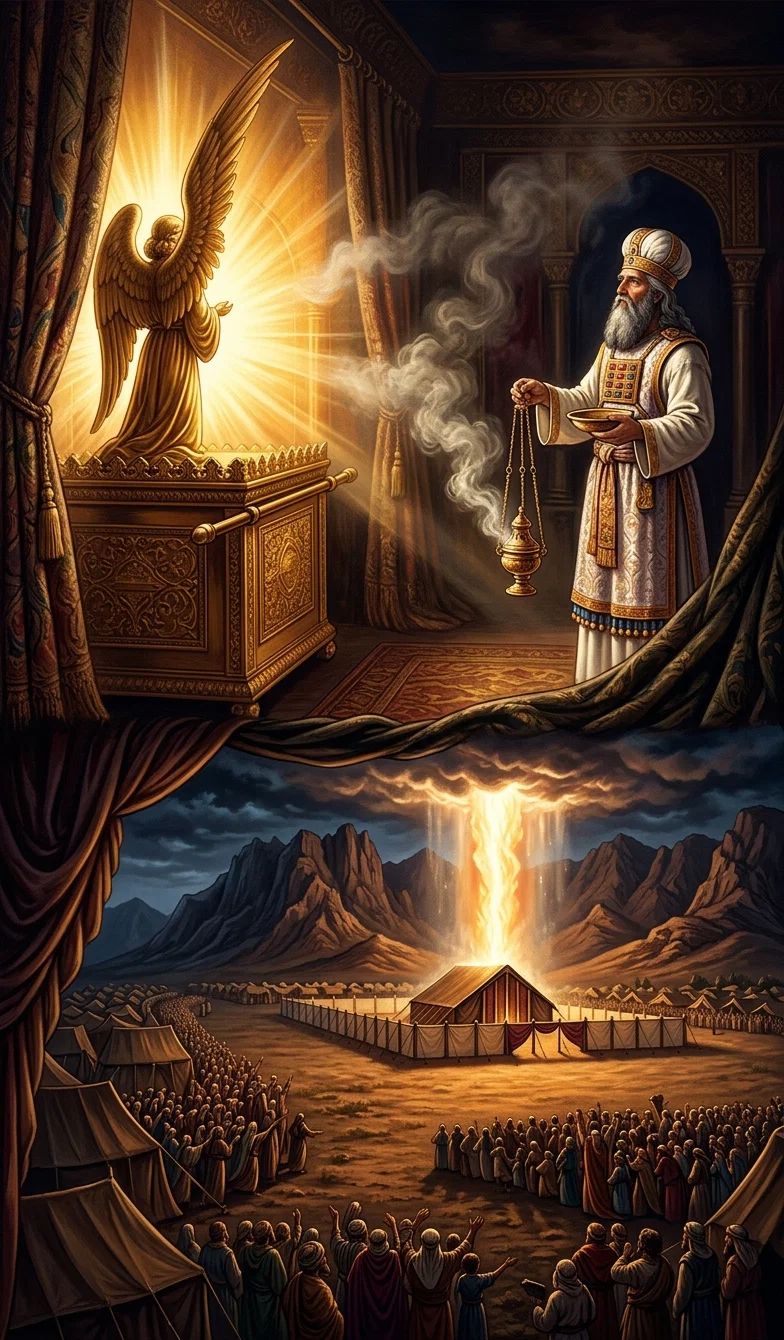
THE ATONEMENT.
THE ATONEMENT.

PROPHECY OF DANIEL 8. NO. 4.

BY W. L. ILES.

What Is the Cleansing of the Sanctuary?

“Unto two thousand three hundred days; then shall the sanctuary be cleansed.” Dan. 8:14.
Whatever this cleansing may be, it must take place at the end of the 2,300 days, or years, of Dan. 8:14. Every conclusion drawn from this prophecy thus far has been based upon the word of God; so we shall still call forth the Bible, to bear testimony upon the cleansing of the sanctuary.
“And almost all things are by the law [ceremonial law] purged [cleansed] with blood; and without shedding of blood there is no remission. It was therefore necessary that the patterns of things in the heavens [the earthly sanctuary] should be purified [cleansed] with these [blood of goats and calves, Heb. 9:12, 19], but the heavenly things themselves [the heavenly sanctuary] with better sacrifices than these.” Heb. 9:22, 23. “Neither by the blood of goats and calves, but by his own blood, he entered in once into the holy place, having obtained eternal redemption for us.” Verse 12.
From these words of Inspiration we draw the following conclusions:—
1. Both the earthly and the heavenly sanctuaries undergo purification, or cleansing.
2. The earthly sanctuary was cleansed with the blood of animals.
3. The heavenly sanctuary is purified or cleansed by the blood of Jesus Christ.
4. The cleansing is of such a nature that it brings in remission of sin.
No one who believes the Bible can doubt that the heavenly things must be purified, or cleansed. This cleansing does not consist in a removal of physical uncleanness, but it is a cleansing from sin, the sins there recorded, for it takes the blood of Christ to do the cleansing.
The work of the high priest of the old dispensation was typical, or was a “shadow” of the work of our great High Priest, Jesus Christ, in the heavenly sanctuary. “For every high priest is ordained to offer gifts and sacrifices; wherefore it is of necessity that this Man have somewhat also to offer. For if he [Christ] were on earth, he should not be a priest, seeing that there are priests that offer gifts according to the law; who [the priests] serve unto the example and shadow of heavenly things.” Heb. 8:3–5. If the priests of the earthly sanctuary did a shadowy work, we can examine their work, and thus look from the shadow to the substance. It will be remembered that there are the same articles of furniture in the sanctuary in which Christ acts as high priest as there were in one in which earthly priests served.
If we can determine the steps taken by the high priest of the old dispensation in the cleansing of the earthly sanctuary, we can soon determine what the cleansing of the heavenly sanctuary is, which was to take place at the end of the 2,300 days of Dan. 8:14, or in A.D. 1844.
The typical, or shadowy, work of the old dispensation may be divided into two divisions, namely, daily work and yearly work. “Now when these things were thus ordained, the priests went always [daily] into the first tabernacle [holy place], accomplishing the service of God. But into the second [most holy place] went the high priest alone once every year, not without blood, which he offered for himself, and for the errors of the people.” Heb. 9:6, 7.
Work in the holy place was going on every day of the year. One day of the year, and only one, the high priest went into the “most holy place” to do a work there. One year’s work of the old dispensation is typical of the entire work of Christ from the time he ascended into heaven until his priesthood work shall close.
The day called the day of atonement (at-one-ment), when the high priest went into the most holy (Lev. 23:27), was the day typical of the great day of atonement, or cleansing of the heavenly sanctuary. In order that the nature of that work may be understood, we give a description of the work done by the priests. All through the year when a person had sinned or broken the law which was within the ark, he brought his sin-offering to the door of the sanctuary, and, placing his hands upon its head, he confessed his sin or transgression, and by this act transferred his sin from the guilty party to an innocent sin-offering. This was not literally accomplished, but only a type of what actually does take place in the work of Christ. This sin-offering was slain, and its blood taken into the holy place and sprinkled before the veil. All through the new dispensation the sinner, or transgressor of God’s holy law, which is in the ark in the heavenly sanctuary, comes by faith to the great sin-offering (Isa. 52:10, 11), and there confesses his sins (1 John 1:9), the guilt is removed from the guilty party, and placed upon the innocent Lamb of God. “Behold the Lamb of God, which taketh [margin, ‘beareth’] away the sin of the world!” What sacrifice on the part of our loving Saviour! The sinner’s only hope is to accept of Christ as his sin-offering, and when the sin is confessed to him, it is, by the merits of his blood, carried to the holy place of the heavenly sanctuary. The sin has been recorded in the books of heaven.
But altho the sinner has accepted of Christ, and confessed his sin to him, and the sin has been forgiven, it is not yet blotted out. The blotting out of sins does not take place until the day of cleansing the sanctuary, when Christ enters into the most holy place of the heavenly sanctuary. While Christ is there present, the blotting out of sin is accomplished. “Repent ye therefore, and be converted, that your sins may be blotted out, when the times of refreshing shall come from the presence of the Lord.” Acts 3:19.
We have a description of the cleansing of the earthly sanctuary in the sixteenth chapter of Leviticus, from which we gather the following:—
1. The high priest made an atonement for himself and his house. Verse 6. Christ, our High Priest, does not make an atonement for himself, for he was sinless. Heb. 7:26, 27.
2. The high priest took of the congregation two “kids of the goats,” and presented them at the door of the tabernacle, and cast lots upon them, one lot for the Lord, and one lot for the scapegoat, or, as the margin renders it, “Azazel.”
3. One of these goats was a type of Christ, and the other was a type of Satan. Lev. 16:5–10.
4. The goat which was a type of Christ, which was for the people, was slain, and his blood was taken within the veil, or into the most holy place, and sprinkled upon the mercy-seat, which was upon the ark. Lev. 16:15.
5. The high priest then took the scapegoat, and confessed over it all the iniquity of the children of Israel, and the goat was sent away by the hand of a fit man into the wilderness. It was said of this, “And the goat shall bear upon him all their iniquities unto a land not inhabited.” Lev. 16:20–22.
We will sum up the work done in the earthly sanctuary on the day of atonement, in the five following statements: (1) The high priest entered the most holy place of the sanctuary; (2) an atonement was made for the children of Israel; (3) in the atonement work, a goat, typical of Christ, was slain, and its blood carried into the most holy place; (4) the sins of the children of Israel were removed (but only in type) from the sanctuary, and therefore it is called its cleansing; (5) a goat, typical of Satan, bore the sins of the children of Israel into a land not inhabited.
The cleansing of the heavenly sanctuary, or the great antitypical day of atonement, began at the close of the 2,300 days, or in 1844.
We have seen the shadow, now let us look at the substance.
1. Christ, our High Priest, entered, in 1844, into the holy of holies of the sanctuary above, the tabernacle not made by man, to do a work for his people.
2. The work done by him is a work of atonement. It is sometimes said that the atonement was made when Christ died on the cross; but only the provisions for the atonement were then made. If the atonement for individual sins was made by Christ while upon earth, it must have been done irrespective of character, and for all mankind, and the consequence would be universal salvation.
3. Christ enters into the second apartment of the heavenly temple, and there presents the merits of his blood, before the “Ancient of Days” (Dan. 7:9, 10), in behalf of his chosen people. The merits of Christ’s blood reaches the mercy-seat.
4. In the cleansing of the heavenly sanctuary, the sins which have been confessed to Christ, and forgiven, must now be “blotted out.” Acts 3:19.
5. At the close of the day of atonement, the antitypical scapegoat, Satan, is led forth to have the iniquities of God’s people placed upon him, and to be sent into the wilderness, or bottomless pit. Rev. 20:1, 2.
Some have thought that the scapegoat was a type of Christ, because it bore all the sins of the children of Israel. We are all sinners through Adam (Rom. 5:12), but Christ bore the sins of the world, thus freeing us from condemnation through Adam’s sin. Christ “tasted death for every man,” and so “as in Adam all die, even so, in Christ shall all be made alive.” As individuals, we must bear the penalty of our own sins, unless we accept of Christ; but if we do break partnership with the devil and accept of Christ, our sins will finally be placed upon the devil, the senior partner in the firm, who is the originator of sin, and has used his satanic power to lead us into it. This is the reason Satan is so persistent in leading men into sin and away from Christ. If we accept of Christ, Satan must bear the penalty; if we do not, we bear it ourselves.
If at-one-ment is to be made, sins blotted out from the books of heaven and placed upon Satan, it must be determined who are worthy.
The cleansing of the heavenly sanctuary is a work in which Christ appears before the “Ancient of Days” as our advocate, and “the books” of heaven “are opened,” and the judgment day begins. This will be considered next week.

HAVE YOU CUT LOOSE?

BY H. P. H.
It is God’s plan that we “grow in grace, and in the knowledge of our Lord and Saviour Jesus Christ;” but many professed Christians are sensible of the fact that they are not advancing, indeed, have less warmth and zeal and joy than when first converted. They are like the humblebee,—largest when first born. Realizing what they should be, they toil and struggle with all their might; still the desired end is not reached. What is the matter? Is Christianity a failure?—By no means. God’s plan is perfect; his provision is full and free and can never fail. In Christ is perfection for every soul.
Where, then, is the cause of failure with so many? If it is not on God’s part, it surely must be found with us; yes, it is with us. Christ is our righteousness, and in him the works were finished from the foundation of the world; and if we believe, we enter into his rest and cease from our works. All turns on the point of believing. If we really believe in Christ, our own imperfect work ceases; then Christ lives in us, and his perfect work begins, and we have rest and joy and peace; then we know whom we have believed.
But before Christ lives in us, we, the flesh, must die; we must cease walking after the flesh and walk after the Spirit. Here is where the non-advancing ones fail. They have not yielded all, and it being impossible to serve two masters, Christ and the flesh, they make no progress.
Such are in much the same condition as a company of sailors who rowed from their ship to the shore; and tying their boat to the wharf, went straight to a saloon to make up for their enforced abstinence on the sea. Late in the dark night they essayed to return; more than usually tipsy, they were concerned as to how to reach their ship. Finally one discovered the ship’s light, and, leaving the rest to pull at the oars, he took the rudder to steer for the light. After rowing a long time, they seemed to be no nearer the light than when they started. Finally one asked, Have you made loose from the wharf? On looking, they found that their rope was still tied fast.
That is where many professed Christians are,—still tied to the wharf,—and so all effort amounts to nothing. Cut loose, give up all, and as soon as you are entirely free from the world, you will find an abundant growth in Christ. Half-hearted work will not do; entire consecration is needed. Entire consecration is not the hard way; it is the easy way; it is the way that brings rest; to be tied to the world and still trying to serve Christ is the hard way. Don’t try it; cut loose, and take the easy way.

THE LAW IN CHRIST.

BY PROF. W. W. PRESCOTT, A.M.

The Relation between the Law and the Gospel.

ALL that man has lost through sin has been restored “through the redemption which is in Christ Jesus.” “For this purpose the Son of God was manifested, that he might destroy [undo] the works of the devil.” All this is accomplished for us “not by works of righteousness which we have done, but according to his mercy he saved us, by the washing of regeneration, and renewing of the Holy Ghost; which he shed on us abundantly through Jesus Christ our Saviour.” And yet God does not make his plan of salvation effective for any individual without his co-operation. God has honored man by bestowing upon him reasoning powers and the freedom of choice, and while man can by no means save himself, yet it is not God’s plan to save him contrary to his will. He says to him: “Come now, and let us reason together, saith the Lord; though your sins be as scarlet, they shall be as white as snow; though they be red like crimson, they shall be as wool.” “He that will [willeth or chooseth], let him take the water of life freely.”
In the beginning God “created man in his own image,” “in the likeness of God made he him;” but this image has been marred and well-nigh obliterated by sin. Yet “God so loved the world that he gave his only-begotten Son, that whosoever believeth in him should not perish, but have everlasting life,” that thus through him “who is the image of the invisible God” man might be “created in Christ Jesus unto good works,” and restored to the image of God, by being “conformed to the image of his Son.” The wondrous provisions of God’s grace whereby “he might be just and the justifier of him which believeth in Jesus,” have nothing less than this in view, that “as we have borne the image of the earthy, we shall also bear the image of the heavenly.”

The Divine Agency and Its Efficacy.

The agency employed by God to bring about this result is called “the Gospel,” which is defined to be “the power of God unto salvation to every one that believeth.” It is “the Gospel of your salvation,” “the Gospel of the grace of God,” “the Gospel of peace,” the same Gospel which was “preached before . . . unto Abraham,” and afterwards to the children of Israel; “for unto us was the Gospel preached, as well as unto them.” This Gospel of Christ is God’s divine power to save believers, “for therein is the righteousness of God revealed.” The righteousness of God is revealed in the Gospel, and for that reason the Gospel “is the power of God unto salvation.” It is salvation from sin and restoration to a life of righteousness which are needed, and this experience is provided for us through the incarnation, the death, and the resurrection of Christ, who “was made in the likeness of men,” and “who was delivered for our offenses, and was raised again for our justification.” But this is the Gospel; for we read: “Moreover, brethren, I declare unto you the Gospel . . . by which also ye are saved. . . . For I delivered unto you first of all that which I also received, how that Christ died for our sins according to the Scriptures; and that he was buried, and that he rose again the third day according to the Scriptures.”
The efficacy of the Gospel is also presented in these words: “For Christ sent me not to baptize, but to preach the Gospel; not with wisdom of words, lest the cross of Christ should be made of none effect. For the preaching of the cross is to them that perish, foolishness; but unto us which are saved, it is the power of God.” The Gospel is the power of God to every one that believeth. A discourse concerning the cross is, to those who are saved, the power of God, because the cross of Christ—Christ, the crucified Saviour, dying for sin—is the central thought of the Gospel. So also we read again: “But we preach Christ crucified, unto the Jews a stumbling block, and unto the Greeks foolishness; but unto them which are called, both Jews and Greeks, Christ the power of God, and the wisdom of God.” From these scriptures it is evident that the efficacy of the Gospel, its power to salvation, is found in the fact that it is “God’s joyful message . . . concerning his Son, Jesus Christ our Lord,” who is “the Lord our Righteousness.” Thus it appears that the Gospel becomes the power of God unto salvation, because of the righteousness which is revealed in it, and that this righteousness is found only in Christ, and is inseparable from him. This is the hope of the Gospel, “which is Christ in you, the hope of glory; whom we preach, warning every man, and teaching every man in all wisdom; that we may present every man perfect in Christ Jesus.” “And ye are complete in him.”

The Character of God.

Wrong views concerning our relation to God’s plan of salvation for us have arisen from failing to comprehend the fulness of the character of God. While it is true that “he delighteth in mercy,” and “taketh pleasure . . . in those that hope in his mercy,” it is also true that he is “of purer eyes than to behold evil,” and that he will “execute judgment and justice in the earth.” God requires that his own character, as revealed in Christ, should be the standard of character for his children. “Be ye therefore perfect, even as your Father which is in heaven is perfect.” “But as he which hath called you is holy, so be ye holy in all manner of conversation.” And abundant provision has been made in Christ that the expectation of God for man may be fully met; for he “hath blessed us with all spiritual blessings in heavenly places [or things] in Christ,” and “hath chosen us in him . . . that we should be holy and without blame before him in love,” and “hath made us accepted in the Beloved;” but all this is for a definite purpose, which is that we, “being made free from sin and become the servants of God,” should be found “righteous before God, walking in all the commandments and ordinances of the Lord blameless.” “Thou shalt call his name Jesus; for he shall save his people from their sins;” but there is no provision made to save people in their sins.
In order that man may intelligently co-operate with God in his purpose to restore his image in him, God has made a revelation to man of his own character as the standard of perfection and the test of righteousness. Since God designs to renew his likeness in us, we may know what he is by what he requires of us. The holiness, the righteousness, and the goodness of God are set forth in his law, which is declared to be “holy, and just [righteous], and good;” and the perfection which he requires of us will be revealed in a life which is in harmony with “that good and acceptable and perfect will of God.” Because “a man is not justified by the works of the law, but by the faith of Jesus Christ,” and because we “are not under the law, but under grace,” some have fallen into the error of supposing that Christians have nothing whatever to do with the law of God. It is therefore well worth our while to consider the purposes served by the law, and the relation between the law and the Gospel.

The Revealer of Sin.

In order that it may be true of us that “the blood of Jesus Christ his Son cleanseth us from all sin,” we must “confess our sins;” and we must be made aware of sin before we can confess it. This brings out the first purpose of the law, “for by the law is the knowledge of sin,” and “I had not known sin, but by the law; for I had not known lust, except the law had said, Thou shalt not covet.” The way in which the law reveals sin appears from the fact that “all unrighteousness is sin,” and that the law reveals unrighteousness by defining righteousness. The law, being a transcript of the righteous character of God, is used by the Holy Spirit to “reprove the world of sin,” by showing men that they are “wretched, and miserable, and poor, and blind, and naked,” when their own characters are placed in contrast with the purity and holiness of God. When we thus see God, we exclaim with Isaiah, “Wo is me! for I am undone; because I am a man of unclean lips;” and with Job we say, “I abhor myself, and repent in dust and ashes.” All this is made plain in the Scripture. “Righteous art thou, O Lord, and upright are thy judgments. Thy testimonies that thou hast commanded are righteous and very faithful.” “My tongue shall speak of thy word; for all thy commandments are righteousness.” But while the law thus makes known sin to us by setting forth the righteous character of God, and being itself righteousness, it is yet utterly unable to confer that righteousness upon us. “I do not frustrate the grace of God; for if righteousness come by the law, then Christ is dead in vain.” “For if there had been a law given which could have given life, verily righteousness should have been by the law. But the Scripture hath concluded all under sin, that the promise by faith of Jesus Christ might be given to them that believe.” Here is where the word of Christ avails for us; and the very object of that work is that the righteousness defined by the law and revealed in the Gospel may be fulfilled in us. “For what the law could not do, in that it was weak through the flesh, God sending his own Son in the likeness of sinful flesh, and for sin, condemned sin in the flesh; that the righteousness of the law might be fulfilled in us, who walk not after the flesh, but after the Spirit.” “For he hath made Him to be sin for us, who knew no sin; that we might be made the righteousness of God in Him.”

God’s Character Revealed to Us.

The righteousness of the law was fulfilled by Christ, who did “not come to destroy, but to fulfil” the law, and who by a life of perfect obedience to the Father’s will, wherein he “became obedient unto death, even the death of the cross,” was “made unto us wisdom, and righteousness, and sanctification, and redemption;” “for as by one man’s disobedience many were made sinners, so by the obedience of One shall many be made righteous. Moreover the law entered, that the offense might abound. But where sin abounded, grace did much more abound; that as sin hath reigned unto death, even so might grace reign through righteousness unto eternal life by Jesus Christ our Lord.” The work accomplished by Christ in behalf of man is more than to pay the penalty for a broken law. It includes the bringing of man into harmony with that law. He “gave himself for us, that he might redeem us from all iniquity, and purify unto himself a peculiar people, zealous of good works.” For this it became necessary not only that righteousness should be imputed to us, but imparted to us; not only that Christ should live for us, but that he should live in us; not only that we should be “justified by faith,” but that we should be “sanctified by faith.” So “the Word was made flesh, and dwelt among us (and we beheld his glory [character], the glory [character], as of the only-begotten of the Father), full of grace and truth.” Angels could convey messages for God and could do deeds for God, but only the Son could reveal the righteousness of God by being God. In his life among men Christ became the righteousness which was defined in the law. “The law was given by Moses, but grace and truth [the reality] came by Jesus Christ.” In the law, considered merely as a code, we have only the form of truth; but Christ is the truth. “Behold, thou art called a Jew, and restest in the law, and makest thy boast of God, and knowest his will, and approvest the things that are more excellent, being instructed out of the law; and art confident that thou thyself art a guide of the blind, a light of them which are in darkness, an instructor of the foolish, a teacher of babes, which hast the form of knowledge and of the truth in the law.” The law gives the form, but Christ is the reality. Christ had the law in his heart, and so his life was the law in living characters. This was set forth in the prophecy concerning his work centuries before he was “made of a woman:” “I delight to do thy will, O my God; yea, thy law is within my heart.”
(To be continued.)

THE POPE'S NEW ENCYCLICAL.

The Examiner, of San Francisco, publishes an abstract of the pope's latest encyclical on the reunion of the Christian church. This abstract comes from Cardinal Gibbons, to whom has been sent advanced sheets. We publish striking extracts from this abstract, with the observation, which will be patent to the reader, that Rome consistently holds that reunion is possible only in the Roman Catholic fold. Further comment is reserved till later:—
“The Holy Father, intent upon the work of bringing all to the one fold of Christ, considers that it would conduce to that end were he to set before the peoples of the Christian world the ideal and exemplar of the church as divinely constituted, to which church all are bound by God's command to belong.”
“In Scripture the church is called the body of Christ. It is visible as being a living and organized society, and is animated by the invisible vital principle of supernatural life. Those, therefore, who either deny that Christ's church is a visible body, or refuse to allow that it has ‘the perennial communication of the gifts of divine grace,’ are equally ‘in a grievous and pernicious error.’”
“Christ endowed his apostles with authority like his own, and promised that the spirit of truth should direct them and remain with them forever, and because of this commission, it is no more allowable to repudiate one iota of the apostles' teaching than to reject any point of the doctrine of Christ himself. This apostolic mission was intended for the salvation of the whole race, and consequently must last to the end of time.”
“The magisterium instituted by Christ in his church was by God's will perpetuated in the successors appointed by the apostles, and in like manner the duty of accepting and professing all that is taught is also perpetual. There is nothing which the church, founded on these principles, has been more careful to guard than the integrity of the faith. The fathers of the church are unanimous in considering as outside the Catholic communion any one who in the least degree deviates from one point of the doctrine proposed by the authoritative magisterium of the church.”
“The church is man's guide to whatever pertains to heaven. This is the office appointed to it by God, that it may watch over and may order all that concerns religion, and may, without hindrance, exercise according to its judgment its charge over Christianity. Wherefore, they who pretend that the church has any wish to interfere in civil matters or to infringe upon the rights of the state, either know it is not, or wickedly calumniate it.”
“As no true and perfect human society is conceived which is not governed by some supreme authority, so Christ of necessity gave to his church a supreme authority to which all Christians may be obedient. For the preservation of unity there must be unity of government jure divino, and men may be placed outside the one fold by schism as well as heresy.”
“The nature of this supreme authority can be ascertained from the positive evidence of the will of Christ in the matter. As he willed that his kingdom should be visible, Christ was obliged to designate a vice-regent on earth in the person of St. Peter. He also determined that the authority given to him for the salvation of mankind in perpetuity should be inherited by St. Peter's successor.”
“It can not be doubted from the words in the Holy Writ that the church, by the will of God, rests on St. Peter as a building upon its foundation. St. Peter could not fulfil this duty without the power of commanding, forbidding, and judging, which is proper to be called jurisdiction. It is by the power of jurisdiction that nations and commonwealths are held to be greater—a primacy of honor and the shadowy right of giving advice and admonition, which is called direction, could not give unity or strength to any society of men.”
“Metaphorical expressions of the ‘keys’ and of ‘binding and loosening’ indicate ‘the power of making laws, of judging and of punishing—a power which our Lord declares to be of such amplitude and force that God would ratify whatever is decreed by it.’ Thus the power of St. Peter is supreme and absolutely independent, and as such having no other power on earth as its superior, it embraces the whole church and all things committed to the church.”

MAKING VOID THE WORD OF GOD.

BY W. N. GLENN.
A MINISTER of Oakland, Cal., who seems to be a minister of “another gospel” (Gal. 1: 6–9), says:—
The old seventh-day Sabbath was Jewish, and had been abolished for Jew and gentile. It was meant only for the Jews, and everything Jewish has been done away.
The seventh-day Sabbath was given to man before he fell, while he was in Eden. Were Adam and Eve Jews? If they were, then what about marriage? It was also instituted in Eden, when there were only the first pair. If the seventh-day Sabbath must go because it is Jewish, then must marriage also go; for the two institutions were inaugurated for the use of mankind under the same auspices. But the Lord himself expressly says that “salvation is of the Jews.” John 4:22. Shall we therefore conclude that salvation has been done away?
Again, the apostle Paul says of his “kinsmen according to the flesh” (and he was a Jew): “To whom pertaineth the adoption, and the glory, and the covenants, and the giving of the law, and the service of God, and the promises; whose are the fathers, and of whom as concerning the flesh Christ came, who is over all, God blessed forever.” Rom. 9: 3–5. Shall we therefore conclude that all these things, including even Christ, have been done away?
This minister of “another gospel,” in supporting the first-day sabbath theory, further says:—
Authorized example is equal to precept or command in Christianity.
That depends upon whose example we take. There is but one “authorized example” set before men, and that is the example of Christ. His positive injunction to his disciples is, “Follow thou me.” We have no other example of Sabbath-keeping on his part than the observance of the seventh day. He said, “The Sabbath was made for man.” When?—Before the fall, as already stated. See Gen. 2: 2, 3. “Therefore,” he adds, “the Son of man is Lord also of the Sabbath day.” Of course he is Lord of everything that he made, and his example in keeping the Sabbath that he himself had made, is the best example for Christians to follow.
But, as the opposers of the law of God always stultify their own arguments, so this minister gives away his cause in the following admission:—
To be fair, however, there is no command to keep the first day of the week. There is no positive enactment upon the subject. But this only shows the wisdom of God.
To this we may add that it shows also the unchangeable character of his law. “The law of the Lord is perfect.” Ps. 19:7. “Wherefore the law is holy, and the commandment holy, and just, and good.” Rom. 7:12. “Do we then make void the law through faith? God forbid; yea, we establish the law.” Chap. 3:31. “It is easier for heaven and earth to pass, than one tittle of the law to fail.” Luke 16:17. The admission that “there is no command to keep the first day,” further shows that the advocates of first-day observance are urging upon Christians as duty that which God has not enjoined. Like the scribes and Pharisees of old, they make the commandment of God of none effect by their tradition, and teach for doctrines the commandments of men. See Matt. 15:1–9.
In further admission of the wisdom of God in not giving any express command to keep the first day of the week, this antinomian first-day apologist says:—
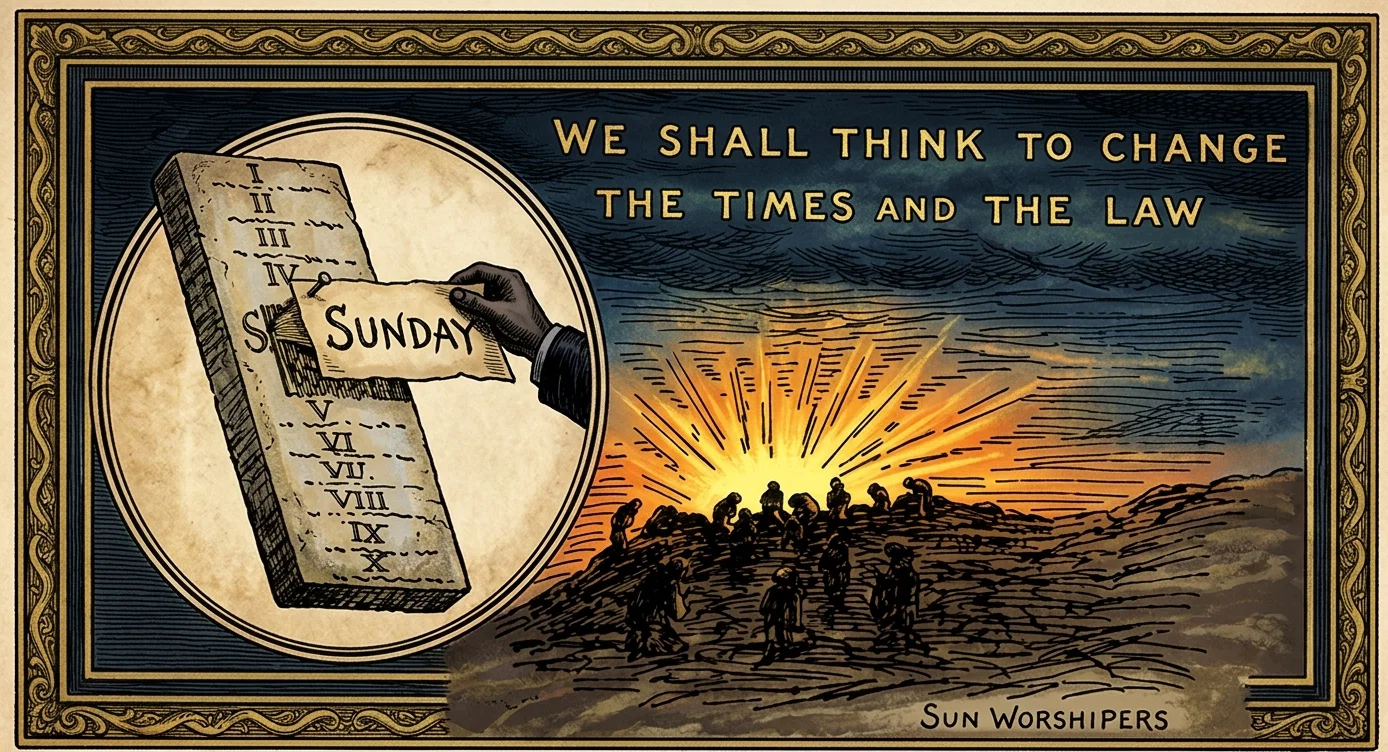
Sun Worshippers
Sun Worshippers
For had the first day of the week been established by positive enactment as a day of rest and worship, and the manner of its observance been decreed among the myriads of the poor, the bond and bread-winners and busy men generally who have accepted the Christ in this age of activity, the law must have been broken continually.
We especially commend this to the ardent advocates of human Sunday laws. If they can see wisdom in God’s not making a Sunday law, on account of such dire results, why should they undertake such a work? Can they do successfully that from which God refrains? “Shall mortal man be more just than God? shall a man be more pure than his Maker? Behold, he put no trust in his servants; and his angels he charged with folly; how much less in them that dwell in houses of clay, whose foundation is in the dust, which are crushed before the moth? They are destroyed from morning to evening; they perish forever without any regarding it. Doth not their excellency which is in them go away? they die, even without wisdom.” Job 4:17–21. Such are the frail worms of the dust that assume to command in the name of the Lord that which God has not commanded. “Behold, I am against the prophets, saith the Lord, that use their tongues, and say, He saith.” Jer. 23:31.
“Let us hear the conclusion of the whole matter: Fear God, and keep his commandments; for this is the whole duty of man. For God shall bring every work into judgment, with every secret thing, whether it be good, or whether it be evil.” Eccl. 12:13, 14.
Continue reading: ONE WHO CARRIED LAMPS