Your ShelfYour Projects

Signs of the Times, Vol. 26, No. 2.

LIGHT REJECTED
Earlier text: The Seal of God

THE TIDE HAS TURNED.

Less than a year ago the soldier caste had carte blanche in San Francisco. A sentimental enthusiasm—too generally mistaken for patriotism—took hold of the masses and stirred them almost to distraction. For a time it was hero worship gone mad; everything in army uniform was a hero. The newspapers, the political orators, and the preachers lauded the soldiers. The women, old and young, féted them and smiled on them, and the more forward ones kissed them. Young women strolled with men in uniform whom they would have disdained to notice in their former garb; and acquaintance was ofttimes formed without even the formality of an introduction. And the boys of every age strove to imitate the man in uniform, while their young hearts fairly thirsted for blood. Even the officers of the law relaxed their wonted vigilance, lest the carnal pleasures of the soldier be too much limited and patriotism seem lacking. But the soldiers, underneath the artificial halo of glory with which they were for the time enshrouded, were only men, and many of them proved to be very ordinary men at that. Their conspicuous appearance in Chinatown, the Barbary Coast, and the slum districts in general, was, and still is, proof that “all is not gold that glitters.”
Six months ago such an utterance as the above would have been subject to severe denunciation on the part of many who are to-day looking at the soldiers in the vicinity of San Francisco through a different glass. The Tribune of this city, which was second to none in encomiums of “our heroes” when their municipal and social prestige was at flood tide, has this to say in a recent issue:—
“The action of the military authorities at the Presidio, in co-operating with the San Francisco police department, in suppressing the lawlessness of the soldiers now quartered in San Francisco, is a highly commendable departure from the customary red-tape methods of the army. Ever since the emergency camps were established, the metropolis has been subjected to an era of viciousness on the part of those wearing Uncle Sam’s uniform, the offenders not even stopping short of murder. At first, when the patriotic spirit was running high, there was a disposition on the part of the civic authorities not to inflict punishment when the offense simply consisted of drunkenness or disturbing the peace, but a change soon had to be made in this program, for the soldiers imposed upon good nature to an alarming extent. An appeal to General Shafter, however, brought about the prompt establishment of a provost guard, and after this all went well for a while.
“Then came the Hildebrand murder, that shocked the community, and the laxity of the prosecution aroused such a pronounced public sentiment on the proposition that the officials put on the screws and the turbulent elements were brought under control. The barriers have been gradually raised again, tho until now the law-breaking element is more in evidence than ever, as is shown by the recent shooting by a drunken army officer at an inoffensive citizen, and the outbreak in the colored regiment that has led to the present reform movement.
“It stands to reason that an iron rule must be exercised over the soldiers now reaching the coast en route to and from Manila. In the first place, a very small percentage of the troops consists of trained and experienced men, the great majority being ‘raw recruits’ who overestimate their importance from the time they don Uncle Sam’s uniform. There is an excuse for this, tho, the trouble being that the hero flavor hovers around every man who enlists during war time, and the applause and enthusiasm with which the various regiments are greeted make each soldier think that he is a privileged character and can do about as he pleases. Then there is the temptation of being invited to drink everywhere he goes, and, as most of the soldiers are young men, they soon fall into evil habits, if, indeed, they had not contracted them before they enlisted.”
This is indeed a sad picture, but it is not overdrawn in the least particular. It is a significant commentary upon the times in which we live, and the general encouragement of the young men to enter upon a military career. The results are more than hinted at in the fact that one of the journals which a few months ago was conspicuous in the general plaudits showered upon the men who were bound to Manila, is now constrained to advise that on their return an “iron rule be exercised” over them. And this advice is based upon experience with those who have previously returned, as well as with those awaiting transportation thither. As the picture must be drawn as a warning against the evils of army life, we are glad that it is so faithfully done by a journal whose influence was all on the side of the popular embrace of the men in uniform and armed with the weapons of death. True, the story could have been told a year ago just as well as now, but it would not have been heeded by a people aroused to fever heat by the prevailing spirit of war. Now that some of the results are seen and recognized through actual experience, may we not hope that at least the professed church of Christ will reflect that He whom they profess to follow did most emphatically declare, “The Son of man is not come to destroy men’s lives, but to save them.” In the light of His example, how can they who profess His name urge men on to a death-incurring and death-dealing occupation, or encourage the youth to learn the use of carnal weapons and the art of warfare against flesh and blood? Or how can men professing His name urge or applaud measures that involve the wholesale destruction of life—spiritual as well as physical—which He came to save, even at the sacrifice of His own life?

CONSUMPTION OF BEER.

A RECENT issue of the Scientific American says:—
“In 1897 in Germany 1,383,700,000 gallons of beer were consumed; 1,192,000,000 were drunk in Great Britain, 180,000,000 in France, and 90,000,000 in Russia. It is estimated that 36 gallons per head are drunk in Belgium, 32 in Great Britain, 25 in Germany, 21 in Denmark, 12 in Switzerland, 10 in the United States, 9 in Holland, 5 in France, 3 1/2 in Norway, 2 3/4 in Sweden, and 1 in Russia. A writer in the North American Review declares that a large quantity of beer is consumed in order to satisfy the craving for the elements which are eliminated from wheat in making white bread.”
It will be observed that the foregoing figures represent nothing more than the beer that has been drunk; they do not include wines, whiskies, and numerous other alcoholic drinks. The suggestion of the doctor who writes for the North American Review is worthy of consideration. And in connection with the thought that the system is being deprived of the natural food elements that are taken out of the flour for making white bread, there are some other points that should be thought about.
This is an age of stimulants and stimulation. Every nerve is drawn to the highest possible tension in prosecuting business or pleasure, or, more frequently, in trying to prosecute both. Flesh foods, which form the most stimulating diet that can be eaten, have come to be almost universally used. A beefsteak or a mutton roast is not merely a food; it is a stimulant as well. And this flesh food stimulant calls for other stimulants and irritants. The flesh-eater desires with his meat such things as pepper, Worcestershire sauce, mustard, and other similar stimulants and irritants. And by thus stimulating the body through the foods that are eaten daily, the system clamors for stronger and still stronger stimulants. At first tea and coffee seem to satisfy the demand. But in thousands of instances wines, beer, and other strong drinks are soon indulged, so that this increasing craving may be satisfied.
The tendency, however, is strongly running toward a more and more exciting life, and, consequently, toward a more and more exciting diet, and along with the diet a still greater demand for strong drink. The tastes and habits of the people are becoming more and more luxuriant and extravagant. Debasing luxuries that only a prince could afford a few decades ago are freely indulged by the common people to-day. So-called “high living” is becoming well-nigh universal, and the spread of the drink habit is alarmingly enormous.
Should we leave the utterances of divine prophecy out of the question, any philosopher who is not blinded by prejudice would be able to see that the race can not continue in its present course without soon destroying itself. Every sincere person should honestly and earnestly study the conditions of today. T.
A DESPATCH from Dallas, Texas, under date of December 25, says: “This has been a bloody Christmas for Dallas, and the coroner has been kept busy. Six men have been shot since last night, three fatally. Newspaper reports from over the State announce thirty-one affrays in which guns or knives were used, with fatal results in most cases.” This is but an index to the violence of these times. Does it look as tho the millennium was dawning? God says, “This know also, that in the last days perilous times shall come.” 2 Tim. 3:1. Observe that the text says perilous times shall come “in the last days,” and not a millennium of righteousness. God knew beforehand what would be the condition of things, and He told it as it would be. And are not these times becoming indeed “perilous”? Lynchings, and murders, and robberies, and wars, and rumors of wars, all show the increasing perils of these times. The very last of the last days are right here. Everything shows it. Not one or two things merely testify to it in an obscure way, but multiplied evidences testify positively to the fact that the great and final day is right at hand. Get ready for it, and then do all in your power to carry the message to others, and help them to get ready.

THE INCREASE OF SUICIDES.

SOME years ago a young lady, well known to the writer, left her father's house and forsook her father's God, and married an infidel Spiritualist. It was not many years before her heart was broken, her home wrecked, her life blasted, and she was a homeless wanderer in the earth.
In her distress she wrote to the great high priest of American infidelity, asking him what comfort there was in infidelity for her. She got no answer. Defaming the Bible, blaspheming the God of Abraham, pointing out the mistakes of Moses, and defending star route thieves and government plunderers perhaps left little leisure for writing answers to such epistles.
About the winter of 1894 the infidel oracle found voice, and through the columns of a New York paper gave, in substance, the following advice: "When you are sick or poor, or in trouble or disgrace, and see no way out, go and hang yourself; blow out your brains; swallow poison; commit suicide."
That year, 1894, there were 4,912 suicides in the United States—an increase of 452 over the previous year; and numbers of the suicides had on their person copies of the infidel arguments showing that suicide was no sin. One New York editor testifies that a dozen instances of suicide have occurred where these same documents were in evidence in the case.
When people believe they have a right to kill themselves, it does not take them long to claim the right to kill others, and that same year there was an increase of 3,000 murders in the United States, making a total of 9,800, or nearly ten times as many as would occur in a year twenty years before.
Dr. Ireland, in the Journal of Mental Science, asserts and shows that "a steady and rapid increase of self-destruction is common to the whole civilized world."
Infidels boast that infidelity is spreading. Doubtless this is true; and with it murder and suicide are increasing with rapid strides. And there is the most suicide where there is the most infidelity.
Most of the church-members in America are women; most of the infidels are men. But the men who commit suicide outnumber the women suicides nearly three to one. In New York in 1892 there were 805 female suicides, and 3,055 men. In 1897 there were 1,452 women and 5,078 men who committed suicide.
In London, where more Bibles are printed than in any other city on earth, there are 87 suicides to a million people in a year; but Paris, gay, godless, Christless, Sabbathless, has 592 suicides to a million, or more than six times as many as London in proportion to the population.
God gives to those who obey Him "length of days, and long life, and peace" (Prov. 3:2), and promises to them eternal life at last. The men who serve Satan write books inquiring, "Is life worth living?" That depends on how men live it. If you live it as God commanded, life is well worth living, for "the hoary head is a crown of glory, if it be found in the way of righteousness" (Prov. 16:31); but Satan has no happy old men, and if men will serve the devil, the shorter their lives are the better, and so "the wages of sin is death." Rom. 6:23.—The Christian.

A GOOD WORK.

We are in receipt of the eighteenth annual report of the principal of the Tuskegee Normal and Industrial Institute, Tuskegee, Ala., for the year ending May 31, 1899. As is well known, the head and chief worker in this great enterprise is Prof. Booker T. Washington, himself a colored man, who is doing more for his race from an earthly point of view than any other man. He aims not to educate alone, but to teach to do. The Tuskegee Institute has connected with it twenty-six industries: agriculture, blacksmithing, brickmasonry, carpentry, carriage trimming, cooking, dairying, drawing of various kinds, plain sewing, plastering, plumbing, printing, sawmilling, founding, housekeeping, harness-making, horticulture, laundering, machinery, mattress-making, millinery, nurse training, painting, shoemaking, stock-raising, tailoring, tinning, and wheelwrighting. It began in 1881 in a little shanty, with 1 teacher and 30 students; it averaged last year 1,164 students, and 88 officers and teachers. It is a good work, and we bid Professor Washington Godspeed.

Peace and Sudden Destruction

The President has sent to the Senate the treaty negotiated last July by the representatives of the various nations at The Hague Peace Congress. It is said that ten signatures have already been attached to the convention for the pacific settlement of international disputes. It will be agreed among men that they will quit fighting, but they will not keep the agreement. And when they complete this agreement that they are to have wars no more, then will they say, “Peace and safety,” just as the Word of God foretells. But this “peace and safety” is such only in name, for the sure Word further says, “Then sudden destruction cometh upon them; . . . and they shall not escape.” “Sudden destruction” can not come where there is real “peace and safety.” We should not be deceived by peace congresses or peace talk. Any one should be able to recognize that the world was never in such a ferment for war as now. Every nation is involved. It is the rush of all the armies of earth in their preparations for the great battle of the great day of the Lord that we hear, and not the gentle and kindly whisperings of an assured peace. Study the Word of God, then look around you, and you will know for yourself the meaning of the events in these times.
The many rumors of international alliances are a significant omen. On one day the papers report a proposed alliance between England and the United States. The next day it is England, Germany, and the United States that have reached an agreement of alliance. Then, again, it is Russia and France, and then England and Turkey, and so on. This is a strong indication of the feverish condition of the world. It shows that the rulers of the nations are disturbed and afraid as they view the situation in international politics, and hence they are eagerly looking about for some means of augmenting their strength so that they may stem the tide. But all men should know that the collapse of the whole world is right at hand. Every prophecy shows that the end of all things is almost here. And the spirit of war that is calling out these proposed international alliances is the clear fulfillment of one of the plainest of these divine prophecies.
Negotiations have been opened by the United States for the purchase of Chatham Island, one of the Galapagos group. The island is desired by the Navy Department for a coaling station. How feverish is this country becoming to make of herself a great naval power! The order of things in the government has been reversed, and it will be nothing but war preparations and various broils and entanglements until the time is reached when America will rush, with all the other nations, into the great and final battle-field of Armageddon.
Prof. Reginald Fessenden and his assistant, Professor Kitner, of the Western University of Pennsylvania, are said to have invented a receiver for the wireless telegraphy that is two thousand times more sensitive than the one invented by Marconi. Marconi’s instrument has sent messages a distance of over 90 miles. Professor Fessenden thinks that his instrument, when fully perfected, will transmit messages without any wire clear across the Atlantic.
Rumors continue to come in regard to the prospect of King Menelek leading his forces against Great Britain. The subject is causing much uneasiness in London. If Menelek and his Abyssinian forces, with all their modern equipments for war, should rise up against England just now, it would make a very serious situation.
A sleeping operator on the North Pacific Railroad in Montana, allowed two freight trains to collide on December 25, near Bearmouth, and four men and nine horses were killed, and several other men were more or less seriously injured.
In a severe storm off the North Carolina coast, on December 24, the British steamship Ariosto was driven ashore, and twenty-one sailors were drowned.
Major-General Henry W. Lawton was instantly killed by a Filipino bullet near San Mateo on December 19.

RELIGION IN THE PHILIPPINES.

THE Catholic religion prevails throughout the civilized portion of the archipelago, with the exception of the Mohammedans in the Sulu group and the island of Mindanao, comprising a population of about two hundred and fifty thousand. Polygamy is also practised in this Mohammedan territory, and it is a part of the Mohammedan religion. They are a race of powerful and fearless men, and are religious fanatics. It is part of their belief that the road to heaven can be attained by killing Christians. This portion of the archipelago is governed by the Moro chiefs, they having set up an independent government of their own, having at no time been under Spanish or Catholic sovereignty.
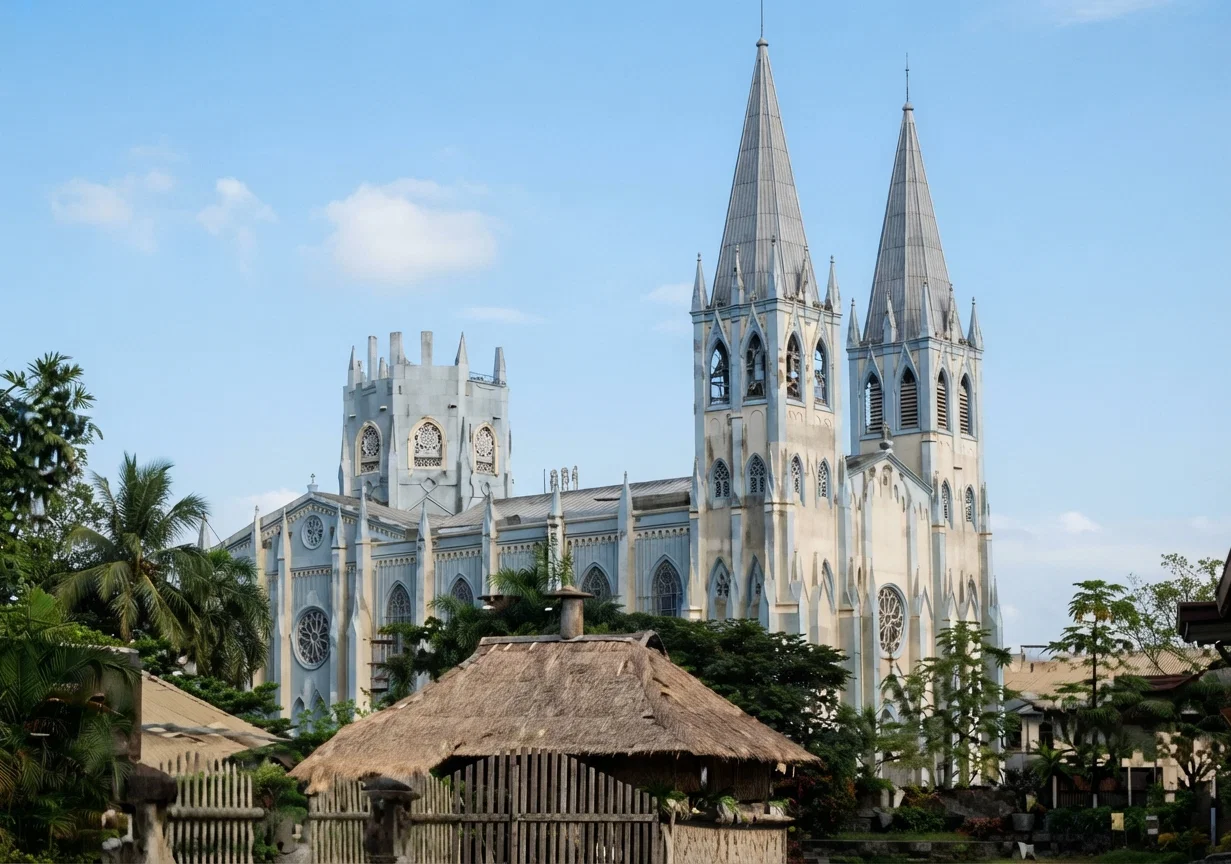
San Sebastian Church, Manila, Philippine Islands.
The archbishop of Manila presides over the spiritual welfare of the Ladrones and the Caroline group as well as the Philippines. The Philippines are divided into five dioceses, and are presided over by five bishops. They are also divided into one hundred and eight parishes and missions, which are in charge of the Jesuits. Each province or district is presided over by at least one or more Spanish priests.
The archbishop of Manila has his seat in the Walled City, and is assisted by an ecclesiastical chapter consisting of a dean and four dignitaries, the archdeacon, the precentor, the superintendent of schools, and the treasurer.
The Church and State under Spanish rule were inseparable. The monks had such a grasp upon those in authority that all they had to do was to speak the word, and their wishes were carried out to the letter, the Spanish Government being a mere puppet in their hands. The monks imposed exorbitant church taxes on the Filipinos, and many times they succeeded in getting the land of the natives confiscated and made over to them, compelling the original owners to till the land for them and continue to pay their church tax. If their crops should fail, their tax was not reduced, but increased. Failing to contribute to them, their carabou and cattle were seized, and in many instances the families were driven from their old homesteads. The monks, not being content with this, interfered with their family relations, many of them living in their quarters like despotic pashas. Many instances are on record where women have taken their own lives to rid themselves of these clerical traitors.
With such a state of affairs existing, what can be expected of a people who have seen nothing but corruption and vice existing under the cloak of religion?
The non-recognition of the Filipino priests by the Spanish also had a tendency to irritate the people at large. Instead of treating their priests as colleagues and co-workers, they were treated as inferior beings and underlings. Were they given a parish, it would be in some of the poorer districts where their income would hardly sustain them.
The cause leading to the Filipino rebellions of 1872 and 1896 was the despotic and tyrannical treatment of the native Filipino by the monastic orders. Freemasonry was a great bane to the monks. It was largely through this and other kindred orders, and the instigation of their leaders, Andres Bonafacio, Dr. Jose Rizal, Emilio Aguinaldo, and many others, that the Filipinos have been kept in a state of rebellion. It was through the pen of Dr. Rizal, in his novels, that the Filipinos and the world at large were made acquainted with the misdeeds of the monks. All complaints of the natives about the wrongdoings of the clergy remained without response, for the monks had colleagues in Madrid and Manila, and all complaints were intercepted or the complainants intimidated before reaching the higher Spanish authorities. One after another of these opposers of the ecclesiastical rulers were put out of the way, or driven into exile. Dr. Rizal was executed on the Luneta, in Manila, in 1897, and a reward of $25,000 was offered for the head of Aguinaldo. His countrymen being loyal to him, he lived to see the overthrow of Spanish rule, and, it is wished, religious oppression in the Philippines.
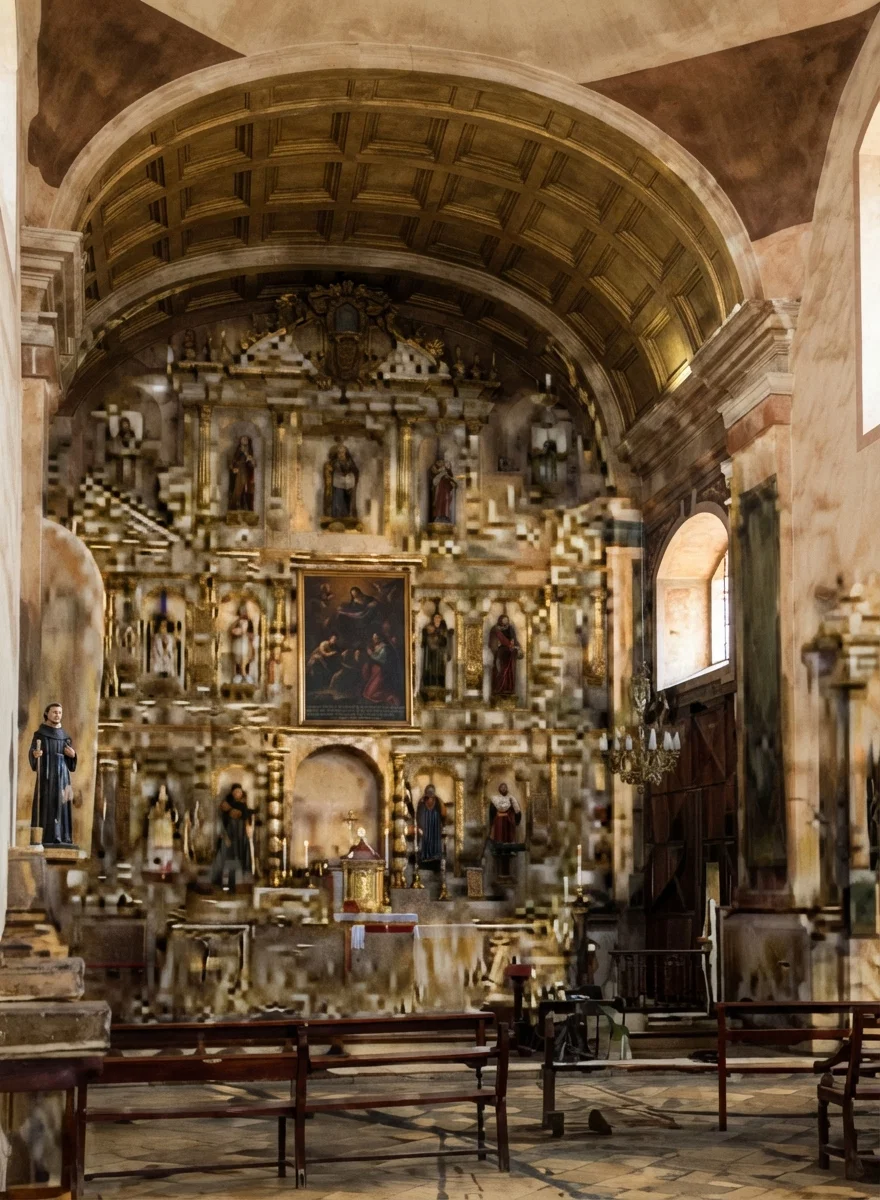
Nave of Church in Manila, Used as a Hospital by American Troops.
The native Filipino is naturally of a religious turn of mind, but seems to seek that form of worship which has outward show, and appeals to his imagination. A form of worship without images, incense, pomp, ornamentation, and bright colors will not appeal to his sympathies. This explains why the Catholic faith has such a strong hold in the Philippines. Anything imaginable or bordering on the supernatural makes a strong impression upon the Filipino. They wear charms and armlets with Latin prayers engraved on them, which they believe will protect them from all harm. Most of the Filipino families have a crucifix or shrine at which they worship since the priests have left the small villages. It is not uncommon to see the natives congregate in houses and have their worship at early morn and at the close of day. The women are the most religiously inclined. They seem very devoted to their religion, and nothing can prevent them from attending their regular masses.
There are but a few Protestants among the English and Germans around Manila, and so the native Filipino has comparatively little knowledge of the Protestant religion, and but few have heard the Gospel of Jesus Christ. They ask vague questions concerning our God, and whether it is the same One they have in the Philippines. I have put in many hours trying to tell them of our religion, and have always found them ready and willing listeners. They all seem anxious to learn what they can "of the religion of the Americano."
The church property, like the clergy, was under the control of the Spanish Government. In Manila, like other Catholic cities, the churches form interesting studies of architecture. They were built by the sweat and blood of an oppressed people, and are now relics of a dead tho not forgotten past. Manila has many massive cathedrals. They, with their towering spires and many-chimed bells, present an imposing spectacle. The church of San Sebastian without doubt is by far the grandest. It, from outward appearance, looks to be made of granite; but it is constructed of steel throughout. Its walls are of plates of steel bolted to a frame of the same material. The interior is very imposing. There are two rows of pillars which branch out and form the arches of the ceiling. The furnishings of the altar are very elaborate, and many vessels and ornaments are of silver and gold. In the vestry is a hard wood table made of one piece of timber nine feet across, and twenty-seven feet in circumference. The windows of stained glass are most wonderfully designed. Great pipe-organs may be seen, and at early mass they fill the spacious cathedrals with, mellow music. Many of these churches are not ceiled, but are most elaborately finished to the very top of the domes, from which hang beautifully ornamented chandeliers.
The most peculiar feature connected with these cathedrals is the fact that they contain no seats; the congregation remains standing during services.
To attend these churches, to see the gold and silver ornaments, the priests with their almost priceless robes, and then to note the half-clad, half-starved beggars forming part of the congregation, one would decide that the time has come for the introduction of a different religion. It tells a story of tyranny and oppression more eloquently than words. Is it not time that the shackles of such a religion be shaken from the necks of this people? Is it not time that we should stir ourselves to the utmost to spread the Gospel to these sin-sick souls?
It is a strange fact, but nevertheless a true one; the grander the church and more demonstrative the religion, the more plentiful and destitute the beggars. This is said to be true all over the world, and I know it to be true in the Philippines. The people are anxious and waiting to hear the Gospel of Jesus Christ. It has been the one object of their lives to be rid of Spanish rule and the tyranny and oppression of the leaders of the Catholic Church.
It is beyond the comprehension of one living in our country of religious liberty to imagine the degree of persecution that has been perpetrated upon this people in the Philippines. It goes to show what the Church and State will do when combined under one rule.
May they soon be liberated from this religion, and have an opportunity to hear the simple Gospel of Jesus Christ.
EUGENE G. WOOD.

DO GOOD.

Do good; for good alone will live, The rust of time defying, When darkness comes, when chaos reigns, Tho even hope lie dying.
Do good; for good doth make the soul The better for the doing, As arms grow strong from laboring strong, Love sweet from lovers' wooing.
Do good; tho small may seem thy deed, And none thereof be knowing, Yet some day thou shalt ken its shade: Thy good tree's ever growing.
Do good; for good was done to thee When God gave thee to-morrow; Do good; for thinkest thou, O man, There's not enough of sorrow?
Fort Robinson, Neb. NELS ANDERSON.

WAITING GOD'S TIME.

THIS is what the editor of the Sunday School Times quotes the veteran missionary of Zululand, Aldin Grout, as saying at a missionary gathering in 1858, of his early labors in South Africa—saying it "not despondently or sadly, but with a ringing, soldierly voice: 'I worked there as God gave me opportunity and ability for ten years, with various interruptions and intermissions, yet at the end of that period I could not point to a single convert in all the field in all the years; nor could I even point to a single one of my hearers of whom I could confidently say that he had been really interested or benefited by my message during all the time. Yet in all that time it never entered my head to doubt that I and my fellow-workers were where God had called us to labor, and were doing what God had set us to do. We were there giving God's message, sowing the seed of God's truth. It was for one to plant, for another to water, for God to give—or to withhold—the increase as seemed best to Him. Thirteen years added to that ten, have passed since then,' he said; 'there are now more than thirty Christian churches with hundreds of church-members in that apparently unfruitful field.' It is good to be in God's field and work; whatever the seeming results, for a time, may be."

HOPE'S MISSION.

SWEET Hope, thou angel beckoning on, To teach our weary souls to rest Within a haven of sweetest bliss, While earthly cares our faith shall test! Hope is the messenger of faith, Which teaches us in trust to wait Until God's will hath been revealed, To show us what shall be our fate. 'Tis the consoler of the heart, A good physician near at hand, When trials come to overwhelm The trembling earth on which we stand; Hope lifts us in her restful arms, And her sweet consolation lends, Till happiness shall reign again, And sorrow into gladness blends.
MARTHA SHEPARD LIPPINCOTT. Moorestown, N.J.

SOUTH AMERICA'S THOUSANDS.

SOUTH AMERICA is an extensive missionary field, divided by the natural conformation of its surface, its mountains and rivers, into four general mission fields, as follows:—

NORTHERN FIELD.

Name. Area, square miles. Population.
Colombia, 502,000 3,500,000
Venezuela, 594,165 2,550,385
Guiana, 168,962 367,443
Total, 1,265,127 6,417,828

EASTERN FIELD.

| Brazil, | 3,219,000 | 14,000,000 |

SOUTHERN FIELD.

| Paraguay, | 91,970 | 560,000 | | Uruguay, | 72,110 | 648,299 | | Argentina, | 1,125,686 | 4,086,492 | | Total, | 1,289,166 | 5,294,791 |

WESTERN FIELD.

| Chile, | 293,970 | 3,115,815 | | Bolivia, | 567,240 | 2,330,000 | | Ecuador, | 120,000 | 1,200,000 | | Peru, | 500,000 | 2,971,844 | | Total, | 1,481,210 | 9,617,659 |

SUMMARY.

| Northern Field, | 1,265,127 | 6,417,828 | | Eastern " | 3,219,000 | 14,000,000 | | Southern " | 1,289,166 | 5,294,791 | | Western " | 1,481,210 | 9,617,659 | | Grand total, | 7,254,503 | 35,330,278 |
Surely here is a large field, in which scarcely a beginning has yet been made.
F. H. WESTPHAL.

FOLLOW THE GUIDE.

LIKE Alpine climbers, our only safety is in steadfastly fixing our gaze on Jesus, our guide, and following step by step the path He trod, that He might know the dangers and difficulties that beset our way. And we may be sure He will never lead us further or faster than we can safely follow.—Rose Porter.

USE YOUR STRENGTH.

A LADY was watching a potter at his work, whose one foot was kept with "never-slackening speed turning his swift wheel round," while the other rested patiently on the ground. When the lady said to him in a sympathizing tone, "How tired your foot must be!" the man raised his eyes and said: "No, ma'am; it isn't the foot that works that's tired, it's the foot that stands. That's it."
If you want to keep your strength, use it; if you want to get tired, do nothing. As a matter of fact, we all know that the last man to go to for a helping hand for any new undertaking is the man who has plenty of time on his hands. It is the man and woman who are doing most who are always willing to do a little more.
The people who are tired of life are not those who work, but those who are too proud or too lazy to do so. Many of the rich are morbidly restless, while those who have to earn their daily bread are comparatively contented and happy. The Bible says that "the sleep of a laboring man is sweet, whether he eat little or much" (Eccl. 5:12); and the busy worker has health and blessing which the listless idler never knows.—Selected.

Buddhist Missionaries and Bible Skepticism

A DELEGATION of Buddhist missionaries from Japan have commenced operations in San Francisco. If the professing Christians in this country had stood true to their faith in the literal Word of God, there would be but little soil here for the seed-sowing of such missionaries. But so many have been led to look upon the Bible as only partly true, and they have covered it over with so many human speculations and fallacious reasonings, that the hearts of men are not fortified, even against these worse than ridiculous theories of the darkest heathenism. The speculative way in which men have been dealing with the Bible has educated this generation to the place where men and women are eager for the most fanciful and mystical doctrines. It does not matter whether these doctrines have any sense to them or not. If they are only mysterious and mythical there are thousands of people who are eager to espouse them. And yet men tell us that the world is getting better and we are soon to have a millennium of righteousness.

BABY'S FIRST WARDROBE.

Hygienic patterns for complete outfit. Full directions for making, showing necessary material, etc., sent post-paid upon receipt of 50 cts., together with an interesting booklet on the proper care of infants.
MRS. F. M. KELLOGG, 38 Washington St., Battle Creek, Mich.

The Best, Handiest, Easiest Running

The best, handiest, easiest running, cheapest, and most durable

Fly Shuttle Carpet Loom

most durable # FLY SHUTTLE # CARPET LOOM In the world,—100 yards a day. Catalogue free. EUREKA LOOM CO. 5018 Main St., Battle Creek, Mich.

Mention the Signs of the Times

When you write, please mention the SIGNS OF THE TIMES.

DR. J. E. CHILDS

DENTIST
ROOMS 8 AND 9 BLAKE BLOCK 1065 WASHINGTON ST. OAKLAND
OFFICE HOURS 9 A. M. TO 12 M. 1 P. M. TO 5 P. M.
OPEN SUNDAYS
Continue reading: THE FUNERAL OF A FAILURE