The Youth’s Instructor, Vol. 65, No. 22.

For the Finding-Out Club

The Youth’s Instructor

May 29, 1917

Review and Herald Publishing Assn. · Takoma Park Station, Washington, D. C. · May 29, 1917

For the Finding-Out Club

Who Is It?

PEOPLE are hurrying to the temple. Near a tall pillar stands a boy surrounded by a royal guard. The crown is solemnly placed upon his head, and thousands take up the cry, “God save the king!” The royal trumpets are sounded, and rejoicing is heard afar off.
A wicked queen approaches the temple, and as she sees the new king she cries, “Treason! Treason!” She has ruled several years, and has endeavored to destroy all the royal children; but one was hidden by his nurse, and as she sees him now she is filled with terror. The order is given: “Have her forth: . . . and him that followeth her kill with the sword.” Soon she is carried outside and slain.
The rejoicing continues. The reign of the wicked queen is over, and many years of peace and prosperity fill the land. Who is the new king? and who is the wicked queen? MERTON BAKER.
The chief priest at the time of Zedekiah was a brother of Baruch. He was an officer in Zedekiah’s army, was taken captive by Nebuchadnezzar, and was finally brought before the Babylonian king, and put to death. Who was he? LOUISE SANDERS.
The commander of Saul’s army was his cousin, who was the son of Ner. He was known as “the father of light.” It was he who brought David to the honored court, after he had killed Goliath. Being at the head of the tribe of Benjamin, he encouraged a hostile feeling against the tribe of Judah. He made Ish-bosheth king over Israel, and in a war which followed, this man was at the head of Ish-bosheth’s army. Joab, who was the leader of David’s army, barely escaped from the field of battle with his life.
Ish-bosheth reprimanded his general for having chosen for his wife Rizpah, a woman who had been one of Saul’s concubines. In his anger at being thus reproved the general went to David and offered his services in uniting the two kingdoms. David made a great feast for the general and the men who came with him, and allowed him to depart in peace. He had left the city when Joab returned home, but by some deception he was induced to return. When he entered the gate, Joab killed him with the sword in revenge for his having killed Asahel, Joab’s brother. David sorrowed greatly over the general’s death, and said: “Know ye not that there is a prince and a great man fallen this day in Israel?” Name the commander. GLADYS PHIPPS.
When the temple was repaired, the high priest Hilkiah found a book of God’s law, given by Moses. Hilkiah gave it to a scribe, who took it to King Josiah. The king, hearing the words of the law, rent his clothes, and commanded the priest, with others, to inquire of the Lord’s servant concerning the words of the book. Who was the person whom they consulted? MAYBELLE SEELY.
He was born in Cana of Galilee, and is known as a simple, truthful character. His name is mentioned by but one writer in the New Testament, and occurs only six times. He is mentioned by this name in connection with only two events. The first time is in connection with his own introduction to Christ, and the second was at the time Jesus showed himself at the Sea of Tiberias after his resurrection, to a small company, when this man is named as one of the company. He is supposed, however, to have been one of the twelve apostles, probably Bartholomew; and under this name is mentioned elsewhere in the Gospels. INEZ MILES.
A king is seated in his royal palace. It is wintertime, and a fire burns on the hearth before him. Around him are his courtiers telling of a strange book which they have heard read. The king sends for the book. It is brought, and with curiosity he listens while it is read. Soon his countenance changes; anger and fear take possession of him as he seizes the book, cuts out leaf after leaf, and throws them into the fire till all are consumed. Neither the king nor his courtiers are willing to forsake their evil ways, and to accept the reproof of that book.
Far from the palace, in a secluded spot, are two men. The face of one shows the marks of trouble and privation; the other is a young man. The older man is dictating, while the other is bending to catch every word, and faithfully writes it in a book. The book is finished. It contains all the judgments and warnings of the Lord found in the book that was burned by the king, and also many additional words.
The king still refuses to accept the warnings from the Lord, and he and his wicked courtiers die an ignominious death, while the two faithful men are kept by the Lord in the day of trouble. Name the king, the prophet, and the prophet’s scribe, or secretary. MERTON BAKER.
Important tidings came to a certain family, and in the excitement which followed, a nurse caught up a lad of five years, and fled with him. In her haste, she let him fall, and he was made a lifelong cripple by the accident. Later in life, his servant, by false suggestions, obtained his master’s inheritance; but David showed kindness to the cripple, for his father’s sake, and allowed him to eat at his table continually. This man, with true humility of heart, asked of David, “What is thy servant, that thou shouldst look upon such a dead dog as I am?” Who was he? MAYBELLE SEELY.
A certain man was a sheik and a priest of the Kenites, a Midianitish tribe. The Kenites and the Hebrews were much alike in many ways, and although the priest was a worshiper of the Semitic god “El,” he believed in the superiority of the Hebrew God as a deity. He gave counsel to the great lawgiver, and assisted him in organizing a judicial system. The similarity in the religious belief of the lawgiver and the priest led the former to seek an asylum with the latter in time of trouble. The daughter of the priest became the wife of the lawgiver, and both were finally brought into the camp of Israel. LOUISE SANDERS.

Miscellaneous Bible Facts, Customs, and Anecdotes

The middle chapter of the Bible is Psalms 117. It is also the shortest chapter.
The shortest verse in the Bible is John 11:35; the longest, Esther 8:9. In Ezra 7:21 occur all the letters of the alphabet except J.
After three years’ work by a painstaking compiler, the number of words in the Bible was found to be 774,751, and the number of letters 3,566,480. There are also 41,173 verses and 1,189 chapters.
In ancient times the Hindu priests of Java wrote on the leaves of the lontar palm. Lontar palm leaves, after being soaked in water two weeks, then carefully dried, may be used as parchment. Insects will not eat them, and they will not decay for centuries.
The number of spots burned on a Chinese monk’s head shows how much he has elected to endure. Each receives as severe an initiation as he desires, and gets therefrom certain privileges. If a monk has three spots, he can get three meals free at any monastery in China; six spots entitles him to six meals; nine spots to three days’ board.
An orthodox churchman in Blairstown, Missouri, rebelled because his wife made him wipe the dishes after each meal. He claimed vehemently that it was not a man’s work. His good wife is something of a Bible student, and quoted to him the following scripture: “I will wipe Jerusalem as a man wipeth a dish, wiping it, and turning it upside down.” 2 Kings 21:13. The Blairstown man still wipes dishes.
Probably one of the most interesting Bibles in our country is that belonging to Secretary of State Lansing. It is one which was given to him by his wife. In the margins he has drawn maps, and written many notes and references that are so carefully drawn and printed as to look like finished type. Every part of the wide margins is decorated with some temple, city, or printed reference. All this is the result of one-half hour’s study of the Bible each day. Mr. Lansing is recognized as one of the best-informed Bible students of the day. He taught a men’s Bible class for many years before taking up his duties as Secretary of State.

Our Guide

ELMER P. DAVIS
A PRECIOUS book the Bible is To us, who on a foreign strand Are pilgrims to a better land,— A land where all is peace and bliss, Where all is truth and righteousness.
O precious Book! O Book divine! We do not fear the toilsome way; For thou dost shed thy glorious ray To lead us on from shrine to shrine, Past deserts drear and boisterous brine.
Though long’s the way and dark the night, We do not grope in vain, nor faint; For strength thou givest to each saint Who grasps by faith thy words of might; And lo! at morn all shall be right.

Nature in the Bible

RACHEL SALISBURY
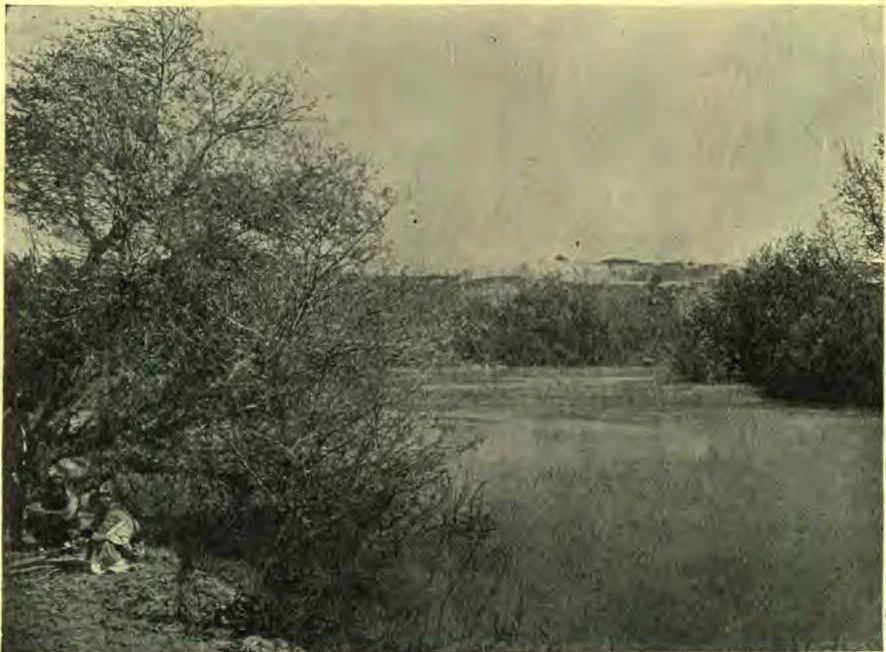
A View of the River Jordan
The Bible is one of the greatest of nature textbooks, although the word “nature” in the sense of the great out of doors does not occur in it. It brings before us the rich colors of the setting sun, the weird beauty of the moonlit desert, and the wild, restless anger of the stormy sea; but it never leads us to think of creation apart from the Creator. The little snatches of description that sketch the life of Bible times, seldom fail to have their appending simile, or spiritual inference. Creation is appreciated only as it leads the mind of man to the Master Mind above, who reveals himself to men in the beauties of the flowers, and the joys of the birds and creatures of his hand.
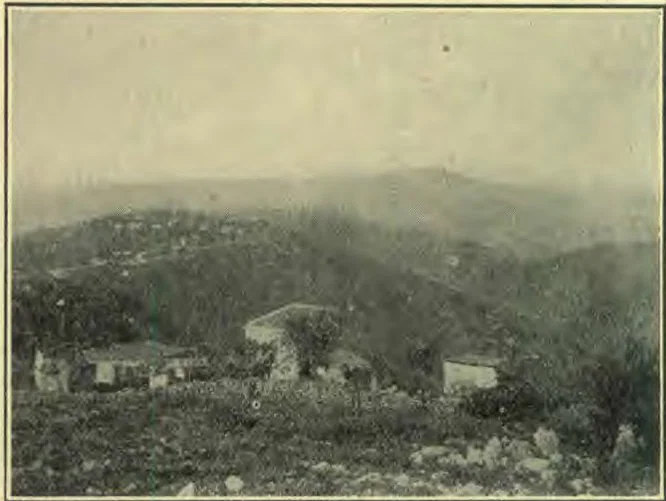
Mount Lebanon in the Distance
Christ’s parables contain some of the most beautiful bits of nature painting that are recorded. “Consider the lilies of the field, how they grow; they toil not, neither do they spin: and yet I say unto you, That Solomon in all his glory was not arrayed like one of these. Wherefore, if God so clothe the grass of the field, which today is, and tomorrow is cast into the oven, shall he not much more clothe you?” “Behold the fowls of the air: for they sow not, neither do they reap, nor gather into barns; yet your heavenly Father feedeth them.”
Every detail of the natural life about him was familiar to Christ. He loved the birds and the trees and the streams and the flowers. He saw beauty in, and obtained strength of mind from, the varied landscape about him. And he sought to paint this natural life so simply for others, that they too would learn to know it as the interpretation of God’s love.
The love of nature runs like a silver thread through all the stories and songs of the Bible. This is more characteristic of the Old Testament than of the New. Of all the nature lovers of the first-named, Isaiah is probably the most ardent, and the most representative. His appreciation is manifest the moment the book is opened. The prophet, dismayed at the hardness of Israel’s heart, turns to nature for a sympathizing ear. He utters his first complaint in these words: “The ox knoweth his owner, and the ass his master’s crib: but Israel doth not know, my people doth not consider.” Beasts of burden remain faithful to the master who provides them food and shelter, but reasoning men, who have far greater blessings, turn with ingratitude from the hand of the Giver. This is but one of the beautiful figures that Isaiah uses. Nature powerfully interprets his meaning, and he makes it the basis of some of his grandest and most sublime teaching.
Unlike David, Elisha, and others of the great nature lovers of the Bible, Isaiah was born and brought up in the city. He had all the privileges of the nation’s capital, and he improved them. He became a shrewd and wise statesman, a favored prophet, and a counselor of kings. But he never tried to cover up the evils of the “Queen of Cities.” Faithfully he pictured her sins in dreary colors; and then, after times of terrible denunciation, he would flee outside the city limits, and find consolation in the great heart of nature that he loved. Knowing that the Lord would cut off his people if they continued in their downward course, even as the fruit growers cut down the olive trees when they would bear no more, he found consolation in this lesson from some old stump that was again sending forth shoots: “There shall come forth a rod out of the stem of Jesse, and a Branch shall grow out of his roots: and the Spirit of the Lord shall rest upon him. . . . With righteousness shall he judge the poor.”
Throughout his book, Isaiah gives us at intervals terse word pictures describing city life as he saw it in and about Jerusalem. We see long lines of camels and dromedaries journeying from Jerusalem to Egypt, laden with the riches of Palestine. Ranks of chariots and horsemen wind slowly up and down the sacred hill. In the city, vain women and scheming men, apostate priests and wicked rulers, use any means to attain their ends.
But these were not the pictures he loved to paint. Isaiah loved the out of doors, and his soul responded to every phase of life in nature as keenly as a poet’s. He loved the beauties of earth, sea, and sky, and all the myriad little things that fill them with brightness and music. He had a first-hand knowledge of the birds and flowers, fields and woods, hills and valleys, streams and rivers, and even the mighty ocean,—the things that make up the geography of the little land in which he lived. He was acquainted with its creatures, and delighted in the sunlight and shadows that played upon its hillsides. His pulpit was beneath the open skies. In the quiet of his own home he studied the rolls of the prophets, but he found the interpretation in the great out of doors, in the handiwork of Him who inspired the sacred books. He loved the mountains, the tempests, and the lightning; for they made him realize the majesty and omnipotence of Jehovah. From all around him he gathered beauty as some men gather gold; pastoral scenes of peace and joy were more delightful to him than all the riches of Palestine could have been.
Isaiah gives us some impressive, but not overdrawn word pictures. “Wickedness burneth as the fire: it shall devour the briers and thorns, and shall kindle in the thickets of the forest, and they shall mount up like the lifting up of smoke.” His keen, observing eyes must have watched a forest fire, beginning first in the outer scrub of briers and twigs, creeping in under the thick, dry underbrush of the forest, and mounting up the trunks of the great trees in bursts of blaze and heavy smoke.
Here is a contrasting picture: “As birds flying, so will the Lord of hosts defend Jerusalem.” I can imagine him lying on his back under some broad tree, and looking out past its shelter into the clear blue sky, watching a big buzzard or hungry eagle circling slowly, lazily, monotonously out in the sunlight, seemingly unconcerned, yet ever watchful and quick to swoop down when occasion called. So, thought Isaiah, the Lord, though sometimes seemingly indifferent, is ever ready to help his children when they need him.
His book abounds in snapshot pictures, which are very suggestive. One of them is a picture of lazy dogs, curled up in the noonday sun, so full that they scarce care to lift a curious eye to the passer-by. They are gluttonous and spoiled; they are dumb dogs. Again we find a lonely old booth in a deserted vineyard. It is a sprawling, ramshackle affair, rapidly falling into decay. Long since deserted by its keeper, it is left a solitary lodge in a garden of cucumbers.
In the early springtime in Palestine, there are many flowers, and luxuriant vegetation of every kind beautifies the hills and valleys; but by May, all these have disappeared, and the hills are baked brown, and every living thing has fled to the brooks and streams. So there are few flowers to grace the summer landscape, and this causes the poet to mourn. “The grass withereth, the flower fadeth; but the word of our God shall stand forever.” But June is not absolutely destitute of beauty. Fields of ripening grain, patches of green herbs, and somber groves of olive trees relieve the monotony.
Isaiah loved the ocean in its various forms and moods. We see him lounging and meditating on the cliffs of Lebanon, where the cedars cast their great shadows far out over the water. The high towers and fenced walls make cool shadows about him, and before him lies the merchant fleet of Tarshish, whose purple sails, glittering galley oars, and gilded prows make a pleasing picture in the sunlight, as it dances over the rippling waves of the blue Mediterranean Sea.
The prophet also draws many lessons from the wind. One can feel its freshness and force playing through many beautiful passages that he has written. Sometimes it is the soft, light, west wind that sighs through the bulrushes. Sometimes it is the rough east wind that thunders against the walls, tears down the grain, and dries up the streams, warning all men to flee to shelter. Here he brings in the figure; the man Christ Jesus is the shelter.
Isaiah’s pen is not weak to paint the picture of this fair land that he loved, when it suffered the curse of drouth or famine. The rivers fail, and there is no water for the thirsty people. Sand bars and rocks make islands in the middle of the seas. The anglers lament, because they can find no more support for their families. The brimstone around the Dead Sea is changed into a sulphurous dust, which the wind catches and blows all over the land. The pelican screams from the shore, and the bittern from the reeds and flags beyond Jordan.
But his heart fills with gladness, and his pen is quick to respond, when this desolate condition changes. The falling rain makes the parched ground a pool; the brooks fill again, and the flowers come back to brighten the banks of the streams. The rushes and reeds wave over the cool, rippling water, and the birds coo in the bright sunlight. “The mountains and the hills . . . break forth . . . into singing, and all the trees of the field . . . clap their hands.” Springs refill, the gardens are planted again, and irrigated. Cattle stray away up the hillsides, and sheepfolds are enlarged. The corn grows fast and fine, and the fields look smooth and healthy. Highways are repaired, and the exiled inhabitants return to their homes with joy. The righteous sit under the vines of the restored vineyards, eating the new fruit in contentment and peace.
Isaiah was one of the earliest poets to love and sing of the trees. From trees he draws some of his most beautiful lessons. “As the days of a tree are the days of my people.” I can imagine him sitting under a gnarled and sturdy old oak, looking at its ragged yet beautiful limbs, and realizing that they are emblems of permanence, ere he wrote that verse. This lesson continues to inspire poets, for Holmes says of trees,
“There’s nothing on earth that keeps its youth, So far as I know, but a tree and truth.”
John Muir says, “As far as man is concerned, they are the same yesterday, today, and forever.”
Isaiah had an extensive knowledge of the individual trees. He knew that one shaking would never clean an olive tree of all its fruit. In one verse he pictures the tree and its shaking, and tells us that two or three berries are always left in the uppermost branches, and four or five on the outermost tips of the most fruitful ones.
We have not space to show further the wide range of knowledge of this prophet, his love of the varied forms of nature, and his interest in the industries of man. Botany, zoology, physics, astronomy, geology, mineralogy, chemistry, and other sciences are all represented in the field of Isaiah’s knowledge. From everything he beholds—even so tiny a thing as a nail—he draws a lesson. All his lessons are pointed, and set forth directly or indirectly the great theme of his book,—the omnipotence and majesty of God.
Isaiah was a philosopher of the natural world. In everything about him he saw the divine revelation of God’s love to man. In its sublime spectacles he saw the majesty and power of God. In its quiet pastoral scenes he saw loving-kindness, mercy, and tenderness. One is vivid and full of action, the other full of serenity and peace. Both are delightful to read. Isaiah was a poet to whom the world was a song. He wrote of nature as one who had a keen insight into its mysteries, who understood its message, and who loved, as Newton says, “the out of doors in the Bible, and the great Bible of the out of doors.”
His spirit was ever in tune with God through nature. In it he found a visible companion and comforter, which ever directed his mind to the Great Comforter above. He was thankful for the beauties of the world in which he lived, for he believed them to be a foretaste of the glories of the world to come.

A Parable

THE study of the Bible is like unto three pilgrims who were making a journey through a rough, deserted country to the city of a king.
As they traveled along the dry, rocky road, suddenly they came to a very high and precipitous mountain, that lay directly across the way. Continuing their course along the foot of the steep, overhanging cliffs, they came to an open door above which were the words, “He that enters here may find peace and comfort to his soul.”
They entered, and as they proceeded, the darkness and gloom thickened about them. When it had become so dark that they could no longer see anything about them, a voice said, “Stoop and gather. He who gathers most will have cause for sorrow; he who gathers little will have greater cause for sorrow; and he who gathers least will have the greatest cause for sorrow.”
The three pilgrims were at first confused and bewildered. One thought he would stoop to see what he had been asked to gather. As he felt about upon the ground, he found nothing but rough, hard pebbles. Since the voice had promised sorrow to all, he decided not to burden himself with what seemed a worthless load. The second likewise stooped, and his curiosity led him to pick up one of the pebbles, which he put into his pocket. The third, in obedience to the voice, stooped and began to fill his pockets with the pebbles which lay all about his feet. He was surprised to find that, although the first were rough and sharp, the more he gathered the smoother they became. When he had filled his pockets, they all groped on in the darkness.
At last an angel came to them and led them to the light. When they could see clearly, the pilgrim who had filled his pockets found that the pebbles were all rubies and pearls and diamonds of priceless value. He was indeed sorry that he had not gathered more. The pilgrim who had the one rough pebble found that it was a golden nugget. He was truly more sorrowful than the first because he had taken but one nugget when he might have had more. As the pilgrim who had been unwilling to burden himself with rough pebbles beheld the gold, the rubies, the pearls, and the diamonds of his companions, he was filled with the deepest sorrow because he had taken none of the precious jewels that lay at his feet.
As the pilgrims proceeded, they came to a tollgate. One, having nothing with which to pay, decided to remain there, and labor for an enemy of his king. His companions pleaded with him. The one who had many jewels offered to pay his toll; but rejecting aid, he chose to become a servant of the enemy.
As the other two went on their way, they came to an inn, where they decided to spend the night, which was fast approaching. The landlord was giving a great feast and reception in honor of his son who had just taken a wife and was entering upon a large, adjoining estate.
During the reception, the two pilgrims were introduced to the son, who offered them lucrative positions of service. The pilgrim who had left his small nugget of gold at the tollgate, having nothing with which to pay his night’s lodging, decided to accept a position of service with this young man, who was also an enemy of his king. His companion pleaded with him long and earnestly, offering to pay all the expenses of the journey, until they reached the city of the king, when he might repay him.
But his pleading was in vain, and he was obliged to press on in his journey alone. As he proceeded, the way became brighter and his burdens lighter. He was surprised to find that the rubies, the pearls, and the diamonds shone with greater luster, and seemed not to diminish in store, although he expended them continually by the way.
As he neared the city, his trials thickened. The king, knowing that he was coming, sent a soldier to protect and encourage him. Robbers assailed him at every turn of the road. But pressing on with confidence in the protection which the king had provided him, he baffled every enemy until at last he joined the happy throng of the king, who had come out with a great retinue to meet him. D. M. SOPER.

The Bible on the Battle Field

Two years and nine months ago, in far-away Serbia, the shot was fired that has brought untold misery to millions. Nations flew to arms, and the world was plunged into a war which grows more bitter and desperate as the days go by. Weapons of warfare and death-dealing devices have been multiplied, until it is not difficult to believe that the spirits of demons are abroad in the earth.
But at the same time another movement was commenced—a movement to bring before men the man Jesus, who came not to bring death, but “that they might have life, and that they might have it more abundantly.” The Scripture Gift Mission was organized for the distribution of portions of Scripture among the soldiers of all warring nations. Mrs. Grace Pettman Pont, of Brighton, England, gave a report of the work done by this mission in the Missionary Review of the World for March. She says that the society holds the unique record of having distributed, since the war began, seventeen million “Active Service” Testaments, and “Khaki” and “Navy” Gospels, in eighty-eight languages.
Photo by J. A. Wiles
In each Testament is reproduced an autograph message written by Lord Roberts, just before his death: “I ask you to put your trust in God. He will watch over you. You will find in this little book, guidance when you are in health, comfort when you are in sickness, and strength when you are in adversity. “F. M.”
Each “Navy” Gospel contains a message from Admiral Sir John Jellicoe: “Be strong and of good courage; be not afraid, neither be thou dismayed; for the Lord thy God is with thee whithersoever thou goest. Honor all men. Love the brotherhood. Fear God. Honor the King. “Yours very truly, “John Jellicoe.”
Then as an invitation to accept Christ, at the end of each gospel is a “decision” form, which says: “Being convinced that I am a sinner, and believing that Christ died for me, I now accept him as my personal Saviour, and with his help I intend to confess him before men.”
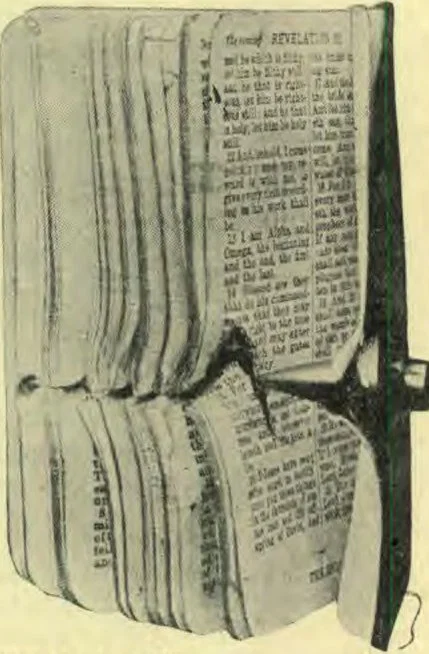
All that this decision has meant to those who were face to face with death, will never be known; but we do know that many desolate wives and mothers have been comforted when these forms, signed by their loved ones, have been placed in their hands. And sometimes these Testaments have brought not only spiritual life, but actual physical salvation. Our illustration shows an example of how this was done. It is interesting to every Seventh-day Adventist to notice that the text immediately above the bullet in the open Bible, is one which we all hold dear: “Blessed are they that do his commandments.”
The work of distribution of the Scriptures among the soldiers has received help from the royalty of different nations. The queen of the Belgians expressed her thanks for the work being done for the Belgian soldiers; a Rumanian princess showed the deepest interest in distributing the Word of God among the soldiers of her country. The former empress of Russia granted the use of her own supply train to assist in forwarding the books to the active army. Russia’s record is the most wonderful of all—five million portions of God’s Word distributed among the fighting forces since the war began!
The British and Foreign Bible Society is carrying on its work as formerly. Even its offices in hostile countries are still open; and since the war began, five million copies of the Bible have been passed through this society. The following incident is related: “In one Eastern country, where the officials naturally require all mission workers to be registered, a policeman stopped a Bible Society colporteur and asked for his permit. ‘Here it is!’ said the colporteur, and opening his Bible, he pointed to the words of the great commission, ‘Go ye into all the world, and preach the gospel to every creature.’ He was allowed to pass.”
Another powerful agency among the soldiers is the Pocket Testament League. In the British army alone 250,000 pledge cards have been signed by soldiers on the field. It is estimated that now the league is adding a thousand a day to its numbers. In the corner of the league military membership card is a small blank square where the men, as they make decision for Christ, may mark the letters A. C. (accept Christ), thus publicly acknowledging Christ as their Saviour. In a report issued by the league we read: “A worker writes of a corporal returned from the front who told him that when death was striking all around him in the trenches he offered all the money he had (about seventy-five dollars) for a Testament, but not one of the men could be induced to part with his treasured little book.” We are told that the time is coming when our Bibles will be taken from us. Shall we at that time have God’s Word so hidden in our hearts that we shall be able to bring comfort to others as well as ourselves? or shall we, too late, offer in vain all we possess for the words which we now neglect?
“A city missionary, whose work lies among the men of a British fire brigade, tells a wonderful story. One dark night of desperate danger and death, a Christian fireman had been called out five times to extinguish fires caused by bombs dropped from Zeppelins upon ‘somebody’s home,’ ‘somewhere.’ The danger was over at last, and the crowd, to relieve the tension of pent-up feeling, was ready for a laugh and a joke. The fireman, exchanging his heavy helmet for a cloth cap, dropped a paper out of the lining, and a rough-looking man shouted out in fun: “’Ere, look, ’e’s dropped a love letter!’
“Standing six feet high, the fireman stooped and picked up the paper, saying, ‘Aye, aye, mates, it is a love letter! You can have it; here you are!’ Greatly surprised, the laughter of the crowd hushed, and the fireman went on: “‘I’ll read what it says!’ And slowly and clearly he read from the paper . . . the old familiar verse, John 3:16. ‘Let me tell you what it means! . . . This is God’s love letter, and it is for you, for me, and everybody else. That love has done everything for me! . . . I’ve been as tough a customer as any of you, but when I came across God’s love letter, it pulled me up and changed me, and here I am, to face bombs and fire, because I believe in that love letter. Now, let me ask you, weren’t you afraid when the bombs began bursting? You need have no real fear if you believe in God’s love letter! I’ve done, and must get away; you take that letter home and think about it!’”
“The fireman climbed onto his engine, and the crowd dispersed. The gospel message had been given in the darkness of midnight from the lips of a workingman—a message out of the recent horrors of a Zeppelin raid. Has it not been written, for all time, that God maketh even the wrath of man to praise him?”
God is indeed using the wrath of man to bring many to a realization of their need of him, and the hearts of many are being turned to him, as they face death on the battle field. Shall we wait until death threatens, before we consecrate our lives to him?
OLIVE D. OSBORNE.
Continue reading: Ready Always to Give an Answer