The Youth’s Instructor, Vol. 65, No. 22.

For the Finding-Out Club
Earlier text: Ready Always to Give an Answer

Bible Heroines

ARE you acquainted with the heroines of the Bible? If not, you have missed reading some of the most beautiful stories in the English language. And if you have thought that men alone did great things in Bible history, you will, after having read some of the stories of Bible heroines, want to include them with Noah, Abraham, David, Daniel, and others, in the roll of truly heroic characters.
Perhaps, in general, they have not performed such great, outstanding acts of heroism as the great men of the Bible have; but though more quiet and unassuming, their acts are none the less worthy of the name heroic, and their characters are none the less noble and great. There are, however, some women of Bible history whose fame rests on the fact that they have heroically met a great crisis. Among this class is Queen Esther.
Suddenly raised from the lowly life of a conquered people and made queen of Persia, Esther did not become vain because of her beauty and position. Neither did she, while surrounded by the wealth and luxury of the royal court, forget her own people, and the God in whom she had been taught to believe. And when the crisis came, and the wicked Haman seemed about to execute his vengeance upon her cousin Mordecai, and the destruction of all the Jews in the realm seemed evident, Esther proved herself.
Putting aside all fear for her personal safety, she bravely appeared, unbidden, in the presence of the king, to request that the wicked decree of Haman be thwarted in its execution. A less heroic person might have refused to risk so much for results which seemed so uncertain. Esther's greatness consisted in unselfishly doing what her duty required. In this, true greatness ever lies. And every one who always nobly performs each duty as it comes, be it small or great, has the elements of a really heroic character.
Another type of heroine is portrayed in the beautiful pastoral story of Ruth. An English literary man was once asked by a group of girls to read to them the most touching story he had ever seen. Substituting modern names for the original ones, he read to them the story of Ruth. The girls were delighted with the story and asked who the author was.
Ruth was a shepherdess, and a member of that despised race, the Moabites. The test in her life came when, weighed down by sorrow, she had to decide whether she would cast her lot with her heathen relatives or with the people of God. In making her decision she cannot be said to have done any great thing, yet that act has been deemed worthy of a place in the Book of books. It takes courage and determination to do right when the way is dark and uncertain. Ruth possessed these elements of heroic character, and in her declaration to Naomi that “where thou goest, I will go; and where thou lodgest, I will lodge: thy people shall be my people, and thy God my God,” she showed a purpose no less firm because gently expressed.
Quite another type of woman is found in the strong-minded Deborah. In a time of national crisis, she arose to the occasion, and led the forces of Israel in the battle against the Canaanites. In accordance with her position as servant of the Lord, Deborah had told Barak of the Lord's purpose to deliver Sisera into his hands. But the faint-hearted Barak refused to go against Sisera unless Deborah would go with him. The prophetess complied with his wish, and went herself into the battle. Sisera, with his hosts, had encamped on the plains of Esdraelon, on the banks of the river Kishon. Deborah's army was upon Mt. Tabor, from whose summit they could see the camps of the enemy. When all was ready, Deborah bade Barak rise, and “silently down from the mountain crown the great procession swept.”
A less dauntless spirit than Deborah's would have quailed before such an undertaking, but the prophetess would not be discouraged in the carrying out of a work which involved the welfare of the people whose ruler she was, and upon whom God had set his approval. God honored her courage by giving her victory over her enemy. In the fifth chapter of Judges is recorded Deborah's wonderful song of victory in which she tells us that the battle was not won by human strength, but “the stars in their courses fought against Sisera.”
Other heroines, not less worthy of mention than these three, are found in the narratives of both the Old and the New Testament. Some of them are among the nameless women of the Bible, but the stories of their heroic lives have nevertheless had their influence for good, and even yet bid us live nobly in our present world.
LAURA PATTERSON.

College Men and the Bible

In the autumn of 1903, a West Point student, addressing a large company of his fellow students, uttered these significant words: “The cadets at West Point know comparatively little concerning the English Bible. The students of North America are planning to increase twofold the number of men studying this Book the present year. We men at West Point should have a part, and we will have a part, in this enterprise.” Five hundred cadets at West Point were studying the Bible in less than two weeks. Each year since then this number has been maintained, and increases, in spite of the fact that these men have less than forty-five minutes to themselves each day. In speaking of this work, the dean of the West Point faculty said: “Judging from the results at the United States Military Academy, I am inclined to believe that this student uprising for the study of the Bible is one of the most profitable and strategic movements of our times.”
This awakening of new interest in the Bible was not confined to West Point, but was coincident with similar movements elsewhere. That it is of wide scope is shown by the fact that in hundreds of colleges and universities of the United States and Canada, are thousands of men in voluntary attendance upon Bible classes. And the work is of special interest by virtue of the fact that it is of student leadership. The success of the idea brings to our notice once more the fact that the great influential force in college life is the college man. The student who mingles with the “fellows,” indulging in the same activities, is the deciding factor relative to any material change in institutional life.
All classes of students are represented in this movement. During the year 1904, seventy representative members of Greek-letter fraternities gathered in a room at the University of Michigan. The meeting was called by one of the men to consider the relation of the study of the Bible to fraternity-house life of the university. After the nature of the study had been presented to the men, this student, who was captain of both the football and baseball teams, said: “I have never been known particularly as a religious man, yet I have come to appreciate that, especially in fraternity life, some of us must face seriously the problems and the temptations of our college days. It appears to me that these problems can be considered in connection with a sane and intelligent study of the Bible.” The result was the formation of groups for the study of the Bible in fourteen Greek-letter fraternities at the University of Michigan. And from this beginning there has grown a nation-wide interest in this Book among fraternity men.
There is one factor which has had marked effect upon this movement. It is the introduction of Bible courses in the curriculum of most of our great colleges. During the nineteenth century, the decipherment of the hieroglyphics on unearthed materials brought to light the ancient civilization of Egypt and of the Tigris-Euphrates valley. This made it possible to picture Biblical history on its true background, and unconsciously led to a renewed study of the Bible as a record of ancient history. And with this interest in the classroom there arose a similar one, conducted on different lines, outside of the classroom.
There was a time when it seemed proper for a college man to apologize for the study of the English Bible. This attitude has been very largely changed by the breadth of view which has characterized this interest in the colleges. In our larger institutions where many men are members of these groups, nearly every variety of belief is represented, nevertheless the students come together to take up certain phases of the Bible, to talk over personal and college problems, and to voice their deep appreciation of the vast opportunities and privileges of college brotherhood. And invariably the men affirm that the class hour is only a small per cent of the value of the study.
The influence of this student movement in the United States has spread to many other nations. Over 150,000 college men in different countries are engaged in a voluntary study of this greatest Book. It would be, indeed, difficult to predict the future results of this interest of college men in the Bible.
JOHN THOMPSON.

The Bible Year

Senior Assignment

June 3: Job 6, 7. Job’s answer to Eliphaz.
June 4: Job 8 to 10. First speech of Bildad; answer of Job.
June 5: Job 11 to 14. First speech of Zophar; answer of Job.
June 6: Job 15 to 17. Second speech of Eliphaz; answer of Job.
June 7: Job 18, 19. Second speech of Bildad; answer of Job.
June 8: Job 20, 21. Second speech of Zophar; answer of Job.
June 9: Job 22 to 24. Third speech of Eliphaz; answer of Job.
For notes on this assignment, see Review for May 31.

Junior Assignment

June 3: Psalms 1, 15, 19. The blessed man; etc.
June 4: Psalms 23, 24, 27. The shepherd psalm.
June 5: Psalm 37. Trust in the Lord.
June 6: Psalms 39, 41, 42. Guarding the tongue.
June 7: Psalms 46, 47. The refuge psalm.
June 8: Psalms 67, 73. A plea for mercy.
June 9: Psalm 78. God’s goodness and mercy.
Titles are given only for the first psalm in each days’ reading.

Poetry of the Bible

Do you like to read poetry? Perhaps you like it and perhaps you do not; but what has that to do with Bible reading? You didn’t know there was poetry in the Bible, did you? Perhaps you have read it and didn’t know it. How strange!
Esther is the last book of history in the Old Testament. Then we come to the poetry. There are five books of poetry—Job, Psalms, Proverbs, Songs of Solomon, and Lamentations. Besides there are several poems in other books, such as the song of Lamech in the fourth chapter of Genesis, the song of Moses at the Red Sea, and the dirge of David over Saul and Jonathan.
If you will turn to the Revised Version you will see that the poetry is there printed differently, so that you can tell it from the prose. But Bible poetry does not rhyme, as we ordinarily understand rhyme, not even in the Hebrew language. Here is a verse of English poetry:
“O thou in whose presence my soul takes delight, On whom in affliction I call, My comfort by day and my song in the night, My hope, my salvation, my all.”
Here the last words of the first and third, and second and fourth lines sound alike. But in Hebrew poetry we have the rhythm of thought. The thought is often repeated in other words to make it more impressive, as,—
“Enter not into the path of the wicked, And walk not in the way of evil men.”
Sometimes the thought is just a little different, but the sentences are alike:—
“The law of the Lord is perfect, converting the soul: The testimony of the Lord is sure, making wise the simple.”
When you get older and study literature, I am sure you will be interested to study more about this subject; for the most important literature that has ever been written is in the Bible.

Job

We do not know just when the book of Job was written. It is thought by some people to be the oldest book in the world. We have asked you to read only the first and the last of this book. You will find it all very interesting, I am sure, if you desire to read it, but you can understand it better, perhaps, when you are a few years older.
Job was a great but good man, who lived in the land of Uz, somewhere in the Syrian desert, east of Palestine. The Lord allowed him to be greatly afflicted, for some good purpose. The last chapter shows how Job, after all this affliction, submitted himself to the Lord and how the Lord blessed him. What trait of character do we often speak of in connection with Job? M. E. K.

Thoughts for Workers

(Texts for June 3-9)
OUR Master inaugurated the profit-sharing plan. He suffered the cruel death of the cross that all who will may become his joint heirs and share with him all things. Soon he will obtain possession of the earth renewed, and receive the heathen for his inheritance. Then those who have served and suffered with him here, those who have made a covenant with him “through sacrifice,” will enter into the joys of their Lord and share the “spoils,” of earth’s greatest victory. What a grand triumphal entry that will be! How this promise should spur the weary worker on to greater diligence!
But there are other reasons for diligence in these twilight hours. There is going to be a great prayer meeting in the near future, when those who have forgotten God and spurned his salvation will turn to him for help. Rich men will be there with their gold; poor men with their needs; statesmen with their fame; orators with their eloquence; and backslidden Christians with their stale records of good deeds. All, all will mingle their cries to God for help. But their cries are in vain; they have turned too late; the door of mercy has been closed, and no man can open it. This will be the saddest of all sad gatherings. What are you doing to save friends who have not turned to God, from being compelled to attend that meeting?
The Christian worker may go forth in confidence if he is honestly endeavoring to obey the Master in every detail. The God who led the children of Israel out of Egypt in triumph, who destroyed 85,000 of the Assyrian host in the night of Jerusalem’s extremity, is with the faithful worker. He is the same mighty God today. He is still working miracles for the workers who are willing to be common tools in his hands. Every conversion you witness is one of God’s miracles, for only the mighty power of God’s Spirit can lead a sinner “from the error of his way.” Your work, your daily life, your prayers, your efforts, are tools which the Master wishes to use; but the work demands superhuman power, and he must do it.
The Christian worker need never despair because “the wrath of man” seems to make his best efforts futile. God has proved time and again how he makes the wrath of man to praise him. When the wrath of the Turkish sultan went forth in a decree to rid the country of all Christians who would not denounce Christianity and accept Mohammedanism, the missionaries began to pray. God heard their prayers; the sultan died; the decree fell lifeless; and Christianity enjoyed more peace and greater prosperity than before. Missionaries everywhere relate similar experiences; and even you and I, if we keep on intimate terms with the Master, may prove this consoling promise in our own work when we meet with wrath, prejudice, and opposition.
Every Christian is a colaborer with Christ, and is to declare his glory among those around him. He is to do this by living a Christian life that is consistent, strong, cheerful, sympathetic, sociable, and helpful; and he is to do it through prayer and tactful missionary effort.
Our days of service are so fleeting, our strength so feeble, our skill so blundering; but still, wonder of wonders, God wants to use us! He has poured out the riches of heaven to purchase our services. “Through the ages an increasing purpose runs,” and he has made us a part of it. This ennobles human life, and makes living worth while; for the life that fully conforms to his will scatters deeds that will not bring shame and sorrow, but deeds that will outlast this perishable earth, and give the faithful worker great joy while the eternal ages roll.

Missionary Volunteer Society Programs for Week Ending June 9

THE programs for this date, with notes, illustrations, and other helpful material, will be found in the Church Officers’ Gazette for June.

X — Shipwrecked and Saved

(June 9)
LESSON SCRIPTURE: Acts 27:21-44.
MEMORY VERSE: “Many are the afflictions of the righteous: but the Lord delivereth him out of them all.” Ps. 34:19.

Questions

1. Who encouraged the sailors in this time of danger? What did Paul say they should have done? Acts 27:21.
2. What exhortation did he give them? On whose authority did he speak? Verses 22, 23. Note 1.
3. What did the angel say to Paul? Why did he ask his fellow travelers to be of good courage? What did he say would happen to them? How long did the storm continue? What did the sailors think about midnight of the fourteenth night? Verses 24-27. Note 2.
4. What did they do to secure their safety? After this what were the sailors about to do? What did Paul say to the centurion and soldiers? How was the sailors’ plan thwarted? Verses 28-32.
5. What did Paul ask those on the ship to do? What reason did he give for making this request? After speaking, what did he do? Verses 33-35. Note 3.
6. What effect did Paul’s words and example have upon the sailors and passengers? What was done next? Verses 36-38.
7. When daylight came, what did they see? What did they think best to do? Verse 39.
8. What was done with the anchors? (See margin of verse 40.) What did they do to gain the shore? Verse 40.
9. What happened to the ship when they reached the shore? Verse 41.
10. When the soldiers saw the danger, what did they think best to do? Verse 42. Note 4.
11. Why was their plan not carried out? Verse 43.
12. How did those on the ship reach land? How many escaped? Verse 44.

Notes

1. “For fourteen days they drifted under a sunless and starless heaven. The apostle, though himself suffering physically, had words of hope for the darkest hour, a helping hand in every emergency. He grasped by faith the arm of Infinite Power, and his heart was stayed upon God. He had no fears for himself; he knew that God would preserve him to witness at Rome for the truth of Christ. But his heart yearned with pity for the poor souls around him, sinful, degraded, and unprepared to die. As he earnestly pleaded with God to spare their lives, it was revealed to him that his prayer was granted.”—“The Acts of the Apostles,” p. 442.
2. The ship followed no certain course during the storm, but was driven hither and thither by the hurricane. “Adria” does not mean the Adriatic Sea, but it was a name then given to the central part of the Mediterranean Sea.
3. Paul was never ashamed of being a Christian. He boldly told the Roman officers, prisoners, and sailors that he belonged to God and was his servant. If at any time one might plead to be excused from returning thanks for food, it would be on shipboard in such a storm, and surrounded by heathen men who did not believe in God. But Paul showed his colors on every proper occasion. “He took bread, and gave thanks to God in presence of them all.” It is well for boys and girls who love Jesus to learn early to stand up bravely for him no matter by what companions they are surrounded.
4. “Paul and the other prisoners were now threatened by a fate more terrible than shipwreck. The soldiers saw that while endeavoring to reach land it would be impossible for them to keep their prisoners in charge. Every man would have all he could do to save himself. Yet if any of the prisoners were missing, the lives of those who were responsible for them would be forfeited. Hence the soldiers desired to put all the prisoners to death. The Roman law sanctioned this cruel policy, and the plan would have been executed at once but for him to whom all alike were under deep obligation. Julius, the centurion, knew that Paul had been instrumental in saving the lives of all on board; and, moreover, convinced that the Lord was with him, he feared to do him harm. He therefore ‘commanded that they which could swim should cast themselves first into the sea, and get to land: and the rest, some on boards, and some on broken pieces of the ship. And so it came to pass, that they escaped all safe to land.’ When the roll was called, not one was missing.”—“The Acts of the Apostles,” p. 445.

Bible Study by Books

STANDING on a rock jutting out from the top of a high mountain in China, I looked down upon the beauty of the plain spread out before me. There lay the rice fields cut up into patches of different shapes and sizes. As the grain was touched by the soft breeze, it waved gently in the brilliant sunlight. The grain in some of the fields was dark green, while in other fields it was a brighter tint. There on the mountain top, I could view the beauty of the varied shades, and make comparison between the many shapes and sizes. The fields were intersected by a winding stream, and dotted by many little villages.
Passing through those fields a few days before, I had not appreciated this beauty. Now as I gained a glimpse of the whole country, and saw in a brief space of time the entire scene, I became intensely interested in what I saw, and formed a desire to go down among those fields, and see them close by. I desired to visit the villages and sail on the river. I had become interested through the bird’s-eye view. This view, which is so necessary to fully appreciate the beauty of any landscape, is just as necessary to comprehend the beauties of God’s Word.
Have you ever taken your Bible and read it book by book, endeavoring to search out the central idea and obtain a knowledge of the general message of each one? There are sixty-six of these books, and it is necessary for us to have a general knowledge of each. Search for the central message. Learn something of the historical setting of each book, and find out for what reason it was written. Then sit down and read it through before laying it aside. When finished, sit for a moment and think of the great thoughts of the book. Approach God’s Word reverently, read it carefully, study it prayerfully, leave it thoughtfully.
While these books are separated, having different authors, yet they are connected by one purpose, one thought, which like a golden thread runs from book to book. Break that thread at one point, and the whole is disconnected. Read each book carefully, trying to search out the golden thought. Endeavor to understand the message before laying it aside. There may be many things hard to understand, but rest assured that all that is necessary to one’s salvation will be revealed to the Spirit-filled child of God when he earnestly studies the divine Word.
It is well, when studying the Bible by books, to obtain first some general outline of the book to be read. Find what the key verse is, and into what separate parts the book may be divided. This knowledge may be obtained from some good Bible commentary or other reliable aid to Bible study. While reading, keep the outline in mind, and note the leading thoughts of the book. Approach the Bible with a reverent desire to know its hidden meaning, not that you may show to others the brilliant knowledge that you have obtained, but that you may draw near to God, the author, and receive large drafts from the fountain of true knowledge, which is salvation.
FREDERICK LEE.

Explanatory Note

BY courtesy of the editor, Mrs. Chase, the members of the Journalism class in Washington Missionary College have had the privilege of getting out this number of the INSTRUCTOR. The various articles of which it is made up have been written by them or by other students in the English classes of the college, and the work of preparing the copy and reading the proofs has also fallen to them. The chief responsibility has rested upon Misses Rachel Salisbury and Jessie Evans, both members of the Senior class, who have served respectively as editor and associate editor.
M. ELLSWORTH OLSEN, Head of the Department of English.

Jewish Navigation

THE ships of Ezekiel's time were very heavy and commodious, and were used wholly for merchandise. The Hebrews were proud of their ships, and made them of the best material they could obtain. The boards were made of the fir tree, the masts of the tall, slender, yet strong cedar from Lebanon. In some, there were ivory benches, the material being brought from the isles of Chittim. The sails were of blue and purple, and came from Egypt. The oars were made of oak.
A little later we find two kinds of boats. One, the man-of-war, was long and narrow, and was propelled mostly by oars. The chief weapon of attack was a ram, or sharpened beam, which was used to pierce and sink the enemy's ship. The other boat was for merchandise. It was more oval in shape than the warship.
On account of the highland location of the Jews, they were slow in using the sea. King David was the first to take advantage, at least on a very large scale, of this important mode of transportation. This is perhaps because of his association with the Phoenicians. At the time of the building of the temple, we find Hiram sending the fir and cedar trees from Lebanon to David, on floats or rafts.
In 145 B. C., Joppa was the principal seaport of the Jews. At that time the mariners had no compasses; they were guided by the stars. This prevented navigation in cloudy weather. Ships usually laid in port from October until spring.
Not until the time of Paul do we find ships used for passengers. By this time quite an advancement had been made in the structure of the boats; the ships were now built about one hundred and eighty feet long, and carried two thousand seven hundred tons.
The Jews were always great fishermen, confining themselves, however, to the inland lakes and rivers. They fished with nets almost entirely, the hook being seldom used. The fishermen of Galilee were a most important element of Jewish population, and from this class Jesus chose some of his most loyal disciples.
JOHN KEELER.
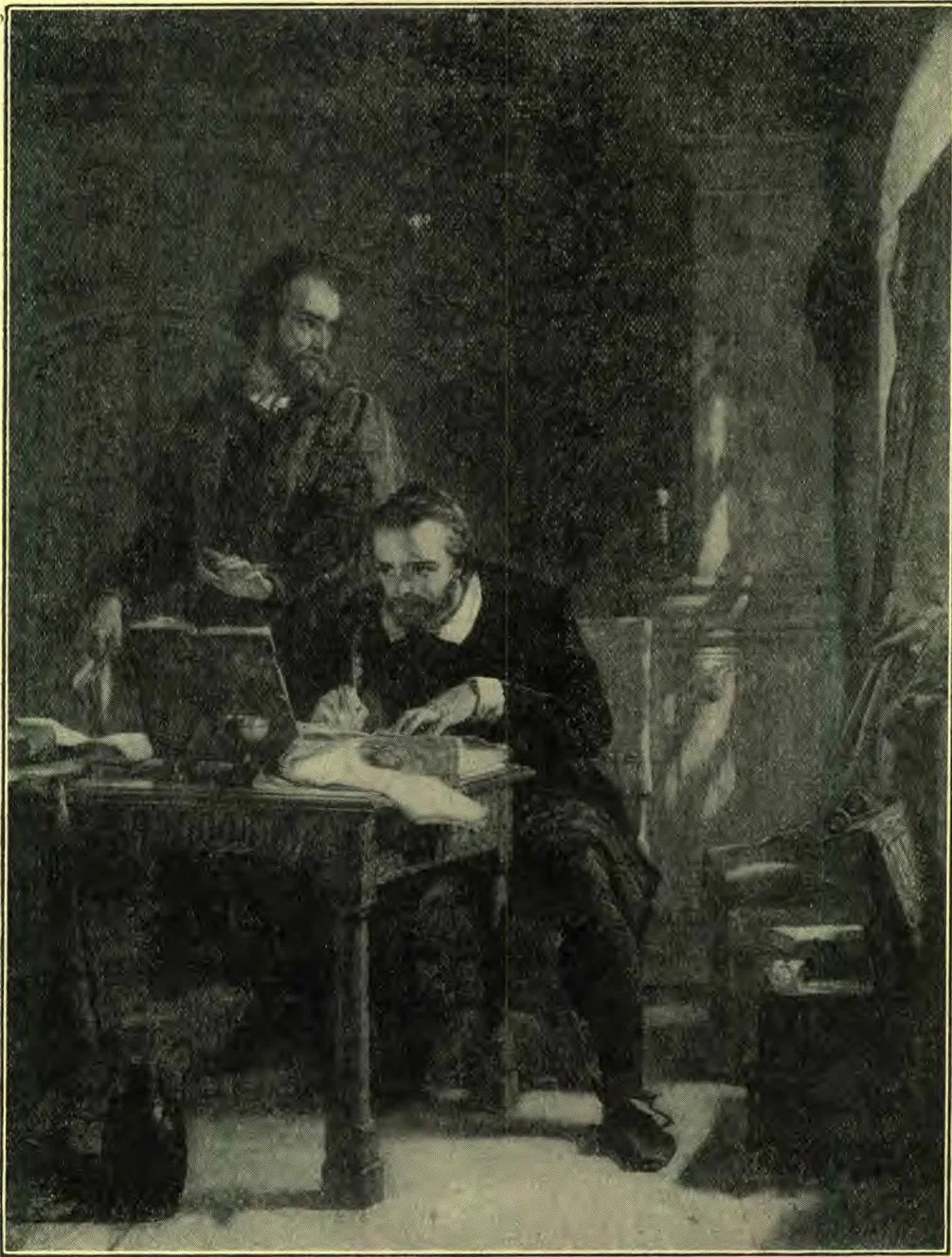
TYNDALE, TRANSLATING THE BIBLE.
V. Shipwrecked and Saved

You have reached the end of this edition.

The Youth’s Instructor · May 29, 1917