The Youth’s Instructor, Vol. LII, No. 49

At the Door

The Youth’s Instructor

December 6, 1904

Review and Herald Publishing Assn. · Washington, D. C. · December 6, 1904

At the Door

I THOUGHT myself indeed secure, So fast the door, so firm the lock; But, lo! he toddling comes to lure My parent ear with timorous knock.
My heart were stone could it withstand The sweetness of my baby's plea,— That timorous, baby knocking, and “Please let me in,— it's only me.”
I threw aside the unfinished book, Regardless of its tempting charms, And opening wide the door, I took My laughing darling in my arms.
Who knows but in eternity, I, like a truant child, shall wait The glories of a life to be, Beyond the Heavenly Father's gates?
And will that Heavenly Father heed The truant's supplicating cry, As at the outer door I plead, 'Tis I, O Father! only I?”
— Eugene Field.

The Children's Poet

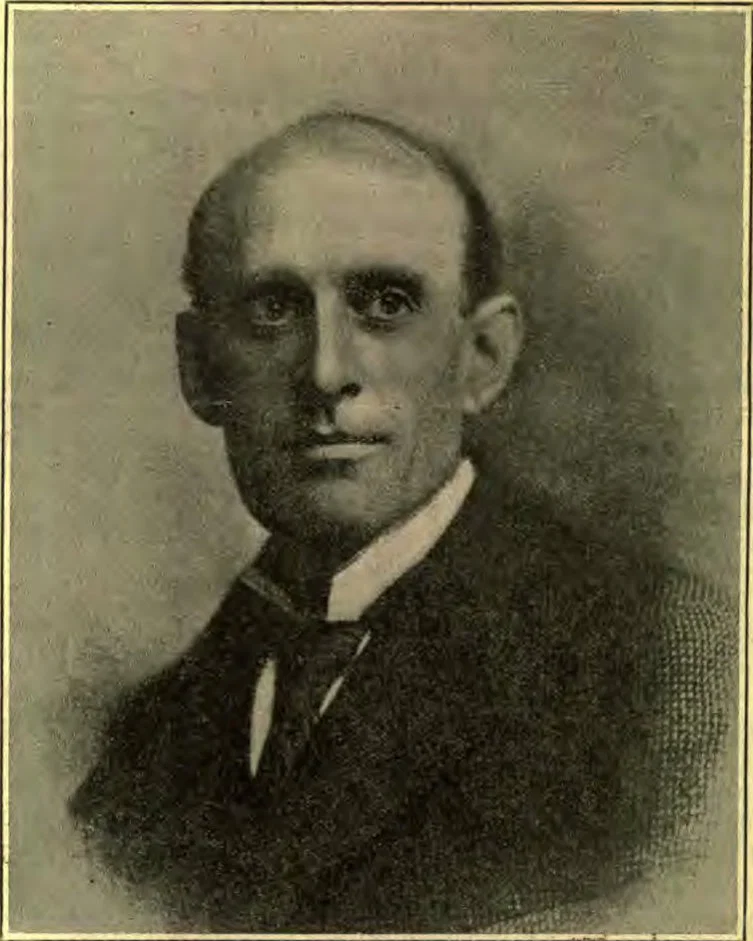
FROM good, clean, notable blood on both ancestral sides came this great writer of the Mississippi Valley, Eugene Field. He was born in St. Louis, Missouri, Sept. 3, 1850. Because he loved children, wrote for them, and lived in close sympathy with his own, he, as no other writer, was enabled to portray the joys and sorrows of childhood.
When he was only six years of age, his mother died; but he never forgot her. He said, “I have carried the remembrance of her soothing voice and gentle touch all through my life. In later years he wrote a poem entitled ‘To My Mother,’ which expresses his heart longing for her. The first stanza gives an idea of the poem:—
“How fair you are, my mother! Ah, though ’tis many a year Since you were here, Still do I see your beauteous face, And with the glow Of your dark eyes cometh a grace Of long ago.”
Fortunately, after the loss of their mother, Eugene and his little brother, Roswell, were not left without the sympathy of a kind, motherly heart. They were left to the care of a cousin, Mary Field French, of Amherst, Massachusetts, who cared for them faithfully and lovingly, and did much to brighten their lives. She secured the best instructors to be found in New England, and the little fellows improved their opportunities.
Among his playfellows Eugene was a natural leader and prime favorite. He excelled in conversational powers. He seems to have formed his literary tastes gradually as his mind and character developed. He went to a number of colleges, but finally was graduated from Columbia College, Missouri. He then visited, with a friend, St. Joseph, Missouri. Here he met Julia Sutherland Comstock, who was destined to be thereafter the chief inspiration of his life. He was married Oct. 16, 1873.
EUGENE FIELD
EUGENE FIELD
After spending six months in Europe, at the age of twenty-two, he associated himself with the St. Louis Evening Journal. Later he served as editor of the Denver Tribune, and also of the Kansas City Times. Mr. Field then accepted a position as paragrapher of the Chicago Daily News. His originality of thought and expression soon brought him into great popularity. His stories and poems were collected and published in 1896 under the titles of “A Little Book of Western Verse” and “A Little Book of Profitable Tales.” It has been said of him that he produced more first-class newspaper work than any other man in the country. While in London a few years later, he wrote a second book of verse, which embraces a broader range than any of his other books.
The death of his oldest son, Melvin, is said to have suggested the well-known poem, “Little Boy Blue,” telling how the little fellow kissed his tin soldiers and put them away, and told them to be good and wait till he should come again. “And faithful to Little Boy Blue they stand, Each in the same old place, Awaiting the touch of a little hand, The smile of a little face.”
The children who pleased him were the quaint, old-fashioned ones or the happy-go-lucky kind.
One little friend complained that the moaning of the wind frightened her at night so that she could not sleep. And he wrote for her “The Night Wind,” which is one of his prettiest children's poems.
He wrote many pretty lullabys, which have charmed the children, and the mothers too. To please a restless, wakeful child he wrote the “Poppy Lady.”
“The Rock-a-bye Lady from Hush-a-bye Street, Comes stealing, comes creeping, And the poppies, they hang from her head to her feet, And each has a dream that is tiny and fleet.”
Another poem which many little ones love is the Dutch lullaby, “Winken, Blinken, and Nod.” These three little fishermen,—
“Winken, Blinken, and Nod, one night Sailed off in a wooden shoe, Onto a river of misty light, Into a sea of dew. ‘Where are you going? and what do you wish?’ The old moon asked the three: ‘We’ve come to fish for herring fish That live in this beautiful sea; Nets of silver and gold have we,’ Said Winken, Blinken, and Nod.”
And then he tells how they fished all night until suddenly—
“Down from the sky came the wooden shoe, Bringing the fishermen home.”
Now we wonder who these quaint little fishermen are, but we find that,—
“Winken and Blinken are two little eyes, And Nod is a little head, And the shoe that rocked them all night long Is a wee one's trundle-bed.”
Not many years ago Mr. Field died, but children have not ceased to sing his lullabys, nor will they soon.
ANNIE SMITH.

Japanese Lullaby

SLEEP, little pigeon, and fold your wings,— Little blue pigeon with velvet eyes; Sleep to the singing of mother-bird swinging— Swinging the nest where her little one lies.
Away out yonder I see a star,— Silvery star with a tinkling song; To the soft dew falling I hear it calling— Calling and tinkling the night along.
In through the window a moonbeam comes,— Little gold moonbeam with misty wings; All silently creeping, it asks, “Is he sleeping— Sleeping and dreaming while mother sings?”
Up from the seas there floats the sob Of the waves that are breaking upon the shore. As though they were groaning in anguish, and moaning— Bemoaning the ship that shall come no more.
But sleep, little pigeon, and fold your wings,— Little blue pigeon with mournful eyes; Am I not singing? See! I am swinging— Swinging the nest where my darling lies. — Eugene Field.

James Watt and His Workshop

Visitors to the bustling, smoky city of Birmingham, England, will see in the heart of the city the mansion once owned and occupied by James Watt, the famous inventor. In his day it stood some distance outside of the city, in the midst of a wide and leafy park; but the brick houses and the brick sidewalks have crawled farther and farther into the country, until now the former suburban home is confined within narrow limits.
Close to the stately mansion is the humble little workshop where the great inventor worked. It remains just as he left it for the last time, more than eighty-five years ago.
Through the kindness of the generous proprietor of the estate, visitors are allowed to enter the dingy little shop, and it is an inspiration to go into the time-stained room that he occupied for so many years. There are the tools with which he worked, the plans he drafted, the models of his inventions, and his papers with his own handwriting.
As one stands in the doorway, it seems just as if the former owner had stepped out only for a minute, and would presently return.
Village gossips tell the story that the ghost of Watt occasionally flits back at dead of night to his old workshop, and may be heard tapping away at his unfinished models. One thing is certain, if the old gentleman ever should return, he would find things looking just the same as when he stepped out on that August day nearly a century ago. What a story it tells, this little old shop in the midst of that busy, teeming city!
Here James Watt labored for more than twenty years, so busy that sometimes he forgot to eat. There is a small, rough, wooden shelf, placed just outside the door, on which the great inventor was accustomed to have his meals placed when he was deep in his calculations; for no one was allowed to lift the latch of his workshop door when he was at work inside. Often his dinner would remain on the shelf untasted for hours, while the scheming brain on the other side of the door was busy evolving some intricate problem, or the skilful hands were perfecting some important invention.
This room tells the story of Watt's life; to know the man one should visit this little shop. Doubtless when the young folk think of James Watt, they picture the dreamy little boy watching the lid of his mother's teakettle as the steam gently lifts it while it hangs over the blaze of the great chimney. But here you see an old man in a dirty leather apron, a rich old man, and a famous one, too, still content to work like a common laborer in a dingy shop, interested to the last in the progress of the world and the benefit of humanity. This is the real Watt, whom the world remembers to-day,—the inventor, the worker, the benefactor.
Watt was a wonderfully busy man all his life, and the general reader hardly knows how much we are indebted to him along many lines. In this old shop are the models of many an invention that makes life more worth the living. In one corner of the room is the first copying-press for copying manuscript by using a glutinous ink, and pressing the written page against a moistened sheet of thin paper. Every time you see a business letter, looking a little blurred or inky, as if it had just gone through a damp copying-press, you can say to yourself, “James Watt had something to do with the production of this letter.”
The first steel pen was made in this shop. So when you dip your steel pens into your ink-bottles, you can give another thought to the useful old man who did so many wonderful things in this dingy workroom. Here in this shop the first sun picture was taken, antedating Daguerre by several years; but the lucky Frenchman first made his invention known to the public, and so made his name immortal. However, James Watt has enough honor heaped upon his name.
Although skilled in mathematics and mechanics, Watt had no business faculty. But he had a good partner who attended to that. Watt used to say of himself that he would rather face a loaded cannon than to settle an account or make a bargain. He had the good sense to put his whole mind on inventing, while he left the account and bargain business to Matthew Boulton.
Dreamy, silent, romantic old shop, may it long be suffered to stand as a memento and reminder of its famous master! After a visit within its walls, one feels much better acquainted with the inventor. Here you meet him face to face, as it were, shake hands with him, and see him as he really looked, busy with his plans and tools. In the lovely old Handsworth church, where his marble statue stands in the quiet niche where his ashes sleep, you know that he is dead, but here in the dusty old workshop he still lives.—Sabbath School Visitor.

Food Habits of Birds

It would be useless for me to say that birds do no damage on the farm or in the orchard, for they certainly do; but in almost every case the good they do is far in excess of the injury. Some live almost exclusively upon insects; others destroy large numbers of small mammals, such as mice, gophers, and rabbits, which would otherwise do serious damage to grain and other vegetation. Still others are exceedingly valuable as scavengers in removing putrid and offensive matters, which, if left, would greatly endanger health and life.
One of the most valuable of the insect destroyers is the quail. Professor Bruner, of the University of Nebraska, says: “Perhaps no other bird that frequents the farm pays higher prices for the grain it eats than does the quail. Living about the hedgerows, groves, and ravines, where insect enemies gather and lurk during the greater part of the year, this bird not only seizes large numbers of these enemies daily during the summer months, when they are ‘abroad in the land,’ but all winter through it scratches among the fallen leaves and other rubbish that accumulates about its haunts, seeking for hibernating insects of various kinds. Being a timid little creature, the quail seldom leaves cover to feed openly in the fields, and therefore does but little actual harm in the way of destroying grain. In fact, it takes only stray kernels that otherwise might be lost. This bird is one of the few that feeds upon that unsavory insect, the chinch-bug; and the number of this pest that occasionally are destroyed by it is really astonishing. No farmer or fruit grower should ever kill a quail himself, nor permit another person to hunt it on his premises.”
There are some birds that live almost entirely on grain, but it has been found by repeated examination of their stomach contents, that the good done by them in destroying noxious weeds, more than pays for the harm they do as grain eaters.
The United States Department of Agriculture has made a careful investigation of the food habits of hawks and owls. The result of their observations show that with few exceptions these birds are the farmers’ friends, and not his enemies.
There are but few birds that feed largely upon hairy caterpillars. Among these are the cuckoos; and for this reason they are of great benefit to man.
The woodpeckers are beneficial, some more so than others. They are especially serviceable in destroying the larvæ of wood-boring insects. When we remember that one borer will often kill an entire tree if left to itself, we can understand that these birds do a large amount of good even if they destroy only a small number of insects.
One of the most common woodpeckers in many of the States, is the flicker. It lives largely on ants, which seem to form about half its diet. It has been proved, also, that it destroys many of the chinch-bugs. The stomach of a specimen killed near Lincoln, Neb., was found to contain nearly one thousand of these bugs. About one fourth of its diet consists of fruit, but this is usually furnished by nature, and not by man, the bird seeming to prefer the wild fruits to the cultivated.
The kingbird, sometimes called the bee bird, is often accused of destroying bees, and justly so; but the bees that it destroys are chiefly drones, so very little harm is done.
The crow is almost universally considered a thief and an outlaw, a black-coated vagabond, hovering over the fields of the industrious, and fattening on the labors of the farmers. But his character is not so bad as it is usually thought to be. He destroys myriads of worms, moles, mice, caterpillars, grubs, and beetles. A thorough investigation made by the United States Department of Agriculture has resulted in the conviction that even the crow does more good than harm.
The English sparrow is usually considered a pest, and deserving of death; but there is undoubtedly heaped upon his head more blame than he merits. At any rate, it has some beneficial traits, as well as those that are injurious. It seems to have an intense hatred for the periodical cicada, or seventeen-year locust, as it is perhaps more commonly called. Dr. J. B. Smith, one of the highest authorities on economic entomology says that “wherever the English sparrow has been introduced, the periodical cicada is doomed.” Where the sparrows are numerous, entire broods of the insect are destroyed, being attacked and pulled to pieces in the most ruthless manner.
It is probable that much of the evil work of which the English sparrow is accused is the result of the blue jay’s depredations, but we should be careful in condemning any kind of bird until we have a thorough knowledge of its habits.
“In the red-winged blackbird we have a friend that we little dream of when we see the large flocks gathering about our corn fields during late summer and early fall. During the rest of the year it is engaged most of the time in waging war on various insect pests, including such forms as the ‘grub-worms,’ cut-worms, grasshoppers, army worm, beet caterpillar, and various other insects. Even when it visits our corn fields, it more than pays for the corn it eats by the destruction of the worms that lurk under the husks of a large per cent of the ears in every field.”
Various birds are often accused of destroying fruit, but if dishes of water were placed in the orchard and vineyard, where the birds could drink without fear of cats or small boys, the injury to the fruit would be much less than it is.
Among our most common birds are the meadow-lark, the brown thrasher, the catbird, and the robin. The first of these, the meadow-lark, is one of the most valuable of the insect-destroying birds. The others also destroy many insects, but are more or less destructive to fruit. However, extensive investigations have proved that they are all worthy of protection, and that they pay a high price for the fruit they eat.
The following words, quoted from a paper by Wilson Tout, are worthy of careful thought: “The living question for us is bird protection. How can we secure the best results? I would say, By education. Get the teachers at work, get the sportsman interested in the observation of game laws, urge the importance of bird protection on the people, show the folly of using ‘stuffed’ birds for head ornamentation, and a silent revolution in favor of the birds is bound to take place. Then every roadside will teem with the brood of the quail, the drowsy yeomanry will be awakened by the early matin of our friendly robin, and the thrasher, securely tipping the topmost twig of a towering tree, and shaking his little throat, will send forth a song, the wild, artless harmony of which will gladden the hearts of mankind, and inspire them to nobler thoughts. Then men will bow their heads before the gush of melody bursting from every coppice and impenetrable bramble, and, looking through nature, will learn of nature’s God.”
B. E. CRAWFORD.

Little Boy Blue

THE little toy dog is covered with dust, But sturdy and stanch he stands; And the little toy soldier is red with rust, And his musket molds in his hands. Time was when the little toy dog was new, And the soldier was passing fair; And that was the time when our Little Boy Blue Kissed them, and put them there.
“Now, don’t you go till I come,” he said, “And don’t you make any noise!” So, toddling off to his trundle-bed, He dreamt of the pretty toys; And as he was dreaming, an angel song Lured from us our Little Boy Blue,— O, the years are many, the years are long, But the little toy friends are true.
Aye, faithful to Little Boy Blue they stand, Each in the same old place, Awaiting the touch of a little hand, The smile of a little face. And they wonder, as waiting these long years through In the dust of that little chair, What has become of our Little Boy Blue Since he kissed them, and put them there. — Eugene Field.

The Giant Fishes of the Sea

Many people, including some scientists, believe that there exist in the sea to-day monster animals—sea-serpents, leviathans, and giant fishes—which have never been captured, and hence are unknown to zoologists, and have no place in scientific books. Whatever may be the facts in regard to such creatures, there are well-known members of the fish class which deserve to be regarded as monsters, and which may have given rise to the sea-serpent stories. Some of the most noteworthy of these fishes are here referred to and illustrated.
At the mention of giant fishes, many young folk will at once think of the sharks, among which, indeed, are found the largest existing fishes. Of the numerous kinds of sharks, noteworthy on account of their size, there are four in the front rank; these are the sleeper shark, the man-eater shark, the basking-shark, and the whale-shark.
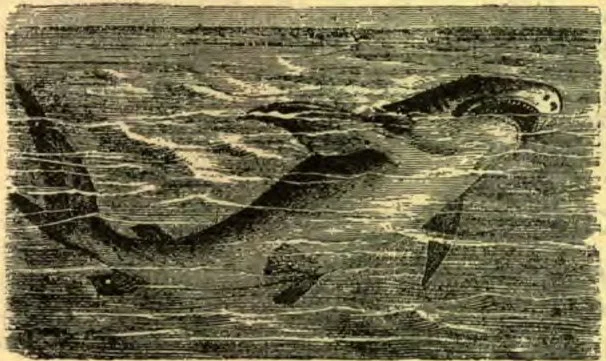
MAN-EATING SHARK
MAN-EATING SHARK
The sleeper-shark, whose scientific name (Somniosus microcephalus, meaning sleepy small-headed fish) fits it so admirably, appears to have developed its body at the expense of its brain; for it is a sluggish, stupid glutton, about six times as long as the average man. Its home is in the arctic regions, but it sometimes makes visits as far south as Massachusetts, Oregon, and the British Isles. It is usually seen lying quietly at the surface, apparently dozing, and is easily approached by vessels; but sometimes, when hungry, it rouses itself and goes in search of its prey, fiercely attacking and injuring whales, apparently unconscious of the great difference in their respective sizes.
One of the largest, and perhaps the most formidable of sharks is the “man-eater,” or great blue shark. It roams through all temperate and tropical seas, and is everywhere dreaded. Its maximum length is forty feet, and its teeth are three inches long. While there are few authentic records of sharks attacking human beings, there have undoubtedly been many cases of sharks simply swallowing people who have fallen overboard, just as they would swallow any other food. How easy it would be for a man-eater to devour a person, may be judged from the finding of a whole hundred-pound sea-lion in the stomach of a thirty-foot shark on the Californian coast. A certain man-eater, thirty-six and a half feet long, had jaws twenty inches wide inside, and teeth two and a half inches long.
SHARK'S TEETH
SHARK'S TEETH
The basking-shark, known also as the elephant-shark and bone-shark, is an inhabitant of the polar seas, but is occasionally observed as far south as Virginia and California, and some years ago was not rare on the English and New England coasts. It reaches a maximum length of fifty feet, and is exceeded in size by only three or four animals now alive. Provided with small teeth, it feeds on fishes and floating crustaceans, and is not of a ferocious disposition. It is dangerous only because of its great bulk, and when attacked, its powerful tail easily demolishes small boats. The basking-shark was formerly hunted on the coasts of Norway and Ireland for its oil; it was also sought on the shores of Massachusetts in the early part of the last century; and many of these sharks from twenty-five to thirty-eight feet long were recorded. The liver of a large specimen sometimes yielded twelve barrels of oil.
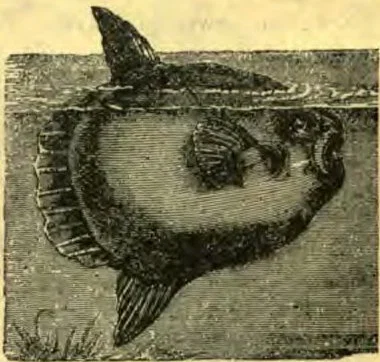
SUNFISH
SUNFISH
The largest of all fishes, the largest of all cold-blooded animals, and the largest of all existing animals, except a few kinds of whales, is the whale-shark, originally discovered at the Cape of Good Hope, but now known in Japan, India, South America, Panama, California, and elsewhere, a specimen having recently been obtained in Florida. This shark is said to attain a length of seventy feet, and is known to exceed fifty feet.
A fish of such peculiar form that the Italians call it mola (millstone), and the Spaniards pes luna (moonfish), is known to Americans and English as the sunfish; for it appears at the surface of the ocean on bright days, and spends many hours basking listlessly in the sun, sometimes lying flat with one side out of the water, sometimes with the back fin projecting like a buoy above the surface. The fish is disk-shaped, its height nearly equaling its length. It is one of the most grotesque of fishes, being apparently nearly all head. Of almost world-wide distribution, it is particularly abundant on the southeastern coast of the United States and on the California coast. It swims but little, being usually content to be drifted along by the ocean currents. The Gulf Stream wafts many a sunfish north each summer, so that the species is not rare off southern New England. That the fish deserves a place on the list of giant fishes may be judged from the fact that examples weighing from two hundred to five hundred pounds are not rare, and that much larger ones are occasionally found. The weight of the largest known specimen, caught in 1893, at Redondo Beach, California, was eighteen hundred pounds. On such a monster, lying on its side, there would be room for thirty men to stand.
The valuable mackerel family has one member which easily ranks first in size among the “bony fishes,” as distinguished from the sharks, rays, sturgeons, etc., which have gristly skeletons; this is the horse-mackerel, or great tunny (Thunnus thynnus), whose range encircles the globe, and which is an object of fisheries in many countries, notably southern Europe. Built on the compact and graceful lines of our common mackerel, it excels in speed, alertness, and vigor among the fishes of the high seas, and might very easily make a trip across the ocean in one third the time of our fastest steamships. It preys on all kinds of small fish, and is often seen playing havoc among schools of luckless herring and menhaden. Fifteen feet is about its maximum length, and fifteen hundred pounds its estimated maximum weight, although it is likely that this weight is considerably exceeded. Thirty tunnies harpooned by one fisherman during a single season weighed upward of thirty thousand pounds. A mutilated specimen ten feet long was found by the writer on the coast of Massachusetts; its head weighed two hundred and eighty-two pounds; its carcass about twelve hundred pounds.—Hugh M. Smith, in St. Nicholas.
(To be concluded)

Value of the Bob White

THE ornithologists of the Department of Agriculture have been making an investigation of the economic value of the bob white, or common quail, as a result of which it is now announced that that bird is “probably the most useful, abundant species on the farms.” Field observations, experiments, and examinations show that it consumes large quantities of weed seeds, and destroys many of the worst insect pests with which farmers contend, and yet it does not injure grain, fruit, or any other crop. It is figured that from September 1 to April 30, annually, in Virginia alone, the total consumption of weed seed by bob whites amounts to five hundred seventy-three tons. Some of the pests which it habitually destroys, the report says, are the Mexican cotton boll weevil, which damages the cotton crop upward of fifteen million dollars a year; the potato beetle, which cuts off ten million dollars from the value of the potato crop; the cotton worms, which have been known to cause thirty million dollars’ loss a year; the chinch-bugs and the Rocky Mountain locust, scourges which leave desolation in their path, and have caused losses to the extent of one hundred million dollars in some years. The report urges measures to secure the preservation of the bob whites in this country.—Selected.

Making the Most of Leisure Time

“A MAN’S leisure time is his unused capital.”

O Wasted Life: A Verse on Time and Heaven

“O WASTED life! How sad to know That one has nothing then to show For all the time that God has given To fit him for the joys of heaven; While others bind their ripened sheaves, He gathers only whitened leaves.”

THE WEEKLY STUDY

Imprisonment of Paul and Silas at Philippi

Opening Exercises.

SCRIPTURE FOR STUDY: Acts 16: 19-40.
PARALLEL SCRIPTURE FOR STUDY: Acts 5: 17-29; 12: 1-19.
SCRIPTURE FOR PERSONAL STUDY: Acts 14: 22; 1 Peter 4: 12-16; Matt. 5: 10-12.
REFERENCE STUDY: “Sketches from the Life of Paul,” pages 75-81.
OUTLINE OF TOPICS:—
  • Why imprisoned.
  • Whipped.
  • Charge to jailer.
  • Paul and Silas pray.
  • The earthquake.
  • Its effect.
  • Jailer converted.
  • Baptism.
  • Released from prison.
  • Departure.

Notes

Note the power of prayer. When Peter was in prison, “prayer was made without ceasing of the church unto God for him,” and the Lord sent a mighty angel to liberate him. Paul and Silas, with feet in the stocks, and suffering from a terrible scourging, were still happy in the Lord, and at the midnight hour “prayed, and sang praises unto God.” In response, an earthquake rent the jail. Truly the “effectual fervent prayer of a righteous man availeth much.” Jesus says, “What things soever ye desire, when ye pray, believe that ye receive them, and ye shall have them.” Mark 11: 24. Let us pray much.
It seemed a strange providence which permitted the apostles at the very beginning of their labors in this new field to be arrested, and thrust into prison. Apparently this would hinder their work. But God permitted it that his work might be advanced. Joseph’s feet were “hurt with fetters,” but he became a mighty man in Egypt. Daniel, too, was cast into the lions’ den. This was perhaps the only way the jailer could be reached by the gospel. Nothing can stop the progress of the car of truth.
“There in the pitchy darkness and desolation of the dungeon, Paul and Silas prayed, and sang songs of praise to God. The other prisoners heard with astonishment the voice of prayer and praise issuing from the inner prison. They had been accustomed to hear shrieks and moans, cursing and swearing, breaking at night upon the silence of the prison; but they had never before heard the words of prayer and praise ascending from that gloomy cell. The guards and prisoners wondered who these men were who, cold, hungry, and tortured, could still rejoice and converse cheerfully with each other.”
“An angel was sent from heaven to release the apostles. As he neared the Roman prison, the earth trembled beneath his feet, the whole city was shaken by the earthquake, and the prison walls reeled like a reed in the wind. The heavily bolted doors flew open; the chains and fetters fell from the hands and feet of every prisoner.”
“The keeper of the jail had heard with amazement the prayers and singing of the imprisoned apostles. . . . He fell asleep with these sounds in his ears, but was awakened by the earthquake, and the shaking of the prison walls.”
“The severity with which the jailer had treated the apostles had not aroused their resentment, or they would have allowed him to commit suicide. But their hearts were filled with the love of Christ, and they held no malice against their persecutors.”
“He [the jailer] hastened into the inner dungeon, and fell down before Paul and Silas, begging their forgiveness. . . . He saw the light of heaven mirrored in their countenances. . . . He saw his own deplorable condition in contrast with that of the disciples, and with deep humility and reverence asked them to show him the way of life. . . . The jailer then washed the wounds of the apostles, and ministered unto them; and was baptized by them. A sanctifying influence spread among the inmates of the prison, and the hearts of all were opened to receive the truths uttered by the apostles.”
“Paul and Silas felt that to maintain the dignity of Christ’s church, they must not submit to the illegal course proposed by the Roman magistrates. . . . They had been publicly thrust into prison, and now refused to be privately released, without proper acknowledgments on the part of the magistrates.”
“The magistrates entreated them to depart, because they feared their influence over the people, and the power of heaven that had interfered in behalf of those innocent men who had been unlawfully scourged and imprisoned. . . . They complied with the request of the magistrates, but did not hasten their departure precipitously. They went rejoicing from the prison to the house of Lydia, where they met the new converts to the faith of Christ, and related all the wonderful dealings of God with them.”
“Paul’s labors at Philippi resulted in the establishment of a church there, whose numbers steadily increased.” G. B. T.

Missionary Gardens

THIS is just the time of year when many are interested in that beautiful service, the Harvest Ingathering. As one of its most interesting features needs much planning and time, it seems only wise that, as we complete the service for this year, we turn our attention to the one in the future. This most interesting feature is the missionary garden, which is the result of the children's own work.
At a recent Harvest Ingathering service a number of baskets of potatoes, pumpkins, and other vegetables were brought, which were the direct work of the children. Each had been given a small piece of ground, and by his own efforts had planted, cared for, and harvested his crop. Thus all the children not only felt pleased to be able to bring their offering when the time came; but they gained a practical experience of much value to them. Very few children are so situated that they could not have a small piece of ground to cultivate.
One of our ministers, living in a city, where all the ground he has is a very small back yard, desired so much to have a few tomatoes that he dug up his back yard and set out tomato plants, leaving only a foot-path. As a result of his work he had a good yield of tomatoes.
Surely, then, all who live in a small village or in the country can find a piece of ground large enough for the children's missionary garden.
LULU I. TARBELL.

What Our Young People Are Doing

I HAVE just read a letter from a young man, in which I was greatly interested. Here are quotations from it:—
I hope and pray that this campaign may be the beginning of the effort on our part to arise and give this message to “every nation, and kindred, and tongue, and people,” and that it will hasten the time when bloodshed and corruption and all things that offend will give place to that “blessed hope, and the glorious appearing of the great God and our Saviour Jesus Christ.”
I wish my order was larger. It may be possible for me to raise it to twenty-five sets before the first of November.
Your brother in Christ.
And the preceding is but an individual expression of the general sentiment I have found everywhere. I believe this to be a fulfilment of the following statement made in “Education:” “Already many hearts are responding to the call of the Master Worker, and their numbers will increase. With such an army of workers as our youth, rightly trained, might furnish, how soon the message of a crucified, risen, and soon-coming Saviour might be carried to the world!”
H. H. HALL, Sec. Gen. Conf. Pub. Com.
Continue reading: Words of Courage