Review and Herald Publishing Assn. · Washington, D. C. · August 8, 1905
Traces of Sabbath Observance in Olden Time
By William A. Spicer
5—Some Pioneers In the Modern Revival of the Sabbath Truth
ALL through the Dark Ages witnesses for God’s Sabbath were protesting against the lawless rule of the papacy. History gives us only a glimpse here and there of these early Protestants. We know that about the year 600, the pope was pronouncing curses upon Sabbath-keepers in Rome itself. While Queen Margaret in Scotland was pressing the Culdee churches to give up the Sabbath, the agents of Pope Gregory (about 1054) were fighting against the Sabbath in the regions about Constantinople.
All along the centuries the Waldenses had among their numbers those who went to the root of the matter and kept God’s Sabbath instead of the papal Sunday, amid their mountain retreats in the Alps. They were missionaries. Even the young people braved persecution and death in going forth as workmen, teachers, or peddlers to carry the light to other places. Like witnesses for the truth were found in those times in Bohemia and far Hungary. Not long after the Reformation had spread over the continent of Europe, there began in England the distinct Sabbath revival which has continued to our own day.
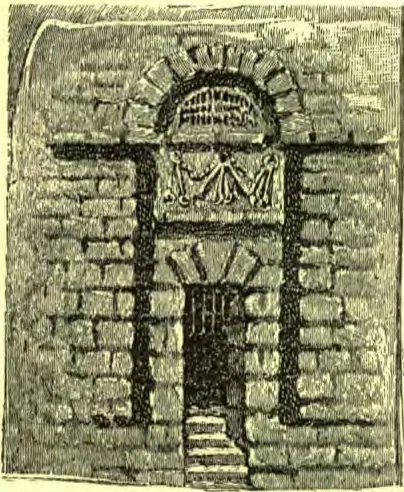
ONE ENTRANCE TO OLD NEWGATE
About the time the Pilgrim Fathers were landing in New England, to find religious freedom, John Trask was stirring up the church authorities by preaching the Sabbath in London. He was brought before the old star-chamber court, where the clergy of that time had it all their own way in trying men for heresy. For “scandalizing the king, the bishops, and the clergy,” by preaching that they ought to obey the fourth commandment he was put in the pillory at Westminster. Standing on a platform, with head and hands through holes in the boards of the pillory set upright before him, he was made a spectacle to the crowds. Afterward he was publicly whipped to Fleet prison, near the Ludgate Circus. The Memorial Hall, a headquarters for the dissenting churches in London, now stands on the site of the old Fleet prison, where so many dissenters suffered. The distance from Westminster is about a mile and a quarter, perhaps. It is only a short penny ride on a ’bus now, down through bustling Fleet Street and the Strand, by way of Charing Cross. But it was doubtless a long road to Trask that day, whipped at the tail of a cart, followed by the curious crowd, and cursed by the clergy. After keeping him imprisoned for one year, they broke him down, and he gave up the Bible Sabbath.
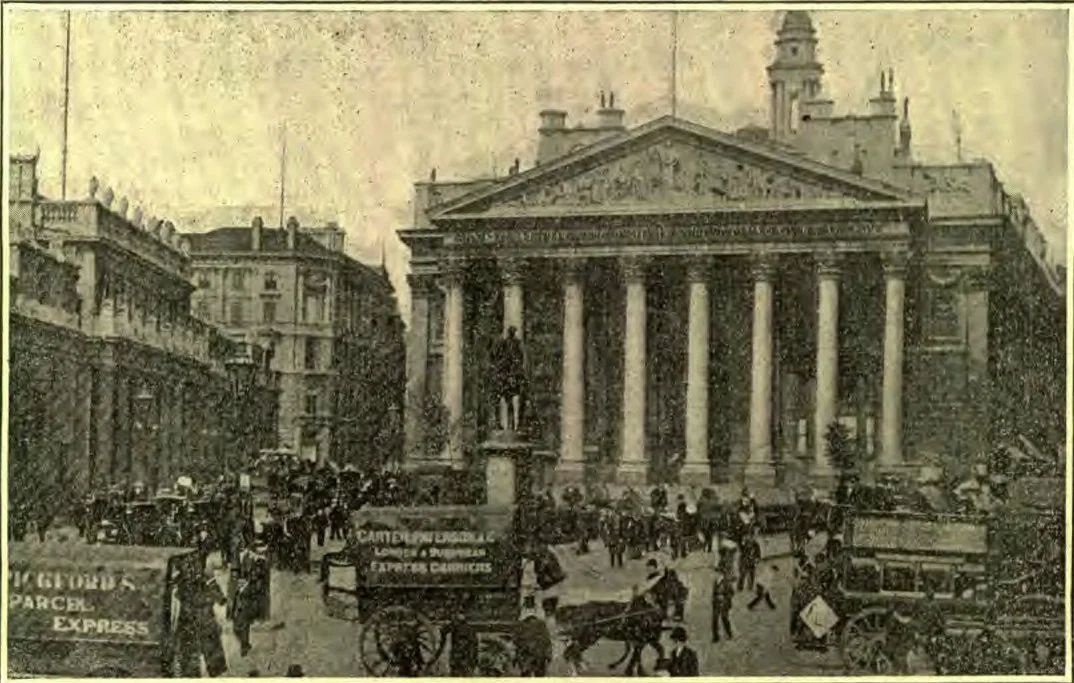
MANSION HOUSE PLACE, LONDON
His wife was made of sterner stuff. A mild little woman, the Lord showed in her case how, out of weakness, the child of faith is made strong.
Amid the struggles that her husband had as a preacher of the Sabbath, she helped to keep the home going by school-teaching. She had no school on Sabbath, of course, and none on Sunday. Any Sunday-keeper might have done the same thing without occasioning remark; but it was different with a Sabbath-keeper. An old writer, Pagitt, who lived at that time, says that, “for teaching only five days in the week, and resting upon Saturday, it being known upon what account she did it,” Mrs. Trask was sent to prison.
No doubt those who broke her husband down, thought soon to quench her little light. Old Pagitt writes that she was noted for her kindness to the poor, and “endued with many particular virtues, well worthy the imitation of all good Christians,” but he adds that a strange “obstinacy in her private conceits spoiled her.” She would be true to the Sabbath of the Lord her God, though all the world were against her. For nearly sixteen years she was kept a prisoner, loving not her life unto the death; for death only released her at last.
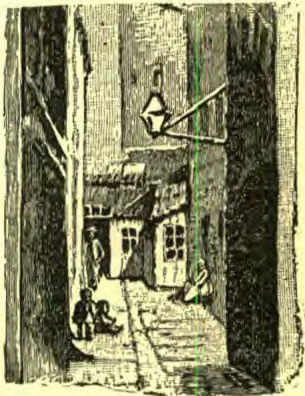
BULL-STAKE ALLEY
One October Sabbath, about the year 1661, a congregation of Sabbath-keeping Baptists were meeting in their house of worship in Bull-stake Alley, off the Whitechapel Road. This was doubtless well on the outskirts of London in those days. Now it is in the busy heart of the East End. John James was preaching that Sabbath afternoon, when officers and soldiers rushed in and dragged him to prison.
He was tried for treason. Some witnesses, who were shown to be false and unreliable men, testified that they had heard him utter words against the king and government. It is evident that the basis of their lying witness was the fact that John James preached the second coming of Christ as well as the Sabbath. He believed that Christ’s kingdom was near at hand, and that all the kingdoms of this world would give place to the everlasting kingdom of King Jesus. In the trial, the conduct and manner of James won general sympathy. But those were unsettled times politically, and the clergy were harshly dealing with all who had separated from the church.
James was sentenced to be hanged, and his body cut up and exposed on the city gates.
He was not at all dismayed. He met the judge’s sentence with the words: “Blessed be God; whom man condemneth, God justifieth.” While lying in prison, awaiting death, many tried to secure his pardon, having been won over to him by his Christlike bearing. But at last he went to Tyburn tree, the place of execution, now well within West London, near the Oxford Street corner of Hyde Park. On the scaffold he prayed for his people and country, for the false witnesses against him, for the executioner, and for the coming of Christ. Hearts were melted at the scene. The executioner begged his forgiveness for what he was about to do. A friend, observing his freedom in God, said to him, “This is a happy day.” James answered, “I bless God it is.” Then with the prayer, “Father, into thy hands I commit my spirit,” this Sabbath-keeping witness overcame the powers of darkness by the blood of the Lamb and the word of his testimony; for he, too, loved not his life unto the death. His head was set up on a pole in Whitechapel Road, in front of Bull-stake Alley.2
Mansion House Place, by the Bank of England and the Royal Exchange, is the heart of London. The main thoroughfares running out from it are like great swollen arteries, through which throbs the life of that vast city. Near this center, just off Broad Street, now all too narrow for the traffic rushing through it, there is a short alley leading to a low building which still bears the name “Pinner’s Hall.” In this hall Francis Bampfield ministered to a congregation of Sabbath-keeping Baptists. He had been a clergyman of the Church of England. One historian says he was “a celebrated preacher, and a man of serious piety.”
One Sabbath in February, 1682, the under sheriff and his officers came into the meeting hall and ordered him in the name of the king to cease preaching. He replied that he had orders from the Head of the church and the King of kings to preach the word. They arrested him and brought him to trial. He was sentenced to imprisonment for life in old Newgate prison. He died after about a year, being seventy years old, and unable to endure the hardships suffered. The old historian says he was followed to his grave by “a very great company of factious and schismatical people.”
We must close this story of men and women of olden time who kept God’s Sabbath when it meant persecution and suffering, and sometimes the sacrifice of life itself. But they counted God’s truth far more precious than life. Despised of the world, counted obstinate and factious, their names are nevertheless on God’s great honor roll of the heroes of faith in all ages—men and women of whom the world was not worthy, who suffered and bled and died for the truth as it is in Jesus. Now that the last days have come, and the closing conflict is on, may we also learn to value the truth of God above all else. We live in stirring times. Witnesses are needed still, in all the earth, who will do and dare for the word of God and the glory of his cause.
W. A. SPICER.
Spiritualism: The Crowning Delusion of Sin
By G. B. Thompson
Spiritualism
For six thousand years the prince of darkness has carried on his warfare against God in the earth. His work is to deceive souls, and drag them down to ruin. In the closing scenes in the history of the earth he will come down with special power, and work with all deceivableness of unrighteousness. Rev. 12:12; 2 Thess. 2: 8-12. “Be sober, be vigilant; because your adversary the devil, as a roaring lion, walketh about, seeking whom he may devour.” 1 Peter 5:8. None are safe from his wiles, only as they study the Bible and implicitly follow the counsels and admonitions of the Lord.
As the crowning delusion in the mysterious drama of sin we behold spiritualism. Here the arch rebel, clad in the robes of an angel of light, presents before the world the final, almost over-mastering deception, and gathers its millions into his deadly embrace preparatory to its final plunge into the lake of fire.
Spiritualism is founded on the belief of the soul’s immortality and the consciousness of the dead. The theological error of an immortal, never-dying soul is almost universally believed. In the seance the spirit “medium” professes to be able to bring back the souls from the spirit world and materialize them before us. The world believes that they are conscious, and it is but a step further to believe that they can return and converse with us. This is a terrible delusion.
“I saw the rapidity with which this delusion [spiritualism] was spreading. A train of cars was shown me, going with the speed of lightning. The angel bade me look carefully. I fixed my eyes upon the train. It seemed that the whole world was on board. Then he showed me the conductor, a fair, stately person, whom all the passengers looked up to and reverenced. I was perplexed, and asked my attending angel who it was. Said he, ‘It is Satan. He is the conductor, in the form of an angel of light. He has taken the world captive. They are given over to strong delusions, to believe a lie that they may be damned. His agent, the highest in order next to him, is the engineer, and other of his agents are employed in different offices as he may need them, and they are all going with lightning speed to perdition.’” — “Early Writings,” page 125.
Satan laid the foundation for this monstrous error in the garden of Eden. The Creator had warned Adam and Eve of the result of disobedience, telling them that in the day they ate of the forbidden tree, they should surely die. Gen. 2:17. But Satan appeared on the scene, and boldly contradicted the statement of Jehovah by saying, “Ye shall not surely die.” Gen. 3:4. Man sinned. He tried the terrible experiment which has filled the world with sorrow, and on every hand we behold the terrible ravages of death. Every seared leaf, fading flower, bowed form, and funeral procession is a silent testimony to the truthfulness of the words of the Creator.
But Satan, in order to establish the truthfulness of his statement, has instilled into the darkened minds of men the fable that there is no such thing as death, that man possesses by nature an immortal soul which survives the dissolution of the body, and continues a conscious existence in the realms of bliss, or with the lost amid the confines of despair. And to settle forever the fact that he, and not the Creator, told the truth in the beginning, spiritualism, the most fatal delusion this sin-cursed earth has ever known, comes to his aid, claiming to be able to materialize the forms of the dead, and bring messages of comfort to the living from the spirit world. And, dear reader, there is nothing within the reach of mortals which is able to unmask this tremendous deception, and strip from it its pretended garments of light, revealing the hideous thing that it is, except the blessed Bible. Let this be studied, and our souls anchored to the everlasting rock.
Tested by the Bible, the doctrine of the consciousness of the dead, which is the basic pillar of spiritualism, is shattered at once, and like the temple of Dagon when bereft of its pillars by the hand of Samson, the structure collapses. God’s Word tells us that the dead are not conscious, and that between death and the resurrection they have no part in human affairs.
“Put not your trust in princes, nor in the son of man, in whom there is no help. His breath goeth forth, he returneth to his earth; in that very day his thoughts perish.” Ps. 146: 3, 4. “Thou prevailest forever against him, and he passeth: thou changest his countenance [in death], and sendest him away. His sons come to honor, and he knoweth it not; and they are brought low, but he perceiveth it not of them.” Job 14:20, 21. “For the living know that they shall die: but the dead know not anything, neither have they any more a reward; for the memory of them is forgotten. Also their love, and their hatred, and their envy, is now perished; neither have they any more a portion forever in anything that is done under the sun.” “Whatsoever thy hand findeth to do, do it with thy might; for there is no work, nor device, nor knowledge, nor wisdom, in the grave whither thou goest.” Eccl. 9:5, 6, 10. “The dead praise not the Lord, neither any that go down into silence.” Ps. 115:17.
These texts, and many others which might be given, prove conclusively that the dead are not in a state of consciousness and able to communicate with the living, and that spiritualism comes to us with a falsehood upon its lips.
In connection with the marvelous working of spiritualism, there is doubtless more or less deception practised upon its votaries, for this pleases the devil well. But it is a sad mistake to conclude, as some do, that it is all humbug. There is a real wonder-working power behind the screen, the manipulations of a master mind. There are real “rappings,” “slate writings,” “mind readings,” “materializations,” and working of miracles. The power is satanic. “For they are the spirits of devils, working miracles, which go forth unto the kings of the earth and of the whole world, to gather them to the battle of that great day of God Almighty.” Rev. 16:14. Satan and his fallen angels are there working, impersonating the dead, and what purports to be our friends who sleep in Jesus are imps from the abode of darkness. The same words our friends once spoke may be repeated, and in the very tone, but it is Satan, “transformed into an angel of light.” 2 Cor. 11:14.
This miracle-working delusion is a sign of the end; for it is when Satan is working with “all power and signs and lying wonders” (2 Thess. 2:8, 9), that Jesus is revealed in the clouds of heaven.
“Those who would stand in this time of peril must understand the testimony of the Scriptures concerning the nature of man and the state of the dead; for in the near future many will be confronted by the spirits of devils personating beloved relatives or friends, and declaring the most dangerous heresies.” — “Great Controversy.”
G. B. THOMPSON.
Practical Things About Tithing—IV
By Mrs. D. A. Fitch
In “Early Writings” we read: “It is hard for some who profess the present truth, to even do so little as to hand the messengers God’s own money that he has lent them to be stewards over.”
It is self, large and dense, which stands in the way so that the tithing question can not be viewed in its just light, and causes us to use for selfish ends our own portion, and the Lord’s also. Some dare appropriate for their own use ten tenths of their increase plus the curse of Mal. 3:9, rather than depend upon nine tenths plus the blessings of verses 10-12.
Many who would gladly tithe what they really earn are not able to do so because not allowed to handle any of the resources of the family. Wives, sons, and daughters should share in the income so they can return to God for his benefactions to them.
It was recently said to the writer: “Elder—always paid a tithe on the board of his children while they were at home with him. Sometimes it was quite difficult to do so, but he was always faithful. Perhaps that is why the Lord has given him all his sons to labor in the ministry.”
There are many very practical phases of the tithing problem, and it is the desire of the writer that the youth think deeply and candidly so as to start right in the Christian course. It is not at all encouraging to find, after a few years, that a large debt to the Lord has been accumulating, and must be paid. Know accurately what is your increase, whether it be in earnings, gifts, inheritance, or from any other source. To illustrate: You need a garment the value of which is ten dollars, but it can not be purchased until you have earned the ten dollars and enough more to meet the tithe, which must always be first-fruits; but in the meantime some friend, having learned your need, presents you with the garment; are you under any less obligation to tithe its value than if you had earned the money yourself? Is it not true that any useful gift should have its value tithed?
Suppose you find a sum of money. Having made all known efforts to find the owner, and failing, it is legally yours. What is duty now? What is your privilege, too?
MRS. D. A. FITCH.
Two Trifles
By Elizabeth Golden
“Isn’t Aunt Sue the dearest person you ever saw?” exclaimed Helen Fairmont as she and her visitor sank into a garden seat in the beautiful grounds surrounding Mrs. Armour’s lovely home. “Nothing ever seems to be too much trouble for her, if she can make others happy.”
“Yes,” answered Mary Sutton, “I just felt like giving her a good hug when she told you her plan. Is it really just for me that she is going to let you give the picnic here?”
“Just for that very reason. It will be simply fine. Oh, she is so sweet! You see, two weeks ago when you wrote that finally you could arrange to visit me for the summer, I was so full of the good news that I couldn’t get to Aunt Sue’s quickly enough to tell her about it,—somehow one always wants to tell Aunt Sue about things,—and she said she used to go to school with your mother, and was very fond of her, and she was all ready to like you, too, and that just the very minute you reached here, we were both to come over—I mean you and I were.”
“Oh, dear,” laughed Mary, “I think you’d better stop and take a good long breath, and get the we’s and you’s straightened.”
“I don’t care,” Helen went chattering on. “You know what I mean. Just what we’ve done. We, you and I—is that right?—were to come to her house and choose what kind of an entertainment we wanted her to give, so you might meet my friends.”
“Who thought of the garden picnic?” inquired Mary, her face all happy animation. Then, not waiting for Helen’s answer, she said, enthusiastically: “Isn’t this a beautiful spot in which to picnic?”
The girls stopped talking long enough to look about at the pride of Mrs. Armour’s heart, the lovely grounds round her home. They surrounded a fine old house of colonial type, for which they made a dainty setting. A double row of dignified and ancient elms flanked a pathway leading from the gate. The lawn on each side of the walk made one think of the answer the English gardener gave to the inquiry as to the cause of the velvety beauty of England’s lawns. “Why, sir,” said he, “we sows ’em, and we mows ’em, and we mows ’em, and we sows ’em.” Mrs. Armour’s lawn had the appearance of having undergone a like experience. At the back and sides of the house was a variety of shrubs and bushes whose blossoms in the spring-time made the place indescribably sweet. Mrs. Armour boasted that there were forty kinds of bushes, but her husband laughingly said that he had never been able to count more than thirty-nine and a half, “for you certainly couldn’t call that Japanese dwarf a whole one.”
June roses ran riot in season, and later, more cultivated varieties, blooming regularly through the summer, took their part in providing fragrance. Sweet old-fashioned garden plants and more valuable products, procured with much trouble and expense, helped to make a bower that might have satisfied even more fastidious eyes than those which reveled in them now.
Mrs. Armour’s great delight was in using her garden, and she had given Helen the privilege of inviting all her young friends to “picnic” there the following Thursday evening.
“And, O Mary, you just can’t imagine how pretty it is here with the Chinese lanterns swung from tree to tree and the dainty tables scattered round.” Helen could scarcely contain herself.
Mary laughed merrily. She was equally delighted, but naturally she took everything in a more quiet manner. Smiling at Helen’s exuberance of spirit, she asked: “What was it your aunt said about the sandwiches?”
“She wants us to help make them, and she was telling me she’d like me to cut them a little more carefully than I did last time I helped her. Say, Mary, don’t tell anybody if I tell you a secret, will you?” Nell whispered in a hoarse tone of mock mystery.
“No, I’ll not. Helen Fairmont. What is it?”
“You’d never think Aunt Sue has a hobby, would you?”
“No, I don’t think I should.”
“Well, she has. She’s the most particular old darling about little things that you ever saw. Now those sandwiches I made I will admit were not cut very prettily, but, dear me! they tasted good enough. Tom Canton ate six. I told her so, but she said they should have looked good, too.”
“Well, what’s her hobby?”
“I just told you. It’s trifles. She says life is made of them, and trifles with the rough edges polished off make beautiful lives. And she loves to quote such things as, ‘Trifles make perfection, but perfection is no trifle.’ She says trifles decide almost everything for us, and shape our characters. She says it’s interesting to study how most big things grow from the little ones.”
“Helen, I think she’s right.” Mary’s dark, thoughtful eyes looked into her friend’s.
“Oh, pshaw, I don’t! It isn’t trifles, trifles, trifles that decide things and make the real differences. It’s the big things. For instance, it is brother Tom’s education in the School of Technology that placed him in the responsible position we’re all so proud of him for obtaining.”
“Yes, but I heard him say himself that he just happened, by mistake, to leave one of his scribbled figures on your uncle’s desk, and your uncle picking it up, by mistake, too, said that a boy who could do that should have a chance at the right training.”
“Why, that’s a fact, Mary mine,” said Helen, in surprise. “I never thought of it that way.”
“And,” continued Mary, full of her subject, “did I ever tell you how I came to go to Europe last summer with mother’s friend?”
“No; I often wondered how it happened that she took you.”
“She was calling on mother one day, and while they talked, I sat at the other end of the room reading a story, the scene of which was laid in Italy. It mentioned the beautiful scenery about Brindisi. I didn’t know just where Brindisi is, so I interrupted them to ask if Brindisi were near Venice. Mrs. Carter is a great traveler, and she laughed heartily at my question. Then she turned to mother and said: ‘Jessie, I think that daughter of yours needs a little brushing up in her geography. I think she’ll have to come with me this summer and study it awhile.’ And it was just that stupid little mistake of mine which procured for me that glorious trip. Perhaps if I hadn’t interrupted Mrs. Carter and mother, I might never have gone, or at least until I had myself earned enough to go.”
“Well,” Helen returned slowly. “I’ll admit it was so in those cases, but I won’t agree that it happens so often. For example”—glancing about for an idea, she caught sight of a young man, a former schoolmate, passing just in front of the Armour home—“for example, I don’t suppose it was a trifle made Alson Jarvis turn out the kind of individual he has become lately. He used to be a fine boy, but I’m afraid he’s getting dissipated. He doesn’t go with our crowd much now. I guess he isn’t invited the way he used to be before he began going with those South Town boys.”
“I wish I could prove to you my side of the argument. Let’s try your Aunt Sue’s idea of studying how the big things come from little ones. Wouldn’t it be interesting to find the cause of this one case? I wouldn’t be one bit surprised if it were just some little thing which was the pivot which turned him.”
“All right,” agreed Helen. “I don’t believe your theory, but it would be fun, as you say, to try it. Will”—Will was her brother—“insists Al’s not so black as he’s been painted lately. We’ll get Will to find out for us if he can.”
Then the talk drifted to the more absorbing subject of sandwiches and cakes.
At dinner time the two girls confided to the accommodating Will their desire to find what had changed Al.
“Same old woman’s vice, is it?” said Will, banteringly. “Trying to pry into private closets regardless of the kind of welcome their enclosed skeletons may accord you?”
Mary, not accustomed to his teasing, blushed furiously, wondering if she had really been guilty of an indelicate presumption, but Helen spoke up quickly in their defense:—
“Now, Will, you know perfectly well it isn’t any such thing. As a pledge of our good faith—does that sound nice and lawyer-like?”—Will was studying law, and Helen, too, liked to tease occasionally—“I do affirm that if you’ll do that for us, I’ll do something nice for him on your account.”
“Then I certainly will. It’s what I’ve been trying to convince you a month you ought to do.”
The girls told him why it was they were so anxious to know more of Alson’s private affairs.
“I’d like to prove that your Aunt Sue and I are right, you know,” said Mary.
“Well,” said Will, turning to his sister’s guest, “don’t you let them prejudice you against Al. He’s off the track just now, I know. The girls aren’t having much to do with him, but I’ve seen worse than he is.”
Will went off whistling as though his confidence at least was not shattered.—Elizabeth Golden, in the Wellspring.
(To be concluded)
Essays of Eden
By Elvira A. Webber
We meet on Time’s unsteady sea,
Thrill ’neath the love light of an eye;
A billow flings us far apart;
We think, and thinking, drop a sigh.
Across some dark, some desert waste,
There floats the fragment of a song;
We hush a heart-throb, but the strain
On rushing winds is borne along.
We feed the flame of fading hope,
We drink the breath of drooping flowers,
And groping, touch a pitying hand
Outstretched from jewelled heights to ours.
It guides us toward a golden dawn,
And there, thrice beautiful, the friend,
The hope elusive, and the song,
In joy’s exultant paeans blend.
ELVIRA A. WEBBER.
The Phases of the Moon
By Claude Conard
In answer to the frequently asked question, “What is the cause of the different phases of the moon, as new moon, half-moon, full moon?” a simple illustration is all that is necessary.
Take an orange or a round apple into a room at night. Stand at some distance from the lamp, and hold the orange at arm’s length between you and the light. It should be held a little above your direct line of vision so that the lamp can be seen at the same time. Notice that you can not see any light whatever shining from the lamp upon the orange, although it is shining on the opposite side. Turn it slowly round toward the left, still holding the orange at arm’s length, and note that you can begin to see the light shining on the side toward the lamp. At one fourth of the distance around, you can see the light on one half of the side of the orange nearest to you; at half way, you can see distinctly the whole illuminated outline; turning still further, the lightened part grows smaller, until at three fourths of the distance around, the light can be seen on only half of it again; and as it is brought to the original position, you can see, as at first, only the blackened disk.
In this illustration, the lamp takes the place of the sun, and the orange, the moon. Your position represents the earth, from which the moon is viewed.
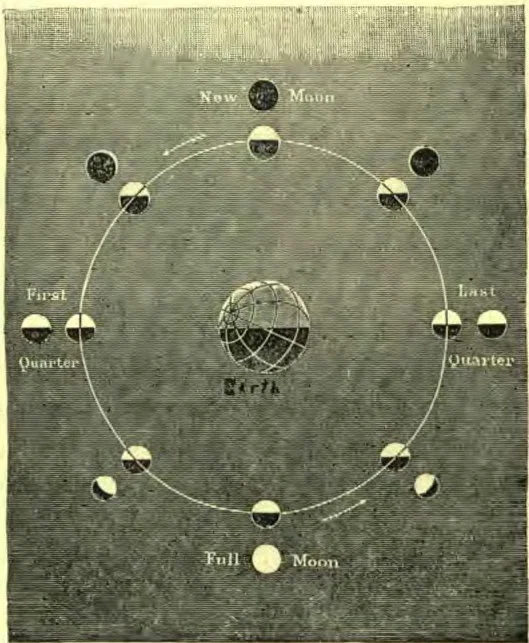
The moon passes around the earth once each month, or more definitely, in about twenty-nine and one-half days. Not being a body which gives off light of itself, the moon shines with a light borrowed from the sun; that is, it merely reflects the rays of sunlight which fall upon it. Hence, when the moon is between us and the sun, we can not have reflected to us any of this light shining upon it. This accounts for several nights and days in the month during which the moon is not seen at all. As it passes a little out of direct line between the earth and sun, we can begin to see the light reflected from one edge, so to speak, the same as we did the lamplight on the orange. This is what is called new moon.
A little more can be seen each night, until the end of the first week, when we can see the light shining on about one half of the moon’s disk, that is, the side toward us. This is known as the first quarter. In another week we have full moon; and then the illuminated part begins to wane, passing the last quarter at the end of the third week, then still growing smaller until it resembles a new moon, after which we lose sight of it altogether for a few nights, when it reappears, as it did a month before, in the form of a thin band of yellow light, to pass through the same phases during the next four weeks.
The accompanying diagram illustrates very nicely the phases of the moon. The figures on the outside represent the moon as it appears to us at stated periods during the month; those directly on the circle show the manner in which the sunlight shines on it all the time. At each phase represented we can see from the earth only the light part lying within the circle.
During the first and fourth weeks, or when less than half the moon is visible, it is said to be crescent; and during the second and third weeks, when more than half of its illuminated face is shown, it is known as the gibbous phase.
No doubt you have noticed during the early part of the new moon period, that the portion of the moon’s disk which does not get the direct sunlight is often visible, illuminated by a pale reddish light. This is due to the reflection of the sunlight from the earth, and is known as earth-shine. From the moon the earth would appear to have the same phases as the moon shows to us, only at opposite times of the month. Hence when the moon is full to us, the earth would be totally darkened to an observer on its surface. At the time of new moon, the earth is at its full, and it is this light reflected on the moon which enables us to see its reddish-brown outline.
Reference Study: “Sketches from the Life of Paul,” pages 252-261.
Topics for Study:—
Paul permitted to speak.
Complimentary words.
Denies charge of heresy.
Describes his persecution of Christians.
His conversion.
Divine commission.
Believed Moses and prophets.
Festus speaks.
Paul’s reply.
Personal appeal to Agrippa.
Agrippa’s response.
Paul’s noble reply.
Interview ends.
Agrippa’s words to Festus.
Notes
“In all the pomp and splendor of royalty, Agrippa and Bernice went to the audience room, attended by a train of followers in the costly apparel of Eastern display. . . . At his command, Paul, still manacled as a prisoner, was led in, and the king gazed with cold curiosity upon him, now bowed and pale from sickness, long imprisonment, and continued anxiety.”
“What a contrast was there presented! Agrippa and Bernice were destitute of the traits of character which God esteems. . . . That aged prisoner, standing chained to his soldier guard, presented nothing imposing or attractive in his dress or appearance, that the world should pay him homage, yet this man, apparently without friends or wealth or position, had an escort that worldlings could not see. Angels of heaven were his attendants.”
“And he (Agrippa) could but be affected by that burning zeal which neither stripes nor imprisonment could quench. For a time he forgot the dignity of his position, lost sight of his surroundings, and, conscious only of the truths which he had heard, seeing only the humble prisoner standing as God’s ambassador, he answered involuntarily, ‘Almost thou persuadest me to be a Christian.’”
“Two years afterward, the result of that day’s proceedings saved the life so precious to the cause of God. Festus, finding that his own judgment of the case, on grounds of Roman justice, was sustained from a Jewish standpoint by the protector of the temple, sent a letter to the emperor, stating that no legal charge could be found against the prisoner.” G. B. T.
Alameda, California
By Lowell M. Brown
FOUR years ago our Society was started. At that time Brother Chamberlain was our regular leader, and our studies were in the nature of short Bible readings, in which all the members took part. There was no regular organization. Afterward the Society was organized according to the plan outlined in the YOUTH’S INSTRUCTOR, with a leader, assistant, and secretary. The lessons in the INSTRUCTOR were adopted as the basis of study, and some missionary work was done.
Then several of our best workers moved from Alameda, and the meetings were discontinued. We all greatly missed these services, and when the church-school was organized, we again took up the work of the Society, and secured the teacher as our leader. While our membership is small compared with the Societies of Oakland and San Francisco, we are having good meetings.
We raised $16.50 for the Huntsville school in the South, and have done some missionary work in the way of visiting, giving Bible readings, etc.
Several small donations have been made to foreign missionary work, and a number of the younger members have sold Signs, one of the boys selling two hundred of one of the special numbers and about twenty-five a week of the regular Signs.
We have adopted the plan of having our meetings on the first and third Sabbaths of each month. We are of good courage, even though there is so much to do, and seemingly so few to do it. LOWELL M. BROWN.