A YOUNG People’s Society was organized Jan. 1, 1902, at Welsh, Louisiana. At that time we did not realize the importance and responsibility of the work, neither did we appreciate it as we do now. As we watch its growth and development, we praise our Father above.
We have found in our experience that the co-operation of the Society with the church has been of benefit to both organizations.
We are drawing very near the close of this world’s history; soon Christ and his retinue of angels will appear in the clouds of heaven; then our time for saving souls will be forever at an end. The question with each of us is, Have I so deep an appreciation of the sacrifice upon Calvary that I am willing to make the work of saving souls my most important work?
The Young People’s Society is a living channel through which God can communicate to many the unsearchable riches of heaven. Let us pray and work that our Societies may not be mere places of entertainment, but a band of zealous workers.
We are greatly interested in the sacred work appointed to our young people, and the prayer of the Welsh company is that God’s blessing will rest upon all the organizations throughout the land. The Society here consists of twenty members, all of whom are encouraged by the work they have done.
B. M. HEALD, President.
The City Child
By Laura Spencer Porter
If I lived in the country, I know what I would do,
I'd have a great big garden, and hills and pastures, too;
I'd waken every morning to see the sun come up,
And I'd hear the big bees bumble in the morning-glory’s cup;
I'd see the sagging cobwebs all spangled with the dew;
I'd fly a kite, I'd sail a boat, I'd have a pet or two—
A nice old toad-frog, maybe, and my little dog that died,
And a pair of pink-eyed rabbits, and a guinea-pig beside.
There'd be a stable, too, with stalls, and hay and corn and hens,
And underneath the eaves a box built specially for wrens.
I'd know the horses all so well I'd dare go near their legs,
And when the old hens cackled, I'd run and hunt for eggs.
I'd go into the forest, and there so still I'd lie,
The butterflies and bees would stop to rest as they went by.
The breeze would come and sway and bend the tip-top boughs all green,
And the leaves would laugh and flutter, with the deep-blue sky between.
Then if I stayed, oh, very still,—as I can when I try,—
I'd see the mother robin teach the little birds to fly.
I'd hear the brook go babbling, and I'd watch the minnows swim,
And the crawfish back and scuttle when I got too close to him.
When the cows were milked and lowing, and the busy day was done,
I'd run back home to mother, and we'd watch the setting sun;
We'd listen to the crickets, and she'd tell what they said,
Till the big bullfrog said, “Hunk-ker-chunk! It’s time to go to bed!”
My mother used to do these things when she was small like me.
That's why I know about them all—she tells me, don't you see?
—Laura Spencer Porter.
A Chance Acquaintance
By Helena H. Thomas
Our constitutional walk that beautiful spring morning had taken us so far into the country that my friend at last exclaimed: “That projecting rock looks too tempting to pass by. I move that we rest thereon.”
“I second the motion,” said I, and an instant later we were both enjoying the beautiful scenery surrounding us to such an extent that we forgot that our seat was the reverse of easy.
“Why don’t you carry away a reminder of this pretty spot?” queried I of my companion, who, as we often tell her—jokingly—carries her camera everywhere except to church.
“I intend to before we leave,” was the rejoinder, “but I want some life in the view, and so far there has not been a single passer-by.”
“This road does not seem to be much traveled, but I see some one on horseback heading this way.”
“Yes, indeed!” exclaimed my camera friend, “and I must make sure of him. Now, you ask him some question when he gets here, and then I’ll snap him. I want to make sure of that chance!”
“Say, boy,” cried I an instant later, “is that beautiful pony yours?”
“Why, yes, lady; he’s mine part of the time, anyhow.”
This the boy said as he drew rein and looked at me in such a way that I was tempted to make his acquaintance, so my next query was: “Are you in a hurry?”
“I should say not,” was the frank reply. “To tell the truth, I’m just putting in my time while grandpa is having a nap, and wasn’t going anywhere in particular.”
“Well, then, just dismount and join us. I like nothing better than to visit with boys.”
He needed no urging, but speedily jumped to the ground, and, hitching his pony with a loose rein, said: “Now, Dandy, you can munch this nice grass while we wait.”
“Yours is a fine pony,” said I, as the boy showed his training by lifting his cap, and saying: “My name is Harold Rogers. I’m staying with grandfather, who lives on the next farm.”
INSEPARABLE FRIENDS
“I am very glad to meet you,” I said, introducing myself as well as the one who said, “Perhaps I owe you an apology for taking your picture without your leave, but I could not resist the temptation.”
“O, that’s all right,” said the boy, good-naturedly. “I have a camera too, and snap everything in sight, without asking leave, either.”
This led to an interchange of queries, such as, “What is the make of your camera?” and similar questions, until Harold was perfectly at his ease with us, and then it was my turn to query, “What did you mean, if I may ask, by saying that the pony was yours part of the time? Is it a partnership horse?”
“It is, in a way,” was the laughing reply of the boy, who had already told us that his home was in Cleveland. “It is like this. The pony was raised for me by my grandfather, and given to me when a little colt, as far back as I can remember, on condition that it could remain here, and that I would come every summer to see it.”
“I suspect that was a ruse on your grandfather’s part to get you here,” was the laughing retort.
“Well, it’s worked, anyhow, for I have been here every summer since.”
“Have you never been tempted to spend your vacations elsewhere?”
“Well, yes, I did want to go with father and mother to Europe this summer the worst kind” (he had before told us of the camera his parents were to bring him on their return), “but of course I couldn’t give up coming here!”
“That’s a beautiful pony, sure enough,” said the artist-photographer; “but if I’d had your chance, I should have quickly given up my claim to the horse for the sake of going to Europe. Just think of the views you could have secured!”
“Perhaps I can’t make you understand how I felt,” was the hesitating reply; “but Dandy wasn’t in it at all.”
“Not in it? Why, you seem to contradict yourself. A moment ago you gave us the impression that you had come here every summer to make your conditional claim on the pony good, and now you convey the idea that you were not influenced by that.”
“Just a misunderstanding, I am sure,” I made haste to say, “which Harold will soon clear up if you will let him tell his story in his own way.”
“Well, I’ll try to make my meaning clear,” said Harold, with a grateful look toward the one who understands boys. “I admit that seeing Dandy and riding horseback was what counted for most when I was a little shaver, but now it’s—it’s my grandpa.”
“Isn’t grandmother an attraction, too?”
“There isn’t any. She died three years ago,” was the rueful answer. “That’s why I wouldn’t miss coming for anything. Poor grandpa is so lonesome since she went away. It makes my heart ache every time I look at him.”
“Why, you are having anything but a jolly time, then!” said one interested listener in a tone of sympathy.
“Not ‘jolly’ for a fact,” was the ready rejoinder; “but I’m happy, and I couldn’t be anywhere else.”
“It seems to me that you are learning the secret of true happiness early in life, my young friend,” said I from a full heart.
“I don’t quite catch your meaning,” said Harold, looking me squarely in the face.
“Well, it seems to me that a boy who gives up the charms of a trip to Europe for the sake of giving joy to his lonely grandfather must know from experience that the secret of real happiness is in making others happy.”
But Harold, boy-like, was evidently shy of praise, and so, with an air of indifference replied: “Grandpa and I are real chums, anyhow, and I like to be with him. Europe will keep. But Dandy is getting restless, and grandpa will be awake by this time, so I must be off.”
We detained him, however, long enough to give him directions where to find us when next he went to town, for we wanted to cultivate the acquaintance of one who gave evidence of being a prince among boys.—Helena H. Thomas, in The Children’s Visitor.
The Prize Jack-Knife
In his book, “On the Indian Trail,” Mr. Egerton Young gives a graphic description of his life among the Cree Indians of the far Northwest. To induce the Indian boys to sing, he tried this plan:—
Knowing the boys love pocket-knives, he says, I went to one of my boxes, and, taking out six very good ones, I stood up before the crowd and said:—
“Boys, listen to me. I am going to give these6six knives to the six boys who will sing the best. And look! While five of them are good two-bladed knives, one of them is a splendid four-bladed one! Now I am going to give this best one to the boy who will sing the best of all!”
Great, indeed, was the excitement among the Indian lads: Nearly every boy in the audience rushed to the front, and the trial began. Indians in their wild state have no music worth preserving, and so in all our missions our hymns and songs are translated, and the tunes of civilization are used. The teacher seated herself at the little organ and the testing began. They sang such hymns as “Rock of Ages,” “Come, thou Fount of every blessing,” “Just as I am,” “Jesus, my all, to heaven has gone,” and many others.
The inferior singers were weeded out very rapidly, and sent back to their seats. When the number was reduced to about ten, the work of selection proceeded more slowly; but eventually the number was reduced to six.
The question now was which of these six was to receive the four-bladed knife. This was not easy to settle. The members of the committee differed very decidedly; so one boy after another was tried, over and over again, and still no unanimous decision could be reached.
While the committee was discussing the matter, five of the boys, seeing our perplexity, took the matter out of our hands and settled it in a way that surprised and delighted us all. These five were fine specimens of Indian lads; they were lithe and strong, and full of life and fun.
The sixth boy, Jimmie Jakoos, was a cripple, having one leg which was very much shorter than the other, the result being that he had to use crutches. These five had moved over to one side, and were observed to be excitedly, though quietly, engaged in conversation.
After their brief discussion, one of them sprang up, and looking at me, asked: “Missionary, may I say something?”
“Certainly you may,” I replied.
“Well, missionary,” he answered, “we five boys have been talking it over, and this is what we think about it. You see we are well and strong. We can chase the rabbit, and partridge, and other game; and then, when winter comes, we can skate on the rivers and lake; but Jimmie is lame—he has a bad leg. He can not run in the woods; he can not go skating on the ice.
“But Jimmie is fond of whittling. He is a good hand at making bows and arrows, and paddles, and other things, and a fine knife would be just the thing for him. And so we five boys have talked the matter over, and as he is a cripple, we will be very glad if you will give the best knife to Jimmie.”
Noble boys! How the people were thrilled at this speech! It electrified me, and filled not only my eyes with tears, but my heart with joy.
I could but think of the past, of the cruelty and intense selfishness of those dark days when, among both the young and old, every one was for himself, and the unfortunate and feeble were neglected and despised. Among the heathen Indian tribes the rule has always been that the sickly or deformed are treated harshly and cruelly, just as a lame or weak animal is despised and ill used. But the gospel had done its work among these Cree boys. Now, thanks to the blessed influences of Christianity, they were learning this Christlike spirit, and would spontaneously act in this brotherly way.
So to Jimmie was given the four-bladed knife, and to the other boys were handed the two-bladed ones; but so pleased was I with the spirit displayed by them that I added to the gift a good shirt or jacket as each boy chose.—Sunday School Visitor.
Insects and Their Habits, and What Harold Learned About Them
By Mrs. L. D. Avery-Stuttle
“I’ll tell you, Harold, the queen ant does not have to manage the eggs at all; she only lays them.”
“Well, I think if she lays eighty thousand eggs every day, that is about all that ought to be expected of her,” said Harold.
“Certainly; and this is evidently what the other ants think; for they feed her very lovingly, and busy themselves night and day carrying away the multitude of eggs which she is constantly producing.”
“Where do they carry them? I guess all the egg-baskets must soon be full.”
“The ‘egg baskets,’ as you call them, are little cells, just above the mother queen’s apartment, which are separated from one another by partitions of sawdust which the ingenious insects have gummed together. This nursery, as we may term it, is so placed in the nest as to get the greatest amount of fresh air; and as there is still the attic above it, it has a more even temperature than any of the other rooms; and of course this is necessary, as they seem to understand.”
“I suppose,” said Harold, “that the queen goes up to the nursery, once in a while, to see her eggs and ’tend to things.”
“O, no; she never walks about; she is constantly confined to her royal chamber, although you see her outside, in the picture.”
“I wonder if she doesn’t get pretty tired of staying in one room and never going outdoors at all; I should; when it rains and I have to stay indoors all day, I feel cross,” said Harold.
“I dare say; but the poor queen could not get out of her room even if she wanted to, for the workers have made her doors so small that she could not possibly get her large body through them.”
“I know she must be lonesome all alone,” said Harold, who did not enjoy being left alone, even for an hour.
“But you see the little servants are with her, to feed her, and carry away her eggs, and, besides, her royal spouse is close beside her all the time. But it is a good thing that these destructive insects have very many enemies which hunt and destroy or eat them by the million. Because if they did not, and if the insects kept on multiplying at such a rapid rate, they must, after a time, overrun everything, and would literally drive mankind off the face of the earth. But while these little termites have deadly enemies, they are very friendly among themselves, and extremely devoted to their ungraceful and enormous queen. Her chamber forms the center of their home; it seems to be for her sake that the soldiers fight and the workers toil. Indeed, the whole community seems never to tire of paying their respects to her in one way or another.”
“But still, Uncle Frank, if I were in her place, I should hardly think all this paid me for living in prison.”
“No, there is nothing so dear to the human heart as liberty; and this, the desire for freedom, was implanted in our souls by the great Being who created not only the tiny insects, but our own wonderful bodies.
“Here is a stanza I would like to ask you to commit to memory; and to-morrow you shall have a peep through my microscope, and we will learn about something too small to be seen by the unaided eye:—
“‘Shall we not trust the mighty One
Who rules the earth and sky,
Who guides the planets ’round the sun
With his omniscient eye?
And yet he marks the sparrow’s fall,
For in his sight there’s nothing small.’”
MRS. L. D. AVERY-STUTTLE.
(To be continued)
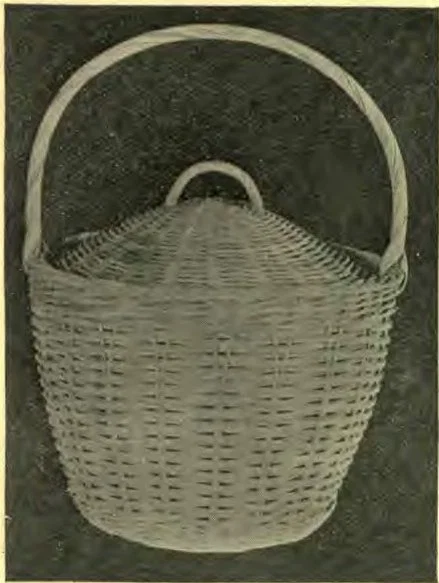
A Round Lunch-Basket
By Mrs. E. M. F. Long
Model 10
MATERIAL, reeds Nos. 1, 3, 4, 5, 6, and 9.
Diameter of base, six and one-half inches; top, ten inches; height, seven and one-half inches.
Thirty-eight stakes, twenty inches long, of No. 4 reed. Insert one each side of each spoke, and use double. Use No. 3 reed for weaving. Five rows of triple twist; five and one-half inches of double weaving. Now separate the stakes and use them singly.
This is done to make the top of the basket stronger and the border firm and close. One row of triple twist; cover ridge, two rows of triple twist.
Cover ridge, border, and cover same as darning basket. Handle same as handy basket.
Fig. 2 shows a reed picture-frame. Fifteen No. 5 reeds in groups of five were used to form a three-strand braid. This was made in one long piece, and afterward fitted to a pine foundation, and glued and tacked in place. The corners were mitered.
MRS. E. M. F. LONG.
Happiness Lies in Liking What We Do
“HAPPINESS does not consist in doing what we like, but in liking what we do.”
MEMORY VERSE: “Blessed are they which are persecuted for righteousness’ sake: for theirs is the kingdom of heaven.” Matt. 5: 10.
“And it came to pass, when Jesus had made an end of commanding his twelve disciples, he departed thence to teach and to preach in their cities.”
“And the king Herod heard of him (for his name was spread abroad); and he said, That John the Baptist was risen from the dead, and therefore mighty, works do show forth themselves in him. Others said, That it is Elias. And others said, That it is a prophet, or as one of the prophets. But when Herod heard thereof, he said, It is John, whom I beheaded: he is risen from the dead. For Herod himself had sent forth and laid hold upon John, and bound him in prison for Herodias’ sake, his brother Philip’s wife: for he had married her. For John had said unto Herod, It is not lawful for thee to have thy brother’s wife. Therefore Herodias had a quarrel against him, and would have killed him; but she could not: for Herod feared John, knowing that he was a just man and an holy, and observed him; and when he heard him, he did many things, and heard him gladly.”
“And when a convenient day was come, that Herod on his birthday made a supper to his lords, high captains, and chief estates of Galilee; and when the daughter of the said Herodias came in, and danced, and pleased Herod and them that sat with him, the king said unto the damsel, Ask of me whatsoever thou wilt, and I will give it thee, and he sware unto her, Whatsoever thou shalt ask of me, I will give it thee, unto the half of my kingdom. And she went forth and said unto her mother, What shall I ask? And she said, The head of John the Baptist. And she came in straightway with haste unto the king, and asked, saying, I will that thou give me by and by in a charger the head of John the Baptist.”
“And the king was exceeding sorry; yet for his oath’s sake, and for their sakes which sat with him, he would not reject her. And immediately the king sent an executioner, and commanded his head to be brought: and he went and beheaded him in the prison, and brought his head in a charger, and gave it to the damsel: and the damsel gave it to her mother. And when his disciples heard of it, they came and took up his corpse, and laid it in a tomb.”
Questions
1. When Jesus had sent out the twelve, what did he himself do? Who heard of him?
2. What did Herod say? What reports were spread by others? But of what was Herod positive?
3. Why had Herod shut up John in prison? Luke 3: 19, 20. Who hated John? What would she have been glad to do? Why would not Herod kill John?
4. What feast did Herod give? Who were invited?
5. Who came in and danced before Herod at this feast? What did Herod promise to give her?
6. To whom did the girl go for counsel? What did her wicked mother tell her to ask?
7. How did the king feel when he heard her request? Yet what did he do? Why?
8. When the head of John was given to the damsel, to whom did she carry it? Though this wicked woman had caused the death of John, was she able to stop the influence of his life?
9. When John’s disciples heard what had happened, what did they do?
Scattering Sunshine
A LADY friend, who does not forget that she is a lady even when shopping, and who carries her bright and kindly religious life into a store as truly as into a drawing-room, gave me this little incident from her experience. She went the other day into a busy store to purchase some article. The shop-girl was attentive, but rather quick. Turning suddenly, she said to the lady:—
“Oh, I beg your pardon, I fear I appeared abrupt, I only wanted to give you prompt service. Perhaps there is something more you would like to look at.”
The lady assured her that her promptness was much appreciated, and that she always liked to trade at her counter because she was not only prompt, but bright and sunny. Tears came at once to the girl’s eyes. Her heart was opened by the loving words of the lady, and she told the little story of her life in a few words. She said:—
“I had a great ambition to study and fit myself for teaching. I had some evidence in my quickness in studies that I could, perhaps, rank well as a teacher if I could only secure the necessary education. My mother and father died suddenly. My brother is still young, but supporting himself, and we have an invalid sister whom we two must care for. I could not study as I had hoped to fit myself for my life-work. I must do what I could. I got a place in this store and began work here. I at first thought all my hopes were defeated. There is nothing for me to look forward to but the treadmill of a shop-girl’s life. It was not the hard work, but it shut me out from all the privileges that I most longed for.”
“Then I thought, No, I am a Christian girl. God in his providence has led me to this place and this work. I must do it for others’ sake as well as my own. I will try to use my life to the best advantage where I am. I looked over my checks one night, and found that I had waited upon seventy-two persons that day. I said to myself, What an excellent opportunity for doing good! And I determined that I would try and make everybody who traded with me just a bit happier, and, perhaps, even though only a shop-girl, I might bring sunlight into a good many lives in a day. I have been trying it some months now, and surely life has taken on a new meaning for me, and my work is pleasant and I am happy.”
Who has a better secret for a happy life than that? Whose life so humble that he can not make it nobly useful? Whose light so small that it may not shed a few rays of light into a darker life? Whose comforts so limited that they may not awaken thankfulness that shall overflow to some more sorrowful heart? The quiet, cheerful consecration of that shop-girl gives us each a lesson.
On the other hand, is there not in this little incident a lesson to those who stand on the other side of the counter? How many women make it a rule to speak some kind and appreciative word to the girl who waits upon them in the shop? How many of you never pull over the goods on the bargain-counter, nor poke things here and there with your parasols, nor barter and squeeze and browbeat, just a little, these girls who can not answer back, although the unladylike conduct of some woman in silk and satin merits it? Should not each one of us determine, as has our friend the shop-girl, that every day we will make the lives that we touch, whichever side of the counter, brighter and sunnier and better? “He went about doing good.”
— Congregationalist.
A Good Name Is Better Than Riches
“A GOOD name is better than riches. So it ought to be. It is harder to get.”
Prayer for the Little Children Everywhere
“LORD, bless the little children wherever they may be—
Far out on the silent prairie, down by the sounding sea.
Like flowers in the crowded city, like birds in the forest free—
Lord, bless the little children, wherever they may be.”
VIII—The Tithe Reserved for the Support of Christ's Ambassadors
(August 19)
MEMORY VERSE: “For ye know the grace of our Lord Jesus Christ, that, though he was rich, yet for your sakes he became poor, that ye through his poverty might be rich.” 2 Cor. 8: 9.
Questions
1. What is the high position of the gospel minister? 2 Cor. 5: 20.
5. To what time does this commission extend? Matt. 24: 14.
6. How much of their time and strength are the ministers of Christ to devote to the Lord's work? Acts 6: 4.
7. What account will the minister be called to render to God for the results of his time and labor? Heb. 13: 17.
8. What provision was made for the support of the ministers in ancient Israel? Num. 18: 21.
9. How are the ministers under the gospel dispensation to be supported? 1 Cor. 9: 13, 14.
10. What will the minister be compelled to do if the church fails to bring in the tithe? Neh. 13: 10; note .
11. What are we urged to do that there may be more ministers in the great harvest field? Luke 10: 2.
12. In what way may we co-operate with God in answering our own prayer? Mal. 3: 10.
13. Will there come a time when it will be too late to use our means to give the bread of life to the people? Amos 8: 11, 12; note .
14. Of what use will the gold and silver that has been withheld from the cause of God be in that day? Isa. 2: 19-21.
Notes
A Letter Worth Reading
ROME held the aged Paul a prisoner; yet his spirit was not bound. He was active in ministering to the churches, accomplishing more than if he had been free to travel among them. The fact that he was a prisoner gave him the sympathy of his brethren in a greater measure than he otherwise would have had it. Of course this bond of affection strengthened his influence for good. Though a prisoner for two years or more, he kept in close touch with the churches he had raised up. He sent delegates to them who informed him in regard to their spiritual condition. Paul would then write letters to the churches, reproving, admonishing, and encouraging them. The epistles to the Galatians, Ephesians, Philippians, Colossians, and the letter to Philemon were written from Rome during his imprisonment.
Besides his oversight of the great mission fields of Asia Minor and Greece, he daily taught the gospel truths to large companies who came to “his own hired house” to hear him. Though constantly under the close supervision of a soldier, he was allowed much freedom in entertaining friends. Luke, Timothy, Mark, Demas, and Tychicus were with the apostle, and they doubtless did much to influence persons to come to hear him preach. Many needed no urging; for they were glad for the opportunity of hearing a prisoner speak. Whether at first out of curiosity or not, some even of Cæsar’s household came to hear him, and finally accepted the truth of God.
There was an old pagan slave that wandered in one day to hear the discourse. Perhaps he had heard enough about the good prisoner to make him think it might be his master’s friend and fellow laborer. He found he was right in his thought, and Paul recognized him as Onesimus, the slave of Philemon, who was a member of the Colossian church. He saw that the man was in great distress financially, so aided him, and afterward explained to him the truths of the gospel. Onesimus was now ready to listen to the counsel of the apostle, though when they had met at Ephesus he was wholly indifferent to eternal things. Onesimus had robbed Philemon, and then fled to Rome. He was profligate and unprincipled, but God used the apostle to lead the old man into the way of righteousness. He was fully converted, and became a great help to Paul, who learned to love him for his piety, meekness, and sincerity, and also because of his personal service to the apostle, and his zeal in the work of God. Paul valued him as a missionary worker; but he recognized that Onesimus was under obligation to his former master, to whom he had proved so untrue. He therefore advised him to return to Asia, confess his errors, and do what he could to right the wrong. It was a very severe trial to the old man to give himself up to his master; but loyalty and duty required it, so he determined to go.
To make the return as easy for Onesimus as possible, the apostle Paul wrote a letter to Philemon. You will find this interesting epistle in the New Testament. Our Father seemed to think its generous spirit was worth preserving. The letter begins with an affectionate greeting to Philemon, who had been given the truth by Paul, and afterward had been a fellow laborer with him. The tactful apostle then reminded Philemon that every good purpose and trait of character which he himself possessed must be accredited to the grace of Christ; for this alone caused him to differ from the sinful and perverse. The same grace could transform his old slave—a debased criminal—into a sincere, trusting child of God, and a useful worker in the cause of Christ. Paul did not command Philemon, but urged him to receive Onesimus kindly, saying, “I beseech thee for my son Onesimus, whom I have begotten in my bonds, which in times past was unprofitable to thee, but now profitable to me and thee.” In these lines the whole story is told. Paul further said that he would have been glad to have kept Onesimus to minister to him in his bonds as Philemon himself would have done had he been with his aged friend, but he did not desire the services of Onesimus unless Philemon voluntarily sent him back to Rome.
Paul did not want Philemon to think of Onesimus any more as a slave or servant, but he asked that he might be received as a brother in Christ, or as Paul’s own son, or even as the apostle himself would be received were he to visit Philemon. Paul even added that if Philemon still held Onesimus under obligation to restore the money he took from him, he himself would pay the amount. This is the climax of Christian brotherhood.
Union College Catechism
THIS is the title of the substance of the second number of the Central Union Conference Bulletin. It consists of nearly one hundred questions that people are likely to ask about Union College, with direct, pointed answers which give the pith of the annual calendar. It is designed for wide-spread distribution. Anybody may have any reasonable number of them for the asking. Address Central Union Conference Bulletin, College View, Neb.