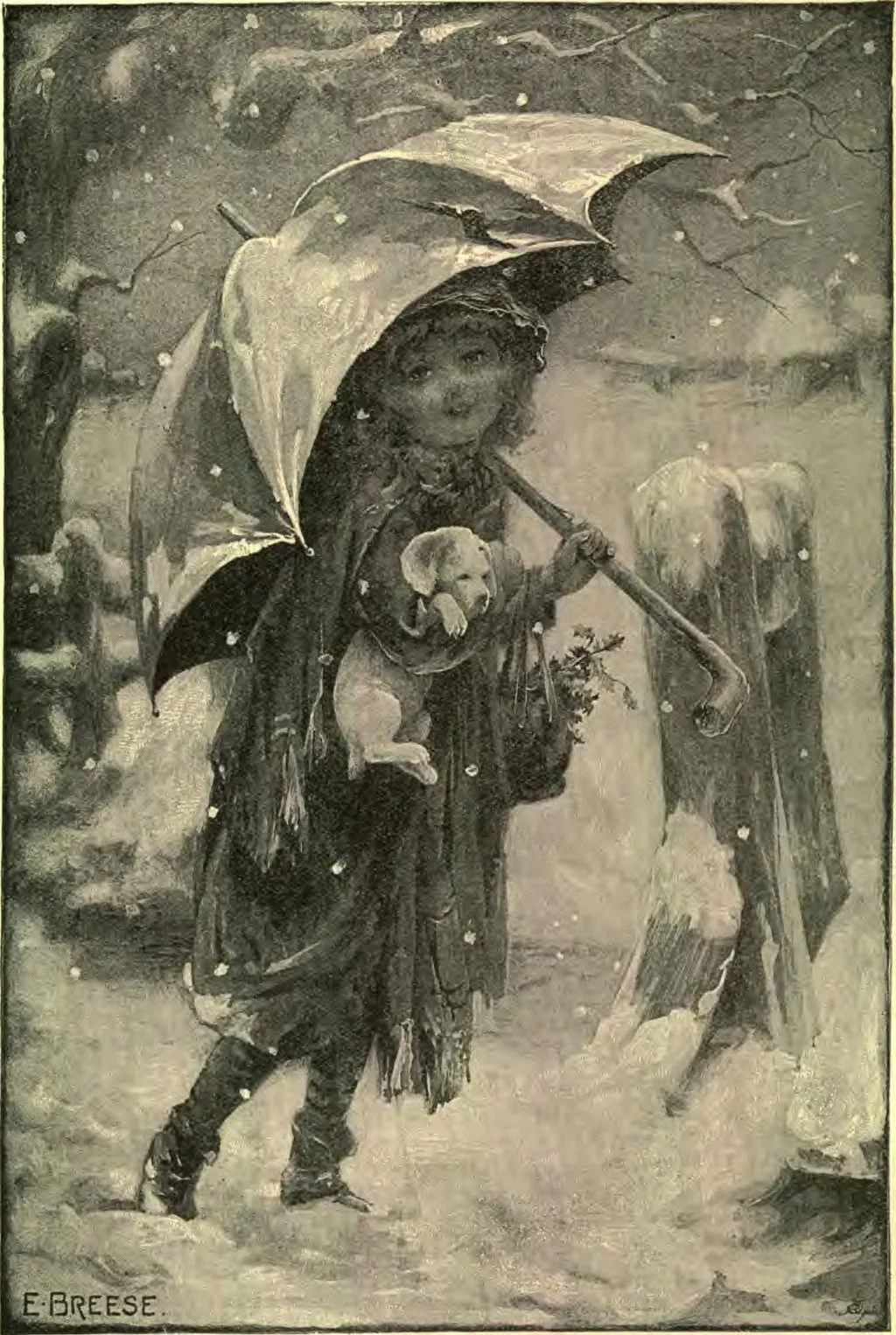
When Luck and Pluck, one summer day,
Went faring forth together,
Pluck wore a suit of homespun gray,
Luck had a cap and feather;
A handsome, dashing fellow he,
And full of careless pleasure.
“Come, follow me; I hold the key.”
He cried, “of boundless treasure!”
He looked so gay, and bold, and strong,
That listening ears were plenty,
His train of followers grew long,
A dozen — fifteen — twenty —
A hundred — still they came; while Pluck
Tramped on, with few behind him;
“Poor plodding fools!” cried laughing Luck,
“A stupid guide you’ll find him!”
Luck led his careless troop ahead
With boasting and with revel,
The sun shone radiant overhead,
The road was smooth and level;
But as the day wore on, behold!
Athwart the way, a river
Without a bridge flowed deep and cold,
A sight to make one shiver.
“Well, well,” cried Luck, “we’ll sit and wait,
It may run dry to-morrow,
Or we’ll see coming, soon or late,
Some boat that we can borrow!”
So down they sat — and there they stayed
To wait and hope at leisure,
While Luck assured them, undismayed,
They still would reach the treasure.
But Pluck, with those who tramped behind
His sturdy figure, waited
No moment on the bank, to find
Whether the stream abated;
They plunged, they swam, they fought their way,
The shore in safety gaining, —
And theirs the treasure is to-day,
While Luck looks on, complaining!
— Selected.
Contentment and Harmony in Humble Homes
SOME of the most ideal homes, where peace, contentment, and harmony dwell, have been the abodes of poor people. No rich carpets covered the floors, no costly paintings were on the walls, and there were no pianos, no works of art; but there were contented minds, and unselfish, devoted lives. Each member of the family contributed as much as possible to the happiness of all, endeavoring to compensate by kindness and intelligence for the poverty of their surroundings.—Success.
BUSY FOLK
By Frank Walcott Hutt
LET us be partners with Every Day,
Claiming a share in the work to do;
Setting no unfinished part away,
Bravely determined to see it through.
Come, let the duties be what they may,
Let us be partners with Every Day.
Let’s learn the business of Doing Well
Each in his place, be it great or small.
Early and late let example tell,
Whatever standards about us fall.
Come, let’s be earnest, and so excel;
Let’s learn the business of Doing Well.
FRANK WALCOTT HUTT.
WHO IS JACK?
By Aunt Betty
Jack is a busy fellow, and turns his attention to so many things that you might call him a jack-of-all-trades, though that is not the name by which he is known.
In the first place, Jack is something of a farmer; at least he spends much time every winter in mellowing and pulverizing the soil turned over in the fall by the plows of other farmers. Sometimes, when very energetic, he becomes a woodcutter, and then he splits whole trees at one stroke.
As a bridge-builder, Jack excels: he spans wide rivers with the most beautiful bridges, that glitter like silver in the sunlight. What is most curious, though he works alone, he can put up a good, strong bridge in the course of a few days; yet if he goes away, it will swiftly and silently disappear, leaving not a trace behind. While it lasts, thousands may cross over it in safety; but after Jack leaves, no power known to man may preserve the bridge from decay, or build another until he returns, when he will immediately set to work on another, precisely like the first.
Jack is an efficient health-officer, and pokes around in all sorts of corners, destroying disease-germs that even the sun had failed to find. At his approach many dreaded diseases flee in terror, leaving their victims to regain their health and rosy cheeks under Jack's care.
Jack manufactures diamonds, too, of all sizes, from tiny ones that float in the air, to huge ones, like mountains, that float on the sea. Sometimes he decorates the eaves of houses and the limbs of trees with them.
And this brings us to the mischievous side of his character; for though his diamonds are light enough to float in the water, they are heavy enough to break the limbs off our fruit-trees. But he seems to think that “all work and no play makes Jack a dull boy;” so he delights in playing practical jokes. He trips up hundreds of little boys and girls,—yes, and big ones, too,—giving their heads painful and resounding bumps. Hundreds of kettles and crocks, bottles and pitchers, he cracks open when no one is looking. And he often bites, and kills, our choicest plants.
NOT AFRAID OF JACK
But, ah!—the pictures he can paint,—mountains and plains, lakes and rivers, palms and ferns, spired churches and turreted castles,—not on canvas, but on a certain clear mineral, much used in some countries in building houses. And withal he is a most sociable fellow, in his rough way. He will greet you, as he greets every one else,—rich and poor, old and young,—with a vicious tweak of your nose. Instead of lifting your cap, you will pull it down a little tighter, while you answer his greeting with a hearty “tish-shoo!” AUNT BETTY.
AUNT PAULINA’S NOSE
ONE day when Cecilia Barrett went to eat dinner with her grandmother, she talked a great deal about a little sachet she had lost.
“It was a lovely perfume, grandmother,” she said, “and the dearest little blue silk case—a kind of pale-blue—just lovely. But,” she shook her head slowly, “I know well enough where it is. May I have another apple, grandmother? We never have this kind. I know well enough Ruth Pettingill’s—well, I’ll say found it, for she smells just like it, and you can’t deceive my nose.”
Grandfather laughed as he pushed back his chair. “Please excuse me, Calista,” he said; “but don’t let Cecelia go until you’ve told her about her great, great Aunt Paulina’s nose. She may have inherited it.”
“Grandfather loves to make fun,” sighed Cecilia, as he went out, and grandmother began to gather up the forks and spoons, and put them in a basin of hot water.
“Your great, great Aunt Paulina,” she said—“please hand your grandfather’s cup and saucer, Cely—was your grandfather’s aunt. You may have seen her picture in some old album, but she died before you were born. She was always discovering some wonderful thing that never was except in her imagination.”
The little girl at the end of the table grew a trifle pinker than before, but grandmother wiped a spoon, composedly, and went on without looking at her.
“One day her brother Ezra took in a poor, friendless boy from the State reform school. The boy’s name was Henry. Uncle Ezra and his wife were kind to him, and he lived with them for years, and made a good man; but that first winter Uncle Ezra and Aunt Caroline were both called away suddenly, one day, and Aunt Paulina went to keep house. The next day she came over here, and began to talk about Henry. ‘He’d cleaned out the doughnut jar before I got there,’ she said; ‘and I can’t find out what he’s done with ’em, either. He can’t have eaten ’em all, for Caroline always makes a jar full.’ We asked her how she knew there were any, and she said she smelled them. ‘Just made,’ says she, ‘when I got there. Ezra and Caroline hadn’t been gone an hour, and she must have fried them the last thing. I know doughnuts when I smell ’em,’ she said.
“She stayed there a week, and she hunted for those doughnuts all the time. Henry was a timid boy, used to a very strict rule, and to being found fault with, and he was so afraid of her62he wouldn’t go into the house if he could help it. He ate scarcely anything, and that made her feel still surer that he had a hoard of doughnuts hidden away. He thought she was crazy, she talked so much to him about eating on the sly, and confessing his sins, and we were afraid he would run away; but Uncle Ezra and Aunt Caroline came home at the end of the week, and then Aunt Paulina went home, but not until she had found out about the doughnuts.”
“Did the boy take them?” Cecelia had finished the apple, and was listening eagerly.
Grandmother laughed softly as she settled the spoons in the holder. “There were not any to take. Aunt Caroline had put the pot of doughnut fat on to heat when the message came that her brother was sick, and she put it away again without making the doughnuts.”
“She did smell them, then,” said Cecelia. “She had a pretty good nose after all.”
“She smelt a little fat,” replied grandmother, gravely. “But, as Uncle Ezra said, an egg-shell in your dooryard doesn’t prove that one of your hens has hatched a big flock of chickens, and that your next-door neighbor has stolen them all. Now, I don’t know anything about Ruth Pettingill’s sachet, but if you will look in the little upper left-hand drawer in your grandfather’s desk, you will find yours. I picked it up from the floor after you had gone home Sunday.”
“I’m very glad to get it again,” Cecelia said, slowly, a minute or two later, her nose buried in the sachet. She seated herself on the sofa and watched her grandmother. “Grandmother,” she said, presently, “are you going to say, ‘Now, you see’?”
“No,” grandmother smiled. “If you can’t see and remember for yourself, it isn’t much use to do it for you.”—Sabbath-School Visitor.
DIVISION II — PHILOSOPHY
By O. C. Godsmark
Chapter XX — Electricity and the X-Ray
§205. The two great lines of investigation in the field of electricity have been, first, how to produce electricity, and second, what it will do when produced. What electricity really is, has been largely a matter of speculation. It is commonly accepted, however, that electricity is one of the higher manifestations of vibration, and so far as our present study goes, we shall so consider it. It appears to occupy the field next higher than light.
§206. We have already learned that while heat occupies much of the same field of vibration with light, yet it falls considerably below light in the lower ranges of its manifestation; and while electricity is closely related to, or associated with, light, yet we have to get above light in its highest forms to find that form of vibration which we call electricity. To learn that electricity is closely related to light, we have but to apply one of the electrodes of a battery to the region of the optic nerve, and by its stimulation we receive the impression of light. This is not the case when applied to the auditory nerve; for the reason that the nerves of hearing receive vibrations of a much lower order.
§207. One phase of electricity to which we wish to call special attention, is its quality of being changed in its manifestations. We can not say of electricity, as we did of light and sound, that by increasing or decreasing the number of vibrations a second, within its special field, we get a higher or lower form of electricity. This may be true, and may give us galvanism or magnetism, for all we at present know. There is, however, this one very interesting fact concerning electricity,— its power of being slowed down so that it enters the field of light.
§208. It is well known that phosphorus has the power, not only of receiving and storing up rays of light, but also of giving them forth again in a much subdued, or lower, form. For instance, a plate of phosphorus may receive light from the direct rays of the sun, which are bright and penetrating; but when it gives forth these same rays of light the following night, we find them much subdued in power.
§209. By forcing the electrical current through a “Crookes’s tube,” it meets with a certain amount of resistance, which brings much of it near to the field of light. But this same current, though yet in its modified form, retains much of the penetrating qualities characteristic of electricity. These modified rays, or “X-rays,” may then be caused to pass through some object or collection of objects, which permit the electric rays to penetrate them more or less readily. For instance, a coin is placed behind a piece of timber; the X-rays penetrate the stick of timber so much more readily than they do the coin, that, could the eye recognize these rays, we should see the shadow of the coin through the timber; but the vibrations of which these modified rays consist are yet too rapid to be recognized by the eye. Here it is that the “fluorescent plate” of the X-ray machine comes in. By causing these modified rays to fall upon the specially prepared plate, they are still further reduced in their velocity, and so brought within the range of light. So we see the shadow of the coin through the intervening stick of timber.
§210. When a slight electric current is caused to pass over a wire of considerable size, we notice no change in the appearance of the wire, especially if it is a good conductor of electricity; but if the electric force is considerable, and the wire is small and composed of a substance that is a poor electrical conductor, we find immediately that the electricity, being thus resisted and slowed down, is converted into heat and light, both of which are lower forms of vibration than electricity. The resistance offered to the electric current as it is forced to pass from one carbon point to another in the arc lamp, changes the electricity into light, by slowing down, or lowering, the number of vibrations a second to a point that brings it within the range of vision.
§211. Suppose a thunderbolt hurled from the skies. The friction of the atmosphere, which is a very poor conductor of electricity, causes such a retarding of the vibratory movements of the outermost portions of the electrical ball that they become slowed down to a point where the eye recognizes them as light, not as electricity.
§212. Now if electricity can be, and constantly is being, changed from its original form to that of light, by meeting with resistance; if light is changed from a perfect white ray to a distorted one of a lower nature—one which shows a preponderance of the yellow and red rays—by meeting with resistance, as we have seen in our past studies; if sound is also lowered in its pitch by meeting with a like resistance—its compositeness lost and distorted to a tone of a different one of a lower nature,—why, then, is there not an underlying principle in all this upon which we can build our structure of scientific truth?—We believe there is. So far we have sought to present these subjects in so simple and plain a manner that all could grasp them, and see the true simplicity of the statements made. If our views thus far are true, then we may expect to understand the scientific principles found in the Bible; for just as truly as God is the author of Sacred Writ, and just as truly as his hands formed the mighty worlds that swing in space, obedient to the laws that govern their courses through the heavens, so surely is there harmony existing between nature and revelation.
DR. O. C. GODSMARK.
2005 Magazine St., Louisville, Ky.
What Is Going On in the World.
Two-and-One-Half-Cent Pieces.— A bill favoring the resumption of the coinage of two-and-one-half-cent pieces has been introduced in the House of Representatives. It is claimed that the prices of department stores and other business reasons demand the use of such fractional coins.
A Timber Mine.— In Tongking, Indo-China, there is a curious underground timber mine, in good working condition. “In a sand formation, at a depth of from fourteen to twenty feet, a deposit of trunks of trees has been found, and from this deposit the people dig timber. It is used for making coffins and troughs, and for carving. The trunks are many of them three feet in diameter and forty-five feet long, being apparently the remains of fir-trees which were buried thousands of years ago by an earthquake.”
To Sea in an Air-Ship.— On January 28 M. Santos-Dumont, the young Brazilian who last October attracted world-wide attention by his successful flight around the Eiffel Tower according to the conditions set for the award of a prize of $20,000, made two successful trips over the Bay of Naples. In the afternoon trip he was out forty-five minutes, and sailed in three directions over the open sea, at a height of about one hundred meters. On the completion of the second trip, he sent the following telegram to the president of the republic of Brazil: “Went out on open sea with great success. My experiments will continue every day when the weather is fine.”
Cost of Repairing a Battle-Ship.— A fair idea of the cost of repairing a modern ironclad may be gained from estimates of repairing the injuries received by the “Oregon” in June of 1901. The injury was sustained by striking an uncharted reef in Chinese waters, while the vessel was on the way from Japan to Taku. The ship is now in dry dock at the Puget Sound navy yard, and since the first of November six hundred men have been at work daily, removing the injured portions. As this work is finished, the number will soon be increased to twelve hundred. The time required for the repairs will be six or eight months, and the work will cost the government a million dollars.
New Sub-Marine Ferry-Boat.— A French inventor, M. Goubet, has devised a model “of a boat intended to run under water, and to convey passengers between France and England by means of a cable stretched across the Channel. Perhaps his strongest argument for an under-water passage is that the steadiness of motion would prevent seasickness, the traditional terror of the English Channel. The submarine boat ‘Fulton’ lately lay undisturbed on the bottom off the Long Island coast while a tempest overhead sent many vessels to destruction, a fact which is in accordance with former experience that the disturbances produced by storm-waves do not reach very deep.”
Cession of the Danish West Indies.— On January 24 a treaty ceding the Danish West Indies to the United States was signed by Secretary Hay and the Danish minister, Constantine Brun. After the ratification by our Senate and the Danish Rigsdad, the treaty will be submitted to the inhabitants of the islands for their approval. It is understood that the purchase price of the three islands—St. Thomas, St. Croix, and St. John, all situated within sight of one another, and63comprising an area of about one hundred and twenty-seven square miles—is in the neighborhood of $5,000,000. This is considerably less than the amount agreed upon thirty-five years ago, when Secretary Seward signed a treaty—which failed, however, to receive the ratification of the Senate—agreeing to pay $7,500,000 for the two islands of St. Thomas and St. John. St. Thomas is called the “Gateway of the Caribbean,” and has one of the best harbors in the West Indies. The principal industry at present is the coaling of steamers; but it is thought that if the United States acquires possession of the islands, it will establish a naval station at St. Thomas.
WITHOUT A WEDDING GARMENT
(March 1)
MEMORY VERSE: “For many are called, but few are chosen.”
1. And Jesus answered and spake unto them again by parables, and said,
2. The kingdom of heaven is like unto a certain king, which made a marriage for his son,
3. And sent forth his servants to call them that were bidden to the wedding: and they would not come.
4. Again, he sent forth other servants, saying, Tell them which are bidden, Behold, I have prepared my dinner: my oxen and my fatlings are killed, and all things are ready: come unto the marriage.
5. But they made light of it, and went their ways, one to his farm, another to his merchandise:
6. And the remnant took his servants, and entreated them spitefully, and slew them.
7. But when the king heard thereof, he was wroth: and he sent forth his armies, and destroyed those murderers, and burned up their city.
8. Then saith he to his servants, The wedding is ready, but they which were bidden were not worthy.
9. Go ye therefore into the highways, and as many as ye shall find, bid to the marriage.
10. So those servants went out into the highways, and gathered together all as many as they found, both bad and good: and the wedding was furnished with guests.
11. And when the king came in to see the guests, he saw there a man which had not on a wedding garment:
12. And he saith unto him, Friend, how camest thou in hither not having a wedding garment? And he was speechless.
13. Then said the king to his servants, Bind him hand and foot, and take him away, and cast him into outer darkness: there shall be weeping and gnashing of teeth.
14. For many are called, but few are chosen.
Synopsis
Christ was still in the temple teaching the people. They took him for a prophet, but the chief priests and Pharisees were seeking by every possible means to slay him. While fear of the people kept them off, Jesus took advantage of the opportunity to give another warning. In a parable he showed the Jewish leaders that they were making light of the King’s message, and therefore their queen city, Jerusalem, would be burned up, and they, the murderers, would be destroyed.
In our lesson we find two invitations to the gospel feast,—one given to the Jews, and the other to the Gentiles. We are living in the time when the King comes in to see the guests. We have all been called to the marriage, and the wedding garments are ready. The chosen few will have these garments on.
Questions
1. In what way did Jesus continue to answer the chief priests and Pharisees?
2. To what did he compare the kingdom of heaven?
3. Who were sent forth to call the guests?
4. How was the king’s message treated?
5. Who is represented by this king? By his son? By the servants? (NOTE.—The feast is the gospel feast.)
6. Again, what message did the king send to the people?
7. How was his kind invitation received? Did you ever hear any one “make light” of preaching and the instruction of ministers?
8. How did this affect the king?
9. What did he do to those wicked people?
10. Who were the people here referred to?
11. When was “their city” destroyed? What armies did this? See “Great Controversy,” Vol. IV, chapter 1.
12. What did the king then say to his servants? Why were they unworthy?
13. In what places, therefore, were the servants to bid others to come?
14. How was the wedding furnished with guests? What was the character of those who came?
15. When the king came in to see the guests, what did he see?
16. What startling question did the king ask the man?
17. What shows that the man was to blame? How could he have obtained a wedding garment? Notice verse 4.
18. In applying the parable, what is the wedding garment? See Rev. 3:18 and 19:8; read the first quotation.
19. What command did the king give concerning this man?
20. What will be the sad consequence of our not accepting the offer of Christ’s righteousness?
21. With what solemn statement did Jesus close his instruction?
22. What of this parable was still to be fulfilled when Christ gave it?
23. In what time brought to view in the parable are we now living? Read the second quotation.
Quotations from the Lesson Help
1. “Those who reject the gift of Christ’s righteousness are rejecting the attributes of character which would constitute them the sons and daughters of God. They are rejecting that which alone could give them a fitness for a place at the marriage feast. In the parable, when the king inquired, ‘How camest thou in hither not having a wedding garment?’ the man was speechless. So it will be in the great Judgment-day. Men may now excuse their defects of character, but in that day they will offer no excuse.”—Pages 316, 317.
2. “By the king’s examination of the guests at the feast is represented a work of judgment. The guests at the gospel feast are those who profess to serve God, those whose names are written in the book of life. But not all who profess to be Christians are true disciples. Before the final reward is given, it must be decided who are fitted to share the inheritance of the righteous. This decision must be made prior to the second coming of Christ in the clouds of heaven; for when he comes, his reward is with him, ‘to give every man according as his work shall be.’ Before his coming, then, the character of every man’s work will have been determined, and to every one of Christ’s followers the reward will have been apportioned according to his deeds.
“It is while men are still dwelling upon the earth that the work of investigative judgment takes place in the courts of heaven. The lives of all his professed followers pass in review before God. All are examined according to the record of the books of heaven, and according to his deeds the destiny of each is forever fixed.
“By the wedding garment in the parable is represented the pure, spotless character which Christ’s true followers will possess. To the church it is given ‘that she should be arrayed in fine linen, clean and white,’ ‘not having spot, or wrinkle, or any such thing.’ The fine linen, says the Scripture, ‘is the righteousness of saints.’ It is the righteousness of Christ, his own unblemished character, that through faith is imparted to all who receive him as their personal Saviour.”—Page 310.
Leaving the World Better Than We Found It
We must take the world as we find it; there is no avoiding that. But we ought not to leave the world as we found it; there would be no excuse for that. A large share of our proper work in life ought to be in the line of seeing to it that the world shall be better, when we leave it, than it was when we entered it, simply because we have been in it. Otherwise our life is a failure. —Selected.
Youth's Instructor Subscription Renewal Form
By Editor
MARCH, 1902
IF the yellow address-label on the first page of this paper, or on the wrapper, bears this month and year (John Brown 1902), it indicates that the following blank should be filled out by you now, and mailed to the Review and Herald, Battle Creek, Mich., before the end of this month:—
Name, ................................................
Post-office, ..........................................
Street, ................................................
County, ...............................................
State, ..................................................
Inclosed find $...... (money-order, express order, registered letter, or bank draft), for which please send....copies of the YOUTH’S INSTRUCTOR....months to above address.
P. S.—If you object to clipping this out of your paper, or wish to forward other subscriptions, please write names and full addresses on a separate sheet, stating amount inclosed for that purpose.
SHORTHAND BY MAIL
Your spare time can be well improved by studying shorthand, and this can be done at small expense to you by taking a mail course at your home. We are using “The Rogers Compendium of the Graham System of Shorthand,” a method arranged especially for home study, and giving an epitome of a system of shorthand acknowledged to be the best, the briefest, and the most complete. The only presentation of Standard Phonography in which all shorthand outlines are written as first learned, thus greatly abbreviating the work on the part of the student. A complete course in thirty lessons, illustrated by facsimile notes, with key. The correction of all students’ papers given special attention by experts. Reasonable tuition rates. If interested, write for full particulars. Practicing stenographers wishing to prepare for rapid reporting work should secure the last twenty lessons.
FIRESIDE CORRESPONDENCE SCHOOL,
Battle Creek, Mich.
GRAND TRUNK R'Y SYSTEM.
By W. C. Cunliffe
Taking Effect June 2, 1901.
Trains leave Battle Creek.
WEST-BOUND.
No. 2, Mail and Express, to Chicago........................ 12.15 P. M.
No. 7, Limited Express, to Chicago........................ 7.10 A. M.
No. 3, Lehigh Valley Express, to Chicago.................. 3.50 P. M.
No. 5, International Express.............................. 2.17 A. M.
No. 75, Mixed, to South Bend.............................. 7.30 A. M.
Nos. 9 and 75, daily, except Sunday.
Nos. 3, 5, and 7, daily.
EAST-BOUND.
No. 10, Mail and Express, East and Detroit................ 3.45 P. M.
No. 8, Limited Express, East and Detroit.................. 4.14 P. M.
No. 4, Lehigh Express, East and Canada..................... 8.32 P. M.
No. 6, Atlantic Express, East and Detroit................. 2.10 A. M.
No. 2, Express, East and Detroit........................... 7.00 A. M.
No. 74, Mixed (starts from Nichols yard)................... 7.15 A. M.
Nos. 10 and 74, daily, except Sunday.
Nos. 4, 6, 8, and 2, daily.
W. C. CUNLIFFE, Agent,
BATTLE CREEK.
ARE YOU CONCERNED ABOUT THE PRISONER'S SALVATION?
By David Paulson
DID you, the first time you were away from home among absolute strangers, experience a peculiar feeling of loneliness, that seemed to take away from you your natural courage and sense of well-being? If so, you can dimly appreciate the sensation that steals over a young man when for the first time he looks out through prison bars from a cell just large enough to stand in when his steel cot is let down from the wall. Next day he begins some menial work without the opportunity of speaking a word to his fellow workmen; and his humble fare is so totally different from that which he has been used to that perhaps at first he has not the courage to attempt to eat it. Some of his associates are hardened criminals, who have served time in different prisons.
You may say, “But doesn’t he deserve it?” — Yes; but when we take into consideration his home influence, the various experiences that he has passed through, perhaps it was no worse for him to steal than it is for you and me to get angry or to criticise our brethren. True, the law can not make this discrimination; but a just God certainly does, and he wants us to recognize it. Many a man behind prison bars committed his crime under provocation which his weak human nature could not resist, and now in his cell his heart for the first time is beginning to turn toward that source of divine strength that alone can make us what we should be. Have we any duty toward these poor men?
Once a year we have been issuing a sufficiently large number of the Life Boat so that it could be put into the hands of as many of the one hundred thousand prisoners in our State prisons as cared to read it. The flood of appreciative letters received by us from the prisoners as a result of these efforts shows that this work has not been in vain. Some of these letters are so pathetic in the gratitude expressed that they move one to tears as he reads them.
Portions of worn-out copies of the Life Boat have been treasured as carefully as if they had been some sacred memento from home. Prison officials all over the United States have written us, telling us how eager the men are to get the Life Boat, and how much good the magazine has accomplished.
Our April number will be a special prisoners’ issue. We will ask God to help us to produce a number that will contain some helpful message on every page. We shall issue at least fifty thousand copies. This will cost several hundred dollars. A friend has already given fifty dollars toward defraying this expense. A dollar will place a copy of the Life Boat in more than a hundred cells. If you are not already a subscriber, send twenty-five cents for your own subscription, and a few cents extra to help do something in this missionary work that has thus far been so terribly neglected. When Christ says, “I was in prison, and ye visited me,” does he not mean just such work? Address 28 Thirty-third Place, Chicago, Ill.
DAVID PAULSON, M. D.
Healdsburg Reader Praises Her Instructor Premium Bible
A FRIEND in Healdsburg is so well pleased with her INSTRUCTOR Premium Bible, secured a year ago, that she sends for another for her husband.
Red Letter Offer: New Subscriptions Only
By Editor
WE would call attention to the fact that subscriptions to the INSTRUCTOR under the Red Letter Offer, which appeared a few weeks ago, should all be new subscriptions. Former subscribers will not be entered for longer than the time that the money sent will pay for. Remember, too, that it is not sufficient simply to have the paper sent to another member of the same family. This offer was made simply to secure new subscriptions, which will be supplied at a loss to the paper at this rate; but it was hoped in this way to interest a number of new readers, who would become permanent subscribers to the INSTRUCTOR.
DECISION DAY
THERE is a popular movement on foot in the Sunday-schools of the land to set apart one day every year to be known as “decision day.” However one may view the wisdom of thus tacitly encouraging any to wait till a convenient season to make the great decision, still the words have a solemn sound: they attract and hold the attention.
Decision day! As one thinks of it, he wonders why any one should care to wait to decide to accept beauty for ashes, the oil of joy for the spirit of heaviness; why any one should cling to the filthy garment of his own efforts at righteousness, instead of accepting the spotless robe prepared for all who will accept it as a gift. Sometimes, often indeed, it is fatal to put off making this, the greatest decision that can come to any soul. And why should any one wait? God is always ready to receive those who come to him; he waits to be gracious,—to bestow upon those who come to him the riches of his love and forgiveness and strength. “Now,” he declares, “is the accepted time;” and again he urges, “To-day is the day of salvation.”
Decision day! It is not alone for those who have never decided for Christ. Assuming that the great decision has been made,—are we then through with decision day once and forever?—Ah, we know better than that; we have learned, by troublesome experience, the fallacy of any such opinion. Every day brings its questions for us to decide, and it is a law with whose workings we are too sadly familiar that according as we decide rightly or wrongly, we gain or lose in strength.
It may be in trifles (we call them so, in our unthinking way) that a decision shall be made to-day that will have its influence on all the future life and character. Faithfulness in an unpleasant task, or the tiniest lapse in duty; courtesy and gentleness in thought and speech, or long-curbed impatience in an unguarded moment given free expression; a principle upheld, or an almost imperceptible lowering of the standard; a cordial giving of one’s self in friendly sympathy and help, or a selfish closing of the gates of love to an unwelcome comer,—it is in just such little things that we decide; for, mind you, one has not to write it in a book, nor even to say, in words, “To-day I will be faithful, gentle, loving, and true;” or, “Who cares? I will let it go,” in order to decide. Acts follow thoughts; and this is why they record the decisions that have already, perhaps unconsciously, been made.
So, as we think about it, we see plainly that we can not postpone this matter of deciding if we would: every day, whether we will or not, is a decision day. Not may be, but IS. The question for each one of us, therefore, is, What does my life show my decision to be?