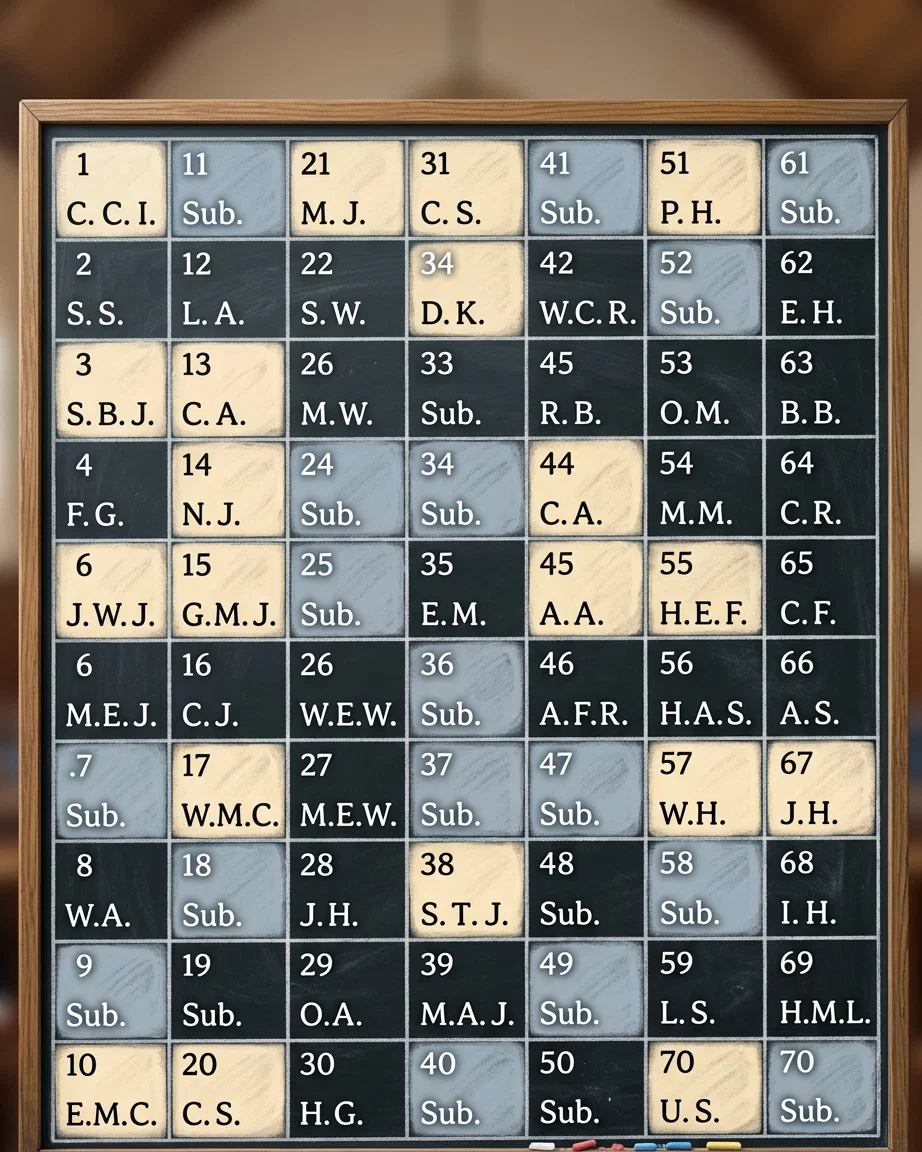
The preceding diagram is an illustration of the blackboard plan, or square system, recommended on page 7 of the Review of January 31, for each church to adopt in raising its portion of the $150,000 fund.
Sabbath, March 30, Elder E. J. Van Horn, of Ohio, and I, visited the Boggstown (Ind.) church; and after a discourse by Elder Van Horn, I took a special blackboard that I had previously diagramed as above, with as many squares as there were members in the church, numbering each square to correspond with the number of each member as recorded in the Church Record. After a short talk upon the necessity of raising this money to meet the urgent demands from fields or institutions where this fund is to be disbursed, I had the church clerk turn to the list of membership in the Church Record, and read slowly the list, pausing a moment to give each one an opportunity to say whether he would pay the amount represented by the block, which we have adopted in Indiana as three dollars. As rapidly as the names were read and the persons responded, we wrote their initials in the square. Some of the members were absent, and a few were unable to pay, so after we had passed over the whole list, we went back and gave an opportunity to any who desired, to pay for those not able to pay, or be responsible for those who were absent. Before I returned home, the full amount had been provided for. A large portion of this had already been paid, so the rest was quickly made up, and the full quota for this church was raised.
This is a very simple method, and can easily be worked in all our churches. Where persons are not able to pay the full quota, let some brother or sister assist them. If our church officers will take up this plan at once, and lift all they can themselves, and thus encourage the lay brethren and sisters, it will be but a few weeks till the greater portion of this fund can be raised. It is possible; and when these fields to which this money is to go are in such crying need, why not drop every other interest for the present, and unitedly give the cause of God one mighty forward movement?
Think of Kingston and the West Indies, where four thousand dollars of this money is to be used, and the terrible calamity through which they have just passed, which has prepared the inhabitants for this message. Shall we not step in without delay and do all in our power to let the people know what these things mean? Valparaiso, Chile, is to receive two thousand dollars of this fund, and is in about the same situation. They need their money at once, and that which is true of these places is true of every other field and institution that is to share in the disbursement of this fund.
I wish to request our church officers throughout Indiana to arrange for a special service the first Sabbath in May to take up this matter, using the diagram as illustrated above, and let us make one mighty effort to complete this work.
W. J. Stone.
Atlantic Union Conference
By I. H. Evans
Received on the $150,000 Fund up to April 2, 1907
Atlantic Union Conference
Central New England Conf. ........ $1,244.41
Chesapeake Conference ............ 134.70
Eastern Pennsylvania Conf. ...... 535.49
Greater New York Conf. ........... 400.75
Maine Conference ................. 245.18
New Jersey Conference ............ 164.45
New York Conference .............. 1,018.17
Southern New England Conf. ....... 631.61
Vermont Conference ............... 662.77
Virginia Conference .............. 207.12
Western Pennsylvania Conf. ....... 502.67
West Virginia Conference ......... 180.67
Western New York Conf. ........... 479.56
Total ............................ $6,407.55
Canadian Union Conference
Not specified .................... $130.41
Maritime Conference .............. 281.43
Quebec Conference ................ 6.00
Ontario Conference ............... 3.00
Total ............................ $420.84
East Michigan Conference ........ $670.05
Indiana Conference .............. 2,616.06
North Michigan Conference ....... 146.39
Northern Illinois Conference .... 922.94
Ohio Conference ................. 2,606.00
Southern Illinois Conference .... 619.46
West Michigan Conference ........ 2,234.87
Wisconsin Conference ............ 1,343.80
Total ............................ $11,159.57
North Pacific Union Conference
Conference not specified ........ $305.30
British Columbia Conference .... 10.00
Montana Conference .............. 130.65
Upper Columbia Conference ...... 970.50
Western Washington Conf. ....... 864.39
Idaho Conference ................ 245.90
Western Oregon Conference ...... 532.07
Total ............................ $3,058.81
Northern Union Conference
Alberta Conference ............... $75.80
Manitoba Conference ............. 238.70
Saskatchewan Mission field ...... 24.85
Minnesota Conference ............. 2,590.14
South Dakota Conference ......... 2,005.60
North Dakota Conference .......... 772.63
Total ............................ $5,707.72
Pacific Union Conference
Arizona Conference ............... $156.87
California-Nevada Conf. ......... 2,693.26
Southern California Conf. ....... 281.94
Utah Conference .................. 96.01
Total ............................ $3,228.08
Arkansas Tract Society .......... $213.14
Oklahoma Conference ............. 609.34
Texas Conference ................ 756.13
Indian Territory ................ 3.00
Total ............................ $1,581.61
Unknown
Unknown .......................... $146.20
Foreign
Australia ........................ $122.45
China ............................ 3.00
South Africa ..................... 128.16
Jamaica .......................... 3.17
Yukon Territory .................. 10.00
England .......................... 256.32
Gold Coast, West Africa .......... 10.00
Mexico ........................... 1.50
Costa Rica ....................... 2.00
India ............................ 12.48
South America .................... 23.35
Switzerland ...................... 5.81
Panama ........................... 1.00
Nicaragua ........................ 2.00
Trinidad ......................... .34
British Honduras ................. 17.00
Norway ........................... 25.00
Japan ............................ 12.50
Total ............................ $636.58
Grand Total ........................ $39,184.06
I. H. EVANS, Treasurer.
An Occasion for Rejoicing
By Ellen G. White
The Return of the Exiles—No. 3
An Occasion for Rejoicing
MRS. E. G. WHITE
As preparations for building the temple advanced from month to month, the faithful remnant of Israel began to gather courage. Long had they been deprived of every visible token of God's presence with them. And now, surrounded as they were by many sad reminders of the terrible apostasy of their fathers, which had finally resulted in lifelong captivity, they longed for some abiding token of divine forgiveness and favor. Above the restoration of personal property and many ancient privileges, they valued the approval of God. Wonderfully had he wrought in their behalf; and now they longed for an assurance of his pardoning love and protecting care. By working diligently to rebuild the temple, they hoped to hasten the restoration of special blessings connected with the sanctuary service. Within the walls of this second temple they expected to see revealed the glory of the Lord.
Wise plans for the prosecution of the work were laid by Zerubbabel the governor, Joshua the high priest, and their associates in authority. They "appointed the Levites, from twenty years old and upward, to set forward the work of the house of the Lord." "All they that were come out of the captivity unto Jerusalem" responded nobly, and with willing hands began to prepare the building material. Some of the immense stones brought to the temple site in the days of Solomon, had escaped destruction at the hands of the Babylonians. These stones were made ready for use, and much new material was provided.
The foundation-stone of the temple was laid amid scenes of great rejoicing. Accompanied by the trumpets of the priests and the cymbals of the sons of Asaph, the people "sang together by course in praising and giving thanks unto the Lord; because he is good, for his mercy endureth forever toward Israel."
The sentiment of this hymn of praise and thanksgiving is that expressed in the one hundred and thirty-sixth psalm—a most appropriate recognition of God's merciful providences in behalf of the children of the captivity:—
"O give thanks unto the Lord; for he is good: for his mercy endureth forever.
"O give thanks unto the God of gods: for his mercy endureth forever.
"O give thanks to the Lord of lords: for his mercy endureth forever.
"To him who alone doeth great wonders: for his mercy endureth forever.
"To him that by wisdom made the heavens;" "that stretched out the earth above the waters;" "that made great lights;" "the sun to rule by day," "the moon and stars to rule by night,"—to him, the Creator of all these, the congregation of Israel gave thanks, acknowledging that "his mercy endureth forever."
"To him that smote Egypt in their first-born," "and brought out Israel from among them," "with a strong hand, and with a stretched out arm;" "to him which divided the Red Sea into parts," "and made Israel to pass through the midst of it," "but overthrew Pharaoh and his host in the Red Sea;" "to him which led his people through the wilderness;" "to him which smote great kings," "and slew famous kings," "Sihon king of the Amorites," "and Og king of Bashan," "and gave their land for an heritage," "even an heritage unto Israel his servant,"—to him, the Mighty Leader of the hosts of Israel, the returned exiles now rendered praise as the One whose mercy endureth forever.
And this same Mighty Leader is the One who hath "remembered us in our low estate," "and hath redeemed us from our enemies." O, let us ever "give thanks unto the God of heaven: for his mercy endureth forever!"
The laying of the corner-stone of the second temple should have called forth expressions of gratitude from every heart. The house that was about to be built was the subject of many prophecies. The Lord's servants, and especially those who had had long experience in the things of God, should have recounted the remarkable providences leading up to the work that was being done; and they should have entered heartily into the spirit of the occasion. Especially should all the aged have rejoiced because God in his mercy had not cut them off in their iniquities at the time of the destruction of Jerusalem by the armies of Nebuchadnezzar. Throughout the long period of captivity they had been spared, and now they were permitted to witness this scene of rejoicing.
But mingled with the music and the shouts of praise ascending on that glad day, was a discordant note of sorrow and dissatisfaction. "Many of the priests and Levites and chief of the fathers, who were ancient men, that had seen the first house, when the foundation of this house was laid before their eyes, wept with a loud voice." Among the aged men who had seen the glory of Solomon's temple, there were some who lamented and wept over the inferiority of the building that was now to be erected.
It was but natural and right that these aged men should have feelings of sadness because of the results of long-continued impenitence. Had they and their generation obeyed God and carried out his purpose for Israel, the temple built by Solomon would not have been destroyed, and the captivity would not have been necessary. It was because of their former ingratitude and disloyalty, that they had been scattered among the heathen. Through long years of exile they were brought to realize the sacredness of God's law and the sinfulness of disobedience.
But conditions were now changed. In tender mercy the Lord had once more visited his people, and had allowed them to return to their own land. Feelings of sadness because of the mistakes of the past should have given place to feelings of joy. In a remarkable way God had moved upon the heart of King Cyrus to aid them in rebuilding the temple at Jerusalem, and this should have called forth expressions of profound gratitude. But some failed of discerning God's opening providences. Instead of rejoicing, they entertained thoughts of discontent and discouragement.
This spirit of murmuring and complaining, and of making unfavorable comparisons, had a depressing influence on the minds of many. The expressions of doubt and discouragement weakened the hands of the builders. The workmen were led to question whether they should proceed with the erection of a building that at the beginning was so freely criticized and was the cause of so much lamentation.
There were many in the congregation, however, who did not look upon the lesser glory of this temple, as compared with the first temple, with such dissatisfaction. "Many shouted aloud for joy: so that the people could not discern the noise of the shout of joy from the noise of the weeping of the people: for the people shouted with a loud shout, and the noise was heard afar off."
Our words and actions have a far-reaching influence for good or for evil. Could those who failed to rejoice at the laying of the foundation-stone of the temple, have foreseen the results of their mournful conduct on that day, they would have been appalled. Little did they realize the weight of their words of disapproval and disappointment. Little did they foresee how much they delayed the final completion of the Lord's house.
"O that men would praise the Lord for his goodness, and for his wonderful works to the children of men!" "Praise9ye the Lord. "O give thanks unto the Lord, for he is good: for his mercy endureth forever." "Blessed be the Lord God of Israel from everlasting to everlasting: and let all the people say, Amen. Praise ye the Lord."
When Love Came Down
By H. A. Kean
When love came down—
To take a cross and leave a crown
And robes of light for pilgrim's gown,
He came a Stranger to his own,
When Love came down.
When Love hung on the tree—
His heart's blood flowed for you and me,
That we might live, that we might be
With him through all eternity,
When Love hung on the tree.
When Love lay dead—
“The face of God was veiled in dread,
Seraph and cherub weeping fell
As rose that awful chant from hell,
‘The Son lies dead!’”
When Love awoke—
Ten thousand saints adoring spoke.
The golden harps of heaven rang,
And blood-marked throngs triumphant
sang:
“He lives, he reigns forever more,”
The Lamb of God—to die no more—
When Love awoke.
— H. A. Kean.
Use of the Tithe
By T. E. Bowen
T. E. BOWEN
In a recent issue of the REVIEW, Elder Daniells presented the amount of tithe voted to the General Conference Mission Board from union and State conferences during 1906. This tithe was a surplus in these treasuries, after the laborers in these home fields had been paid. The grand total amounted to over fifty-two thousand dollars. This is a splendid tribute to missions, every dollar of which goes to sustain laborers in foreign fields, the same as ministers at home are supported from the tithe. And this is as it should be.
That this plan is in harmony with the mind of the Lord, and that the home fields are encouraged thus to share their tithe in the support of fields in distant lands where no churches exist, the following from a special Testimony published not long ago, will show:—
“In some of the larger conferences the tithe may be more than sufficient to sustain the laborers now in the field. . . . These conferences should feel a burden for the regions beyond their own borders. There are missions to be sustained in fields where there are no churches and no tithes, and also where the believers are few, and the tithe limited. If you have means that is not needed after settling with your ministers in a liberal manner, send the Lord’s money to these destitute places. Special light on this point has been given. I was listening to the voice of the heavenly messenger, and the directions given were that the churches that had buildings and facilities should in this way [note the wording — sharing of their surplus tithe AS CONFERENCES to support ministers in mission fields] assist the missions in foreign countries.”
That responsibility rests upon all our churches in faithfully supporting the cause of God with tithes and offerings, and that if all are faithful at home, there will be no lack, is shown by the following:—
“If the members of the church exercise economy [the same economy manifested by the laborers themselves: ‘Our ministers should be dealt with in a fair, liberal, Christian manner, yet there should be no extravagance; economy must be practised; for the wants of the cause of God are many, and it must advance’] and self-denial in dress and in all their expenses, as God requires, there will be no lack of funds. The tithe will be increased, and there will be donations [apart from the tithe] sufficient for all church expenses.”
By these quotations it will be plainly seen that the plan of sharing our surplus tithe with the mission fields is a heaven-born one, and that God’s rich blessing will rest upon all those who manifest in this manner a practical interest in the work of God in the darker portions of his vineyard. But in doing it, it should ever be kept in mind that there is a right and a wrong way of rendering this assistance. It is not left with individuals to withhold their tithe from their own church treasury, sending it directly to some mission field, or even to the General Conference itself. This is disorganization. But the tithe having been paid over to the home treasury, when the conference officers, or delegates representing these home conference churches, vote a surplus to the general treasury, this is in harmony with every principle of thorough organization, and with such use of the tithe God is pleased, and will command his blessing to rest upon all who do it.
Takoma Park, D. C.
F. I. RICHARDSON
By F. I. Richardson
The Eastern Question—No. 1
F. I. RICHARDSON
For many years the attention of the statesmen of the civilized nations of the world has been drawn to Turkey. Each nation of Europe covets that portion of Turkey lying in Europe, and that highway for vessels between the Black Sea and the Mediterranean. Especially is this true of Russia; and for many years the Russians have been working to that end, carrying out the instructions of Peter the Great. But the nations, recognizing the advantage any nation would possess that held the Dardanelles, have united in holding one another in check. But the Russian bear has grown to such colossal proportions that some begin to feel that these powers will not be able to hold him in check much longer. The following words from a representative of England, the nation that has done most, perhaps, to keep the Turk where he is, reveals the situation. A writer in the Fortnightly Review, London, says: “Let us abandon the disgraceful protectorate of Constantinople, and say to France, Take Syria. It is true Russia would then go to Constantinople, but she must go sooner or later, and it is better she should go there as our friend than as our foe.”
The editor of the Keystone, the organ of the jewelers, London, speaks in the same strain: “The time is coming when Russia will secure her longed-for open port on the south. Turkey can not forever bar her way, though backed by the protection of all the powers; for Russia has the logic of the situation on her side, and the march of empire makes this destiny inevitable.”
To these might be added a multitude of testimonies showing the changed attitude of the nations toward Turkey and the undoubted intentions of Russia; but the almost daily reports from the far East, in which Russia is the central figure, are abundant proof that although the seat of operations is at present some distance away, the objective point for Russia is the driving of the Turks out of Europe. The statesman sees in this only a transfer of territory from one political power to another, and the benefits that accrue to the victor therefrom; but to the student of prophecy it has a much deeper significance. Nearly twenty-five hundred years ago the Lord, through his prophets, foretold that these very conditions would be the forerunners of startling events soon to follow, affecting the eternal welfare of every individual living upon the earth at this time.
The eleventh chapter of the book of Daniel is a prophecy, and beginning B. C. 538, gives in plain, literal language many of the important events of the world’s history, from Daniel’s time to the end of the world, dealing especially with this question we have under consideration.
“Also I in the first year of Darius the Mede, even I, stood to confirm and strengthen him. And now will I show thee the truth. Behold, there shall stand up yet three kings in Persia; and the fourth shall be far richer than they all: and by his strength through his riches he shall stir up all against the realm of Grecia.” Dan. 11: 1, 2.
“The angel, after stating that he stood to confirm and strengthen Darius, turns his attention to the future. Three kings shall yet stand up in Persia. To stand up means to reign; three kings were to reign in Persia, referring doubtless to the immediate successors of Cyrus. These were (1) Cambyses, son of Cyrus; (2) Smerdis, an impostor; (3) Darius Hystaspes.
“The fourth shall be far richer than they all. The fourth king from Cyrus was Xerxes, who was truly famous for his great wealth. He was to stir up all against the realm of Grecia. Never before had there been such a levy of men for warlike purposes; never has there been since. His army, according to Herodotus, who lived in that age, reached the fabulous number of five million and a half; but he utterly failed in that enterprise.”
“And a mighty king shall stand up, that shall rule with great dominion, and do according to his will. And when he shall stand up, his kingdom shall be broken, and shall be divided toward the four winds of heaven; and not to his posterity, nor according to his dominion which he ruled: for his kingdom shall be plucked up, even for others beside those.” Verses 3, 4.
Xerxes was the last Persian king to invade Grecia; from that time the power of the Persians began to wane, and the power of the Greeks to rise, until they in turn became the aggressors, and with Alexander the Great at their head, overran the Persian empire, and Alexander became monarch of the world. His kingdom was to be divided, but not for his posterity; it was to be plucked up for others besides those. At the early age of thirty-two years Alexander died in a drunken debauch, and within fifteen years every one of his posterity was murdered, and the kingdom was divided between his four leading generals. Reckoning from the standpoint of Palestine, the native land of the prophet, the kingdom was divided toward the four winds of heaven. Cassander had Greece and the adjacent countries, which lay to10the west; Lysimachus had Thrace, which lay to the north of Palestine; Seleucus had Syria and Babylon, on the east; and Ptolemy had Egypt, on the south.
“And the king of the south shall be strong, and one of his [Alexander’s] princes; and he shall be strong above him, and have dominion; his dominion shall be a great dominion.” Verse 5.
The king of the north and the king of the south are many times referred to in the remaining portion of this chapter; but the kings of the east and of the west are not mentioned again; and the reason for the omission is that very soon Lysimachus conquered Cassander, and annexed Macedon and Greece to Thrace, and Lysimachus was in turn conquered by Seleucus, and Macedon and Thrace annexed to Syria. How appropriate are the words of the prophet. The king of the south (Ptolemy) shall be strong; but one of Alexander’s princes (Seleucus) shall be strong above him, because Seleucus had become possessed of three parts of Alexander’s kingdom. Consequently that territory over which Seleucus reigned became the kingdom of the north, and whatever changes might occur, these first divisions of the empire must determine the names which these portions of territory should ever afterward bear, or we have no standard by which to test the application of the prophecy.
“And at the time of the end shall the king of the south push at him: and the king of the north shall come against him like a whirlwind, with chariots, and with horsemen, and with many ships: and he shall enter into the countries, and shall overflow and pass over.” Verse 40.
At least two thousand years have passed since the fulfilment of the events predicted in verse five. Many changes have taken place; empires have risen and fallen as foretold in the intervening verses; the Ptolemies, Cæsars, and Antonies have each in turn come upon the stage of action, and passed away, and we are brought down in verse 40 to the beginning of the time of the end, and find the king of the south and the king of the north are still upon the stage of action, and engaged in war with some other power.
To find the period called the time of the end, we go back to verses 31-35, and find that a power called the “abomination that maketh desolate” (verse 31, last clause) persecutes and destroys the people of God, “even to the time of the end.” Verse 35. This same power is described in Dan. 7: 25 as “wearing out the saints of the Most High.” The papacy is the power that was guilty of that awful work, as more than fifty million victims will testify at the great day of accounts. The papacy was to have this power for a time, times, and the dividing of time. Verse 25, last clause. Rev. 12: 14, 6, says that that time is 1260 days, which, being prophetic time, is 1260 years. The pope entered upon this career of power by the decree of Justinian, emperor of the Roman empire, in A. D. 538. As he was to have that power for 1260 years, we add 1260 to A. D. 538, which would bring us to 1798, which would be the beginning of the time of the end. On the tenth day of February of that year the pope lost his temporal power by being taken prisoner by Berthier at the head of the French army, and was taken to France, where he died the following year. Then as 1798 is the beginning of the time of the end, according to verse 40 of Daniel 11 the king of the south and the king of the north must engage in war with some other nation in that year. To find what power it is, we refer to verses 36-39, and find that it is an infidel nation, for verse 37 says, “Neither shall he regard the God of his fathers, . . . nor regard any god: for he shall magnify himself above all.” Scott’s Napoleon, Vol. I, pages 172, 173, makes it plain what nation it was, but for the sake of brevity we quote from an article in Blackwood’s Magazine, written some years ago:—
“France is the only nation in the world concerning which the authentic record survives that as a nation she lifted her hand in open rebellion against the Author of the universe. Plenty of blasphemers, plenty of infidels, there have been, and continue to be, in England, Germany, Spain, and elsewhere, but France stands apart in the world’s history as the single state which, by the decree of her legislative assembly, pronounced that there was no God, and of which the entire population of the capital, and a vast majority elsewhere, women as well as men, danced and sang with joy in accepting the announcement.”
We learn from history that in 1798, France did declare war against Egypt, and Napoleon, at the head of an army of fifty thousand, invaded that country; the Egyptians were able to make but a feeble resistance (push at him). The Turks, claiming Egypt as a semidependency, on learning of the invasion of the French, raised an army, fitted out their navy, and aided by English and Russian ships proceeded against them by sea and land. The French fleet was destroyed. Their army was conquered and driven from the country. And Egypt fell back again into the hands of the Turks, to whom they had to pay annually a heavy tribute. All of the above events happened in such quick succession that it could appropriately be said that the king of the north came against him like a whirlwind. These facts show indisputably that at that time the people occupying the territory of the king of the north were the Turks; so they would be, then, the king of the north, and as they still occupy that territory, they are still the king of the north.
“And he [the king of the north] shall plant the tabernacles of his palace between the seas [Dead Sea and Mediterranean Sea] in the glorious holy mountain [Jerusalem].”
In other words, the prophet says the Turks will be driven from Constantinople, and will make their headquarters, or capital, at Jerusalem. As we noticed in the beginning of this article, all eyes are now turned with interest toward Turkey; and the unanimous opinion of statesmen is that the Turk is soon to be driven from Europe.
The next words of the prophet are of the most solemn and weighty import to the world to-day; for when the Turk goes, the prophet says, “At that time shall Michael [Christ] stand up [reign], the great prince which standeth for the children of thy people: and there shall be a time of trouble, such as never was since there was a nation even to that same time: and at that time thy people shall be delivered, every one that shall be found written in the book.”
Ever since Christ ascended to heaven, he has occupied the position of high priest, and will continue to do so until the judgment is finished; then there will no longer be any necessity for a high priest, for the decision will have been made: “He that is unjust, let him be unjust still: and he which is filthy, let him be filthy still: and he that is righteous, let him be righteous still: and he that is holy, let him be holy still.” Rev. 22: 11.
His priestly robes are then laid aside for royal vesture. The work of mercy is done, and the probation of our race is ended. All cases are decided. And from that time on, till the terrified nations behold the majestic form of their insulted King in the clouds of heaven, the nations are broken as with a rod of iron, and dashed in pieces like a potter’s vessel. Then will be such a time of trouble as never was. A series of judgments unparalleled in the world’s history will fall upon the nations, culminating in the revelation of the Lord Jesus Christ from heaven “in flaming fire taking vengeance on them that know not God, and that obey not the gospel.” “And at that time thy people shall be delivered, every one that shall be found written in the book.”
Phœnix, Ariz.
The Grace of Cheerfulness
By J. S. Washburn
J. S. WASHBURN
Joseph is one of the most wonderful characters in the Bible. Sold as a slave from a father who loved him, from a home where there was comfort and plenty, by his cheerful, willing service he became trusted with all in the house of Potiphar. Then, falsely accused, thrown into prison, his cheerful service wins him the head position in that prison. He brought comfort and light and good cheer to those who sat in desolation and darkness. God counted his cheerful service as worthy of the highest position in Egypt next to the throne.
How cheerful Jesus was, even in the forepart of the evening of the night of his betrayal. “Be of good cheer; I have overcome the world.” And yet hanging over him was the awful shadow of the cross, and there was tightening upon him the cruel grip of Satan, the prince of darkness.
How cheerful was the apostle Paul—cast down, yet not forsaken; bearing all things, hoping all things, enduring all things. “But godliness with contentment11is great gain.” “Having food and raiment, let us be therewith content.” “I have learned, in whatsoever state I am, therewith to be content.” I Tim. 6:8; Phil. 4:11. “Be content with such things as ye have: for he hath said, I will never leave thee, nor forsake thee.” Heb. 13:5. “A merry heart doeth good like a medicine.” Prov. 17:22. “He that is of a merry heart hath a continual feast.” Prov. 15:15.
The world does not have that which brings cheerfulness and contentment. Even in the mirth of the world the heart is heavy. But a true Christian must be cheerful under every circumstance. If circumstances are not the pleasantest, our surest hope of bettering our condition is to accept cheerfully the situation in which we find ourselves; and, like Joseph, with a gracious, cheerful heart, do our utmost, and God will see also that our head is lifted up. He will surely say to us, ‘Come up higher.’ My brother, do you know that the very strongest recommendation that you can possibly have for a higher place, for a better position, is cheerful acceptance of your present situation, and the fulfilling of its duties gladly and without complaining?
O, in this world of cheerless gloom, what a blessing is a word of kindness, of hope, of light, a cheerful smile! My brother, my sister, you owe this to the world, to be cheerful, whatever your situation. Before you is eternal life, the blessed hope. Our Friend is with us alway, and we shall sit upon a higher throne than that of Joseph at the last. Be of good cheer.