The Youth’s Instructor, Vol. LII, No. 36

A Wonder—The Trinidad Pitch Lake

The Youth’s Instructor

September 6, 1904

Review and Herald Publishing Assn. · Washington, D. C. · September 6, 1904

A Wonder—The Trinidad Pitch Lake
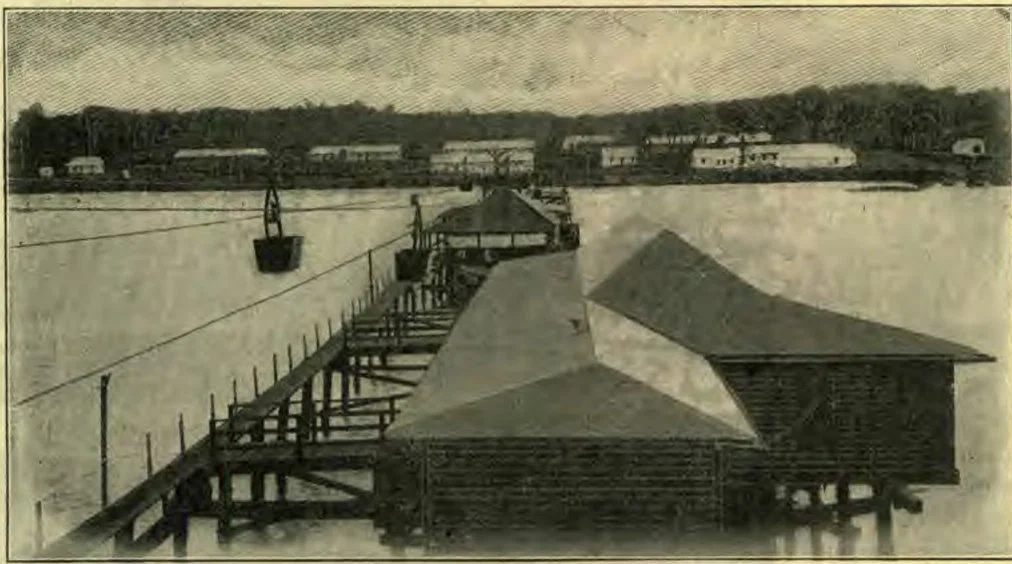
It is not my purpose to weary INSTRUCTOR readers with a subject worn out by many writers; yet I thought you would doubtless be interested in a report of a visit of our own missionaries to that quaint and only half-explained phenomenon, the “Trinidad Pitch Lake.” Our usual duties having taken us within a few miles of the lake, Elder W. A. Sweany and the writer decided to take a half day and visit the wonder of which we had heard so much. At San Fernando we boarded the little coastal steamer “Paria” at nine in the morning, and were soon steaming away to the southwest, along the lowland which forms the peninsular extremity of southwestern Trinidad, whose flat top is but little higher than the sea. At one time these lowlands were cultivated for sugar, but now, for the most part, they form a wild jungle. Soon after eleven o’clock our little steamer stopped at the village of La Brea, the place that is usually connected with the pitch lake, but we were not to land here. Before the advent of one of those modern productions, “trusts,” all pitch was shipped from this village. But the “Asphalt Trust,” an English corporation run by American push, found that it was a waste of time and money to carry all the pitch over this long route, so cut a new way across to the beach, and built their own village of Brighton. Our next stopping place was opposite this village. We stepped down into a little rowboat, which was loaded down almost to the gunwalls. In the moments we could snatch from anxiously watching the waves that continually threatened to swamp us, we saw, as we neared the landing-place, a long narrow wharf built out into the sea, at the end of which lay a steamer being loaded with asphalt for New York. Another steamer bound for London was anchored near by, awaiting its turn. Many of the large cities of Europe get their asphalt from Trinidad. The ships carrying pitch are loaded by iron buckets of about nine cubic feet capacity. These are strung one hundred ten feet apart, on a cable which connects the vessel with the “works” one-half mile away. These buckets each hold about one thousand pounds of asphalt, and the cable that carries them is supported by iron pillars, and works on the principle of the endless chain.
Immediately on reaching the shore we found an asphalt path which led us up over the little hill along the line of buckets. We followed this path through the village, noting that each room had its garbage box, nothing being allowed to be thrown carelessly about to decay and threaten the health of the workers, a necessary precaution in the tropics.
We soon reached the top of the small hill, where, just before us, were the works. We found them to be low sheds—all the building required in this climate—with a few small houses where tools and other necessaries are kept. In these sheds are the engines, with the appurtenances furnishing the power to run the endless chain conveying the buckets to the ship, and also to draw the cars from the lake. Only a small engine of thirteen-horsepower is needed, as it is all down grade to the ships, the force of gravity being almost sufficient to carry the loaded buckets down, and at the same time return the empty ones. We passed on through the works, as our interest was in the lake just beyond, and there it lay before us, a broad black expanse of one hundred acres.
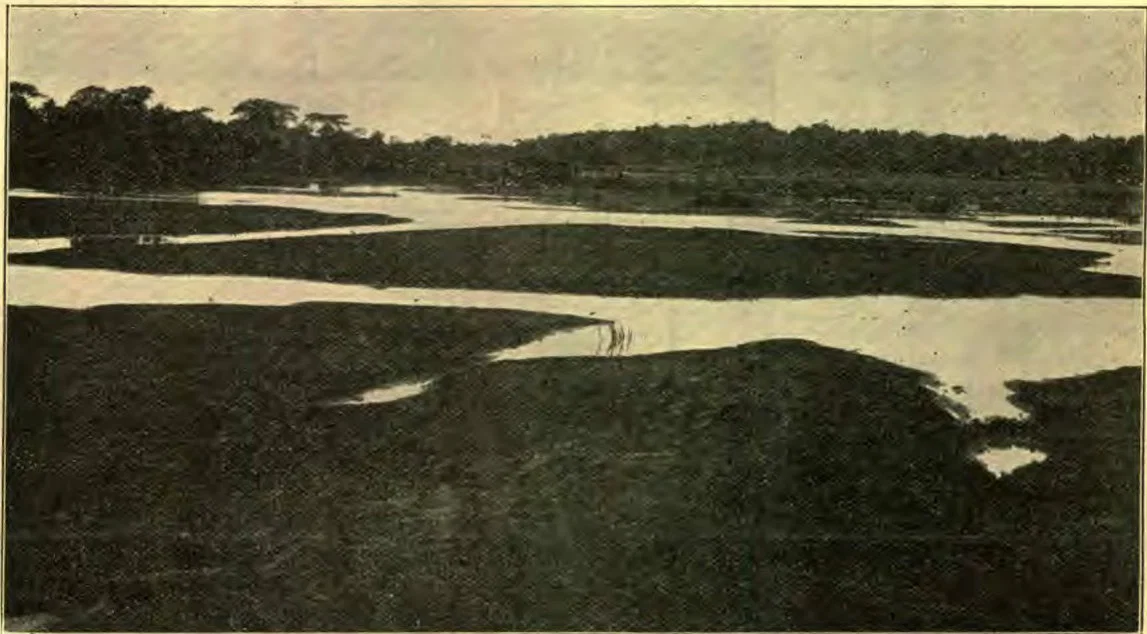
Containing millions of tons of asphalt, covered here and there with small islands of soil, with tropical vegetation growing upon them. We stood upon its brink with a feeling of wonder as to the origin of this great black lake, apparently solid, yet always in slow circular motion.
There are different speculations as to the origin of the pitch. Some contend that it is due to some convulsion of nature, such as volcanic action; but to us this seems impossible, as then the pitch, which is rich in oil, would have been burned by the intense heat, and we would have only a charred remnant. It seems far more reasonable to regard the pitch as having been formed in the same way as were the great coal-mines, a portion of the great mass of vegetation buried at the time of the flood having in some way been changed to asphalt instead of to coal.
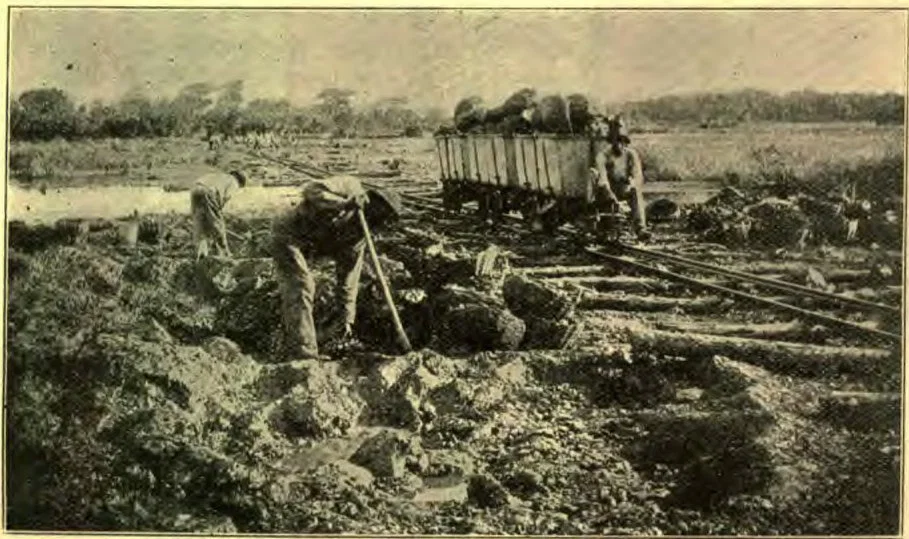
DIGGING THE PITCH
DIGGING THE PITCH
We walked with some misgivings on to the black Stygian-looking pool, and found it hard and fully able to bear our weight. As to-day is comparatively cool, we found the “pitch” quite solid; but on a hot day, one could not stand long in the same place. There is a diminutive railroad in the shape of a horseshoe, with the two ends in the sheds, running out to the center of the lake. Each car of this railway carries two of the half-ton iron buckets spoken of before.
As the men were at work out at the center of the lake, we made our way along the little road to the spot where they were working. They were all negroes. The first we approached was hard at work with a pickax, digging up blocks of the brittle asphalt about one foot each way, and weighing perhaps seventy-five pounds. This was broken into smaller pieces and laid up on the bank for the loaders. This hole is about one hundred feet in diameter, and from three to five feet deep. Strange to say, to-morrow morning it will be filled up again, and the lake will be as level as it ever was, and the man will be able to dig as much asphalt from the same spot as he dug to-day. Thousands of tons have been removed from along the side of this same railroad, and thousands of tons will still be taken, without moving the road, and the workman stands in precisely the same spot day after day. A digger gets from ten to fifteen cents a load, and the loaders get six cents an hour, very good wages indeed for the West Indies. Nearly every island in the West Indies was represented in the gang before us.
Small oval or elongated air-bubble holes in the pitch were noticed; their oval shape indicates the slow movement of the great mass. The motion is so slow as to be almost imperceptible, so that some writers have questioned whether there was any; but the little railroad has demonstrated it beyond further question. You may lay the ties and rails ever so straight in the morning, but before night you will have it worked into innumerable forms of the letter S. Several men worked all day to keep this railroad sufficiently straight to be serviceable. It was formerly supposed that the lake was inexhaustible; but a commission of experts recently sent out from England to investigate the matter, have reported that while there is no diminution of supply perceptible to the eye alone, careful surveys show us that the center of the lake is sinking in proportion to the amount of pitch taken out, so that the actual shape of the surface of the lake at the present time resembles a saucer. The manager, however, informed us that he had run a gas-pipe three hundred feet straight down into the lake, before it was broken off, so there is no probability of a sudden failure of supply. There is also connected with the works, apparatus for purifying the pitch. This is done by boiling it to a liquid form by steam running through coils. During this operation all sediment sinks to the bottom, and the liquid is run into barrels, where it hardens. Most of the pitch exported to America and Europe is sent in the crude state.
Instead of returning by Brighton, we took the longer route to La Brea. The lake has overflowed both above and below the surface of the ground; and as a result one can find pitch for miles around the actual lake. At La Brea, on the beach, is located the claims of all the private diggers of pitch. They own the land, having purchased it in the usual way, and in spite of all that the concessioners at the lake can do, are still winning pitch from mother earth. A great hole is dug in the ground, perhaps one hundred feet square and from ten to twenty feet deep, then it is left for a few months, and lo it all fills up again, when it can once more be emptied of its valuable contents.
The lake itself is owned by the Trinidad government. The concessioners, or the company leasing the lake, who hold the sole right to win pitch from the lake, claim that this pitch came from the lake, and is theirs, although found on another’s land. This has led to endless litigation in the courts as injunction after injunction has been served. Thus the lake has proved a valuable mine to the lawyer, the owner, and the government. The government owns the lake and gets a royalty of $1.50 per ton from the concessioners. As one hundred thousand tons are shipped to the States every year, besides that going to Europe and other countries, we can see that it is a source of great revenue, and is rightly called “the black diamond mine.” At the lake eight hundred fifty tons per day, can be easily loaded on the steamers; nine hundred fifty-nine tons is the best record, but many days the workmen are idle.
There is a good lesson wrapped up in the history of this lake. It was discovered by Sir Walter Raleigh while he was searching for gold. He reported it to the English government, but could stop only long enough to note the fact, and then pushed on up the pestilential swamps of the Orinoco, vainly seeking El Dorado, which was always just beyond, and always of untold wealth, rivaling the riches of the Aztecs of Mexico and the Incas of Peru. The El Dorado of his imagination was to him of much more value than the plain black expanse of pitch lying within his grasp. He died without realizing his El Dorado, while later generations have found it in the lake he treated lightly.
At three o’clock, after enjoying one of the large luscious pineapples for which La Brea is famous, we were taken to our little steamer, feeling well repaid for our five hours’ visit. The next time you walk on your asphalt pavement, remember the great black lake surrounded by tall palm trees and jungle, beneath the blaze of a tropical sun, and remember that representatives of the third angel’s message are here, and a people is being gathered out on the firm platform of the commandments of God and the faith of Jesus. “And this gospel of the kingdom shall be preached in all the world for a witness to all nations, then shall the end come.”
CORNER OF THE PITCH LAKE
GEO. F. ENOCH.
BUCKETS AND ENDLESS CHAIN

A Bath in the Great Salt Lake

A FEW days ago, in company with a brother of the Salt Lake City church, I had the privilege of a bath in the Great Salt Lake. From boyhood I had heard of this great inland body of salt water in the heart of Utah, in the midst of the great Mormon settlement, but never before had I the privilege of seeing it, and bathing in its waters.
The lake is about eighteen miles from the city, and is reached by steam cars, which make the trip in thirty minutes. The country between the city and lake is a vast alkali flat, and it is thought, was covered at one time by the lake. Of late years the shore line has been receding, and the lake has seemed to be gradually drying up. At Saltair, the great bathing resort, a huge pavilion has been erected, resting on twenty-five thousand piles. A few years ago, no doubt, this great building was over the water, and the piles were driven into the water, but now, as the water has receded, it is quite on dry land. From the pavilion are two arms, one longer than the other, which in graceful circular form reach out to the deeper water. In here are the bath rooms in great number, the one assigned to the writer being eight hundred four. In and about the pavilion are carried on all kinds of amusements to attract the people, who daily flock here by the thousands for fun and frolic.
On entering the water one is attracted by the beautiful bottom of the lake, which is of soft white sand, with no pebbles or rock to hurt the feet. The water is very clear, and the bottom may be seen at the depth of many feet. A safer place to bathe could not be imagined, for the bottom slopes to deep water so gently that one could hardly get beyond his depth unless he purposed to do so.
Wading out about forty rods, we came to water that reached the breast, and concluded that we would strike out for a swim, as we had often done in fresh water, but at once found the limbs raised completely to the surface of the water, and the body placed in a horizontal position. This position in swimming, as all know, is unnatural, if not painful, so we turned on the back, as the remarkable buoyancy of the water keeps one at the surface without effort on the part of the swimmer. With a quiet motion of the hands to furnish propelling power, one can go into even the deep water with safety with but little if any danger, of sinking; indeed, one could not sink if he tried, but might, if he were not careful, become strangled with the briny water entering the nose or mouth. A drop of the water in the eye, while possibly not dangerous, is quite painful, and will close the eyes for some moments. No living thing can exist in this lake, as the water is over twenty per cent salt.
In each dressing-room is a spray of fresh water, which is at once resorted to on coming from the bath, to rinse the salt water from the body; but often persons forget this, and dress without using the spray; the face then will look as though one had been carelessly using complexion powder, as it will be covered with fine white salt.
A bath in this lake is very invigorating, and one does not tire or feel exhausted as he does in fresh water, and as the body is dried, there is a glow on the skin, similar somewhat to the salt glow after a treatment in one of our sanitariums.
One of the most beautiful sights I ever beheld was a sunset scene on the lake. The lake shone like burnished gold, the western heavens were aglow with the glory of the setting sun, and my mind was filled with the thought of what the sea of glass might be before the throne of God. Grand was this sight, but grander yet will be the things which await those who are faithful to God. Just a little longer and our eyes shall behold the King in his beauty and the blessed home of rest and peace. W. B. WHITE.

The Boy with the Book

In feudal ages, knight and squire Joined embassies for king and sire, Made fit and brave by tourney bold, On battle-field of cloth of gold, By faultless archer’s grace and aim, And eager liegeman’s fearless fame.
But, knight of gentler symbols, thou Shalt keep as fair a tryst, I trow; And Wisdom’s chivalry shall teach A nobler act and holier speech; And Right, the armourer, and Truth, Accouter thee for fields of ruth Where golden spurs await thee — go, Subdue, and win, and teach thy foe.
FRANK WALCOTT HUTT.

Purity of Heart

“PURER in heart, O God, Help me to be; May I devote my life Wholly to thee. Watch thou my wayward feet, Guide me with counsel sweet: Purer in heart Help me to be.
“Purer in heart, O God, Help me to be; Teach me to do thy will Most lovingly. Be thou my Friend and Guide. Let me with thee abide; Purer in heart Help me to be.”

Character Building

(Concluded)
THE following statement is found in “Christ’s Object Lessons:” “Words are of no value unless accompanied by appropriate deeds.” That they have no foundation, no fixed purposes, no standard principles formed within their lives on which to begin their structure, is one great reason that so many start for the kingdom and so soon turn back. If this part of the problem were overcome, would it not remove any cause for the excuse—poor as it is, yet so often given—that I am not a Christian because I can do as good or better than some one else who does profess Christ. Then, young man, young woman, if we could but realize that the thoroughness, diligence, promptness, and fixed purposes that we do or do not manifest in our work, are swaying the characters of those around us, would we not arouse and do our duty, at least by showing forth these principles in our own lives?
When God drove the fallen pair from their beautiful home, and said that they should earn their bread by the sweat of their brow, was it for punishment?—No, but because in his great divine mercy and wisdom he knew that it would be impossible to save fallen men unless he gave them something that would make a foundation on which to build a character. This is God’s design for the whole human race.
In “Christian Education” I read the following: “The Christian youth should be in earnest, trained to bear responsibilities with brave heart and willing hand. He should be ready to encounter the trials of life with patience and fortitude. He should seek to form a character after the model of the divine One, following maxims of worth, confirming himself in habits that will enable him to win the victor’s crown.”
Our young people of to-day are being reared in different circumstances than were our fathers and mothers and grandparents. In those days so long gone by, it was necessary that every member of the family be employed in constant labor in order to maintain the home, and thus these habits and principles above stated were forced on the children and youth of that age. But how different it is with the young people of to-day! But few have any burden for the welfare of the home, or any interest in the success of the father’s business. It is the tendency of the age to educate young people to receive without giving, to feel that the opportunities that they have are their inherent rights, and that they owe nothing to any one for them. This condition reminds us of the time when Rome distributed free corn to her citizens. What did it do for Rome?—Destroyed her. What will indolence do for an individual, society, or nation? The same answer must come—destruction.
Then, young friends, should we not seek earnestly to develop strong and pure habits, not only to build a character for ourselves, but also that our lives may be useful both for humanity and for God? The following words as given by another fit the thought I desire to convey: “To do some work that is needed, and to do it thoroughly; to make our toil count for something in adding to the sum total of what is actually profitable for humanity; to make two blades of grass grow where one grew before, or, better still, to make one wholesome idea take root in a mind that was bare and fallow; to make our example count for something on the side of honesty, cheerfulness, courage, good faith, and love,” is an aim none too high for the lowest and most humble, and none too low for the most ambitious. If we keep this aim uppermost in our minds, with the constant desire to plant a seed of truth in the heart of some shipwrecked soul, we can rest assured that we are building and advancing toward the great example of truth and character. John Ruskin says, “He only is advancing in life, whose heart is getting softer, whose blood warmer, whose brain quicker, whose spirit is entering into living peace. And the men who have this life in them are the true lords and kings of the earth—they, and they only.”
To sum up the qualifications essential for a grand and noble character, I can not do better than to express it in the words of Hinsdale: “There are two classes of moral qualities, which may generally be described as the harder and the softer, the more rugged and the more gentle, the stronger and the more gracious. Under one category we bring courage, truth, justice, and righteousness; under the other, compassion, purity, tenderness, and innocence. The first give character its firmness and permanence; the second its grace and loveliness.”
The life that is the possessor of such qualifications in their completeness is nothing short of divine, and can be found manifest only in the life of the lowly Nazarene. Would we be the recipients of such virtues, we must follow his lowly path in humility, purity, and simplicity, and thus by his help ascend the ladder, round by round, until the crown is won. If we follow him, we must participate in giving this gospel message to a dying world. If we would teach the truth, our lives must have the correspondence with it that the poet indicated in the following lines:—
“Thou must be true thyself If thou the truth wouldst teach; Thy soul must overflow If thou another’s soul wouldst reach; It needs the overflowing heart To give the lips full speech. Think truly, and thy thought Shall the world’s famine feed; Speak truly, and thy word Shall be a fruitful seed; Live truly, and thy life Shall be a great and glorious creed.”
H. A. MORRISON.

Personal Work for Others

It must not be understood that this individual work by an individual in behalf of souls, as described in this volume, is in any sense unique or exceptional. While it is here offered as personal testimony, it is referred to as the kind of work that has had power in behalf of souls from the beginning, and that it is likely to be most effective as long as God is God, and as souls are souls.
For example, the preachers who are known as winning most souls to Christ are not preachers who expect to win souls in a great congregation by their eloquent and fervid appeals from the pulpit, but they are those who feel that the “inquiry meeting,” or the “after-meeting” which follows their best preaching services, has chief value in its enabling them to get face to face with the needy sinner who is present in his needs. This has been so for centuries with the evangelists and revivalists of most prominence and effectiveness. Any “evangelist” who failed to give this evidence of his appreciation of the power of an individual with individuals for Christ and his cause, would be a failure in all his evangelistic labors. This conviction, indeed, is the test of the preacher’s interest in individual souls, and of his determination to win them.
A stationary fog-horn has its value, on a reef or a rocky shore, as a warning to those who approach the point of danger. We must not say that this mode of sounding an alarm has no value, but we can not suppose that a fog-horn, however clear its sound or well worked its mechanism, can fill the place of a coast-guard of trained life-savers, who are on the watch to put out their well-manned life-boat to save endangered single souls. There are different ways of working for different individual souls. Some of these ways are better than others, but all of them are a great deal better than none.
More than thirty years ago I was present at a meeting of clergymen of different denominations, where a proposition was being considered of inviting a well-known “evangelist” to conduct a series of “revival meetings” in the community. Some of these clergymen criticized the methods of work and the manner of this evangelist. By and by a clergyman who was something of a sacramentarian in his views and practises, and therefore least likely to be in sympathy with revival methods, surprised all present by saying, earnestly:—
“You will understand that the public methods of this man, in his work, are not such as I myself should incline to; but I want to bear testimony to his fidelity to his Master in all his life course. I was his fellow student in college. I knew him well there, and I can speak understandingly of his ways. In all the four years of his college course, no student could be six weeks there without having to meet squarely the question of his personal relations to Christ, in consequence of the loving and earnest appeals of that follower of Christ. I knew more than one who was thus influenced by him. In my own case, I was a skeptic when I entered college, and I had little thought on the subject of religion anyway. But that man’s appeals I had to meet, and I could not resist them. It is in consequence of his faithfulness that my life is given to the Christian ministry. And now, whatever I think of that man’s public Christian methods, I can not but be grateful for his fidelity to his Master and ours.”
Those of us who heard that testimony in behalf of one who was faithful as an individual to individual souls, could not but feel that, apart from the question of the wisdom of his ordinary public methods for Christ, his spirit of faithfulness commanded our respect and approval. The true seeker after souls is too earnest in his work to be willing to divide his energies among more than one. That soul he loves, and that soul he must have.
And it seemed to me, as I listened to this testimony as to that man’s faithfulness to individuals for Christ, and as I thought over the matter afterward, that his life choice of the work of an evangelist, or revivalist, may have pivoted on his success as an individual worker for individuals. As he had found that addressing a multitude did not win a multitude, but that appealing to any individual did often win the individual, may he not have chosen that kind of ministerial work which gave most prominence to work with individuals for Christ? As a worker for individuals, he had prominence in Christ’s service, in widely different fields, for a whole generation.
Another example of persistence in work for individual souls, which impressed me profoundly, was in another than the college sphere, although in the same earnest spirit. Soon after the Civil War, while enlistments for the regular army were still going on in different parts of the country, in order to bring up that army to its specified numbers on the peace basis, young officers, with a good record of service and of known efficiency, were assigned to this duty, and some of these officers did good work for Christ as well as for country.
One such young officer was in turn assigned to several New England cities, and made his mark for his Master in all of these fields of action and influence. Having the true idea of work for many as best done through work for one, he pressed that idea in all that he did, or that he urged others to do. His profession as a soldier led him to feel that the best way of winning recruits is by enlisting one man at a time, rather than by trying to win a roomful by a patriotic speech.
In each city to which he was assigned he naturally went to the Young Men’s Christian Association as a hopeful center and starting-point. There he usually found the weekly prayer-meeting as perhaps the highest point of spiritual devotion. But this was, to his mind, too much after the pattern of an ordinary church service, where the congregation was largely of church-members and church-goers, while he wanted to reach those who were still outside, but who were compelled to come in, against their ordinary preferences and inclinations. Hence to this work he vigorously set himself at once.
Going at one time, into such a prayer-meeting, early in the evening, he asked the leaders how many persons had been sought out from the highways and byways that evening. On being told that nothing of the kind had been done, he asked that all should kneel at once in prayer, offering an ejaculation of consecration to this service, and of petition for help in this service, and then all should scatter to the street corners and drinking-places and gambling-houses, seeking souls, and urging them to come in where they could be helped. Fifteen minutes or more later they were to return to the association rooms, and then they might have a powerful prayer-meeting there. The first experiment was an eminent success, and its every repetition seemed an improvement on this. More of those for whom they had there hoped and prayed were gathered in in a single evening, under this plan of work, than under the old plan, or the no plan, in any year before.
Of course the good results of this kind of effort were a surprise to those who had supposed that being willing to pay for a seat in church, or being willing to look up for themselves a regular religious service, was an essential preliminary to being a hopeful member of a regular congregation. This has been so, in fact, for centuries. In this case gamblers gave up gambling, drunkards gave up drinking, scoffers gave up scoffing, doubters gave up doubting, and those who had been counted as outcasts became glad and grateful followers of the Lord Jesus, urging their old associates to receive life instead of death, as they had already accepted it. In one instance a rumseller, influenced by his now rescued customers, abandoned his vile pursuit, and became an active recruiting officer for the Captain of his salvation. Such results as this are natural when souls are sought one at a time by one who is in loving, living earnestness, intent in pursuit of that one soul.
Such a teacher as this, in such a work as this, was a power for good over those whom he inspired and led in it. He did not propose to do all the work which he pointed out. He simply convinced them that this was the way for its doing, and then he left them to do it. Those who had never thought of this method of work took hold of it gladly and effectively under his direction.—H. Clay Trumbull, in “Individual Work for Souls.”

A Purpose

SEVERAL years ago on Sabbath evening there was assembled in one of our institutions a little band of young men, students of the school, earnestly discussing their interest in the work of the gospel, and their desire to have a part in the proclamation of the advent message wherever God might direct. One young man said, “What a joy to know that God had used you in saving one soul.” All of these young men are now, I believe, in the work of the Lord, some at home, and some in foreign fields. The young man who made the remark has had good success in winning souls. This is an illustration of what a holy purpose, constantly cherished in the heart, will accomplish. M. E. KERN.

THE WEEKLY STUDY

Conversion of Saul

TEXTS FOR PERSONAL STUDY: Matt. 18: 1-3; John 3: 1-7; Acts 3: 19.
REFERENCE STUDY: “Sketches from the Life of Paul,” second chapter.

OUTLINE OF TOPICS:—

The occasion. Place. Time of day. Agent in conversion. Glory manifested. Voice. Language used. Effect on Saul. Effect on those with him. Ananias. Direction given him by the Lord. Preparation of Saul. Christ’s message. Filled with Holy Spirit. Receiving of sight. Baptism.

Notes

Locate Damascus on the map, note distance from Jerusalem, population in Paul’s time, etc.
Let the opening exercises be varied each week. Study to make this part of the exercises interesting. The leader can do much in this way to add to the interest and profit of the meeting. Assign to each member of the class, if possible, a portion of Scripture to read.
“The date of Paul’s conversion has repeatedly been derived from 2 Cor. 11: 32, 33 (Comp. Gal. 1: 17; Acts 9: 19), and according to the best view is put in 34.”—Schaff.
“We have been tempted into some prolixity in describing Damascus. But, in describing the solemn and miraculous event which took place in its neighborhood, we hesitate to enlarge upon the words of Scripture.”—Conybeare and Howson.
“The Saviour had spoken to Saul through Stephen, whose clear reasoning from the Scriptures could not be controverted. The learned Jew had seen the face of the martyr reflecting the light of Christ’s glory and looking like the face of an angel.”—“Sketches from the Life of Paul.”
“Saul was about to journey to Damascus upon his own business; but he was determined to accomplish a double purpose, by searching out, as he went, all the believers in Christ.”—Id.
“While Saul, with his companions, was gazing and admiring the fertile fields near Damascus, suddenly a light above the brightness of the sun shone round about him. . . . The scene was one of the greatest confusion. The companions of Saul were stricken with terror, and almost blinded by the intensity of the light. They heard the voice, but saw no one, and to them all was unintelligible and mysterious. But Saul, lying prostrate upon the ground, understood the words that were spoken, and saw clearly before him the Son of God. One look upon that glorious Being imprinted his image forever upon the soul of the stricken Jew.”—Id.
“When the effulgent glory was withdrawn, and Saul arose from the earth, he found himself totally deprived of sight. The brightness of Christ’s glory had been too intense for his mortal sight, and when it was removed, the blackness of night settled upon his vision.”—Id.
“He was taken to the house of the disciple Judas, and there he remained, in solitude, studying upon the strange revelation that had broken up all his plans, and changed the entire current of his life.”—Id.
“This wonderful conversion of Saul demonstrates in a startling manner the miraculous power of Christ in convicting the mind and heart of man.”—Id.
“Paul was baptized by Ananias in the river of Damascus. He was then strengthened by food, and immediately began to preach Jesus to the believers in the city, the very ones whom he had set out from Jerusalem with the purpose of destroying.”—Id. G. B. T.

Something in Him

THE young people who are ending this year of school in a less satisfactory manner than they hoped, may gain inspiration from the example of the hero of the following incident:—
A fine football player at one of our colleges so neglected his studies through his zest in sports that, in the spring examinations, he failed on enough subjects to make it necessary for him to take his year over again.
In conversation with a fellow student, he said: “I don’t think I’ll be back. I’ll drop the whole thing over, and try to get into business.”
Said his friend: “You’ll do nothing of the sort. You can come back here next year and stand at the head of the class. Let the faculty know there’s something in you.”
That was the parting word. The football man went home, and thought the matter over for a few days. The result was an order for some books on the honor course. The family was informed that he had some extra work to do, and would show a better record next year, or they need not spend another dollar on him.
Through the summer he was punctual at breakfast every morning, and faithful in doing half a forenoon’s work and some evening chores each day on the farm. The rest of the time he spent in the best room, studying.
In college the next year he kept an honorable place on the “team,” but it was noticed that he had other things on hand.
At the spring examinations he made a first-class in every subject, and led his class in philosophy. This standing was maintained the next year.
To-day he holds a doctor’s degree in philosophy, and is a professor of high standing in a prominent university. There was something in him.—Selected.
Continue reading: One Little Widow