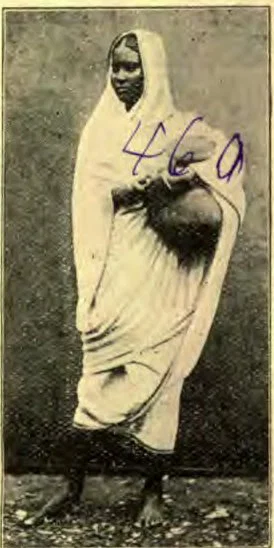
SEVEN years a widow, yet only eleven years old! The shadow—nay, the curse—of widowhood, had hung over little Sita ever since she remembered anything. The little brown girl often wondered why other little girls living near her had such happy, merry times, while she knew only drudgery and ill-treatment from morning until night. One day when six of the weary years had passed, and she was ten years old, Sita found out what widow meant. Then, to the cruelties she already endured, was added the terror of the woes to come. She had gone, as usual, in her tattered garments, with three large brass waterpots on her head, to the great open well from which she drew the daily supply of water for a family of nine. She was so tired, and her frail little back ached so pitifully, that she sat down on a huge stone to rest a minute. Resting her weary head on one thin little hand, she was a picture of childish woe. Many deep sorrows had fallen on her young heart, but she was still a child in mind and years, yearning for companionship and love.
INDIAN WATER-CARRIER
Many Brahman servants were drawing water near her, and looked bright and happy in their gay-colored cotton saris. A woman so poor that she must draw her own drinking water, but still a Brahman, came near, and to her Sita appealed for help.
“Will you not draw a little water for me? I am ill and tired, and the well is very deep.”
The woman turned angrily, and uttered, in a scathing tone, the one word, “Widow!” then she burst out: “Curse you, how dare you come between me and the glorious sun? Your shadow has fallen upon me, and I’ll have to take the bath of purification before I can eat food! Curse you, stand aside!” Poor Sita stood bewildered. She made no answer, but tears coursed down her cheeks. Something akin to pity made the woman pause, and halting at a safe distance from the shadow of the child, she talked to her in a milder tone. She was thinking, perhaps, of her two soft-eyed daughters, very dear to her proud heart, though she mourned bitterly when they were born, because the gods had denied her sons.
“Why should I help you,” she said, “when the gods have cursed you? See, you are a widow!”
Then, in answer to the child’s vacant gaze, she continued: “Don’t you understand? Didn’t you have a husband once?”
“Yes, I think so,” Sita answered; “an old, bad man who used to shake me, and tell me to grow up quickly to work for him; perhaps he was my husband. When he died, they said I killed him, but I did not.”
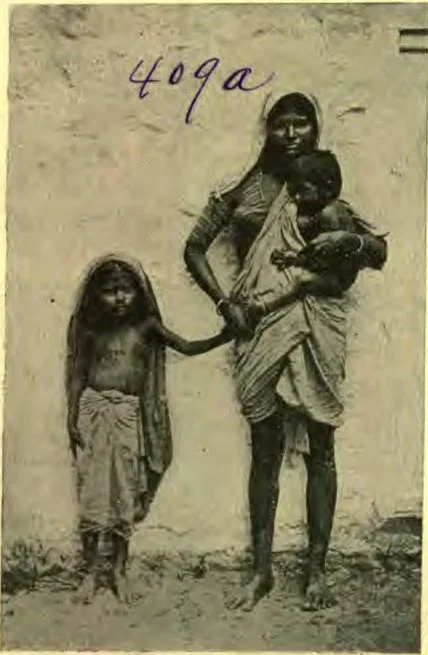
LITTLE SITA'S NEIGHBORS
“So you call him bad?” the woman cried. “Ah! no wonder the gods hate you. No doubt you were very wicked ages and ages ago, and so now you are made a widow. By and by you will be born a snake or a toad,” and gathering up her waterpots, she went away.
The slender, ill-fed child hurriedly filled the brass vessels, knowing that abuse awaited her late return. Raising the huge jars to her head, she hastened to her house—a home she never knew. The sister-in-law met the little thing with violent abuse, and bade her prepare the morning meal. The child was ill, and nearly fell with fatigue.
“I’ll show you how to wake up,” the woman cried, and seizing a hot poker, she laid it on the arms and hands of the child. Screaming with pain, the poor little creature worked on, trembling if the sister-in-law even looked her way.
This was one day. Each of the seven long years contained three hundred sixty-five such days, and now they were growing worse. The last year, in token of the deep disgrace of widowhood, the child’s soft dark tresses had been shaved off, and her head left bare. When that has been done, but one meal a day is permitted a widow, no matter how she works.
Most of the little girls who saw Sita would run from her, fearing pollution. But there was one who shone on her like a gleam of sunshine whenever she saw her. One day after the woman had abused her at the well, Sita found a chance to tell Tungi about it.
“There is a better God than that,” Tungi said. “Our people do not know him, and that is why I am not allowed to talk with you. I am married, and my husband lives in a distant city. If I speak to you, they believe that he will die. But in the school I attend, many do not believe these things.”
“How can you go to school?” Sita asked. “My sister-in-law says that only bad people learn to read.”
“So my mother used to think,” said Tungi; “but my husband is in school, and he has sent word that I must go until he calls for me to come to his home. Then he can have a wife who can understand when he talks about his books. He says the English have happy families, and it is this that makes them so. The wives know books, and how to sing, and how to make home pleasant. My mother says it is all very bad, but he is my husband, and I must do as he says. I am very glad; for it is very pleasant there.”
Thus the bright-eyed little Brahman wife chatted away, as gay as a bird. The fount of knowledge was opened to her—the beaming eye, the elastic figure, and the individuality of her Western sisters were becoming hers.
But none of these things seemed for Sita. For nine weary months after Tungi went to school, the shaven-headed child, living on one meal a day, went about sad and lonely. When she again saw her bright-faced little friend, her condition had grown worse. Her neck and arms were full of scars where bits of flesh had been pinched out in vindictive rage of her husband’s relatives, who believed her guilty of his death. Brutality, growing stronger with use, made them callous to the sufferings of the little being in their power. No one who cared knew of the pangs of hunger, the violent words, and the threats of future punishment. Once or twice she had looked down into the cool depths of the well, and wondered how quickly she could die. Only the terror of punishment after death kept this baby-widow from suicide.
One day as she was weeping by the gate-way of Tungi’s house, the little child-wife told the little child-widow of a safe refuge for such as she, where neither poverty nor ignorance could exclude her—a home under the loving care of one who knew the widow’s curse. After many difficulties, Sita found this shelter. Here she forgot her widowhood, and found her childhood. Here, in the beautiful garden, or at her lessons, helping with cooking, or leaning lovingly on the arm of Ramabai’s chair, she passed many sweet and useful years. By and by she found the greatest joy in love, higher and better than human love can ever be. Later, when a beautiful young womanhood had crowned her, she was sought by an earnest young Christian as his wife.
Many of the millions of the child-widows in India never find release from the bonds of cruel custom and false religion. In Hinduism there is no hope for such accursed ones.—Belle Brain.
Kindly Words
By Benjamin Keech
A kind word costs but little, yet ’tis worth its
weight in gold,
And he who speaks one willingly has treasures
rich, untold,
That, in the distant future, he may reap, with
thankful hand;
For kindly words, once spoken, yield a harvest
fair and grand.
There never was a person who could not appreciate
A word, when kindly spoken, be he small or be
he great;
And every word that’s uttered in a kindly voice,
and true,
Can hardly fail to bear its seed, and blossom
forth, anew.
Each kindly word will sink into the heart that
longs for it,
And in the fertile soil will grow and blossom
forth,—a bit
Of warm and tender sunshine that will brighten
some one’s way,—
And kindly deeds will blossom from the seed
you sow to-day.
Each kindly deed shall be a factor in the mighty
force
Which, in the distant years to come, shall quell
the downward course
Of sin and wrong that binds the world, and holds
it in its sway—
Then go and speak your kindly words,—oh, speak
them while you may.
— Benjamin Keech, in Vick’s Family Magazine.
Bone Products
Not every one knows, perhaps, that glue, glycerin, scouring soap, toilet soap, and fertilizers are all obtained from bones. It is a fact that they are, and it may interest you to learn how the bones are made to yield these products.
Cicero said: “Economy is of itself a great revenue,” and in the economy practised in a factory where bones are utilized we have a fine demonstration of the truth of his words. In using up the bones, there is no waste worth mentioning, and they prove a “great revenue.” When taken to the factory, the first step necessary to their utilization is that of cleansing them from bits of dried flesh and particles of foreign matter that may have adhered to them. Experienced employees carefully assort the bones, then place them in “crushers,” where they are crushed to a mass. This crushed mass is next given a good soaking in a mild solution of sulphuric acid. When removed from the “soaking vats,” the crushed bones are white and perfectly clean-looking. Next they are placed in digesters, and subjected to a pressure of steam for several hours. Then a spigot in the bottom of the “digester” is opened, and liquid glue is drawn off. Glue is the chief product obtained from bones. This liquid glue from the “digesters” undergoes a process of evaporation, after which a portion of it is allowed to harden for use as glue in the business world, and a part is refined and sold as gelantin, for use on our tables. The grease obtained from the bones is drawn off into “cooling vats,” and in its crude state is made into laundry soaps. When the grease is to be used for toilet soaps, it is refined and mixed with vegetable oils and perfumes.
From the liquids which “run off” from the boiling soap, glycerin is manufactured. Finally the crushed bones which are taken from the “digesters” are put into a grinding apparatus, and ground up for use as fertilizers. Even the water in which the bones are cleansed is not wasted. It is “boiled down,” and made into a fertilizer that brings a good price.—Selected.
False Constantine
By Roy F. Cottrell
A FEW years after the death of Nero, five men ruled the empire, one after another, in such a just and peaceable manner that they are known in history as the “five good emperors;” but after them the world saw terrible scenes. In only a little more than one hundred years, sixty men were given the title of “emperor,” and only seven died a natural death. Every one of the others died in some violent manner. This is enough to show the spirit of the times, so we will not linger upon this part of Roman history.
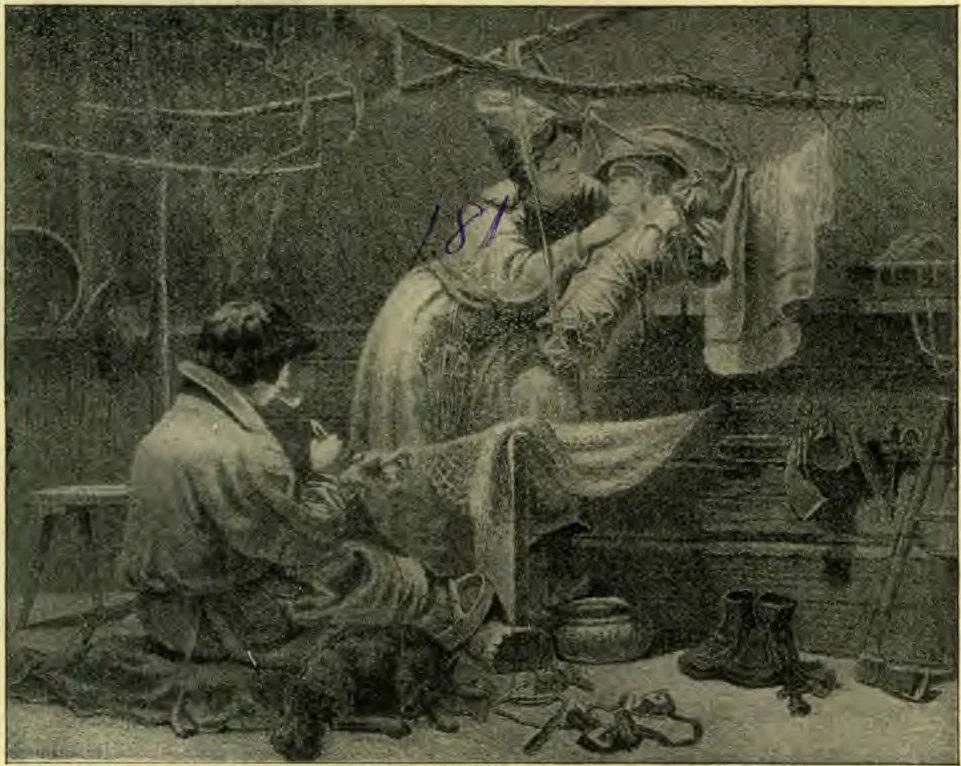
LAPLAND BABY READY FOR CHURCH
When Constantine became emperor (306 A. D.), the Christians were suffering the most terrible persecution that the Roman empire ever inflicted upon them. A few years previous, the kingdom was divided into four parts, and was ruled by four emperors. Two others now arose to claim the throne, so that for the first and last time Rome had six emperors at once. But it was not their intention to rule the world together. Each one desired to have it all for himself; so for eighteen years there was almost continual warfare, and at the end of that time Constantine was sole emperor of the world.
After reigning about five years, he professed to have become a Christian. No one can tell exactly when he was converted, while many claim that he never was. But from the beginning, he favored the Christians, and by his influence a decree was given in 313 A. D. which granted to all classes freedom to worship in any way they might choose. Well would it have been for the Christians had they been content with this victory; but no, they gladly accepted help from the state, and used it to their own ruin.
As Constantine is called the “first Christian emperor,” it will be interesting to notice how well he deserved the title. At that time the sun itself was everywhere worshiped by the Romans, and Constantine gave it great honor as his guide and protector. After his death the story was told that during one of his wars, he saw in the heavens a beautiful cross, bearing the words, “With this sign you will conquer.” This tale is doubtless false, yet it is a fact that the cross was made his royal standard; and a symbol of Christ was placed upon his banners and the shields of his soldiers. Yet he did not forsake idolatry; for just beneath the cross was a likeness of the emperor and his sons in gold. To these the heathen part of his army bowed in worship.
According to his direction the money was coined with the name of Christ upon one side, and the figure and name of the sun-god upon the other. He it was who made the first law requiring rest upon the first day of the week, and in his decree it was named the “day of the sun”—Sunday. So we find a trace of his mixture of heathen customs with Christian worship, even in our own day.
After this Constantine became jealous of his eldest son, and had him put to death. A nephew met the same fate; and then, to the horror of every one, he caused his wife, with whom he had lived for twenty years, to be killed. At the age of sixty-four, and in the thirty-first year of his reign, Constantine was taken seriously ill, and feeling that he was about to die, called for a bishop, and was baptized. Shortly after this he passed away; but in his will he stated that he thought he had been poisoned by his brothers and their children, and that he desired his sons to have them put to death. Six princes of the royal family thus perished, and so the record bears witness that Constantine was a murderer even in the hour of death. He had favored the Christians because he needed their help and influence, but we think of him as a Christian only in name.
The bishops enjoyed the help he had given the church, and sought in every way to please him. They made up the story that Constantine was a second Moses, the leader of the new Israel. As Moses was brought up at the court of Pharaoh, and finally fled from Egypt, so this new Moses was held during his youth by his enemies, and at last made his escape. When he defeated the army of one of his rivals, and the leader himself - was drowned in the river, it was a second victory at the Red Sea; the new Pharaoh had been drowned, and the new song of deliverance was sung. Then as Moses built the tabernacle in the wilderness, so Constantine must likewise erect one. He built it at a distance from his camp, and there he would go, pretending to have visions and to talk with the Lord. It was told that angels were seen standing about Constantine, that his dining-room might be the New Jerusalem described in the book of Revelation, and many other such wild stories were invented. It seems impossible that the church could have wandered so far from Christ in three short centuries, but it is the truth. There were a few, however, who remained loyal to God, and were made sad as they beheld the church drifting into sin. At this time great inducements were held out for all to become Christians. No one could hold any office unless he was a member of the church; and it is said that Constantine gave to each convert a white garment and twenty pieces of gold. The result of this was to bring nearly all the people of the empire into the church, while a large share of them were just as thoroughly heathen as before. To them it was a change of name, but not of heart.
It was during the reign of Constantine that the church united itself with the state, and he7became the head of both. In the church many disputes arose, and the emperor was made the final judge. A council of the church would be called, and after listening to both sides, this half-Christian, half-heathen emperor would write out the decision to which all must yield, or else suffer banishment and perhaps death. The church, having forsaken the power of God, now embraced the civil power, and ere long “that man of sin”—the papacy—was revealed.
Roy F. Cottrell.
How Lapland Babies Attend Church
ONE of the most curious customs of the Laplanders is the manner of taking the babies to church, described in the Ram’s Horn. The mothers go regularly, even when they have wee babies. Sometimes they ride ten or fifteen miles in a sleigh drawn by a reindeer. They all have warm clothes on, the baby in particular. Often it is wrapped in bearskins.
As soon as the family arrives at the little church, and the reindeer is secured, Father Lapp shovels out a bed of snow, and Mother Lapp wraps baby snugly in skins, and lays it down there. Then Father Lapp piles the snow all around it, and the parents go into the church. Over twenty or thirty of these babies lie out there in the snow. The little ones are not strong enough to knock the snow aside and get away, so they just lie still and go to sleep. When church is out, the father goes to the spot, puts his hands down into the snow, pulls the baby out, and shakes off the snow; then the reindeer trots off and takes them all home again.—Missionary Review of the World.
MEMORY VERSE: “Remember now thy Creator in the days of thy youth.” Eccl. 12:1.
“And Hezekiah slept with his fathers, and they buried him in the chiefest of the sepulchers of the sons of David: and all Judah and the inhabitants of Jerusalem did him honor at his death. And Manasseh his son reigned in his stead.”
Manasseh was only twelve years old when he began to reign; but he became a very wicked king. He built again the high places that his father had cast down, and reared up altars for Baalim. In the courts of the temple he built altars to carry on the heathen worship of the sun and stars, and he even set up a carved image in the house of God itself. He made his children pass through the fire, and he consulted with wizards and dealt with a familiar spirit. We are told that he made Judah and the inhabitants of Jerusalem to err, and to do “worse than the heathen.”
When the Lord spoke to the king and the people, through the prophets, they would not listen. So at last he sent upon them the captains of the host of the king of Assyria. They bound the king with fetters, and carried him away captive to Babylon.
Manasseh seems to have been truly sorry for his sin. “When he was in affliction, he besought the Lord his God, and humbled himself greatly before the God of his fathers, and prayed unto him.” The Lord heard the prayer of the repentant Manasseh, and brought him again to Jerusalem into his kingdom.
During the rest of his life, Manasseh reigned well. “He took away the strange gods, and the idol out of the house of the Lord, and all the altars that he had built in the mount of the house of the Lord, and in Jerusalem, and cast them out of the city.” He also repaired the altar of the Lord, and offered sacrifices upon it.
Manasseh reigned for fifty-five years; and at his death his son Amon had the throne for two years. Amon did very wickedly, following the example of his father in the early part of his reign. Finally his servants conspired against him, and slew him in his own home.
Then the people took his little son, Josiah, and made him king over them. “Josiah was eight years old when he began to reign, and he reigned in Jerusalem one and thirty years. And he did that which was right in the sight of the Lord, and walked in the ways of David his father, and declined neither to the right hand, nor to the left.”
“For in the eighth year of his reign, while he was yet young, he began to seek after the God of David his father: and in the twelfth year he began to purge Judah and Jerusalem from the high places, and the groves, and the carved images, and the molten images.”
“And they brake down the altars of Baalim in his presence; and the images, that were on high above them, he cut down; and the groves, and the carved images, and the molten images, he brake in pieces, and made dust of them, and strowed it upon the graves of them that had sacrificed unto them.”
After Josiah had thoroughly cleansed Jerusalem from idol-worship, he went into the other cities of Judah, and did the same work.
Questions
1. What honors were shown to Hezekiah at his death? How long had he been king in Jerusalem? 2 Chron. 29:1.
2. Who was the next king? How old was he when he began to reign? What kind of king was he during the first part of his reign?
3. Tell some of the things that Manasseh did that were very evil in the sight of the Lord. What did he lead the people of Judah and Jerusalem to do? How wicked did they become?
4. How did they receive the messages that the Lord sent to them? What did he finally send? What was done with Manasseh?
5. When the king was in affliction, what did he do? How was his prayer answered? Tell how he showed that he was truly sorry for his sins.
6. How long did Manasseh reign? Who was the next king? For how many years? Tell how he met his death.
7. Whom did the people then make king over them? How old was Josiah at this time? How carefully did he walk in the ways of David?
8. In the eighth year of Josiah’s reign, whom did he begin to seek? How old was he then? What work did he begin in the twelfth year of his reign?
9. Tell how he cleansed Jerusalem from idols and idolatry. Where did he then carry on the same work?
10. Repeat the Memory Verse. Why is it a good thing to remember the Creator in the days of thy youth? Give two or three reasons. Whom did King Josiah remember while he was still young?
XII—The New Earth
(September 17)*
MEMORY VERSE: “Nevertheless we, according to his promise, look for new heavens and a new earth, wherein dwelleth righteousness. Wherefore, beloved, seeing that ye look for such things, be diligent that ye may be found of him in peace, without spot and blameless.” 2 Peter 3: 13, 14.
Questions
1. What view was next presented to the prophet? Rev. 21: 1. What is said of the first heaven and the first earth?
2. How is this passing away of the first heaven and the first earth described by Peter? 2 Peter 3: 10.
3. What promise is made in connection with this description of the destruction of the heavens and earth? Verse 13.
4. What was God’s plan originally in creating the earth? Isa. 45: 18; .
15. How will God’s people be employed? Verses 21, 22; .
16. What is said of worship in the new earth? Isa. 66: 22, 23.
17. What are we urged to do, seeing we look for these things? 2 Peter 3: 14.
18. In view of all this, what encouragement may we derive from what seems to be a delay of the coming of the Lord? Verse 15.
Notes
_It Is Not so Much_
What you think, as what you say.
What you earn, as what you save.
What you say, as how you say it.
What you want, as what you need.
What you believe, as what you do.
What you give, as how you give it.
What you work, as how it is done.
What you possess, as how you use it.
What you learn, as what you remember.
— Paragon Monthly.
Inactivity Is Rust; Rust Is Death
“INACTIVITY is rust; rust is death.”
The Glory of Heaven in Lifting the Fallen
“THE glory of heaven is in lifting up the fallen.”
Following the Things That Make for Peace
“LET us therefore follow after the things which make for peace, and things wherewith one may edify another.” Rom. 14: 19.
Do You Wish to Learn Spanish?
By M. E. Kern
“YOUNG men should be qualifying themselves by becoming familiar with other languages, that God may use them as a medium to communicate his saving truth to those of other nations. . . . If young women who have borne but little responsibility would devote themselves to God, they could qualify themselves for usefulness by studying and becoming familiar with other languages.”
The call is plain. Who of our young men and women will respond? The message is due. It is due to every nation, kindred, tongue, and people.
Union College furnishes an excellent opportunity for young men and women who desire to prepare themselves for the Spanish field. The instructor has the special advantage of having lived in Mexico three years, and taught in the Spanish language. She has done considerable translating also. The Spanish students are taught to converse in the language, and special attention is given to religious literature. In two years an apt student can easily become sufficiently proficient to enter a Spanish field, and quickly obtain a working knowledge of the language. Miss Winifred Peebles or C. C. Lewis, president of the college, will be glad to correspond with any who may contemplate taking up this work. Address them at College View, Neb.
M. E. KERN.
Fifty Arrests in Alexandria Under Sunday Law
NEARLY fifty arrests were made last Sunday in the little town of Alexandria, one of the suburbs of Washington City, because of violation of a recent Sunday law.
Deadly August Heat Strikes Spain
AUGUST was a hard month for some countries. In portions of Spain hundreds died from the intense heat, the thermometer at Seville sometimes registering one hundred twenty degrees Fahrenheit in the shade. A number are said to have died from the gases which arose from the melting of the asphalt in the streets.
Harvest Ingathering Service Plans for Churches
By Editor
THERE will appear in the INSTRUCTOR in a short time an article on the “Harvest Ingathering” service, also a suggestive program. We trust that every church, where practicable, will plan to hold an “Ingathering” service. Last year many dollars flowed into the mission treasury through these meetings, and rich blessings came to the children and youth who participated in them. It is not too early to begin to plan for the work.
Union College Messenger Special Young People's Convention Report
“THE July issue of the Union College Messenger is a double number, of over eighty pages, and all the space is devoted to a ‘report of the Young People’s convention of the Central Union Conference, held in College View, May 31 to June 5, 1904.’ The price of this number is ten cents, and the price of the Messenger for a full year, including this special issue, is 35 cents. Address Union College Messenger, College View, Neb.”
Signs of the Times and the Call to Warn
“WARS and rumors of wars,” calamities, epidemics, fearful catastrophes of all kinds, make up the daily bulletin. The world is plunging forward into those fearful times just ahead that are to mark the closing of sin’s dark reign, and usher in the glad day of the kingdom of God. Now is the time for all who understand the meaning of these things to sound the note of warning. “Come out of her, my people, that ye be not partakers of her sins, and that ye receive not of her plagues.”
Racial Violence in Georgia and the Mob Spirit
The recent conflict in Georgia between the whites and negroes is but an indication of what is to come. Already a number of organizations have been formed by the whites with the avowed purpose of whipping all blacks who have made themselves obnoxious to the citizens. The Washington Star says “the mob spirit seems to prevail throughout the country in which the recent trouble took place.” Serious indeed is the condition of a country or community when those who have acted a part in an unlawful, inhuman burning of men at the stake, could take the bones of the victims and express them to the president with an audacious message.
Cholera Devastates Teheran: City Deserted and Silent
“CHOLERA-RIDDEN Teheran, still as death by day and like bedlam at night,” is one of the headlines that appeared in a recent daily paper. Three hundred deaths a day is the present record, and the tendency is still upward. “Business is entirely dislocated, work suspended, and the necessities of life hardly procurable.” Streets and bazars, usually crowded, are now deserted. Thousands of citizens have fled from the city for safety. Funeral processions, lamentations of the bereaved, and invocations to prophets and saints, it is said, are all that now break the silence of the plague-stricken Persian city.
Elder Colcord on the District of Columbia Sunday Law
Elder W. A. Colcord recently preached a stirring discourse in Washington on the question “Should the District of Columbia Have a Sunday Law?” The Washington Times, in its report of the address, quoted the following paragraphs:—
“Let every one who loves freedom, respects truth, and names the name of Christ, take his stand against this wicked, unchristian thing. God wants only willing worshipers. His law, not man’s, is supreme in religious things, and his Word the true guide-book to heaven.”
“The church of Christ, clothed with his power, preaching his word, and working as he worked, is beautiful and effective for the highest good; but stripped of these, and clothed with civil power, and wielding carnal weapons, it becomes an engine of the worst of tyrannies.”
“Sunday, Jan. 31, 1904, a minister in Kansas said: ‘There is a class of people who will not keep the Christian sabbath unless they are forced to do so. But that can be easily done. If we would say we will not sell anything to them, we will not buy anything from them, we will not work for them, nor hire them to work for us, the thing could be wiped out, and all the world would keep the Christian sabbath.’”
“This is what is wrapped up in this Sunday-law movement. It is time the mask was torn from it, and the people knew what is in it. Whatever its pretentions, it is not Christian. Christ did not persecute, nor seek to enforce his teachings by a resort to the civil power.”
A Valuable Set of Lessons
PRESIDENT L. A. Hoopes said: “The Lessons in New Testament history by M. E. Kern are most practical because of their arrangement for class and private study.” Many others have spoken highly of this set of lessons on the Life of Christ and the Acts of the Apostles.
Send for a copy to the Union College Press, College View, Neb., and see what these lessons are like. Price of the set, 90 cents, postpaid. They are used in the School of Correspondence at Union College, as well as in church-schools, academies, and colleges.
Burdens That Draw Us Back to Christ
WHEN beneath some heavy cross you faint,
And say, “I can not bear this load alone,”
You say the truth. Christ made it purposely
So heavy that you must return to him.
The bitter grief which “no one understands,”
Conveys a secret message from the King.
Entreating you to come to him again.
The Man of Sorrows understands it well;
In all points tempted, he can feel with you.
You can not come too often or too near.
The Son of God is infinite in grace,
His presence satisfies the longing soul;
And those who walk with him from day to day
Can never have a “solitary way.”
— Selected.
Bookkeeping, Penmanship, and Shorthand by Mail
Bookkeeping, Penmanship, or Shorthand successfully taught by mail. A number of persons have been qualified for greater usefulness by taking work with us. You can do the same. Write for particulars. Fireside Accounting Institute, Battle Creek, Mich.