The Youth’s Instructor, Vol. 29, No. 34.

THE RIVER JORDAN

The Youth’s Instructor

Aug 24, 1881

S. D. A. Publishing Association · Battle Creek, Mich. · Aug 24, 1881

THE RIVER JORDAN.
“O my God, . . . I will remember thee from the land of Jordan, and of the Hermonites, from the hill Mizar.” Ps. 42:6.
THERE is no river in the world like the Jordan—none so wonderful in its historic memories, none so hallowed in its sacred associations, and none so remarkable in its physical geography. It is THE RIVER of the Holy Land. It has been more or less intimately connected with all the great events of Scripture history from the patriarchs to the apostles. Its banks have been the scene of the most stupendous miracles of judgment, power, and love, ever the earth witnessed. When the fire of heaven had burnt up Sodom’s guilty cities and polluted plain, the waters of the Jordan rolled over them and buried them forever from the face of man. Thrice was the swollen torrent of that river stayed, and its channel divided to let God’s people and prophets pass over “dry shod.” Once, at the bidding of the man of God, the iron ax rose buoyant from its channel, and floated on its surface. Once its waters gave forth healing virtue, as if to prove to the proud Syrian chief the fallacy of his sneering exclamation: “Are not Albana and Pharpar, rivers of Damascus, better than all the waters of Israel?” Greater still were those miracles of our Lord which the evangelists have grouped thickly on and around the central lake of the Jordan. There did the storm-tossed billows hear and obey the voice of their Creator; there did the incarnate Son of God walk upon the face of the deep; there, obedient to his will, the fishes filled the disciples’ nets; along those shores the lame walked, the deaf heard, the blind saw, the sick were healed, lepers were cleansed, the dead were raised to life again. But the most glorious event the Jordan ever witnessed was Christ’s baptism; for when he was baptized, “the heavens were opened unto him, and he saw the Spirit of God descending like a dove, and lighting upon him;” and when the Divine Son was perfectly equipped for his great work of redeeming love—when just about to set out on his glorious mission—the voice of the Divine Father pierces the vault of heaven, and proclaims to the astonished and joyful disciples on Jordan’s banks the divine approval of both work and worker: “This is my beloved Son, in whom I am well pleased.” Surely, then, we may say that every spot along the stream is “holy ground,” and that the name JORDAN is not only emblazoned on the page of history, but enshrined in the Christian’s heart.
It would almost seem as if nature or nature’s God had from the first prepared this river to be the scene of wondrous events, by giving to its physical geography some wondrous characteristics. Its principal fountain, bursting from the base of Hermon, is, like the mouths of other rivers, on the level of the ocean. It descends rapidly through its whole course, and at length empties into the Dead Sea, whose surface has a depression of no less than 1312 feet. The whole valley of the Jordan is thus a huge rent, or fissure, in the earth’s crust. Though it is not much over a hundred miles in length, at its southern end, along the shores of that mysterious lake, we have the climate and products of the tropics, while at its northern end, on the brow of Hermon, we have a region of perpetual snow.
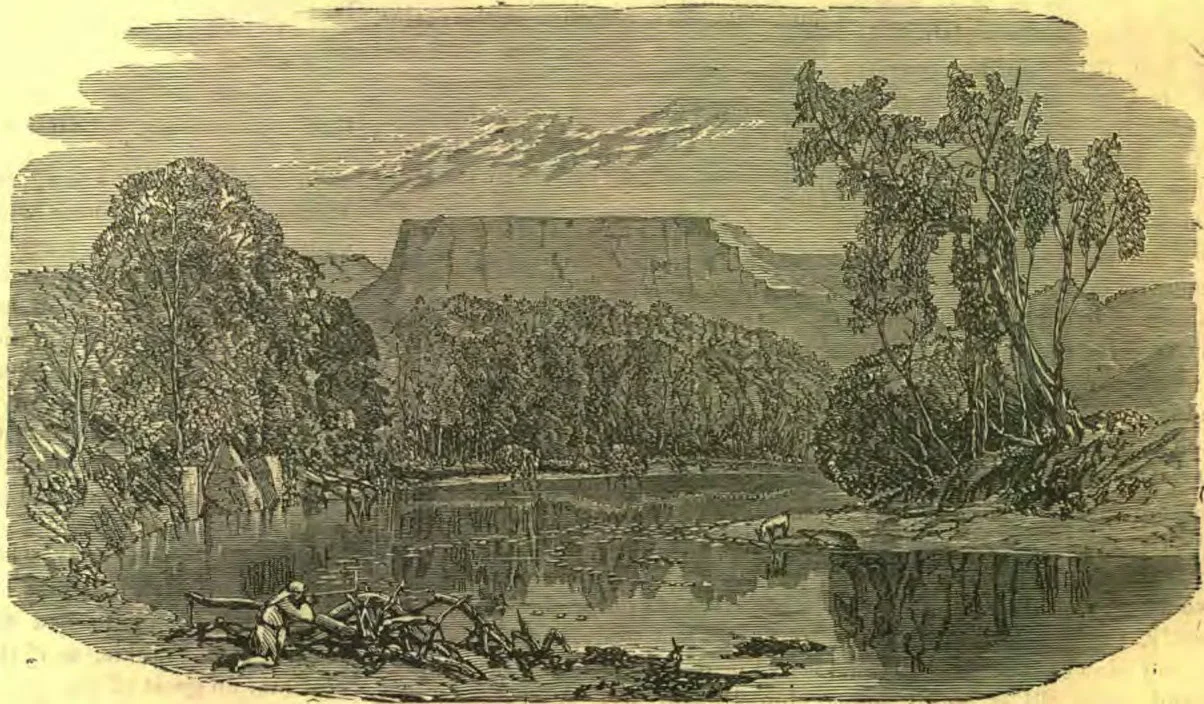
SCENE ON THE JORDAN.
Between the Lake of Galilee and the Dead Sea lies a long, deep valley, varying from five to ten miles in breadth, and shut in by the parallel mountain ranges of Samaria and Gilead. Down the center of this valley, in the bed of a deep ravine, winds the river Jordan. It has two distinct lines of banks. The first or lower banks confine the stream, are comparatively low, generally alluvial, and thickly fringed with foliage. The second, or upper banks are at some distance from the channel—occasionally nearly half a mile apart, and in places they rise to a height of one hundred and fifty feet. The appearance of the river itself is exceedingly varied. Now it sweeps gracefully round a green meadow, softly kissing with its rippling waves the blushing flowers of the oleander as they bend over it;—now it clasps a wooded islet in its shining arms;—now fretted by projecting cliffs, and opposed by rocky ledges, it dashes madly forward in sheets of foam.
One bridge alone spans the river, on the road which joins the ancient cities of Bethshean and Gadara. But the ruins of many others are visible, and the fords are numerous. Of the latter, one of the most remarkable is Succoth, where Jacob crossed with his flocks and herds (Gen. 33:17), and where the fleeing hosts of Zebah and Zalmunna suffered so terribly from the Israelites (Judges 7:24; 8:4-10). The plain around Succoth is abundantly watered by fountains and streamlets from the mountains. The soil is exceedingly rich. Dr. Robinson says of it: “The grass, intermingled with tall daisies and wild oats, reached to our horses’ backs, while the thistles sometimes overtopped the riders’ heads.” Jacob showed his usual worldly wisdom, when he encamped at this favored spot, and “made booths [Succoth] for his cattle.”
But the most interesting spot on the Jordan is unquestionably that now called the “pilgrim’s bathing-place,” opposite Jericho. Here the channel is deep, the current rapid, and yet, on three different occasions, the river was stayed by a miracle, and the channel left dry, to let God’s people pass over. And an interest still higher and holier clings to it. It is the scene of Christ’s baptism. Sitting here one day on the river’s bank, beneath the shade of a great willow tree, I read in succession the Bible narratives of the passage of the Israelites under Joshua, of the translation of Elijah, and of the baptism of Jesus; and then looking up on those grey bluffs that bound the narrow ravine, I involuntarily exclaimed, “Oh, that my eyes had seen those glorious events of which you were the witnesses! Oh, that the eye of sense had witnessed what the eye of faith now contemplates!—the marshalled hosts of Israel; the ark on which rested the Shekinah glory; then the fiery chariot bearing God’s prophet to heaven; and last of all, ‘the Dove,’ the Heavenly Dove, coming down and abiding upon the Saviour.”
It was in the month of April I visited this “holy place” on the Jordan. It was already the time of harvest, for the people of Jericho were reaping their little fields up on the plain. And we are told that “Jordan overfloweth all his banks all the time of harvest” (Joshua 3:15; 1 Chron. 12:15). The fact is still true, though Palestine is changed. The heavy rains of early spring falling on the northern mountains, and the winter snow melting on the sides of Hermon, send a thousand tributaries to the sacred river. It rises to the top of the lower banks, and when I was there, the ruddy, swollen waters had flowed over and covered portions of the verdant meadows on each side.
Mounting my horse, I followed the tortuous river to its mouth, and saw it empty its waters into that sea of death. One would almost think they flow in reluctantly, for the current becomes slower and slower, and the channel wider and wider, till at length water touches water, and the Jordan is lost. Such is this sacred river, without a parallel, historical or physical, in the whole world,—a complete river beneath the level of the ocean, disappearing in a lake which has no outlet, and which could have none. In whatever way we regard it, the Jordan stands alone.—Porter.

LIFE'S MEASURE.

He liveth long who liveth well, So ran the legend terse and old; To keep the truth in mind were well, For truth is better kept than gold.
The one will perish in an hour; One never dies, but bright and pure As Heaven itself, when earthly power Has passed, forever shall endure.
Not by the years of life is told The length of life, but by the zeal And kindly works, as, growing old, Men for each other do and feel.
His life is long whose work is well; And be his station low or high, He who the most good works can tell, Lives longest though he soonest die.
Then, as the sweet-winged moments speed, Freight them with wealth of truth and worth, With garnered sheaves of thought and deed For the glad harvest-home on earth.
Within the rankling breast of Hate, In desert ways where no flowers bloom, In scenes where Folly sits in state, In wan-faced Sorrow's house of gloom,
Sow love, and taste its fruitage sweet; Sow smiles and see the desert spring; Sow wisdom for the harvest meet; Sow sunshine for the joy 't will bring.
—Selected.

THE LITTLE GIRL THAT NOBODY LIKED.

“Wasn’t it kind in Miss Hodge to give us such a short Latin lesson?” said Sue.
“I don’t know as it was very kind. She generally gives us long enough ones to make up,” said Katie.
“Say, don’t you think that new girl is pretty?” whispered Carrie.
“Not so very. Too many freckles,” said Katie.
Katie walked home alone. Frankie was in the front yard, putting the last touches to a snow man.
“Look, Kit, isn’t he a big feller,” shouted the little boy.
“I don’t call him so very tremendous,” said Katie. “You needn’t throw that snow-ball at me, sir.”
Katie went into the house, and found mamma and Aunt Eleanor talking with Mrs. Eldridge in the parlor.
“What red cheeks your little girl has!” said Mrs. Eldridge pleasantly; “she must have been out in the cold.”
“I don’t think it’s very cold to-day,” said Katie, seating herself by the register.
“My Minnie has been out skating for the first time this winter,” Mrs. Eldridge went on.
“Does she like to skate? I hate to,” said Katie.
Mrs. Eldridge said no more, but turned to Katie’s mamma.
“Katie, I must show you the hood Mrs. Eldridge brought me,” said mamma, after she was gone. “Don’t you think it’s pretty?”
“I don’t think red’s a pretty color a bit. What a queer shape it is! I’ve got to go and study.”
“Eleanor, what shall I do with that child?” said Mrs. Wicks helplessly. “Do tell me what is the matter with her.”
“Her food don’t agree with her; I’m pretty sure of that” said grandma. “The child’s stomach is out of order.”
“I’ve talked and I’ve talked, and it does no good,” continued Mrs. Wicks. “She contradicts from morning till night. I’ll turn her over to you, Eleanor. I wish you would have a serious talk with her. But if you ever have children of your own, you’ll find it not such an easy matter,” sighed Mrs. Wicks, “to make angels of them.” Aunt Eleanor had heard this many times before. She laughed, and went on crocheting, but she did not forget her little niece with her sad infirmity.
That night they all sat in the parlor. Grandma was nodding over her knitting; papa complained there was nothing in the paper; Frankie was pulling the cat’s tail; and Katie was groaning, “Oh, dear, I wish somebody’d play ‘go-bang’ with me.”
“Let’s all play something,” said Aunt Eleanor, throwing down her work. “I heard of a new game the other day. Let me tell you. First some one goes out of the room.”
“Oh, let me go! let me go!” cried Katie.
“In just a minute, dear. The people left in the room decide on some adjective, like amiable, or conceited, or flattering; and when you come in, and say something to each one, he must be amiable, or conceited, as the case may be, in his answer. And you must guess by his manner what this adjective is. You all understand? There, Katie dear, run out in the hall. We won’t keep you long.”
So papa and mamma and grandma begged Eleanor to tell them some adjective. They could really think of not another one in the language besides amiable and conceited and flattering, and those Katie had already heard.
“I have one,” said Aunt Eleanor, and whispered something in the ear of each. “Come, Katie.”
Katie had been thinking up questions as she sat on the hall stairs, and started out bravely.
“Auntie, don’t you think mamma’s new bonnet is pretty?”
“Pretty!” said Aunt Eleanor, “I wouldn’t be hired to wear such a looking thing.”
Katie looked puzzled, and a little uncomfortable.
“Mamma, are we going to have that nice pudding for dinner to-morrow?”
“I’m sure I don’t know,” said Mrs. Wicks, with a weariness which was quite sincere. “Who cares for pudding? I’d like never to see one again.”
“Well, papa, you like it any way, don’t you? You said you did.”
“A man has a right to change his mind, hasn’t he?” said Mr. Wicks, gruffly. “I suppose I can eat it if I can’t get anything else, though.” Katie reddened. Had she not said that very thing at breakfast?
“Frankie,” she went on, “you ought to go to bed. It’s half past seven.”
“I’m not going to bed till I get ready,” said Frankie, as if the game cost him no great effort.
“You naughty boy! Now, grandma, how did you like the work-bag I gave you Christmas?”
Grandma looked troubled, but Aunt Eleanor gave her warning.
“I thought, dear,” said the old lady, tremulously, “that it was a very queer shape.”
Katie could bear it no longer. “I don’t know anything about your old game; but I know you are all perfectly horrid! You contradict every thing I say. You don’t agree”—
“Hurrah! you’ve guessed it. And a person who never agrees is what?”
Poor Katie! she stood still, looking from one to the other, then sobbed out, “I—I—suppose you—you mean disagreeable,” and rushed out of the room.
When Aunt Eleanor went up stairs, a tearful voice called, “Auntie, will you come here a minute?”
“Yes, dear.”
“Oh, aunty, I know what you all meant. You played that game on purpose, so I could hear how it sounded. I’m never going to be disagreeable again.”
It was a great promise to make, and it must be confessed that Katie sometimes forgot to keep it. At the end of a year she was by no means a little angel, but she was quite as far from being “the little girl that nobody liked.”—Christian Register.

A Robin Rescued, Released, and Returning to the Window

A ROBIN with a broken wing fell into the hands of a twelve-year-old New Hampshire boy. He took it home and cared for it in a vacant attic till it was able to fly, when he took it out in a basket a mile away in the woods, and set it free. The next spring the same bird with a little lop in its wing came and pecked at the window of the boy’s house. The boy made a shelf for it outside, in the middle of the window. A nest was soon built by the bird on this shelf, and a brood of birds was successfully reared thereon.

Sabbaths as Quiet Islands in Life

SABBATHS are quiet islands on the tossing sea of life.

HE KNOWETH.

THERE are flow'rets down in the valley low, And over the mountain side, Which were never praised by human voice, Nor by human eye descried.
Yet as sweet as the breath of the royal rose Is the perfume they exhale; And why they bloom and where they bloom The good Lord knoweth well.

CROSSES

If loving hearts were never lonely, If all they wished might always be, Accepting what they looked for only, They might be glad, but not in Thee. We need as much the cross we bear, As air we breathe, as light we see; It draws us to Thy side in prayer, It binds us to our strength in Thee.

HOW TOWER-CLOCKS ARE WOUND.

The oldest tower-clock in New York is in St. Paul's steeple. It was made in 1778, by John Thwait, of London. The clock in St. John's Church was put in the tower in 1812. The Trinity clock was put in its lofty station, two hundred feet from the pavement, in 1846, by James Rogers. In dry weather this clock runs well; but in damp, chilly weather it sometimes stops, owing to the gathering of moisture on the wheels. Originally, two men were required to wind it, each of the three fifteen-hundred-pound weights having to be lifted over fifty feet. Some time ago the winding-gear was changed, so that one man can now wind it.
Describing the operations of winding, the clock-keeper said, “The crank is about twenty inches long; and when I turn it around, I make a sweep of thirty inches. It’s a good deal harder than turning a grindstone; but the machine has a ratchet, so that I can stop and rest when I want to. The crank has to be turned seven hundred and fifty times to turn the barrel twenty-one times. Around the barrel is wound the wire rope that holds the fifteen-hundred-pound weight. The weight is simply a box with pieces of iron in it. That is very old-fashioned. Now we have iron weights so molded that they can be added to or subtracted from, and the weight can be graded to a nicety. A new wire rope was put to the chimes’ weight the other day. The rope is what is called tiller-rope, and is two hundred and eighty feet long and three-quarters of an inch thick. It takes me an hour and a half to wind up the clock.”
St. Paul’s clock has a single back-gear, and two weights of one thousand pounds each. It takes three-quarters of an hour to wind it. St. John’s clock is wound in less than an hour, while the modern clock of St. George’s, in charge of the same keeper, is wound in fifteen minutes.—Selected.

The Dyer and the Cloth: A Parable on Reputation

A man once took a piece of white cloth to a dyer to have it dyed black. He was so pleased with the dyer’s skill that some time after he took a piece of black cloth to have it dyed white. But the dyer said: “A piece of cloth is like a man’s reputation; it can be dyed black, but you cannot make it white again.”

SCENES IN THE LIFE OF CHRIST.

LESSON 31.—JESUS TEACHES PURITY AND LOVE.

In our last lesson we had the first part of what is called the Sermon on the Mount. Jesus had chosen the twelve apostles, and now began to teach them the precious truths which they were to teach other people. While he thus taught them, the apostles were close about him, and the great crowd of people who had come to hear were a little farther away, but where they could hear his words. The way Jesus talked seems very different from the way most people feel. It was not as the Jews had explained the Bible. He taught that it is far better to be poor in the things of this life, and have the favor of God than it is to be rich in the things of this life, and not have the favor of God; that it is better to mourn for our sins than to make light of religion, or join in foolish laughing; that it is better to be persecuted for doing right than to be praised of all men, for all men will not praise those who are careful to do as Jesus taught.
In this lesson we go a little farther in the Sermon on the Mount. It is, perhaps, not best to notice all that Jesus said; for some of his teaching was meant for grown up people instead of children.
The Jews had been taught that they should not kill, and any one who should kill should be in danger of the judgment; but Jesus said, “Whosoever is angry with his brother without a cause shall be in danger of the judgment; and whosoever shall say to his brother, Raca (vain fellow), shall be in danger of the council; but whosoever shall say, Thou fool, shall be in danger of hell fire.”
Jesus then taught that we ought to give up anything, no matter how much we think of it, if it causes us to do wrong, and thus sin against God.
In speaking of swearing he said, “But I say unto you, Swear not at all; neither by heaven, for it is God’s throne; nor by the earth, for it is his footstool; neither by Jerusalem, for it is the city of the great King. Neither shalt thou swear by thy head, because thou canst not make one hair white or black. But let your communication be, Yea, yea; Nay, nay; for whatsoever is more than these cometh of evil.” By this we see that it is wrong to use by-words of any kind, and that our language should be at all times as simple as possible.
He also taught them that they should not return blow for blow, nor evil for evil in any way; that they should be kind, willing to lend, and ready to help those who could not help them in return.
In speaking of our duty to love others, he said, “But I say unto you, Love your enemies, bless them that curse you, do good to them that hate you, and pray for them which despitefully use you and persecute you; that ye may be the children of your Father which is in heaven; for he maketh the sun to rise on the evil and on the good, and sendeth rain on the just and on the unjust.” “For if ye love them which love you, what thank have ye? for sinners also love those that love them. And if ye do good to them which do good to you, what thank have ye? for sinners also do even the same. And if ye lend to them of whom ye hope to receive, what thank have ye? for sinners also lend to sinners, to receive as much again. But love ye your enemies, and do good, and lend, hoping for nothing again; and your reward shall be great, and ye shall be the children of the Highest; for he is kind unto the unthankful and to the evil. Be ye therefore merciful, as your Father also is merciful.”

QUESTIONS.

  1. What did we have in our last lesson?
  2. What had Jesus done just before he began to preach this sermon?
  3. What did he teach the apostles in this sermon?
  4. Where was the great crowd of people while Jesus was talking to the disciples?
  5. Do most people think and feel as Jesus talked in that sermon?
  6. Had the Jewish teachers taught the people as Jesus did?
  7. What did he say about being rich or poor in this life?
  8. What about mourning and laughing?
  9. What about being praised and being persecuted?
  10. What are we to do in this lesson?
  11. Shall we notice all that Jesus said?
  12. Why not?
  13. What had the Jews been taught about murder?
  14. Who did Jesus say should be in danger of the judgment?
  15. Who did he say should be in danger of the council?
  16. Who did he say should be in danger of hell-fire?
  17. What did he teach about giving up things that are dear to us?
  18. What did he say about swearing?
  19. Why should we not swear by heaven?
  20. Why should we not swear by the earth?
  21. Why not by Jerusalem?
  22. Why is it wrong to swear by one’s head?
  23. How simple did he say our communication should be? Why?
  24. What lesson may we learn from this teaching?
  25. How did Jesus teach that we should do when we are struck or ill-treated in any way?
  26. How did he say we should treat those around us?
  27. What did he say in speaking of our duty to love others?
  28. What must we do if we would be the children of our Father in heaven?
  29. What good example does he set us?
  30. What did Jesus say about our loving those only who love us?
  31. What about our doing good to those who love us?
  32. What about our lending to those who can pay us again?
  33. How did he say we should do?
  34. What promise is made to those who do so?
  35. How merciful did he say we should be?
  36. How does our Heavenly Father show his mercy?

NEW-TESTAMENT HISTORY.

LESSON 44.—WHAT DEFILES A MAN.

When some of the scribes and Pharisees from Jerusalem saw some of the disciples of Jesus eat bread with unwashed hands, they found fault. “For the Pharisees, and all the Jews, except they wash their hands oft, eat not, holding the tradition of the elders. And when they come from market, except they wash, they eat not. And many other things there be, which they have received to hold, as the washing of cups, and pots, brazen vessels, and of tables.” When these cavilers asked Jesus why his disciples did not, in these things, walk according to the tradition of the elders, he referred them to Isa. 29:13, saying, “Well hath Esaias prophesied of you hypocrites, as it is written, This people honoreth me with their lips, but their heart is far from me. Howbeit in vain do they worship me, teaching for doctrines the commandments of men.” He told them furthermore that they were so zealous for their own traditions that in order to keep them they often set aside the commandments of God. As an example, he cited them to their violation of the fifth commandment, as follows: “For God commanded, saying, Honor thy father and mother, and, He that curseth father or mother, let him die the death. But ye say, Whosoever shall say to his father or his mother, It is a gift, by whatsoever thou mightest be profited by me; and honor not his father or his mother, he shall be free. Thus have ye made the commandment of God of none effect by your tradition.” “And he called the multitude, and said unto them, Hear and understand: Not that which goeth into the mouth defileth a man; but that which cometh out of the mouth, this defileth a man. Then came his disciples, and said unto him, Knowest thou that the Pharisees were offended, after they heard this saying? But Jesus answered and said, Every plant which my Heavenly Father hath not planted, shall be rooted up. Let them alone: they be blind leaders of the blind, and if the blind lead the blind, both shall fall into the ditch. Then answered Peter and said unto him, Declare unto us this parable. And Jesus said, Are ye also yet without understanding?” He then showed them that whatever is eaten passes through the process of digestion, and cannot affect the character. “But,” said he, “those things which proceed out of the mouth come forth from the heart; and they defile the man. For out of the heart proceed evil thoughts, murders, adulteries, fornications, thefts, false witness, blasphemies. These are the things which defile a man; but to eat with unwashed hands defileth not a man.” “Then Jesus went thence, and departed into the coasts of Tyre and Sidon. And, behold, a woman of Canaan came out of the same coasts, and cried unto him, saying, Have mercy on me, O Lord, thou Son of David! my daughter is grievously vexed with a devil. But he answered her not a word. And his disciples came and besought him, saying, Send her away; for she crieth after us. Now the woman was a Greek, a Syro-Phoenician by nation. So Jesus said, ‘I am not sent but unto the lost sheep of the house of Israel.’ Then came she and worshiped him, saying, Lord, help me. But he answered and said, It is not meet to take the children’s bread and to cast it to dogs. And she said, Truth, Lord; yet the dogs eat of the crumbs which fall from their master’s table. Then Jesus answered and said unto her, O woman, great is thy faith; be it unto thee even as thou wilt. And her daughter was made whole from that very hour.”

QUESTIONS.

  1. What caused some of the scribes and Pharisees from Jerusalem to find fault with Jesus and his disciples? Matt. 15; Mark 7.
  2. Where was our Lord at this time? He was probably in Capernaum.
  3. What peculiar customs had the Jews in regard to washing hands, etc.? Mark 7: 3, 4.
  4. What question did these fault-finding scribes and Pharisees ask Jesus?
  5. To what scripture did he refer them?
  6. What did he say? Mark 7: 6, 7.
  7. What did he say that their zeal for their own traditions often led them to do?
  8. To what did he call their attention as an example?
  9. What did he say God had commanded? Matt. 15: 4.
  10. What tradition had the Jews in regard to filial duty? Verses 5, 6.
  11. What sin had they committed in holding and teaching such a tradition?
  12. When he had called the multitude, what did he say to them?
  13. What did Jesus say when his disciples told him that the Pharisees were offended at his talk?
  14. In what sense were they blind leaders of the blind?
  15. What did he say would become of these blind guides and their followers?
  16. What request did Peter make?
  17. How did Jesus show astonishment at such a request?
  18. What explanation did he afterward make?
  19. How is it that those things which proceed out of the mouth defile the man?
  20. Where do all evil deeds take their rise?
  21. Where did Jesus next go?
  22. How did he try to conceal himself? Mark 7: 24.
  23. By whom was he sought and found? Verse 25; Matt. 15: 22.
  24. How did this woman present herself to the Lord?
  25. What earnest petition did she present?
  26. How did Jesus receive her?
  27. What did his disciples beseech him to do?
  28. What did he say in regard to his mission?
  29. When the woman pressed her suit with still greater earnestness, what did Jesus say to her?
  30. What reply did she make?
  31. How did the Master address her?
  32. What change took place in the afflicted daughter?

THE PHOENICIAN SEA-COAST.

Along the whole sea-board of Palestine extends a low plain, twenty miles wide at the southern end, but at the northern a mere strip. In Bible times it was divided into three provinces,—Philistia, Sharon, and Phoenicia. The ridge of Carmel separated the two latter. At its northern base is the plain of Acre, reaching inland till it joins Esdraelon. But the mountains of Naphtali first, and then the loftier and bolder chain of Lebanon, shoot out their western roots; and the coast plain, from Achzib to the entrance of Hamath, does not average more than a mile in breadth, and is often intersected by rocky promontories. On this narrow tract, under the shadow of Lebanon, stood the world-renowned cities of Tyre and Sidon.
The founders of Phoenicia were Sidon, Arvad, Arki (Gen. 10: 15–18), sons of Canaan, and consequently, in the Bible as well as on their own coins and monuments the people are always called “Canaanites.” (Judges 1: 31, 32). The name Phoenicia is of Greek origin, and probably derived from the “palms” (phoinikes) that once waved on the sunny plain. Phoenicia was the great mother of commerce—the England, in fact, of the Old World. The proudest cities along the shores of the Mediterranean were her daughters,—Carthage, Syracuse, Cadiz, Marseilles, and many others. The plain of Phoenicia was included in the Land of Promise (Josh. 13: 4–6), but the Israelites were unable, and probably unwilling, to expel the wealthy and powerful traders (Judges 1: 31, 32). David and Solomon even sought their aid as seamen, and took advantage of their skill as architects. (2 Sam. 5: 11; 1 Kings 5: 9: 27).
Thus, while the sacred interest that clusters round every spot in Palestine can scarce be said to find a place in Phoenicia, there is a historic interest in its wave-washed ruins that makes them dear to the scholar, and there is an occasional connection between them and Bible story, which awakens the attention of the Christian. Elijah’s miracle at Zarephath, a city of Sidon (1 Kings 17: 9; Luke 4: 26), our Lord’s interview with the Syro-Phoenician woman (Matt. 15: 21; Mark 7: 26), and the Apostle Paul’s visits to Tyre (Acts 21: 3), Sidon (27: 3) and Ptolemais (21: 7), can never be forgotten. Phoenicia, too, is full of prophetic interest. The infallible truth of Scripture is written upon her desolate shores.
My first ride through Phoenicia was a continuation of one of my earliest tours in the Holy Land. Many years have passed since then, but the scenes are still fresh before the eye of memory. From Nazareth I journeyed westward through the wooded hills of Galilee and across the rich plain of Acre. Accho, or Ptolemais, has little Biblical interest, so I pass it and ride northward to Achzib, one of these cities which Asher thought it best to leave, with Accho and Zidon, in the hands of the Phoenicians (Judges 1: 31). The hills were now close upon my right, clothed with olive groves, which brought to my mind Moses’ blessing upon Asher—“Let him dip his foot in oil” (Deut. 33: 24). I scaled the Tyrian Ladder, a bold headland which shoots far into the sea, and in two hours more I clambered up the dizzy staircase to the top of the White Cape—a perpendicular cliff of limestone rising hundreds of feet from the bosom of the deep; along its brow the ancient and only road is carried, hewn in the living rock. Thence I pushed onward and encamped at the fountains of Tyre.
Nearly the whole shore from the Tyrian Ladder northward was strewn with ruins. Heaps of hewn stone and quantities of marble tesserae lay in my path; while broken shafts and mounds of rubbish were seen to the right and left—here crowning a cliff, there washed by the waves. One thing I specially noted: from the time I left Achzib till I reached the fountains I did not see a human being,—a mournful and solitary silence reigns along Phoenicia’s coast.—Syria’s Holy Places.

THE PET DEER.

When my grandmother was a little girl, her father moved with his family to the then far West, and settled in the northern part of the State of Ohio. They came in a large covered wagon, and were several weeks on the road. At night they camped by the road-side or slept in their wagon. It was some time in May that they reached their new home in the forest. The neighbors were few and far between, but their hearts were warm, and they gladly welcomed the family to their homes until the father had finished them a cabin in the woods.
Everything was new and strange to the children, of whom there were four, grandmother, and two boys who were older than she, besides the baby, scarcely two years old. To them the new log house seemed grander than a king’s palace, and a happy day it was to them when they moved into it. The new, wild life greatly pleased them, and they did not miss the home and friends left in the East as their parents did; nor did they realize the want and hard work which were before them.
First, a few trees were cut down around the house, and some corn and beans planted among the stumps; and then the father and the boys went hard at work to clear and prepare ground enough to sow some wheat on in the fall, so that they might have bread for the next year. Little Lucy, for that was grandmother’s name, found plenty to busy her in caring for the baby brother and helping mother with chores about the house, but she began sometimes to be lonely; for the boys had to work all day, and there were no little girls near enough to come and play with her, as they had done in the old home. And so the summer passed away.
But one day in the fall, father and the boys had been away hunting; and at night they came bringing with their game a little live fawn, which, they said, was to be a pet for Lucy, so that she would not get so lonesome. It was a pretty, delicate little creature, but it trembled with fear, and seemed so afraid that Lucy was very sorry for it. In the morning the boys built a pen for it, and Lucy finally made it drink some milk, and eat the tender grass she brought. After a while it grew so tame that they could let it out of the pen, and it would follow Lucy about like a little dog. The fawn was really a great deal of company for Lucy, and many were the happy hours she spent playing with the sportive little thing. She named it Nannie, and as soon as it heard her call its name, it would come bounding toward her like a playful kitten.
The boys made a nice place for the fawn in the new log barn which was built that autumn; so, much to Lucy’s delight, they were able to keep it through the long cold winter. But Nannie seemed as glad as the children to see the warm, bright days of spring return, and to have her freedom once more. During the early part of the summer she stayed around the house, and would never go out of sight except to follow some of the family along the winding forest paths or to visit some of their distant neighbors. But about the middle of the summer, Nannie began to go off alone into the woods and stay several hours a day, but always returning before night-fall. Finally she would be gone most all day, and at last one night she did not come at all. Lucy thought her pet would surely return the next day, but it did not; and they never saw it again. They all missed it very much, for it had come to seem almost like one of the family. Whether its deer friends coaxed it to stay with them, or whether some hunter shot it, thinking it a wild deer, they never knew; but it was a long time before Lucy was comforted for the loss of her pet.

“WHO PRAYED LAST NIGHT.”

Day after day had the sun shone out Till the earth was choking with dust and drought, And millions of blossoms on hill and plain Were almost dead for the want of rain.
All through the meadows the heads of wheat Bent low with the long-continued heat, And the farmer murmured, “No crop of grain Shall I harvest this year if it doesn’t rain!”
The clouds hung heavy in hearts that knew How much depended on rain and dew. And tears were plenty as days went by; But clouds and tears were not in the sky.
Our Willie noticed the frown that lay On his father’s forehead from day to day, And longed to banish with loving art The fears that troubled the farmer’s heart.
“Mamma, do you think that God would hear If I prayed for rain?” “Why, of course, my dear,” Was the mother’s earnest and prompt reply. “Well, then,” said Willie, “I mean to try.”
At bedtime, Willie, o’ercome with play, Forgot the prayer that he meant to say; But the angels, watching his slumbers, guessed The thought that quivered within his breast.
Next morn all over the thirsty plain Was heard the steady drip of rain, And Willie, o’erjoyed at the welcome sight, Exclaimed, “Why, mamma, who prayed last night?”

Dress and Rich Clothes as Signs of a Little Soul

THERE is not in the world a surer sign of a little soul, than the striving to gain respect by such means as dress and rich clothes; none will depend on these but they who have no other.
Continue reading: MAKE PUSSY PURR